TREND,GROWTHANDFUTUREPROSPECTOFMOBILE
COMPREHENSIVEOVERVIEW
COMPILED BY: VIVEK K. SINGH
Mobile Device
COMPREHENSIVE OVERVIEW ON MOBILE DEVICES
Analysis of many sources finds smartphone penetration worldwide will remain under a third in 2013, according
to figures from eMarketer.
Data show that several markets worldwide reached a milestone in mobile usage in 2012. By the end of 2012,
over half of mobile phone users in six countries had made the switch from feature phones to smartphones. The
coming years will see a domino effect hit regions around the world as smartphones become the norm in more
places.
The worldwide smartphone penetration rate among mobile users will remain just under a third in 2013,
eMarketer expects, and will approach the halfway point by 2017.
eMarketer estimates that in 2012, six countries (South Korea, Norway, Sweden, Australia, the UK and the US)
saw smartphone user penetration rates among mobile phone users rise above 50% for the first time.
As a percentage of population, a majority of residents in South Korea, Australia, Norway and Sweden will also
use smartphones this year, eMarketer estimates, though average penetration worldwide among the total
population will come in under 20%.
South Korea led the world in 2012 in the share of mobile users who used a smartphone, at 60%. Australia, at
53%, was the only other country in Asia-Pacific to pass the halfway mark in 2012, with Japan set to follow in
2014.
In regional terms, only North America will boast average smartphone penetration rates above 50% in 2013
among mobile users, as Canada crosses the 50% mark this year. Western Europe as a whole will cross that
boundary in 2014. Led by Nordic countries Norway and Sweden, along with the UK, Western Europe boasted
three countries with smartphone penetration above 50% among mobile users in 2012. Two other Nordic
countries and the Netherlands will follow close behind, and larger markets including Germany, France, Italy and
Spain will pass the smartphone tipping point in 2014. (eMarketer, 2013)
The travel category involves only 2% of mobile activity, according to a new Google mobile search behavior study
entitled ‘Mobile Search Moments Study'. Yet, 12% of mobile travel searches resulted in a purchase. On the bright
side, travel searches on smartphones led to an above-average number of follow-up actions.
A majority of these follow-up actions occurred within an hour of the mobile search, a much more rapid move to
potential conversion than is the average for desktop searches. The majority of mobile searches take place in the
afternoon and evening, and most happen in a place likely to have a desktop connection available.
Startlingly, smartphone users located at a school were more likely to launch a travel search - defined as searching
for prices for flights, hotels, etc.-than any other type of search from a school.
In partnership with Nielsen, Google analyzed over 6,000 mobile searches and the actions that resulted, drawing
precise and measurable connections between mobile searches and the online and offline conversions that they
drive. (Hotelmarketing, 2013)
There is no global web, according to the findings of the Wave 5 of GlobalWebIndex by Trendstream. Wave 5, and
subsequent comparison with all the previous waves of research that they have carried out since GlobalWebIndex
started in July 2009, show that there may be some broad global trends but the behavior of consumers is
increasingly variable as you go from country to country and region to region.
Trendstream believes that those differences will only grow. The use of different platforms such as mobile, tablet
and TV to access the internet is becoming more widespread and the return of traditional paid-for content
(enabled by the rise in app use) are just two trends that are likely to boost the localization of internet consumption
patterns.
Some of the findings show that:
COMPREHENSIVE OVERVIEW ON MOBILE DEVICES
 Mobile internet usage is growing globally largely thanks to the increasing use of mobile applications or
apps that take full advantage of enhancements in user interface in recent years.
 Internet users in the APAC region still lead in terms of the proportion of mobile users that are
downloading apps on the mobile phones just as they lead the world in internet usage on mobiles.
 On the other hand, the share of mobile users in LATAM markets downloading apps is stagnant.
 Mass video consumption is diversifying into multiple internet platforms.
 Professional content is driving global differentiation.
 Younger users are the least adverse to paying for content.
 Micro-blogging and social networking are growing fastest.
 Micro-blogging growth is being driven by BRIC.
 Real-time moves users towards transmission and away from creation.
 Facebook has grown fastest globally since Wave 1, However, broader social networking decline is
kicking in.
 Massive decline in contribution on Facebook.
 Young demographics show the impact of the transmitter economy.
 Social network brand interactions are catching the branded website.
 Growing demand for one to one relationship and content.
They also listed some truths/realities:
 Reality 1 - traditional sources still drive
mass knowledge. Even active micro
bloggers turn to traditional new sources.
 Reality 2 - traditional TV is not in decline
even for heavy social users.
(We are social, 2011)
Americans are the most likely to have used QR
code, according to a study of QR code usage among
consumers in the US, UK, Germany, and France.
The study of 2,000 Americans and 1,000
Europeans undertaken by Pitney Bowes found that
US consumers were more likely to report having
scanned QR codes across every medium by which
the codes were delivered.
For QR codes printed in magazines, nearly two out
of five Americans between 18 to 24 years old and
36% of Americans between 25 to 34 years old
reported having scanned one. In Germany, where
usage was next highest, 27% of 18- to 24-year-olds
and 23% of 25- to 34-year-olds had tried scanning
barcodes in magazines.
On average, young adults across every country were
most likely to have tried scanning a magazine, at
27%. These consumers tended to be more familiar
with scanning barcodes located on printed
materials such as mail, posters or packaging-21%
had tried each. They were less likely to scan QR
codes delivered through digital screens, e.g. on a
COMPREHENSIVE OVERVIEW ON MOBILE DEVICES
website (13%), in an email (9%) or on TV (7%). (eMarketer, 2013)
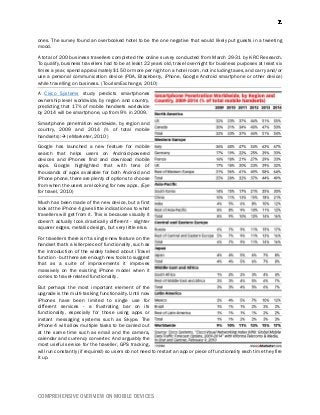
Worldwide smartphone penetration will reach 45% of mobile phone users in 2016, according to eMarketer.
Smartphone user adoption worldwide, by region, 2013 and 2016 (% of mobile phone users) (eMarketer, 2013)
While smartphones have gone mainstream in many regions around the globe, adoption among emerging
countries is still developing. China is the only country among the high-growth BRIC (Brazil, Russia, India, and
China) markets where smartphones are predominant, owned by two-thirds of Chinese mobile subscribers as of
the first half of 2012, according to new research from Nielsen.
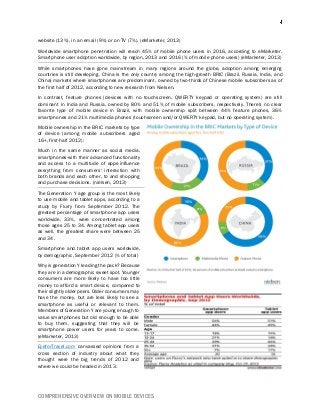
In contrast, feature phones (devices with no touchscreen, QWERTY keypad or operating system) are still
dominant in India and Russia, owned by 80% and 51% of mobile subscribers, respectively. There's no clear
favorite type of mobile device in Brazil, with mobile ownership split between 44% feature phones, 36%
smartphones and 21% multimedia phones (touchscreen and/or QWERTY keypad, but no operating system).
Mobile ownership in the BRIC markets by type
of device (among mobile subscribers aged
16+, first-half 2012):
Much in the same manner as social media,
smartphones-with their advanced functionality
and access to a multitude of apps-influence
everything from consumers' interaction with
both brands and each other, to and shopping
and purchase decisions. (nielsen, 2013)
The Generation Y age group is the most likely
to use mobile and tablet apps, according to a
study by Flurry from September 2012. The
greatest percentage of smartphone app users
worldwide, 33%, were concentrated among
those ages 25 to 34. Among tablet app users
as well, the greatest share were between 25
and 34.
Smartphone and tablet app users worldwide,
by demographic, September 2012 (% of total)
Why is generation Y leading the pack? Because
they are in a demographic sweet spot. Younger
consumers are more likely to have too little
money to afford a smart device, compared to
their slightly older peers. Older consumers may
have the money, but are less likely to see a
smartphone as useful or relevant to them.
Members of Generation Y are young enough to
value smartphones but old enough to be able
to buy them, suggesting that they will be
smartphone power users for years to come.
(eMarketer, 2013)
EyeforTravel.com canvassed opinions from a
cross section of industry about what they
thought were the big trends of 2012 and
where we could be headed in 2013.
COMPREHENSIVE OVERVIEW ON MOBILE DEVICES
1. The mobile revolution got underway but it is still early days: One of the most interesting findings from
EyeforTravel's detailed consumer research this year was that 46% of travel suppliers agree with the
statement that mobile has increased customer engagement. According to EyeforTravel's General Manager,
Gina Baillie, those travel brands that understand how mobile can enhance the entire travel consumer
experience will be the winners in 2013 and beyond. When it comes to mobile, travel industry mentor and
guest columnist Don Birch is clear on one thing: that the mobility (tablets and smart phones) revolution has
only just begun. He says that we will see a major shift in the way travelers follow the travel cycle.
2. Mobile only deals and pricing it right: For Sarah Gavin, the Director of Public Relations and Social Media at
Expedia.com one of the biggest trends of 2012 was the rise of deals available exclusively through mobile.
Rosie Akenhead, EyeforTravel.com's Global Events Director, pointed out whether or not you should price
differently on mobile and desktop was a big trending topic in early 2012. Time will tell.
3. Serious about social and the personal touch: For Rémi Lefevre, Global Community Manager Upscale &
Luxury Brands at Intercontinental Hotels Group (IHG), 2011 saw all major hotel brands hop on the social
media bandwagon. But he said that 2012 really was the year where we all streamlined our strategies and
started to scale up our efforts. This has been especially true in terms of social media customer care. Today
hoteliers seem to understand the importance of those now not-so-new channels of communication, both for
getting valuable feedback from their guests as well as engaging in real conversations with them. Ultimately
the aim is to provide them with added value and a sense of personalization.
4. Content AND format will be king: Guest reviews have become crucial and many brands are finding diverse
ways to integrate guests' feedback on their websites. But where will people read these reviews? For Don
Birch it will be on smaller screens. He said that there will be demand for more demand for more content, but
in tablet sized bites. Content and format will be king.
5. The emergence of ‘nonline' travel: 2012 saw the coming of age of the multi-tasking, multiscreen traveler.
Google's Rob Torres, managing director of advertising and marketing travel sector said that 2012 was the
first year of ‘nonline travel'. While travellers have long been at the forefront of the digital revolution, they
have now integrated online and offline in every stage of travel (dreaming, researching, booking, experiencing
and sharing). He said that they no longer see a line between online and offline during the five stages of travel
and neither do smart travel advertisers. Travellers now share their offline travel experiences via video and
social; they use information acquired online which was formerly available only offline, to plan their travel.
They are also the smartest travellers we've ever seen. They're savvier searchers than ever, and travel
suppliers and OTAs have faster and better insights and tools than ever to serve them.
6. Google and the portable concierge: More and more people will have a portable concierge in their pocket or
bag that helps them research and book things like excursion trips, restaurant reservations, flight changes
and so on. And every travel supplier and OTA will have the chance to make that travel advisor work through
advertising, mapping technology, video, and easy-to-use mobile websites and apps, says Torres.
7. Loved up with loyalty: Rewards continue to be a huge trend in online travel. Expedia launched its Expedia
Awards programme in 2011. Within a year, 3.7 million Expedia travellers had signed up - that's an average
of 7,000 travellers enrolling each day. This programme will be expanded. In fact in September 2012 Expedia
launched a similar reward scheme for small business travellers.
8. Big Data is here: there is now no excuse to not be customer centric: Data and analytics has never been so
important for the travel industry, according to EyeforTravel's Akenhead. She said that ‘Out' are the days of
trial and error, ‘in' are fact-based decisions that make logical business sense. She expects to see the clever
travel businesses making supreme choices on their email and social marketing efforts, and reaping the
benefits too. s. Gazing into the crystal ball, her prediction is that there digital spend will grow more than
offline as it becomes less easy to track its success.
9. Market movements: the patterns we see in major markets will continue. Western countries in general will
see flat or gentle growth. In the leisure travel industry, people will keep taking primary holidays but
discretionary travel will remain slow. There may be further cuts in UK but Northern Europe (Benelux) and the
Nordic will remain strongish. What seems certain, however, is that the BRIC countries will continue to see
growth. Travel firms will do well to think about how their offering catering to these growing markets.
10. Collaboration and crowdsourcing is here to stay: P2P (person to person) is very on-trend right, according to
Akenhead. It seems with the ability to communicate with people so easily in all corners of the world the
desire to collaborate, share services and have more authentic travel experiences will continue. AirBnb is one
COMPREHENSIVE OVERVIEW ON MOBILE DEVICES
of these that seems to be flying. The company's chief executive reportedly said recently that his company
would fill more rooms than Hilton Hotels by the end of the year! We'll see. One thing is certain, AirBnb
recognizes the need to stay fresh and relevant.
(Eye for Travel, 2012)
1.7 billion People around the world will access the internet via a mobile device in 2013, according to eMarketer's
estimates. By 2016, there will be a staggering 2.5 billion mobile internet users worldwide.
15% of consumers are already using the mobile web for travel services, and another 13% are using mobile
applications downloaded from one of the top app stores, according to research by Tealeaf. Delivering a
compelling experience in the mobile channel is critical for successfully engaging consumers.
A recent Harris Interactive survey revealed that 85% of consumers who had conducted a mobile transaction in
the last year expected the experience on their mobile devices to be better than using a laptop or desktop
computer. The same Harris Interactive survey also showed that only 41% of consumers thought the mobile
experience lived up to their expectations. There is a huge gap between the expectation and the actual experience.
The Harris Interactive survey also revealed that 63% of all online adults would be less likely to buy from a
company via other purchase channels if they experienced a problem conducting a mobile transaction. (tnooz,
2012)
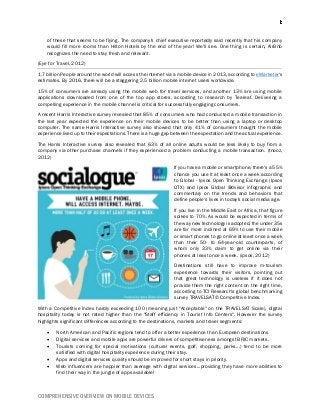
If you have a mobile or smartphone, there's a 55%
chance you use it at least once a week according
to Global - Ipsos Open Thinking Exchange (Ipsos
OTX) and Ipsos Global @dvisor infographic and
commentary on the trends and behaviors that
define people's lives in today's social media age.
If you live in the Middle East or Africa, that figure
spikes to 70%. As would be expected in terms of
the way new technology is adopted, the under 35s
are far more inclined at 69% to use their mobile
or smart phones to go online at least once a week
than their 50- to 64-year-old counterparts, of
whom only 33% claim to get online via their
phones at least once a week. (ipsos, 2012)
Destinations still have to improve m-tourism
experience towards their visitors, pointing out
that great technology is useless if it does not
provide them the right content on the right time,
according to TCI Research's global benchmarking
survey TRAVELSAT© Competitive Index.
With a Competitive Index hardly exceeding 100 (meaning just "Acceptable" on the TRAVELSAT Scale), digital
hospitality today is not rated higher than the "Staff efficiency in Tourist Info Centers". However the survey
highlights significant differences according to the destinations, markets and travel segments:
 North American and Pacific regions tend to offer a better experience than European destinations
 Digital services and mobile apps are powerful drivers of competitiveness amongst BRIC markets.
 Tourists coming for special motivations (cultural events, golf, shopping, parks...) tend to be more
satisfied with digital hospitality experience during their stay.
 Apps and digital services quality should be improved for short stays in priority.
 Web influencers are happier than average with digital services...providing they have more abilities to
find their way in the jungle of apps available!
COMPREHENSIVE OVERVIEW ON MOBILE DEVICES
(Abouttourism, 2012)
Tnooz and tealeaf produced a webinar ‘The Mobile Traveler Experience' (see video) to outline some of the
problems at the heart of the new mobile traveller experience:
 What does ‘mobile first' really mean?
 How do consumers use mobile phones for travel today?
 How should the travel industry approach the design and development of mobile services?
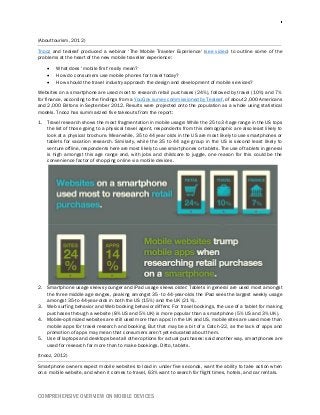
Websites on a smartphone are used most to research retail purchases (24%), followed by travel (10%) and 7%
for finance, according to the findings from a YouGov survey commissioned by Tealeaf, of about 2,000 Americans
and 2,000 Britons in September 2012. Results were projected onto the population as a whole using statistical
models. Tnooz has summarized five takeouts from the report:
1. Travel research shows the most fragmentation in mobile usage: While the 25 to 34 age range in the US tops
the list of those going to a physical travel agent, respondents from this demographic are also least likely to
look at a physical brochure. Meanwhile, 35 to 44 year olds in the US are most likely to use smartphones or
tablets for vacation research. Similarly, while the 35 to 44 age group in the US is second least likely to
venture offline, respondents here are most likely to use smartphones or tablets. The use of tablets in general
is high amongst this age range and, with jobs and childcare to juggle, one reason for this could be the
convenience factor of shopping online via mobile devices.
2. Smartphone usage skews younger and iPad usage skews older: Tablets in general are used most amongst
the three middle age ranges, peaking amongst 35- to 44-year-olds the iPad sees the largest weekly usage
amongst 35-to 44-year-olds in both the US (15%) and the UK (21%).
3. Web surfing behavior and Web booking behavior differs: For travel bookings, the use of a tablet for making
purchases through a website (8% US and 5% UK) is more popular than a smartphone (5% US and 3% UK).
4. Mobile-optimized websites are still used more than apps: In the UK and US, mobile sites are used more than
mobile apps for travel research and booking. But that may be a bit of a Catch-22, as the lack of apps and
promotion of apps may mean that consumers aren't yet educated about them.
5. Use of laptops and desktops beat all other options for actual purchases: said another way, smartphones are
used for research far more than to make bookings. Ditto, tablets.
(tnooz, 2012)
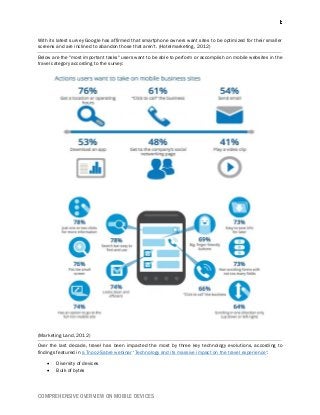
Smartphone owners expect mobile websites to load in under five seconds, want the ability to take action when
on a mobile website, and when it comes to travel, 63% want to search for flight times, hotels, and car rentals.
COMPREHENSIVE OVERVIEW ON MOBILE DEVICES
With its latest survey Google has affirmed that smartphone owners want sites to be optimized for their smaller
screens and are inclined to abandon those that aren't. (Hotelmarketing, 2012)
Below are the "most important tasks" users want to be able to perform or accomplish on mobile websites in the
travel category according to the survey:
(Marketing Land, 2012)
Over the last decade, travel has been impacted the most by three key technology evolutions, according to
findings featured in a Tnooz-Sabre webinar ‘Technology and its massive impact on the travel experience':
 Diversity of devices
 Bulk of bytes
COMPREHENSIVE OVERVIEW ON MOBILE DEVICES
 Speed of sharing.
Just 10 years ago...
 Only 5% households had broadband internet
 Wi-Fi wasn't even a thought
 Social media didn't exist
 Only 50% of people had a cell phone of any kind
 500k mobile all made in 2000 vs 9.6 million tweets in 2012 during each Olympic Opening Ceremony.
And today...
Facebook:
 955 million active users
 526 million daily active users
 500 million monthly mobile app users
 300 million photos uploaded per day
 52% plan to spend less time on Facebook in 2012
 2x more users trust amazon than Facebook with data.
Everyone else:
 1 billion tweets posted every 3 days
 4 billion YouTube videos watched daily
 25% fortune 100 companies using pinterest
 150+ million LinkedIn accounts
 30+ million instagram users pre-Facebook acquisition
 7 terabytes of new data created by twitter daily
 On of twitter processing 40-5- terabytes daily
 4 million visits to travel flash sales sites daily
The webinar also listed trends impacting travel inspiration, travel decisions, and in-transit experience:
TRENDS IMPACTING TRAVEL INSPIRATION:
 Social sharing: is evolving to include new mediums like audio.
 Crowd-sourcing: reinvents itself and continues to be used in new ways as people put the power of the
crowd to creative use.
 Interactive touchwalls: invade retail allowing retailers to draw in & keep people in-store longer and more
often. Tomorrow's potential - destinations themselves could enable life-size, fun interactive trip planning
on-site at airports, hotels, and even offline agency storefronts.
 Immersive experiences: connect buyers with products in more real, vibrant and engaging ways.
 Second screen interactions: 42% of tablet owners use their device while watching TV.
 Info overload + attention deficient society.
TRENDS IMPACTING TRAVEL DECISIONS:
 Social CRM and intelligent data mining
 Extreme meritocracy
 Data visualization and its democratization
 NFC and mobile payments.
TRENDS IMPACTING THE IN-TRANSIT EXPERIENCE:
COMPREHENSIVE OVERVIEW ON MOBILE DEVICES
 Recording personal travel histories
 Self-charging technology
 Trading data for convenience
 Online to offline
 Location-based services
 Quantified self and travel behavior optimization.
(tnooz, 2012)
Recent research reports reveal that the popularity of mobile channels will continue to increase in the coming
years, as it has become a significant aid in this fast-paced and competitive sector. The predictions by IDC show
that by 2015, the sale of smartphones will attain the magic figure of 982 million, while the number of web users
on mobile will exceed desktop internet users by 2014, according to Morgan Stanley.
Some of the emerging trends in mobile industry and the marketing opportunities associated with them in the
travel industry are:
 Smartphones will continue to stay: With the increasing demand of smartphones, it can well be said that
smartphones will increasingly be used for hotel booking. Bookings made via a mobile device will surpass
the number of booking made through PC. It is believed that smartphone, will very soon become the new
laptop and the hotel industry is also ready to reap the benefit of the emerging trend. For a range of firms,
the mobile channel has already become a travel planning and hotel distribution channel.
 Use of smartphones in M-Commerce: There are only a handful of smartphone users who utilize mobile
phones to shop, pay bills and make transactions, but the situation is changing fast, since the mobile
users are becoming highly comfortable with their phone for commerce.
 The Merging of Social, Local and Mobile has potential: The continued development in social, local and
mobile presents a host of opportunities to travel providers. Firms like Hotel Tonight and Uber have
accepted mobile as a new medium with an entirely new user dynamics for travellers exploring new cities.
(Hotel and Resort Insider by TravelMole, 2012)
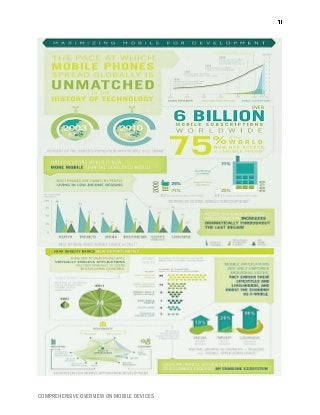
Mobile phone use in developing countries has surpassed that of developed areas, according to a recent World
Bank report. About three-quarters of the world now have easier access to a mobile phone than a bank account,
electricity, or clean water, the report said.
Following a "mobile first" path, the developing world is using mobile apps to help build and educate rather than
entertain. Between 2000 and 2010, the number of mobile users in developing countries surpassed those in
high-income nations, jumping from 29% to 77 in less-developed areas.
Already, between 80 and 95% of the population of Kenya, Mexico, and Indonesia send text messages.
In the 12 years since the turn of the century, mobile phones have multiplied the world over, growing from less
than 1 billion in use, to 6 billion this year - a pace that is unmatched in the history of technology, the World Bank
said. It took 128 years to reach 1 billion fixed telephone line users; mobile networks achieved that in two
decades.
By about 2015, the World Bank expects the number of mobile subscriptions to actually overtake the world's
population. In Oct. 2011, the number of wireless subscriber connections surpassed the US population -327.6
million versus 315.5 million, according to CTIA.
Mobile applications not only empower individual users, according to the World Bank but they enrich their
lifestyles and livelihoods, and boost the economy as a whole. Below on the next page an infographic represent
the study. (PCMAG, 2012)
COMPREHENSIVE OVERVIEW ON MOBILE DEVICES
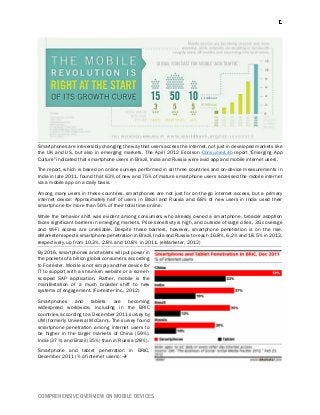
Smartphones are irreversibly changing the way that users access the internet, not just in developed markets like
the UK and US, but also in emerging markets. The April 2012 Ericsson ConsumerLab report "Emerging App
Culture" indicated that smartphone users in Brazil, India and Russia were avid app and mobile internet users.
The report, which is based on online surveys performed in all three countries and on-device measurements in
India in late 2011, found that 63% of new and 75% of mature smartphone users accessed the mobile internet
via a mobile app on a daily basis.
Among many users in these countries, smartphones are not just for on-the-go internet access, but a primary
internet device: Approximately half of users in Brazil and Russia and 68% of new users in India used their
smartphone for more than 50% of their total time online.
While the behavior shift was evident among consumers who already owned a smartphone, broader adoption
faces significant barriers in emerging markets. Price sensitivity is high, and outside of large cities, 3G coverage
and Wi-Fi access are unreliable. Despite these barriers, however, smartphone penetration is on the rise.
eMarketer expects smartphone penetration in Brazil, India and Russia to reach 16.8%, 6.2% and 18.5% in 2012,
respectively, up from 10.3%, 2.8% and 10.8% in 2011. (eMarketer, 2012)
By 2016, smartphones and tablets will put power in
the pockets of a billion global consumers, according
to Forrester. Mobile is not simply another device for
IT to support with a shrunken website or a screen-
scraped SAP application. Rather, mobile is the
manifestation of a much broader shift to new
systems of engagement. (Forrester Inc., 2012)
Smartphones and tablets are becoming
widespread worldwide, including in the BRIC
countries, according to a December 2011 survey by
UM (formerly Universal McCann). The survey found
smartphone penetration among internet users to
be higher in the larger markets of China (59%),
India (37%) and Brazil (35%) than in Russia (28%).
Smartphone and tablet penetration in BRIC,
December 2011 (% of internet users): 
COMPREHENSIVE OVERVIEW ON MOBILE DEVICES
UM's survey included only internet users who go online at least every other day; in less-developed markets these
tend to represent some of the highest earners in their respective countries, as studies in Mexico and China have
shown.
Smartphone users represent a relatively small percentage of mobile phone users in Russia, 11.8% in July 2011,
according to GfK Group. As forecast elsewhere in the world, expect smartphone penetration in Russia to increase
as prices for both devices and data services drop in the future.
eMarketer forecasts that internet users in Russia will reach 67.9 million in 2012, comprising nearly 50% of the
country's total population, compared to 42.4% in China, 42% in Brazil and 8.9% in India. (eMarketer, 2012)
Cruise sector recorded the biggest increase in bookings via mobile devices in the last six months.
20% of travel brands surveyed globally are using mobile for direct sales, according to findings from a video co-
produced by EyeforTravel & Digital Visitor using research data from EyeforTravel's Social Media & Mobile in Travel
report that looks at the upcoming trends in Social Media and Mobile and the impact it has had on the travel
industry. (View video here).
Other findings show that:
 25% of travel brands are using mobile for building brands awareness.
 65% of travel industry respondents revealed they are allocating 25% of their marketing budget to their
mobile distribution strategy.
 Direct bookings via mobile devices increased by 30% in the third quarter of 2011.
 The cruise sector has seen the biggest increase in bookings via mobile devices over the last six months.
(Eye for Travel, 2012)
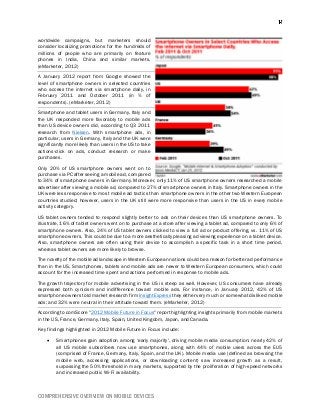
75% of internet users surveyed worldwide preferred receiving retail promotions via email over text, According to
a March 2012 report from Ipsos.
Internet users in the UK and US were even more
inclined to prefer email than the average internet
user, at 87% and 86%, respectively.
Internet users in the largest emerging-market
countries, though, were less partial to email-based
marketing messages. Among the so-called BRIC
countries, Brazil came closest to the worldwide
average, with 76% of respondents in the country
preferring email. Respondents in Russia, India and
China also preferred email over text, but greater
portions of respondents (at 32%, 34% and 43%,
respectively) in those countries preferred receiving
promotions via text message.
In countries like India and China, where total
internet user numbers can measure in the
hundreds of millions and mobile users approach the
billion mark, these percentage differences can
mean a much broader reach for promotions than in
more developed markets such as the UK or US.
In a statement, Ipsos claimed that worldwide, promotions via email are preferred for online purchases and the
ease of printing coupons for in-store use. This may be true for consumers in developed economies and for
COMPREHENSIVE OVERVIEW ON MOBILE DEVICES
worldwide campaigns, but marketers should
consider localizing promotions for the hundreds of
millions of people who are primarily on feature
phones in India, China and similar markets.
(eMarketer, 2012)
A January 2012 report from Google showed the
level of smartphone owners in selected countries
who access the internet via smartphone daily, in
February 2011 and October 2011 (in % of
respondents). (eMarketer, 2012)
Smartphone and tablet users in Germany, Italy and
the UK responded more favorably to mobile ads
than US device owners did, according to Q3 2011
research from Nielsen. With smartphone ads, in
particular, users in Germany, Italy and the UK were
significantly more likely than users in the US to take
actions-click on ads, conduct research or make
purchases.
Only 20% of US smartphone owners went on to
purchase via PC after seeing a mobile ad, compared
to 34% of smartphone owners in Germany. Moreover, only 11% of US smartphone owners researched a mobile
advertiser after viewing a mobile ad, compared to 27% of smartphone owners in Italy. Smartphone owners in the
UK were less responsive to most mobile ad tactics than smartphone owners in the other two Western European
countries studied; however, users in the UK still were more responsive than users in the US in every mobile
activity category.
US tablet owners tended to respond slightly better to ads on their devices than US smartphone owners. To
illustrate, 16% of tablet owners went on to purchase at a store after viewing a tablet ad, compared to only 6% of
smartphone owners. Also, 24% of US tablet owners clicked to view a full ad or product offering, vs. 11% of US
smartphone owners. This could be due to a more aesthetically pleasing ad viewing experience on a tablet device.
Also, smartphone owners are often using their device to accomplish a specific task in a short time period,
whereas tablet owners are more likely to browse.
The novelty of the mobile ad landscape in Western European nations could be a reason for better ad performance
than in the US. Smartphones, tablets and mobile ads are newer to Western European consumers, which could
account for the increased time spent and actions performed in response to mobile ads.
The growth trajectory for mobile advertising in the US is steep as well. However, US consumers have already
expressed both cynicism and indifference toward mobile ads. For instance, in January 2012, 42% of US
smartphone owners told market research firm InsightExpress they either very much or somewhat disliked mobile
ads; and 32% were neutral in their attitude toward them. (eMarketer, 2012)
According to comScore "2012 Mobile Future in Focus" report highlighting insights primarily from mobile markets
in the US, France, Germany, Italy, Spain, United Kingdom, Japan, and Canada.
Key findings highlighted in 2012 Mobile Future in Focus include:
 Smartphones gain adoption among ‘early majority', driving mobile media consumption: nearly 42% of
all US mobile subscribers now use smartphones, along with 44% of mobile users across the EU5
(comprised of France, Germany, Italy, Spain, and the UK). Mobile media use (defined as browsing the
mobile web, accessing applications, or downloading content) saw increased growth as a result,
surpassing the 50% threshold in many markets, supported by the proliferation of high-speed networks
and increased public Wi-Fi availability.
COMPREHENSIVE OVERVIEW ON MOBILE DEVICES
 Smartphone platform wars intensify as Android and Apple take the lead in most markets.
 Surge in mobile App usage shapes a dual mobile browsing experience, fuelling category growth: in 2011,
both the US and EU5 saw the growth in mobile app use exceed the growth in mobile browser use, leading
to both markets seeing the same percentage of their mobile audience use both apps and browsers to
access mobile media. Health ranked as the fastest-growing mobile media category in the US in 2011,
followed by Retail and other commerce-related categories such as Electronic Payments and Auction
Sites.
 Mobile retail information leads to emergence of Smartphone shopping behaviors: more than half of the
US smartphone population used their phone to perform retail research while inside a store in 2011,
illustrating the emergence of savvy smartphone shoppers who bring online shopping behaviors in-store
- a trend seen in other markets as well. At the end of 2011, nearly 1 in 5 smartphone users scanned
product barcodes and nearly 1 in 8 compared prices on their phone while in a store.
 Mobile devices fuel social networking on-the-go, driving real-time online interaction: 64.2 million US
smartphone users and 48.4 million EU5 smartphone users accessed social networking sites or blogs
on their mobile devices at least once in December 2011, with more than half of these mobile social
networking users accessing social media almost every day. While mobile social networking users
showed the highest propensity to read posts from people they knew personally, more than half of those
in the US and nearly half in the EU5 also reported reading posts from brands, organizations, and events.
 Mobile connectivity and connected devices encourage cross-platform digital media consumption among
‘digital omnivores': tablets quickly rose in popularity in 2011, taking less than two years to account for
nearly 40 million tablets in use among US mobile users and outpacing smartphones which took 7 years
to reach the same. By the end of 2011, nearly 15% of US mobile users also had tablets - a trend seen
across other markets as well.
(comScore, 2012)
1.8 billion Mobile device units were sold to end users worldwide in 2011, up 11.1% on 2010, according to
Gartner. Smartphones accounted for 31% of all device sales with 472 million units sold, up 58% year on year.
The analyst firm's findings chime with those released earlier this year by Strategy Analytics. Apple has displaced
Samsung as the leading smartphone vendor in the field, with a 23.8% share of the high end handset market in
the fourth quarter of last year, and 19% across the whole 12 months. Apple sold 35.5 million iPhones in the last
three months, according to Gartner. (telecoms, 2012)
61% of mobile users are unlikely to return to your mobile site if they had trouble or if your site was too hard to
use, according to a March 2011 study by Compuware. 40% said they would visit a competitor's site instead, and
19% said they would have a negative overall perception of your business if they had a bad mobile experience
with your site.
Research shows that web retailers could increase consumer engagement by 85% with a mobile-specific website.
51% of consumers are more likely to purchase from retailers that have mobile-specific websites.
Leon Spencer shares five best practices to keep in mind when building your mobile website:
 KISS - that's right...Keep It Super Simple! Think about it. When you're on your mobile device you are
most likely on-the-go. When you want some sort of information, you need it quick and you don't want to
have to hunt all over for it. Make sure that your navigation and layout is simple. Don't try to include
everything from your main website into your mobile site. People searching mobile are only looking for
basic information.
 Design for Thumbs...not Mice. Again, you're not putting together a site that someone is going to spend
a ton of time on. You want to make it as easy and simple for them to navigate as you can. If they can
COMPREHENSIVE OVERVIEW ON MOBILE DEVICES
click-to-call you with their thumb or find a map to your location with their thumb, then you are on the
right track.
 Prioritize your Content - Give your mobile site user the most often needed information first. Maybe it's
just your telephone number. Maybe it's your address. Whatever it is make sure that you come up with
your own order of priorities for the information you are providing. You can use Google Analytics from
your main website to see what is most often being searched on mobile devices and this should help you
in sorting your content.
 Use Uniquely Mobile Features - make sure that you're not building your mobile presence in the same
way you would for desktops. Use the functionality of what a mobile device provides to enhance your
engagement with your customers. For example, mobile devices use GPS. Keep that in mind if you are
offering content that could be relevant to specific geographical areas. Don't waste your site user's time
by giving them content that's not relevant to their location. Let's say you have multiple locations for your
business. Through location-based technology in mobile you can provide the most relevant location of
your business to a user that is searching for your company. Another way to use mobile features is to
provide content that would be relevant to what the user would actually be doing at the time they are
searching for you on a mobile device.
 Make it easy to convert - Because people are most likely out and on-the-go when they are accessing
your mobile site, so their ability to get distracted and move on is high. So, if you are collecting information
in a web form - make it short and sweet. Don't require a lot of fields to be completed because it can be
difficult and take too much time. Think of the bare minimum that you may need. Make it easy to call
you! Maybe put a click-to-call button at the very top of your mobile site. Wherever you place it make sure
it is very easy to see.
(BlogNotions, 2011)
Currently 38% of travel brands have a mobile friendly website, up from 35% in February 2011, according to the
second edition of EyeforTravel's Travel Marketing & Distribution Barometer published in November 2011.
At 67%, China was the country with the highest proportion of brands with mobile friendly sites. The UK stood at
55%. Spain had the lowest out of the countries surveyed at 20%. (Eye for Travel, 2011)
Mobile devices, including smartphones and tablets, now account for 7% of worldwide traffic on the Web,
according to a report by comScore.
ComScore found that 37% of cellphone traffic takes place over a Wi-Fi connection. That has continued to grow
in recent years; the report noted that Wi-Fi traffic through mobile devices grew as much as 3% in the last three
months alone.
Most startling among the mobile statistics is the disproportionate usage rate of Apple iPad owners. The report
found that the iPad accounts for 97% of all tablet traffic in the US. Analysts at IDC recently estimated Apple has
sold 75% of all tablets. Apple said in July 2011 that it had sold close to 29 million iPads since the device went
on sale in April 2010. (Hotelmarketing, 2011)
Smartphone adoption in Europe stands at 39%, according to InSites Consulting "The world is mobile" study. 28%
have a smartphone with Internet/data subscription and 11% have a smartphone without internet/data
subscription.
47% of smartphone-connected Europeans will surf the mobile internet every day and 66% of connected
smartphone users log on to their social media profile(s) every day. 56% of Europeans smartphone users follow
brands on social media. (InSites Consulting - four words newsletter, 2011)
The number of passengers carrying smartphones has almost doubled in the past 12 months, jumping from 28%
to 54%, according to the annual SITA-Air Transport World passenger self-service survey found.
COMPREHENSIVE OVERVIEW ON MOBILE DEVICES
The figure soars to 74% of business and first class passengers and frequent flyers, with exactly three-quarters
of passengers passing through the world's busiest airport, Atlanta Hartsfield-Jackson, carrying one.
SITA-ATW spoke to nearly 2,500 passengers at Abu Dhabi International Airport, Beijing International Airport,
Frankfurt International Airport, Mumbai International and Sao Paulo Guarulhos.
The combined passenger numbers for the airports reached 283.5 million last year. Highlights of the survey's
findings include:
 73% would like to use mobile boarding passes, with 17% already having done so.
 Almost a quarter (23%) have used Bluetooth connections at an airport.
 Around a third (33%) use mobiles to check in - 36% for business and first class passengers.
 Over 50% of business and first class receive SMS text messages for alerts.
 Four out of five do not want to receive information about shopping deals at airports, although
passengers at Abu Dhabi (34%), Beijing (32%) and Mumbai (30%) do.
 75% of smartphone users would connect to a free wifi network at an airport and are generally looking
to access trip-related information.
 The most popular activity when connected at the airport is information on flights (77%), security (50%),
departure gate walking times (40%), directions (21%) and airport parking (21%).
(tnooz, 2011)
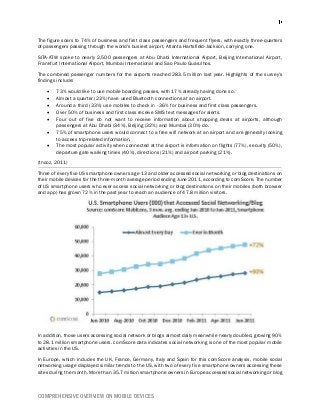
Three of every five US smartphone owners age 13 and older accessed social networking or blog destinations on
their mobile devices for the three-month average period ending June 2011, according to comScore. The number
of US smartphone users who ever access social networking or blog destinations on their mobiles (both browser
and app) has grown 72% in the past year to reach an audience of 47.8 million visitors.
In addition, those users accessing social network or blogs almost daily meanwhile nearly doubled, growing 90%
to 28.1 million smartphone users. comScore data indicates social networking is one of the most popular mobile
activities in the US.
In Europe, which includes the UK, France, Germany, Italy and Spain for this comScore analysis, mobile social
networking usage displayed similar trends to the US, with two of every five smartphone owners accessing these
sites during the month. More than 35.7 million smartphone owners in Europe accessed social networking or blog
COMPREHENSIVE OVERVIEW ON MOBILE DEVICES
destinations on their mobile in June, an increase of 80% from the previous year. Daily usage surged as well, with
17.9 million smartphone users accessing social sites on their device almost daily in Europe, climbing 94% from
June 2010.
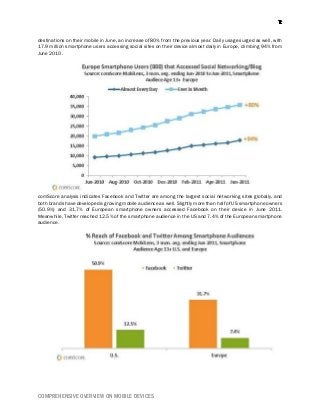
comScore analysis indicates Facebook and Twitter are among the largest social networking sites globally, and
both brands have developed a growing mobile audience as well. Slightly more than half of US smartphone owners
(50.9%) and 31.7% of European smartphone owners accessed Facebook on their device in June 2011.
Meanwhile, Twitter reached 12.5% of the smartphone audience in the US and 7.4% of the European smartphone
audience.
COMPREHENSIVE OVERVIEW ON MOBILE DEVICES
About 7 in 10 (69%) US smartphone and tablet users check social network status updates on their mobile device,
making it the most popular mobile social networking activity, according to September 2011 data from Prosper
Mobile Insights. Viewing photos closely follows in popularity (66%).
Other mobile social networking activities performed by more than half of mobile users include updating status
(53%) and sending emails (51%), while 49% post photos taken on their smartphone/tablet. Only 26.5% go to
retailer pages to find deals while shopping, and 15% don't access social media sites on their mobile device.
(MarketingCharts, 2011)
61% of online travel companies surveyed in a recent global EyeforTravel poll do not have a mobile friendly
website; while 71% do not have a mobile app.
Jeremy Copp, VP Mobile Europe, comScore, a speaker at the EyeforTravel Summit event in May 2011, shared
that in the EU5 countries (France, Germany, Spain, UK, Italy), 11.3 million consumers accessed travel services
via mobile in February 2011 alone. Travel application access grew by 52% year-on-year.
Out of the EU5, 36% of mobile market now use apps or their mobile browser. Interestingly, Spain is leading the
way in terms of smartphone adoption (adopting at a higher rate than even the US) but EyeforTravel found that
French travel companies were the heaviest investors in mobile followed by Germany.
Mobile is only going to continue to grow. The rapid development of social networking sites and the consequent
need to be constantly connected is fuelling mobile growth. Japan's social networking site ‘Mixi' shows how social
networking trends can encourage mobile access and overtake desktop access. 84% of their page views are now
via mobile (report by Morgan Stanley as cited by Dave Scheine, Director of European Operations, Yelp).
Many travel companies don't want to hear that they need to invest money into yet another distribution and
marketing channel but quite simply, if your customer is searching for travel information online and your site is
not optimised for mobile or you don't have an app then chances are they will find your competitors first.
(aboutourism, 2011)
Internet usage via mobile is quickly becoming as important as internet usage via PC among those who own
smartphones, according to research from Google and the Mobile Marketing Association (MMA) conducted during
the first half of 2011 in several countries around the world.
In the US, the survey found, 58% of smartphone owners had used their phone to go online every day during the
week before polling, vs. 78% who said the same of their PC. When asked about usage the day before polling,
53% said they used the mobile internet multiple times, compared with 67% who said the same of their PC.
Daily social networking activities show an even
smaller spread between mobile and PC usage. In the
US, there was only a 9 percentage point gap between
the two.
Smartphone users in selected countries who us
online or mobile social networks at least once a day,
Q2 2011 (% of respondents): 
Compared to social networking, which has truly taken
off as a major mobile activity, online video usage on
smartphones is still low. But frequent viewing rates
are becoming comparable to those for the desktop
web. Two in 10 smartphone users in the US said they
watched mobile video every day, compared with 34%
who watched each day on their computer.
COMPREHENSIVE OVERVIEW ON MOBILE DEVICES
The vast majority of smartphone users surveyed around the world said they planned to increase usage of the
mobile internet in the next year, including 91% of US respondents, suggesting the rates of these and other mobile
content activities will continue to rise.
The survey found that 31% of US internet users had a smartphone. eMarketer estimates that 31% of US mobile
users will have a smartphone by the end of this year, rising to 43% by 2015. (eMarketer, 2011)
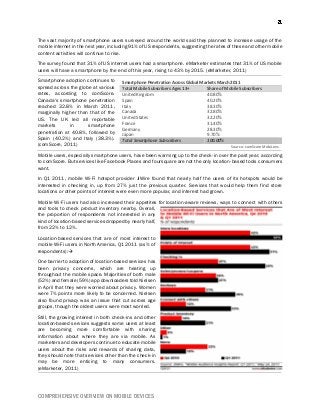
Smartphone adoption continues to
spread across the globe at various
rates, according to comScore.
Canada's smartphone penetration
reached 32.8% in March 2011,
marginally higher than that of the
US. The UK led all reportable
markets in smartphone
penetration at 40.8%, followed by
Spain (40.2%) and Italy (38.3%).
(comScore, 2011)
Mobile users, especially smartphone users, have been warming up to the check-in over the past year, according
to comScore. But services like Facebook Places and foursquare are not the only location-based tools consumers
want.
In Q1 2011, mobile Wi-Fi hotspot provider JiWire found that nearly half the users of its hotspots would be
interested in checking in, up from 27% just the previous quarter. Services that would help them find store
locations or other points of interest were even more popular, and interest had grown.
Mobile Wi-Fi users had also increased their appetites for location-aware reviews, ways to connect with others
and tools to check product inventory nearby. Overall,
the proportion of respondents not interested in any
kind of location-based services dropped by nearly half,
from 22% to 12%.
Location-based services that are of most interest to
mobile Wi-Fi users in North America, Q1 2011 (as % of
respondents):
One barrier to adoption of location-based services has
been privacy concerns, which are heating up
throughout the mobile space. Majorities of both male
(52%) and female (59%) app downloaders told Nielsen
in April that they were worried about privacy. Women
were 7% points more likely to be concerned. Nielsen
also found privacy was an issue that cut across age
groups, though the oldest users were most worried.
Still, the growing interest in both check-ins and other
location-based services suggests some users at least
are becoming more comfortable with sharing
information about where they are via mobile. As
marketers and developers continue to educate mobile
users about the risks and rewards of sharing data,
they should note that services other than the check-in
may be more enticing to many consumers.
(eMarketer, 2011)
Smartphone Penetration Across Global Markets March 2011
Total Mobile Subscribers Ages 13+ Share of Mobile Subscribers
United Kingdom 40.80%
Spain 40.20%
Italy 38.30%
Canada 32.80%
United States 32.20%
France 31.40%
Germany 28.30%
Japan 9.70%
Total Smartphone Subscribers 100.00%
Source: comScore MobiLens
COMPREHENSIVE OVERVIEW ON MOBILE DEVICES
The number of internet connected devices is set to explode in the next four years to over 15 billion (twice the
world's population) by 2015, according to Cisco's fifth annual forecast of upcoming trends. Cisco predicts the
proliferation of tablets, mobile phones, connected appliances and other smart machines will drive this growth.
The company said consumer video will continue to dominate internet traffic. It predicts that by 2015, 1 million
minutes of video will be watched online every second.
Cisco's Visual Networking Index also estimated that at the same time more than 40% of the world's projected
population will be online, a total of nearly 3 billion people. The networking giant forecast that by 2015 internet
traffic will reach 966 exabytes a year. An exabyte is equal to one quintillion bytes. In 2004, global monthly
internet traffic passed one exabyte for the first time. (BBC, 2011)
The travel industry's love affair with apps is waning, according to findings from EyeForTravel's "Travel Distribution
& Marketing Barometer". The industry is investing more in mobile websites than Apps.
The findings show that only 8% of the big travel companies (those spending between US$51 to US$100 million
on marketing) do not have a mobile site whilst 25% do not have a mobile application.
Interestingly those that have invested in these channels report a similar success across both apps and mobile
web with 42% seeing an increase in traffic from both apps and the mobile website. This would suggest it's the
higher costs related to app building that is slowing investment.
The cost of mobile marketing seems to be hindering the smaller travel companies. Over 67% of travel companies
with a marketing budget of less than US$400K are not yet tracking and recording traffic and bookings from
mobile browsing or apps. With lastminute.com reporting a 400% growth in mobile browsing in 2010, tracking is
obviously key. (Eye for travel, 2011)
The number of consumers accessing travel information via mobile devices when on holiday has doubled in the
last year, according to a global survey of 1,700 people carried out by Frommers.
52% of respondents said that they were most likely to access travel information on their mobile devices when
travelling, compared to 27% in 2010. Respondents aged between 18 and 34 are the biggest advocates, with
72% of this age group accessing mobile travel content on holiday, compared to only 48% in 2010.
The survey also revealed the top six types of mobile travel content that consumers want when on holiday. The
most important function is seeing points of interest like attractions, restaurants and shops on a map (57%),
followed by key phrases in local languages (55%), local offers (51%), itineraries and walking tours (50%), local
etiquette and customs (49%) and tipping and currency converters (45%). Interestingly, the 18-34 age bracket
expressed an increased interest in accessing information related to local etiquette and customs and it ranked
as the third most important type of content for this age group.
In terms of influencing holiday decision making, the survey revealed that user reviews on travel websites and
travel guidebooks are equally important with 81% of consumers considering them very influential. Editorial
content on travel websites came in a close second with 80%. Social media has become more notably more
important in holiday decision making, with 36% of respondents considering online social networks as influential,
compared to 22% in 2010. This indicates that using social media as a means of planning travel will be
increasingly important to businesses.
Businesses should also look to engage with holidaymakers via social networks when they return home as over
half (51%) of all respondents indicated they are likely to post a hotel review online, and over one third of all
respondents would post travel photos(38%) or share travel experiences on Facebook (33%).
The survey revealed that travellers are increasingly more reliant on digital content in all phases of the travel
cycle, considering many types of information as influential to their decision making than in prior surveys. The
most common time to look for destination information online continues to be before deciding where to go (93%),
however, over 77% now look for destination information online when booking accommodation and flights,
COMPREHENSIVE OVERVIEW ON MOBILE DEVICES
compared to less than 48% in 2010. There have also been significant rises in demand for destination content
after booking but before leaving, while on holiday and after returning.
When planning a holiday consumers ranked "description destinations" and "special offers and deals" as the most
important travel content, with 88% each. At the booking stage, "maps of destinations" (83%), is the most
important closely followed by airport transportation information and city or resort guides (81% each). After
booking but before travelling consumers rated weather as the most important information (85%), followed by
attractions, events and maps (84% each).
Despite this increased demand, consumers continue to encounter many negative experiences on travel
websites. The most common problems are confusing websites, poor site navigation and insufficient destination
information, with 58% each. This suggests that by addressing these common complaints, businesses could
benefit from opportunities to engage successfully with consumers before, during and after their holiday.
(Hotelmarketing, 2011)
Google says it is already seeing 19% of all hotel queries in search being conducted on mobile devices, supporting
the idea that mobile is now more important than ever in travel marketing.
The stat also backs recent data from eMarketer which suggested the number of US consumers, for example,
using a mobile to research travel products will climb from 19.7 million in 2010 to 29.7 million by next year.
Google, of course, has a vested interest in persuading hoteliers to throw part of their marketing budget into
mobile search as well as existing desktop web PPC advertising. But despite the ulterior motive, such data is
pretty compelling and travel companies are being urged to consider mobile in the same way as perhaps they
interact with consumers on the web-based journey. (Hotelmarketing, 2011)
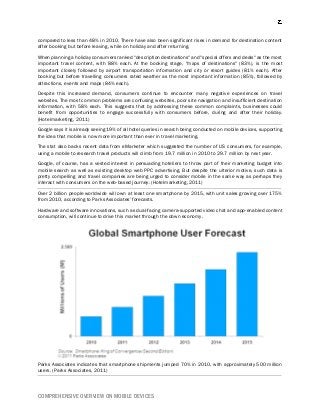
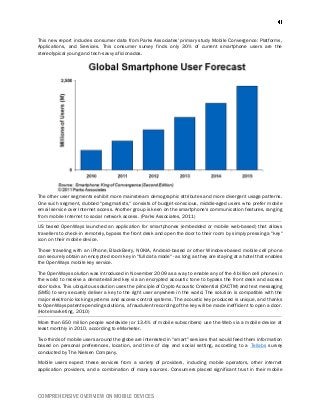
Over 2 billion people worldwide will own at least one smartphone by 2015, with unit sales growing over 175%
from 2010, according to Parks Associates' forecasts.
Hardware and software innovations, such as dual-facing camera-supported video chat and app-enabled content
consumption, will continue to drive this market through the down economy.
Parks Associates indicates that smartphone shipments jumped 70% in 2010, with approximately 500 million
users. (Parks Associates, 2011)
COMPREHENSIVE OVERVIEW ON MOBILE DEVICES
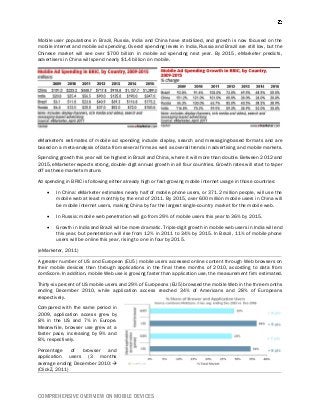
Mobile user populations in Brazil, Russia, India and China have stabilized, and growth is now focused on the
mobile internet and mobile ad spending. Overall spending levels in India, Russia and Brazil are still low, but the
Chinese market will see over $700 billion in mobile ad spending next year. By 2015, eMarketer predicts,
advertisers in China will spend nearly $1.4 billion on mobile.
eMarketer's estimates of mobile ad spending include display, search and messaging-based formats and are
based on a meta-analysis of data from several firms as well as overall trends in advertising and mobile markets.
Spending growth this year will be highest in Brazil and China, where it will more than double. Between 2012 and
2015, eMarketer expects strong, double-digit annual growth in all four countries. Growth rates will start to taper
off as these markets mature.
Ad spending in BRIC is following either already high or fast-growing mobile internet usage in those countries:
 In China: eMarketer estimates nearly half of mobile phone users, or 371.2 million people, will use the
mobile web at least monthly by the end of 2011. By 2015, over 600 million mobile users in China will
be mobile internet users, making China by far the largest single-country market for the mobile web.
 In Russia: mobile web penetration will go from 29% of mobile users this year to 36% by 2015.
 Growth in India and Brazil will be more dramatic. Triple-digit growth in mobile web users in India will end
this year, but penetration will rise from 12% in 2011 to 34% by 2015. In Brazil, 11% of mobile phone
users will be online this year, rising to one in four by 2015.
(eMarketer, 2011)
A greater number of US and European (EU5) mobile users accessed online content through Web browsers on
their mobile devices than through applications in the final three months of 2010, according to data from
comScore. In addition, mobile Web use is growing faster than application use, the measurement firm estimated.
Thirty-six percent of US mobile users and 29% of Europeans (EU5) browsed the mobile Web in the three months
ending December 2010, while application access reached 34% of Americans and 28% of Europeans
respectively.
Compared with the same period in
2009, application access grew by
8% in the US and 7% in Europe.
Meanwhile, browser use grew at a
faster pace, increasing by 9% and
8%, respectively.
Percentage of browser and
application users (3 months
average ending December 2010:
(ClickZ, 2011)
COMPREHENSIVE OVERVIEW ON MOBILE DEVICES
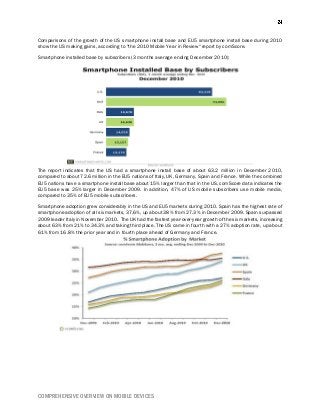
Comparisons of the growth of the US smartphone install base and EU5 smartphone install base during 2010
show the US making gains, according to "the 2010 Mobile Year in Review" report by comScore.
Smartphone installed base by subscribers (3 months average ending December 2010):
The report indicates that the US had a smartphone install base of about 63.2 million in December 2010,
compared to about 72.6 million in the EU5 nations of Italy, UK, Germany, Spain and France. While the combined
EU5 nations have a smartphone install base about 15% larger than that in the US, comScore data indicates the
EU5 base was 25% larger in December 2009. In addition, 47% of US mobile subscribers use mobile media,
compared to 35% of EU5 mobile subscribers.
Smartphone adoption grew considerably in the US and EU5 markets during 2010. Spain has the highest rate of
smartphone adoption of all six markets, 37.6%, up about 38% from 27.3% in December 2009. Spain surpassed
2009 leader Italy in November 2010. The UK had the fastest year-over-year growth of the six markets, increasing
about 63% from 21% to 34.3% and taking third place. The US came in fourth with a 27% adoption rate, up about
61% from 16.8% the prior year and in fourth place ahead of Germany and France.
COMPREHENSIVE OVERVIEW ON MOBILE DEVICES
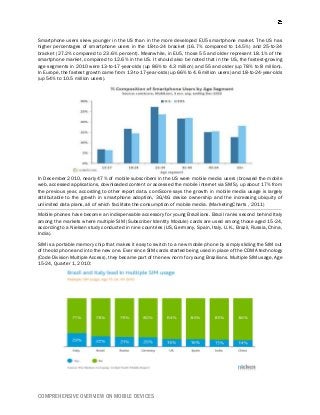
Smartphone users skew younger in the US than in the more developed EU5 smartphone market. The US has
higher percentages of smartphone users in the 18-to-24 bracket (16.7% compared to 14.5%) and 25-to-34
bracket (27.2% compared to 23.6% percent). Meanwhile, in EU5, those 55 and older represent 18.1% of the
smartphone market, compared to 12.6% in the US. It should also be noted that in the US, the fastest-growing
age segments in 2010 were 13-to-17-year-olds (up 86% to 4.3 million) and 55 and older (up 78% to 8 million).
In Europe, the fastest growth came from 13-to-17-year-olds (up 66% to 4.6 million users) and 18-to-24-year-olds
(up 54% to 10.5 million users).
In December 2010, nearly 47% of mobile subscribers in the US were mobile media users (browsed the mobile
web, accessed applications, downloaded content or accessed the mobile internet via SMS), up about 17% from
the previous year, according to other report data. comScore says the growth in mobile media usage is largely
attributable to the growth in smartphone adoption, 3G/4G device ownership and the increasing ubiquity of
unlimited data plans, all of which facilitate the consumption of mobile media. (MarketingCharts , 2011)
Mobile phones have become an indispensable accessory for young Brazilians. Brazil ranks second behind Italy
among the markets where multiple SIM (Subscriber Identity Module) cards are used among those aged 15-24,
according to a Nielsen study conducted in nine countries (US, Germany, Spain, Italy, U.K., Brazil, Russia, China,
India).
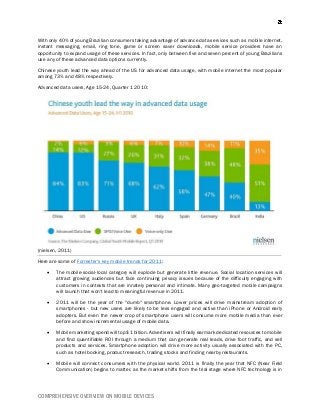
SIM is a portable memory chip that makes it easy to switch to a new mobile phone by simply sliding the SIM out
of the old phone and into the new one. Ever since SIM cards started being used in place of the CDMA technology
(Code Division Multiple Access), they became part of the new norm for young Brazilians. Multiple SIM usage, Age
15-24, Quarter 1, 2010:
COMPREHENSIVE OVERVIEW ON MOBILE DEVICES
With only 40% of young Brazilian consumers taking advantage of advance data services such as mobile internet,
instant messaging, email, ring tone, game or screen saver downloads, mobile service providers have an
opportunity to expand usage of these services. In fact, only between five and seven percent of young Brazilians
use any of these advanced data options currently.
Chinese youth lead the way ahead of the US for advanced data usage, with mobile internet the most popular
among 73% and 48% respectively.
Advanced data users, Age 15-24, Quarter 1 2010:
(nielsen, 2011)
Here are some of Forrester's key mobile trends for 2011:
 The mobile-social-local category will explode but generate little revenue. Social location services will
attract growing audiences but face continuing privacy issues because of the difficulty engaging with
customers in contexts that are innately personal and intimate. Many geo-targeted mobile campaigns
will launch that won't lead to meaningful revenue in 2011.
 2011 will be the year of the "dumb" smartphone. Lower prices will drive mainstream adoption of
smartphones - but new users are likely to be less engaged and active than iPhone or Android early
adopters. But even the newer crop of smartphone users will consume more mobile media than ever
before and show incremental usage of mobile data.
 Mobile marketing spend will top $1 billion. Advertisers will finally earmark dedicated resources to mobile
and find quantifiable ROI through a medium that can generate real leads, drive foot traffic, and sell
products and services. Smartphone adoption will drive more activity usually associated with the PC,
such as hotel booking, product research, trading stocks and finding nearby restaurants.
 Mobile will connect consumers with the physical world. 2011 is finally the year that NFC (Near Field
Communication) begins to matter, as the market shifts from the trial stage where NFC technology is in
COMPREHENSIVE OVERVIEW ON MOBILE DEVICES
place. Other technologies like QR codes and augmented reality (AR) apps will prompt users to hold their
smartphones up to products and other objects around them. These features will remain niche but
provide a springboard for brands willing to experiment.
 4G will remain mostly hype. 4G technology will have little impact in 2011, with few LTE devices available
before year end. It's taken almost seven years for half of mobile users in the U.S. and Europe to get on
3G networks, according to Forrester.
 Casual gaming will lead content charge. Here's where "Angry Birds" comes in. The casual games market
will continue to boom in 2011 and Forrester expects new business models based on subscriptions,
micro-payments, and in-app billing to expand from gaming to categories including news and music.
Forrester closes its report by advising companies to "ignore the technology hype" because technologies like LTE,
NFC and mobile AR are disruptive but will take years to emerge. It further points out that many companies
embraced apps without considering that consumers will quickly toss them aside if they don't provide any real
value. (Forrester, 2011)
Half of travel firms believe the value of mobile websites have yet to be realized but 70% expect to make more
revenue from mobile in the next 12 months, according to Travolution research.
Travolution conducted a trade and consumer survey in November 2010 through research partner
eDigitalResearch for the next edition of Travolution dedicated to apps. Of the 470 travel organizations that
responded only 17% had a smartphone app and a similar proportion said they had a mobile enabled website.
And of those with mobile sites 43% said they had the same functionality as their conventional sites. Among those
with apps 44% said they include destination guides.
Firms that had apps and mobile websites said they were most often developed in-house. (Hotelmarketing, 2010)
Apple's App Store reached a landmark 10 billion downloads in January 2011, further underlining the lead of the
iPhone-maker in mobile online software battle. Apple launched the mobile application store for the iPhone back
in mid-2008 and it proved to be an instant hit, driving sales of the smartphone and helping reshape the way
mobile content was delivered.
The iPhone app store offers more than 300,000 programs, and there are also more than 40,000 apps available
for the iPad.
Its closest rival is privately-held GetJar, which sells software
for all platforms, and reached one billion downloads in June
2010. Google's Android Market and Nokia's Ovi Store are
among other larger mobile online stores.
(Hotelmarketing.com, 2011)
There will be a significant consumer and enterprise shift
away from the desktop and laptop PC in favor of mobile
devices like smartphones, tablets and netbooks in 2011,
according to a new white paper from Deloitte entitled
"Technology, Media & Telecommunications Predictions
2011?. The white paper forecasts that out of $815 million
which will be spent globally on PC- and non-PC computing
devices, $375 million (46%) will be spent on smartphones.
The second- and third-largest revenue drivers will still be
traditional laptops ($200 million, 24.5%) and desktops
($150 million, 18%). However, the remaining $90 million
will consist of tablets ($50 million, 6%) and netbooks ($40
million, 5%). This means a combined 57% of 2011 computing device sales will consist of non-PC devices.
COMPREHENSIVE OVERVIEW ON MOBILE DEVICES
Deloitte estimates the current worldwide PC install base at more than 1.5 billion units, and PC device sales are
expected to increase 15% year-over-year in 2011. By the end of 2011, Deloitte projects mobile devices will
represent about 25% of the global computing device install base.
In one sign of rising mobile devices being used for functions once handled by PCs, during November 2010, the
number of visitors to web-based email sites declined 6% compared to the previous year, while email engagement
declined at an even greater rate, according to new comScore MobiLens data. However, during the same time
period, the number of users accessing email via their mobile devices grew by 36%. (MarketingCharts , 2011)
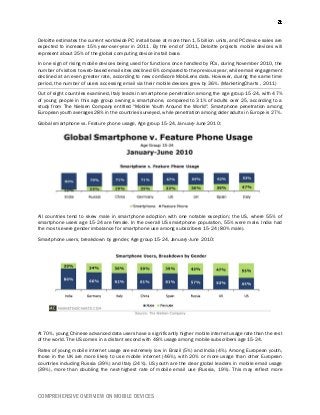
Out of eight countries examined, Italy leads in smartphone penetration among the age group 15-24, with 47%
of young people in this age group owning a smartphone, compared to 31% of adults over 25, according to a
study from The Nielsen Company entitled "Mobile Youth Around the World". Smartphone penetration among
European youth averages 28% in the countries surveyed, while penetration among older adults in Europe is 27%.
Global smartphone vs. Feature phone usage, Age group 15-24, January-June 2010:
All countries tend to skew male in smartphone adoption with one notable exception; the US, where 55% of
smartphone users age 15-24 are female. In the overall US smartphone population, 55% were male. India had
the most severe gender imbalance for smartphone use among subscribers 15-24 (80% male).
Smartphone users, breakdown by gender, Age group 15-24, January-June 2010:
At 70%, young Chinese advanced data users have a significantly higher mobile internet usage rate than the rest
of the world. The US comes in a distant second with 48% usage among mobile subscribers age 15-24.
Rates of young mobile internet usage are extremely low in Brazil (5%) and India (4%). Among European youth,
those in the UK are more likely to use mobile internet (46%), with 20% or more usage than other European
countries including Russia (39%) and Italy (24%). US youth are the clear global leaders in mobile email usage
(39%), more than doubling the next-highest rate of mobile email use (Russia, 19%). This may reflect more
COMPREHENSIVE OVERVIEW ON MOBILE DEVICES
sophisticated wireless networks and frequent texting usage in other parts of the world. Chinese youth also lead
in mobile ringtone downloads and IM, and tie with Russian youth for mobile screensaver downloads.
Price was the most common consideration in selecting a mobile phone for young people in almost all surveyed
countries, although Nielsen data indicates that is true among other age groups, too. Youth aged 15 to 24 put
price as the first purchase driver, with the exception of Russian youth, 21% of whom placed design/style first.
Personal payment for mobile charges increases as teens move into young adulthood. Across the countries
surveyed, personal payment increases on average 30% once mobile users exit their teen years. Germany and
Brazil are tied for the highest percentage of teens who say they pay their own bill, while Italy has the lowest. The
US has the lowest rate of personal payment among ages 20-24, with only 45% of youth in that age bracket paying
for their own service.
US mobile phone owners age 13-17 send and receive an average of 3,705 texts per month, according to other
recent data from The Nielsen Company. This is more than double the next-highest average number of texts sent
and received in average month, 1,707, performed by 18-to-24-year-olds. (MarketingCharts, 2011)
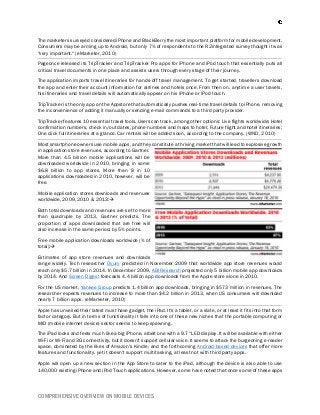
The usage of mobile phones has become ubiquitous in our daily lives. In developed regions every individual has
a mobile phone and its penetration is drastically increasing in developing countries.
The Japanese mobile users were the most connected of the three markets (Japan, US and Europe) researched
by comScore in October 2010. Japanese users topping the list of connected media usage, browser usage and
application usage. SMS services are still popular in European regions, however, if one looks at the mobile usage
of Japanese users this functionality will be extinct in the near future. Majority of Japanese users use their mobile
phones to send emails.
4.7% of mobile users in the US have accessed travel service from their mobile, compared to 4.1% in Europe and
3.3% in Japan.
COMPREHENSIVE OVERVIEW ON MOBILE DEVICES
Mobile behaviors by percent of total mobile audience, 7 October 2010:
Looking at the social networks used, Facebook leads in the US and Europe, while Mixi leads in Japan. Twitter is
doing a great job in Japan and Facebook and YouTube need to step up their game in order to conquer the
Japanese market. (SocialTimes, 2011)
Top four mobile social media brands:
COMPREHENSIVE OVERVIEW ON MOBILE DEVICES
Although applications deliver the best experience today, they are costly to develop and require specialist skills
to build and manage. HTML 5 could take over in the near future, providing many of the advantages of applications
such as offline access of websites and geo-location services, according to experts at the "Does Mobile Matter"
session at the World Travel Market.
Mobile applications are a ‘short-term bet', according to a mobile expert speaking at the Does Mobile Matter?
Session. Giving his top 10 tips for mobile, CX Partners Managing Director Giles Colbourne claimed mobile would
become the centre of all businesses and advised companies to think about mobile first and build out from there.
(Hotelmarketing, 2010)
While mobile search overall has increased four-fold in the past year, according to Google, searches for travel-
related terms have jumped 12 times and hotel-specific terms are up 30 times in the same period. Moreover,
those travelers are booking differently than those doing so from a desktop, and are often choosing places to stay
on the eve of their trip or once they have reached their destination.
Whether 2010 finally shapes up to be the year for mobile, it already has a huge head start in one sector: travel.
As a result, marketers with apps are raking in profits.
The mobile-search traveler is likely to be on business. More than 60% of surveyed business travelers make
reservations or bookings via mobile vs. nearly 40% of personal travelers, according to Google research. Car-
rental service Avis says travelers with corporate accounts and BlackBerry devices have had a big hand in its
100% growth in mobile web reservations year over year. (Hotelmarketing, 2010)
Patently Apple first introduced us to Apple's future iTravel App in April 2010. In July, Apple followed up with two
new iTravel services relating to Airline and hotel services. Today, Apple's next iTravel direction takes us to the
cruise line industry.
Apple knows that researching and putting together a cruise itinerary could be a daunting experience for
consumers. Trying to figure out where to go, what excursions and/or off-shore activities to take or sifting through
an endless list of cruise line services, could be intimidating.
Planning a cruise with Apple's iTravel for cruise lines will greatly simplify that process from pre-cruise to post-
cruise. Apple's future iTravel app will take advantage of NFC and location based technologies to enhance your
cruise line experience with such services as social networking, interactive ship maps, the ability to purchase
onboard tickets to shows or restaurants and even to act as a universal remote to control in-cabin electronics and
climate control.
Apple's latest patent even surprises with a very strong hint of providing a future iPhone with a pico projector so
as to possibly enhance your travel experience by being able to show off your excursion iMovies to an audience.
(Hotelmarketing, 2010)
Consumers do consider apps a must, according to an October 2010 survey from interface design agency
EffectiveUI conducted by Harris Interactive. More than three-quarters of mobile app users said they expected all
brand name companies to have a mobile application, and nearly as many said they expected the app to be easier
to use than the company's website.
But the survey also highlighted the danger of developing an app for its own sake. Almost 7 in 10 app users said
their perception of a brand would be negatively affected if it had an app that wasn't useful or helpful. And many
apps appear to fall into this category; 38% of respondents said they were not satisfied with most apps from their
favorite brands.
An earlier survey from Adobe found most mobile device users preferred using browsers to apps for a variety of
functions, despite the assumption among marketers and industry experts that apps provide a better user
experience. These users may also have been unimpressed with many of the apps they had tried.
COMPREHENSIVE OVERVIEW ON MOBILE DEVICES
Marketers must keep ease of use and also utility in mind when designing apps. The application must be a natural
fit for the brand and offer a genuine value to users, or they could be actively turned off from the brand.
(eMarketer, 2010)
October 2010 saw a surge of 134% in mobile web usage, compared to last year. Global mobile data traffic surged
in October 2010 at the fastest rate in seven months, raising the prospect of new orders for the makers of
telecoms equipment.
The largest mobile internet browser firm, Opera, said that global data traffic through its browser rose 15% in
October 2010 from September 2010, and surged 134% from a year ago. The mobile internet market has boomed
since the introduction of Apple's iPhone in 2007 and a raft of other smartphones hitting the market.
The Blackberry, iPhone and Nokia browsers all have 16 to 18% market shares. (ITPRO FIT FOR BUSINESS, 2010)
Mobile internet is demonstrating unprecedented early stage growth, with adoption rate growing faster than
desktop internet did, according to Morgan Stanley. Apple is currently leading the charge.
Subscribers to various technologies at the 11th Quarter after launch:
 Mobile internet (iPhone + iTouch - launched June 2007): around 86 million
 Mobile internet (NTT docomo I-mode - launched 6/99): around 31 million
 Desktop Internet (Netscape - launched 12/94): around 18 million
 Desktop internet (AOL - v2.0 launched 9/94): around 8 million
Estimated number of days to reach 1 million units sold:
 Nintendo Wii: 13
 Nintendo DS: 15
 iPad: 28
 iPhone: 74
 Netbooks: 180
 BlackBerry: 300+
 iPod: 360+
Morgan Stanley indicates that 3G is key to the success of mobile internet and that 2010 is estimated to be the
mainstream inflection point when 3G penetration rate will reach the 20% mark.
Global 3G+ subscribers and penetration rate, 2007 - 2014:
 2007: 273 million (8% penetration rate)
 2008: 430 million (11%)
 2009: 688 million (15%)
 2010: 1,055 million (21%)
 2011: 1,503 million (27%)
 2012: 1,928 million (33%)
 1013: 2,348 million (38%)
 2014: 2,776 million (43%)
USA has surpassed Japan as country with most 3G users in the first quarter of 2009. USA has become the global
leader in mobile users and innovation.
3G users in Japan vs USA, 2003-2009:
 2003: 3million (Japan) / nil (USA)
 2004: 16 million / 2 million
 2005: 36 million / 8 million
COMPREHENSIVE OVERVIEW ON MOBILE DEVICES
 2006: 57 million / 21 million
 2007: 74 million / 54 million
 2008: 87 million / 82 million
 2009: 99 million / 123 million
(Morgan Stanley Research, 2010)
Apple sold 14.1 million iPhones in the third quarter of 2010, up 91% year-on-year and 67.86% quarter-on-
quarter. The figure puts the total number of iPhones sold since launch at 73.72 million. The company sold 4.19
million iPads during the same period. (telecoms, 2010)
Smartphone use accounts for 65% of all mobile cellular traffic worldwide, despite smartphone penetration
running at just 13%, according to Informa Telecoms & Media. Usage is set to increase exponentially over the
next five years, with average traffic per smartphone user increasing by 700% by 2015.
Smartphone users across the globe currently average 85MB of traffic per month, with Apple's iPhone proving the
handset on which most traffic is generated. Devices running the Android OS sit behind the iPhone in terms of
traffic generation, and the Google-backed OS will not overtake Apple in this metric, Informa said, because Android
will be deployed across low-, mid- and high-user segments.
The traffic disparity between smartphone and non-smartphone is most pronounced in North America, where 86%
of mobile data traffic is currently generated by smartphone users, according to Malik Kamal-Saadi, principal
analyst at Informa Telecoms & Media. Average traffic per user (ATPU) for smartphones is set to hit 776MB/month
by 2015.
Growth in Western Europe will also be impressive, hitting 736MB/month in 2015, up from less than
44MB/month in 2009. The highest use will remain in the advanced markets of Japan and South Korea, which
currently average 199MB/month and 271MB/month. (telecoms, 2010)
A cross-market analysis of mobile
activities in Japan, the U.S. and
Europe revealed significant
differences among consumers by
geography, according to a study by
comScore. Mobile users in Japan
were the "most connected" of the
three markets, with more than 75%
using connected media (browsed,
accessed applications or
downloaded content) in June
2010, compared to 43.7% in the
US and 38.5% in Europe.
Japanese mobile users also
displayed the strongest usage of
both applications and browsers
with 59.3% of the entire mobile
population accessing their
browsers in June and 42.3%
accessing applications.
Comparatively 34.0% of mobile
users in the US and 25.8% in
Europe used their mobile browsers,
with 31.1% in the US and 24.9% in
Europe accessing applications.
Select Mobile Behaviors in Japan, United States and EU5 (UK, DE, FR, ES and IT) June 2010
Percent of Total Mobile Audience
Japan United States Europe
Total Audience: 13+ yrs old 100.00% 100.00% 100.00%
Used connected media (Browsed, Accessed
Applications or Downloaded Content)
75.20% 43.70% 38.50%
Used browser 59.30% 34.00% 25.80%
Used application 42.30% 31.10% 24.90%
Messaging Usage
Sent text message to another phone 40.10% 66.80% 81.70%
Used major instant messaging service 3.30% 17.20% 12.60%
Used email (work or personal) 54.00% 27.90% 18.80%
Social Media/Entertainment
Accessed Social Networking Site or Blog 17.00% 21.30% 14.70%
Listened to music on mobile phone 12.50% 13.90% 24.20%
Took photos 63.00% 50.60% 56.80%
Captured video 15.40% 19.20% 25.80%
Watched TV and/or video on mobile phone 22.00% 4.80% 5.40%
Played games 16.30% 22.50% 24.10%
Financial Information
Accessed bank accounts 8.00% 9.40% 7.10%
Accessed financial news or stock quotes 16.10% 10.00% 7.20%
Retail/Travel
Accessed online retail 7.20% 5.50% 4.10%
Accessed classifieds 4.20% 6.60% 4.20%
Accessed travel service 3.30% 4.70% 4.10%
Other
Accessed maps 15.70% 16.00% 10.80%
Accessed traffic reports 12.60% 8.20% 5.90%
Accessed weather 34.10% 22.30% 13.70%
Source: comScore MobiLens
COMPREHENSIVE OVERVIEW ON MOBILE DEVICES
Messaging methods also varied with Europeans displaying the strongest use of text messaging with 81.7%
sending a text message in June, compared to 66.8% in the US and just 40.1% in Japan. Japanese users exhibited
the highest reach in the email category at 54%, while consumers in the US were most likely to use instant
messaging services on their mobile (17.2%).
Social networking/blogs reached the greatest percentage of mobile users in the US at 21.3%, followed by Japan
at 17.0% and Europe at 14.7%. Japanese users were most likely to capture photos (63.0%) and watch TV/video
(22.0%) on their mobiles, while Europeans were most likely to listen to music (24.2%) and play games (24.1%).
A demographic analysis of mobile media
users across markets showed that mobile
media consumption was more balanced
across age segments in Japan when
compared to the US and Europe. In the US,
25-34 year olds were 44% more likely to
access mobile media than an average mobile
user, with 18-24 year olds 39% more likely.
In Europe, 18-24 year olds represented the
most-connected segment, 54% more likely to
be mobile media users, while persons age
25-34 were 35% more likely.
The US and Europe also showed greater gender disparity among mobile media audiences. Females were 9% less
likely to be mobile media users in the US, while females in Europe were 16% less likely.
Across markets, local and global brands showed varying levels of adoption by mobile audiences. In all three
markets, the top mobile social
media brand mirrored the top PC-
based social networking brand
with Facebook leading in the US
and Europe and Mixi leading in
Japan. Local brands Gree and
Mobage Town were the 2nd and
4th most accessed social
networking brands in Japan. Twitter was the only brand to be ranked in the top four in all markets. (comScore,
2010)
Mobile technology is being adopted by the corporate travel industry in four key ways: mobile itinerary
management, security and safety on the road, mobile commerce, and automating and expediting the travel
process, according to a whitepaper by BCD Travel "Changing the DNA of Managed Travel: Using Social and Mobile
to Enhance Productivity, Morale and the Bottom Line".
Thanks to the growth in the usage of smart-phones and the Social Web, today's workforce has developed new
habits and expectations around interactive information-sharing, mobility, interoperability, user-centered design
and collaboration. These expectations are changing the way they see, and move through, the landscape of
managed travel.
The white paper argues that, properly deployed, social Web and mobile technology can help keep travellers
informed and aware, offer newly personalized corporate travel experiences and feed vital information into the
corporation's program management framework and processes. (Travel Industry Wire, 2010)
Availability of free Wi-Fi does influence venue choice with nearly two-thirds of respondents indicated that free Wi-
Fi influences their choice of venue, according to In-Stat's Wi-Fi Hotspot research. An additional 31% indicated
that free access may influence their choice, and just 5% said that it would have no influence over venue choice.
Some of the research findings include:
Mobile Media Usage in Japan, United States and EU5 (UK, DE, FR, ES and IT)
by Demographic Segment June 2010, Total Mobile Audience Age 13+
Connected Media Audience Index*
Japan United States Europe
Total Audience: 13+ yrs old 100 100 100
Male 102 110 116
Female 98 91 84
Persons Age:
13-17 114 130 133
18-24 117 139 154
25-34 114 144 135
35-44 111 117 103
45-54 105 85 78
55+ 80 39 57
Source: comScore MobiLens
Top Mobile Social Networking/Chat/Blog Brands in Japan, United States and EU5 (UK,
DE, FR, ES and IT) by Audience Size June 2010, Total Mobile Audience Age 13+
Japan United States Europe
Mixi Facebook Facebook
Gree MySpace YouTube
Twitter YouTube MSN / Windows Live / Bing
Mobage Town Twitter Twitter
Source: comScore MobiLens
COMPREHENSIVE OVERVIEW ON MOBILE DEVICES
 Worldwide annual hotspot connects, or sessions, will reach over 2 billion by the end of 2010 with annual
hotspot connects anticipated to grow to over 11 billion by 2014.
 Asia/Pacific will have about a quarter of the worldwide hotspot venues over the forecast period.
 By 2012, handhelds are anticipated to account for half of hotspot connects.
 The total worldwide hotspot market size will swell to 319,200 venues by year-end.
(WiFi Foundation, 2010)
According to Google, it is a matter of when, not if, mobile devices will overtake the desktop as the web access
point of choice for users. Therefore, the trend that will have the greatest impact on the travel business is the
astronomical rise in the use of smart phones.
The combination of sophisticated mobile devices coupled with location based applications, the possibility of
offline navigation with no roaming fees, augmented reality and more of such developments mean the world of
travel planning and buying continues to evolve.
Even as it seems there is plenty to do considering the latest technology and gadgets-related developments, it is
also emphasized that gadgets or distribution technology do not make that much difference in terms of total travel
spend worldwide.
However, a business' performance can be impacted by changes in technology. A simple example is the decline
of the brick and mortar travel agencies after the web developed. Now, does that mean if a business does not
have a native iPad application, it's doomed to fail? Doubtful. And on the other hand, if a business spends too
much time on the latest/greatest gadget, it could seriously mis-direct resources. It is an interesting dilemma:
How much attention / money should one spend on emerging technology? Unfortunately, there are no obvious
answers and mistakes can be grievous down the road due to path-dependent development.
Significantly, travel-related mobile activities such as viewing maps, getting directions, researching local activities
and travel products have gained steam faster than transactions to date. However, the growth opportunity in the
mobile market as a source of travel-related transactions is far too big to be ignored and is gaining serious
momentum.
Google believes that as smartphones with full web kit browsers continue to grow, more and more users will be
able to access the web and search with Google from their mobile devices. The company wants to enable users
to search as easily on their phones as they do on the desktop; keep in mind that searches on mobile phones are
generally incremental to desktop searches as users often search with their phone when they are away from a
desktop - on the road, away for the weekend. At the same time, Google acknowledges that search on the mobile
device is special, however, in that there are unique characteristics of the phone that let us expand the ways
users can search.
Overall, it is clear that travel planning and booking will happen anytime, anywhere - even up to the last minute.
Also, travellers will draw upon the advice and influence of their social graph throughout the travel life cycle - and
can immediately broadcast reviews and other insights back to their social graph whenever they want. Finally,
with location-aware services out there, everyone (including businesses) will make their communications more
relevant, based on where the traveler is physically located, at any given point in time. (Hotelmarketing, 2010)
As of August 2010, travellers have downloaded Hilton-brand apps 340,000 times. Revenue generated from room
bookings across Hilton's brands via the mobile apps soared 200% in May vs. May 2009. Hilton expects
customers will book "well over" 100,000 room nights via mobile apps in 2010.
The surge that Hilton Worldwide has seen this year in its iPhone application downloads and mobile room
bookings surprises even Chuck Sullivan, the company's senior vice president of global online services.
COMPREHENSIVE OVERVIEW ON MOBILE DEVICES
Part of what's driven the surge in app use since Hilton launched its first apps has been the rollout of 3G networks.
(Hotelmarketing, 2010)
Microsoft released a new version of its Bing app for the iPhone and iPod touch and it incorporates Bing Travel
features for the first time. When mobile users click on Travel, they can conduct flight searches and also view the
estimated price for alternative airports and dates.
Consumers can utilize Bing Travel's predictive technology to see recommendations on whether they should "buy
now" or wait, and they also can see displays of top deals from their local airports.
Consumers can also view a flight status feature to see if their flights are on time.
Separately, Bing upgraded the app's mapping features, giving more prominence to information about traffic,
business listings and neighborhood labels. The feature also enables users to switch between map and list views.
(tnooz, 2010)
The most recent Apple iTravel patent reveals that in addition to making room reservations, travellers could also
make requests about temperature, lighting, and the types of food or beverages to have available, etc. Then, the
iPhone could act as a room key and as a remote control for things like A/V devices.
The initial iTravel patent detailed an application that could connect to various airlines or transportation services,
and book or retrieve reservations for flights, hotels, car rentals, etc., all from the device. Check-in/Baggage Claim
data and identity information could also be accessed in the app to make boarding and retrieving or checking
luggage that much easier.
The most recent iTravel patent reveals that in addition to making and retrieving reservations, the iTravel app
could actually communicate with equipment on airplanes and add a layer of personalization to travel.
The iTravel app could also connect directly to hotel services like dry cleaning, room service and the hotel spa,
and make it easy to reserve tables at nearby restaurants, book cabs or get suggestions for local entertainment.
Finally, the app could be used to pay your bill, request transportation, use reward programs and also keep track
of receipts. (TourismExchange, 2010)
The threshold of 5 billion mobile phone subscribers will be exceeded this year for the first time. By the end of the
year, the 4.5 billion figure will have increased by 12 per cent to 5.1 billion. Of these, 800 million persons are
already using the fast UMTS mobile communications standard; an increase of 37 per cent. In 2011, there will
already be more than one billion UMTS subscribers.
The number of mobile phone subscribers has doubled in the past five years. This figure is expected to rise by 10
percent to 5.6 billion in 2011. The growth in developing and emerging countries is especially strong. According
to the most recent data from the UN agency International Telecommunication Union (ITU), more than half the
homes in these countries, even in rural areas, have a mobile phone connection. Landlines are rarely found or
not at all. In the EU the number of mobile phone subscribers is expected to rise to around 650 million by the end
of 2010. This is a growth of almost 3 per cent compared to the previous year. Nearly a third of these now use
UMTS. Germany has the most mobile phone contracts in the EU: around 111 million by the end of 2010. Germany
is followed by Italy (87 million), Great Britain (81 million), France (62 million) and Spain (57 million). By
comparison: There are an anticipated 220 million in Russia and 287 million in the USA.
The use of mobile communications is increasing far more in Asia and South America than in Europe and North
America. In China, the number of mobile phone subscribers has risen by almost 13 percent this year to around
844 million. This figure is expected to grow by one-tenth within the next year to 930 million. In India, the number
of subscriptions will go up by 30 per cent to 680 million. In Brazil, there will be 193 million connections by the
end of the year; a growth of 11 percent. Japan is technically very advanced: 96 percent of all mobile
communications users already use UMTS. (EITO, 2010)
A greater portion of Chinese mobile subscribers are accessing the internet via mobile devices than users in the
US, according to a report from The Nielsen Company. Research conducted by the measurement firm also
COMPREHENSIVE OVERVIEW ON MOBILE DEVICES
suggested more Chinese users download mobile applications and make use of mobile instant messaging
services than their US counterparts.
Although mobile devices are only just reaching widespread penetration in China, Nielsen found 38% of mobile
subscribers there claim to access online content on a monthly basis, compared with just 27% of subscribers in
the US. In addition, 20% of users in China claim to download mobile apps and 23% use mobile instant messaging
products, compared with 18% and 16% of US users, respectively.
China also surpassed the US in terms of text message usage, with 86% of users there using SMS services
compared with 64% of US subscribers. Two areas in which the US continues to outpace China in terms of
adoption, however, are location-based services and e-mail.
Nielsen's research was based on face-to-face surveys with 4,946 consumers age 15 and up in 19 cities around
China. The interviews were conducted in March 2010. (ClickZ, 2010)
Whether tourists are backpacking in Bali or camel trekking across the Sahara, the Postcards app captures their
image on iPhone and android smartphones, sending it to the folks back home by conventional post.
In the recent two-month test-phase, 18,000 holidaymakers sent unique ‘DIY' postcards using the free app - which
can be accessed from both Android and iPhone platforms.
Already one of the Apple website's top 30 apps in their ‘free stuff' travel section, the free ‘Postcards' download
lets users take a photo or upload from their library and input text to family and friends. It costs UK£1.49 to send
first class postcards anywhere in the world, processed via PayPal.
The worldwide postcards are sent to a printing firm in Dorset via file transfer protocol (FTP) at 4pm every day.
They are then run off using state-of-the-art Xerox printers and collected for dispatch by Royal Mail at 5.15pm the
same day. (Travelmole, 2010)
COMPREHENSIVE OVERVIEW ON MOBILE DEVICES
Business travellers ranked adjusting travel plans, making dinner reservations and checking into hotels as three
of the top four "must-have" mobile applications, according to a recent survey from Omni Hotels & Resorts. The
survey, which asked about mobile and social application preferences and usage, found that access to these
tools were an integral part of time management on the road. Beyond taking care of travel matters, the survey
also revealed that business travellers utilized mobile and social applications to take care of personal items,
explore the local area and connect virtually with friends and family.
Checking the latest sports scores, updating
Facebook, looking for the nearest coffee spot
and tweeting were also highly rated in the recent
survey. In addition, 61% of all business travellers
were burning the midnight oil online - not on
business from the day - but rather managing their
personal lives remotely.
The younger business traveler was even more
focused on finding personal balance. Nearly one
third of younger business travellers, ages 25 to
34, were more likely to order perks that make
their hotel stay more comfortable; over 40%
tweet about their travels and 65% enjoy updating
Facebook to let everyone know where they are.
Business travellers, who are inclined to order
services from a hotel on a mobile device or
computer, prefer things which will help travel go
more smoothly. When asked which types of
services they would order using their mobile
device or computer, almost six in 10 business
travellers said they would request a car service
to the airport, while 48% said they would order
anything that would allow them to multitask while
on a business trip.
When asked what hotel Wi-Fi is used for at night
other than work, 61% of business travellers said
they randomly surf the web, while others use the
time to catch up with life outside of work. Also in
the survey, 49% of business travellers pay bills
online and 34% Skype or chat with their family at
home.
A sizeable number, 40% of business travellers,
check Facebook or other social networking Web
site(s) on hotel Wi-Fi and 34% of travellers say
they update their Facebook status.
Just over half - 55% - of the business travellers
surveyed said they never tweet while on a
business trip, and only 11% said they tweet
often. Among those who said they would tweet
during a hotel stay, positive experiences, such as
free room upgrades (70%) and free Wi-Fi (62%)
were more likely to incent a tweet than negative
COMPREHENSIVE OVERVIEW ON MOBILE DEVICES
ones. The survey found an overbooked hotel to be the one negative that would likely put guests in a tweeting
mood.
A total of 200 business travellers completed the online survey conducted from March 29-31 by KRC Research.
To qualify, business travellers had to be at least 22 years old, travel overnight for business purposes at least six
times a year, spend approximately $150 or more per night on a hotel room, not including taxes, and carry and/or
use a personal communication device (PDA, Blackberry, iPhone, Google Android smartphone or other device)
while travelling on business. (TourismExchange, 2010)
A Cisco Systems study predicts smartphones
ownership level worldwide, by region and country,
predicting that 17% of mobile handsets worldwide
by 2014 will be smartphone, up from 9% in 2009.
Smartphone penetration worldwide, by region and
country, 2009 and 2014 (% of total mobile
handsets): (eMarketer, 2010)
Google has launched a new feature for mobile
search that helps users on Android-powered
devices and iPhones find and download mobile
apps. Google highlighted that with tens of
thousands of apps available for both Android and
iPhone phone, there are plenty of options to choose
from when the users are looking for new apps. (Eye
for travel, 2010)
Much has been made of the new device, but a first
look at the iPhone 4 gives little indication as to what
travellers will get from it. This is because visually it
doesn't actually look drastically different - slighter
squarer edges, metallic design, but very little else.
For travellers there isn't a single new feature on the
handset that's a killer piece of functionality, such as
the introduction of the widely talked about iTravel
function - but there are enough new tools to suggest
that as a suite of improvements it improves
massively on the existing iPhone model when it
comes to travel-related functionality.
But perhaps the most important element of the
upgrade is the multi-tasking functionality. Until now
iPhones have been limited to single use for
different services - a frustrating bar on its
functionality, especially for those using apps or
instant messaging systems such as Skype. The
iPhone 4 will allow multiple tasks to be carried out
at the same time such as email and the camera,
calendar and currency converter. And arguably the
most useful service for the traveller, GPS tracking,
will run constantly (if required) so users do not need to restart an app or piece of functionality each time they fire
it up.
COMPREHENSIVE OVERVIEW ON MOBILE DEVICES
With so many travel-related apps dependent on the GPS connection but often causing irritation to users as they
seemingly start again when opened, this could be seen as a major step forward for the handset. (tnooz, 2010)
Google has unveiled a new online app store for its Chrome browser consumers to purchase games, in a move to
give the search giant a central role in the next generation of web media and entertainment.
The Chrome Web Store, which Google said will be available soon, will make it easy for web surfers to find web
applications and purchase them with one click. The store will be accessible through Google's Chrome web
browser, which the company said now has 70 million users, up from 30 million in June 2009.
The idea of aggregating a range of free and paid applications at an online store for downloading by consumers
has been widely popularized by Apple's 'App Store' for the iPhone. Google's mobile operating system Android and
Research In Motion's BlackBerry and others also now have their own app stores.
Google also announced a new format for web video that it said will be open-source and royalty free. The new
video format, dubbed webm, is based on technology that Google acquired through its $120 million purchase of
On2 Technologies earlier this year.
Google is also widely expected to unveil a television-internet product in collaboration with Intel and Sony. (ITPRO,
2010)
A mobile contactless payment solution, designed to enable iPhone users to make contactless transactions, such
as Visa mobile payments, by simply waving the iPhone in front of a contactless payment terminal, has been
launched. The solution, In2Pay, has been introduced by DeviceFidelity.
The solution combines DeviceFidelity's In2Pay microSD technology with a specially designed, patent-pending
protective case that adds mobile contactless capability and works with iPhone 3GS and iPhone 3G. By placing a
removable In2Pay microSD into the protective case, iPhone users can take advantage of In2Pay's secure
contactless capabilities where contactless transactions are offered. They range from buying goods in retail stores
and at unattended kiosks, to transit ticketing, and even securely accessing buildings and computers networks.
Trials are scheduled to start during the second quarter of 2010. (Eye for travel, 2010)
Apple has filed a patent for a travel app called iTravel that books flights, hotels and car reservations, as well as
providing ticketless check-in using Near Field Communications (NFC), a short-range wireless technology.
Apple has already indicated its interest in the ticketing space by filing a patent for "Concert Ticket +", an event
ticketing system linked to iTunes. But this is the first indication that the company is actively looking to target the
travel vertical.
The patent suggests that, as well as buying travel products, travellers will be able to use the app to pass through
airline check-in and security without paper tickets or even a passport. The app could be used to wirelessly check
in the traveler at the ticket counter, and using a combination of fingerprint or retina scan, identify them to airline
and security personnel. The app with also allow travellers to check themselves in at the boarding gate and help
them find their RFID-tagged luggage at the other end.
iPhones don't currently have in-built NFC capabilities, but the technology is already widely used in Japan for
mobile ticketing and payments. There are rumors that the next 4G iPhone will include NFC, and the filing of the
iTravel patent certainly suggests the thinking at Apple is rapidly moving in this direction.
With rumors of a purchase of ITA Software, a vertical play into travel from Apple's arch rival Google is also looking
more likely than ever. (Eye for travel, 2010)
The demand for smartphones is creating a demographic shift among users, who will exceed 1 billion worldwide
by 2015, stimulating demand for more entry-level models that offer mainstream solutions such as mobile email
and social networking applications, according to Parks Associates' Smartphone: King of Convergence.
COMPREHENSIVE OVERVIEW ON MOBILE DEVICES
This new report includes consumer data from Parks Associates' primary study Mobile Convergence: Platforms,
Applications, and Services. This consumer survey finds only 30% of current smartphone users are the
stereotypical young and tech-savvy aficionados.
The other user segments exhibit more mainstream demographic attributes and more divergent usage patterns.
One such segment, dubbed "pragmatists," consists of budget-conscious, middle-aged users who prefer mobile
email service over Internet access. Another group is keen on the smartphone's communication features, ranging
from mobile Internet to social network access. (Parks Associates, 2011)
US based OpenWays launched an application for smartphones (embedded or mobile web-based) that allows
travellers to check-in remotely, bypass the front desk and open the door to their room by simply pressing a "key"
icon on their mobile device.
Those traveling with an iPhone, BlackBerry, NOKIA, Android-based or other Windows-based mobile cell phone
can securely obtain an encrypted room key in "full data mode" - as long as they are staying at a hotel that enables
the OpenWays mobile key service.
The OpenWays solution was introduced in November 2009 as a way to enable any of the 4 billion cell phones in
the world to receive a dematerialized key via an encrypted acoustic tone to bypass the front desk and access
door locks. This ubiquitous solution uses the principle of Crypto Acoustic Credential (CACTM) and text messaging
(SMS) to very securely deliver a key to the right user anywhere in the world. The solution is compatible with the
major electronic-locking systems and access-control systems. The acoustic key produced is unique, and thanks
to OpenWays patents-pending solutions, a fraudulent recording of the key will be made inefficient to open a door.
(Hotelmarketing, 2010)
More than 650 million people worldwide (or 13.4% of mobile subscribers) use the Web via a mobile device at
least monthly in 2010, according to eMarketer.
Two-thirds of mobile users around the globe are interested in "smart" services that would feed them information
based on personal preferences, location, and time of day and social setting, according to a Tellabs survey
conducted by The Nielsen Company.
Mobile users expect these services from a variety of providers, including mobile operators, other internet
application providers, and a combination of many sources. Consumers placed significant trust in their mobile
COMPREHENSIVE OVERVIEW ON MOBILE DEVICES
carriers in terms of protecting the information needed to provide smart services, and overall selected carriers
more often than any other group as the "most appropriate" provider of services.
Consumers' expectations regarding smart location-based services closely mirrored their desires in other areas,
such as news, media and entertainment content, where less than one-half named mobile carriers as the best
source of information, followed by other Web providers and a combination.
When it came to shopping services, however, there was a notable difference: Mobile carriers dropped somewhat
in importance, and advertisers became a much more prominent source of information.
US marketers have already begun experimenting with exactly this type of smart shopping service. "Geo-fencing"
provides personalized marketing messages to shoppers based on their location or proximity to a marketer's
store. 1020 Placecast, for example, piloted a ShopAlerts program that was embraced by mobile users:
 60% said the location-triggered messages were "cool" and "innovative."
 79% claimed to be more likely to visit a store.
 65% made a purchase.
 73% were likely to use the service again.
(eMarketer, 2010)
Mobile is at least somewhat important to the strategy of more than ¾ of marketers in North America, according
to a January 2010 survey by R2integrated. But
barriers to mobile campaigns remain.
The greatest obstacle, the survey found, was
difficulty in developing the business case for mobile
campaigns, followed by inability to measure ROI and
a lack of a mobile component to the strategic
marketing road map.
Barriers to using a mobile marketing campaign
according to marketing professionals in North
America, January 2010 (% of respondents):
Asked what the most critical area of improvement
was in mobile, 43% of respondents said quantifying
ROI as the top response.
Respondents said the main goals of their mobile
campaigns were raising company awareness and
generating leads. To that end, marketers were most
likely to measure their success by an increase in
customers or sales.
Methods used to measure success of mobile
campaigns according to marketing professionals in
North America, January 2010 (% of respondents):
It appears that 2010 will be a year of experimentation and education on mobile marketing as marketers struggle
to come to terms with its practicality and ROI, according to R2integrated. This shouldn't suggest that marketers
ought to table their mobile marketing plans, but that they should pay considerable attention to how they can
connect the dots back to driving revenue.
Most respondents reported that they would spend less than 15% of their budgets over the next year on mobile,
though about one-quarter would spend between 15% and 30%. More than half were focused on mobile Website
development, while 40% used apps for their campaigns.
COMPREHENSIVE OVERVIEW ON MOBILE DEVICES
The marketers surveyed considered iPhone and BlackBerry the most important platform for mobile development.
Consumers may be arming up to Android, but only 7% of respondents to the R2integrated survey thought it was
"very important." (eMarketer, 2010)
Pageonce released its TripTracker and TripTracker Pro apps for iPhone and iPod touch that essentially puts all
critical travel documents in one place and assists users through every stage of their journey.
The application imports travel itineraries for hands-off travel management. To get started, travellers download
the app and enter their account information for airlines and hotels once. From then on, anytime a user travels,
his itineraries and travel details will automatically appear on his iPhone or iPod touch.
TripTracker is the only app on the Appstore that automatically pushes real-time travel details to iPhone, removing
the inconvenience of adding it manually or sending e-mail commands to a third party provider.
TripTracker features 10 essential travel tools. Users can track, among other options: Live flights worldwide; Hotel
confirmation numbers, check in/out dates, phone numbers and maps to hotel; Future flight and hotel itineraries;
One click full itineraries at a glance. Car rentals will be added soon, according to the company. (WND, 2010)
Most smartphone owners use mobile apps, and they constitute a thriving market that will lead to explosive growth
in application store revenues, according to Gartner.
More than 4.5 billion mobile applications will be
downloaded worldwide in 2010, bringing in some
$6.8 billion to app stores. More than 8 in 10
applications downloaded in 2010, however, will be
free.
Mobile application stores downloads and revenues
worldwide, 2009, 2010 & 2013:
Both total downloads and revenues are set to more
than quadruple by 2013, Gartner predicts. The
proportion of apps downloaded that are free will
also increase in the same period, by 5% points.
Free mobile application downloads worldwide (% of
total):
Estimates of app store revenues and downloads
range widely. Tech researcher Ovum predicted in November 2009 that worldwide app store revenues would
reach only $5.7 billion in 2014. In December 2009, ABI Research projected only 5 billion mobile app downloads
by 2014. And Screen Digest forecasts 4.4 billion app downloads from the Apple store alone in 2010.
For the US market, Yankee Group predicts 1.4 billion app downloads, bringing in $573 million in revenues. The
researcher expects revenues to increase to more than $4.2 billion in 2013, when US consumers will download
nearly 7 billion apps. (eMarketer, 2010)
Apple has unveiled their latest must have gadget, the iPad. It's a tablet, or a slate, or at least it fits into that form
factor category. But in terms of functionality it falls into one of these new niches that the portable computing or
MID (mobile internet device) sector seems to keep spawning.
The iPad looks and feels much like a big iPhone, albeit one with a 9.7" LED display. It will be available with either
Wi-Fi or Wi-Fi and 3G connectivity, but it doesn't support cellular voice. It seems to attack the burgeoning e-reader
space, dominated by the likes of Amazon's Kindle, and the forthcoming Android-based devices that offer more
features and functionality, yet it doesn't support multitasking, at least not with third party apps.
Apple will open up a new section in the App Store to cater to the iPad, although the device is also able to use
140,000 existing iPhone and iPod Touch applications. However, some have noted that once some of these apps
COMPREHENSIVE OVERVIEW ON MOBILE DEVICES
scale up to the available resolution of the iPad (1024 by 768 pixels at 132 pixels per inch) they look a bit like
the blocky graphics of the Commodore 64.
Taking the e-reader market head on, the iPad will feature an iBooks app that allows users to browse, purchase
and download e-books to read on the device. The screen isn't up to the same standards as electronic ink, but
that's because it's being pitched as a jack of all trades when teamed with the iWork suite of office tools, Safari
browser (with the same lack of support for Flash and Java that the iPhone suffers from), email client, and photo,
video and music player apps.
The Wi-Fi only model will start shipping in late March 2010, while the Wi-Fi and 3G models will be available in
April. (telecoms, 2010)
More than half of internet users worldwide made a mobile device part of their shopping activities in December
2009, according to a Motorola report.
Generation Y respondents came out ahead on every
measure of mobile shopping activity that Motorola
studied, while boomers lagged behind. In some
cases, the usage gap was significant. Gen Y users,
for example, were 6.5 times as likely as baby
boomers to have gotten coupons or special offers
via mobile. And crucially, they were more than three
times as likely to have made a mobile purchase over
the past two weeks.
Internet users worldwide who have used a mobile
phone for in-store shopping activities, by
generation, December 2009 (% of respondents):
Mobile shopping habits differed just as greatly by
region, with North America coming in last by almost
every measure. Users in Asia-Pacific were
enthusiastic adopters; nearly 8 in 10 reported some
mobile shopping activity, and 23% had made a
mobile purchase.
Usage of mobile phone for shopping-related
activities* by internet users worldwide, by region,
December 2009 (% of respondents):
Latin America was also a source of above-average
mobile shopping activity, though users there did not
approach those in Asia-Pacific for advanced actions
such as mobile couponing and mobile purchases.
An October 2009 study from the IBM Institute for
Business Value reached similar conclusions.
Internet users surveyed in India, China and Brazil
reported a significantly greater willingness to shop
via mobile phones than respondents in the US, UK
and Canada. (eMarketer, 2010)
COMPREHENSIVE OVERVIEW ON MOBILE DEVICES
The share of Web site traffic on tablets grew more than 300% in the past year, according to research by Adobe.
Tablets' share of Web site traffic will exceed smartphone traffic by early 2013, reaching 10% of total Web site
traffic in 2014. (Hotelmarketing, 2012)
More travellers from China and Brazil than UK and US own tablet devices, according to stats shared by Henry
Harteveldt of Atmosphere Research Group at an OpenJaw customer conference in Dublin in May 2012.
Air passengers from the UK, US, Brazil and China were surveyed in the second quarter of 2012 to reveal that
while in the US 35% own a tablet, it's 50% of travellers in Brazil and 53% in China.
Stats for mobile ownership among travellers show 78% of travellers in Brazil and 89% in China have a
smartphone compared with around 66% for UK and US travellers.
Across all four countries travellers are now spending more time browsing for personal use than watching the
television and are interested in carrying out/buying a range of ‘low risk' items including restaurant reservations
and booking sightseeing tours via mobile.
COMPREHENSIVE OVERVIEW ON MOBILE DEVICES
Harteveldt used the stats to emphasis the big three travel tech trends that online retailers need to take notice
of - mobile, consumer control and big data. The research shows travellers don't think retailers are making the
best use of technology to personalise offers to them or improve the overall experience.
(tnooz, 2012)
There will be 375 million tablets purchased globally and 760 million tablets in use by 2016, according to
Forrester Research. This growth (from 56 million sold in 2011) represents a 46% compound annual growth rate.
By 2016, a third of tablets will be sold directly to the business. Emerging markets will also contribute greatly to
tablet adoption. Forrester believes that these markets will account for 40% of tablets sold in 2016. (Forrester,
2012)
Worldwide tablet sales surpassed 16 million units in 2010 and accounted for 5.1% of total PC sales, according
to research by Computer Industry Almanac Inc. In the USA tablet sales accounted for 12% of total PC sales in
2010. The sales growth of pads and tablets will continue
and will account for an increasing share of total PCs.
By 2015 the worldwide sales of tablets are projected to
reach nearly 36% of total PC sales or 186 million units,
which higher than the total worldwide PC sales in 2004.
USA tablet sales are forecasted to top 53 million units in
2015 or over 43% of total PC sales.
Much of the growth is coming from the iPad and similar pad and tablet devices, which are included in the total
PC figures in this report. Windows 8 which is expected in mid to late 2012 will also be used for tablets and is
expect to compete and expand the current tablet market, which are primarily iPads and Android based.
(Computer Industry Almanac Inc., 2012)
Mobile web browsing on travel sites has increased by almost three quarters in the past six months and now
accounts for an average of 17.4% of traffic, according to a research entitled the ‘Beginning of the End of the PC
Era?' from web design and digital specialist Nucleus.
The research reveals the growth in traffic from mobile devices in January 2012 compared with August 2011 and
shows luxury sites have the highest mobile penetration. The studied carried out on 10 UK and international travel
websites also reveals some have witnessed a doubling in mobile web browsing over the six months with the top
site generating 24.2% of its traffic from tablets and smartphones.
U.S. & World Tablet Sales 2010 2012 2015
Worldwide
Tablet PC Sales (Millions) 16.6 86.6 185.7
Tablet PC Sales Share (%) 5.1 20.9 35.9
USA
Tablet PC Sales (Millions) 10.1 30.6 53.3
Tablet PC Sales Share (%) 12 29.6 43.5
Source: Computer Industry Almanac Inc.
COMPREHENSIVE OVERVIEW ON MOBILE DEVICES
Apple devices dominate mobile browsing taking an average share of 85.6% of all mobile browsing devices and
the figure increases for luxury brand websites. Meanwhile, browsing using an Android device has dropped in the
six months although there is evidence to show those devices are being used on mass market travel sites but iOS
devices still do better. Only the iPad has increased its share of the mobile web browsing market - up 12% in the
past six months. (tnooz, 2010)
Tablets are booming, with more than 25 million iPads sold to date and 50 million expected to be sold in 2011.
Tablets are taking our entertainment experience in a new direction, and in the next two to five years, the tablet
could serve as your universal remote control. All of which means the future of the digital home is already here.
The tablet's sizable screen offers a mobile alternative to watching movies and shows on a traditional TV, and
touch capabilities make it the ideal remote for controlling connected TVs and stereos around the house. The
tablet's advent has shaped the direction of our industry, and with it "anytime, anywhere" entertainment is now a
reality. As a result, how we experience video and music has been change forever. (Hotelmarketing, 2011)
UK-based Ebookers and digital solutions company Fortune Cookie have developed a new iPad app they claim is
the first social media travel guide.
The ebookers Explorer application aggregates social media content from around the web to create a dynamic
travel magazine, integrating with services such as Flickr, Facebook, YouTube, Google Blogs and Twitter. It also
serves relevant hotels from the ebookers inventory.
The new app, set to launch at travel agent consortium Advantage's 2011 conference, is not intended to handle
bookings, but rather to help inspire users in the early stages of the travel decision-making cycle. (Hotelmarketing,
2011)
Apple is forecasting 40 million iPads to be shipped in 2011 and there are more new tablets slated for release in
the next few months than you can count on the fingers of both hands.
Ipsos have been looking at the US tablet market since the early days of the iPad in spring 2010, tracking its rise
and how it is being used by the earliest adopters. Key findings show that:
 With the tablet entrance price around $500 it is still seen as a luxury item. This is evidenced in the far
higher proportion of owners coming from households earning $100,000 or more. It's also something of
a young man's game right now, with 45% of owners in the 18 -34 age bracket and almost six in ten being
male. Even owners see it as something of a luxury. They may have just spent their hard earned money
on a tablet but only one in ten say it's the single device they would keep if they were forced to choose.
This puts it behind the laptop (41%) and desktop (20%), and on a par with their smartphone (10%).
Despite, or maybe even because of, being seen as a luxury, there's a huge demand for tablets - just over
one third of all internet users would like get their hands on one. Even if only a proportion of these follow
through on their interest then this will clearly start to bring the profile of owners more in line with the
general population. The age profile of tablets will still be skewed towards 18-34s but the gender and
income profiles will move closer to the population average.
 It's interesting to look at what the tablet might do to "computer" use. Consumers coming to the tablet
market this year are expecting to get a device that is great for social networking, emailing, casual
gaming, reading content and viewing video - including movies. They'll use it for finding out information
but the general sense is of a content consumption and socializing device, rather than the more
"workhorse" laptop or desktop PC. Many of the same activities are also being switched away from the
smartphone, again moving across to the tablet. At the same time, the tablet appears to be driving new
video consumption occasions over-and-above those which it has simply cannibalized from other devices.
This includes more full length TV and movie viewing, further strengthening the tablet's position as a
content consumption and socializing device.
(Ipsos, 2011)
COMPREHENSIVE OVERVIEW ON MOBILE DEVICES
Apple's flagship tablet accounts for 93% of all tablet sales in the third quarter of 2010, according to research
from ABI.
The figures from ABI Research claimed 4.5 million tablets were shipped in the third quarter of 2010, of which
93% of those sales were iPads. (ITPRO, 2011)
Consumers around the world are increasingly aware of tablets and e-readers and are prepared to buy these
devices, especially if prices come down, according to a survey of more than 14,000 consumers in 16 markets,
including China, Germany, the UK, and the US.
These findings suggest that the initial consumer interest in these devices, which reached a crescendo in April
2010 with the release of Apple's iPad, remains strong. Apple sold 3 million iPads in the US in the first 80 days
after its release and is set to release its new model in March 2011.
This survey confirms that tablets and e-readers are set to rapidly become the next must-have device, according
to Dominic Field, a BCG partner and US leader of the firm's media practice.
Two-thirds (67%) of all US consumers were familiar with tablets and e-readers in December 2010, when the
survey was conducted, up from 54% in March 2010, when BCG conducted a similar survey. The US findings
mirrored those in most other markets. In China, some 73% were familiar with these devices, the highest of any
of the markets in the survey. In the UK, the figure was 59%, up 16%, the biggest jump in awareness of any
market.
Worldwide, intent to purchase remains strong: 69% of consumers who are already familiar with tablets and e-
readers are planning to purchase one of these devices in the next three years, down only slightly from 73% in
the March 2010 survey. In the US, 50% of consumers familiar with these devices plan to buy a tablet or an e-
reader in the next year, up 3% points since March. (The Boston Consulting Group, 2011)
Worldwide tablet sales are expected to reach 81.3 million units in 2012, up from 15.7 million in 2010, according
to eMarketer. The iPad, which essentially revitalized the category, will remain the market-share leader through
the forecast period, with an expected 69% of the global market in 2012, down from 85% in 2010. Consumers in
the US will be big drivers of tablet sales, accounting for 62% of all tablets sold in 2010.
Total tablet sales worldwide, 2010-2012 (in units):
 2010: 15.7 million, of which 13.3 million (or 85%) iPads
 2011: 43.6 million, of which 34.0 million (78%) iPads
 2012: 81.3 million, of which 56.1 million ( 69%) iPads
A Nielsen survey noted that iPad users were more likely than users of iPhones and other connected devices to
click on ads of various types, including video, text, multimedia and interactive.
Marketers who take the plunge into tablet advertising will be rewarded with an audience that is engaged,
predisposed to the "wow" factor and primed to purchase. The demographic profile of a typical tablet user is high-
income, 18 to 34 years old, male and more likely than average to respond to an ad by completing a purchase,
whether through a tablet app, a website or a phone. (eMarketer, 2010)
iPad users are more receptive to advertising than users of other connected devices such as rival tablets and
smartphones, according to Nielsen Company.
Following a survey of 5,000 users, the audience measurement company concluded iPad owners are more
comfortable with receiving advertising, have a higher view of the ads presented to them, and are more likely to
make a purchase after viewing an ad when compared with owners of other internet-enabled mobile devices,
including iPhones.
COMPREHENSIVE OVERVIEW ON MOBILE DEVICES
In addition, the research found iPad owners expect more from advertiser content, with greater portions reporting
they enjoy ads with interactive features, are more likely to look at ads with video content, and find ads on their
device "new and interesting." (ClickZ, 2010)
COMPILED BY: VIVEK K. SINGH
EMAIL: WIWECK@GMAIL.COM
LINKEDIN: HTTP://IN.LINKEDIN.COM/IN/WIWECKSINGH
COMPREHENSIVE OVERVIEW ON MOBILE DEVICES
1. (2010, November). Retrieved from ITPRO FIT FOR BUSINESS.
2. aboutourism. (2011, July). Why the Travel Industry Needs to Wake Up to Mobile. Retrieved from
aboutourism: http://aboutourism.wordpress.com/2011/07/29/why-the-travel-industry-needs-to-
wake-up-to-mobile/
3. Abouttourism. (2012, December 6). Global Tourism Survey: Visitors Expect Better Digital & Mobile
Experience. Retrieved from aboutourism: http://aboutourism.wordpress.com/2012/12/06/global-
tourism-survey-visitors-expect-better-digital-mobile-experience/
4. BBC. (2011, June 1). Cisco predicts internet device boom. Retrieved from BBC:
http://www.bbc.co.uk/news/technology-13613536
5. BlogNotions. (2011, November 6). 5 Best Practices for Mobile Web. Retrieved from BlogNotions:
http://social-media.blognotions.com/2011/11/06/5-best-practices-for-mobile-
web/?_m=3l%2e000q%2e13%2ejc0ak00igo%2elp
6. ClickZ. (2010, August 06). China Trumps U.S. in Mobile Internet, App Use. Retrieved from ClickZ:
http://www.clickz.com/clickz/news/1726963/china-trumps-us-mobile-internet-app-use
7. ClickZ. (2010, November 02). iPad Users More Receptive to Mobile Advertising. Retrieved from ClickZ:
http://www.clickz.com/clickz/stats/1866281/ipad-users-receptive-mobile-advertising
8. ClickZ. (2011, Feb 15). Mobile Web More Popular Than Apps Among Mobile Users. Retrieved from
ClickZ: http://www.clickz.com/clickz/news/2026530/mobile-web-popular-apps-mobile-users
9. Computer Industry Almanac Inc. (2012, January 04). Worldwide Tablet Sales Will Reach Nearly 36% of
Total PC Sales in 2015. Retrieved from Computer Industry Almanac: http://www.c-i-
a.com/pr012012.htm
10. comScore. (2010, October 07). comScore Releases First Comparative Report on Mobile Usage in
Japan, United States and Europe. Retrieved from comScore:
http://www.comscore.com/Insights/Press_Releases/2010/10/comScore_Release_First_Comparativ
e_Report_on_Mobile_Usage_in_Japan_United_States_and_Europe
11. comScore. (2011, June 1). comScore Launches Mobile Measurement in Canada. Retrieved from
comScore:
http://www.comscore.com/Insights/Press_Releases/2011/6/comScore_Launches_Mobile_Measure
ment_in_Canada
12. comScore. (2012, FEBRUARY 23). comScore Releases the “2012 Mobile Future in Focus” Report.
Retrieved from comScore:
http://www.comscore.com/Insights/Press_Releases/2012/2/comScore_Releases_the_2012_Mobile
_Future_in_Focus_Report
13. EITO. (2010, August 11). More than five billion mobile phone users. Retrieved from EITO:
http://www.eito.com/epages/63182014.sf/en_GB/?ObjectPath=/Shops/63182014/Categories/Pre
ss/Press_Releases_2010/PI_2010-11-08
14. eMarketer. (2010, January 25). Big Boost Is Forecast for App Stores. Retrieved from eMarketer:
http://www.emarketer.com/Article/Big-Boost-Forecast-App-Stores/1007478
15. eMarketer. (2010, June 10). Canadian Mobile Subscriptions to Climb 20% by 2014. Retrieved from
eMarketer: http://www.emarketer.com/Article/Canadian-Mobile-Subscriptions-Climb-20-by-
2014/1007747
COMPREHENSIVE OVERVIEW ON MOBILE DEVICES
16. eMarketer. (2010, November 22). Don’t Create an App for Apps’ Sake. Retrieved from eMarketer:
http://www.emarketer.com/Article/Dont-Create-App-Apps-Sake/1008055
17. eMarketer. (2010, Feb 08). Mobile Marketers Demand ROI. Retrieved from eMarketer:
http://www.emarketer.com/Article/Mobile-Marketers-Demand-ROI/1007504
18. eMarketer. (2010, January 10). Mobile Shopping Takes Hold Worldwide. Retrieved from eMarketer:
http://www.emarketer.com/Article/Mobile-Shopping-Takes-Hold-Worldwide/1007471
19. eMarketer. (2010, March 04). Mobile Users Want Personalized Services. Retrieved from eMarketer:
http://www.emarketer.com/Article/Mobile-Users-Want-Personalized-Services/1007545
20. eMarketer. (2010, December 16). What Tablets Can Do for Marketers. Retrieved from eMarketer:
http://www.emarketer.com/Article/What-Tablets-Do-Marketers/1008113
21. eMarketer. (2011, April 19). Growing Mobile Ad Spending in BRIC. Retrieved from eMarketer:
http://www.emarketer.com/Article/Growing-Mobile-Ad-Spending-BRIC/1008348
22. eMarketer. (2011, June 6). Interest Builds for Location-Based Services Beyond the Check-In.
Retrieved from eMarketer: http://www.emarketer.com/Article/Interest-Builds-Location-Based-
Services-Beyond-Check-In/1008426
23. eMarketer. (2011, June 11). Mobile Activities Rival PC for Smartphone Owners. Retrieved from
eMarketer: http://www.emarketer.com/Article/Mobile-Activities-Rival-PC-Smartphone-
Owners/1008461
24. eMarketer. (2012, April 10). Consumers in BRIC Countries Show Stronger Preference for SMS
Promotions. Retrieved from eMarketer: http://www.emarketer.com/Article/Consumers-BRIC-
Countries-Show-Stronger-Preference-SMS-Promotions/1008966
25. eMarketer. (2012, March 12). Europe Tops US in Mobile Ad Response Rates. Retrieved from
eMarketer: http://www.emarketer.com/Article/Europe-Tops-US-Mobile-Ad-Response-Rates/1008897
26. eMarketer. (2012, April 19). Ranks lowest in smartphone penetration, but shows promise for future
growth. Retrieved from eMarketer: http://www.emarketer.com/Article/Russias-Smartphone-
Penetration-Lags-Rest-of-BRIC/1008987
27. eMarketer. (2012, March 16). Smartphone Ownership Jumps in Japan. Retrieved from eMarketer:
http://www.emarketer.com/Article/Smartphone-Ownership-Jumps-Japan/1008908
28. eMarketer. (2012, May 31). Smartphones a Primary Access Device in Emerging Markets. Retrieved
from eMarketer: http://www.emarketer.com/Article/Smartphones-Primary-Access-Device-Emerging-
Markets/1009086
29. eMarketer. (2013, January 15). 'Generation Y' Leads the Way on Smartphones. Retrieved from
eMarketer: http://www.emarketer.com/Article/Generation-Y-Leads-Way-on-Smartphones/1009604
30. eMarketer. (2013, May 29). Smartphone Adoption Tips Past 50% in Major Markets Worldwide.
Retrieved from eMarketer: http://www.emarketer.com/Article/Smartphone-Adoption-Tips-Past-50-
Major-Markets-Worldwide/1009923
31. eMarketer. (2013, January 18). Three Out of Four UK Mobile Users to Own Smartphones by 2016.
Retrieved from eMarketer: http://www.emarketer.com/Article/Three-of-Four-UK-Mobile-Users-Own-
Smartphones-by-2016/1009614
32. eMarketer. (2013, January 28). US Ahead of Western Europe in QR Code Usage. Retrieved from
eMarketer: http://www.emarketer.com/Article/US-Ahead-of-Western-Europe-QR-Code-
Usage/1009631
COMPREHENSIVE OVERVIEW ON MOBILE DEVICES
33. Eye for travel. (2010, April 22). Apple Patents “iTravel” – mobile booking and ticketless check-in App
for iPhone. Retrieved from Eye for travel: http://www.eyefortravel.com/mobile-and-technology/apple-
patents-%E2%80%9Citravel%E2%80%9D-%E2%80%93-mobile-booking-and-ticketless-check-app-
iphone
34. Eye for travel. (2010, June 08). eyefortravel. Retrieved from Eye for travel:
http://www.eyefortravel.com/mobile-and-technology/new-feature-mobile-search-google
35. Eye for travel. (2010, May 20). Turning iPhone into a Visa mobile payment device. Retrieved from Eye
for travel: http://www.eyefortravel.com/mobile-and-technology/turning-iphone-visa-mobile-payment-
device
36. Eye for travel. (2011, April 27). Mobile websites beat mobile apps for selling travel. Retrieved from Eye
for travel: http://www.eyefortravel.com/mobile-and-technology/mobile-websites-beat-mobile-apps-
selling-travel
37. Eye for Travel. (2011, November). Travel Distribution & Marketing Barometer (2nd Edition). Retrieved
from Eye for Travel: http://events.eyefortravel.com/travel-distribution-marketing-barometer/index.php
38. Eye for Travel. (2012, March). Retrieved from Eye for Travel:
http://www.youtube.com/watch?v=stnFeBHfU44&list=UUuAOMkcajigBn7ioQDcahvA&index=2&featur
e=plcp&utm_source=http%3a%2f%2fuk.eyefortravel.com%2ffc_eyefortravellz%2f&utm_medium=ema
il&utm_campaign=Weekly+Newsletter+3+May+2012+ROW&utm_term=Google+Plus+case+study
39. Eye for Travel. (2012, December 18). Crystal ball gazing with the industry: 2012 trends and a look to
the future. Retrieved from Eye for Travel: http://www.eyefortravel.com/mobile-and-technology/crystal-
ball-gazing-industry-2012-trends-and-look-
future?utm_source=http%3a%2f%2fuk.eyefortravel.com%2ffc_eyefortravellz%2f&utm_medium=email
&utm_campaign=Weekly+Newsletter+20+December+2012+ROW&utm_term=Tra
40. Forrester. (2011, January 25). 2011 MOBILE TRENDS. Retrieved from Forrester:
http://blogs.forrester.com/thomas_husson/11-01-25-2011_mobile_trends
41. Forrester. (2012, April 24). FORRESTER: 375 MILLION TABLETS WILL BE SOLD GLOBALLY IN 2016.
Retrieved from Forrester:
http://www.forrester.com/Forrester+375+Million+Tablets+Will+Be+Sold+Globally+In+2016/-/E-
PRE3384
42. Forrester Inc. (2012, February 23). Mobile Is The New Face Of Engagement. Retrieved from Forrester:
http://www.forrester.com/Mobile+Is+The+New+Face+Of+Engagement/fulltext/-/E-RES60544
43. Hotel and Resort Insider by TravelMole. (2012, August). Upcoming trends in mobile travel strategies.
Retrieved from Hotel and Resort Insider:
http://www.hotelresortinsider.com/news_story.php?news_id=139375&cat_id=8&m_id=Y!Y!s~~Ab
44. Hotelmarketing. (2010, December 01). 2010, the year mobile hotel bookings took off. Retrieved from
Hotelmarketing.com:
http://www.hotelmarketing.com/index.php/content/article/2010_the_year_mobile_hotel_bookings_t
ook_off/
45. Hotelmarketing. (2010, March 02). An iPhone app to bypass front desks and open room locks.
Retrieved from Hotelmarketing:
http://www.hotelmarketing.com/index.php/content/article/an_iphone_app_to_bypass_front_desks_a
nd_open_room_locks/
COMPREHENSIVE OVERVIEW ON MOBILE DEVICES
46. Hotelmarketing. (2010, October 12). Google’s take on mobile travel search. Retrieved from
Hotelmarketing:
http://www.hotelmarketing.com/index.php/content/article/googles_take_on_mobile_travel_search/
47. Hotelmarketing. (2010, November 10). Mobile travel apps are short term bet, HTML 5 likely to replace
them. Retrieved from Hotelmarketing:
http://www.hotelmarketing.com/index.php/content/article/mobile_travel_apps_are_short_term_bet_
html_5_likely_to_replace_them/
48. Hotelmarketing. (2010, December 03). More news from Apple iTravel, this time for cruise travel.
Retrieved from Hotelmarketing.com:
http://www.hotelmarketing.com/index.php/content/article/more_news_from_apple_itravel_this_time
_for_cruise_travel/
49. Hotelmarketing. (2010, September 27). Revenue from mobile apps soar at Hilton. Retrieved from
Hotelmarketing:
http://www.hotelmarketing.com/index.php/content/article/revenue_from_mobile_apps_soar_at_hilto
n/
50. Hotelmarketing. (2010, December 15). Travel research points to an appy future. Retrieved from
Hotelmarketing:
http://hotelmarketing.com/index.php/content/article/travel_research_points_to_an_appy_future
51. Hotelmarketing. (2011, May 16). Retrieved from Hotelmarketing:
http://www.hotelmarketing.com/index.php/content/article/demand_for_mobile_travel_content_has_
doubled_in_the_last_year/
52. Hotelmarketing. (2011, May 05). Ebookers iPad app is ‘first social media travel guide’. Retrieved from
Hotelmarketing:
http://www.hotelmarketing.com/index.php/content/article/ebookers_ipad_app_is_first_social_media
_travel_guide/
53. Hotelmarketing. (2011, October 13). Mobile devices account for a growing portion of web traffic.
Retrieved from Hotelmarketing:
http://www.hotelmarketing.com/index.php/content/article/mobile_devices_account_for_a_growing_p
ortion_of_web_traffic/
54. Hotelmarketing. (2011, May 18). One in five hotel searches come from mobile devices. Retrieved from
Hotelmarketing:
http://www.hotelmarketing.com/index.php/content/article/one_in_five_hotel_searches_come_from_
mobile_devices/
55. Hotelmarketing. (2011, July 05). The tablet will be the center of the connected lifestyle. Retrieved
from Hotelmarketing:
http://www.hotelmarketing.com/index.php/content/article/the_tablet_will_be_the_center_of_the_co
nnected_lifestyle/
56. Hotelmarketing. (2012, September 27). Google survey reveals what users want from mobile sites,
including travel. Retrieved from Hotelmarketing:
http://www.hotelmarketing.com/index.php/content/article/google_survey_reveals_what_users_want
_from_mobile_sites_including_travel/
57. Hotelmarketing. (2012, September 05). Tablets to outpace smartphone traffic by 2014. Retrieved
from Hotelmarketing:
http://www.hotelmarketing.com/index.php/content/article/tablets_to_outpace_smartphone_traffic_b
y_2014/
COMPREHENSIVE OVERVIEW ON MOBILE DEVICES
58. Hotelmarketing. (2013, March 19). Travel one of the least popular mobile activities. Retrieved from
Hotelmarketing:
http://www.hotelmarketing.com/index.php/content/article/travel_one_of_the_least_popular_mobile_
activities/
59. Hotelmarketing.com. (2011, January). Retrieved from Hotelmarketing.
60. InSites Consulting - four words newsletter. (2011, October). Retrieved from insites:
http://messagentu.insites.be/optiext/optiextension.dll?ID=KiLDnxBIHCKMkIndKKKU
61. Ipsos. (2011, April). Are we going to take to the Tablet? Retrieved from Ipsos: http://www.ipsos-
na.com/knowledge-ideas/media-content-technology/ipsos-ideas/Default.aspx?q=are-we-going-to-
take-to-the-tablet
62. ipsos. (2012, November 20). Socialogue: Have a Mobile Phone, Will Access Internet. Maybe. Retrieved
from ipsos: http://www.ipsos-na.com/news-polls/pressrelease.aspx?id=5900
63. ITPRO. (2010, May). Google sets up chrome app store. Retrieved from ITPRO:
http://www.itpro.co.uk/623488/google-sets-up-chrome-app-store?CMP=NLC-
Newsletters&uid=c42628194697975cbbb8c8aacc142a80
64. ITPRO. (2011, February 24). Apple iPad accounts for 93 per cent of tablet sales. Retrieved from
ITPRO: http://www.itpro.co.uk/631366/apple-ipad-accounts-for-93-per-cent-of-tablet-sales
65. Marketing Land. (2012, September 25). Google Survey Reveals What Users Want From Mobile Sites.
Retrieved from Marketing Land: http://marketingland.com/google-survey-what-users-want-from-
mobile-sites-22606
66. MarketingCharts . (2011, January 25). Mobile Devices to Overtake PCs This Year. Retrieved from
MarketingCharts : http://www.marketingcharts.com/direct/mobile-devices-to-overtake-pcs-this-year-
15836/?utm_campaign=newsletter&utm_source=mc&utm_medium=textlink
67. MarketingCharts . (2011, February 25). US Gains on EU5 in Smartphone Adoption. Retrieved from
MarketingCharts : http://www.marketingcharts.com/direct/us-gains-on-eu5-in-smartphone-adoption-
16304/
68. MarketingCharts. (2011, September 21). 3 in 5 US Smartphone Users Access SocNets. Retrieved
from MarketingCharts: http://www.marketingcharts.com/direct/3-in-5-us-smartphone-users-access-
socnets-19340/?utm_campaign=newsletter&utm_source=mc&utm_medium=textlink
69. MarketingCharts. (2011, January). Global smartphone vs. Feature phone usage. Retrieved from
MarketingCharts.com: http://www.marketingcharts.com/uncategorized/us-youth-have-higher-
smartphone-penetration-than-adults-15665/nielsen-smartphone-feature-phone-global-use-jan11gif/
70. Morgan Stanley Research. (2010, June). Internet Trends 2010 by Morgan Stanley Research.
Retrieved from Slide Share: http://www.slideshare.net/CMSummit/ms-internet-trends060710final
71. nielsen. (2011, February 23). IN BRAZIL, MOBILE PHONES INCREASINGLY IMPORTANT TO THE
YOUNG. Retrieved from nielsen: http://www.nielsen.com/us/en/newswire/2011/in-brazil-mobile-
phones-increasingly-important-to-the-young.html
72. nielsen. (2013, January 17). SMARTPHONES: STILL ROOM TO GROW IN EMERGING COUNTRIES.
Retrieved from nielsen: http://www.nielsen.com/us/en/newswire/2013/smartphones-still-room-to-
grow-in-emerging-countries.html
73. Parks Associates. (2011, May 17). Smartphone Users To Quadruple Over Next Five Years. Retrieved
from Parks Associates: http://www.parksassociates.com/blog/article/parks-pr2011-smartphones
COMPREHENSIVE OVERVIEW ON MOBILE DEVICES
74. Parks Associates. (2011, May 17). Smartphone Users To Quadruple Over Next Five Years. Retrieved
from Parks Associates: http://www.parksassociates.com/blog/article/parks-pr2011-smartphones
75. PCMAG. (2012, July 18). Mobile Use in Developing Nations Skyrockets. Retrieved from PCMAG:
http://www.pcmag.com/article2/0,2817,2407335,00.asp
76. SocialTimes. (2011, January 21). Mobile Usage Stats for USA, Europe and Japan [Infographic].
Retrieved from SocialTimes: http://socialtimes.com/mobile-usage-stats-for-usa-europe-and-japan-
infographic_b35367
77. telecoms. (2010, January 28). iPad is really big iPhone, without the phone. Retrieved from telecoms:
http://www.telecoms.com/17644/ipad-is-really-big-iphone-without-the-phone/
78. telecoms. (2010, October 19). iPhone sales almost double year on year to 14 mil. Retrieved from
telecoms: http://www.telecoms.com/22940/iphone-sales-almost-double-year-on-year-to-14-mil/
79. telecoms. (2010, November 02). Smartphone traffic to grow 700% in five years. Retrieved from
telecoms.com: http://www.telecoms.com/23187/smartphone-traffic-to-grow-700-in-five-years/
80. telecoms. (2012, February 15). Gartner: smartphone sales up 58 per cent in 2011. Retrieved from
telecoms: http://www.telecoms.com/39996/gartner-smartphone-sales-up-58-per-cent-in-
2011/?utm_source=rss&utm_medium=rss&utm_campaign=gartner-smartphone-sales-up-58-per-
cent-in-2011
81. The Boston Consulting Group. (2011, March 01). Global Awareness of Tablets and E-Readers Is Rising
Fast, According to a New Study by The Boston Consulting Group. Retrieved from The Boston
Consulting Group: http://www.bcg.com/media/PressReleaseDetails.aspx?id=tcm:12-72963
82. tnooz. (2010, September 27). Bing Travel debuts in Bing iPhone app. Retrieved from tnooz:
http://www.tnooz.com/2010/09/27/mobile/bing-travel-debuts-in-bing-iphone-
app/?utm_source=Tnooz+Mailing+List&utm_medium=email&utm_campaign=a8a154a4a4-
RSS_EMAIL_CAMPAIGN
83. tnooz. (2010, June 07). iPhone 4: What does an upgraded handset do for travel. Retrieved from tnooz:
http://www.tnooz.com/2010/06/07/mobile/iphone-4-what-does-an-upgraded-handset-do-for-
travel/?utm_source=Tnooz+Mailing+List&utm_medium=email&utm_campaign=c16ae2cb15-
RSS_EMAIL_CAMPAIGN
84. tnooz. (2010, February 07). Research shows massive surge in iPad travel browsing. Retrieved from
tnooz: http://www.tnooz.com/2012/02/07/news/research-shows-massive-surge-in-ipad-travel-
browsing/?utm_source=Tnooz+Mailing+List&utm_medium=email&utm_campaign=8f525a1929-
RSS_EMAIL_CAMPAIGN
85. tnooz. (2011, October 4). What are passengers doing on their mobile phones at airports? Retrieved
from tnooz: http://www.tnooz.com/2011/10/04/mobile/what-are-passengers-doing-on-their-mobile-
phones-at-
airports/?utm_source=Tnooz+Mailing+List&utm_medium=email&utm_campaign=59e9e20dee-
RSS_EMAIL_CAMPAIGN
86. tnooz. (2012, October 31). 5 mobile trends shaping how travel companies can reach consumers.
Retrieved from tnooz: http://www.tnooz.com/2012/10/31/news/5-mobile-trends-shaping-how-travel-
companies-can-reach-
consumers/?utm_source=Tnooz+Mailing+List&utm_medium=email&utm_campaign=30283498b7-
RSS_EMAIL_CAMPAIGN
87. tnooz. (2012, May 28). Tablet stats getting interesting as ownership in Brazil and China outstrips UK
and US. Retrieved from Tnooz: http://www.tnooz.com/2012/05/28/news/tablet-stats-getting-
COMPREHENSIVE OVERVIEW ON MOBILE DEVICES
interesting-as-ownership-in-brazil-and-china-outstrips-uk-and-
us/?utm_source=Tnooz+Mailing+List&utm_medium=email&utm_campaign=0736d8b559-
RSS_EMAIL_CAMPAIGN
88. tnooz. (2012, November 22). The user experience revolution on mobile travel services: from mobile-
first to mobile-only. Retrieved from tnooz: http://www.tnooz.com/2012/11/22/news/the-user-
experience-revolution-on-mobile-travel-services-from-mobile-first-to-mobile-
only/?utm_source=Tnooz+Mailing+List&utm_medium=email&utm_campaign=0f9ba4c62d-
RSS_EMAIL_CAMPAIGN
89. tnooz. (2012, August 15). Tnooz-Sabre webinar VIDEO: Technology and its massive impact on the
travel experience. Retrieved from tnooz: http://www.tnooz.com/2012/08/15/event/webinar-
event/tnooz-sabre-webinar-video-technology-and-its-massive-impact-on-the-travel-experience/
90. TourismExchange. (2010, August). Apple’s iTravel wants to connect directly to hotel services.
Retrieved from TourismExchange:
http://www.tourismexchange.com/exchange/en/newsroom/home/getArticle.jsp?articleID=12404&la
nguageID=1
91. TourismExchange. (2010, July). Business travelers use mobile and social apps to. Retrieved from
TourismExchange:
http://www.tourismexchange.com/exchange/en/newsroom/home/getArticle.jsp?articleID=12116&la
nguageID=1
92. Travel Industry Wire. (2010, September 30). Smart-Phones And The Social Web Creating New
Landscape For Managed Travel. Retrieved from Travel Industry Wire:
http://www.travelindustrywire.com/article49082.html
93. Travelmole. (2010, July). Retrieved from Travelmole:
http://www.travelmole.com/mobi_news_feature.php?id=1143423
94. We are social. (2011, August 18). GlobalWebIndex W5: Social media usage. Retrieved from
wearesocial: http://wearesocial.net/blog/2011/08/globalwebindex-wave-5-global-social-media-
usage/
95. WiFi Foundation. (2010, October 20). Free Wi-Fi Hotspots influence venue choice for 95% of users.
Retrieved from WiFi Foundation: http://www.wififoundation.org/latest-
news/index.php?view=item&id=6:free-wi-fi-hotspots-influence-venue-choice-for-95-of-users
96. WND. (2010, January). TripTracker from Pageonce Takes off on iPhone. Retrieved from WND:
http://www.wnd.com/markets/news/read/11632574/triptracker_from_pageonce_takes_off_on_iph
one
CONTACT:
VIVEK K. SINGH
EMAIL: WIWECK@GMAIL.COM
CONNECT ON LINKEDIN: HTTP://IN.LINKEDIN.COM/IN/WIWECKSINGH

Mobile Device: Trend, Growth and Future Prospect

  • 1.
  • 2.
  • 3.
    COMPREHENSIVE OVERVIEW ONMOBILE DEVICES Analysis of many sources finds smartphone penetration worldwide will remain under a third in 2013, according to figures from eMarketer. Data show that several markets worldwide reached a milestone in mobile usage in 2012. By the end of 2012, over half of mobile phone users in six countries had made the switch from feature phones to smartphones. The coming years will see a domino effect hit regions around the world as smartphones become the norm in more places. The worldwide smartphone penetration rate among mobile users will remain just under a third in 2013, eMarketer expects, and will approach the halfway point by 2017. eMarketer estimates that in 2012, six countries (South Korea, Norway, Sweden, Australia, the UK and the US) saw smartphone user penetration rates among mobile phone users rise above 50% for the first time. As a percentage of population, a majority of residents in South Korea, Australia, Norway and Sweden will also use smartphones this year, eMarketer estimates, though average penetration worldwide among the total population will come in under 20%. South Korea led the world in 2012 in the share of mobile users who used a smartphone, at 60%. Australia, at 53%, was the only other country in Asia-Pacific to pass the halfway mark in 2012, with Japan set to follow in 2014. In regional terms, only North America will boast average smartphone penetration rates above 50% in 2013 among mobile users, as Canada crosses the 50% mark this year. Western Europe as a whole will cross that boundary in 2014. Led by Nordic countries Norway and Sweden, along with the UK, Western Europe boasted three countries with smartphone penetration above 50% among mobile users in 2012. Two other Nordic countries and the Netherlands will follow close behind, and larger markets including Germany, France, Italy and Spain will pass the smartphone tipping point in 2014. (eMarketer, 2013) The travel category involves only 2% of mobile activity, according to a new Google mobile search behavior study entitled ‘Mobile Search Moments Study'. Yet, 12% of mobile travel searches resulted in a purchase. On the bright side, travel searches on smartphones led to an above-average number of follow-up actions. A majority of these follow-up actions occurred within an hour of the mobile search, a much more rapid move to potential conversion than is the average for desktop searches. The majority of mobile searches take place in the afternoon and evening, and most happen in a place likely to have a desktop connection available. Startlingly, smartphone users located at a school were more likely to launch a travel search - defined as searching for prices for flights, hotels, etc.-than any other type of search from a school. In partnership with Nielsen, Google analyzed over 6,000 mobile searches and the actions that resulted, drawing precise and measurable connections between mobile searches and the online and offline conversions that they drive. (Hotelmarketing, 2013) There is no global web, according to the findings of the Wave 5 of GlobalWebIndex by Trendstream. Wave 5, and subsequent comparison with all the previous waves of research that they have carried out since GlobalWebIndex started in July 2009, show that there may be some broad global trends but the behavior of consumers is increasingly variable as you go from country to country and region to region. Trendstream believes that those differences will only grow. The use of different platforms such as mobile, tablet and TV to access the internet is becoming more widespread and the return of traditional paid-for content (enabled by the rise in app use) are just two trends that are likely to boost the localization of internet consumption patterns. Some of the findings show that:
  • 4.
    COMPREHENSIVE OVERVIEW ONMOBILE DEVICES  Mobile internet usage is growing globally largely thanks to the increasing use of mobile applications or apps that take full advantage of enhancements in user interface in recent years.  Internet users in the APAC region still lead in terms of the proportion of mobile users that are downloading apps on the mobile phones just as they lead the world in internet usage on mobiles.  On the other hand, the share of mobile users in LATAM markets downloading apps is stagnant.  Mass video consumption is diversifying into multiple internet platforms.  Professional content is driving global differentiation.  Younger users are the least adverse to paying for content.  Micro-blogging and social networking are growing fastest.  Micro-blogging growth is being driven by BRIC.  Real-time moves users towards transmission and away from creation.  Facebook has grown fastest globally since Wave 1, However, broader social networking decline is kicking in.  Massive decline in contribution on Facebook.  Young demographics show the impact of the transmitter economy.  Social network brand interactions are catching the branded website.  Growing demand for one to one relationship and content. They also listed some truths/realities:  Reality 1 - traditional sources still drive mass knowledge. Even active micro bloggers turn to traditional new sources.  Reality 2 - traditional TV is not in decline even for heavy social users. (We are social, 2011) Americans are the most likely to have used QR code, according to a study of QR code usage among consumers in the US, UK, Germany, and France. The study of 2,000 Americans and 1,000 Europeans undertaken by Pitney Bowes found that US consumers were more likely to report having scanned QR codes across every medium by which the codes were delivered. For QR codes printed in magazines, nearly two out of five Americans between 18 to 24 years old and 36% of Americans between 25 to 34 years old reported having scanned one. In Germany, where usage was next highest, 27% of 18- to 24-year-olds and 23% of 25- to 34-year-olds had tried scanning barcodes in magazines. On average, young adults across every country were most likely to have tried scanning a magazine, at 27%. These consumers tended to be more familiar with scanning barcodes located on printed materials such as mail, posters or packaging-21% had tried each. They were less likely to scan QR codes delivered through digital screens, e.g. on a
  • 5.
    COMPREHENSIVE OVERVIEW ONMOBILE DEVICES website (13%), in an email (9%) or on TV (7%). (eMarketer, 2013) Worldwide smartphone penetration will reach 45% of mobile phone users in 2016, according to eMarketer. Smartphone user adoption worldwide, by region, 2013 and 2016 (% of mobile phone users) (eMarketer, 2013) While smartphones have gone mainstream in many regions around the globe, adoption among emerging countries is still developing. China is the only country among the high-growth BRIC (Brazil, Russia, India, and China) markets where smartphones are predominant, owned by two-thirds of Chinese mobile subscribers as of the first half of 2012, according to new research from Nielsen. In contrast, feature phones (devices with no touchscreen, QWERTY keypad or operating system) are still dominant in India and Russia, owned by 80% and 51% of mobile subscribers, respectively. There's no clear favorite type of mobile device in Brazil, with mobile ownership split between 44% feature phones, 36% smartphones and 21% multimedia phones (touchscreen and/or QWERTY keypad, but no operating system). Mobile ownership in the BRIC markets by type of device (among mobile subscribers aged 16+, first-half 2012): Much in the same manner as social media, smartphones-with their advanced functionality and access to a multitude of apps-influence everything from consumers' interaction with both brands and each other, to and shopping and purchase decisions. (nielsen, 2013) The Generation Y age group is the most likely to use mobile and tablet apps, according to a study by Flurry from September 2012. The greatest percentage of smartphone app users worldwide, 33%, were concentrated among those ages 25 to 34. Among tablet app users as well, the greatest share were between 25 and 34. Smartphone and tablet app users worldwide, by demographic, September 2012 (% of total) Why is generation Y leading the pack? Because they are in a demographic sweet spot. Younger consumers are more likely to have too little money to afford a smart device, compared to their slightly older peers. Older consumers may have the money, but are less likely to see a smartphone as useful or relevant to them. Members of Generation Y are young enough to value smartphones but old enough to be able to buy them, suggesting that they will be smartphone power users for years to come. (eMarketer, 2013) EyeforTravel.com canvassed opinions from a cross section of industry about what they thought were the big trends of 2012 and where we could be headed in 2013.
  • 6.
    COMPREHENSIVE OVERVIEW ONMOBILE DEVICES 1. The mobile revolution got underway but it is still early days: One of the most interesting findings from EyeforTravel's detailed consumer research this year was that 46% of travel suppliers agree with the statement that mobile has increased customer engagement. According to EyeforTravel's General Manager, Gina Baillie, those travel brands that understand how mobile can enhance the entire travel consumer experience will be the winners in 2013 and beyond. When it comes to mobile, travel industry mentor and guest columnist Don Birch is clear on one thing: that the mobility (tablets and smart phones) revolution has only just begun. He says that we will see a major shift in the way travelers follow the travel cycle. 2. Mobile only deals and pricing it right: For Sarah Gavin, the Director of Public Relations and Social Media at Expedia.com one of the biggest trends of 2012 was the rise of deals available exclusively through mobile. Rosie Akenhead, EyeforTravel.com's Global Events Director, pointed out whether or not you should price differently on mobile and desktop was a big trending topic in early 2012. Time will tell. 3. Serious about social and the personal touch: For Rémi Lefevre, Global Community Manager Upscale & Luxury Brands at Intercontinental Hotels Group (IHG), 2011 saw all major hotel brands hop on the social media bandwagon. But he said that 2012 really was the year where we all streamlined our strategies and started to scale up our efforts. This has been especially true in terms of social media customer care. Today hoteliers seem to understand the importance of those now not-so-new channels of communication, both for getting valuable feedback from their guests as well as engaging in real conversations with them. Ultimately the aim is to provide them with added value and a sense of personalization. 4. Content AND format will be king: Guest reviews have become crucial and many brands are finding diverse ways to integrate guests' feedback on their websites. But where will people read these reviews? For Don Birch it will be on smaller screens. He said that there will be demand for more demand for more content, but in tablet sized bites. Content and format will be king. 5. The emergence of ‘nonline' travel: 2012 saw the coming of age of the multi-tasking, multiscreen traveler. Google's Rob Torres, managing director of advertising and marketing travel sector said that 2012 was the first year of ‘nonline travel'. While travellers have long been at the forefront of the digital revolution, they have now integrated online and offline in every stage of travel (dreaming, researching, booking, experiencing and sharing). He said that they no longer see a line between online and offline during the five stages of travel and neither do smart travel advertisers. Travellers now share their offline travel experiences via video and social; they use information acquired online which was formerly available only offline, to plan their travel. They are also the smartest travellers we've ever seen. They're savvier searchers than ever, and travel suppliers and OTAs have faster and better insights and tools than ever to serve them. 6. Google and the portable concierge: More and more people will have a portable concierge in their pocket or bag that helps them research and book things like excursion trips, restaurant reservations, flight changes and so on. And every travel supplier and OTA will have the chance to make that travel advisor work through advertising, mapping technology, video, and easy-to-use mobile websites and apps, says Torres. 7. Loved up with loyalty: Rewards continue to be a huge trend in online travel. Expedia launched its Expedia Awards programme in 2011. Within a year, 3.7 million Expedia travellers had signed up - that's an average of 7,000 travellers enrolling each day. This programme will be expanded. In fact in September 2012 Expedia launched a similar reward scheme for small business travellers. 8. Big Data is here: there is now no excuse to not be customer centric: Data and analytics has never been so important for the travel industry, according to EyeforTravel's Akenhead. She said that ‘Out' are the days of trial and error, ‘in' are fact-based decisions that make logical business sense. She expects to see the clever travel businesses making supreme choices on their email and social marketing efforts, and reaping the benefits too. s. Gazing into the crystal ball, her prediction is that there digital spend will grow more than offline as it becomes less easy to track its success. 9. Market movements: the patterns we see in major markets will continue. Western countries in general will see flat or gentle growth. In the leisure travel industry, people will keep taking primary holidays but discretionary travel will remain slow. There may be further cuts in UK but Northern Europe (Benelux) and the Nordic will remain strongish. What seems certain, however, is that the BRIC countries will continue to see growth. Travel firms will do well to think about how their offering catering to these growing markets. 10. Collaboration and crowdsourcing is here to stay: P2P (person to person) is very on-trend right, according to Akenhead. It seems with the ability to communicate with people so easily in all corners of the world the desire to collaborate, share services and have more authentic travel experiences will continue. AirBnb is one
  • 7.
    COMPREHENSIVE OVERVIEW ONMOBILE DEVICES of these that seems to be flying. The company's chief executive reportedly said recently that his company would fill more rooms than Hilton Hotels by the end of the year! We'll see. One thing is certain, AirBnb recognizes the need to stay fresh and relevant. (Eye for Travel, 2012) 1.7 billion People around the world will access the internet via a mobile device in 2013, according to eMarketer's estimates. By 2016, there will be a staggering 2.5 billion mobile internet users worldwide. 15% of consumers are already using the mobile web for travel services, and another 13% are using mobile applications downloaded from one of the top app stores, according to research by Tealeaf. Delivering a compelling experience in the mobile channel is critical for successfully engaging consumers. A recent Harris Interactive survey revealed that 85% of consumers who had conducted a mobile transaction in the last year expected the experience on their mobile devices to be better than using a laptop or desktop computer. The same Harris Interactive survey also showed that only 41% of consumers thought the mobile experience lived up to their expectations. There is a huge gap between the expectation and the actual experience. The Harris Interactive survey also revealed that 63% of all online adults would be less likely to buy from a company via other purchase channels if they experienced a problem conducting a mobile transaction. (tnooz, 2012) If you have a mobile or smartphone, there's a 55% chance you use it at least once a week according to Global - Ipsos Open Thinking Exchange (Ipsos OTX) and Ipsos Global @dvisor infographic and commentary on the trends and behaviors that define people's lives in today's social media age. If you live in the Middle East or Africa, that figure spikes to 70%. As would be expected in terms of the way new technology is adopted, the under 35s are far more inclined at 69% to use their mobile or smart phones to go online at least once a week than their 50- to 64-year-old counterparts, of whom only 33% claim to get online via their phones at least once a week. (ipsos, 2012) Destinations still have to improve m-tourism experience towards their visitors, pointing out that great technology is useless if it does not provide them the right content on the right time, according to TCI Research's global benchmarking survey TRAVELSAT© Competitive Index. With a Competitive Index hardly exceeding 100 (meaning just "Acceptable" on the TRAVELSAT Scale), digital hospitality today is not rated higher than the "Staff efficiency in Tourist Info Centers". However the survey highlights significant differences according to the destinations, markets and travel segments:  North American and Pacific regions tend to offer a better experience than European destinations  Digital services and mobile apps are powerful drivers of competitiveness amongst BRIC markets.  Tourists coming for special motivations (cultural events, golf, shopping, parks...) tend to be more satisfied with digital hospitality experience during their stay.  Apps and digital services quality should be improved for short stays in priority.  Web influencers are happier than average with digital services...providing they have more abilities to find their way in the jungle of apps available!
  • 8.
    COMPREHENSIVE OVERVIEW ONMOBILE DEVICES (Abouttourism, 2012) Tnooz and tealeaf produced a webinar ‘The Mobile Traveler Experience' (see video) to outline some of the problems at the heart of the new mobile traveller experience:  What does ‘mobile first' really mean?  How do consumers use mobile phones for travel today?  How should the travel industry approach the design and development of mobile services? Websites on a smartphone are used most to research retail purchases (24%), followed by travel (10%) and 7% for finance, according to the findings from a YouGov survey commissioned by Tealeaf, of about 2,000 Americans and 2,000 Britons in September 2012. Results were projected onto the population as a whole using statistical models. Tnooz has summarized five takeouts from the report: 1. Travel research shows the most fragmentation in mobile usage: While the 25 to 34 age range in the US tops the list of those going to a physical travel agent, respondents from this demographic are also least likely to look at a physical brochure. Meanwhile, 35 to 44 year olds in the US are most likely to use smartphones or tablets for vacation research. Similarly, while the 35 to 44 age group in the US is second least likely to venture offline, respondents here are most likely to use smartphones or tablets. The use of tablets in general is high amongst this age range and, with jobs and childcare to juggle, one reason for this could be the convenience factor of shopping online via mobile devices. 2. Smartphone usage skews younger and iPad usage skews older: Tablets in general are used most amongst the three middle age ranges, peaking amongst 35- to 44-year-olds the iPad sees the largest weekly usage amongst 35-to 44-year-olds in both the US (15%) and the UK (21%). 3. Web surfing behavior and Web booking behavior differs: For travel bookings, the use of a tablet for making purchases through a website (8% US and 5% UK) is more popular than a smartphone (5% US and 3% UK). 4. Mobile-optimized websites are still used more than apps: In the UK and US, mobile sites are used more than mobile apps for travel research and booking. But that may be a bit of a Catch-22, as the lack of apps and promotion of apps may mean that consumers aren't yet educated about them. 5. Use of laptops and desktops beat all other options for actual purchases: said another way, smartphones are used for research far more than to make bookings. Ditto, tablets. (tnooz, 2012) Smartphone owners expect mobile websites to load in under five seconds, want the ability to take action when on a mobile website, and when it comes to travel, 63% want to search for flight times, hotels, and car rentals.
  • 9.
    COMPREHENSIVE OVERVIEW ONMOBILE DEVICES With its latest survey Google has affirmed that smartphone owners want sites to be optimized for their smaller screens and are inclined to abandon those that aren't. (Hotelmarketing, 2012) Below are the "most important tasks" users want to be able to perform or accomplish on mobile websites in the travel category according to the survey: (Marketing Land, 2012) Over the last decade, travel has been impacted the most by three key technology evolutions, according to findings featured in a Tnooz-Sabre webinar ‘Technology and its massive impact on the travel experience':  Diversity of devices  Bulk of bytes
  • 10.
    COMPREHENSIVE OVERVIEW ONMOBILE DEVICES  Speed of sharing. Just 10 years ago...  Only 5% households had broadband internet  Wi-Fi wasn't even a thought  Social media didn't exist  Only 50% of people had a cell phone of any kind  500k mobile all made in 2000 vs 9.6 million tweets in 2012 during each Olympic Opening Ceremony. And today... Facebook:  955 million active users  526 million daily active users  500 million monthly mobile app users  300 million photos uploaded per day  52% plan to spend less time on Facebook in 2012  2x more users trust amazon than Facebook with data. Everyone else:  1 billion tweets posted every 3 days  4 billion YouTube videos watched daily  25% fortune 100 companies using pinterest  150+ million LinkedIn accounts  30+ million instagram users pre-Facebook acquisition  7 terabytes of new data created by twitter daily  On of twitter processing 40-5- terabytes daily  4 million visits to travel flash sales sites daily The webinar also listed trends impacting travel inspiration, travel decisions, and in-transit experience: TRENDS IMPACTING TRAVEL INSPIRATION:  Social sharing: is evolving to include new mediums like audio.  Crowd-sourcing: reinvents itself and continues to be used in new ways as people put the power of the crowd to creative use.  Interactive touchwalls: invade retail allowing retailers to draw in & keep people in-store longer and more often. Tomorrow's potential - destinations themselves could enable life-size, fun interactive trip planning on-site at airports, hotels, and even offline agency storefronts.  Immersive experiences: connect buyers with products in more real, vibrant and engaging ways.  Second screen interactions: 42% of tablet owners use their device while watching TV.  Info overload + attention deficient society. TRENDS IMPACTING TRAVEL DECISIONS:  Social CRM and intelligent data mining  Extreme meritocracy  Data visualization and its democratization  NFC and mobile payments. TRENDS IMPACTING THE IN-TRANSIT EXPERIENCE:
  • 11.
    COMPREHENSIVE OVERVIEW ONMOBILE DEVICES  Recording personal travel histories  Self-charging technology  Trading data for convenience  Online to offline  Location-based services  Quantified self and travel behavior optimization. (tnooz, 2012) Recent research reports reveal that the popularity of mobile channels will continue to increase in the coming years, as it has become a significant aid in this fast-paced and competitive sector. The predictions by IDC show that by 2015, the sale of smartphones will attain the magic figure of 982 million, while the number of web users on mobile will exceed desktop internet users by 2014, according to Morgan Stanley. Some of the emerging trends in mobile industry and the marketing opportunities associated with them in the travel industry are:  Smartphones will continue to stay: With the increasing demand of smartphones, it can well be said that smartphones will increasingly be used for hotel booking. Bookings made via a mobile device will surpass the number of booking made through PC. It is believed that smartphone, will very soon become the new laptop and the hotel industry is also ready to reap the benefit of the emerging trend. For a range of firms, the mobile channel has already become a travel planning and hotel distribution channel.  Use of smartphones in M-Commerce: There are only a handful of smartphone users who utilize mobile phones to shop, pay bills and make transactions, but the situation is changing fast, since the mobile users are becoming highly comfortable with their phone for commerce.  The Merging of Social, Local and Mobile has potential: The continued development in social, local and mobile presents a host of opportunities to travel providers. Firms like Hotel Tonight and Uber have accepted mobile as a new medium with an entirely new user dynamics for travellers exploring new cities. (Hotel and Resort Insider by TravelMole, 2012) Mobile phone use in developing countries has surpassed that of developed areas, according to a recent World Bank report. About three-quarters of the world now have easier access to a mobile phone than a bank account, electricity, or clean water, the report said. Following a "mobile first" path, the developing world is using mobile apps to help build and educate rather than entertain. Between 2000 and 2010, the number of mobile users in developing countries surpassed those in high-income nations, jumping from 29% to 77 in less-developed areas. Already, between 80 and 95% of the population of Kenya, Mexico, and Indonesia send text messages. In the 12 years since the turn of the century, mobile phones have multiplied the world over, growing from less than 1 billion in use, to 6 billion this year - a pace that is unmatched in the history of technology, the World Bank said. It took 128 years to reach 1 billion fixed telephone line users; mobile networks achieved that in two decades. By about 2015, the World Bank expects the number of mobile subscriptions to actually overtake the world's population. In Oct. 2011, the number of wireless subscriber connections surpassed the US population -327.6 million versus 315.5 million, according to CTIA. Mobile applications not only empower individual users, according to the World Bank but they enrich their lifestyles and livelihoods, and boost the economy as a whole. Below on the next page an infographic represent the study. (PCMAG, 2012)
  • 12.
  • 13.
    COMPREHENSIVE OVERVIEW ONMOBILE DEVICES Smartphones are irreversibly changing the way that users access the internet, not just in developed markets like the UK and US, but also in emerging markets. The April 2012 Ericsson ConsumerLab report "Emerging App Culture" indicated that smartphone users in Brazil, India and Russia were avid app and mobile internet users. The report, which is based on online surveys performed in all three countries and on-device measurements in India in late 2011, found that 63% of new and 75% of mature smartphone users accessed the mobile internet via a mobile app on a daily basis. Among many users in these countries, smartphones are not just for on-the-go internet access, but a primary internet device: Approximately half of users in Brazil and Russia and 68% of new users in India used their smartphone for more than 50% of their total time online. While the behavior shift was evident among consumers who already owned a smartphone, broader adoption faces significant barriers in emerging markets. Price sensitivity is high, and outside of large cities, 3G coverage and Wi-Fi access are unreliable. Despite these barriers, however, smartphone penetration is on the rise. eMarketer expects smartphone penetration in Brazil, India and Russia to reach 16.8%, 6.2% and 18.5% in 2012, respectively, up from 10.3%, 2.8% and 10.8% in 2011. (eMarketer, 2012) By 2016, smartphones and tablets will put power in the pockets of a billion global consumers, according to Forrester. Mobile is not simply another device for IT to support with a shrunken website or a screen- scraped SAP application. Rather, mobile is the manifestation of a much broader shift to new systems of engagement. (Forrester Inc., 2012) Smartphones and tablets are becoming widespread worldwide, including in the BRIC countries, according to a December 2011 survey by UM (formerly Universal McCann). The survey found smartphone penetration among internet users to be higher in the larger markets of China (59%), India (37%) and Brazil (35%) than in Russia (28%). Smartphone and tablet penetration in BRIC, December 2011 (% of internet users): 
  • 14.
    COMPREHENSIVE OVERVIEW ONMOBILE DEVICES UM's survey included only internet users who go online at least every other day; in less-developed markets these tend to represent some of the highest earners in their respective countries, as studies in Mexico and China have shown. Smartphone users represent a relatively small percentage of mobile phone users in Russia, 11.8% in July 2011, according to GfK Group. As forecast elsewhere in the world, expect smartphone penetration in Russia to increase as prices for both devices and data services drop in the future. eMarketer forecasts that internet users in Russia will reach 67.9 million in 2012, comprising nearly 50% of the country's total population, compared to 42.4% in China, 42% in Brazil and 8.9% in India. (eMarketer, 2012) Cruise sector recorded the biggest increase in bookings via mobile devices in the last six months. 20% of travel brands surveyed globally are using mobile for direct sales, according to findings from a video co- produced by EyeforTravel & Digital Visitor using research data from EyeforTravel's Social Media & Mobile in Travel report that looks at the upcoming trends in Social Media and Mobile and the impact it has had on the travel industry. (View video here). Other findings show that:  25% of travel brands are using mobile for building brands awareness.  65% of travel industry respondents revealed they are allocating 25% of their marketing budget to their mobile distribution strategy.  Direct bookings via mobile devices increased by 30% in the third quarter of 2011.  The cruise sector has seen the biggest increase in bookings via mobile devices over the last six months. (Eye for Travel, 2012) 75% of internet users surveyed worldwide preferred receiving retail promotions via email over text, According to a March 2012 report from Ipsos. Internet users in the UK and US were even more inclined to prefer email than the average internet user, at 87% and 86%, respectively. Internet users in the largest emerging-market countries, though, were less partial to email-based marketing messages. Among the so-called BRIC countries, Brazil came closest to the worldwide average, with 76% of respondents in the country preferring email. Respondents in Russia, India and China also preferred email over text, but greater portions of respondents (at 32%, 34% and 43%, respectively) in those countries preferred receiving promotions via text message. In countries like India and China, where total internet user numbers can measure in the hundreds of millions and mobile users approach the billion mark, these percentage differences can mean a much broader reach for promotions than in more developed markets such as the UK or US. In a statement, Ipsos claimed that worldwide, promotions via email are preferred for online purchases and the ease of printing coupons for in-store use. This may be true for consumers in developed economies and for
  • 15.
    COMPREHENSIVE OVERVIEW ONMOBILE DEVICES worldwide campaigns, but marketers should consider localizing promotions for the hundreds of millions of people who are primarily on feature phones in India, China and similar markets. (eMarketer, 2012) A January 2012 report from Google showed the level of smartphone owners in selected countries who access the internet via smartphone daily, in February 2011 and October 2011 (in % of respondents). (eMarketer, 2012) Smartphone and tablet users in Germany, Italy and the UK responded more favorably to mobile ads than US device owners did, according to Q3 2011 research from Nielsen. With smartphone ads, in particular, users in Germany, Italy and the UK were significantly more likely than users in the US to take actions-click on ads, conduct research or make purchases. Only 20% of US smartphone owners went on to purchase via PC after seeing a mobile ad, compared to 34% of smartphone owners in Germany. Moreover, only 11% of US smartphone owners researched a mobile advertiser after viewing a mobile ad, compared to 27% of smartphone owners in Italy. Smartphone owners in the UK were less responsive to most mobile ad tactics than smartphone owners in the other two Western European countries studied; however, users in the UK still were more responsive than users in the US in every mobile activity category. US tablet owners tended to respond slightly better to ads on their devices than US smartphone owners. To illustrate, 16% of tablet owners went on to purchase at a store after viewing a tablet ad, compared to only 6% of smartphone owners. Also, 24% of US tablet owners clicked to view a full ad or product offering, vs. 11% of US smartphone owners. This could be due to a more aesthetically pleasing ad viewing experience on a tablet device. Also, smartphone owners are often using their device to accomplish a specific task in a short time period, whereas tablet owners are more likely to browse. The novelty of the mobile ad landscape in Western European nations could be a reason for better ad performance than in the US. Smartphones, tablets and mobile ads are newer to Western European consumers, which could account for the increased time spent and actions performed in response to mobile ads. The growth trajectory for mobile advertising in the US is steep as well. However, US consumers have already expressed both cynicism and indifference toward mobile ads. For instance, in January 2012, 42% of US smartphone owners told market research firm InsightExpress they either very much or somewhat disliked mobile ads; and 32% were neutral in their attitude toward them. (eMarketer, 2012) According to comScore "2012 Mobile Future in Focus" report highlighting insights primarily from mobile markets in the US, France, Germany, Italy, Spain, United Kingdom, Japan, and Canada. Key findings highlighted in 2012 Mobile Future in Focus include:  Smartphones gain adoption among ‘early majority', driving mobile media consumption: nearly 42% of all US mobile subscribers now use smartphones, along with 44% of mobile users across the EU5 (comprised of France, Germany, Italy, Spain, and the UK). Mobile media use (defined as browsing the mobile web, accessing applications, or downloading content) saw increased growth as a result, surpassing the 50% threshold in many markets, supported by the proliferation of high-speed networks and increased public Wi-Fi availability.
  • 16.
    COMPREHENSIVE OVERVIEW ONMOBILE DEVICES  Smartphone platform wars intensify as Android and Apple take the lead in most markets.  Surge in mobile App usage shapes a dual mobile browsing experience, fuelling category growth: in 2011, both the US and EU5 saw the growth in mobile app use exceed the growth in mobile browser use, leading to both markets seeing the same percentage of their mobile audience use both apps and browsers to access mobile media. Health ranked as the fastest-growing mobile media category in the US in 2011, followed by Retail and other commerce-related categories such as Electronic Payments and Auction Sites.  Mobile retail information leads to emergence of Smartphone shopping behaviors: more than half of the US smartphone population used their phone to perform retail research while inside a store in 2011, illustrating the emergence of savvy smartphone shoppers who bring online shopping behaviors in-store - a trend seen in other markets as well. At the end of 2011, nearly 1 in 5 smartphone users scanned product barcodes and nearly 1 in 8 compared prices on their phone while in a store.  Mobile devices fuel social networking on-the-go, driving real-time online interaction: 64.2 million US smartphone users and 48.4 million EU5 smartphone users accessed social networking sites or blogs on their mobile devices at least once in December 2011, with more than half of these mobile social networking users accessing social media almost every day. While mobile social networking users showed the highest propensity to read posts from people they knew personally, more than half of those in the US and nearly half in the EU5 also reported reading posts from brands, organizations, and events.  Mobile connectivity and connected devices encourage cross-platform digital media consumption among ‘digital omnivores': tablets quickly rose in popularity in 2011, taking less than two years to account for nearly 40 million tablets in use among US mobile users and outpacing smartphones which took 7 years to reach the same. By the end of 2011, nearly 15% of US mobile users also had tablets - a trend seen across other markets as well. (comScore, 2012) 1.8 billion Mobile device units were sold to end users worldwide in 2011, up 11.1% on 2010, according to Gartner. Smartphones accounted for 31% of all device sales with 472 million units sold, up 58% year on year. The analyst firm's findings chime with those released earlier this year by Strategy Analytics. Apple has displaced Samsung as the leading smartphone vendor in the field, with a 23.8% share of the high end handset market in the fourth quarter of last year, and 19% across the whole 12 months. Apple sold 35.5 million iPhones in the last three months, according to Gartner. (telecoms, 2012) 61% of mobile users are unlikely to return to your mobile site if they had trouble or if your site was too hard to use, according to a March 2011 study by Compuware. 40% said they would visit a competitor's site instead, and 19% said they would have a negative overall perception of your business if they had a bad mobile experience with your site. Research shows that web retailers could increase consumer engagement by 85% with a mobile-specific website. 51% of consumers are more likely to purchase from retailers that have mobile-specific websites. Leon Spencer shares five best practices to keep in mind when building your mobile website:  KISS - that's right...Keep It Super Simple! Think about it. When you're on your mobile device you are most likely on-the-go. When you want some sort of information, you need it quick and you don't want to have to hunt all over for it. Make sure that your navigation and layout is simple. Don't try to include everything from your main website into your mobile site. People searching mobile are only looking for basic information.  Design for Thumbs...not Mice. Again, you're not putting together a site that someone is going to spend a ton of time on. You want to make it as easy and simple for them to navigate as you can. If they can
  • 17.
    COMPREHENSIVE OVERVIEW ONMOBILE DEVICES click-to-call you with their thumb or find a map to your location with their thumb, then you are on the right track.  Prioritize your Content - Give your mobile site user the most often needed information first. Maybe it's just your telephone number. Maybe it's your address. Whatever it is make sure that you come up with your own order of priorities for the information you are providing. You can use Google Analytics from your main website to see what is most often being searched on mobile devices and this should help you in sorting your content.  Use Uniquely Mobile Features - make sure that you're not building your mobile presence in the same way you would for desktops. Use the functionality of what a mobile device provides to enhance your engagement with your customers. For example, mobile devices use GPS. Keep that in mind if you are offering content that could be relevant to specific geographical areas. Don't waste your site user's time by giving them content that's not relevant to their location. Let's say you have multiple locations for your business. Through location-based technology in mobile you can provide the most relevant location of your business to a user that is searching for your company. Another way to use mobile features is to provide content that would be relevant to what the user would actually be doing at the time they are searching for you on a mobile device.  Make it easy to convert - Because people are most likely out and on-the-go when they are accessing your mobile site, so their ability to get distracted and move on is high. So, if you are collecting information in a web form - make it short and sweet. Don't require a lot of fields to be completed because it can be difficult and take too much time. Think of the bare minimum that you may need. Make it easy to call you! Maybe put a click-to-call button at the very top of your mobile site. Wherever you place it make sure it is very easy to see. (BlogNotions, 2011) Currently 38% of travel brands have a mobile friendly website, up from 35% in February 2011, according to the second edition of EyeforTravel's Travel Marketing & Distribution Barometer published in November 2011. At 67%, China was the country with the highest proportion of brands with mobile friendly sites. The UK stood at 55%. Spain had the lowest out of the countries surveyed at 20%. (Eye for Travel, 2011) Mobile devices, including smartphones and tablets, now account for 7% of worldwide traffic on the Web, according to a report by comScore. ComScore found that 37% of cellphone traffic takes place over a Wi-Fi connection. That has continued to grow in recent years; the report noted that Wi-Fi traffic through mobile devices grew as much as 3% in the last three months alone. Most startling among the mobile statistics is the disproportionate usage rate of Apple iPad owners. The report found that the iPad accounts for 97% of all tablet traffic in the US. Analysts at IDC recently estimated Apple has sold 75% of all tablets. Apple said in July 2011 that it had sold close to 29 million iPads since the device went on sale in April 2010. (Hotelmarketing, 2011) Smartphone adoption in Europe stands at 39%, according to InSites Consulting "The world is mobile" study. 28% have a smartphone with Internet/data subscription and 11% have a smartphone without internet/data subscription. 47% of smartphone-connected Europeans will surf the mobile internet every day and 66% of connected smartphone users log on to their social media profile(s) every day. 56% of Europeans smartphone users follow brands on social media. (InSites Consulting - four words newsletter, 2011) The number of passengers carrying smartphones has almost doubled in the past 12 months, jumping from 28% to 54%, according to the annual SITA-Air Transport World passenger self-service survey found.
  • 18.
    COMPREHENSIVE OVERVIEW ONMOBILE DEVICES The figure soars to 74% of business and first class passengers and frequent flyers, with exactly three-quarters of passengers passing through the world's busiest airport, Atlanta Hartsfield-Jackson, carrying one. SITA-ATW spoke to nearly 2,500 passengers at Abu Dhabi International Airport, Beijing International Airport, Frankfurt International Airport, Mumbai International and Sao Paulo Guarulhos. The combined passenger numbers for the airports reached 283.5 million last year. Highlights of the survey's findings include:  73% would like to use mobile boarding passes, with 17% already having done so.  Almost a quarter (23%) have used Bluetooth connections at an airport.  Around a third (33%) use mobiles to check in - 36% for business and first class passengers.  Over 50% of business and first class receive SMS text messages for alerts.  Four out of five do not want to receive information about shopping deals at airports, although passengers at Abu Dhabi (34%), Beijing (32%) and Mumbai (30%) do.  75% of smartphone users would connect to a free wifi network at an airport and are generally looking to access trip-related information.  The most popular activity when connected at the airport is information on flights (77%), security (50%), departure gate walking times (40%), directions (21%) and airport parking (21%). (tnooz, 2011) Three of every five US smartphone owners age 13 and older accessed social networking or blog destinations on their mobile devices for the three-month average period ending June 2011, according to comScore. The number of US smartphone users who ever access social networking or blog destinations on their mobiles (both browser and app) has grown 72% in the past year to reach an audience of 47.8 million visitors. In addition, those users accessing social network or blogs almost daily meanwhile nearly doubled, growing 90% to 28.1 million smartphone users. comScore data indicates social networking is one of the most popular mobile activities in the US. In Europe, which includes the UK, France, Germany, Italy and Spain for this comScore analysis, mobile social networking usage displayed similar trends to the US, with two of every five smartphone owners accessing these sites during the month. More than 35.7 million smartphone owners in Europe accessed social networking or blog
  • 19.
    COMPREHENSIVE OVERVIEW ONMOBILE DEVICES destinations on their mobile in June, an increase of 80% from the previous year. Daily usage surged as well, with 17.9 million smartphone users accessing social sites on their device almost daily in Europe, climbing 94% from June 2010. comScore analysis indicates Facebook and Twitter are among the largest social networking sites globally, and both brands have developed a growing mobile audience as well. Slightly more than half of US smartphone owners (50.9%) and 31.7% of European smartphone owners accessed Facebook on their device in June 2011. Meanwhile, Twitter reached 12.5% of the smartphone audience in the US and 7.4% of the European smartphone audience.
  • 20.
    COMPREHENSIVE OVERVIEW ONMOBILE DEVICES About 7 in 10 (69%) US smartphone and tablet users check social network status updates on their mobile device, making it the most popular mobile social networking activity, according to September 2011 data from Prosper Mobile Insights. Viewing photos closely follows in popularity (66%). Other mobile social networking activities performed by more than half of mobile users include updating status (53%) and sending emails (51%), while 49% post photos taken on their smartphone/tablet. Only 26.5% go to retailer pages to find deals while shopping, and 15% don't access social media sites on their mobile device. (MarketingCharts, 2011) 61% of online travel companies surveyed in a recent global EyeforTravel poll do not have a mobile friendly website; while 71% do not have a mobile app. Jeremy Copp, VP Mobile Europe, comScore, a speaker at the EyeforTravel Summit event in May 2011, shared that in the EU5 countries (France, Germany, Spain, UK, Italy), 11.3 million consumers accessed travel services via mobile in February 2011 alone. Travel application access grew by 52% year-on-year. Out of the EU5, 36% of mobile market now use apps or their mobile browser. Interestingly, Spain is leading the way in terms of smartphone adoption (adopting at a higher rate than even the US) but EyeforTravel found that French travel companies were the heaviest investors in mobile followed by Germany. Mobile is only going to continue to grow. The rapid development of social networking sites and the consequent need to be constantly connected is fuelling mobile growth. Japan's social networking site ‘Mixi' shows how social networking trends can encourage mobile access and overtake desktop access. 84% of their page views are now via mobile (report by Morgan Stanley as cited by Dave Scheine, Director of European Operations, Yelp). Many travel companies don't want to hear that they need to invest money into yet another distribution and marketing channel but quite simply, if your customer is searching for travel information online and your site is not optimised for mobile or you don't have an app then chances are they will find your competitors first. (aboutourism, 2011) Internet usage via mobile is quickly becoming as important as internet usage via PC among those who own smartphones, according to research from Google and the Mobile Marketing Association (MMA) conducted during the first half of 2011 in several countries around the world. In the US, the survey found, 58% of smartphone owners had used their phone to go online every day during the week before polling, vs. 78% who said the same of their PC. When asked about usage the day before polling, 53% said they used the mobile internet multiple times, compared with 67% who said the same of their PC. Daily social networking activities show an even smaller spread between mobile and PC usage. In the US, there was only a 9 percentage point gap between the two. Smartphone users in selected countries who us online or mobile social networks at least once a day, Q2 2011 (% of respondents):  Compared to social networking, which has truly taken off as a major mobile activity, online video usage on smartphones is still low. But frequent viewing rates are becoming comparable to those for the desktop web. Two in 10 smartphone users in the US said they watched mobile video every day, compared with 34% who watched each day on their computer.
  • 21.
    COMPREHENSIVE OVERVIEW ONMOBILE DEVICES The vast majority of smartphone users surveyed around the world said they planned to increase usage of the mobile internet in the next year, including 91% of US respondents, suggesting the rates of these and other mobile content activities will continue to rise. The survey found that 31% of US internet users had a smartphone. eMarketer estimates that 31% of US mobile users will have a smartphone by the end of this year, rising to 43% by 2015. (eMarketer, 2011) Smartphone adoption continues to spread across the globe at various rates, according to comScore. Canada's smartphone penetration reached 32.8% in March 2011, marginally higher than that of the US. The UK led all reportable markets in smartphone penetration at 40.8%, followed by Spain (40.2%) and Italy (38.3%). (comScore, 2011) Mobile users, especially smartphone users, have been warming up to the check-in over the past year, according to comScore. But services like Facebook Places and foursquare are not the only location-based tools consumers want. In Q1 2011, mobile Wi-Fi hotspot provider JiWire found that nearly half the users of its hotspots would be interested in checking in, up from 27% just the previous quarter. Services that would help them find store locations or other points of interest were even more popular, and interest had grown. Mobile Wi-Fi users had also increased their appetites for location-aware reviews, ways to connect with others and tools to check product inventory nearby. Overall, the proportion of respondents not interested in any kind of location-based services dropped by nearly half, from 22% to 12%. Location-based services that are of most interest to mobile Wi-Fi users in North America, Q1 2011 (as % of respondents): One barrier to adoption of location-based services has been privacy concerns, which are heating up throughout the mobile space. Majorities of both male (52%) and female (59%) app downloaders told Nielsen in April that they were worried about privacy. Women were 7% points more likely to be concerned. Nielsen also found privacy was an issue that cut across age groups, though the oldest users were most worried. Still, the growing interest in both check-ins and other location-based services suggests some users at least are becoming more comfortable with sharing information about where they are via mobile. As marketers and developers continue to educate mobile users about the risks and rewards of sharing data, they should note that services other than the check-in may be more enticing to many consumers. (eMarketer, 2011) Smartphone Penetration Across Global Markets March 2011 Total Mobile Subscribers Ages 13+ Share of Mobile Subscribers United Kingdom 40.80% Spain 40.20% Italy 38.30% Canada 32.80% United States 32.20% France 31.40% Germany 28.30% Japan 9.70% Total Smartphone Subscribers 100.00% Source: comScore MobiLens
  • 22.
    COMPREHENSIVE OVERVIEW ONMOBILE DEVICES The number of internet connected devices is set to explode in the next four years to over 15 billion (twice the world's population) by 2015, according to Cisco's fifth annual forecast of upcoming trends. Cisco predicts the proliferation of tablets, mobile phones, connected appliances and other smart machines will drive this growth. The company said consumer video will continue to dominate internet traffic. It predicts that by 2015, 1 million minutes of video will be watched online every second. Cisco's Visual Networking Index also estimated that at the same time more than 40% of the world's projected population will be online, a total of nearly 3 billion people. The networking giant forecast that by 2015 internet traffic will reach 966 exabytes a year. An exabyte is equal to one quintillion bytes. In 2004, global monthly internet traffic passed one exabyte for the first time. (BBC, 2011) The travel industry's love affair with apps is waning, according to findings from EyeForTravel's "Travel Distribution & Marketing Barometer". The industry is investing more in mobile websites than Apps. The findings show that only 8% of the big travel companies (those spending between US$51 to US$100 million on marketing) do not have a mobile site whilst 25% do not have a mobile application. Interestingly those that have invested in these channels report a similar success across both apps and mobile web with 42% seeing an increase in traffic from both apps and the mobile website. This would suggest it's the higher costs related to app building that is slowing investment. The cost of mobile marketing seems to be hindering the smaller travel companies. Over 67% of travel companies with a marketing budget of less than US$400K are not yet tracking and recording traffic and bookings from mobile browsing or apps. With lastminute.com reporting a 400% growth in mobile browsing in 2010, tracking is obviously key. (Eye for travel, 2011) The number of consumers accessing travel information via mobile devices when on holiday has doubled in the last year, according to a global survey of 1,700 people carried out by Frommers. 52% of respondents said that they were most likely to access travel information on their mobile devices when travelling, compared to 27% in 2010. Respondents aged between 18 and 34 are the biggest advocates, with 72% of this age group accessing mobile travel content on holiday, compared to only 48% in 2010. The survey also revealed the top six types of mobile travel content that consumers want when on holiday. The most important function is seeing points of interest like attractions, restaurants and shops on a map (57%), followed by key phrases in local languages (55%), local offers (51%), itineraries and walking tours (50%), local etiquette and customs (49%) and tipping and currency converters (45%). Interestingly, the 18-34 age bracket expressed an increased interest in accessing information related to local etiquette and customs and it ranked as the third most important type of content for this age group. In terms of influencing holiday decision making, the survey revealed that user reviews on travel websites and travel guidebooks are equally important with 81% of consumers considering them very influential. Editorial content on travel websites came in a close second with 80%. Social media has become more notably more important in holiday decision making, with 36% of respondents considering online social networks as influential, compared to 22% in 2010. This indicates that using social media as a means of planning travel will be increasingly important to businesses. Businesses should also look to engage with holidaymakers via social networks when they return home as over half (51%) of all respondents indicated they are likely to post a hotel review online, and over one third of all respondents would post travel photos(38%) or share travel experiences on Facebook (33%). The survey revealed that travellers are increasingly more reliant on digital content in all phases of the travel cycle, considering many types of information as influential to their decision making than in prior surveys. The most common time to look for destination information online continues to be before deciding where to go (93%), however, over 77% now look for destination information online when booking accommodation and flights,
  • 23.
    COMPREHENSIVE OVERVIEW ONMOBILE DEVICES compared to less than 48% in 2010. There have also been significant rises in demand for destination content after booking but before leaving, while on holiday and after returning. When planning a holiday consumers ranked "description destinations" and "special offers and deals" as the most important travel content, with 88% each. At the booking stage, "maps of destinations" (83%), is the most important closely followed by airport transportation information and city or resort guides (81% each). After booking but before travelling consumers rated weather as the most important information (85%), followed by attractions, events and maps (84% each). Despite this increased demand, consumers continue to encounter many negative experiences on travel websites. The most common problems are confusing websites, poor site navigation and insufficient destination information, with 58% each. This suggests that by addressing these common complaints, businesses could benefit from opportunities to engage successfully with consumers before, during and after their holiday. (Hotelmarketing, 2011) Google says it is already seeing 19% of all hotel queries in search being conducted on mobile devices, supporting the idea that mobile is now more important than ever in travel marketing. The stat also backs recent data from eMarketer which suggested the number of US consumers, for example, using a mobile to research travel products will climb from 19.7 million in 2010 to 29.7 million by next year. Google, of course, has a vested interest in persuading hoteliers to throw part of their marketing budget into mobile search as well as existing desktop web PPC advertising. But despite the ulterior motive, such data is pretty compelling and travel companies are being urged to consider mobile in the same way as perhaps they interact with consumers on the web-based journey. (Hotelmarketing, 2011) Over 2 billion people worldwide will own at least one smartphone by 2015, with unit sales growing over 175% from 2010, according to Parks Associates' forecasts. Hardware and software innovations, such as dual-facing camera-supported video chat and app-enabled content consumption, will continue to drive this market through the down economy. Parks Associates indicates that smartphone shipments jumped 70% in 2010, with approximately 500 million users. (Parks Associates, 2011)
  • 24.
    COMPREHENSIVE OVERVIEW ONMOBILE DEVICES Mobile user populations in Brazil, Russia, India and China have stabilized, and growth is now focused on the mobile internet and mobile ad spending. Overall spending levels in India, Russia and Brazil are still low, but the Chinese market will see over $700 billion in mobile ad spending next year. By 2015, eMarketer predicts, advertisers in China will spend nearly $1.4 billion on mobile. eMarketer's estimates of mobile ad spending include display, search and messaging-based formats and are based on a meta-analysis of data from several firms as well as overall trends in advertising and mobile markets. Spending growth this year will be highest in Brazil and China, where it will more than double. Between 2012 and 2015, eMarketer expects strong, double-digit annual growth in all four countries. Growth rates will start to taper off as these markets mature. Ad spending in BRIC is following either already high or fast-growing mobile internet usage in those countries:  In China: eMarketer estimates nearly half of mobile phone users, or 371.2 million people, will use the mobile web at least monthly by the end of 2011. By 2015, over 600 million mobile users in China will be mobile internet users, making China by far the largest single-country market for the mobile web.  In Russia: mobile web penetration will go from 29% of mobile users this year to 36% by 2015.  Growth in India and Brazil will be more dramatic. Triple-digit growth in mobile web users in India will end this year, but penetration will rise from 12% in 2011 to 34% by 2015. In Brazil, 11% of mobile phone users will be online this year, rising to one in four by 2015. (eMarketer, 2011) A greater number of US and European (EU5) mobile users accessed online content through Web browsers on their mobile devices than through applications in the final three months of 2010, according to data from comScore. In addition, mobile Web use is growing faster than application use, the measurement firm estimated. Thirty-six percent of US mobile users and 29% of Europeans (EU5) browsed the mobile Web in the three months ending December 2010, while application access reached 34% of Americans and 28% of Europeans respectively. Compared with the same period in 2009, application access grew by 8% in the US and 7% in Europe. Meanwhile, browser use grew at a faster pace, increasing by 9% and 8%, respectively. Percentage of browser and application users (3 months average ending December 2010: (ClickZ, 2011)
  • 25.
    COMPREHENSIVE OVERVIEW ONMOBILE DEVICES Comparisons of the growth of the US smartphone install base and EU5 smartphone install base during 2010 show the US making gains, according to "the 2010 Mobile Year in Review" report by comScore. Smartphone installed base by subscribers (3 months average ending December 2010): The report indicates that the US had a smartphone install base of about 63.2 million in December 2010, compared to about 72.6 million in the EU5 nations of Italy, UK, Germany, Spain and France. While the combined EU5 nations have a smartphone install base about 15% larger than that in the US, comScore data indicates the EU5 base was 25% larger in December 2009. In addition, 47% of US mobile subscribers use mobile media, compared to 35% of EU5 mobile subscribers. Smartphone adoption grew considerably in the US and EU5 markets during 2010. Spain has the highest rate of smartphone adoption of all six markets, 37.6%, up about 38% from 27.3% in December 2009. Spain surpassed 2009 leader Italy in November 2010. The UK had the fastest year-over-year growth of the six markets, increasing about 63% from 21% to 34.3% and taking third place. The US came in fourth with a 27% adoption rate, up about 61% from 16.8% the prior year and in fourth place ahead of Germany and France.
  • 26.
    COMPREHENSIVE OVERVIEW ONMOBILE DEVICES Smartphone users skew younger in the US than in the more developed EU5 smartphone market. The US has higher percentages of smartphone users in the 18-to-24 bracket (16.7% compared to 14.5%) and 25-to-34 bracket (27.2% compared to 23.6% percent). Meanwhile, in EU5, those 55 and older represent 18.1% of the smartphone market, compared to 12.6% in the US. It should also be noted that in the US, the fastest-growing age segments in 2010 were 13-to-17-year-olds (up 86% to 4.3 million) and 55 and older (up 78% to 8 million). In Europe, the fastest growth came from 13-to-17-year-olds (up 66% to 4.6 million users) and 18-to-24-year-olds (up 54% to 10.5 million users). In December 2010, nearly 47% of mobile subscribers in the US were mobile media users (browsed the mobile web, accessed applications, downloaded content or accessed the mobile internet via SMS), up about 17% from the previous year, according to other report data. comScore says the growth in mobile media usage is largely attributable to the growth in smartphone adoption, 3G/4G device ownership and the increasing ubiquity of unlimited data plans, all of which facilitate the consumption of mobile media. (MarketingCharts , 2011) Mobile phones have become an indispensable accessory for young Brazilians. Brazil ranks second behind Italy among the markets where multiple SIM (Subscriber Identity Module) cards are used among those aged 15-24, according to a Nielsen study conducted in nine countries (US, Germany, Spain, Italy, U.K., Brazil, Russia, China, India). SIM is a portable memory chip that makes it easy to switch to a new mobile phone by simply sliding the SIM out of the old phone and into the new one. Ever since SIM cards started being used in place of the CDMA technology (Code Division Multiple Access), they became part of the new norm for young Brazilians. Multiple SIM usage, Age 15-24, Quarter 1, 2010:
  • 27.
    COMPREHENSIVE OVERVIEW ONMOBILE DEVICES With only 40% of young Brazilian consumers taking advantage of advance data services such as mobile internet, instant messaging, email, ring tone, game or screen saver downloads, mobile service providers have an opportunity to expand usage of these services. In fact, only between five and seven percent of young Brazilians use any of these advanced data options currently. Chinese youth lead the way ahead of the US for advanced data usage, with mobile internet the most popular among 73% and 48% respectively. Advanced data users, Age 15-24, Quarter 1 2010: (nielsen, 2011) Here are some of Forrester's key mobile trends for 2011:  The mobile-social-local category will explode but generate little revenue. Social location services will attract growing audiences but face continuing privacy issues because of the difficulty engaging with customers in contexts that are innately personal and intimate. Many geo-targeted mobile campaigns will launch that won't lead to meaningful revenue in 2011.  2011 will be the year of the "dumb" smartphone. Lower prices will drive mainstream adoption of smartphones - but new users are likely to be less engaged and active than iPhone or Android early adopters. But even the newer crop of smartphone users will consume more mobile media than ever before and show incremental usage of mobile data.  Mobile marketing spend will top $1 billion. Advertisers will finally earmark dedicated resources to mobile and find quantifiable ROI through a medium that can generate real leads, drive foot traffic, and sell products and services. Smartphone adoption will drive more activity usually associated with the PC, such as hotel booking, product research, trading stocks and finding nearby restaurants.  Mobile will connect consumers with the physical world. 2011 is finally the year that NFC (Near Field Communication) begins to matter, as the market shifts from the trial stage where NFC technology is in
  • 28.
    COMPREHENSIVE OVERVIEW ONMOBILE DEVICES place. Other technologies like QR codes and augmented reality (AR) apps will prompt users to hold their smartphones up to products and other objects around them. These features will remain niche but provide a springboard for brands willing to experiment.  4G will remain mostly hype. 4G technology will have little impact in 2011, with few LTE devices available before year end. It's taken almost seven years for half of mobile users in the U.S. and Europe to get on 3G networks, according to Forrester.  Casual gaming will lead content charge. Here's where "Angry Birds" comes in. The casual games market will continue to boom in 2011 and Forrester expects new business models based on subscriptions, micro-payments, and in-app billing to expand from gaming to categories including news and music. Forrester closes its report by advising companies to "ignore the technology hype" because technologies like LTE, NFC and mobile AR are disruptive but will take years to emerge. It further points out that many companies embraced apps without considering that consumers will quickly toss them aside if they don't provide any real value. (Forrester, 2011) Half of travel firms believe the value of mobile websites have yet to be realized but 70% expect to make more revenue from mobile in the next 12 months, according to Travolution research. Travolution conducted a trade and consumer survey in November 2010 through research partner eDigitalResearch for the next edition of Travolution dedicated to apps. Of the 470 travel organizations that responded only 17% had a smartphone app and a similar proportion said they had a mobile enabled website. And of those with mobile sites 43% said they had the same functionality as their conventional sites. Among those with apps 44% said they include destination guides. Firms that had apps and mobile websites said they were most often developed in-house. (Hotelmarketing, 2010) Apple's App Store reached a landmark 10 billion downloads in January 2011, further underlining the lead of the iPhone-maker in mobile online software battle. Apple launched the mobile application store for the iPhone back in mid-2008 and it proved to be an instant hit, driving sales of the smartphone and helping reshape the way mobile content was delivered. The iPhone app store offers more than 300,000 programs, and there are also more than 40,000 apps available for the iPad. Its closest rival is privately-held GetJar, which sells software for all platforms, and reached one billion downloads in June 2010. Google's Android Market and Nokia's Ovi Store are among other larger mobile online stores. (Hotelmarketing.com, 2011) There will be a significant consumer and enterprise shift away from the desktop and laptop PC in favor of mobile devices like smartphones, tablets and netbooks in 2011, according to a new white paper from Deloitte entitled "Technology, Media & Telecommunications Predictions 2011?. The white paper forecasts that out of $815 million which will be spent globally on PC- and non-PC computing devices, $375 million (46%) will be spent on smartphones. The second- and third-largest revenue drivers will still be traditional laptops ($200 million, 24.5%) and desktops ($150 million, 18%). However, the remaining $90 million will consist of tablets ($50 million, 6%) and netbooks ($40 million, 5%). This means a combined 57% of 2011 computing device sales will consist of non-PC devices.
  • 29.
    COMPREHENSIVE OVERVIEW ONMOBILE DEVICES Deloitte estimates the current worldwide PC install base at more than 1.5 billion units, and PC device sales are expected to increase 15% year-over-year in 2011. By the end of 2011, Deloitte projects mobile devices will represent about 25% of the global computing device install base. In one sign of rising mobile devices being used for functions once handled by PCs, during November 2010, the number of visitors to web-based email sites declined 6% compared to the previous year, while email engagement declined at an even greater rate, according to new comScore MobiLens data. However, during the same time period, the number of users accessing email via their mobile devices grew by 36%. (MarketingCharts , 2011) Out of eight countries examined, Italy leads in smartphone penetration among the age group 15-24, with 47% of young people in this age group owning a smartphone, compared to 31% of adults over 25, according to a study from The Nielsen Company entitled "Mobile Youth Around the World". Smartphone penetration among European youth averages 28% in the countries surveyed, while penetration among older adults in Europe is 27%. Global smartphone vs. Feature phone usage, Age group 15-24, January-June 2010: All countries tend to skew male in smartphone adoption with one notable exception; the US, where 55% of smartphone users age 15-24 are female. In the overall US smartphone population, 55% were male. India had the most severe gender imbalance for smartphone use among subscribers 15-24 (80% male). Smartphone users, breakdown by gender, Age group 15-24, January-June 2010: At 70%, young Chinese advanced data users have a significantly higher mobile internet usage rate than the rest of the world. The US comes in a distant second with 48% usage among mobile subscribers age 15-24. Rates of young mobile internet usage are extremely low in Brazil (5%) and India (4%). Among European youth, those in the UK are more likely to use mobile internet (46%), with 20% or more usage than other European countries including Russia (39%) and Italy (24%). US youth are the clear global leaders in mobile email usage (39%), more than doubling the next-highest rate of mobile email use (Russia, 19%). This may reflect more
  • 30.
    COMPREHENSIVE OVERVIEW ONMOBILE DEVICES sophisticated wireless networks and frequent texting usage in other parts of the world. Chinese youth also lead in mobile ringtone downloads and IM, and tie with Russian youth for mobile screensaver downloads. Price was the most common consideration in selecting a mobile phone for young people in almost all surveyed countries, although Nielsen data indicates that is true among other age groups, too. Youth aged 15 to 24 put price as the first purchase driver, with the exception of Russian youth, 21% of whom placed design/style first. Personal payment for mobile charges increases as teens move into young adulthood. Across the countries surveyed, personal payment increases on average 30% once mobile users exit their teen years. Germany and Brazil are tied for the highest percentage of teens who say they pay their own bill, while Italy has the lowest. The US has the lowest rate of personal payment among ages 20-24, with only 45% of youth in that age bracket paying for their own service. US mobile phone owners age 13-17 send and receive an average of 3,705 texts per month, according to other recent data from The Nielsen Company. This is more than double the next-highest average number of texts sent and received in average month, 1,707, performed by 18-to-24-year-olds. (MarketingCharts, 2011) The usage of mobile phones has become ubiquitous in our daily lives. In developed regions every individual has a mobile phone and its penetration is drastically increasing in developing countries. The Japanese mobile users were the most connected of the three markets (Japan, US and Europe) researched by comScore in October 2010. Japanese users topping the list of connected media usage, browser usage and application usage. SMS services are still popular in European regions, however, if one looks at the mobile usage of Japanese users this functionality will be extinct in the near future. Majority of Japanese users use their mobile phones to send emails. 4.7% of mobile users in the US have accessed travel service from their mobile, compared to 4.1% in Europe and 3.3% in Japan.
  • 31.
    COMPREHENSIVE OVERVIEW ONMOBILE DEVICES Mobile behaviors by percent of total mobile audience, 7 October 2010: Looking at the social networks used, Facebook leads in the US and Europe, while Mixi leads in Japan. Twitter is doing a great job in Japan and Facebook and YouTube need to step up their game in order to conquer the Japanese market. (SocialTimes, 2011) Top four mobile social media brands:
  • 32.
    COMPREHENSIVE OVERVIEW ONMOBILE DEVICES Although applications deliver the best experience today, they are costly to develop and require specialist skills to build and manage. HTML 5 could take over in the near future, providing many of the advantages of applications such as offline access of websites and geo-location services, according to experts at the "Does Mobile Matter" session at the World Travel Market. Mobile applications are a ‘short-term bet', according to a mobile expert speaking at the Does Mobile Matter? Session. Giving his top 10 tips for mobile, CX Partners Managing Director Giles Colbourne claimed mobile would become the centre of all businesses and advised companies to think about mobile first and build out from there. (Hotelmarketing, 2010) While mobile search overall has increased four-fold in the past year, according to Google, searches for travel- related terms have jumped 12 times and hotel-specific terms are up 30 times in the same period. Moreover, those travelers are booking differently than those doing so from a desktop, and are often choosing places to stay on the eve of their trip or once they have reached their destination. Whether 2010 finally shapes up to be the year for mobile, it already has a huge head start in one sector: travel. As a result, marketers with apps are raking in profits. The mobile-search traveler is likely to be on business. More than 60% of surveyed business travelers make reservations or bookings via mobile vs. nearly 40% of personal travelers, according to Google research. Car- rental service Avis says travelers with corporate accounts and BlackBerry devices have had a big hand in its 100% growth in mobile web reservations year over year. (Hotelmarketing, 2010) Patently Apple first introduced us to Apple's future iTravel App in April 2010. In July, Apple followed up with two new iTravel services relating to Airline and hotel services. Today, Apple's next iTravel direction takes us to the cruise line industry. Apple knows that researching and putting together a cruise itinerary could be a daunting experience for consumers. Trying to figure out where to go, what excursions and/or off-shore activities to take or sifting through an endless list of cruise line services, could be intimidating. Planning a cruise with Apple's iTravel for cruise lines will greatly simplify that process from pre-cruise to post- cruise. Apple's future iTravel app will take advantage of NFC and location based technologies to enhance your cruise line experience with such services as social networking, interactive ship maps, the ability to purchase onboard tickets to shows or restaurants and even to act as a universal remote to control in-cabin electronics and climate control. Apple's latest patent even surprises with a very strong hint of providing a future iPhone with a pico projector so as to possibly enhance your travel experience by being able to show off your excursion iMovies to an audience. (Hotelmarketing, 2010) Consumers do consider apps a must, according to an October 2010 survey from interface design agency EffectiveUI conducted by Harris Interactive. More than three-quarters of mobile app users said they expected all brand name companies to have a mobile application, and nearly as many said they expected the app to be easier to use than the company's website. But the survey also highlighted the danger of developing an app for its own sake. Almost 7 in 10 app users said their perception of a brand would be negatively affected if it had an app that wasn't useful or helpful. And many apps appear to fall into this category; 38% of respondents said they were not satisfied with most apps from their favorite brands. An earlier survey from Adobe found most mobile device users preferred using browsers to apps for a variety of functions, despite the assumption among marketers and industry experts that apps provide a better user experience. These users may also have been unimpressed with many of the apps they had tried.
  • 33.
    COMPREHENSIVE OVERVIEW ONMOBILE DEVICES Marketers must keep ease of use and also utility in mind when designing apps. The application must be a natural fit for the brand and offer a genuine value to users, or they could be actively turned off from the brand. (eMarketer, 2010) October 2010 saw a surge of 134% in mobile web usage, compared to last year. Global mobile data traffic surged in October 2010 at the fastest rate in seven months, raising the prospect of new orders for the makers of telecoms equipment. The largest mobile internet browser firm, Opera, said that global data traffic through its browser rose 15% in October 2010 from September 2010, and surged 134% from a year ago. The mobile internet market has boomed since the introduction of Apple's iPhone in 2007 and a raft of other smartphones hitting the market. The Blackberry, iPhone and Nokia browsers all have 16 to 18% market shares. (ITPRO FIT FOR BUSINESS, 2010) Mobile internet is demonstrating unprecedented early stage growth, with adoption rate growing faster than desktop internet did, according to Morgan Stanley. Apple is currently leading the charge. Subscribers to various technologies at the 11th Quarter after launch:  Mobile internet (iPhone + iTouch - launched June 2007): around 86 million  Mobile internet (NTT docomo I-mode - launched 6/99): around 31 million  Desktop Internet (Netscape - launched 12/94): around 18 million  Desktop internet (AOL - v2.0 launched 9/94): around 8 million Estimated number of days to reach 1 million units sold:  Nintendo Wii: 13  Nintendo DS: 15  iPad: 28  iPhone: 74  Netbooks: 180  BlackBerry: 300+  iPod: 360+ Morgan Stanley indicates that 3G is key to the success of mobile internet and that 2010 is estimated to be the mainstream inflection point when 3G penetration rate will reach the 20% mark. Global 3G+ subscribers and penetration rate, 2007 - 2014:  2007: 273 million (8% penetration rate)  2008: 430 million (11%)  2009: 688 million (15%)  2010: 1,055 million (21%)  2011: 1,503 million (27%)  2012: 1,928 million (33%)  1013: 2,348 million (38%)  2014: 2,776 million (43%) USA has surpassed Japan as country with most 3G users in the first quarter of 2009. USA has become the global leader in mobile users and innovation. 3G users in Japan vs USA, 2003-2009:  2003: 3million (Japan) / nil (USA)  2004: 16 million / 2 million  2005: 36 million / 8 million
  • 34.
    COMPREHENSIVE OVERVIEW ONMOBILE DEVICES  2006: 57 million / 21 million  2007: 74 million / 54 million  2008: 87 million / 82 million  2009: 99 million / 123 million (Morgan Stanley Research, 2010) Apple sold 14.1 million iPhones in the third quarter of 2010, up 91% year-on-year and 67.86% quarter-on- quarter. The figure puts the total number of iPhones sold since launch at 73.72 million. The company sold 4.19 million iPads during the same period. (telecoms, 2010) Smartphone use accounts for 65% of all mobile cellular traffic worldwide, despite smartphone penetration running at just 13%, according to Informa Telecoms & Media. Usage is set to increase exponentially over the next five years, with average traffic per smartphone user increasing by 700% by 2015. Smartphone users across the globe currently average 85MB of traffic per month, with Apple's iPhone proving the handset on which most traffic is generated. Devices running the Android OS sit behind the iPhone in terms of traffic generation, and the Google-backed OS will not overtake Apple in this metric, Informa said, because Android will be deployed across low-, mid- and high-user segments. The traffic disparity between smartphone and non-smartphone is most pronounced in North America, where 86% of mobile data traffic is currently generated by smartphone users, according to Malik Kamal-Saadi, principal analyst at Informa Telecoms & Media. Average traffic per user (ATPU) for smartphones is set to hit 776MB/month by 2015. Growth in Western Europe will also be impressive, hitting 736MB/month in 2015, up from less than 44MB/month in 2009. The highest use will remain in the advanced markets of Japan and South Korea, which currently average 199MB/month and 271MB/month. (telecoms, 2010) A cross-market analysis of mobile activities in Japan, the U.S. and Europe revealed significant differences among consumers by geography, according to a study by comScore. Mobile users in Japan were the "most connected" of the three markets, with more than 75% using connected media (browsed, accessed applications or downloaded content) in June 2010, compared to 43.7% in the US and 38.5% in Europe. Japanese mobile users also displayed the strongest usage of both applications and browsers with 59.3% of the entire mobile population accessing their browsers in June and 42.3% accessing applications. Comparatively 34.0% of mobile users in the US and 25.8% in Europe used their mobile browsers, with 31.1% in the US and 24.9% in Europe accessing applications. Select Mobile Behaviors in Japan, United States and EU5 (UK, DE, FR, ES and IT) June 2010 Percent of Total Mobile Audience Japan United States Europe Total Audience: 13+ yrs old 100.00% 100.00% 100.00% Used connected media (Browsed, Accessed Applications or Downloaded Content) 75.20% 43.70% 38.50% Used browser 59.30% 34.00% 25.80% Used application 42.30% 31.10% 24.90% Messaging Usage Sent text message to another phone 40.10% 66.80% 81.70% Used major instant messaging service 3.30% 17.20% 12.60% Used email (work or personal) 54.00% 27.90% 18.80% Social Media/Entertainment Accessed Social Networking Site or Blog 17.00% 21.30% 14.70% Listened to music on mobile phone 12.50% 13.90% 24.20% Took photos 63.00% 50.60% 56.80% Captured video 15.40% 19.20% 25.80% Watched TV and/or video on mobile phone 22.00% 4.80% 5.40% Played games 16.30% 22.50% 24.10% Financial Information Accessed bank accounts 8.00% 9.40% 7.10% Accessed financial news or stock quotes 16.10% 10.00% 7.20% Retail/Travel Accessed online retail 7.20% 5.50% 4.10% Accessed classifieds 4.20% 6.60% 4.20% Accessed travel service 3.30% 4.70% 4.10% Other Accessed maps 15.70% 16.00% 10.80% Accessed traffic reports 12.60% 8.20% 5.90% Accessed weather 34.10% 22.30% 13.70% Source: comScore MobiLens
  • 35.
    COMPREHENSIVE OVERVIEW ONMOBILE DEVICES Messaging methods also varied with Europeans displaying the strongest use of text messaging with 81.7% sending a text message in June, compared to 66.8% in the US and just 40.1% in Japan. Japanese users exhibited the highest reach in the email category at 54%, while consumers in the US were most likely to use instant messaging services on their mobile (17.2%). Social networking/blogs reached the greatest percentage of mobile users in the US at 21.3%, followed by Japan at 17.0% and Europe at 14.7%. Japanese users were most likely to capture photos (63.0%) and watch TV/video (22.0%) on their mobiles, while Europeans were most likely to listen to music (24.2%) and play games (24.1%). A demographic analysis of mobile media users across markets showed that mobile media consumption was more balanced across age segments in Japan when compared to the US and Europe. In the US, 25-34 year olds were 44% more likely to access mobile media than an average mobile user, with 18-24 year olds 39% more likely. In Europe, 18-24 year olds represented the most-connected segment, 54% more likely to be mobile media users, while persons age 25-34 were 35% more likely. The US and Europe also showed greater gender disparity among mobile media audiences. Females were 9% less likely to be mobile media users in the US, while females in Europe were 16% less likely. Across markets, local and global brands showed varying levels of adoption by mobile audiences. In all three markets, the top mobile social media brand mirrored the top PC- based social networking brand with Facebook leading in the US and Europe and Mixi leading in Japan. Local brands Gree and Mobage Town were the 2nd and 4th most accessed social networking brands in Japan. Twitter was the only brand to be ranked in the top four in all markets. (comScore, 2010) Mobile technology is being adopted by the corporate travel industry in four key ways: mobile itinerary management, security and safety on the road, mobile commerce, and automating and expediting the travel process, according to a whitepaper by BCD Travel "Changing the DNA of Managed Travel: Using Social and Mobile to Enhance Productivity, Morale and the Bottom Line". Thanks to the growth in the usage of smart-phones and the Social Web, today's workforce has developed new habits and expectations around interactive information-sharing, mobility, interoperability, user-centered design and collaboration. These expectations are changing the way they see, and move through, the landscape of managed travel. The white paper argues that, properly deployed, social Web and mobile technology can help keep travellers informed and aware, offer newly personalized corporate travel experiences and feed vital information into the corporation's program management framework and processes. (Travel Industry Wire, 2010) Availability of free Wi-Fi does influence venue choice with nearly two-thirds of respondents indicated that free Wi- Fi influences their choice of venue, according to In-Stat's Wi-Fi Hotspot research. An additional 31% indicated that free access may influence their choice, and just 5% said that it would have no influence over venue choice. Some of the research findings include: Mobile Media Usage in Japan, United States and EU5 (UK, DE, FR, ES and IT) by Demographic Segment June 2010, Total Mobile Audience Age 13+ Connected Media Audience Index* Japan United States Europe Total Audience: 13+ yrs old 100 100 100 Male 102 110 116 Female 98 91 84 Persons Age: 13-17 114 130 133 18-24 117 139 154 25-34 114 144 135 35-44 111 117 103 45-54 105 85 78 55+ 80 39 57 Source: comScore MobiLens Top Mobile Social Networking/Chat/Blog Brands in Japan, United States and EU5 (UK, DE, FR, ES and IT) by Audience Size June 2010, Total Mobile Audience Age 13+ Japan United States Europe Mixi Facebook Facebook Gree MySpace YouTube Twitter YouTube MSN / Windows Live / Bing Mobage Town Twitter Twitter Source: comScore MobiLens
  • 36.
    COMPREHENSIVE OVERVIEW ONMOBILE DEVICES  Worldwide annual hotspot connects, or sessions, will reach over 2 billion by the end of 2010 with annual hotspot connects anticipated to grow to over 11 billion by 2014.  Asia/Pacific will have about a quarter of the worldwide hotspot venues over the forecast period.  By 2012, handhelds are anticipated to account for half of hotspot connects.  The total worldwide hotspot market size will swell to 319,200 venues by year-end. (WiFi Foundation, 2010) According to Google, it is a matter of when, not if, mobile devices will overtake the desktop as the web access point of choice for users. Therefore, the trend that will have the greatest impact on the travel business is the astronomical rise in the use of smart phones. The combination of sophisticated mobile devices coupled with location based applications, the possibility of offline navigation with no roaming fees, augmented reality and more of such developments mean the world of travel planning and buying continues to evolve. Even as it seems there is plenty to do considering the latest technology and gadgets-related developments, it is also emphasized that gadgets or distribution technology do not make that much difference in terms of total travel spend worldwide. However, a business' performance can be impacted by changes in technology. A simple example is the decline of the brick and mortar travel agencies after the web developed. Now, does that mean if a business does not have a native iPad application, it's doomed to fail? Doubtful. And on the other hand, if a business spends too much time on the latest/greatest gadget, it could seriously mis-direct resources. It is an interesting dilemma: How much attention / money should one spend on emerging technology? Unfortunately, there are no obvious answers and mistakes can be grievous down the road due to path-dependent development. Significantly, travel-related mobile activities such as viewing maps, getting directions, researching local activities and travel products have gained steam faster than transactions to date. However, the growth opportunity in the mobile market as a source of travel-related transactions is far too big to be ignored and is gaining serious momentum. Google believes that as smartphones with full web kit browsers continue to grow, more and more users will be able to access the web and search with Google from their mobile devices. The company wants to enable users to search as easily on their phones as they do on the desktop; keep in mind that searches on mobile phones are generally incremental to desktop searches as users often search with their phone when they are away from a desktop - on the road, away for the weekend. At the same time, Google acknowledges that search on the mobile device is special, however, in that there are unique characteristics of the phone that let us expand the ways users can search. Overall, it is clear that travel planning and booking will happen anytime, anywhere - even up to the last minute. Also, travellers will draw upon the advice and influence of their social graph throughout the travel life cycle - and can immediately broadcast reviews and other insights back to their social graph whenever they want. Finally, with location-aware services out there, everyone (including businesses) will make their communications more relevant, based on where the traveler is physically located, at any given point in time. (Hotelmarketing, 2010) As of August 2010, travellers have downloaded Hilton-brand apps 340,000 times. Revenue generated from room bookings across Hilton's brands via the mobile apps soared 200% in May vs. May 2009. Hilton expects customers will book "well over" 100,000 room nights via mobile apps in 2010. The surge that Hilton Worldwide has seen this year in its iPhone application downloads and mobile room bookings surprises even Chuck Sullivan, the company's senior vice president of global online services.
  • 37.
    COMPREHENSIVE OVERVIEW ONMOBILE DEVICES Part of what's driven the surge in app use since Hilton launched its first apps has been the rollout of 3G networks. (Hotelmarketing, 2010) Microsoft released a new version of its Bing app for the iPhone and iPod touch and it incorporates Bing Travel features for the first time. When mobile users click on Travel, they can conduct flight searches and also view the estimated price for alternative airports and dates. Consumers can utilize Bing Travel's predictive technology to see recommendations on whether they should "buy now" or wait, and they also can see displays of top deals from their local airports. Consumers can also view a flight status feature to see if their flights are on time. Separately, Bing upgraded the app's mapping features, giving more prominence to information about traffic, business listings and neighborhood labels. The feature also enables users to switch between map and list views. (tnooz, 2010) The most recent Apple iTravel patent reveals that in addition to making room reservations, travellers could also make requests about temperature, lighting, and the types of food or beverages to have available, etc. Then, the iPhone could act as a room key and as a remote control for things like A/V devices. The initial iTravel patent detailed an application that could connect to various airlines or transportation services, and book or retrieve reservations for flights, hotels, car rentals, etc., all from the device. Check-in/Baggage Claim data and identity information could also be accessed in the app to make boarding and retrieving or checking luggage that much easier. The most recent iTravel patent reveals that in addition to making and retrieving reservations, the iTravel app could actually communicate with equipment on airplanes and add a layer of personalization to travel. The iTravel app could also connect directly to hotel services like dry cleaning, room service and the hotel spa, and make it easy to reserve tables at nearby restaurants, book cabs or get suggestions for local entertainment. Finally, the app could be used to pay your bill, request transportation, use reward programs and also keep track of receipts. (TourismExchange, 2010) The threshold of 5 billion mobile phone subscribers will be exceeded this year for the first time. By the end of the year, the 4.5 billion figure will have increased by 12 per cent to 5.1 billion. Of these, 800 million persons are already using the fast UMTS mobile communications standard; an increase of 37 per cent. In 2011, there will already be more than one billion UMTS subscribers. The number of mobile phone subscribers has doubled in the past five years. This figure is expected to rise by 10 percent to 5.6 billion in 2011. The growth in developing and emerging countries is especially strong. According to the most recent data from the UN agency International Telecommunication Union (ITU), more than half the homes in these countries, even in rural areas, have a mobile phone connection. Landlines are rarely found or not at all. In the EU the number of mobile phone subscribers is expected to rise to around 650 million by the end of 2010. This is a growth of almost 3 per cent compared to the previous year. Nearly a third of these now use UMTS. Germany has the most mobile phone contracts in the EU: around 111 million by the end of 2010. Germany is followed by Italy (87 million), Great Britain (81 million), France (62 million) and Spain (57 million). By comparison: There are an anticipated 220 million in Russia and 287 million in the USA. The use of mobile communications is increasing far more in Asia and South America than in Europe and North America. In China, the number of mobile phone subscribers has risen by almost 13 percent this year to around 844 million. This figure is expected to grow by one-tenth within the next year to 930 million. In India, the number of subscriptions will go up by 30 per cent to 680 million. In Brazil, there will be 193 million connections by the end of the year; a growth of 11 percent. Japan is technically very advanced: 96 percent of all mobile communications users already use UMTS. (EITO, 2010) A greater portion of Chinese mobile subscribers are accessing the internet via mobile devices than users in the US, according to a report from The Nielsen Company. Research conducted by the measurement firm also
  • 38.
    COMPREHENSIVE OVERVIEW ONMOBILE DEVICES suggested more Chinese users download mobile applications and make use of mobile instant messaging services than their US counterparts. Although mobile devices are only just reaching widespread penetration in China, Nielsen found 38% of mobile subscribers there claim to access online content on a monthly basis, compared with just 27% of subscribers in the US. In addition, 20% of users in China claim to download mobile apps and 23% use mobile instant messaging products, compared with 18% and 16% of US users, respectively. China also surpassed the US in terms of text message usage, with 86% of users there using SMS services compared with 64% of US subscribers. Two areas in which the US continues to outpace China in terms of adoption, however, are location-based services and e-mail. Nielsen's research was based on face-to-face surveys with 4,946 consumers age 15 and up in 19 cities around China. The interviews were conducted in March 2010. (ClickZ, 2010) Whether tourists are backpacking in Bali or camel trekking across the Sahara, the Postcards app captures their image on iPhone and android smartphones, sending it to the folks back home by conventional post. In the recent two-month test-phase, 18,000 holidaymakers sent unique ‘DIY' postcards using the free app - which can be accessed from both Android and iPhone platforms. Already one of the Apple website's top 30 apps in their ‘free stuff' travel section, the free ‘Postcards' download lets users take a photo or upload from their library and input text to family and friends. It costs UK£1.49 to send first class postcards anywhere in the world, processed via PayPal. The worldwide postcards are sent to a printing firm in Dorset via file transfer protocol (FTP) at 4pm every day. They are then run off using state-of-the-art Xerox printers and collected for dispatch by Royal Mail at 5.15pm the same day. (Travelmole, 2010)
  • 39.
    COMPREHENSIVE OVERVIEW ONMOBILE DEVICES Business travellers ranked adjusting travel plans, making dinner reservations and checking into hotels as three of the top four "must-have" mobile applications, according to a recent survey from Omni Hotels & Resorts. The survey, which asked about mobile and social application preferences and usage, found that access to these tools were an integral part of time management on the road. Beyond taking care of travel matters, the survey also revealed that business travellers utilized mobile and social applications to take care of personal items, explore the local area and connect virtually with friends and family. Checking the latest sports scores, updating Facebook, looking for the nearest coffee spot and tweeting were also highly rated in the recent survey. In addition, 61% of all business travellers were burning the midnight oil online - not on business from the day - but rather managing their personal lives remotely. The younger business traveler was even more focused on finding personal balance. Nearly one third of younger business travellers, ages 25 to 34, were more likely to order perks that make their hotel stay more comfortable; over 40% tweet about their travels and 65% enjoy updating Facebook to let everyone know where they are. Business travellers, who are inclined to order services from a hotel on a mobile device or computer, prefer things which will help travel go more smoothly. When asked which types of services they would order using their mobile device or computer, almost six in 10 business travellers said they would request a car service to the airport, while 48% said they would order anything that would allow them to multitask while on a business trip. When asked what hotel Wi-Fi is used for at night other than work, 61% of business travellers said they randomly surf the web, while others use the time to catch up with life outside of work. Also in the survey, 49% of business travellers pay bills online and 34% Skype or chat with their family at home. A sizeable number, 40% of business travellers, check Facebook or other social networking Web site(s) on hotel Wi-Fi and 34% of travellers say they update their Facebook status. Just over half - 55% - of the business travellers surveyed said they never tweet while on a business trip, and only 11% said they tweet often. Among those who said they would tweet during a hotel stay, positive experiences, such as free room upgrades (70%) and free Wi-Fi (62%) were more likely to incent a tweet than negative
  • 40.
    COMPREHENSIVE OVERVIEW ONMOBILE DEVICES ones. The survey found an overbooked hotel to be the one negative that would likely put guests in a tweeting mood. A total of 200 business travellers completed the online survey conducted from March 29-31 by KRC Research. To qualify, business travellers had to be at least 22 years old, travel overnight for business purposes at least six times a year, spend approximately $150 or more per night on a hotel room, not including taxes, and carry and/or use a personal communication device (PDA, Blackberry, iPhone, Google Android smartphone or other device) while travelling on business. (TourismExchange, 2010) A Cisco Systems study predicts smartphones ownership level worldwide, by region and country, predicting that 17% of mobile handsets worldwide by 2014 will be smartphone, up from 9% in 2009. Smartphone penetration worldwide, by region and country, 2009 and 2014 (% of total mobile handsets): (eMarketer, 2010) Google has launched a new feature for mobile search that helps users on Android-powered devices and iPhones find and download mobile apps. Google highlighted that with tens of thousands of apps available for both Android and iPhone phone, there are plenty of options to choose from when the users are looking for new apps. (Eye for travel, 2010) Much has been made of the new device, but a first look at the iPhone 4 gives little indication as to what travellers will get from it. This is because visually it doesn't actually look drastically different - slighter squarer edges, metallic design, but very little else. For travellers there isn't a single new feature on the handset that's a killer piece of functionality, such as the introduction of the widely talked about iTravel function - but there are enough new tools to suggest that as a suite of improvements it improves massively on the existing iPhone model when it comes to travel-related functionality. But perhaps the most important element of the upgrade is the multi-tasking functionality. Until now iPhones have been limited to single use for different services - a frustrating bar on its functionality, especially for those using apps or instant messaging systems such as Skype. The iPhone 4 will allow multiple tasks to be carried out at the same time such as email and the camera, calendar and currency converter. And arguably the most useful service for the traveller, GPS tracking, will run constantly (if required) so users do not need to restart an app or piece of functionality each time they fire it up.
  • 41.
    COMPREHENSIVE OVERVIEW ONMOBILE DEVICES With so many travel-related apps dependent on the GPS connection but often causing irritation to users as they seemingly start again when opened, this could be seen as a major step forward for the handset. (tnooz, 2010) Google has unveiled a new online app store for its Chrome browser consumers to purchase games, in a move to give the search giant a central role in the next generation of web media and entertainment. The Chrome Web Store, which Google said will be available soon, will make it easy for web surfers to find web applications and purchase them with one click. The store will be accessible through Google's Chrome web browser, which the company said now has 70 million users, up from 30 million in June 2009. The idea of aggregating a range of free and paid applications at an online store for downloading by consumers has been widely popularized by Apple's 'App Store' for the iPhone. Google's mobile operating system Android and Research In Motion's BlackBerry and others also now have their own app stores. Google also announced a new format for web video that it said will be open-source and royalty free. The new video format, dubbed webm, is based on technology that Google acquired through its $120 million purchase of On2 Technologies earlier this year. Google is also widely expected to unveil a television-internet product in collaboration with Intel and Sony. (ITPRO, 2010) A mobile contactless payment solution, designed to enable iPhone users to make contactless transactions, such as Visa mobile payments, by simply waving the iPhone in front of a contactless payment terminal, has been launched. The solution, In2Pay, has been introduced by DeviceFidelity. The solution combines DeviceFidelity's In2Pay microSD technology with a specially designed, patent-pending protective case that adds mobile contactless capability and works with iPhone 3GS and iPhone 3G. By placing a removable In2Pay microSD into the protective case, iPhone users can take advantage of In2Pay's secure contactless capabilities where contactless transactions are offered. They range from buying goods in retail stores and at unattended kiosks, to transit ticketing, and even securely accessing buildings and computers networks. Trials are scheduled to start during the second quarter of 2010. (Eye for travel, 2010) Apple has filed a patent for a travel app called iTravel that books flights, hotels and car reservations, as well as providing ticketless check-in using Near Field Communications (NFC), a short-range wireless technology. Apple has already indicated its interest in the ticketing space by filing a patent for "Concert Ticket +", an event ticketing system linked to iTunes. But this is the first indication that the company is actively looking to target the travel vertical. The patent suggests that, as well as buying travel products, travellers will be able to use the app to pass through airline check-in and security without paper tickets or even a passport. The app could be used to wirelessly check in the traveler at the ticket counter, and using a combination of fingerprint or retina scan, identify them to airline and security personnel. The app with also allow travellers to check themselves in at the boarding gate and help them find their RFID-tagged luggage at the other end. iPhones don't currently have in-built NFC capabilities, but the technology is already widely used in Japan for mobile ticketing and payments. There are rumors that the next 4G iPhone will include NFC, and the filing of the iTravel patent certainly suggests the thinking at Apple is rapidly moving in this direction. With rumors of a purchase of ITA Software, a vertical play into travel from Apple's arch rival Google is also looking more likely than ever. (Eye for travel, 2010) The demand for smartphones is creating a demographic shift among users, who will exceed 1 billion worldwide by 2015, stimulating demand for more entry-level models that offer mainstream solutions such as mobile email and social networking applications, according to Parks Associates' Smartphone: King of Convergence.
  • 42.
    COMPREHENSIVE OVERVIEW ONMOBILE DEVICES This new report includes consumer data from Parks Associates' primary study Mobile Convergence: Platforms, Applications, and Services. This consumer survey finds only 30% of current smartphone users are the stereotypical young and tech-savvy aficionados. The other user segments exhibit more mainstream demographic attributes and more divergent usage patterns. One such segment, dubbed "pragmatists," consists of budget-conscious, middle-aged users who prefer mobile email service over Internet access. Another group is keen on the smartphone's communication features, ranging from mobile Internet to social network access. (Parks Associates, 2011) US based OpenWays launched an application for smartphones (embedded or mobile web-based) that allows travellers to check-in remotely, bypass the front desk and open the door to their room by simply pressing a "key" icon on their mobile device. Those traveling with an iPhone, BlackBerry, NOKIA, Android-based or other Windows-based mobile cell phone can securely obtain an encrypted room key in "full data mode" - as long as they are staying at a hotel that enables the OpenWays mobile key service. The OpenWays solution was introduced in November 2009 as a way to enable any of the 4 billion cell phones in the world to receive a dematerialized key via an encrypted acoustic tone to bypass the front desk and access door locks. This ubiquitous solution uses the principle of Crypto Acoustic Credential (CACTM) and text messaging (SMS) to very securely deliver a key to the right user anywhere in the world. The solution is compatible with the major electronic-locking systems and access-control systems. The acoustic key produced is unique, and thanks to OpenWays patents-pending solutions, a fraudulent recording of the key will be made inefficient to open a door. (Hotelmarketing, 2010) More than 650 million people worldwide (or 13.4% of mobile subscribers) use the Web via a mobile device at least monthly in 2010, according to eMarketer. Two-thirds of mobile users around the globe are interested in "smart" services that would feed them information based on personal preferences, location, and time of day and social setting, according to a Tellabs survey conducted by The Nielsen Company. Mobile users expect these services from a variety of providers, including mobile operators, other internet application providers, and a combination of many sources. Consumers placed significant trust in their mobile
  • 43.
    COMPREHENSIVE OVERVIEW ONMOBILE DEVICES carriers in terms of protecting the information needed to provide smart services, and overall selected carriers more often than any other group as the "most appropriate" provider of services. Consumers' expectations regarding smart location-based services closely mirrored their desires in other areas, such as news, media and entertainment content, where less than one-half named mobile carriers as the best source of information, followed by other Web providers and a combination. When it came to shopping services, however, there was a notable difference: Mobile carriers dropped somewhat in importance, and advertisers became a much more prominent source of information. US marketers have already begun experimenting with exactly this type of smart shopping service. "Geo-fencing" provides personalized marketing messages to shoppers based on their location or proximity to a marketer's store. 1020 Placecast, for example, piloted a ShopAlerts program that was embraced by mobile users:  60% said the location-triggered messages were "cool" and "innovative."  79% claimed to be more likely to visit a store.  65% made a purchase.  73% were likely to use the service again. (eMarketer, 2010) Mobile is at least somewhat important to the strategy of more than ¾ of marketers in North America, according to a January 2010 survey by R2integrated. But barriers to mobile campaigns remain. The greatest obstacle, the survey found, was difficulty in developing the business case for mobile campaigns, followed by inability to measure ROI and a lack of a mobile component to the strategic marketing road map. Barriers to using a mobile marketing campaign according to marketing professionals in North America, January 2010 (% of respondents): Asked what the most critical area of improvement was in mobile, 43% of respondents said quantifying ROI as the top response. Respondents said the main goals of their mobile campaigns were raising company awareness and generating leads. To that end, marketers were most likely to measure their success by an increase in customers or sales. Methods used to measure success of mobile campaigns according to marketing professionals in North America, January 2010 (% of respondents): It appears that 2010 will be a year of experimentation and education on mobile marketing as marketers struggle to come to terms with its practicality and ROI, according to R2integrated. This shouldn't suggest that marketers ought to table their mobile marketing plans, but that they should pay considerable attention to how they can connect the dots back to driving revenue. Most respondents reported that they would spend less than 15% of their budgets over the next year on mobile, though about one-quarter would spend between 15% and 30%. More than half were focused on mobile Website development, while 40% used apps for their campaigns.
  • 44.
    COMPREHENSIVE OVERVIEW ONMOBILE DEVICES The marketers surveyed considered iPhone and BlackBerry the most important platform for mobile development. Consumers may be arming up to Android, but only 7% of respondents to the R2integrated survey thought it was "very important." (eMarketer, 2010) Pageonce released its TripTracker and TripTracker Pro apps for iPhone and iPod touch that essentially puts all critical travel documents in one place and assists users through every stage of their journey. The application imports travel itineraries for hands-off travel management. To get started, travellers download the app and enter their account information for airlines and hotels once. From then on, anytime a user travels, his itineraries and travel details will automatically appear on his iPhone or iPod touch. TripTracker is the only app on the Appstore that automatically pushes real-time travel details to iPhone, removing the inconvenience of adding it manually or sending e-mail commands to a third party provider. TripTracker features 10 essential travel tools. Users can track, among other options: Live flights worldwide; Hotel confirmation numbers, check in/out dates, phone numbers and maps to hotel; Future flight and hotel itineraries; One click full itineraries at a glance. Car rentals will be added soon, according to the company. (WND, 2010) Most smartphone owners use mobile apps, and they constitute a thriving market that will lead to explosive growth in application store revenues, according to Gartner. More than 4.5 billion mobile applications will be downloaded worldwide in 2010, bringing in some $6.8 billion to app stores. More than 8 in 10 applications downloaded in 2010, however, will be free. Mobile application stores downloads and revenues worldwide, 2009, 2010 & 2013: Both total downloads and revenues are set to more than quadruple by 2013, Gartner predicts. The proportion of apps downloaded that are free will also increase in the same period, by 5% points. Free mobile application downloads worldwide (% of total): Estimates of app store revenues and downloads range widely. Tech researcher Ovum predicted in November 2009 that worldwide app store revenues would reach only $5.7 billion in 2014. In December 2009, ABI Research projected only 5 billion mobile app downloads by 2014. And Screen Digest forecasts 4.4 billion app downloads from the Apple store alone in 2010. For the US market, Yankee Group predicts 1.4 billion app downloads, bringing in $573 million in revenues. The researcher expects revenues to increase to more than $4.2 billion in 2013, when US consumers will download nearly 7 billion apps. (eMarketer, 2010) Apple has unveiled their latest must have gadget, the iPad. It's a tablet, or a slate, or at least it fits into that form factor category. But in terms of functionality it falls into one of these new niches that the portable computing or MID (mobile internet device) sector seems to keep spawning. The iPad looks and feels much like a big iPhone, albeit one with a 9.7" LED display. It will be available with either Wi-Fi or Wi-Fi and 3G connectivity, but it doesn't support cellular voice. It seems to attack the burgeoning e-reader space, dominated by the likes of Amazon's Kindle, and the forthcoming Android-based devices that offer more features and functionality, yet it doesn't support multitasking, at least not with third party apps. Apple will open up a new section in the App Store to cater to the iPad, although the device is also able to use 140,000 existing iPhone and iPod Touch applications. However, some have noted that once some of these apps
  • 45.
    COMPREHENSIVE OVERVIEW ONMOBILE DEVICES scale up to the available resolution of the iPad (1024 by 768 pixels at 132 pixels per inch) they look a bit like the blocky graphics of the Commodore 64. Taking the e-reader market head on, the iPad will feature an iBooks app that allows users to browse, purchase and download e-books to read on the device. The screen isn't up to the same standards as electronic ink, but that's because it's being pitched as a jack of all trades when teamed with the iWork suite of office tools, Safari browser (with the same lack of support for Flash and Java that the iPhone suffers from), email client, and photo, video and music player apps. The Wi-Fi only model will start shipping in late March 2010, while the Wi-Fi and 3G models will be available in April. (telecoms, 2010) More than half of internet users worldwide made a mobile device part of their shopping activities in December 2009, according to a Motorola report. Generation Y respondents came out ahead on every measure of mobile shopping activity that Motorola studied, while boomers lagged behind. In some cases, the usage gap was significant. Gen Y users, for example, were 6.5 times as likely as baby boomers to have gotten coupons or special offers via mobile. And crucially, they were more than three times as likely to have made a mobile purchase over the past two weeks. Internet users worldwide who have used a mobile phone for in-store shopping activities, by generation, December 2009 (% of respondents): Mobile shopping habits differed just as greatly by region, with North America coming in last by almost every measure. Users in Asia-Pacific were enthusiastic adopters; nearly 8 in 10 reported some mobile shopping activity, and 23% had made a mobile purchase. Usage of mobile phone for shopping-related activities* by internet users worldwide, by region, December 2009 (% of respondents): Latin America was also a source of above-average mobile shopping activity, though users there did not approach those in Asia-Pacific for advanced actions such as mobile couponing and mobile purchases. An October 2009 study from the IBM Institute for Business Value reached similar conclusions. Internet users surveyed in India, China and Brazil reported a significantly greater willingness to shop via mobile phones than respondents in the US, UK and Canada. (eMarketer, 2010)
  • 46.
    COMPREHENSIVE OVERVIEW ONMOBILE DEVICES The share of Web site traffic on tablets grew more than 300% in the past year, according to research by Adobe. Tablets' share of Web site traffic will exceed smartphone traffic by early 2013, reaching 10% of total Web site traffic in 2014. (Hotelmarketing, 2012) More travellers from China and Brazil than UK and US own tablet devices, according to stats shared by Henry Harteveldt of Atmosphere Research Group at an OpenJaw customer conference in Dublin in May 2012. Air passengers from the UK, US, Brazil and China were surveyed in the second quarter of 2012 to reveal that while in the US 35% own a tablet, it's 50% of travellers in Brazil and 53% in China. Stats for mobile ownership among travellers show 78% of travellers in Brazil and 89% in China have a smartphone compared with around 66% for UK and US travellers. Across all four countries travellers are now spending more time browsing for personal use than watching the television and are interested in carrying out/buying a range of ‘low risk' items including restaurant reservations and booking sightseeing tours via mobile.
  • 47.
    COMPREHENSIVE OVERVIEW ONMOBILE DEVICES Harteveldt used the stats to emphasis the big three travel tech trends that online retailers need to take notice of - mobile, consumer control and big data. The research shows travellers don't think retailers are making the best use of technology to personalise offers to them or improve the overall experience. (tnooz, 2012) There will be 375 million tablets purchased globally and 760 million tablets in use by 2016, according to Forrester Research. This growth (from 56 million sold in 2011) represents a 46% compound annual growth rate. By 2016, a third of tablets will be sold directly to the business. Emerging markets will also contribute greatly to tablet adoption. Forrester believes that these markets will account for 40% of tablets sold in 2016. (Forrester, 2012) Worldwide tablet sales surpassed 16 million units in 2010 and accounted for 5.1% of total PC sales, according to research by Computer Industry Almanac Inc. In the USA tablet sales accounted for 12% of total PC sales in 2010. The sales growth of pads and tablets will continue and will account for an increasing share of total PCs. By 2015 the worldwide sales of tablets are projected to reach nearly 36% of total PC sales or 186 million units, which higher than the total worldwide PC sales in 2004. USA tablet sales are forecasted to top 53 million units in 2015 or over 43% of total PC sales. Much of the growth is coming from the iPad and similar pad and tablet devices, which are included in the total PC figures in this report. Windows 8 which is expected in mid to late 2012 will also be used for tablets and is expect to compete and expand the current tablet market, which are primarily iPads and Android based. (Computer Industry Almanac Inc., 2012) Mobile web browsing on travel sites has increased by almost three quarters in the past six months and now accounts for an average of 17.4% of traffic, according to a research entitled the ‘Beginning of the End of the PC Era?' from web design and digital specialist Nucleus. The research reveals the growth in traffic from mobile devices in January 2012 compared with August 2011 and shows luxury sites have the highest mobile penetration. The studied carried out on 10 UK and international travel websites also reveals some have witnessed a doubling in mobile web browsing over the six months with the top site generating 24.2% of its traffic from tablets and smartphones. U.S. & World Tablet Sales 2010 2012 2015 Worldwide Tablet PC Sales (Millions) 16.6 86.6 185.7 Tablet PC Sales Share (%) 5.1 20.9 35.9 USA Tablet PC Sales (Millions) 10.1 30.6 53.3 Tablet PC Sales Share (%) 12 29.6 43.5 Source: Computer Industry Almanac Inc.
  • 48.
    COMPREHENSIVE OVERVIEW ONMOBILE DEVICES Apple devices dominate mobile browsing taking an average share of 85.6% of all mobile browsing devices and the figure increases for luxury brand websites. Meanwhile, browsing using an Android device has dropped in the six months although there is evidence to show those devices are being used on mass market travel sites but iOS devices still do better. Only the iPad has increased its share of the mobile web browsing market - up 12% in the past six months. (tnooz, 2010) Tablets are booming, with more than 25 million iPads sold to date and 50 million expected to be sold in 2011. Tablets are taking our entertainment experience in a new direction, and in the next two to five years, the tablet could serve as your universal remote control. All of which means the future of the digital home is already here. The tablet's sizable screen offers a mobile alternative to watching movies and shows on a traditional TV, and touch capabilities make it the ideal remote for controlling connected TVs and stereos around the house. The tablet's advent has shaped the direction of our industry, and with it "anytime, anywhere" entertainment is now a reality. As a result, how we experience video and music has been change forever. (Hotelmarketing, 2011) UK-based Ebookers and digital solutions company Fortune Cookie have developed a new iPad app they claim is the first social media travel guide. The ebookers Explorer application aggregates social media content from around the web to create a dynamic travel magazine, integrating with services such as Flickr, Facebook, YouTube, Google Blogs and Twitter. It also serves relevant hotels from the ebookers inventory. The new app, set to launch at travel agent consortium Advantage's 2011 conference, is not intended to handle bookings, but rather to help inspire users in the early stages of the travel decision-making cycle. (Hotelmarketing, 2011) Apple is forecasting 40 million iPads to be shipped in 2011 and there are more new tablets slated for release in the next few months than you can count on the fingers of both hands. Ipsos have been looking at the US tablet market since the early days of the iPad in spring 2010, tracking its rise and how it is being used by the earliest adopters. Key findings show that:  With the tablet entrance price around $500 it is still seen as a luxury item. This is evidenced in the far higher proportion of owners coming from households earning $100,000 or more. It's also something of a young man's game right now, with 45% of owners in the 18 -34 age bracket and almost six in ten being male. Even owners see it as something of a luxury. They may have just spent their hard earned money on a tablet but only one in ten say it's the single device they would keep if they were forced to choose. This puts it behind the laptop (41%) and desktop (20%), and on a par with their smartphone (10%). Despite, or maybe even because of, being seen as a luxury, there's a huge demand for tablets - just over one third of all internet users would like get their hands on one. Even if only a proportion of these follow through on their interest then this will clearly start to bring the profile of owners more in line with the general population. The age profile of tablets will still be skewed towards 18-34s but the gender and income profiles will move closer to the population average.  It's interesting to look at what the tablet might do to "computer" use. Consumers coming to the tablet market this year are expecting to get a device that is great for social networking, emailing, casual gaming, reading content and viewing video - including movies. They'll use it for finding out information but the general sense is of a content consumption and socializing device, rather than the more "workhorse" laptop or desktop PC. Many of the same activities are also being switched away from the smartphone, again moving across to the tablet. At the same time, the tablet appears to be driving new video consumption occasions over-and-above those which it has simply cannibalized from other devices. This includes more full length TV and movie viewing, further strengthening the tablet's position as a content consumption and socializing device. (Ipsos, 2011)
  • 49.
    COMPREHENSIVE OVERVIEW ONMOBILE DEVICES Apple's flagship tablet accounts for 93% of all tablet sales in the third quarter of 2010, according to research from ABI. The figures from ABI Research claimed 4.5 million tablets were shipped in the third quarter of 2010, of which 93% of those sales were iPads. (ITPRO, 2011) Consumers around the world are increasingly aware of tablets and e-readers and are prepared to buy these devices, especially if prices come down, according to a survey of more than 14,000 consumers in 16 markets, including China, Germany, the UK, and the US. These findings suggest that the initial consumer interest in these devices, which reached a crescendo in April 2010 with the release of Apple's iPad, remains strong. Apple sold 3 million iPads in the US in the first 80 days after its release and is set to release its new model in March 2011. This survey confirms that tablets and e-readers are set to rapidly become the next must-have device, according to Dominic Field, a BCG partner and US leader of the firm's media practice. Two-thirds (67%) of all US consumers were familiar with tablets and e-readers in December 2010, when the survey was conducted, up from 54% in March 2010, when BCG conducted a similar survey. The US findings mirrored those in most other markets. In China, some 73% were familiar with these devices, the highest of any of the markets in the survey. In the UK, the figure was 59%, up 16%, the biggest jump in awareness of any market. Worldwide, intent to purchase remains strong: 69% of consumers who are already familiar with tablets and e- readers are planning to purchase one of these devices in the next three years, down only slightly from 73% in the March 2010 survey. In the US, 50% of consumers familiar with these devices plan to buy a tablet or an e- reader in the next year, up 3% points since March. (The Boston Consulting Group, 2011) Worldwide tablet sales are expected to reach 81.3 million units in 2012, up from 15.7 million in 2010, according to eMarketer. The iPad, which essentially revitalized the category, will remain the market-share leader through the forecast period, with an expected 69% of the global market in 2012, down from 85% in 2010. Consumers in the US will be big drivers of tablet sales, accounting for 62% of all tablets sold in 2010. Total tablet sales worldwide, 2010-2012 (in units):  2010: 15.7 million, of which 13.3 million (or 85%) iPads  2011: 43.6 million, of which 34.0 million (78%) iPads  2012: 81.3 million, of which 56.1 million ( 69%) iPads A Nielsen survey noted that iPad users were more likely than users of iPhones and other connected devices to click on ads of various types, including video, text, multimedia and interactive. Marketers who take the plunge into tablet advertising will be rewarded with an audience that is engaged, predisposed to the "wow" factor and primed to purchase. The demographic profile of a typical tablet user is high- income, 18 to 34 years old, male and more likely than average to respond to an ad by completing a purchase, whether through a tablet app, a website or a phone. (eMarketer, 2010) iPad users are more receptive to advertising than users of other connected devices such as rival tablets and smartphones, according to Nielsen Company. Following a survey of 5,000 users, the audience measurement company concluded iPad owners are more comfortable with receiving advertising, have a higher view of the ads presented to them, and are more likely to make a purchase after viewing an ad when compared with owners of other internet-enabled mobile devices, including iPhones.
  • 50.
    COMPREHENSIVE OVERVIEW ONMOBILE DEVICES In addition, the research found iPad owners expect more from advertiser content, with greater portions reporting they enjoy ads with interactive features, are more likely to look at ads with video content, and find ads on their device "new and interesting." (ClickZ, 2010) COMPILED BY: VIVEK K. SINGH EMAIL: WIWECK@GMAIL.COM LINKEDIN: HTTP://IN.LINKEDIN.COM/IN/WIWECKSINGH
  • 51.
    COMPREHENSIVE OVERVIEW ONMOBILE DEVICES 1. (2010, November). Retrieved from ITPRO FIT FOR BUSINESS. 2. aboutourism. (2011, July). Why the Travel Industry Needs to Wake Up to Mobile. Retrieved from aboutourism: http://aboutourism.wordpress.com/2011/07/29/why-the-travel-industry-needs-to- wake-up-to-mobile/ 3. Abouttourism. (2012, December 6). Global Tourism Survey: Visitors Expect Better Digital & Mobile Experience. Retrieved from aboutourism: http://aboutourism.wordpress.com/2012/12/06/global- tourism-survey-visitors-expect-better-digital-mobile-experience/ 4. BBC. (2011, June 1). Cisco predicts internet device boom. Retrieved from BBC: http://www.bbc.co.uk/news/technology-13613536 5. BlogNotions. (2011, November 6). 5 Best Practices for Mobile Web. Retrieved from BlogNotions: http://social-media.blognotions.com/2011/11/06/5-best-practices-for-mobile- web/?_m=3l%2e000q%2e13%2ejc0ak00igo%2elp 6. ClickZ. (2010, August 06). China Trumps U.S. in Mobile Internet, App Use. Retrieved from ClickZ: http://www.clickz.com/clickz/news/1726963/china-trumps-us-mobile-internet-app-use 7. ClickZ. (2010, November 02). iPad Users More Receptive to Mobile Advertising. Retrieved from ClickZ: http://www.clickz.com/clickz/stats/1866281/ipad-users-receptive-mobile-advertising 8. ClickZ. (2011, Feb 15). Mobile Web More Popular Than Apps Among Mobile Users. Retrieved from ClickZ: http://www.clickz.com/clickz/news/2026530/mobile-web-popular-apps-mobile-users 9. Computer Industry Almanac Inc. (2012, January 04). Worldwide Tablet Sales Will Reach Nearly 36% of Total PC Sales in 2015. Retrieved from Computer Industry Almanac: http://www.c-i- a.com/pr012012.htm 10. comScore. (2010, October 07). comScore Releases First Comparative Report on Mobile Usage in Japan, United States and Europe. Retrieved from comScore: http://www.comscore.com/Insights/Press_Releases/2010/10/comScore_Release_First_Comparativ e_Report_on_Mobile_Usage_in_Japan_United_States_and_Europe 11. comScore. (2011, June 1). comScore Launches Mobile Measurement in Canada. Retrieved from comScore: http://www.comscore.com/Insights/Press_Releases/2011/6/comScore_Launches_Mobile_Measure ment_in_Canada 12. comScore. (2012, FEBRUARY 23). comScore Releases the “2012 Mobile Future in Focus” Report. Retrieved from comScore: http://www.comscore.com/Insights/Press_Releases/2012/2/comScore_Releases_the_2012_Mobile _Future_in_Focus_Report 13. EITO. (2010, August 11). More than five billion mobile phone users. Retrieved from EITO: http://www.eito.com/epages/63182014.sf/en_GB/?ObjectPath=/Shops/63182014/Categories/Pre ss/Press_Releases_2010/PI_2010-11-08 14. eMarketer. (2010, January 25). Big Boost Is Forecast for App Stores. Retrieved from eMarketer: http://www.emarketer.com/Article/Big-Boost-Forecast-App-Stores/1007478 15. eMarketer. (2010, June 10). Canadian Mobile Subscriptions to Climb 20% by 2014. Retrieved from eMarketer: http://www.emarketer.com/Article/Canadian-Mobile-Subscriptions-Climb-20-by- 2014/1007747
  • 52.
    COMPREHENSIVE OVERVIEW ONMOBILE DEVICES 16. eMarketer. (2010, November 22). Don’t Create an App for Apps’ Sake. Retrieved from eMarketer: http://www.emarketer.com/Article/Dont-Create-App-Apps-Sake/1008055 17. eMarketer. (2010, Feb 08). Mobile Marketers Demand ROI. Retrieved from eMarketer: http://www.emarketer.com/Article/Mobile-Marketers-Demand-ROI/1007504 18. eMarketer. (2010, January 10). Mobile Shopping Takes Hold Worldwide. Retrieved from eMarketer: http://www.emarketer.com/Article/Mobile-Shopping-Takes-Hold-Worldwide/1007471 19. eMarketer. (2010, March 04). Mobile Users Want Personalized Services. Retrieved from eMarketer: http://www.emarketer.com/Article/Mobile-Users-Want-Personalized-Services/1007545 20. eMarketer. (2010, December 16). What Tablets Can Do for Marketers. Retrieved from eMarketer: http://www.emarketer.com/Article/What-Tablets-Do-Marketers/1008113 21. eMarketer. (2011, April 19). Growing Mobile Ad Spending in BRIC. Retrieved from eMarketer: http://www.emarketer.com/Article/Growing-Mobile-Ad-Spending-BRIC/1008348 22. eMarketer. (2011, June 6). Interest Builds for Location-Based Services Beyond the Check-In. Retrieved from eMarketer: http://www.emarketer.com/Article/Interest-Builds-Location-Based- Services-Beyond-Check-In/1008426 23. eMarketer. (2011, June 11). Mobile Activities Rival PC for Smartphone Owners. Retrieved from eMarketer: http://www.emarketer.com/Article/Mobile-Activities-Rival-PC-Smartphone- Owners/1008461 24. eMarketer. (2012, April 10). Consumers in BRIC Countries Show Stronger Preference for SMS Promotions. Retrieved from eMarketer: http://www.emarketer.com/Article/Consumers-BRIC- Countries-Show-Stronger-Preference-SMS-Promotions/1008966 25. eMarketer. (2012, March 12). Europe Tops US in Mobile Ad Response Rates. Retrieved from eMarketer: http://www.emarketer.com/Article/Europe-Tops-US-Mobile-Ad-Response-Rates/1008897 26. eMarketer. (2012, April 19). Ranks lowest in smartphone penetration, but shows promise for future growth. Retrieved from eMarketer: http://www.emarketer.com/Article/Russias-Smartphone- Penetration-Lags-Rest-of-BRIC/1008987 27. eMarketer. (2012, March 16). Smartphone Ownership Jumps in Japan. Retrieved from eMarketer: http://www.emarketer.com/Article/Smartphone-Ownership-Jumps-Japan/1008908 28. eMarketer. (2012, May 31). Smartphones a Primary Access Device in Emerging Markets. Retrieved from eMarketer: http://www.emarketer.com/Article/Smartphones-Primary-Access-Device-Emerging- Markets/1009086 29. eMarketer. (2013, January 15). 'Generation Y' Leads the Way on Smartphones. Retrieved from eMarketer: http://www.emarketer.com/Article/Generation-Y-Leads-Way-on-Smartphones/1009604 30. eMarketer. (2013, May 29). Smartphone Adoption Tips Past 50% in Major Markets Worldwide. Retrieved from eMarketer: http://www.emarketer.com/Article/Smartphone-Adoption-Tips-Past-50- Major-Markets-Worldwide/1009923 31. eMarketer. (2013, January 18). Three Out of Four UK Mobile Users to Own Smartphones by 2016. Retrieved from eMarketer: http://www.emarketer.com/Article/Three-of-Four-UK-Mobile-Users-Own- Smartphones-by-2016/1009614 32. eMarketer. (2013, January 28). US Ahead of Western Europe in QR Code Usage. Retrieved from eMarketer: http://www.emarketer.com/Article/US-Ahead-of-Western-Europe-QR-Code- Usage/1009631
  • 53.
    COMPREHENSIVE OVERVIEW ONMOBILE DEVICES 33. Eye for travel. (2010, April 22). Apple Patents “iTravel” – mobile booking and ticketless check-in App for iPhone. Retrieved from Eye for travel: http://www.eyefortravel.com/mobile-and-technology/apple- patents-%E2%80%9Citravel%E2%80%9D-%E2%80%93-mobile-booking-and-ticketless-check-app- iphone 34. Eye for travel. (2010, June 08). eyefortravel. Retrieved from Eye for travel: http://www.eyefortravel.com/mobile-and-technology/new-feature-mobile-search-google 35. Eye for travel. (2010, May 20). Turning iPhone into a Visa mobile payment device. Retrieved from Eye for travel: http://www.eyefortravel.com/mobile-and-technology/turning-iphone-visa-mobile-payment- device 36. Eye for travel. (2011, April 27). Mobile websites beat mobile apps for selling travel. Retrieved from Eye for travel: http://www.eyefortravel.com/mobile-and-technology/mobile-websites-beat-mobile-apps- selling-travel 37. Eye for Travel. (2011, November). Travel Distribution & Marketing Barometer (2nd Edition). Retrieved from Eye for Travel: http://events.eyefortravel.com/travel-distribution-marketing-barometer/index.php 38. Eye for Travel. (2012, March). Retrieved from Eye for Travel: http://www.youtube.com/watch?v=stnFeBHfU44&list=UUuAOMkcajigBn7ioQDcahvA&index=2&featur e=plcp&utm_source=http%3a%2f%2fuk.eyefortravel.com%2ffc_eyefortravellz%2f&utm_medium=ema il&utm_campaign=Weekly+Newsletter+3+May+2012+ROW&utm_term=Google+Plus+case+study 39. Eye for Travel. (2012, December 18). Crystal ball gazing with the industry: 2012 trends and a look to the future. Retrieved from Eye for Travel: http://www.eyefortravel.com/mobile-and-technology/crystal- ball-gazing-industry-2012-trends-and-look- future?utm_source=http%3a%2f%2fuk.eyefortravel.com%2ffc_eyefortravellz%2f&utm_medium=email &utm_campaign=Weekly+Newsletter+20+December+2012+ROW&utm_term=Tra 40. Forrester. (2011, January 25). 2011 MOBILE TRENDS. Retrieved from Forrester: http://blogs.forrester.com/thomas_husson/11-01-25-2011_mobile_trends 41. Forrester. (2012, April 24). FORRESTER: 375 MILLION TABLETS WILL BE SOLD GLOBALLY IN 2016. Retrieved from Forrester: http://www.forrester.com/Forrester+375+Million+Tablets+Will+Be+Sold+Globally+In+2016/-/E- PRE3384 42. Forrester Inc. (2012, February 23). Mobile Is The New Face Of Engagement. Retrieved from Forrester: http://www.forrester.com/Mobile+Is+The+New+Face+Of+Engagement/fulltext/-/E-RES60544 43. Hotel and Resort Insider by TravelMole. (2012, August). Upcoming trends in mobile travel strategies. Retrieved from Hotel and Resort Insider: http://www.hotelresortinsider.com/news_story.php?news_id=139375&cat_id=8&m_id=Y!Y!s~~Ab 44. Hotelmarketing. (2010, December 01). 2010, the year mobile hotel bookings took off. Retrieved from Hotelmarketing.com: http://www.hotelmarketing.com/index.php/content/article/2010_the_year_mobile_hotel_bookings_t ook_off/ 45. Hotelmarketing. (2010, March 02). An iPhone app to bypass front desks and open room locks. Retrieved from Hotelmarketing: http://www.hotelmarketing.com/index.php/content/article/an_iphone_app_to_bypass_front_desks_a nd_open_room_locks/
  • 54.
    COMPREHENSIVE OVERVIEW ONMOBILE DEVICES 46. Hotelmarketing. (2010, October 12). Google’s take on mobile travel search. Retrieved from Hotelmarketing: http://www.hotelmarketing.com/index.php/content/article/googles_take_on_mobile_travel_search/ 47. Hotelmarketing. (2010, November 10). Mobile travel apps are short term bet, HTML 5 likely to replace them. Retrieved from Hotelmarketing: http://www.hotelmarketing.com/index.php/content/article/mobile_travel_apps_are_short_term_bet_ html_5_likely_to_replace_them/ 48. Hotelmarketing. (2010, December 03). More news from Apple iTravel, this time for cruise travel. Retrieved from Hotelmarketing.com: http://www.hotelmarketing.com/index.php/content/article/more_news_from_apple_itravel_this_time _for_cruise_travel/ 49. Hotelmarketing. (2010, September 27). Revenue from mobile apps soar at Hilton. Retrieved from Hotelmarketing: http://www.hotelmarketing.com/index.php/content/article/revenue_from_mobile_apps_soar_at_hilto n/ 50. Hotelmarketing. (2010, December 15). Travel research points to an appy future. Retrieved from Hotelmarketing: http://hotelmarketing.com/index.php/content/article/travel_research_points_to_an_appy_future 51. Hotelmarketing. (2011, May 16). Retrieved from Hotelmarketing: http://www.hotelmarketing.com/index.php/content/article/demand_for_mobile_travel_content_has_ doubled_in_the_last_year/ 52. Hotelmarketing. (2011, May 05). Ebookers iPad app is ‘first social media travel guide’. Retrieved from Hotelmarketing: http://www.hotelmarketing.com/index.php/content/article/ebookers_ipad_app_is_first_social_media _travel_guide/ 53. Hotelmarketing. (2011, October 13). Mobile devices account for a growing portion of web traffic. Retrieved from Hotelmarketing: http://www.hotelmarketing.com/index.php/content/article/mobile_devices_account_for_a_growing_p ortion_of_web_traffic/ 54. Hotelmarketing. (2011, May 18). One in five hotel searches come from mobile devices. Retrieved from Hotelmarketing: http://www.hotelmarketing.com/index.php/content/article/one_in_five_hotel_searches_come_from_ mobile_devices/ 55. Hotelmarketing. (2011, July 05). The tablet will be the center of the connected lifestyle. Retrieved from Hotelmarketing: http://www.hotelmarketing.com/index.php/content/article/the_tablet_will_be_the_center_of_the_co nnected_lifestyle/ 56. Hotelmarketing. (2012, September 27). Google survey reveals what users want from mobile sites, including travel. Retrieved from Hotelmarketing: http://www.hotelmarketing.com/index.php/content/article/google_survey_reveals_what_users_want _from_mobile_sites_including_travel/ 57. Hotelmarketing. (2012, September 05). Tablets to outpace smartphone traffic by 2014. Retrieved from Hotelmarketing: http://www.hotelmarketing.com/index.php/content/article/tablets_to_outpace_smartphone_traffic_b y_2014/
  • 55.
    COMPREHENSIVE OVERVIEW ONMOBILE DEVICES 58. Hotelmarketing. (2013, March 19). Travel one of the least popular mobile activities. Retrieved from Hotelmarketing: http://www.hotelmarketing.com/index.php/content/article/travel_one_of_the_least_popular_mobile_ activities/ 59. Hotelmarketing.com. (2011, January). Retrieved from Hotelmarketing. 60. InSites Consulting - four words newsletter. (2011, October). Retrieved from insites: http://messagentu.insites.be/optiext/optiextension.dll?ID=KiLDnxBIHCKMkIndKKKU 61. Ipsos. (2011, April). Are we going to take to the Tablet? Retrieved from Ipsos: http://www.ipsos- na.com/knowledge-ideas/media-content-technology/ipsos-ideas/Default.aspx?q=are-we-going-to- take-to-the-tablet 62. ipsos. (2012, November 20). Socialogue: Have a Mobile Phone, Will Access Internet. Maybe. Retrieved from ipsos: http://www.ipsos-na.com/news-polls/pressrelease.aspx?id=5900 63. ITPRO. (2010, May). Google sets up chrome app store. Retrieved from ITPRO: http://www.itpro.co.uk/623488/google-sets-up-chrome-app-store?CMP=NLC- Newsletters&uid=c42628194697975cbbb8c8aacc142a80 64. ITPRO. (2011, February 24). Apple iPad accounts for 93 per cent of tablet sales. Retrieved from ITPRO: http://www.itpro.co.uk/631366/apple-ipad-accounts-for-93-per-cent-of-tablet-sales 65. Marketing Land. (2012, September 25). Google Survey Reveals What Users Want From Mobile Sites. Retrieved from Marketing Land: http://marketingland.com/google-survey-what-users-want-from- mobile-sites-22606 66. MarketingCharts . (2011, January 25). Mobile Devices to Overtake PCs This Year. Retrieved from MarketingCharts : http://www.marketingcharts.com/direct/mobile-devices-to-overtake-pcs-this-year- 15836/?utm_campaign=newsletter&utm_source=mc&utm_medium=textlink 67. MarketingCharts . (2011, February 25). US Gains on EU5 in Smartphone Adoption. Retrieved from MarketingCharts : http://www.marketingcharts.com/direct/us-gains-on-eu5-in-smartphone-adoption- 16304/ 68. MarketingCharts. (2011, September 21). 3 in 5 US Smartphone Users Access SocNets. Retrieved from MarketingCharts: http://www.marketingcharts.com/direct/3-in-5-us-smartphone-users-access- socnets-19340/?utm_campaign=newsletter&utm_source=mc&utm_medium=textlink 69. MarketingCharts. (2011, January). Global smartphone vs. Feature phone usage. Retrieved from MarketingCharts.com: http://www.marketingcharts.com/uncategorized/us-youth-have-higher- smartphone-penetration-than-adults-15665/nielsen-smartphone-feature-phone-global-use-jan11gif/ 70. Morgan Stanley Research. (2010, June). Internet Trends 2010 by Morgan Stanley Research. Retrieved from Slide Share: http://www.slideshare.net/CMSummit/ms-internet-trends060710final 71. nielsen. (2011, February 23). IN BRAZIL, MOBILE PHONES INCREASINGLY IMPORTANT TO THE YOUNG. Retrieved from nielsen: http://www.nielsen.com/us/en/newswire/2011/in-brazil-mobile- phones-increasingly-important-to-the-young.html 72. nielsen. (2013, January 17). SMARTPHONES: STILL ROOM TO GROW IN EMERGING COUNTRIES. Retrieved from nielsen: http://www.nielsen.com/us/en/newswire/2013/smartphones-still-room-to- grow-in-emerging-countries.html 73. Parks Associates. (2011, May 17). Smartphone Users To Quadruple Over Next Five Years. Retrieved from Parks Associates: http://www.parksassociates.com/blog/article/parks-pr2011-smartphones
  • 56.
    COMPREHENSIVE OVERVIEW ONMOBILE DEVICES 74. Parks Associates. (2011, May 17). Smartphone Users To Quadruple Over Next Five Years. Retrieved from Parks Associates: http://www.parksassociates.com/blog/article/parks-pr2011-smartphones 75. PCMAG. (2012, July 18). Mobile Use in Developing Nations Skyrockets. Retrieved from PCMAG: http://www.pcmag.com/article2/0,2817,2407335,00.asp 76. SocialTimes. (2011, January 21). Mobile Usage Stats for USA, Europe and Japan [Infographic]. Retrieved from SocialTimes: http://socialtimes.com/mobile-usage-stats-for-usa-europe-and-japan- infographic_b35367 77. telecoms. (2010, January 28). iPad is really big iPhone, without the phone. Retrieved from telecoms: http://www.telecoms.com/17644/ipad-is-really-big-iphone-without-the-phone/ 78. telecoms. (2010, October 19). iPhone sales almost double year on year to 14 mil. Retrieved from telecoms: http://www.telecoms.com/22940/iphone-sales-almost-double-year-on-year-to-14-mil/ 79. telecoms. (2010, November 02). Smartphone traffic to grow 700% in five years. Retrieved from telecoms.com: http://www.telecoms.com/23187/smartphone-traffic-to-grow-700-in-five-years/ 80. telecoms. (2012, February 15). Gartner: smartphone sales up 58 per cent in 2011. Retrieved from telecoms: http://www.telecoms.com/39996/gartner-smartphone-sales-up-58-per-cent-in- 2011/?utm_source=rss&utm_medium=rss&utm_campaign=gartner-smartphone-sales-up-58-per- cent-in-2011 81. The Boston Consulting Group. (2011, March 01). Global Awareness of Tablets and E-Readers Is Rising Fast, According to a New Study by The Boston Consulting Group. Retrieved from The Boston Consulting Group: http://www.bcg.com/media/PressReleaseDetails.aspx?id=tcm:12-72963 82. tnooz. (2010, September 27). Bing Travel debuts in Bing iPhone app. Retrieved from tnooz: http://www.tnooz.com/2010/09/27/mobile/bing-travel-debuts-in-bing-iphone- app/?utm_source=Tnooz+Mailing+List&utm_medium=email&utm_campaign=a8a154a4a4- RSS_EMAIL_CAMPAIGN 83. tnooz. (2010, June 07). iPhone 4: What does an upgraded handset do for travel. Retrieved from tnooz: http://www.tnooz.com/2010/06/07/mobile/iphone-4-what-does-an-upgraded-handset-do-for- travel/?utm_source=Tnooz+Mailing+List&utm_medium=email&utm_campaign=c16ae2cb15- RSS_EMAIL_CAMPAIGN 84. tnooz. (2010, February 07). Research shows massive surge in iPad travel browsing. Retrieved from tnooz: http://www.tnooz.com/2012/02/07/news/research-shows-massive-surge-in-ipad-travel- browsing/?utm_source=Tnooz+Mailing+List&utm_medium=email&utm_campaign=8f525a1929- RSS_EMAIL_CAMPAIGN 85. tnooz. (2011, October 4). What are passengers doing on their mobile phones at airports? Retrieved from tnooz: http://www.tnooz.com/2011/10/04/mobile/what-are-passengers-doing-on-their-mobile- phones-at- airports/?utm_source=Tnooz+Mailing+List&utm_medium=email&utm_campaign=59e9e20dee- RSS_EMAIL_CAMPAIGN 86. tnooz. (2012, October 31). 5 mobile trends shaping how travel companies can reach consumers. Retrieved from tnooz: http://www.tnooz.com/2012/10/31/news/5-mobile-trends-shaping-how-travel- companies-can-reach- consumers/?utm_source=Tnooz+Mailing+List&utm_medium=email&utm_campaign=30283498b7- RSS_EMAIL_CAMPAIGN 87. tnooz. (2012, May 28). Tablet stats getting interesting as ownership in Brazil and China outstrips UK and US. Retrieved from Tnooz: http://www.tnooz.com/2012/05/28/news/tablet-stats-getting-
  • 57.
    COMPREHENSIVE OVERVIEW ONMOBILE DEVICES interesting-as-ownership-in-brazil-and-china-outstrips-uk-and- us/?utm_source=Tnooz+Mailing+List&utm_medium=email&utm_campaign=0736d8b559- RSS_EMAIL_CAMPAIGN 88. tnooz. (2012, November 22). The user experience revolution on mobile travel services: from mobile- first to mobile-only. Retrieved from tnooz: http://www.tnooz.com/2012/11/22/news/the-user- experience-revolution-on-mobile-travel-services-from-mobile-first-to-mobile- only/?utm_source=Tnooz+Mailing+List&utm_medium=email&utm_campaign=0f9ba4c62d- RSS_EMAIL_CAMPAIGN 89. tnooz. (2012, August 15). Tnooz-Sabre webinar VIDEO: Technology and its massive impact on the travel experience. Retrieved from tnooz: http://www.tnooz.com/2012/08/15/event/webinar- event/tnooz-sabre-webinar-video-technology-and-its-massive-impact-on-the-travel-experience/ 90. TourismExchange. (2010, August). Apple’s iTravel wants to connect directly to hotel services. Retrieved from TourismExchange: http://www.tourismexchange.com/exchange/en/newsroom/home/getArticle.jsp?articleID=12404&la nguageID=1 91. TourismExchange. (2010, July). Business travelers use mobile and social apps to. Retrieved from TourismExchange: http://www.tourismexchange.com/exchange/en/newsroom/home/getArticle.jsp?articleID=12116&la nguageID=1 92. Travel Industry Wire. (2010, September 30). Smart-Phones And The Social Web Creating New Landscape For Managed Travel. Retrieved from Travel Industry Wire: http://www.travelindustrywire.com/article49082.html 93. Travelmole. (2010, July). Retrieved from Travelmole: http://www.travelmole.com/mobi_news_feature.php?id=1143423 94. We are social. (2011, August 18). GlobalWebIndex W5: Social media usage. Retrieved from wearesocial: http://wearesocial.net/blog/2011/08/globalwebindex-wave-5-global-social-media- usage/ 95. WiFi Foundation. (2010, October 20). Free Wi-Fi Hotspots influence venue choice for 95% of users. Retrieved from WiFi Foundation: http://www.wififoundation.org/latest- news/index.php?view=item&id=6:free-wi-fi-hotspots-influence-venue-choice-for-95-of-users 96. WND. (2010, January). TripTracker from Pageonce Takes off on iPhone. Retrieved from WND: http://www.wnd.com/markets/news/read/11632574/triptracker_from_pageonce_takes_off_on_iph one CONTACT: VIVEK K. SINGH EMAIL: WIWECK@GMAIL.COM CONNECT ON LINKEDIN: HTTP://IN.LINKEDIN.COM/IN/WIWECKSINGH