First EBN Spring University April 1999 Business and Financial Planning Principles-Methods-Software DESMOND RYAN Dublin Business Innovation Centre IDA Enterprise Centre, The Tower, Pearse Street, Dublin 2, Ireland. Tel No: +353-1-671 3111 Fax No: +353-1-671 3330 E-Mail: desryan@dbic.ie WWW: www.dbic.ie
Presentation Objectives To Provide an Overview of Strategic Planning To Relate Strategic Planning to Business Planning To Relate the Business Plan to  Financial Planning  To Show how Software  will assist BIC Executives Theme of today's presentations Basics of BIC Management
The essence of a BIC Business Planning Access to Funds Incubation Space BIC Deliverables
“ Plans Are Nothing Planning is Everything” Dwight D. Eisenhower BICs  must help clients to plan effectively Business Strategy Planning
Truisms of planning Framework for planning Strategic v operational plans Mission statements Developing strategies Setting long-term objectives Assessing strengths & weaknesses Determining threats & opportunities Implementation The Business Plan Why BIC Clients Need Strategic  Planning?
Provides a framework for  management Used to communicate about the  company Serves as a monitor Strategic Business Plans are important BIC deliverables Why Do Strategic Planning?
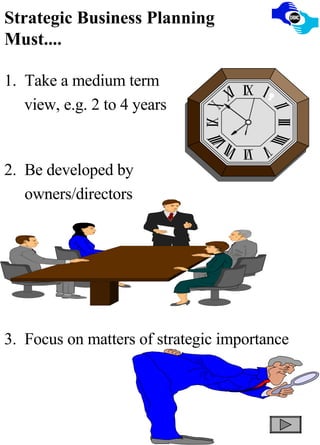
Strategic Business Planning Must.... 1.  Take a medium term    view, e.g. 2 to 4 years 2.  Be developed by  owners/directors   3.  Focus on matters of strategic importance
Business Strategy Planning 4. Be separated from day to day issues 5. Be Realistic, Detached & Critical
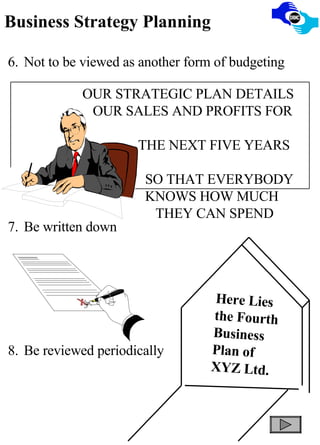
Business Strategy Planning 6. Not to be viewed as another form of budgeting 7. Be written down 8. Be reviewed periodically OUR STRATEGIC PLAN DETAILS OUR SALES AND PROFITS FOR  THE NEXT FIVE YEARS  SO THAT EVERYBODY  KNOWS HOW MUCH  THEY CAN SPEND Here Lies the Fourth Business Plan of XYZ Ltd.
Truisms of Planning BIC Clients should understand Planning is a means and not an end Planning is not a procedure Process is as important as the plan Planning must be done by the client from top down Think strategically and act operationally A plan is a business’s most important  document The plan belongs to the client not to the BIC
Truism of Planning “ In this world nothing is certain except death & taxes” Murphy’s first law: ‘ If anything can go wrong, it will’ Murphy’s fourth law: - if there is a possibility of several things going wrong, the one that will cause the most damage will be the one to go wrong “ If you don’t know where you are going, any road will do”
Strategic Vs Operational Planning Strategic planning is : - Visionary & conceptual - Directional - Broad Operational planning is: - Short-term, tactical &  specific - Action orientated - Focused on Implementation & results
Business Strategy Planning Framework For Planning FORMULATE VISION DEVELOP MISSION SET OBJECTIVES PREPARE STRATEGIES ASSESS INTERNAL STRENGTHS & WEAKNESSES DETERMINE  EXTERNAL THREATS  & OPPORTUNITIES REDEFINE  FUNDAMENTALS & SELECT SPECIFY GOALS PREPARE PROGRAMMES IMPLEMENT PROJECTS
Mission Statements What Business   - Industry   - Activity Products and Services Processes and Technologies Customers, Clients and Users Markets and Segments Channels and Outlets
Take Stock And Redefine REFORMULATE YOUR VISION REVIEW YOUR MISSION REDEFINE YOUR STRATEGIES REVISE YOUR OBJECTIVES BUILD ON STRENGTHS EXPLOIT  OPPORTUNITIES MINIMISE WEAKNESSES AVOID THREATS
Assessing Strengths & Weaknesses Cut through the symptoms and identify internal strengths and weaknesses in the following key areas: Sales/marketing/distribution Product features/range/competitiveness Manufacturing efficiency/capacity Financial position/resources/performance
Assessing Strengths & Weaknesses (cont’d) R&D effort/direction/resources Management resources/expertise Purchasing and materials - sources/supply cost Systems and organisational effectiveness Seek to establish the outstandingly good features, achievements and unique qualities of your proposed company.  Summarise and rank the good/bad points.
Determining Threats & Opportunities Identify critical threats & main opportunities due to: Industry Features Size and segmentation Growth pattern and maturity Established practices Emergence/contraction of niches International Dimension Changes In Market Place Customers Distribution channels Economic factors Social/Demographic/Political
Determining Threats and Opportunities (cont’d) Competitors Identities Performance Likely plans Capacity to make/sell/innovate Market shares Strengths/weaknesses Technology New materials/processes New products/applications Infringement/overlapping by other sectors
Preparing A Business Plan? Why Prepare a Business Plan? Because they are designed to:- Help an entrepreneur clarify, focus and research his project usually over a 3-5 year period Act as a framework within which a business can develop and pursue medium term business strategies Serve as a basis for third party discussions with banks, investors, government and other agencies Provide benchmarks against which actual performance can be assessed
What will the Plan do for BIC Clients ? It Acts as a Map for the Business It Supports Management Control It is a Briefing Document for Key  Staff It Helps Secure Finance
Tips When Preparing a Business Plan Own the Contents Ensure the Plan fits You Be Realistic Be Clear in Your Objectives Be Concise and Clear, Avoid Padding Well Presented, Typed and Bound Remember not everything goes as Planned
The Structure of the Business Plan Executive Summary Background & Description of the Business Management & Organisation Structure Market Research  Marketing and Sales Plan  Operation Plan Financial Plan
Check List Management: Have you clearly stated  how the Business will be  Managed? Market: Have you clearly shown  that there is a market for  your Product or Service? Operations: Have you thought through  the day to day Operational  Issues to make your  Business a Success? Finance: Have you clearly  demonstrated the Financial  viability of the Business?
The Operations Plan Describe the Service or Process Include a Layout Drawing Manufacturing Describe Procedures for Monitoring and  Controling Quality Sources of Raw material, Terms of Trade, possible Vulnerability Employment and Training How Competitors do it
The Financial Plan Financing a Business  Strategy and Raising Finance Types of Project Finance Approaching Sources of Finance Capital Financing Putting a Value on Equity Debt Financing Banks and Debt Financing Grants and Subsidies
The Financial Plan Total Funding & Sources of Funds Three years Cash Flow Forecasts Projected Profit and Loss Accounts Projected Balance Sheets Costing & Pricing details
Management & Organization Structure Current Structure & Organization Organization Charts Key Management Functions Profiles of Promoter & Key Managers Remuneration & Contracts External Professional Advisors
Projections and Assumptions Three year Projections Market Demand & Sales growth Prices & Costs achieved Stocking Levels Creditor & Debtor Days Equipment available, and Lease or Buy Productivity, staff & plant Quality Levels & Yields Research & Development Can Buy Technology
Financing a Business Key Questions What are you trying to do ? What do you estimate it will cost to do it ? Can you or should you finance it yourself ? Business Planning is the Key Activity Matching Plans with Probable Outcomes Reconciling Planned Sales and Expenditures Simulation of Business Process Evaluation of Financing Options Resources Required Cash Required Sources of Cash In-Kind Options
Strategy and Raising Finance Typical Start-Up Problem Lack of Capital A Problem Well Stated ! Objectives in Securing Needed Finance Money . . . What for exactly ? When is it needed ? Where might it come from ? Cost of Finance Interest and Borrowing Degrees of Freedom Dilution of Ownership, Control, and Returns Cost of Capital
Types of Project Finance Capital Equity:  Cash  vs  In Kind Seed / Venture Bank Finance Term Loan Overdraft Commercial Mortgage Grants & Subsidies State Schemes Enterprise Organisation Dublin Business Innovation Centre Others (e.g., First Step) Creditors ?
Capital Financing Promoter’s Money Putting Your Money Where . . . ! Shortage of Cash ! Abundance of In-Kind  ? Investor’s Money Identifying Appropriate Investors Negotiating Mutually-Agreeable Exchange Mechanisms for Offering Returns Equity/Preference Shares/Loans/Options Business Expansion Scheme (BES) Seed/Venture Capital Few Sources Get to Know Evaluation Criteria ? Don’t Expect Quick Fix !
Putting a Value on Equity No Hard and Fast Rules Important to Know . . . Investment to Date - Both Cash and In-Kind Development Investment Required Realistic Evaluation of Cash Needs and Scheduling Realistic Estimation of Profits and Returns on Equity Balancing . . . Resourcing the Business Retaining Ownership Retaining Control Realising Immediate vs Future Value Attracting / Retaining Critical Skills Developing Strategic Alliances
Getting Over Financing Obstacles Be Practical and Realistic About What you Need Be Careful in Justifying Figures Be Vigorous in Validating Your Assessments Be Creative About Options and Sources Be Considerate of What Others Require of You Be as Persistant as You Need Be Be Always Conscious   of What YOU Need and Want
Effective Business and Financial Planning are  critical functions for  BICs This presentation and other relevant information can be downloaded at www.dbic.ie Conclusion

Rome

  • 1.
    First EBN SpringUniversity April 1999 Business and Financial Planning Principles-Methods-Software DESMOND RYAN Dublin Business Innovation Centre IDA Enterprise Centre, The Tower, Pearse Street, Dublin 2, Ireland. Tel No: +353-1-671 3111 Fax No: +353-1-671 3330 E-Mail: desryan@dbic.ie WWW: www.dbic.ie
  • 2.
    Presentation Objectives ToProvide an Overview of Strategic Planning To Relate Strategic Planning to Business Planning To Relate the Business Plan to Financial Planning To Show how Software will assist BIC Executives Theme of today's presentations Basics of BIC Management
  • 3.
    The essence ofa BIC Business Planning Access to Funds Incubation Space BIC Deliverables
  • 4.
    “ Plans AreNothing Planning is Everything” Dwight D. Eisenhower BICs must help clients to plan effectively Business Strategy Planning
  • 5.
    Truisms of planningFramework for planning Strategic v operational plans Mission statements Developing strategies Setting long-term objectives Assessing strengths & weaknesses Determining threats & opportunities Implementation The Business Plan Why BIC Clients Need Strategic Planning?
  • 6.
    Provides a frameworkfor management Used to communicate about the company Serves as a monitor Strategic Business Plans are important BIC deliverables Why Do Strategic Planning?
  • 7.
    Strategic Business PlanningMust.... 1. Take a medium term view, e.g. 2 to 4 years 2. Be developed by owners/directors 3. Focus on matters of strategic importance
  • 8.
    Business Strategy Planning4. Be separated from day to day issues 5. Be Realistic, Detached & Critical
  • 9.
    Business Strategy Planning6. Not to be viewed as another form of budgeting 7. Be written down 8. Be reviewed periodically OUR STRATEGIC PLAN DETAILS OUR SALES AND PROFITS FOR THE NEXT FIVE YEARS SO THAT EVERYBODY KNOWS HOW MUCH THEY CAN SPEND Here Lies the Fourth Business Plan of XYZ Ltd.
  • 10.
    Truisms of PlanningBIC Clients should understand Planning is a means and not an end Planning is not a procedure Process is as important as the plan Planning must be done by the client from top down Think strategically and act operationally A plan is a business’s most important document The plan belongs to the client not to the BIC
  • 11.
    Truism of Planning“ In this world nothing is certain except death & taxes” Murphy’s first law: ‘ If anything can go wrong, it will’ Murphy’s fourth law: - if there is a possibility of several things going wrong, the one that will cause the most damage will be the one to go wrong “ If you don’t know where you are going, any road will do”
  • 12.
    Strategic Vs OperationalPlanning Strategic planning is : - Visionary & conceptual - Directional - Broad Operational planning is: - Short-term, tactical & specific - Action orientated - Focused on Implementation & results
  • 13.
    Business Strategy PlanningFramework For Planning FORMULATE VISION DEVELOP MISSION SET OBJECTIVES PREPARE STRATEGIES ASSESS INTERNAL STRENGTHS & WEAKNESSES DETERMINE EXTERNAL THREATS & OPPORTUNITIES REDEFINE FUNDAMENTALS & SELECT SPECIFY GOALS PREPARE PROGRAMMES IMPLEMENT PROJECTS
  • 14.
    Mission Statements WhatBusiness - Industry - Activity Products and Services Processes and Technologies Customers, Clients and Users Markets and Segments Channels and Outlets
  • 15.
    Take Stock AndRedefine REFORMULATE YOUR VISION REVIEW YOUR MISSION REDEFINE YOUR STRATEGIES REVISE YOUR OBJECTIVES BUILD ON STRENGTHS EXPLOIT OPPORTUNITIES MINIMISE WEAKNESSES AVOID THREATS
  • 16.
    Assessing Strengths &Weaknesses Cut through the symptoms and identify internal strengths and weaknesses in the following key areas: Sales/marketing/distribution Product features/range/competitiveness Manufacturing efficiency/capacity Financial position/resources/performance
  • 17.
    Assessing Strengths &Weaknesses (cont’d) R&D effort/direction/resources Management resources/expertise Purchasing and materials - sources/supply cost Systems and organisational effectiveness Seek to establish the outstandingly good features, achievements and unique qualities of your proposed company. Summarise and rank the good/bad points.
  • 18.
    Determining Threats &Opportunities Identify critical threats & main opportunities due to: Industry Features Size and segmentation Growth pattern and maturity Established practices Emergence/contraction of niches International Dimension Changes In Market Place Customers Distribution channels Economic factors Social/Demographic/Political
  • 19.
    Determining Threats andOpportunities (cont’d) Competitors Identities Performance Likely plans Capacity to make/sell/innovate Market shares Strengths/weaknesses Technology New materials/processes New products/applications Infringement/overlapping by other sectors
  • 20.
    Preparing A BusinessPlan? Why Prepare a Business Plan? Because they are designed to:- Help an entrepreneur clarify, focus and research his project usually over a 3-5 year period Act as a framework within which a business can develop and pursue medium term business strategies Serve as a basis for third party discussions with banks, investors, government and other agencies Provide benchmarks against which actual performance can be assessed
  • 21.
    What will thePlan do for BIC Clients ? It Acts as a Map for the Business It Supports Management Control It is a Briefing Document for Key Staff It Helps Secure Finance
  • 22.
    Tips When Preparinga Business Plan Own the Contents Ensure the Plan fits You Be Realistic Be Clear in Your Objectives Be Concise and Clear, Avoid Padding Well Presented, Typed and Bound Remember not everything goes as Planned
  • 23.
    The Structure ofthe Business Plan Executive Summary Background & Description of the Business Management & Organisation Structure Market Research Marketing and Sales Plan Operation Plan Financial Plan
  • 24.
    Check List Management:Have you clearly stated how the Business will be Managed? Market: Have you clearly shown that there is a market for your Product or Service? Operations: Have you thought through the day to day Operational Issues to make your Business a Success? Finance: Have you clearly demonstrated the Financial viability of the Business?
  • 25.
    The Operations PlanDescribe the Service or Process Include a Layout Drawing Manufacturing Describe Procedures for Monitoring and Controling Quality Sources of Raw material, Terms of Trade, possible Vulnerability Employment and Training How Competitors do it
  • 26.
    The Financial PlanFinancing a Business Strategy and Raising Finance Types of Project Finance Approaching Sources of Finance Capital Financing Putting a Value on Equity Debt Financing Banks and Debt Financing Grants and Subsidies
  • 27.
    The Financial PlanTotal Funding & Sources of Funds Three years Cash Flow Forecasts Projected Profit and Loss Accounts Projected Balance Sheets Costing & Pricing details
  • 28.
    Management & OrganizationStructure Current Structure & Organization Organization Charts Key Management Functions Profiles of Promoter & Key Managers Remuneration & Contracts External Professional Advisors
  • 29.
    Projections and AssumptionsThree year Projections Market Demand & Sales growth Prices & Costs achieved Stocking Levels Creditor & Debtor Days Equipment available, and Lease or Buy Productivity, staff & plant Quality Levels & Yields Research & Development Can Buy Technology
  • 30.
    Financing a BusinessKey Questions What are you trying to do ? What do you estimate it will cost to do it ? Can you or should you finance it yourself ? Business Planning is the Key Activity Matching Plans with Probable Outcomes Reconciling Planned Sales and Expenditures Simulation of Business Process Evaluation of Financing Options Resources Required Cash Required Sources of Cash In-Kind Options
  • 31.
    Strategy and RaisingFinance Typical Start-Up Problem Lack of Capital A Problem Well Stated ! Objectives in Securing Needed Finance Money . . . What for exactly ? When is it needed ? Where might it come from ? Cost of Finance Interest and Borrowing Degrees of Freedom Dilution of Ownership, Control, and Returns Cost of Capital
  • 32.
    Types of ProjectFinance Capital Equity: Cash vs In Kind Seed / Venture Bank Finance Term Loan Overdraft Commercial Mortgage Grants & Subsidies State Schemes Enterprise Organisation Dublin Business Innovation Centre Others (e.g., First Step) Creditors ?
  • 33.
    Capital Financing Promoter’sMoney Putting Your Money Where . . . ! Shortage of Cash ! Abundance of In-Kind ? Investor’s Money Identifying Appropriate Investors Negotiating Mutually-Agreeable Exchange Mechanisms for Offering Returns Equity/Preference Shares/Loans/Options Business Expansion Scheme (BES) Seed/Venture Capital Few Sources Get to Know Evaluation Criteria ? Don’t Expect Quick Fix !
  • 34.
    Putting a Valueon Equity No Hard and Fast Rules Important to Know . . . Investment to Date - Both Cash and In-Kind Development Investment Required Realistic Evaluation of Cash Needs and Scheduling Realistic Estimation of Profits and Returns on Equity Balancing . . . Resourcing the Business Retaining Ownership Retaining Control Realising Immediate vs Future Value Attracting / Retaining Critical Skills Developing Strategic Alliances
  • 35.
    Getting Over FinancingObstacles Be Practical and Realistic About What you Need Be Careful in Justifying Figures Be Vigorous in Validating Your Assessments Be Creative About Options and Sources Be Considerate of What Others Require of You Be as Persistant as You Need Be Be Always Conscious of What YOU Need and Want
  • 36.
    Effective Business andFinancial Planning are critical functions for BICs This presentation and other relevant information can be downloaded at www.dbic.ie Conclusion