Company
An
introduction
What is a company?
 Section 3(1)(i) of the companies act
1956 defines a company as “ a
company formed and registered under
this act or an existing company”.
 ‘Existing Company’ means a company
formed and registered under any of
the earlier company laws.
In broad sense
 A voluntary association of persons who
have come together for carrying on some
business and sharing the profits
therefrom.
 Chief Justice Marshall’s definition of a
company : as a person, artificial,
invisible, intangible, and existing only in
the eyes of the law. Being a mere
creation of law, it possesses only those
properties which the charter of its
creation confers upon it either expressly
or as accidental to its very existence.”
A characteristic view
 A company can be defined as an
"artificial person", invisible, intangible,
created by or under Law, with a
discrete legal entity, perpetual
succession and a common seal. It is
not affected by the death, insanity
or insolvency of an individual member.
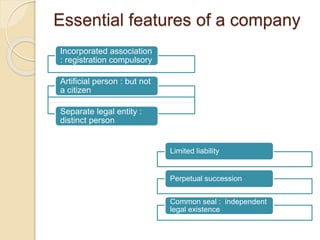
Essential features of a company
Incorporated association
: registration compulsory
Artificial person : but not
a citizen
Separate legal entity :
distinct person
Limited liability
Perpetual succession
Common seal : independent
legal existence
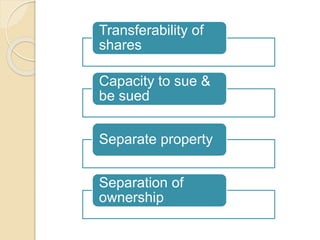
Transferability of
shares
Capacity to sue &
be sued
Separate property
Separation of
ownership
Some case laws
 Salomon v A Salomon & Co
Ltd [1897] AC 22 is a landmark UK
company law case. The effect of the
Lords' unanimous ruling was to uphold
firmly the doctrine of corporate
personality, as set out in
the Companies Act 1862, so that
creditors of an insolvent company
could not sue the company's
shareholders to pay up outstanding
debts.
 Macaura v Northern Assurance Co Ltd [1925] AC
619 appeared before the House Of
Lords concerning the principle of lifting the corporate
veil.
 Mr Macaura owned the Killymoon estate in County
Tyrone, Northern Ireland. He sold the timber there to
Irish Canadian Sawmills Ltd for 42,000 fully paid up £1
shares, making him the whole owner (with nominees).
Mr Macaura was also an unsecured creditor for
£19,000. He got insurance policies - but in his own
name, not the company's - with Northern Assurance
covering for fire. Two weeks later, there was a fire.
Northern Assurance refused to pay up because the
timber was owned by the company, and that because
the company was a separate legal entity, it did not
need to pay Mr Macaura any money.
Types of companies
 Royal charter/ chartered companies.
 Statutory companies.
 Registered companies.
 Under the act, the companies are :
 Company limited by shares.
 Company limited by guarantee.
 Unlimited companies.
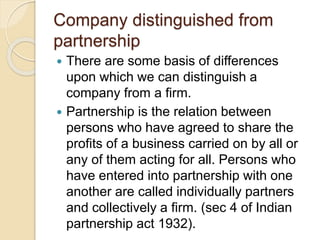
Company distinguished from
partnership
 There are some basis of differences
upon which we can distinguish a
company from a firm.
 Partnership is the relation between
persons who have agreed to share the
profits of a business carried on by all or
any of them acting for all. Persons who
have entered into partnership with one
another are called individually partners
and collectively a firm. (sec 4 of Indian
partnership act 1932).
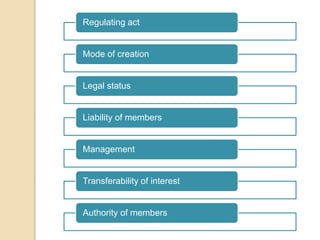
Regulating act
Mode of creation
Legal status
Liability of members
Management
Transferability of interest
Authority of members
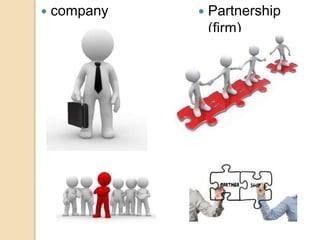
 company  Partnership
(firm)
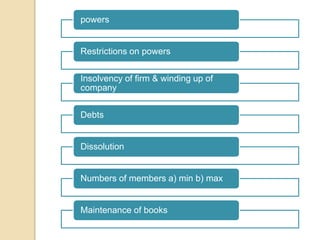
powers
Restrictions on powers
Insolvency of firm & winding up of
company
Debts
Dissolution
Numbers of members a) min b) max
Maintenance of books
Thank you!

Company

  • 1.
  • 2.
    What is acompany?  Section 3(1)(i) of the companies act 1956 defines a company as “ a company formed and registered under this act or an existing company”.  ‘Existing Company’ means a company formed and registered under any of the earlier company laws.
  • 3.
    In broad sense A voluntary association of persons who have come together for carrying on some business and sharing the profits therefrom.  Chief Justice Marshall’s definition of a company : as a person, artificial, invisible, intangible, and existing only in the eyes of the law. Being a mere creation of law, it possesses only those properties which the charter of its creation confers upon it either expressly or as accidental to its very existence.”
  • 4.
    A characteristic view A company can be defined as an "artificial person", invisible, intangible, created by or under Law, with a discrete legal entity, perpetual succession and a common seal. It is not affected by the death, insanity or insolvency of an individual member.
  • 5.
    Essential features ofa company Incorporated association : registration compulsory Artificial person : but not a citizen Separate legal entity : distinct person Limited liability Perpetual succession Common seal : independent legal existence
  • 6.
    Transferability of shares Capacity tosue & be sued Separate property Separation of ownership
  • 7.
    Some case laws Salomon v A Salomon & Co Ltd [1897] AC 22 is a landmark UK company law case. The effect of the Lords' unanimous ruling was to uphold firmly the doctrine of corporate personality, as set out in the Companies Act 1862, so that creditors of an insolvent company could not sue the company's shareholders to pay up outstanding debts.
  • 8.
     Macaura vNorthern Assurance Co Ltd [1925] AC 619 appeared before the House Of Lords concerning the principle of lifting the corporate veil.  Mr Macaura owned the Killymoon estate in County Tyrone, Northern Ireland. He sold the timber there to Irish Canadian Sawmills Ltd for 42,000 fully paid up £1 shares, making him the whole owner (with nominees). Mr Macaura was also an unsecured creditor for £19,000. He got insurance policies - but in his own name, not the company's - with Northern Assurance covering for fire. Two weeks later, there was a fire. Northern Assurance refused to pay up because the timber was owned by the company, and that because the company was a separate legal entity, it did not need to pay Mr Macaura any money.
  • 9.
    Types of companies Royal charter/ chartered companies.  Statutory companies.  Registered companies.  Under the act, the companies are :  Company limited by shares.  Company limited by guarantee.  Unlimited companies.
  • 10.
    Company distinguished from partnership There are some basis of differences upon which we can distinguish a company from a firm.  Partnership is the relation between persons who have agreed to share the profits of a business carried on by all or any of them acting for all. Persons who have entered into partnership with one another are called individually partners and collectively a firm. (sec 4 of Indian partnership act 1932).
  • 11.
    Regulating act Mode ofcreation Legal status Liability of members Management Transferability of interest Authority of members
  • 12.
     company Partnership (firm)
  • 13.
    powers Restrictions on powers Insolvencyof firm & winding up of company Debts Dissolution Numbers of members a) min b) max Maintenance of books
  • 14.