


AMITY BUSINESS
SCHOOL
PRESENTED BY:
SAKSHI TIWARI
MBA (GEN)
NATIONAL
INCOME
NATIONAL INCOME ACCOUNTING
INTRODUCTION
National income accounting provides us with ex-post data about national
income, it cannot explain the level and determinants of national income.
The following identities are true for any level of income. In order to
explain and predict the level of national income, models are constructed.
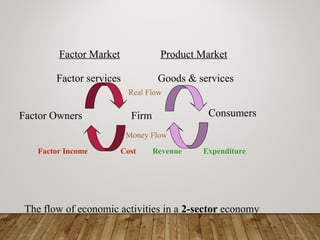
Firm ConsumersFactor Owners
Factor Market Product Market
Factor services Goods & services
ExpenditureRevenueCostFactor Income
Real Flow
Money Flow
The flow of economic activities in a 2-sector economy
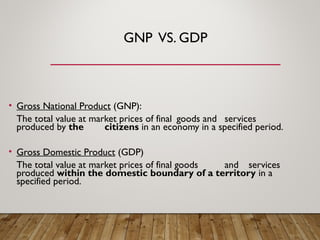
GNP VS. GDP
• Gross National Product (GNP):
The total value at market prices of final goods and services
produced by the citizens in an economy in a specified period.
• Gross Domestic Product (GDP)
The total value at market prices of final goods and services
produced within the domestic boundary of a territory in a
specified period.
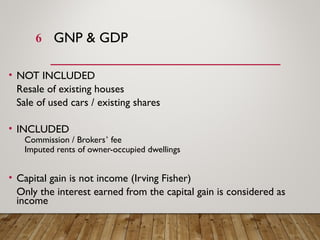
GNP & GDP
• NOT INCLUDED
Resale of existing houses
Sale of used cars / existing shares
• INCLUDED
Commission / Brokers’ fee
Imputed rents of owner-occupied dwellings
• Capital gain is not income (Irving Fisher)
Only the interest earned from the capital gain is considered as
income
6
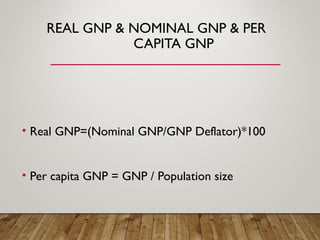
REAL GNP & NOMINAL GNP & PER
CAPITA GNP
• Real GNP=(Nominal GNP/GNP Deflator)*100
• Per capita GNP = GNP / Population size
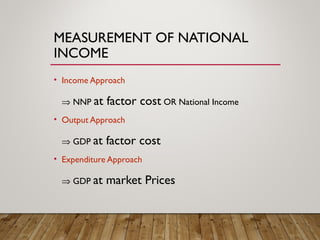
MEASUREMENT OF NATIONAL
INCOME
• Income Approach
⇒ NNP at factor cost OR National Income
• Output Approach
⇒ GDP at factor cost
• Expenditure Approach
⇒ GDP at market Prices
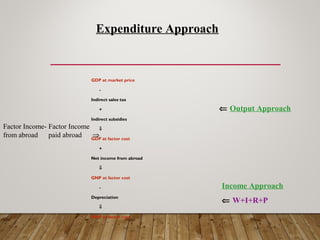
GDP at market price
-
Indirect sales tax
+
Indirect subsidies
⇓
GDP at factor cost
+
Net income from abroad
⇓
GNP at factor cost
-
Depreciation
⇓
NNP at factor cost
Expenditure Approach
Income Approach
⇐ W+I+R+P
⇐ Output Approach
Factor Income-
from abroad
Factor Income
paid abroad ⇒
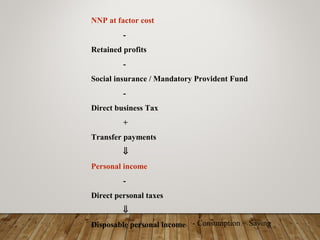
NNP at factor cost
-
Retained profits
-
Social insurance / Mandatory Provident Fund
-
Direct business Tax
+
Transfer payments
⇓
Personal income
-
Direct personal taxes
⇓
Disposable personal income - Consumption = Saving
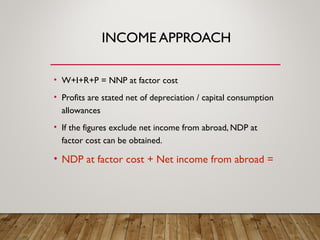
INCOME APPROACH
• W+I+R+P = NNP at factor cost
• Profits are stated net of depreciation / capital consumption
allowances
• If the figures exclude net income from abroad, NDP at
factor cost can be obtained.
• NDP at factor cost + Net income from abroad =
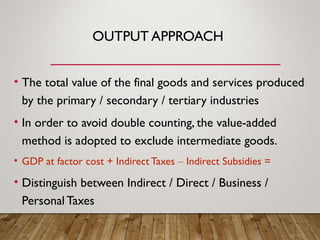
OUTPUT APPROACH
• The total value of the final goods and services produced
by the primary / secondary / tertiary industries
• In order to avoid double counting, the value-added
method is adopted to exclude intermediate goods.
• GDP at factor cost + Indirect Taxes – Indirect Subsidies =
• Distinguish between Indirect / Direct / Business /
Personal Taxes
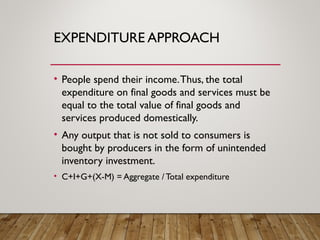
EXPENDITURE APPROACH
• People spend their income.Thus, the total
expenditure on final goods and services must be
equal to the total value of final goods and
services produced domestically.
• Any output that is not sold to consumers is
bought by producers in the form of unintended
inventory investment.
• C+I+G+(X-M) = Aggregate / Total expenditure
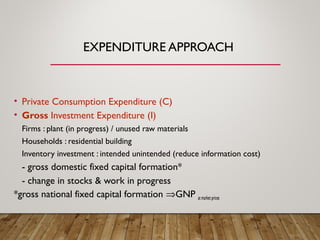
EXPENDITURE APPROACH
• Private Consumption Expenditure (C)
• Gross Investment Expenditure (I)
Firms : plant (in progress) / unused raw materials
Households : residential building
Inventory investment : intended unintended (reduce information cost)
- gross domestic fixed capital formation*
- change in stocks & work in progress
*gross national fixed capital formation ⇒GNP at market prices
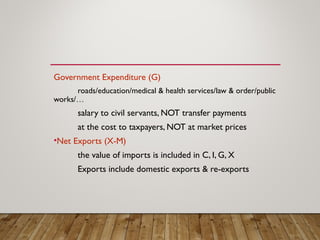
Government Expenditure (G)
roads/education/medical & health services/law & order/public
works/…
salary to civil servants, NOT transfer payments
at the cost to taxpayers, NOT at market prices
•Net Exports (X-M)
the value of imports is included in C, I, G, X
Exports include domestic exports & re-exports
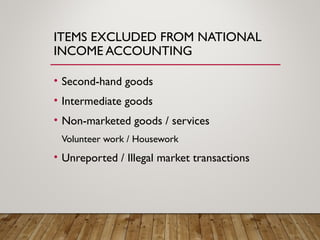
ITEMS EXCLUDED FROM NATIONAL
INCOME ACCOUNTING
• Second-hand goods
• Intermediate goods
• Non-marketed goods / services
Volunteer work / Housework
• Unreported / Illegal market transactions
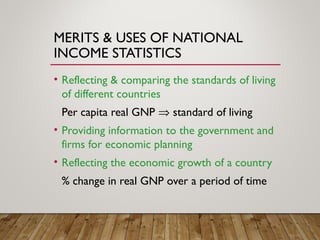
MERITS & USES OF NATIONAL
INCOME STATISTICS
• Reflecting & comparing the standards of living
of different countries
Per capita real GNP ⇒ standard of living
• Providing information to the government and
firms for economic planning
• Reflecting the economic growth of a country
% change in real GNP over a period of time
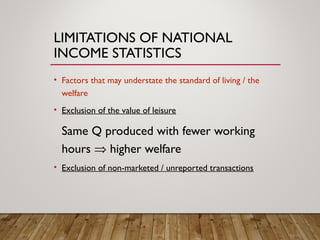
LIMITATIONS OF NATIONAL
INCOME STATISTICS
• Factors that may understate the standard of living / the
welfare
• Exclusion of the value of leisure
Same Q produced with fewer working
hours ⇒ higher welfare
• Exclusion of non-marketed / unreported transactions
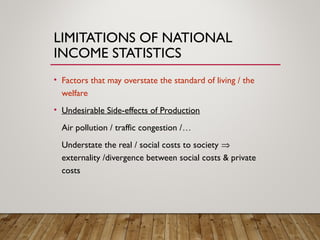
LIMITATIONS OF NATIONAL
INCOME STATISTICS
• Factors that may overstate the standard of living / the
welfare
• Undesirable Side-effects of Production
Air pollution / traffic congestion /…
Understate the real / social costs to society ⇒
externality /divergence between social costs & private
costs
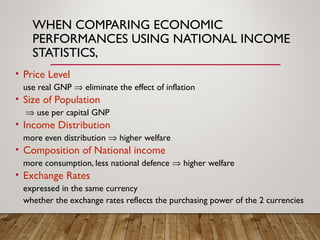
WHEN COMPARING ECONOMIC
PERFORMANCES USING NATIONAL INCOME
STATISTICS,
• Price Level
use real GNP ⇒ eliminate the effect of inflation
• Size of Population
⇒ use per capital GNP
• Income Distribution
more even distribution ⇒ higher welfare
• Composition of National income
more consumption, less national defence ⇒ higher welfare
• Exchange Rates
expressed in the same currency
whether the exchange rates reflects the purchasing power of the 2 currencies

NATIONAL INCOME COMPUTATION

  • 1.
  • 2.
  • 3.
    INTRODUCTION National income accountingprovides us with ex-post data about national income, it cannot explain the level and determinants of national income. The following identities are true for any level of income. In order to explain and predict the level of national income, models are constructed.
  • 4.
    Firm ConsumersFactor Owners FactorMarket Product Market Factor services Goods & services ExpenditureRevenueCostFactor Income Real Flow Money Flow The flow of economic activities in a 2-sector economy
  • 5.
    GNP VS. GDP •Gross National Product (GNP): The total value at market prices of final goods and services produced by the citizens in an economy in a specified period. • Gross Domestic Product (GDP) The total value at market prices of final goods and services produced within the domestic boundary of a territory in a specified period.
  • 6.
    GNP & GDP •NOT INCLUDED Resale of existing houses Sale of used cars / existing shares • INCLUDED Commission / Brokers’ fee Imputed rents of owner-occupied dwellings • Capital gain is not income (Irving Fisher) Only the interest earned from the capital gain is considered as income 6
  • 7.
    REAL GNP &NOMINAL GNP & PER CAPITA GNP • Real GNP=(Nominal GNP/GNP Deflator)*100 • Per capita GNP = GNP / Population size
  • 8.
    MEASUREMENT OF NATIONAL INCOME •Income Approach ⇒ NNP at factor cost OR National Income • Output Approach ⇒ GDP at factor cost • Expenditure Approach ⇒ GDP at market Prices
  • 9.
    GDP at marketprice - Indirect sales tax + Indirect subsidies ⇓ GDP at factor cost + Net income from abroad ⇓ GNP at factor cost - Depreciation ⇓ NNP at factor cost Expenditure Approach Income Approach ⇐ W+I+R+P ⇐ Output Approach Factor Income- from abroad Factor Income paid abroad ⇒
  • 10.
    NNP at factorcost - Retained profits - Social insurance / Mandatory Provident Fund - Direct business Tax + Transfer payments ⇓ Personal income - Direct personal taxes ⇓ Disposable personal income - Consumption = Saving
  • 11.
    INCOME APPROACH • W+I+R+P= NNP at factor cost • Profits are stated net of depreciation / capital consumption allowances • If the figures exclude net income from abroad, NDP at factor cost can be obtained. • NDP at factor cost + Net income from abroad =
  • 12.
    OUTPUT APPROACH • Thetotal value of the final goods and services produced by the primary / secondary / tertiary industries • In order to avoid double counting, the value-added method is adopted to exclude intermediate goods. • GDP at factor cost + Indirect Taxes – Indirect Subsidies = • Distinguish between Indirect / Direct / Business / Personal Taxes
  • 13.
    EXPENDITURE APPROACH • Peoplespend their income.Thus, the total expenditure on final goods and services must be equal to the total value of final goods and services produced domestically. • Any output that is not sold to consumers is bought by producers in the form of unintended inventory investment. • C+I+G+(X-M) = Aggregate / Total expenditure
  • 14.
    EXPENDITURE APPROACH • PrivateConsumption Expenditure (C) • Gross Investment Expenditure (I) Firms : plant (in progress) / unused raw materials Households : residential building Inventory investment : intended unintended (reduce information cost) - gross domestic fixed capital formation* - change in stocks & work in progress *gross national fixed capital formation ⇒GNP at market prices
  • 15.
    Government Expenditure (G) roads/education/medical& health services/law & order/public works/… salary to civil servants, NOT transfer payments at the cost to taxpayers, NOT at market prices •Net Exports (X-M) the value of imports is included in C, I, G, X Exports include domestic exports & re-exports
  • 16.
    ITEMS EXCLUDED FROMNATIONAL INCOME ACCOUNTING • Second-hand goods • Intermediate goods • Non-marketed goods / services Volunteer work / Housework • Unreported / Illegal market transactions
  • 17.
    MERITS & USESOF NATIONAL INCOME STATISTICS • Reflecting & comparing the standards of living of different countries Per capita real GNP ⇒ standard of living • Providing information to the government and firms for economic planning • Reflecting the economic growth of a country % change in real GNP over a period of time
  • 18.
    LIMITATIONS OF NATIONAL INCOMESTATISTICS • Factors that may understate the standard of living / the welfare • Exclusion of the value of leisure Same Q produced with fewer working hours ⇒ higher welfare • Exclusion of non-marketed / unreported transactions
  • 19.
    LIMITATIONS OF NATIONAL INCOMESTATISTICS • Factors that may overstate the standard of living / the welfare • Undesirable Side-effects of Production Air pollution / traffic congestion /… Understate the real / social costs to society ⇒ externality /divergence between social costs & private costs
  • 20.
    WHEN COMPARING ECONOMIC PERFORMANCESUSING NATIONAL INCOME STATISTICS, • Price Level use real GNP ⇒ eliminate the effect of inflation • Size of Population ⇒ use per capital GNP • Income Distribution more even distribution ⇒ higher welfare • Composition of National income more consumption, less national defence ⇒ higher welfare • Exchange Rates expressed in the same currency whether the exchange rates reflects the purchasing power of the 2 currencies