Incentive plan provides incentives to workers to
produce more and are paid bonus or premium for
additional work. This additional payment is called
incentive wages. It offers an attraction of extra
payment for efficiency or more production. The
basic objective of any incentive plan is to increase
the production by giving an inducement to workers
in the form of higher wages.
INDIVIDUAL INCENTIVE PLANS
GROUP INCENTIVE PLAN
Individual incentive plans may be either time based
or production based. Under time based incentive
plans, a standard time is determined for doing a job.
under the production based incentive plans, a
standard of output is determined on scientific basis,
and payment of wages is made on the basis of
number of units produced by a worker.
Where it is impossible to relate output to an individual
employee’s effort it may be possible to relate it to the
efforts of the work group. If in addition, cooperation is
required to produce the desired output, then a group
incentive plan may be the best alternative. A group
incentive plan can reward things that are very different
from what an individual plan rewards, in particular :
cooperation, teamwork, and coordination of activities
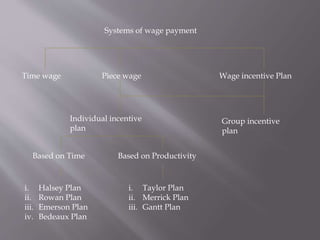
Systems of wage payment
Time wage Piece wage Wage incentive Plan
Individual incentive
plan
Group incentive
plan
Based on Time Based on Productivity
i. Halsey Plan
ii. Rowan Plan
iii. Emerson Plan
iv. Bedeaux Plan
i. Taylor Plan
ii. Merrick Plan
iii. Gantt Plan
Under this plan,
 a minimum time wage is guaranteed to every worker.
 A standard time is fixed for the completion of a job.
 If a worker performs his job in less than the standard
time, he is given bonus. But there is no penalty for
performing the job in more than the standard time fixed.
 The slow worker is paid the time wages and the
efficient worker is paid some bonus in addition to the
time wages.
 In Halsey plan, bonus is paid to a worker is
equal to 50 per cent of time saved multiplied by rate per
hour.
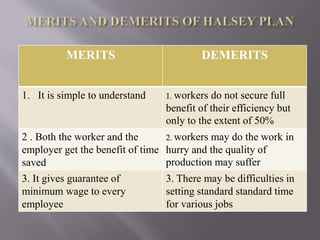
MERITS DEMERITS
1. It is simple to understand 1. workers do not secure full
benefit of their efficiency but
only to the extent of 50%
2 . Both the worker and the
employer get the benefit of time
saved
2. workers may do the work in
hurry and the quality of
production may suffer
3. It gives guarantee of
minimum wage to every
employee
3. There may be difficulties in
setting standard standard time
for various jobs
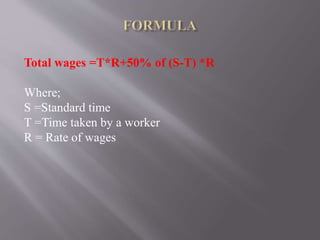
Total wages =T*R+50% of (S-T) *R
Where;
S =Standard time
T =Time taken by a worker
R = Rate of wages
The Rowan plan is a modification of the Halsey
plan. It also guarantees the minimum time wages and
does not penalize a slow worker. A standard time is
fixed for the completion of a job and bonus is paid to
a worker on the basis of time saved. Here efficiency
is measured as,
Efficiency = time saved/ standard time
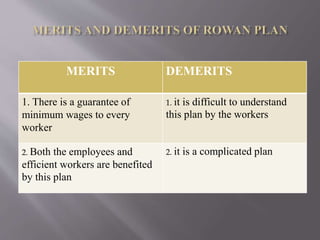
MERITS DEMERITS
1. There is a guarantee of
minimum wages to every
worker
1. it is difficult to understand
this plan by the workers
2. Both the employees and
efficient workers are benefited
by this plan
2. it is a complicated plan
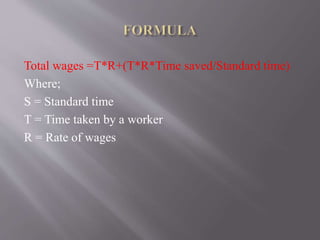
Total wages =T*R+(T*R*Time saved/Standard time)
Where;
S = Standard time
T = Time taken by a worker
R = Rate of wages
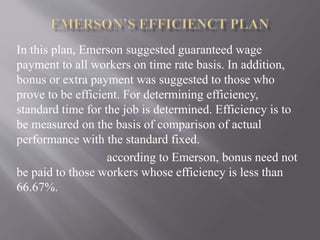
In this plan, Emerson suggested guaranteed wage
payment to all workers on time rate basis. In addition,
bonus or extra payment was suggested to those who
prove to be efficient. For determining efficiency,
standard time for the job is determined. Efficiency is to
be measured on the basis of comparison of actual
performance with the standard fixed.
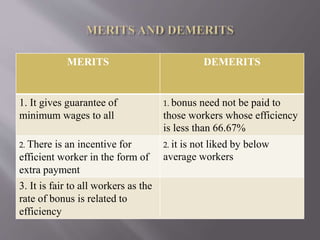
according to Emerson, bonus need not
be paid to those workers whose efficiency is less than
66.67%.
MERITS DEMERITS
1. It gives guarantee of
minimum wages to all
1. bonus need not be paid to
those workers whose efficiency
is less than 66.67%
2. There is an incentive for
efficient worker in the form of
extra payment
2. it is not liked by below
average workers
3. It is fair to all workers as the
rate of bonus is related to
efficiency
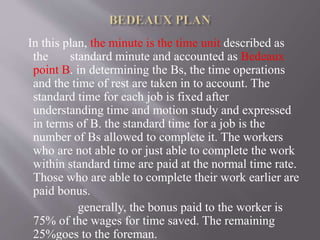
In this plan, the minute is the time unit described as
the standard minute and accounted as Bedeaux
point B. in determining the Bs, the time operations
and the time of rest are taken in to account. The
standard time for each job is fixed after
understanding time and motion study and expressed
in terms of B. the standard time for a job is the
number of Bs allowed to complete it. The workers
who are not able to or just able to complete the work
within standard time are paid at the normal time rate.
Those who are able to complete their work earlier are
paid bonus.
generally, the bonus paid to the worker is
75% of the wages for time saved. The remaining
25%goes to the foreman.
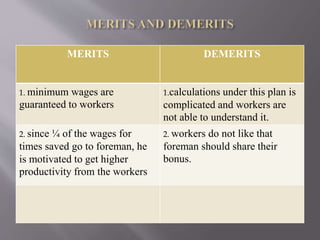
MERITS DEMERITS
1. minimum wages are
guaranteed to workers
1.calculations under this plan is
complicated and workers are
not able to understand it.
2. since ¼ of the wages for
times saved go to foreman, he
is motivated to get higher
productivity from the workers
2. workers do not like that
foreman should share their
bonus.
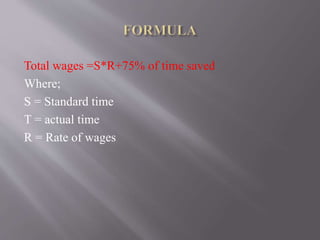
Total wages =S*R+75% of time saved
Where;
S = Standard time
T = actual time
R = Rate of wages
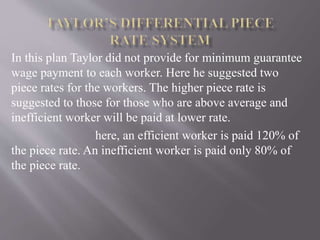
In this plan Taylor did not provide for minimum guarantee
wage payment to each worker. Here he suggested two
piece rates for the workers. The higher piece rate is
suggested to those for those who are above average and
inefficient worker will be paid at lower rate.
here, an efficient worker is paid 120% of
the piece rate. An inefficient worker is paid only 80% of
the piece rate.
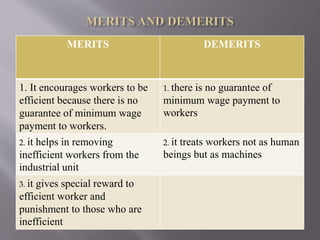
MERITS DEMERITS
1. It encourages workers to be
efficient because there is no
guarantee of minimum wage
payment to workers.
1. there is no guarantee of
minimum wage payment to
workers
2. it helps in removing
inefficient workers from the
industrial unit
2. it treats workers not as human
beings but as machines
3. it gives special reward to
efficient worker and
punishment to those who are
inefficient
This plan offers three grade piece rates rather than
two offered by the Taylors plan. The workers who
produce less than 83% of standard output are paid at
a basic piece rate. Those producing from 83% to
100% of the standard output are paid 110% of the
basic piece rate. The workers producing more than
110%of standard output are paid 120% of basic piece
rate. This system also does not guarantee minimum
wages for the workers.
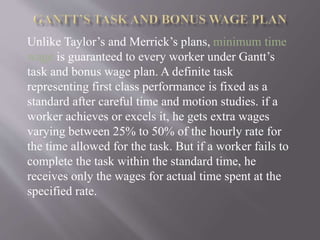
Unlike Taylor’s and Merrick’s plans, minimum time
wage is guaranteed to every worker under Gantt’s
task and bonus wage plan. A definite task
representing first class performance is fixed as a
standard after careful time and motion studies. if a
worker achieves or excels it, he gets extra wages
varying between 25% to 50% of the hourly rate for
the time allowed for the task. But if a worker fails to
complete the task within the standard time, he
receives only the wages for actual time spent at the
specified rate.
 Incentives plans in compensation

Incentives plans in compensation

  • 2.
    Incentive plan providesincentives to workers to produce more and are paid bonus or premium for additional work. This additional payment is called incentive wages. It offers an attraction of extra payment for efficiency or more production. The basic objective of any incentive plan is to increase the production by giving an inducement to workers in the form of higher wages.
  • 3.
  • 4.
    Individual incentive plansmay be either time based or production based. Under time based incentive plans, a standard time is determined for doing a job. under the production based incentive plans, a standard of output is determined on scientific basis, and payment of wages is made on the basis of number of units produced by a worker.
  • 5.
    Where it isimpossible to relate output to an individual employee’s effort it may be possible to relate it to the efforts of the work group. If in addition, cooperation is required to produce the desired output, then a group incentive plan may be the best alternative. A group incentive plan can reward things that are very different from what an individual plan rewards, in particular : cooperation, teamwork, and coordination of activities
  • 6.
    Systems of wagepayment Time wage Piece wage Wage incentive Plan Individual incentive plan Group incentive plan Based on Time Based on Productivity i. Halsey Plan ii. Rowan Plan iii. Emerson Plan iv. Bedeaux Plan i. Taylor Plan ii. Merrick Plan iii. Gantt Plan
  • 7.
    Under this plan, a minimum time wage is guaranteed to every worker.  A standard time is fixed for the completion of a job.  If a worker performs his job in less than the standard time, he is given bonus. But there is no penalty for performing the job in more than the standard time fixed.  The slow worker is paid the time wages and the efficient worker is paid some bonus in addition to the time wages.  In Halsey plan, bonus is paid to a worker is equal to 50 per cent of time saved multiplied by rate per hour.
  • 8.
    MERITS DEMERITS 1. Itis simple to understand 1. workers do not secure full benefit of their efficiency but only to the extent of 50% 2 . Both the worker and the employer get the benefit of time saved 2. workers may do the work in hurry and the quality of production may suffer 3. It gives guarantee of minimum wage to every employee 3. There may be difficulties in setting standard standard time for various jobs
  • 9.
    Total wages =T*R+50%of (S-T) *R Where; S =Standard time T =Time taken by a worker R = Rate of wages
  • 10.
    The Rowan planis a modification of the Halsey plan. It also guarantees the minimum time wages and does not penalize a slow worker. A standard time is fixed for the completion of a job and bonus is paid to a worker on the basis of time saved. Here efficiency is measured as, Efficiency = time saved/ standard time
  • 11.
    MERITS DEMERITS 1. Thereis a guarantee of minimum wages to every worker 1. it is difficult to understand this plan by the workers 2. Both the employees and efficient workers are benefited by this plan 2. it is a complicated plan
  • 12.
    Total wages =T*R+(T*R*Timesaved/Standard time) Where; S = Standard time T = Time taken by a worker R = Rate of wages
  • 13.
    In this plan,Emerson suggested guaranteed wage payment to all workers on time rate basis. In addition, bonus or extra payment was suggested to those who prove to be efficient. For determining efficiency, standard time for the job is determined. Efficiency is to be measured on the basis of comparison of actual performance with the standard fixed. according to Emerson, bonus need not be paid to those workers whose efficiency is less than 66.67%.
  • 14.
    MERITS DEMERITS 1. Itgives guarantee of minimum wages to all 1. bonus need not be paid to those workers whose efficiency is less than 66.67% 2. There is an incentive for efficient worker in the form of extra payment 2. it is not liked by below average workers 3. It is fair to all workers as the rate of bonus is related to efficiency
  • 15.
    In this plan,the minute is the time unit described as the standard minute and accounted as Bedeaux point B. in determining the Bs, the time operations and the time of rest are taken in to account. The standard time for each job is fixed after understanding time and motion study and expressed in terms of B. the standard time for a job is the number of Bs allowed to complete it. The workers who are not able to or just able to complete the work within standard time are paid at the normal time rate. Those who are able to complete their work earlier are paid bonus. generally, the bonus paid to the worker is 75% of the wages for time saved. The remaining 25%goes to the foreman.
  • 16.
    MERITS DEMERITS 1. minimumwages are guaranteed to workers 1.calculations under this plan is complicated and workers are not able to understand it. 2. since ¼ of the wages for times saved go to foreman, he is motivated to get higher productivity from the workers 2. workers do not like that foreman should share their bonus.
  • 17.
    Total wages =S*R+75%of time saved Where; S = Standard time T = actual time R = Rate of wages
  • 18.
    In this planTaylor did not provide for minimum guarantee wage payment to each worker. Here he suggested two piece rates for the workers. The higher piece rate is suggested to those for those who are above average and inefficient worker will be paid at lower rate. here, an efficient worker is paid 120% of the piece rate. An inefficient worker is paid only 80% of the piece rate.
  • 19.
    MERITS DEMERITS 1. Itencourages workers to be efficient because there is no guarantee of minimum wage payment to workers. 1. there is no guarantee of minimum wage payment to workers 2. it helps in removing inefficient workers from the industrial unit 2. it treats workers not as human beings but as machines 3. it gives special reward to efficient worker and punishment to those who are inefficient
  • 20.
    This plan offersthree grade piece rates rather than two offered by the Taylors plan. The workers who produce less than 83% of standard output are paid at a basic piece rate. Those producing from 83% to 100% of the standard output are paid 110% of the basic piece rate. The workers producing more than 110%of standard output are paid 120% of basic piece rate. This system also does not guarantee minimum wages for the workers.
  • 21.
    Unlike Taylor’s andMerrick’s plans, minimum time wage is guaranteed to every worker under Gantt’s task and bonus wage plan. A definite task representing first class performance is fixed as a standard after careful time and motion studies. if a worker achieves or excels it, he gets extra wages varying between 25% to 50% of the hourly rate for the time allowed for the task. But if a worker fails to complete the task within the standard time, he receives only the wages for actual time spent at the specified rate.