INCENTIVE
PLANS
GOURAV NANDA
MBA/45006/19
VANISHRI KORNU
MBA/45016/19
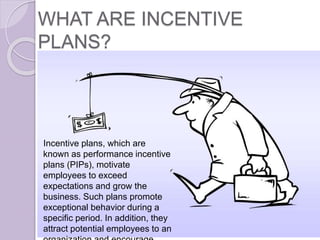
WHAT ARE INCENTIVE
PLANS?
Incentive plans, which are
known as performance incentive
plans (PIPs), motivate
employees to exceed
expectations and grow the
business. Such plans promote
exceptional behavior during a
specific period. In addition, they
attract potential employees to an
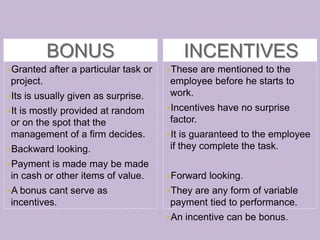
BONUS INCENTIVES
Granted after a particular task or
project.
Its is usually given as surprise.
It is mostly provided at random
or on the spot that the
management of a firm decides.
Backward looking.
Payment is made may be made
in cash or other items of value.
A bonus cant serve as
incentives.
These are mentioned to the
employee before he starts to
work.
Incentives have no surprise
factor.
It is guaranteed to the employee
if they complete the task.
Forward looking.
They are any form of variable
payment tied to performance.
An incentive can be bonus.
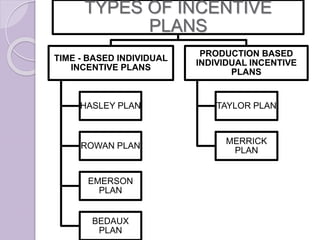
TYPES OF INCENTIVE
PLANS
PRODUCTION BASED
INDIVIDUAL INCENTIVE
PLANS
TAYLOR PLAN
MERRICK
PLAN
TIME - BASED INDIVIDUAL
INCENTIVE PLANS
HASLEY PLAN
ROWAN PLAN
EMERSON
PLAN
BEDAUX
PLAN
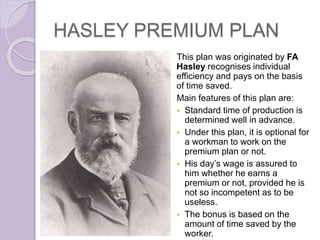
HASLEY PREMIUM PLAN
This plan was originated by FA
Hasley recognises individual
efficiency and pays on the basis
of time saved.
Main features of this plan are:
 Standard time of production is
determined well in advance.
 Under this plan, it is optional for
a workman to work on the
premium plan or not.
 His day’s wage is assured to
him whether he earns a
premium or not, provided he is
not so incompetent as to be
useless.
 The bonus is based on the
amount of time saved by the
worker.
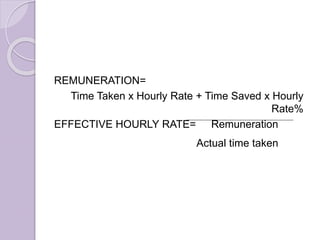
REMUNERATION=
Time Taken x Hourly Rate + Time Saved x Hourly
Rate%
EFFECTIVE HOURLY RATE= Remuneration
Actual time taken..
ROWAN PREMIUM PLAN
This plan was introduced by James Rowan. Under this
method, the standard time and the standard rate of wage
Payment are determined in the same manner as Halsey Plan.
Main features of this plan are:
 Standard time of work is decided.
 Standard rate of wage is decided.
 Bonus is calculated in the ratio of time saved with standard
time.
 This system also there is no provision of punishment for
late completion of the work.
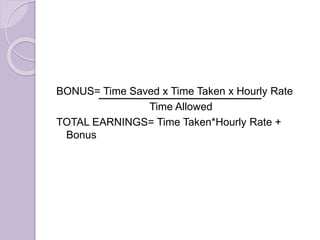
BONUS= Time Saved x Time Taken x Hourly Rate
Time Allowed…..
TOTAL EARNINGS= Time Taken*Hourly Rate +
Bonus
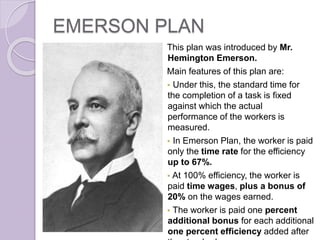
EMERSON PLAN
This plan was introduced by Mr.
Hemington Emerson.
Main features of this plan are:
 Under this, the standard time for
the completion of a task is fixed
against which the actual
performance of the workers is
measured.
 In Emerson Plan, the worker is paid
only the time rate for the efficiency
up to 67%.
 At 100% efficiency, the worker is
paid time wages, plus a bonus of
20% on the wages earned.
 The worker is paid one percent
additional bonus for each additional
one percent efficiency added after
BEDAUX PLAN
This is an incentive scheme in which the standard time for the
completion of a job is fixed and the rate per hour is defined.
Main features of this plan are:
 Standard performance is expressed in terms of points.
 If the worker completes the job in more than standard hours,
then he is paid according to the time-rate, i.e. time taken is
multiplied by the hourly rate.
 The worker, who achieves more than 60 points in one hour,
gets the bonus also.
 Even if the worker does not reach the standard, then he is
paid according to the time-rate.
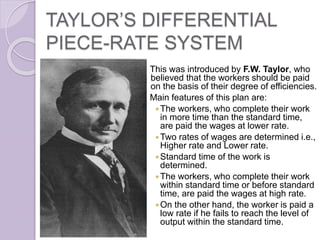
TAYLOR’S DIFFERENTIAL
PIECE-RATE SYSTEM
This was introduced by F.W. Taylor, who
believed that the workers should be paid
on the basis of their degree of efficiencies.
Main features of this plan are:
The workers, who complete their work
in more time than the standard time,
are paid the wages at lower rate.
Two rates of wages are determined i.e.,
Higher rate and Lower rate.
Standard time of the work is
determined.
The workers, who complete their work
within standard time or before standard
time, are paid the wages at high rate.
On the other hand, the worker is paid a
low rate if he fails to reach the level of
output within the standard time.
MERRICK DIFFERENTIAL
PIECE-RATE SYSTEM
This is a modification of Taylor’s differential piece-rate system in
which three piece-rates are used to distinguish between the
beginners, the average workers, and the superior workers,
against two piece-rates in Taylor’s system.
Under this plan, three rates of wages are determined in
place of two rates:
(i) Up to 83% of standard performance - standard rate
(ii) Up to standard performance - standard rate +10%
(iii) Above standard performance - standard rate
+ 20%
EXAMPLE
The following is an example of Angkor Publishers
Pvt. Ltd, in which daily on an average 1500 books
are printed. The following is the data provided of
the standard and actual performance of three
labours.
Standard Production by each worker 60 units per
hour
Working hours in a day 8
Normal rate per hour Rs. 50
Standard time per unit 1 Minute
Output per day is as follows:
Worker A 390units
Worker B 450units
Worker C 600units
Computation of Normal Wage Raw per unit
Normal Rate per hour
Rs.50
Standard Output per hour 60 Units
Normal wage rate per hour(Rs.50/60Units) 0.83p
Efficiency Level
Workers: A B C
Actual Output per day (units)390 450 600
Standard Output per day (units)480 480 480
Efficiency Level achieved:
390X100 450X100 600X100
480 480 480
=81.25% =93.75% =125%
STATEMENT OF EARNING OF WORKERS UNDER
STRAIGHT PIECE RATE SYSTEM
Worker A =390units X Rs.0.83 = Rs.323.7
Worker B =450units X Rs.0.83 = Rs.373.5
Worker C =600units X Rs.0.83 = Rs.498
STATEMENT OF EARNING OF WORKERS UNDER
MERRICK’S MULTIPLE PIECE RATE SYSTEM
Workers A B C
Efficiency level 81.25% 93.75%
125%
Applicable wage 0.83p 0.913p
0.996p
Earnings(Rs.) 390X0.83p 450X0.913p
600X0.996p
=Rs.323.7 =Rs.410.85 =Rs.597.6
REFERENCES
 https://businessjargons.com/merrick-
differential-piece-rate-system.html
 http://www.preservearticles.com/cost-
accounting/halsey-premium-plan-
meaning-features-an-disadvantages-are-
given-below/12318
 https://businessjargons.com/emerson-
plan.html
 http://www.economicsdiscussion.net/wag
es/wage-system/top-8-types-of-
incentive-wage-system-labour-
economics/29319
THANK
YOU

Incentive plans

  • 1.
  • 2.
    WHAT ARE INCENTIVE PLANS? Incentiveplans, which are known as performance incentive plans (PIPs), motivate employees to exceed expectations and grow the business. Such plans promote exceptional behavior during a specific period. In addition, they attract potential employees to an
  • 3.
    BONUS INCENTIVES Granted aftera particular task or project. Its is usually given as surprise. It is mostly provided at random or on the spot that the management of a firm decides. Backward looking. Payment is made may be made in cash or other items of value. A bonus cant serve as incentives. These are mentioned to the employee before he starts to work. Incentives have no surprise factor. It is guaranteed to the employee if they complete the task. Forward looking. They are any form of variable payment tied to performance. An incentive can be bonus.
  • 4.
    TYPES OF INCENTIVE PLANS PRODUCTIONBASED INDIVIDUAL INCENTIVE PLANS TAYLOR PLAN MERRICK PLAN TIME - BASED INDIVIDUAL INCENTIVE PLANS HASLEY PLAN ROWAN PLAN EMERSON PLAN BEDAUX PLAN
  • 5.
    HASLEY PREMIUM PLAN Thisplan was originated by FA Hasley recognises individual efficiency and pays on the basis of time saved. Main features of this plan are:  Standard time of production is determined well in advance.  Under this plan, it is optional for a workman to work on the premium plan or not.  His day’s wage is assured to him whether he earns a premium or not, provided he is not so incompetent as to be useless.  The bonus is based on the amount of time saved by the worker.
  • 6.
    REMUNERATION= Time Taken xHourly Rate + Time Saved x Hourly Rate% EFFECTIVE HOURLY RATE= Remuneration Actual time taken..
  • 7.
    ROWAN PREMIUM PLAN Thisplan was introduced by James Rowan. Under this method, the standard time and the standard rate of wage Payment are determined in the same manner as Halsey Plan. Main features of this plan are:  Standard time of work is decided.  Standard rate of wage is decided.  Bonus is calculated in the ratio of time saved with standard time.  This system also there is no provision of punishment for late completion of the work.
  • 8.
    BONUS= Time Savedx Time Taken x Hourly Rate Time Allowed….. TOTAL EARNINGS= Time Taken*Hourly Rate + Bonus
  • 9.
    EMERSON PLAN This planwas introduced by Mr. Hemington Emerson. Main features of this plan are:  Under this, the standard time for the completion of a task is fixed against which the actual performance of the workers is measured.  In Emerson Plan, the worker is paid only the time rate for the efficiency up to 67%.  At 100% efficiency, the worker is paid time wages, plus a bonus of 20% on the wages earned.  The worker is paid one percent additional bonus for each additional one percent efficiency added after
  • 10.
    BEDAUX PLAN This isan incentive scheme in which the standard time for the completion of a job is fixed and the rate per hour is defined. Main features of this plan are:  Standard performance is expressed in terms of points.  If the worker completes the job in more than standard hours, then he is paid according to the time-rate, i.e. time taken is multiplied by the hourly rate.  The worker, who achieves more than 60 points in one hour, gets the bonus also.  Even if the worker does not reach the standard, then he is paid according to the time-rate.
  • 11.
    TAYLOR’S DIFFERENTIAL PIECE-RATE SYSTEM Thiswas introduced by F.W. Taylor, who believed that the workers should be paid on the basis of their degree of efficiencies. Main features of this plan are: The workers, who complete their work in more time than the standard time, are paid the wages at lower rate. Two rates of wages are determined i.e., Higher rate and Lower rate. Standard time of the work is determined. The workers, who complete their work within standard time or before standard time, are paid the wages at high rate. On the other hand, the worker is paid a low rate if he fails to reach the level of output within the standard time.
  • 12.
    MERRICK DIFFERENTIAL PIECE-RATE SYSTEM Thisis a modification of Taylor’s differential piece-rate system in which three piece-rates are used to distinguish between the beginners, the average workers, and the superior workers, against two piece-rates in Taylor’s system. Under this plan, three rates of wages are determined in place of two rates: (i) Up to 83% of standard performance - standard rate (ii) Up to standard performance - standard rate +10% (iii) Above standard performance - standard rate + 20%
  • 13.
    EXAMPLE The following isan example of Angkor Publishers Pvt. Ltd, in which daily on an average 1500 books are printed. The following is the data provided of the standard and actual performance of three labours. Standard Production by each worker 60 units per hour Working hours in a day 8 Normal rate per hour Rs. 50 Standard time per unit 1 Minute Output per day is as follows: Worker A 390units Worker B 450units Worker C 600units
  • 14.
    Computation of NormalWage Raw per unit Normal Rate per hour Rs.50 Standard Output per hour 60 Units Normal wage rate per hour(Rs.50/60Units) 0.83p Efficiency Level Workers: A B C Actual Output per day (units)390 450 600 Standard Output per day (units)480 480 480 Efficiency Level achieved: 390X100 450X100 600X100 480 480 480 =81.25% =93.75% =125%
  • 15.
    STATEMENT OF EARNINGOF WORKERS UNDER STRAIGHT PIECE RATE SYSTEM Worker A =390units X Rs.0.83 = Rs.323.7 Worker B =450units X Rs.0.83 = Rs.373.5 Worker C =600units X Rs.0.83 = Rs.498 STATEMENT OF EARNING OF WORKERS UNDER MERRICK’S MULTIPLE PIECE RATE SYSTEM Workers A B C Efficiency level 81.25% 93.75% 125% Applicable wage 0.83p 0.913p 0.996p Earnings(Rs.) 390X0.83p 450X0.913p 600X0.996p =Rs.323.7 =Rs.410.85 =Rs.597.6
  • 17.
    REFERENCES  https://businessjargons.com/merrick- differential-piece-rate-system.html  http://www.preservearticles.com/cost- accounting/halsey-premium-plan- meaning-features-an-disadvantages-are- given-below/12318 https://businessjargons.com/emerson- plan.html  http://www.economicsdiscussion.net/wag es/wage-system/top-8-types-of- incentive-wage-system-labour- economics/29319
  • 18.