AC/A RATIO
Presenter –Dr. Tanvi Gupta
Moderator- Dr. Nilutparna Deuri
PREVIOUS YEARS’ QUESTIONS
Q. a) Mechanism of accommodation (4)
b) Anomalies of accommodation and their management (3+3) (Dec2017)
Q. a) Physiology of accommodation with diagrams. (April 2016)
Q. a) What is amplitude of accommodation? (3)
b) What is spasm of accommodation? Name two conditions in which this is commonly seen. (3+2)
c) How do you treat this condition? (2) (Dec 2016)
Q. What is accommodation. Explain its clinical importance with the help of diagram(s). 2+3+5 (Dec 2103)
Q. Describe clinical features and management of partially accommodative esotropia. (Dec 2012)
Q. Define range and amplitude of accommodation.
Q. Describe the principles of management of accommodative anomalies by surgery. (June 2011)
Q. Management of accomodative esotropia. (Dec 2009)
Q. Define accommodation and convergences (Dec 2009)
Accommodation is the process by which the eye focuses on a near target, by altering the
curvature of the crystalline lens.
Simultaneously, the eyes converge, in order to fixate bifoveally on the target.
Both accommodation and convergence are quantitatively related to the proximity of the
target, and have a fairly constant relationship to each other which we measure as AC/A
ratio.
Accomodation begins to develop by 2 months of age
Well developed by 8th month of life
2 years -> 20 D
20 years -> 10D
60 years -> 1 D
There are two factors that control efficiency of accommodation
1. Ability of lens to alter its shape -> substance of lens inelastic – no
accommodation (presbyopia)
2. Power of the ciliary muscle -> weak or paralysed ciliary muscle – no
accommodation (debility, cycloplegia)
Sustained and exaggerated ciliary effort to overcome the muscular
deficiency-> asthenopia, eye strain
Physical accommodation- actual physical deformation of lens (measured in
dioptres)
Physiological component- contractile power of ciliary muscle required to
raise refractive power of lens by 1D (measured in myodioptre)
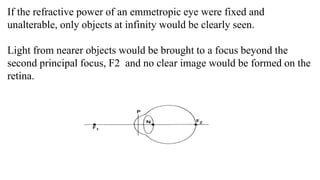
If the refractive power of an emmetropic eye were fixed and
unalterable, only objects at infinity would be clearly seen.
Light from nearer objects would be brought to a focus beyond the
second principal focus, F2 and no clear image would be formed on the
retina.
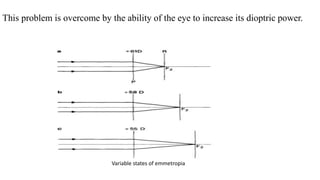
Variable states of emmetropia
This problem is overcome by the ability of the eye to increase its dioptric power.
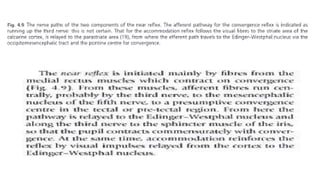
 Synkinesis
 Three components
Convergence (Medial rectus)
Distant object- eyes directed straight forwards. Parallel rays of light fall upon both the macula
Near object- eyes should turn inwards so that both the visual axes are directed upon it
Nearer the object, greater the convergence needed
Pupil constriction (Sphincter Pupillae)
Cuts off the outer part of lens to decrease optical aberrations
Also cuts off the relative increase of light entering from near objects
Accomodation (Ciliary muscle)- the main stimulus for accommodation is image blur
 All three muscles are controlled by the 3rd cranial nerve
NEAR TRIAD
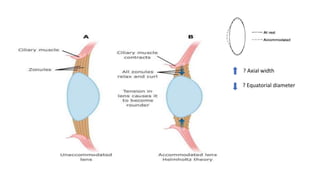
? Axial width
? Equatorial diameter
Modern version of Helmhotz theory
During accommodation
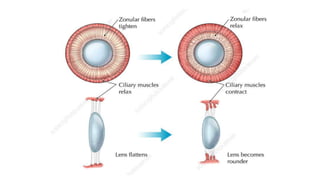
1. Ciliary muscles contract
2. Suspensory ligament relaxes
3. Elastic capsule of lens acts unrestrainedly to deform the lens substance into more spherical,
perhaps conoidal accommodated state that its own natural elasticity resists.
Mechanism of Presbyopia
With increasing age, changes in lens capsule -> leave it with less ability to alter the increasingly
resistant lens substance.
Ciliary muscle power is however, unimpaired.
Physical accommodation is impaired
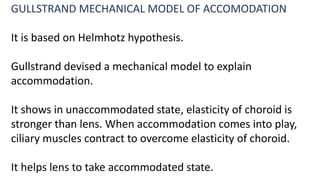
GULLSTRAND MECHANICAL MODEL OF ACCOMODATION
It is based on Helmhotz hypothesis.
Gullstrand devised a mechanical model to explain
accommodation.
It shows in unaccommodated state, elasticity of choroid is
stronger than lens. When accommodation comes into play,
ciliary muscles contract to overcome elasticity of choroid.
It helps lens to take accommodated state.
THANK YOU

Physiology of Accomodation

  • 1.
    AC/A RATIO Presenter –Dr.Tanvi Gupta Moderator- Dr. Nilutparna Deuri
  • 2.
    PREVIOUS YEARS’ QUESTIONS Q.a) Mechanism of accommodation (4) b) Anomalies of accommodation and their management (3+3) (Dec2017) Q. a) Physiology of accommodation with diagrams. (April 2016) Q. a) What is amplitude of accommodation? (3) b) What is spasm of accommodation? Name two conditions in which this is commonly seen. (3+2) c) How do you treat this condition? (2) (Dec 2016) Q. What is accommodation. Explain its clinical importance with the help of diagram(s). 2+3+5 (Dec 2103) Q. Describe clinical features and management of partially accommodative esotropia. (Dec 2012) Q. Define range and amplitude of accommodation. Q. Describe the principles of management of accommodative anomalies by surgery. (June 2011) Q. Management of accomodative esotropia. (Dec 2009) Q. Define accommodation and convergences (Dec 2009)
  • 3.
    Accommodation is theprocess by which the eye focuses on a near target, by altering the curvature of the crystalline lens. Simultaneously, the eyes converge, in order to fixate bifoveally on the target. Both accommodation and convergence are quantitatively related to the proximity of the target, and have a fairly constant relationship to each other which we measure as AC/A ratio.
  • 4.
    Accomodation begins todevelop by 2 months of age Well developed by 8th month of life 2 years -> 20 D 20 years -> 10D 60 years -> 1 D
  • 5.
    There are twofactors that control efficiency of accommodation 1. Ability of lens to alter its shape -> substance of lens inelastic – no accommodation (presbyopia) 2. Power of the ciliary muscle -> weak or paralysed ciliary muscle – no accommodation (debility, cycloplegia) Sustained and exaggerated ciliary effort to overcome the muscular deficiency-> asthenopia, eye strain Physical accommodation- actual physical deformation of lens (measured in dioptres) Physiological component- contractile power of ciliary muscle required to raise refractive power of lens by 1D (measured in myodioptre)
  • 6.
    If the refractivepower of an emmetropic eye were fixed and unalterable, only objects at infinity would be clearly seen. Light from nearer objects would be brought to a focus beyond the second principal focus, F2 and no clear image would be formed on the retina.
  • 7.
    Variable states ofemmetropia This problem is overcome by the ability of the eye to increase its dioptric power.
  • 8.
     Synkinesis  Threecomponents Convergence (Medial rectus) Distant object- eyes directed straight forwards. Parallel rays of light fall upon both the macula Near object- eyes should turn inwards so that both the visual axes are directed upon it Nearer the object, greater the convergence needed Pupil constriction (Sphincter Pupillae) Cuts off the outer part of lens to decrease optical aberrations Also cuts off the relative increase of light entering from near objects Accomodation (Ciliary muscle)- the main stimulus for accommodation is image blur  All three muscles are controlled by the 3rd cranial nerve NEAR TRIAD
  • 9.
    ? Axial width ?Equatorial diameter
  • 11.
    Modern version ofHelmhotz theory During accommodation 1. Ciliary muscles contract 2. Suspensory ligament relaxes 3. Elastic capsule of lens acts unrestrainedly to deform the lens substance into more spherical, perhaps conoidal accommodated state that its own natural elasticity resists. Mechanism of Presbyopia With increasing age, changes in lens capsule -> leave it with less ability to alter the increasingly resistant lens substance. Ciliary muscle power is however, unimpaired. Physical accommodation is impaired
  • 12.
    GULLSTRAND MECHANICAL MODELOF ACCOMODATION It is based on Helmhotz hypothesis. Gullstrand devised a mechanical model to explain accommodation. It shows in unaccommodated state, elasticity of choroid is stronger than lens. When accommodation comes into play, ciliary muscles contract to overcome elasticity of choroid. It helps lens to take accommodated state.
  • 16.

Editor's Notes

  • #4 What is accommodation
  • #5 In Adie’s syndrome damage to ciliary ganglion causes loss of accommodation and hence the initial symptom is image blur.
  • #9 Synkinesis (phenomena acting in concert) with a change in the distance of viewing are known as the ‘near triad’. No component is dependent on the other two for it appearance. If we give a plus lens, and the eye converges to a near point, the pupil will still constrict. Accomodation slowest reaction (0.56, 0.64) Pupillar response is slower than the reaction to light (0.2-0.26 s)
  • #10 The crystalline lens is held suspended under tension by the suspensory ligament which attaches it to the ring of ciliary muscle. Ciliary muscle contraction reduces the tension on the suspensory ligament and lens, allowing the lens to assume a more globular shape. The curvatures of the lens surfaces and the lens thickness are increased and thus the dioptric power is increased. Most of the change in curvature occurs at the anterior lens surface, which moves forwards slightly