CSUN 2013

ACCESSIBLE WEB CONTENT &
INTELLECTUAL DISABILITIES


            © 2013 Interactive Accessibility
The Accessibility Experts TM


Kathy Wahlbin
Email: KathyW@ia11y.com
Phone: 978-443-0798

   http://www.interactiveaccessibility.com


  2/28/2013               © 2013 Interactive Accessibility                            2
Topics

• What is an intellectual disability?
• Statistics
• Types of intellectual disabilities
      – Web Challenges
      – Web Techniques
• Assistive technology
      – Comparison between the three leading text-to-speech software
        applications
      – Demonstrate how these products are used online by users
      – Discuss how their use impacts web products
      – Summarize key points or considerations for web designers and
        developers

2/28/2013                    © 2013 Interactive Accessibility          3
What is an Intellectual Disability?

• Intellectual disability refers to limitations in mental
  functioning and skills such as:
      – Communicating
      – Personal care
      – Socializing
• Causes a child to learn and develop more slowly than a
  typical child


    Source: NICHCY, National Dissemination Center for Children with Disabilities
    (http://nichcy.org/disability/specific/intellectual)


2/28/2013                                  © 2013 Interactive Accessibility        4
Intellectual Disabilities Statistics

• Most common developmental disability
• ~6.5M in the U.S. have an intellectual disability
• Affects about 1 in 10 U.S. families


 Source: The Arc. (2009). Introduction to intellectual disabilities (http://www.thearc.org/page.aspx?pid=2448)


2/28/2013                                     © 2013 Interactive Accessibility                                   5
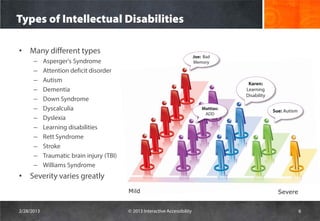
Types of Intellectual Disabilities

• Many different types
                                                                              Joe: Bad
      –     Asperger's Syndrome                                               Memory
      –     Attention deficit disorder
      –     Autism                                                                            Karen:
      –     Dementia                                                                         Learning
                                                                                             Disability
      –     Down Syndrome
      –     Dyscalculia                                                           Mattias:
                                                                                                          Sue: Autism
                                                                                   ADD
      –     Dyslexia
      –     Learning disabilities
      –     Rett Syndrome
      –     Stroke
      –     Traumatic brain injury (TBI)
      –     Williams Syndrome
• Severity varies greatly
                                           Mild                                                             Severe


2/28/2013                                  © 2013 Interactive Accessibility                                             6
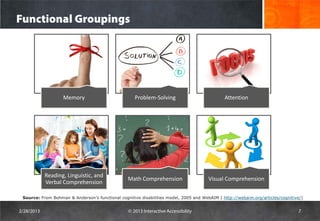
Functional Groupings


                   Memory                            Problem-Solving                          Attention


            Reading, Linguistic, and
                                                 Math Comprehension                    Visual Comprehension
            Verbal Comprehension

 Source: From Bohman & Anderson’s functional cognitive disabilities model, 2005 and WebAIM ( http://webaim.org/articles/cognitive/)


2/28/2013                                         © 2013 Interactive Accessibility                                              7
Strategies

Steps:
1. Provide well-structured content and design for users
   with intellectual disabilities
2. Make sure it works well with the text-to-speech tools


2/28/2013             © 2013 Interactive Accessibility     8
Memory

• Ability to recall what has been learned
      – Immediate, short-term and long-term memory
• Web Challenges
      – Limits their ability to remember how they got to content
• Web techniques
      –     Ensure navigation is consistent throughout the site
      –     Add reminders such as breadcrumbs, icons and other visual markers
      –     Add progress bars for steps and label each step
      –     Keep forms short; omit unnecessary information
             • Each page should focus on one specific task
             • Add descriptive text to labels


2/28/2013                            © 2013 Interactive Accessibility           9
Problem-Solving

• Ability to solve problems based on given information
• Web Challenges
      – Unable to figure out the site organization (clicks on wrong link)
      – Difficulty fixing issues with forms or other error messages
      – May get frustrated and be unable to complete forms or find information
• Web techniques
      – Ensure navigation is consistent throughout the site
      – Write easy to understand instructions and error messages
            • Provide hints on use and how to fix issues
            • Correct issues for users (don’t require specific format)
      – Provide warning messages
      – Limit choices


2/28/2013                              © 2013 Interactive Accessibility          10
Attention

• Difficulty focusing on a specific task
• Web Challenges
      – Distractions such as scrolling text and blinking icons make reading difficult
      – Long pages with lots of information make it challenging to focus
• Web techniques
      –     Shorten pages to specific concept or topic
      –     Use responsive design
      –     Avoid distracting background images
      –     Allow users to stop animations


2/28/2013                           © 2013 Interactive Accessibility                11
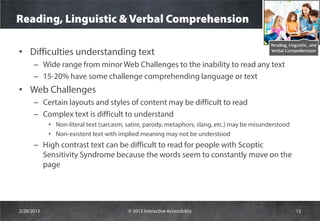
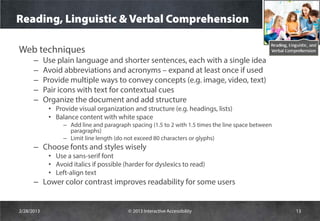
Reading, Linguistic & Verbal Comprehension

• Difficulties understanding text
      – Wide range from minor Web Challenges to the inability to read any text
      – 15-20% have some challenge comprehending language or text
• Web Challenges
      – Certain layouts and styles of content may be difficult to read
      – Complex text is difficult to understand
            • Non-literal text (sarcasm, satire, parody, metaphors, slang, etc.) may be misunderstood
            • Non-existent text with implied meaning may not be understood
      – High contrast text can be difficult to read for people with Scoptic
        Sensitivity Syndrome because the words seem to constantly move on the
        page


2/28/2013                                © 2013 Interactive Accessibility                               12
Reading, Linguistic & Verbal Comprehension

Web techniques
      –     Use plain language and shorter sentences, each with a single idea
      –     Avoid abbreviations and acronyms – expand at least once if used
      –     Provide multiple ways to convey concepts (e.g. image, video, text)
      –     Pair icons with text for contextual cues
      –     Organize the document and add structure
             • Provide visual organization and structure (e.g. headings, lists)
             • Balance content with white space
                  – Add line and paragraph spacing (1.5 to 2 with 1.5 times the line space between
                    paragraphs)
                  – Limit line length (do not exceed 80 characters or glyphs)
      – Choose fonts and styles wisely
             • Use a sans-serif font
             • Avoid italics if possible (harder for dyslexics to read)
             • Left-align text
      – Lower color contrast improves readability for some users


2/28/2013                                 © 2013 Interactive Accessibility                           13
Math Comprehension

• Difficulty understanding mathematical expressions
• Web Challenges
      – E-commerce sites with the price of the items purchased, tax, shipping and
        handling, and other charges
      – Educational content with math problems
• Web techniques
      – Calculate automatically
      – Do not avoid math entirely; sometimes equations are the best way to
        explain concepts and techniques
      – Some users require math to be explained conceptually to understand the
        reasoning behind the math


2/28/2013                        © 2013 Interactive Accessibility                   14
Visual Comprehension

• Difficulty processing visual information
      – May not recognize objects for what they are
      – Visual communication methods include color, spatial relationships, styles,
        design elements, photos, images, etc.
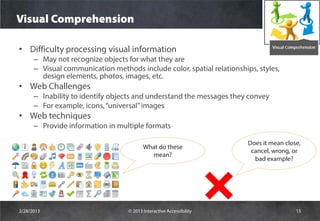
• Web Challenges
      – Inability to identify objects and understand the messages they convey
      – For example, icons, “universal” images
• Web techniques
      – Provide information in multiple formats

                                                                        Does it mean close,
                                          What do these
                                                                         cancel, wrong, or
                                            mean?
                                                                          bad example?


2/28/2013                          © 2013 Interactive Accessibility                      15
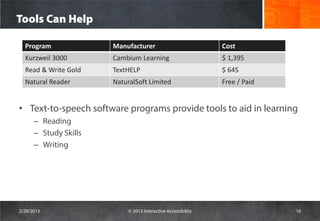
Tools Can Help

  Program              Manufacturer                            Cost
  Kurzweil 3000        Cambium Learning                        $ 1,395
  Read & Write Gold    TextHELP                                $ 645
  Natural Reader       NaturalSoft Limited                     Free / Paid


• Text-to-speech software programs provide tools to aid in learning
      – Reading
      – Study Skills
      – Writing


2/28/2013                   © 2013 Interactive Accessibility                 16
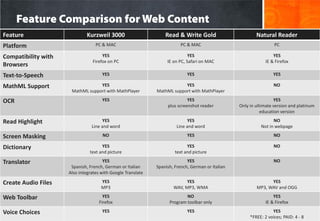
Feature Comparison for Web Content
Feature                       Kurzweil 3000                      Read & Write Gold                        Natural Reader
Platform                          PC & MAC                              PC & MAC                                   PC

Compatibility with                   YES                                     YES                                   YES
                                Firefox on PC                     IE on PC, Safari on MAC                      IE & Firefox
Browsers
Text-to-Speech                       YES                                    YES                                    YES

MathML Support                    YES                                    YES                                       NO
                      MathML support with MathPlayer         MathML support with MathPlayer

OCR                                  YES                                    YES                                    YES
                                                                  plus screenshot reader          Only in ultimate version and platinum
                                                                                                             education version

Read Highlight                        YES                                    YES                                  NO
                                Line and word                          Line and word                        Not in webpage

Screen Masking                       NO                                     YES                                    NO

Dictionary                           YES                                    YES                                    NO
                               text and picture                       text and picture

Translator                            YES                                   YES                                    NO
                      Spanish, French, German or Italian     Spanish, French, German or Italian
                     Also integrates with Google Translate

Create Audio Files                   YES                                   YES                                  YES
                                     MP3                             WAV, MP3, WMA                        MP3, WAV and OGG

Web Toolbar                           YES                                  NO                                      YES
                                    Firefox                        Program toolbar only                        IE & Firefox

Voice Choices                        YES                                    YES                                   YES
                                                                                                       *FREE: 2 voices; PAID: 4 - 8
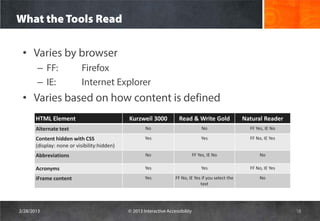
What the Tools Read

 • Varies by browser
       – FF:               Firefox
       – IE:               Internet Explorer
 • Varies based on how content is defined
       HTML Element                           Kurzweil 3000            Read & Write Gold               Natural Reader
       Alternate text                                 No                             No                  FF Yes, IE No

       Content hidden with CSS                        Yes                            Yes                 FF No, IE Yes
       (display: none or visibility:hidden)
       Abbreviations                                  No                         FF Yes, IE No               No

       Acronyms                                       Yes                            Yes                 FF No, IE Yes

       iFrame content                                 Yes            FF No, IE Yes if you select the         No
                                                                                  text


2/28/2013                                     © 2013 Interactive Accessibility                                           18
Kurzweil 3000, Read & Write Gold and Natural Reader


            DEMO OF TOOLS


2/28/2013     © 2013 Interactive Accessibility                     19
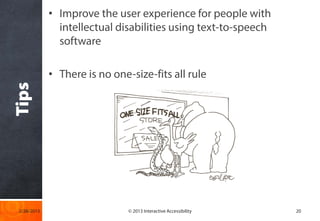
• Improve the user experience for people with
               intellectual disabilities using text-to-speech
               software

             • There is no one-size-fits all rule
Tips


 2/28/2013                     © 2013 Interactive Accessibility   20
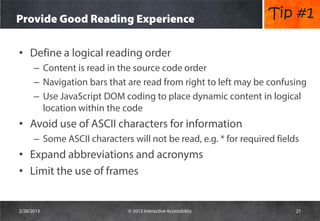
Provide Good Reading Experience                                   Tip #1

• Define a logical reading order
      – Content is read in the source code order
      – Navigation bars that are read from right to left may be confusing
      – Use JavaScript DOM coding to place dynamic content in logical
        location within the code
• Avoid use of ASCII characters for information
      – Some ASCII characters will not be read, e.g. * for required fields
• Expand abbreviations and acronyms
• Limit the use of frames


2/28/2013                     © 2013 Interactive Accessibility           21
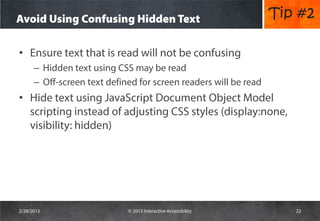
Avoid Using Confusing Hidden Text                                 Tip #2

• Ensure text that is read will not be confusing
      – Hidden text using CSS may be read
      – Off-screen text defined for screen readers will be read
• Hide text using JavaScript Document Object Model
  scripting instead of adjusting CSS styles (display:none,
  visibility: hidden)


2/28/2013                    © 2013 Interactive Accessibility        22
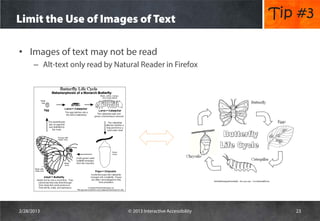
Limit the Use of Images of Text                                      Tip #3

• Images of text may not be read
      – Alt-text only read by Natural Reader in Firefox


2/28/2013                         © 2013 Interactive Accessibility      23
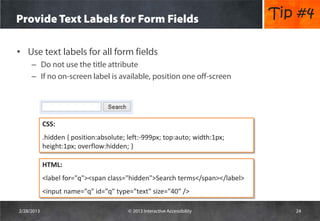
Provide Text Labels for Form Fields                                           Tip #4

• Use text labels for all form fields
     – Do not use the title attribute
     – If no on-screen label is available, position one off-screen


            CSS:
            .hidden { position:absolute; left:-999px; top:auto; width:1px;
            height:1px; overflow:hidden; }

            HTML:
            <label for="q"><span class="hidden">Search terms</span></label>
            <input name="q" id="q" type="text" size="40" />

2/28/2013                                © 2013 Interactive Accessibility        24
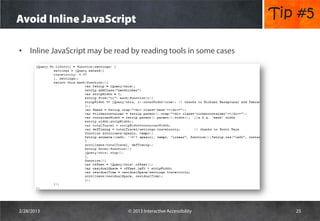
Avoid Inline JavaScript                                           Tip #5

• Inline JavaScript may be read by reading tools in some cases


2/28/2013                      © 2013 Interactive Accessibility      25
Questions?


2/28/2013            © 2013 Interactive Accessibility   26
Kathy Wahlbin
             Email: KathyW@ia11y.com
             Phone: 978-443-0798
             Twitter: @wahlbin


Are you accessible?
Thank you!

2/28/2013   © 2013 Interactive Accessibility   27

Accessible Web Content & Intellectual Disabilities

  • 1.
    CSUN 2013 ACCESSIBLE WEBCONTENT & INTELLECTUAL DISABILITIES © 2013 Interactive Accessibility
  • 2.
    The Accessibility ExpertsTM Kathy Wahlbin Email: KathyW@ia11y.com Phone: 978-443-0798 http://www.interactiveaccessibility.com 2/28/2013 © 2013 Interactive Accessibility 2
  • 3.
    Topics • What isan intellectual disability? • Statistics • Types of intellectual disabilities – Web Challenges – Web Techniques • Assistive technology – Comparison between the three leading text-to-speech software applications – Demonstrate how these products are used online by users – Discuss how their use impacts web products – Summarize key points or considerations for web designers and developers 2/28/2013 © 2013 Interactive Accessibility 3
  • 4.
    What is anIntellectual Disability? • Intellectual disability refers to limitations in mental functioning and skills such as: – Communicating – Personal care – Socializing • Causes a child to learn and develop more slowly than a typical child Source: NICHCY, National Dissemination Center for Children with Disabilities (http://nichcy.org/disability/specific/intellectual) 2/28/2013 © 2013 Interactive Accessibility 4
  • 5.
    Intellectual Disabilities Statistics •Most common developmental disability • ~6.5M in the U.S. have an intellectual disability • Affects about 1 in 10 U.S. families Source: The Arc. (2009). Introduction to intellectual disabilities (http://www.thearc.org/page.aspx?pid=2448) 2/28/2013 © 2013 Interactive Accessibility 5
  • 6.
    Types of IntellectualDisabilities • Many different types Joe: Bad – Asperger's Syndrome Memory – Attention deficit disorder – Autism Karen: – Dementia Learning Disability – Down Syndrome – Dyscalculia Mattias: Sue: Autism ADD – Dyslexia – Learning disabilities – Rett Syndrome – Stroke – Traumatic brain injury (TBI) – Williams Syndrome • Severity varies greatly Mild Severe 2/28/2013 © 2013 Interactive Accessibility 6
  • 7.
    Functional Groupings Memory Problem-Solving Attention Reading, Linguistic, and Math Comprehension Visual Comprehension Verbal Comprehension Source: From Bohman & Anderson’s functional cognitive disabilities model, 2005 and WebAIM ( http://webaim.org/articles/cognitive/) 2/28/2013 © 2013 Interactive Accessibility 7
  • 8.
    Strategies Steps: 1. Provide well-structuredcontent and design for users with intellectual disabilities 2. Make sure it works well with the text-to-speech tools 2/28/2013 © 2013 Interactive Accessibility 8
  • 9.
    Memory • Ability torecall what has been learned – Immediate, short-term and long-term memory • Web Challenges – Limits their ability to remember how they got to content • Web techniques – Ensure navigation is consistent throughout the site – Add reminders such as breadcrumbs, icons and other visual markers – Add progress bars for steps and label each step – Keep forms short; omit unnecessary information • Each page should focus on one specific task • Add descriptive text to labels 2/28/2013 © 2013 Interactive Accessibility 9
  • 10.
    Problem-Solving • Ability tosolve problems based on given information • Web Challenges – Unable to figure out the site organization (clicks on wrong link) – Difficulty fixing issues with forms or other error messages – May get frustrated and be unable to complete forms or find information • Web techniques – Ensure navigation is consistent throughout the site – Write easy to understand instructions and error messages • Provide hints on use and how to fix issues • Correct issues for users (don’t require specific format) – Provide warning messages – Limit choices 2/28/2013 © 2013 Interactive Accessibility 10
  • 11.
    Attention • Difficulty focusingon a specific task • Web Challenges – Distractions such as scrolling text and blinking icons make reading difficult – Long pages with lots of information make it challenging to focus • Web techniques – Shorten pages to specific concept or topic – Use responsive design – Avoid distracting background images – Allow users to stop animations 2/28/2013 © 2013 Interactive Accessibility 11
  • 12.
    Reading, Linguistic &Verbal Comprehension • Difficulties understanding text – Wide range from minor Web Challenges to the inability to read any text – 15-20% have some challenge comprehending language or text • Web Challenges – Certain layouts and styles of content may be difficult to read – Complex text is difficult to understand • Non-literal text (sarcasm, satire, parody, metaphors, slang, etc.) may be misunderstood • Non-existent text with implied meaning may not be understood – High contrast text can be difficult to read for people with Scoptic Sensitivity Syndrome because the words seem to constantly move on the page 2/28/2013 © 2013 Interactive Accessibility 12
  • 13.
    Reading, Linguistic &Verbal Comprehension Web techniques – Use plain language and shorter sentences, each with a single idea – Avoid abbreviations and acronyms – expand at least once if used – Provide multiple ways to convey concepts (e.g. image, video, text) – Pair icons with text for contextual cues – Organize the document and add structure • Provide visual organization and structure (e.g. headings, lists) • Balance content with white space – Add line and paragraph spacing (1.5 to 2 with 1.5 times the line space between paragraphs) – Limit line length (do not exceed 80 characters or glyphs) – Choose fonts and styles wisely • Use a sans-serif font • Avoid italics if possible (harder for dyslexics to read) • Left-align text – Lower color contrast improves readability for some users 2/28/2013 © 2013 Interactive Accessibility 13
  • 14.
    Math Comprehension • Difficultyunderstanding mathematical expressions • Web Challenges – E-commerce sites with the price of the items purchased, tax, shipping and handling, and other charges – Educational content with math problems • Web techniques – Calculate automatically – Do not avoid math entirely; sometimes equations are the best way to explain concepts and techniques – Some users require math to be explained conceptually to understand the reasoning behind the math 2/28/2013 © 2013 Interactive Accessibility 14
  • 15.
    Visual Comprehension • Difficultyprocessing visual information – May not recognize objects for what they are – Visual communication methods include color, spatial relationships, styles, design elements, photos, images, etc. • Web Challenges – Inability to identify objects and understand the messages they convey – For example, icons, “universal” images • Web techniques – Provide information in multiple formats Does it mean close, What do these cancel, wrong, or mean? bad example? 2/28/2013 © 2013 Interactive Accessibility 15
  • 16.
    Tools Can Help Program Manufacturer Cost Kurzweil 3000 Cambium Learning $ 1,395 Read & Write Gold TextHELP $ 645 Natural Reader NaturalSoft Limited Free / Paid • Text-to-speech software programs provide tools to aid in learning – Reading – Study Skills – Writing 2/28/2013 © 2013 Interactive Accessibility 16
  • 17.
    Feature Comparison forWeb Content Feature Kurzweil 3000 Read & Write Gold Natural Reader Platform PC & MAC PC & MAC PC Compatibility with YES YES YES Firefox on PC IE on PC, Safari on MAC IE & Firefox Browsers Text-to-Speech YES YES YES MathML Support YES YES NO MathML support with MathPlayer MathML support with MathPlayer OCR YES YES YES plus screenshot reader Only in ultimate version and platinum education version Read Highlight YES YES NO Line and word Line and word Not in webpage Screen Masking NO YES NO Dictionary YES YES NO text and picture text and picture Translator YES YES NO Spanish, French, German or Italian Spanish, French, German or Italian Also integrates with Google Translate Create Audio Files YES YES YES MP3 WAV, MP3, WMA MP3, WAV and OGG Web Toolbar YES NO YES Firefox Program toolbar only IE & Firefox Voice Choices YES YES YES *FREE: 2 voices; PAID: 4 - 8
  • 18.
    What the ToolsRead • Varies by browser – FF: Firefox – IE: Internet Explorer • Varies based on how content is defined HTML Element Kurzweil 3000 Read & Write Gold Natural Reader Alternate text No No FF Yes, IE No Content hidden with CSS Yes Yes FF No, IE Yes (display: none or visibility:hidden) Abbreviations No FF Yes, IE No No Acronyms Yes Yes FF No, IE Yes iFrame content Yes FF No, IE Yes if you select the No text 2/28/2013 © 2013 Interactive Accessibility 18
  • 19.
    Kurzweil 3000, Read& Write Gold and Natural Reader DEMO OF TOOLS 2/28/2013 © 2013 Interactive Accessibility 19
  • 20.
    • Improve theuser experience for people with intellectual disabilities using text-to-speech software • There is no one-size-fits all rule Tips 2/28/2013 © 2013 Interactive Accessibility 20
  • 21.
    Provide Good ReadingExperience Tip #1 • Define a logical reading order – Content is read in the source code order – Navigation bars that are read from right to left may be confusing – Use JavaScript DOM coding to place dynamic content in logical location within the code • Avoid use of ASCII characters for information – Some ASCII characters will not be read, e.g. * for required fields • Expand abbreviations and acronyms • Limit the use of frames 2/28/2013 © 2013 Interactive Accessibility 21
  • 22.
    Avoid Using ConfusingHidden Text Tip #2 • Ensure text that is read will not be confusing – Hidden text using CSS may be read – Off-screen text defined for screen readers will be read • Hide text using JavaScript Document Object Model scripting instead of adjusting CSS styles (display:none, visibility: hidden) 2/28/2013 © 2013 Interactive Accessibility 22
  • 23.
    Limit the Useof Images of Text Tip #3 • Images of text may not be read – Alt-text only read by Natural Reader in Firefox 2/28/2013 © 2013 Interactive Accessibility 23
  • 24.
    Provide Text Labelsfor Form Fields Tip #4 • Use text labels for all form fields – Do not use the title attribute – If no on-screen label is available, position one off-screen CSS: .hidden { position:absolute; left:-999px; top:auto; width:1px; height:1px; overflow:hidden; } HTML: <label for="q"><span class="hidden">Search terms</span></label> <input name="q" id="q" type="text" size="40" /> 2/28/2013 © 2013 Interactive Accessibility 24
  • 25.
    Avoid Inline JavaScript Tip #5 • Inline JavaScript may be read by reading tools in some cases 2/28/2013 © 2013 Interactive Accessibility 25
  • 26.
    Questions? 2/28/2013 © 2013 Interactive Accessibility 26
  • 27.
    Kathy Wahlbin Email: KathyW@ia11y.com Phone: 978-443-0798 Twitter: @wahlbin Are you accessible? Thank you! 2/28/2013 © 2013 Interactive Accessibility 27