ACADEMIC	WRITING	
Prof.	Ramakanta Mohalik
RIE	Bhubaneswar
ramakantamohalik@rediffmail.com
What	is	Academic	Writing
• Academic writing is clear, concise, focused,
structured and backed up by evidence.
• Its purpose is to aid the reader's
understanding.
• It has a formal tone and style, but it is not
complex and does not require the use of long
sentences and complicated vocabulary.
Academic	Documents
• Book
• Chapter in	an edited	book
• Conference	Paper
• Dissertation
• Theoretical	Paper
• Research	Paper
• Conference	Proceedings	
• Research	Proposal
• Thesis
Academic	Documents
• Abstract
• TV/	Radio	Script	Writings	
• Book/	Film	Reviews
• News	Paper	Editorial
• Research	Project	Report
• Training	Programme	Report
• Conference	Boucher
Types	of	Academic	Writing
• Descriptive
• Analytical
• Persuasive
• Critical
Key	Features
• Formal style or register: Writing should not be casual, but
be in a appropriate formal register.
• Appropriate references: Generally statements of fact will be
expected to be backed up by appropriate authoritative
references-and these to be laid out in the
appropriate citation system.
• Bibliography: Typically this lists those articles read as
background, and will include the sources of individual
citations.
• Plagiarism: The "wrongful appropriation of another
author's language, thoughts, ideas, or expressions", and the
representation of them as one's own original work is
considered academic dishonesty, and can lead to severe
consequences.
Composition	of	Academic	Work	(IMRD)
• Introduction (Background, objectives, problem statement,
rationale etc)
• Method (Method, tools, data collection)
• Result (Empirical results, charts, plots) and
• Discussion (Analysis, Conclusions)
• Other	common	sections	in	academic	documents	are:
• Abstract
• Acknowledgments
• Indices
• Bibliography
• List	of	references
• Appendix/Addendum,
Steps	in	Academic	Writing
• Planning
• Drafting
• Writing
• Editing
• Validating
• Finalaising
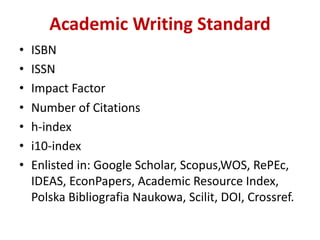
Academic	Writing	Standard
• ISBN
• ISSN
• Impact	Factor
• Number	of	Citations
• h-index
• i10-index
• Enlisted	in:	Google	Scholar,	Scopus,WOS,	RePEc,	
IDEAS,	EconPapers,	Academic	Resource	Index,	
Polska Bibliografia Naukowa,	Scilit,	DOI,	Crossref.
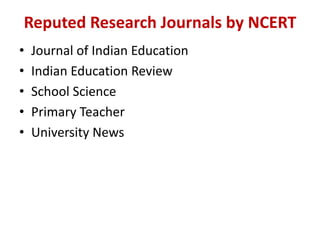
Reputed	Research	Journals	by	NCERT
• Journal	of	Indian	Education
• Indian	Education	Review
• School	Science
• Primary	Teacher
• University	News
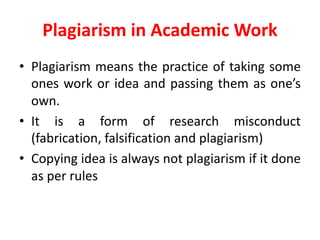
Plagiarism	in	Academic	Work
• Plagiarism means the practice of taking some
ones work or idea and passing them as one’s
own.
• It is a form of research misconduct
(fabrication, falsification and plagiarism)
• Copying idea is always not plagiarism if it done
as per rules
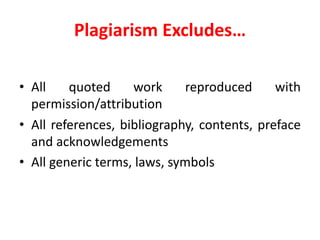
Plagiarism	Excludes…
• All quoted work reproduced with
permission/attribution
• All references, bibliography, contents, preface
and acknowledgements
• All generic terms, laws, symbols
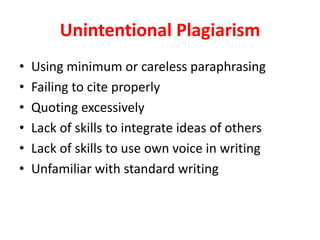
Unintentional	Plagiarism
• Using	minimum	or	careless	paraphrasing
• Failing	to	cite	properly
• Quoting	excessively
• Lack	of	skills	to	integrate	ideas	of	others
• Lack	of	skills	to	use	own	voice	in	writing
• Unfamiliar	with	standard	writing
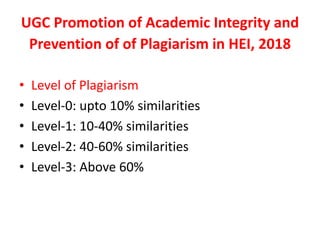
UGC	Promotion	of	Academic	Integrity	and	
Prevention	of	of	Plagiarism	in	HEI,	2018
• Level	of	Plagiarism
• Level-0:	upto	10%	similarities
• Level-1:	10-40%	similarities
• Level-2:	40-60%	similarities
• Level-3:	Above	60%
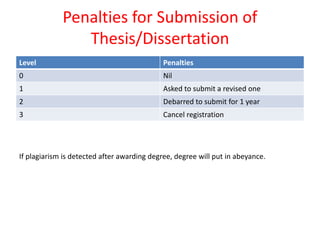
Penalties	for	Submission	of	
Thesis/Dissertation
Level Penalties
0 Nil
1 Asked	to	submit	a	revised	one
2 Debarred	to submit	for	1	year
3 Cancel registration
If	plagiarism	is	detected	after	awarding	degree,	degree	will	put	in	abeyance.
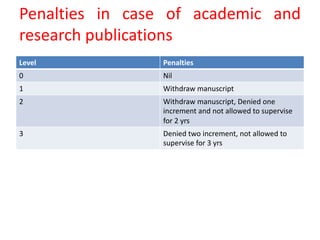
Penalties	 in	 case	 of	 academic	 and	
research	publications
Level Penalties
0 Nil
1 Withdraw manuscript
2 Withdraw	manuscript,	Denied	one	
increment	and	not	allowed to	supervise	
for	2	yrs
3 Denied	two	increment, not	allowed	to	
supervise	for	3	yrs
How	to	Avoid	Plagiarism
• Cite	while	writing
• Avoid	copy-pasting	(Paraphrasing)
• Use	short	quotations
• Take	permission	from	copyright	holder
• Check	paper	in	plagiarism	detection	software
• Avoid	self-plagiarism
Copyright	in	Academic	Work
• Copyright is a form of protection provided the
authors of “original works of authorship”
including literary, dramatic, musical, artistic,
and certain other intellectual works, both
published and unpublished.
• Copyrights are registered by the Copyright
Office of the library of Congress, US

Academic writing