
Nursing 375
Junior SEWS
Overview
SEWS What it is and why it matters
• Assessing how well
  students’ general writing
  and information literacy
  skills are developing.

• Graduation requirement to
  take and pass SEWS credit
  courses because we expect
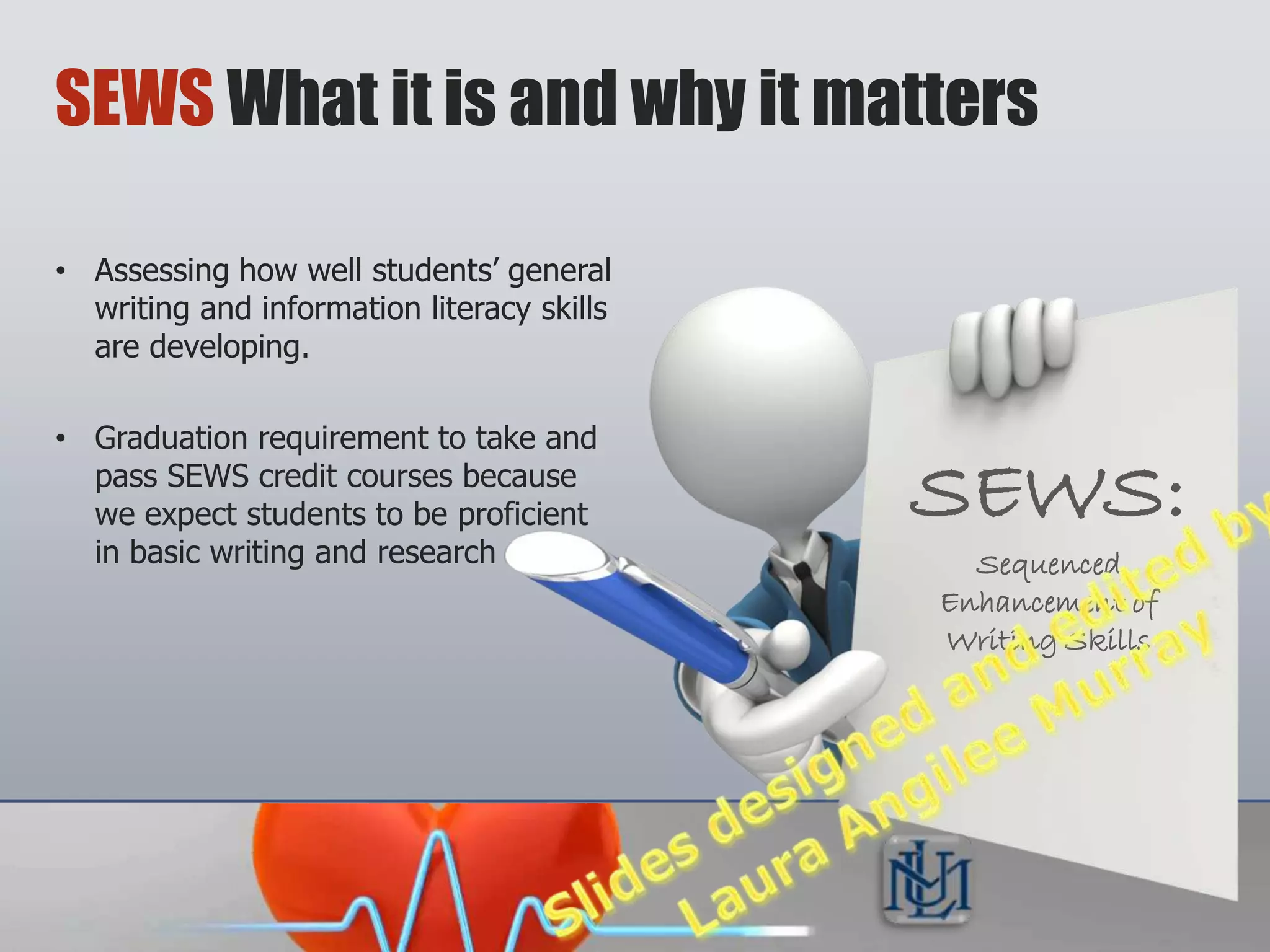
                                 SEWS:
  students to be proficient in     Sequenced
  basic writing and research     Enhancement of
                                 Writing Skills
  skills.
SEWS & QEP
• QEP??? Quality Enhancement
  Plan

• 5-year plan to improve student
  skills in Information
  Literacy, demonstrated most
  through writing

• Show Rubric (handout)
Locating Information
  •   Books
  •   Library Databases
  •   Web Sources
  •   Get help from your
      librarian


 Dr. Tiffani R. Conner
 Tiffani.Conner@lmunet.edu
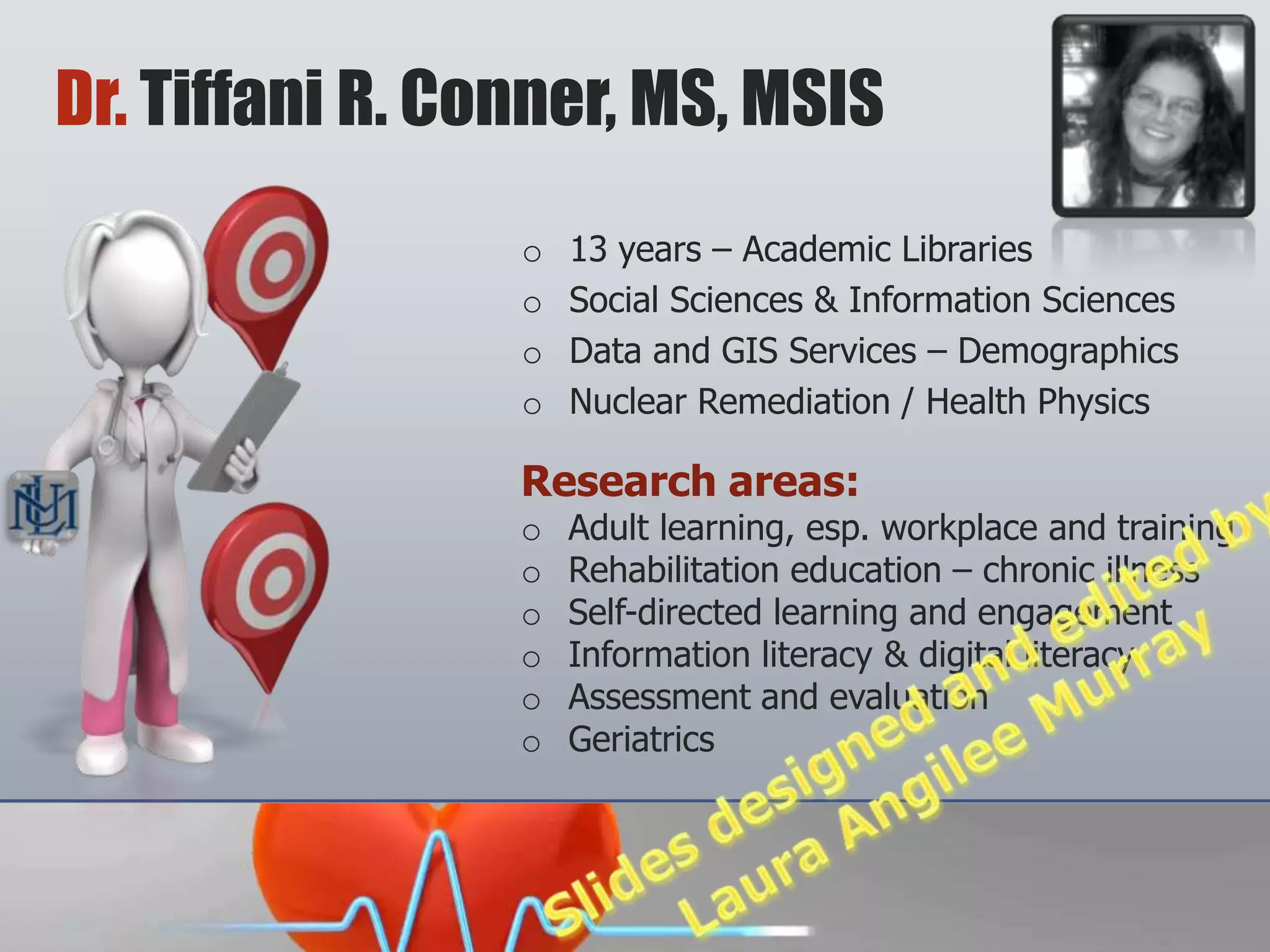
Dr. Tiffani R. Conner, MS, MSIS
                 o   13 years – Academic Libraries
                 o   Social Sciences & Information Sciences
                 o   Data and GIS Services – Demographics
                 o   Nuclear Remediation / Health Physics

                 Research areas:
                 o   Adult learning, esp. workplace and training
                 o   Rehabilitation education – chronic illness
                 o   Self-directed learning and engagement
                 o   Information literacy & digital literacy
                 o   Assessment and evaluation
                 o   Geriatrics
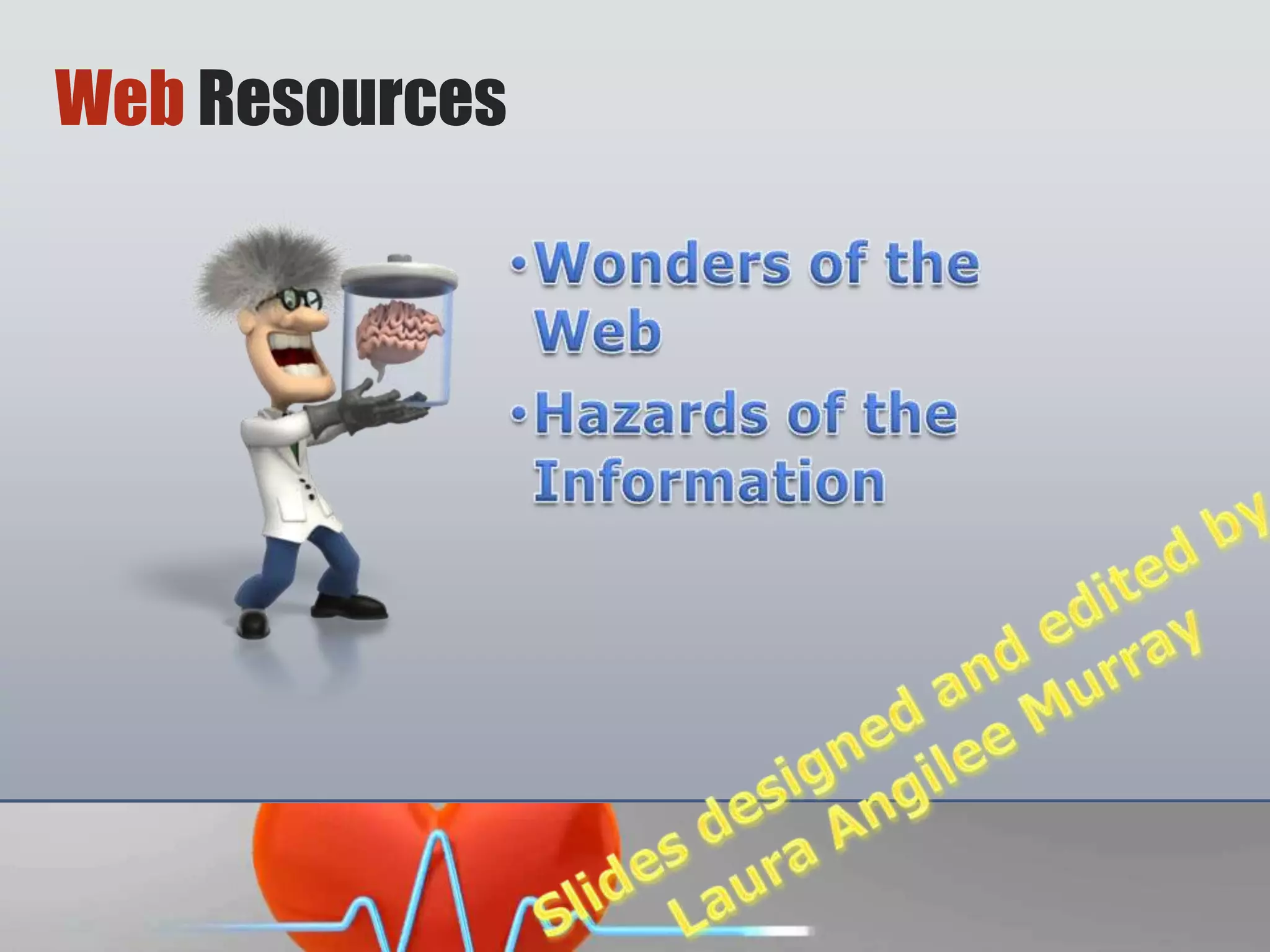
Web Resources
Library Databases
              • Discipline specific and General
              • Authoritative Information
              • Items that cost money from other
                places (websites)
              • Overview of Databases at CVL
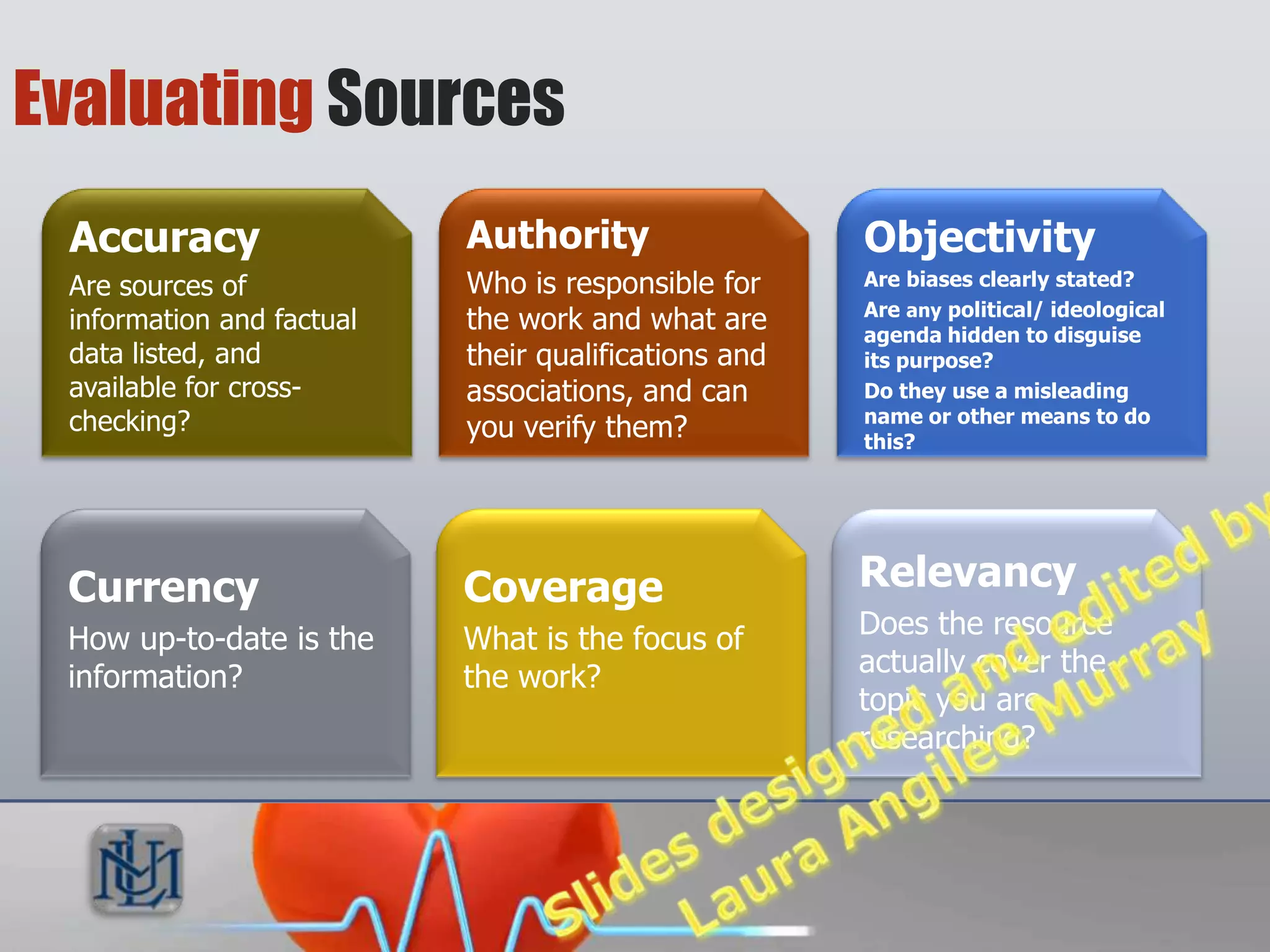
Evaluating Sources
 Accuracy                  Authority                  Objectivity
 Are sources of            Who is responsible for     Are biases clearly stated?
                                                      Are any political/ ideological
 information and factual   the work and what are      agenda hidden to disguise
 data listed, and          their qualifications and   its purpose?
 available for cross-      associations, and can      Do they use a misleading
 checking?                                            name or other means to do
                           you verify them?           this?


 Currency                  Coverage                   Relevancy
 How up-to-date is the     What is the focus of       Does the resource
 information?              the work?                  actually cover the
                                                      topic you are
                                                      researching?
Next Step – Writing
 Looked for our sources
 Read and evaluated them
 Determined which one’s to use
 Now what…..
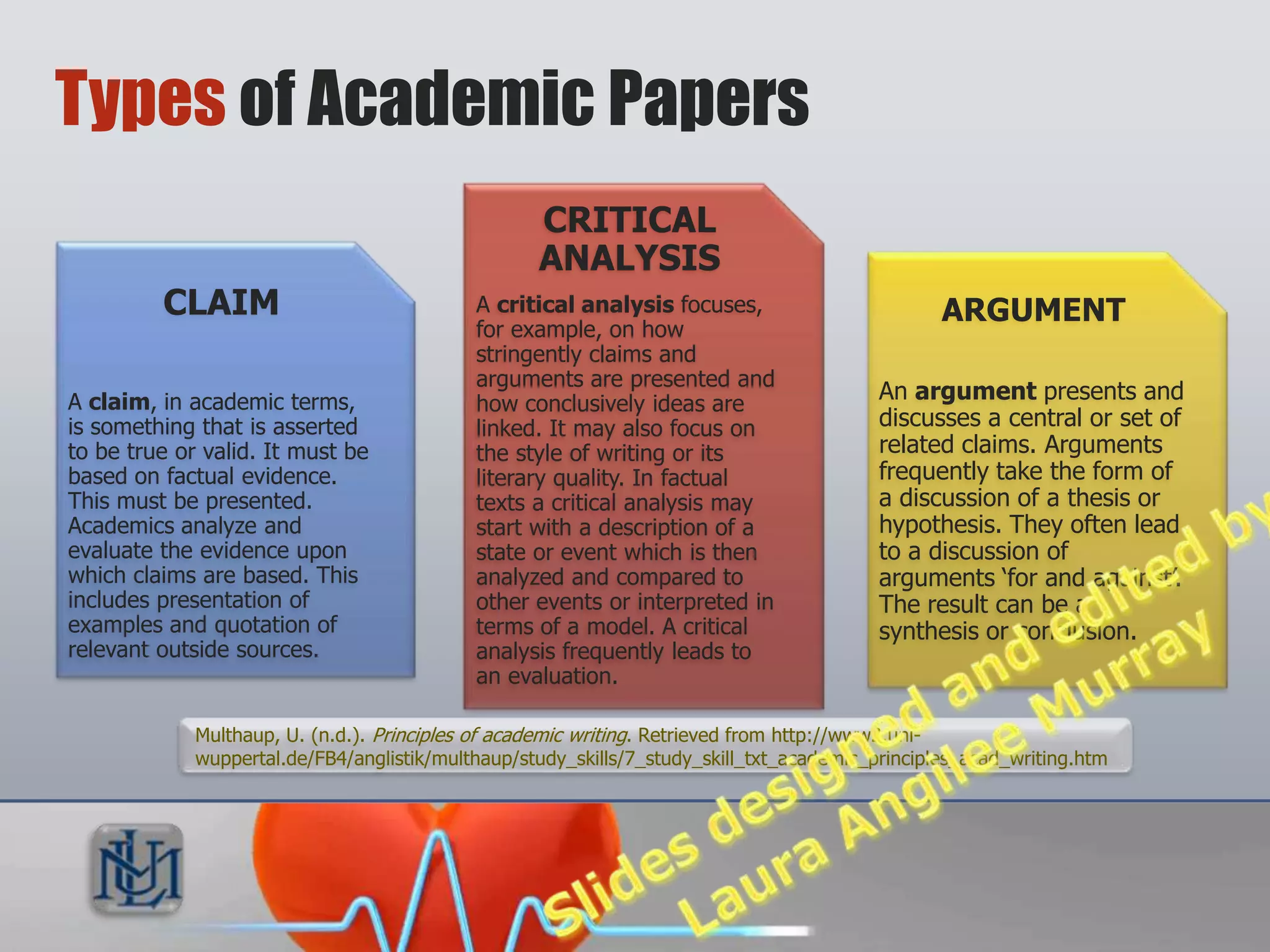
Types of Academic Papers
                                                   CRITICAL
                                                   ANALYSIS
         CLAIM                              A critical analysis                                  ARGUMENT
                                            focuses, for example, on how
                                            stringently claims and
                                            arguments are presented and
A claim, in academic terms,                 how conclusively ideas are
                                                                                          An argument presents and
is something that is asserted               linked. It may also focus on                  discusses a central or set of
to be true or valid. It must be             the style of writing or its                   related claims. Arguments
based on factual evidence.                  literary quality. In factual                  frequently take the form of
This must be presented.                     texts a critical analysis may                 a discussion of a thesis or
Academics analyze and                       start with a description of a                 hypothesis. They often lead
evaluate the evidence upon                  state or event which is then                  to a discussion of
which claims are based. This                analyzed and compared to                      arguments ‘for and against’.
includes presentation of                    other events or interpreted in                The result can be a
examples and quotation of                   terms of a model. A critical                  synthesis or conclusion.
relevant outside sources.                   analysis frequently leads to
                                            an evaluation.

             Multhaup, U. (n.d.). Principles of academic writing. Retrieved from http://www2.uni-
             wuppertal.de/FB4/anglistik/multhaup/study_skills/7_study_skill_txt_academic_principles_acad_writing.htm
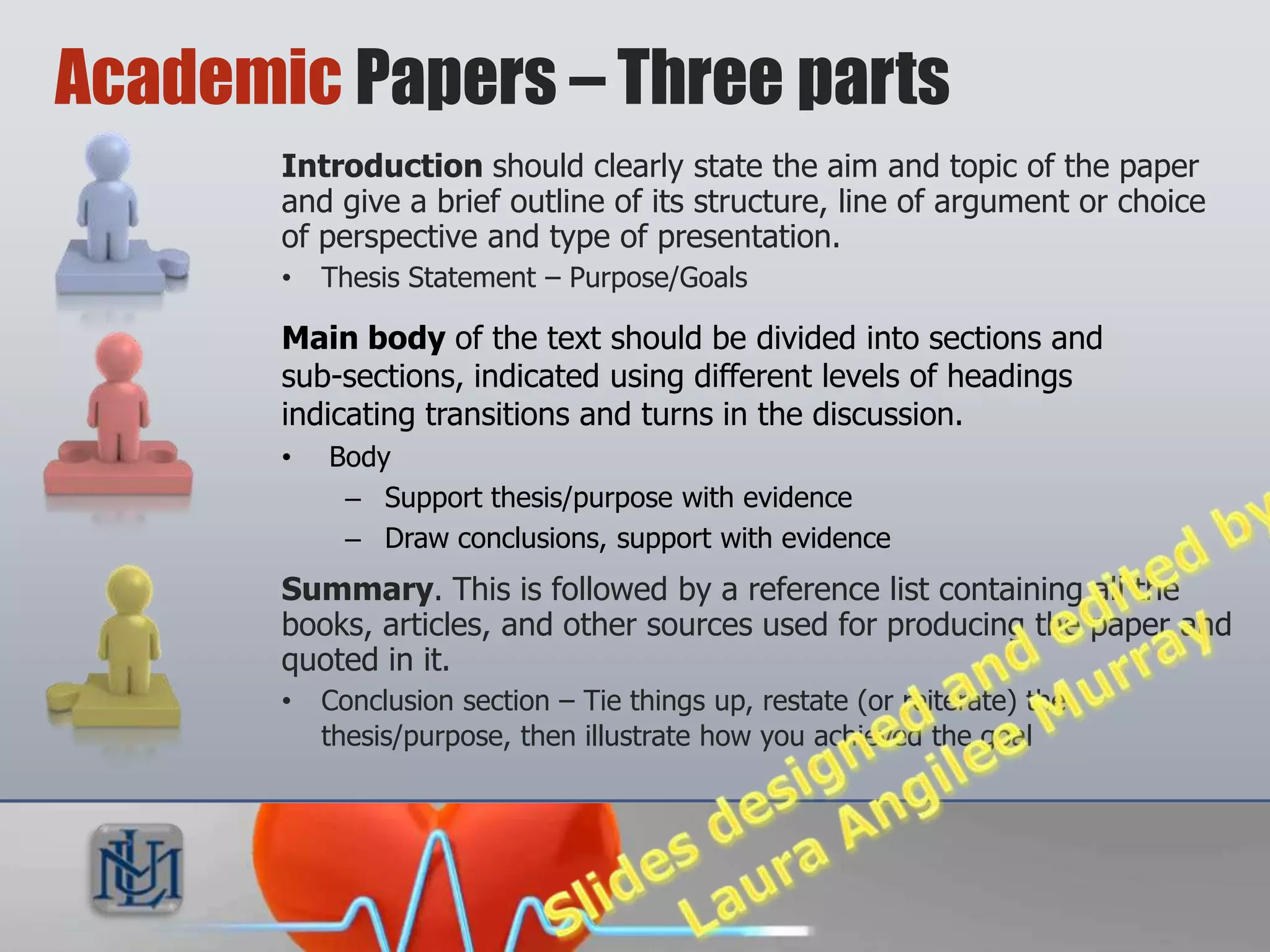
Academic Papers – Three parts
       Introduction should clearly state the aim and topic of the paper and
       give a brief outline of its structure, line of argument or choice of
       perspective and type of presentation.
       •   Thesis Statement – Purpose/Goals

       Main body of the text should be divided into sections and sub-
       sections, indicated using different levels of headings
       indicating transitions and turns in the discussion.
       •   Body
            – Support thesis/purpose with evidence
            – Draw conclusions, support with evidence
       Summary. This is followed by a reference list containing all the
       books, articles, and other sources used for producing the paper and
       quoted in it.
       •   Conclusion section – Tie things up, restate (or reiterate) the
           thesis/purpose, then illustrate how you achieved the goal
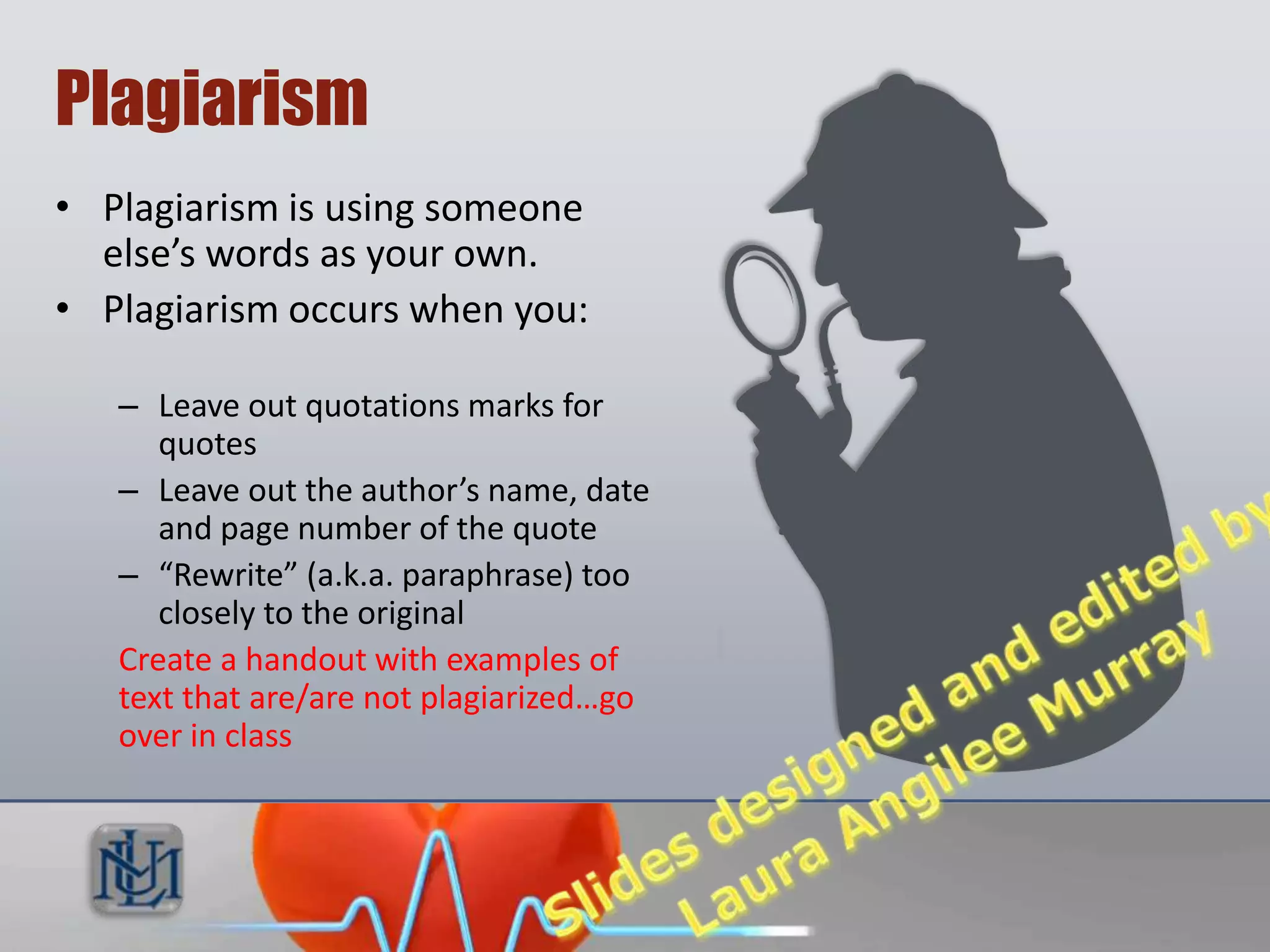
Plagiarism
• Plagiarism is using someone
  else’s words as your own.
• Plagiarism occurs when you:

   – Leave out quotations marks for
      quotes
   – Leave out the author’s name, date
      and page number of the quote
   – “Rewrite” (a.k.a. paraphrase) too
      closely to the original
   Create a handout with examples of
   text that are/are not plagiarized…go
   over in class
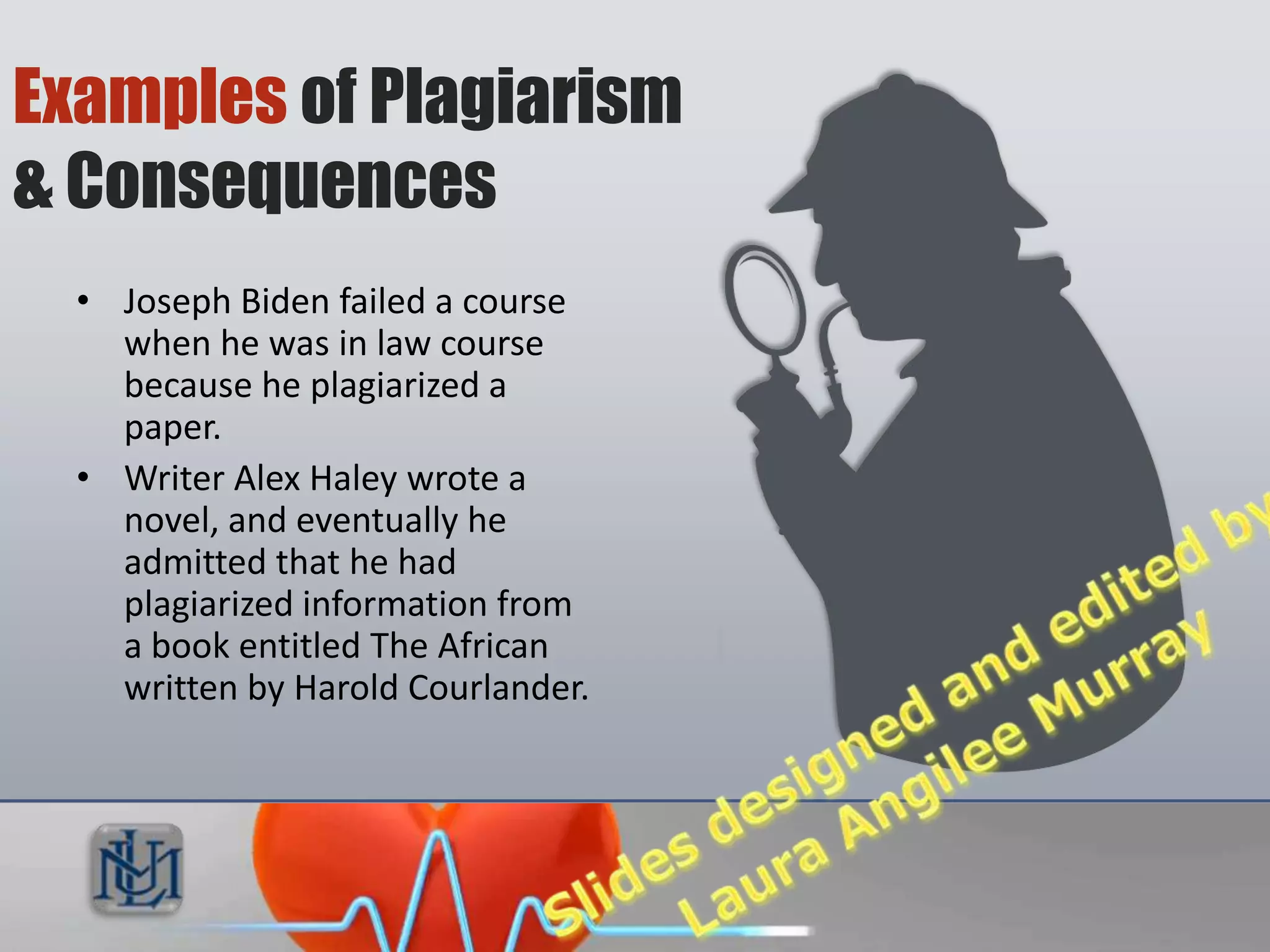
Examples of Plagiarism
& Consequences
  • Joseph Biden failed a course
    when he was in law course
    because he plagiarized a
    paper.
  • Writer Alex Haley wrote a
    novel, and eventually he
    admitted that he had
    plagiarized information
    from a book entitled The
    African written by Harold
    Courlander.
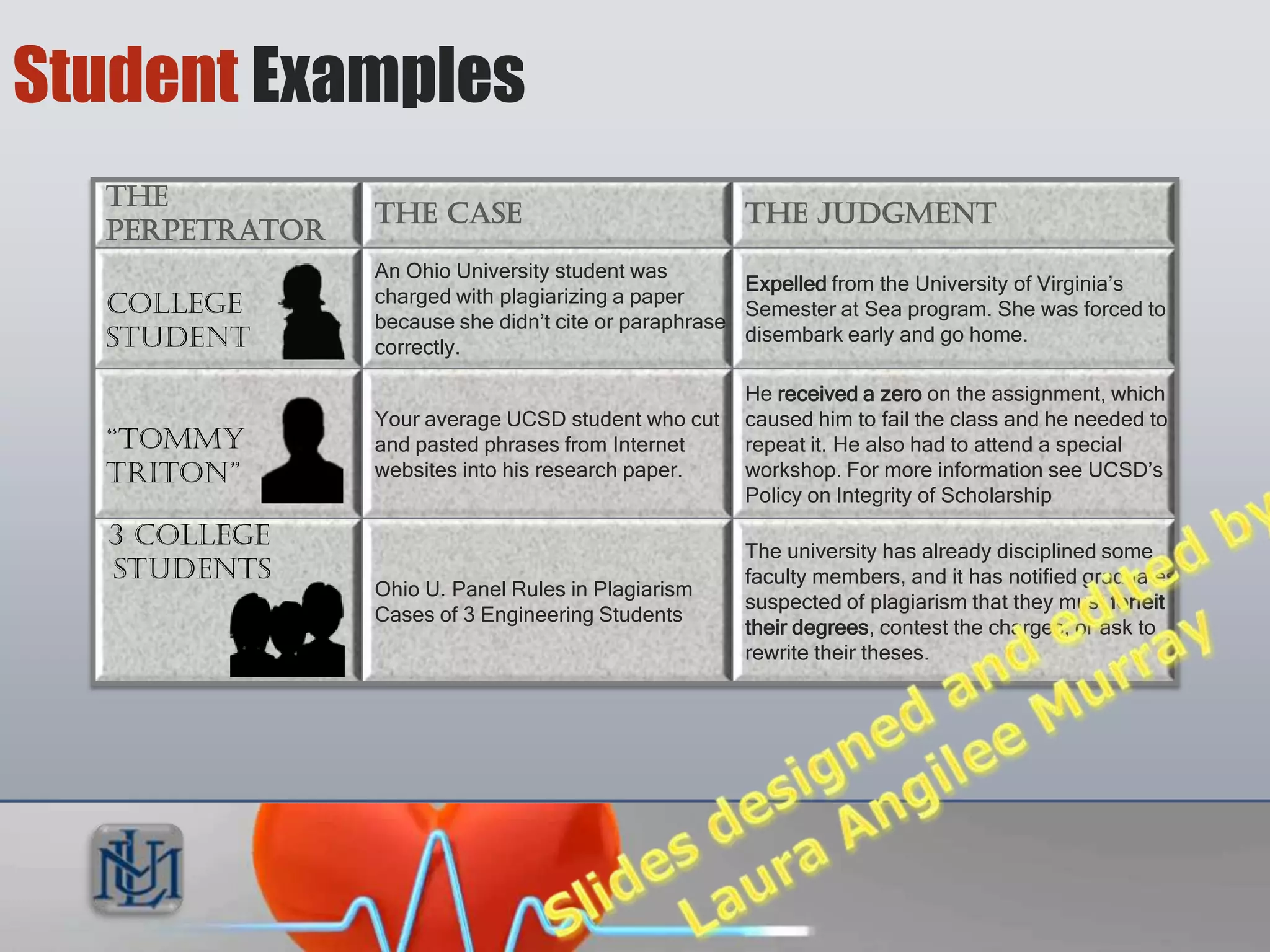
Student Examples
  The
                The Case                             The Judgment
  Perpetrator
                An Ohio University student was
                                                      Expelled from the University of Virginia’s
  College       charged with plagiarizing a paper
                                                      Semester at Sea program. She was forced to
                because she didn’t cite or paraphrase
  Student       correctly.
                                                      disembark early and go home.

                                                     He received a zero on the assignment, which
                Your average UCSD student who cut    caused him to fail the class and he needed to
  “Tommy        and pasted phrases from Internet     repeat it. He also had to attend a special
  Triton”       websites into his research paper.    workshop. For more information see UCSD’s
                                                     Policy on Integrity of Scholarship
  3 college                                          The university has already disciplined some
  students                                           faculty members, and it has notified graduates
                Ohio U. Panel Rules in Plagiarism
                                                     suspected of plagiarism that they must forfeit
                Cases of 3 Engineering Students
                                                     their degrees, contest the charges, or ask to
                                                     rewrite their theses.
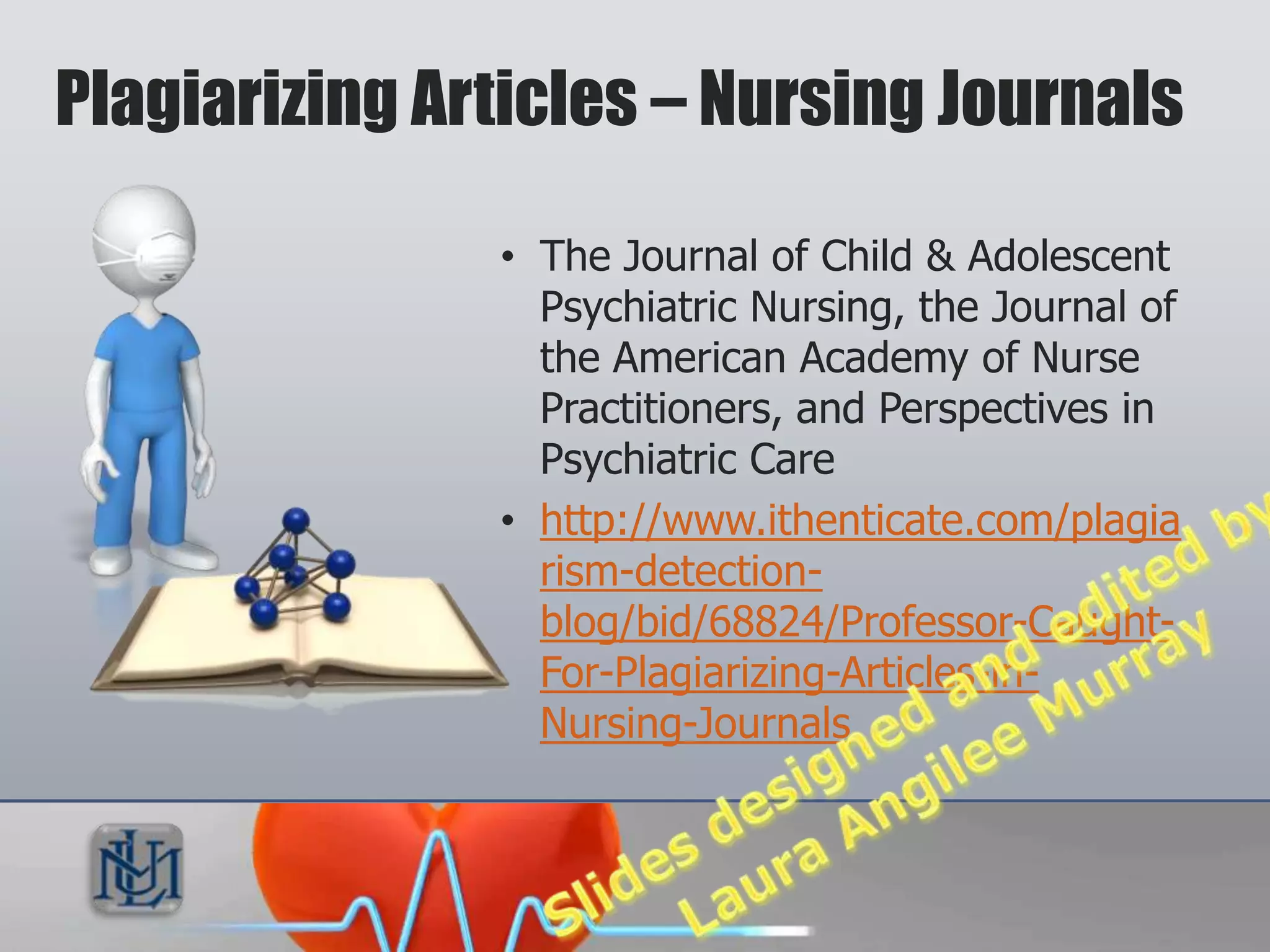
Plagiarizing Articles – Nursing Journals

               • The Journal of Child & Adolescent
                 Psychiatric Nursing, the Journal of
                 the American Academy of Nurse
                 Practitioners, and Perspectives in
                 Psychiatric Care
               • http://www.ithenticate.com/plagia
                 rism-detection-
                 blog/bid/68824/Professor-Caught-
                 For-Plagiarizing-Articles-in-
                 Nursing-Journals
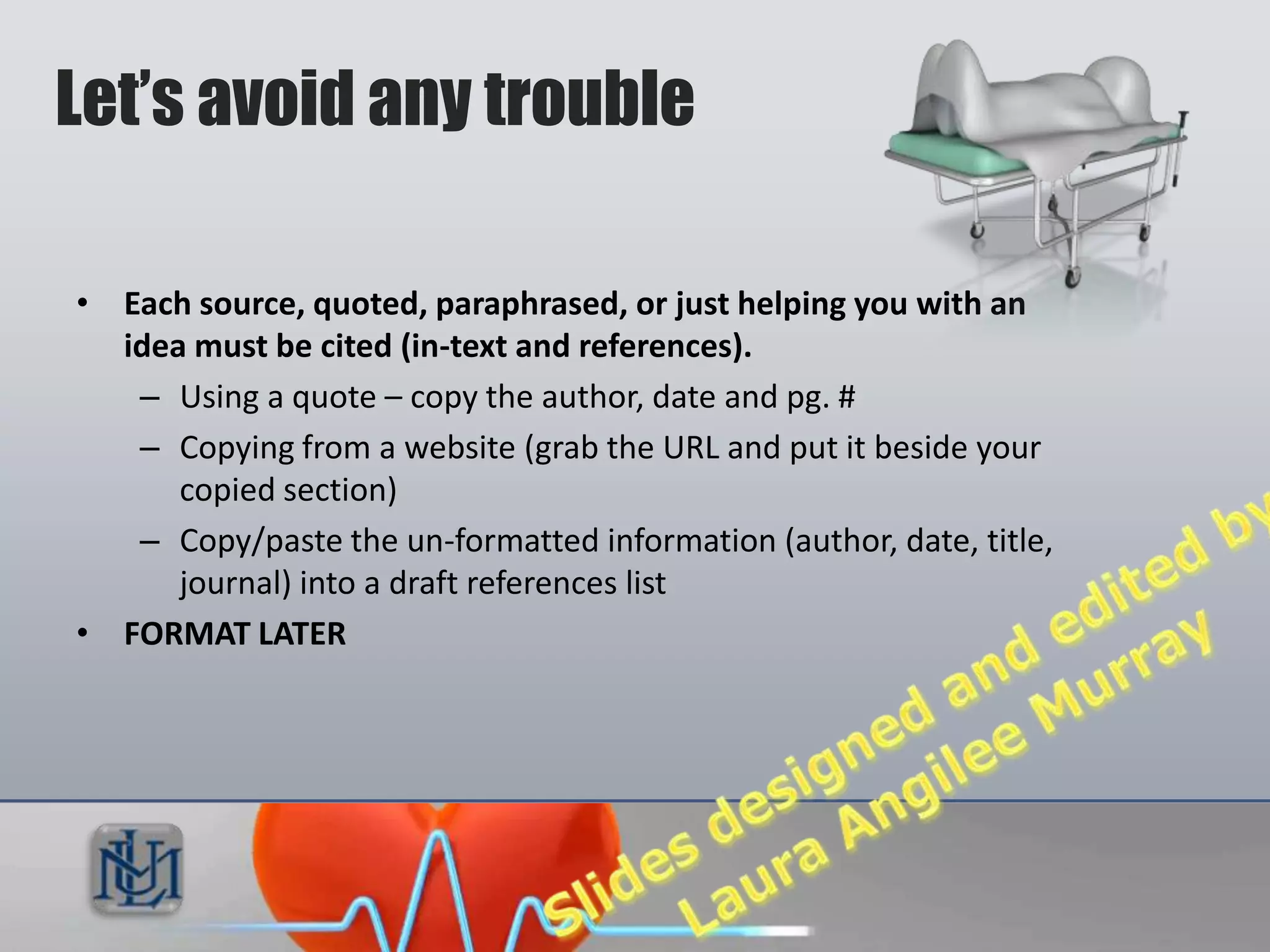
Let’s avoid any trouble

• Each source, quoted, paraphrased, or just helping you with an
  idea must be cited (in-text and references).
   – Using a quote – copy the author, date and pg. #
   – Copying from a website (grab the URL and put it beside your
      copied section)
   – Copy/paste the un-formatted information (author, date, title,
      journal) into a draft references list
• FORMAT LATER
Knowledge Quiz
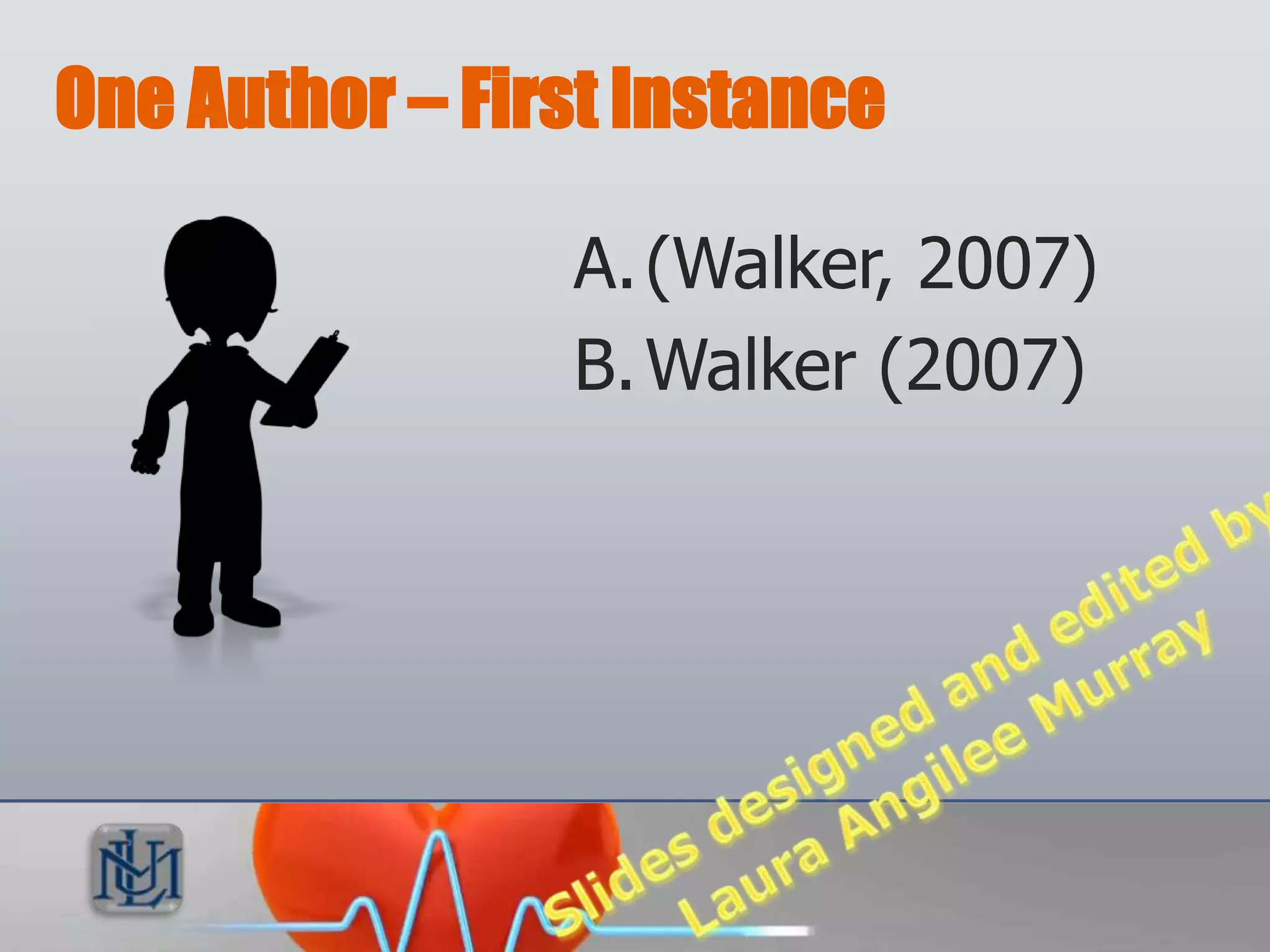
One Author – First Instance

                A. (Walker, 2007)
                B. Walker (2007)
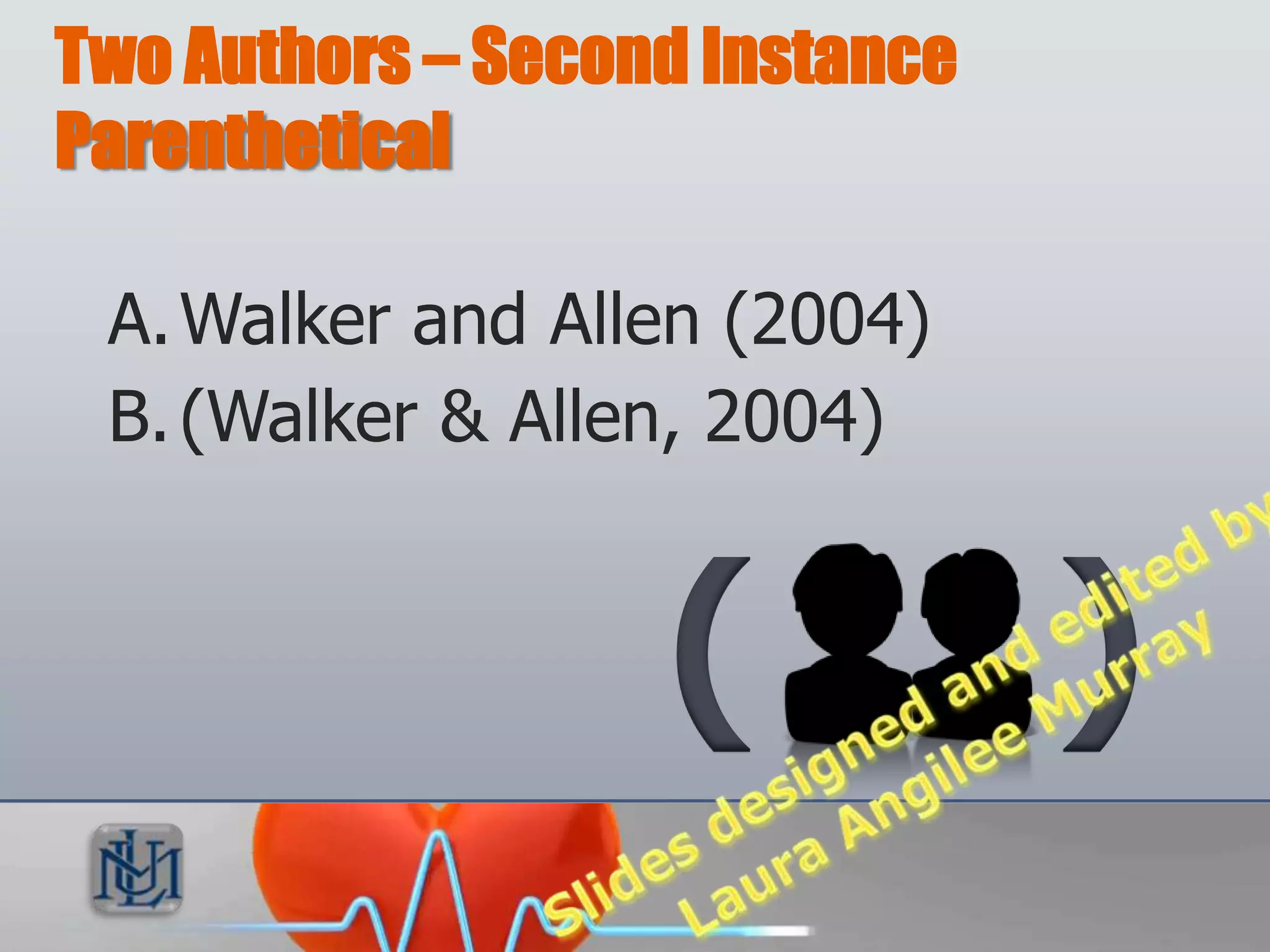
Two Authors – Second Instance
Parenthetical

 A. Walker and Allen (2004)
 B. (Walker & Allen, 2004)


                   (            )
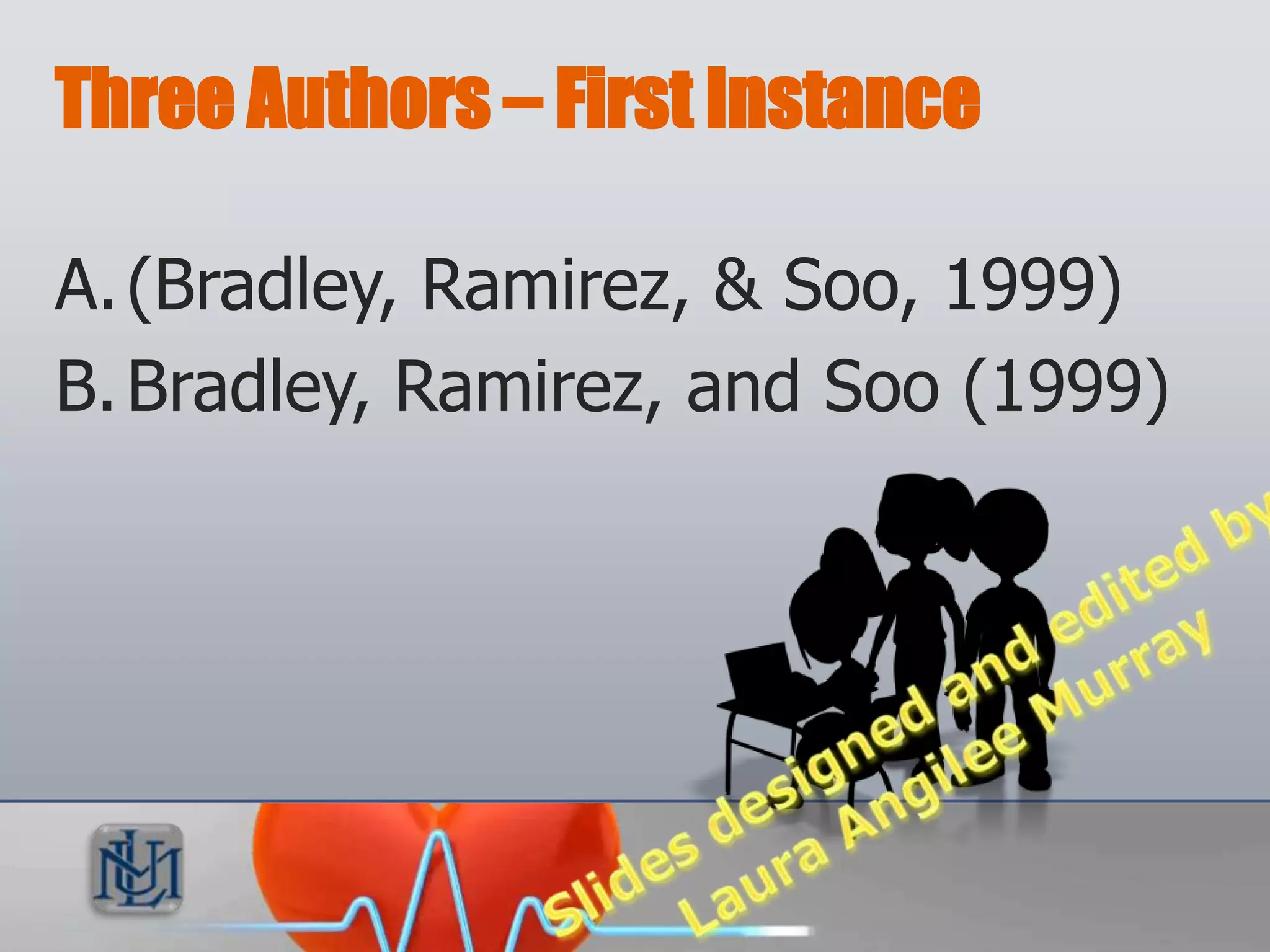
Three Authors – First Instance

A. (Bradley, Ramirez, & Soo, 1999)
B. Bradley, Ramirez, and Soo (1999)
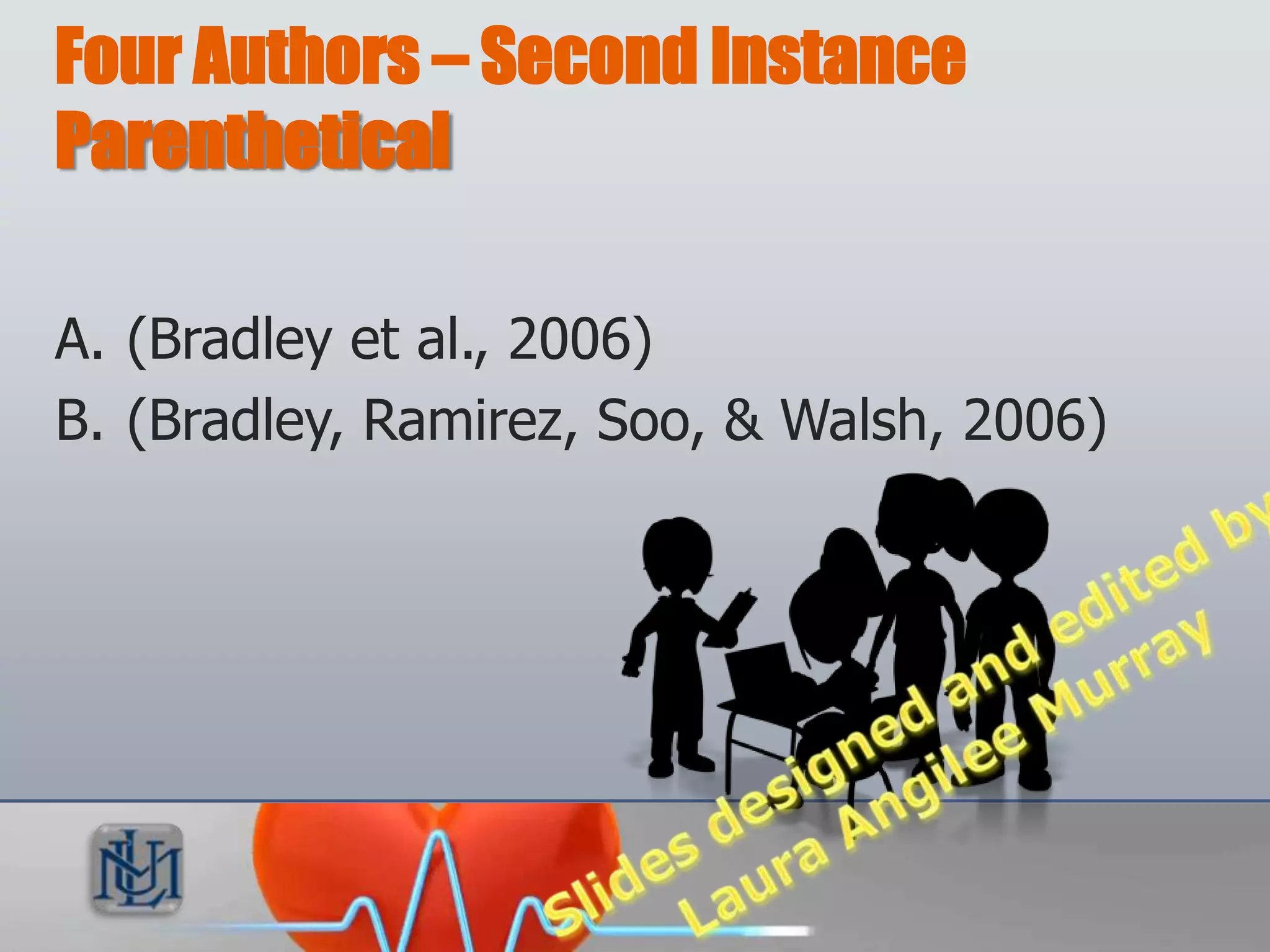
Four Authors – Second Instance
Parenthetical

A. (Bradley et al., 2006)
B. (Bradley, Ramirez, Soo, & Walsh, 2006)
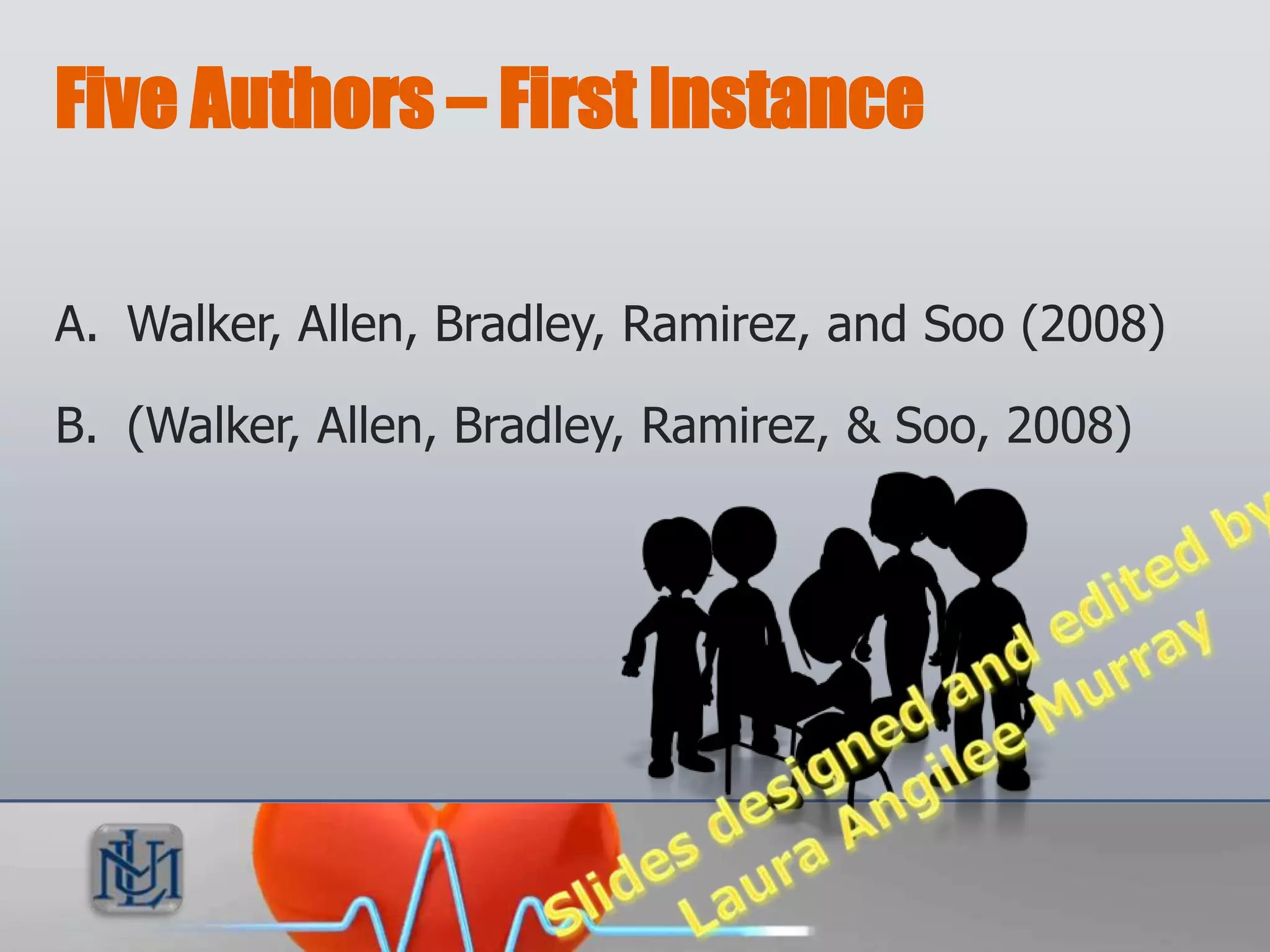
Five Authors – First Instance

A. Walker, Allen, Bradley, Ramirez, and Soo (2008)

B. (Walker, Allen, Bradley, Ramirez, & Soo, 2008)
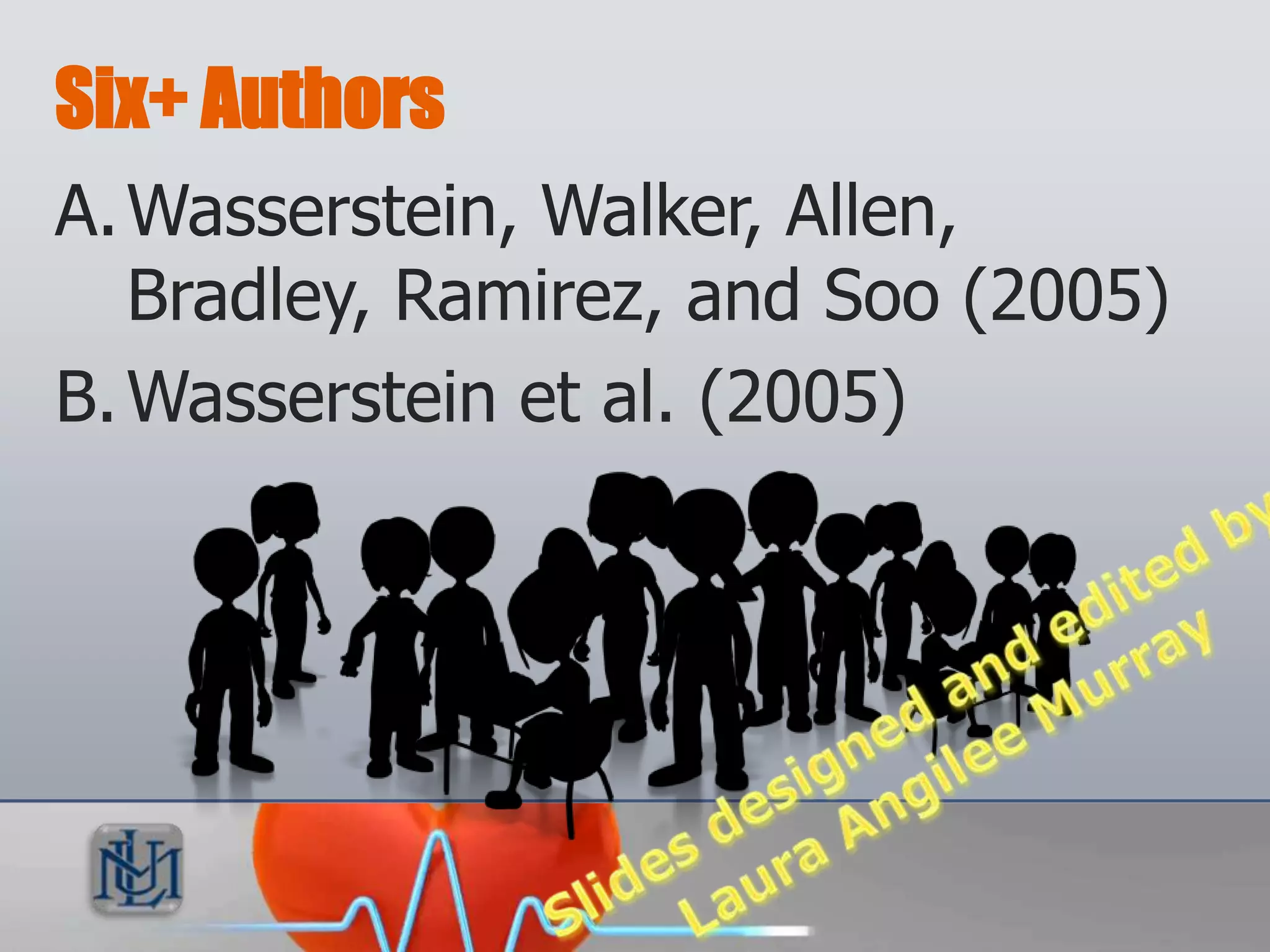
Six+ Authors
A. Wasserstein, Walker, Allen,
   Bradley, Ramirez, and Soo (2005)
B. Wasserstein et al. (2005)
Crediting Sources
Reference List
References
The slide show was designed and edited by Laura Angilee Murray for Lincoln Memorial
University’s Carnegie-Vincent Library. The text presented in this slide show was compiled by
Dr. Tiffani R. Conner. A reference list will be added as soon as one is received.
Please, remember, neither party takes credit for the content in its entirety and any
plagiarism is unintentional and will be answered by the insertion of a references list.

Presentation sample l murray

  • 1.
  • 2.
    SEWS What itis and why it matters • Assessing how well students’ general writing and information literacy skills are developing. • Graduation requirement to take and pass SEWS credit courses because we expect SEWS: students to be proficient in Sequenced basic writing and research Enhancement of Writing Skills skills.
  • 3.
    SEWS & QEP •QEP??? Quality Enhancement Plan • 5-year plan to improve student skills in Information Literacy, demonstrated most through writing • Show Rubric (handout)
  • 4.
    Locating Information • Books • Library Databases • Web Sources • Get help from your librarian Dr. Tiffani R. Conner Tiffani.Conner@lmunet.edu
  • 5.
    Dr. Tiffani R.Conner, MS, MSIS o 13 years – Academic Libraries o Social Sciences & Information Sciences o Data and GIS Services – Demographics o Nuclear Remediation / Health Physics Research areas: o Adult learning, esp. workplace and training o Rehabilitation education – chronic illness o Self-directed learning and engagement o Information literacy & digital literacy o Assessment and evaluation o Geriatrics
  • 6.
  • 7.
    Library Databases • Discipline specific and General • Authoritative Information • Items that cost money from other places (websites) • Overview of Databases at CVL
  • 8.
    Evaluating Sources Accuracy Authority Objectivity Are sources of Who is responsible for Are biases clearly stated? Are any political/ ideological information and factual the work and what are agenda hidden to disguise data listed, and their qualifications and its purpose? available for cross- associations, and can Do they use a misleading checking? name or other means to do you verify them? this? Currency Coverage Relevancy How up-to-date is the What is the focus of Does the resource information? the work? actually cover the topic you are researching?
  • 9.
    Next Step –Writing Looked for our sources Read and evaluated them Determined which one’s to use Now what…..
  • 10.
    Types of AcademicPapers CRITICAL ANALYSIS CLAIM A critical analysis ARGUMENT focuses, for example, on how stringently claims and arguments are presented and A claim, in academic terms, how conclusively ideas are An argument presents and is something that is asserted linked. It may also focus on discusses a central or set of to be true or valid. It must be the style of writing or its related claims. Arguments based on factual evidence. literary quality. In factual frequently take the form of This must be presented. texts a critical analysis may a discussion of a thesis or Academics analyze and start with a description of a hypothesis. They often lead evaluate the evidence upon state or event which is then to a discussion of which claims are based. This analyzed and compared to arguments ‘for and against’. includes presentation of other events or interpreted in The result can be a examples and quotation of terms of a model. A critical synthesis or conclusion. relevant outside sources. analysis frequently leads to an evaluation. Multhaup, U. (n.d.). Principles of academic writing. Retrieved from http://www2.uni- wuppertal.de/FB4/anglistik/multhaup/study_skills/7_study_skill_txt_academic_principles_acad_writing.htm
  • 11.
    Academic Papers –Three parts Introduction should clearly state the aim and topic of the paper and give a brief outline of its structure, line of argument or choice of perspective and type of presentation. • Thesis Statement – Purpose/Goals Main body of the text should be divided into sections and sub- sections, indicated using different levels of headings indicating transitions and turns in the discussion. • Body – Support thesis/purpose with evidence – Draw conclusions, support with evidence Summary. This is followed by a reference list containing all the books, articles, and other sources used for producing the paper and quoted in it. • Conclusion section – Tie things up, restate (or reiterate) the thesis/purpose, then illustrate how you achieved the goal
  • 12.
    Plagiarism • Plagiarism isusing someone else’s words as your own. • Plagiarism occurs when you: – Leave out quotations marks for quotes – Leave out the author’s name, date and page number of the quote – “Rewrite” (a.k.a. paraphrase) too closely to the original Create a handout with examples of text that are/are not plagiarized…go over in class
  • 13.
    Examples of Plagiarism &Consequences • Joseph Biden failed a course when he was in law course because he plagiarized a paper. • Writer Alex Haley wrote a novel, and eventually he admitted that he had plagiarized information from a book entitled The African written by Harold Courlander.
  • 14.
    Student Examples The The Case The Judgment Perpetrator An Ohio University student was Expelled from the University of Virginia’s College charged with plagiarizing a paper Semester at Sea program. She was forced to because she didn’t cite or paraphrase Student correctly. disembark early and go home. He received a zero on the assignment, which Your average UCSD student who cut caused him to fail the class and he needed to “Tommy and pasted phrases from Internet repeat it. He also had to attend a special Triton” websites into his research paper. workshop. For more information see UCSD’s Policy on Integrity of Scholarship 3 college The university has already disciplined some students faculty members, and it has notified graduates Ohio U. Panel Rules in Plagiarism suspected of plagiarism that they must forfeit Cases of 3 Engineering Students their degrees, contest the charges, or ask to rewrite their theses.
  • 15.
    Plagiarizing Articles –Nursing Journals • The Journal of Child & Adolescent Psychiatric Nursing, the Journal of the American Academy of Nurse Practitioners, and Perspectives in Psychiatric Care • http://www.ithenticate.com/plagia rism-detection- blog/bid/68824/Professor-Caught- For-Plagiarizing-Articles-in- Nursing-Journals
  • 16.
    Let’s avoid anytrouble • Each source, quoted, paraphrased, or just helping you with an idea must be cited (in-text and references). – Using a quote – copy the author, date and pg. # – Copying from a website (grab the URL and put it beside your copied section) – Copy/paste the un-formatted information (author, date, title, journal) into a draft references list • FORMAT LATER
  • 17.
  • 18.
    One Author –First Instance A. (Walker, 2007) B. Walker (2007)
  • 19.
    Two Authors –Second Instance Parenthetical A. Walker and Allen (2004) B. (Walker & Allen, 2004) ( )
  • 20.
    Three Authors –First Instance A. (Bradley, Ramirez, & Soo, 1999) B. Bradley, Ramirez, and Soo (1999)
  • 21.
    Four Authors –Second Instance Parenthetical A. (Bradley et al., 2006) B. (Bradley, Ramirez, Soo, & Walsh, 2006)
  • 22.
    Five Authors –First Instance A. Walker, Allen, Bradley, Ramirez, and Soo (2008) B. (Walker, Allen, Bradley, Ramirez, & Soo, 2008)
  • 23.
    Six+ Authors A. Wasserstein,Walker, Allen, Bradley, Ramirez, and Soo (2005) B. Wasserstein et al. (2005)
  • 24.
  • 25.
    References The slide showwas designed and edited by Laura Angilee Murray for Lincoln Memorial University’s Carnegie-Vincent Library. The text presented in this slide show was compiled by Dr. Tiffani R. Conner. A reference list will be added as soon as one is received. Please, remember, neither party takes credit for the content in its entirety and any plagiarism is unintentional and will be answered by the insertion of a references list.