The Description of Developmental Stages for Question
Formation of the Fourth Semester Students of English
Department of Mulawarman University in Academic Year
2011/2012
By Nurul Achmad (08.0508.5141)

Group Member:
Alifa Prima Budiarga
Indy Rahmawaty
Muhammad Syuaib

1005085138
10050851
10050851
CHAPTER I
INTRODUCTION
CHAPTER II
REVIEW OF RELATED
LITERATURE
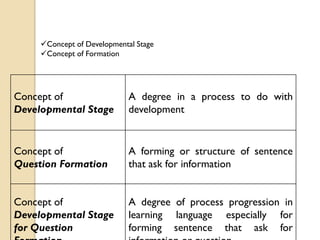
Concept of Developmental Stage
Concept of Formation

Concept of
Developmental Stage

A degree in a process to do with
development

Concept of
Question Formation

A forming or structure of sentence
that ask for information

Concept of
Developmental Stage
for Question

A degree of process progression in
learning language especially for
forming sentence that ask for
Type of Questions by Schramper
WH-Questions

What Kind of music do you
like?

Yes-no Questions

Would Kelly be there next
week?

Question Tag

Jacob is here, isn’t he?

Negative Questions

Isn’t the teacher here today?
Type of Questions by Pyle and Page
WH-Questions

What Kind of music do you
like?

Yes-no Questions

Would Kelly be there next
week?

Question Tag

Jacob is here, isn’t he?

Embedded Question

I don‟t know where she
lives
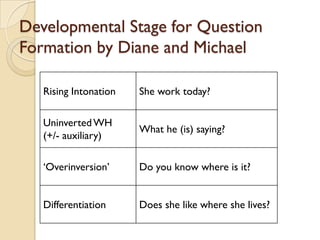
Developmental Stage for Question
Formation by Diane and Michael
Rising Intonation

She work today?

Uninverted WH
(+/- auxiliary)

What he (is) saying?

„Overinversion‟

Do you know where is it?

Differentiation

Does she like where she lives?
Developmental Stage for Question Formation

by Pienemann, Johnston and Brindley
Stage

Description

Sample Utterance

1

Single word of formulae

Four children?

2

Declarative word orders
(no inversion, no fronting)

It‟s a monster in the right corner?
The boys throw the shoes?

Fronting

Where the children are?
Is the picture has two planets on
top?

3
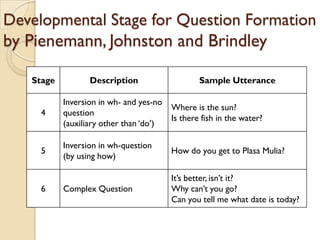
Developmental Stage for Question Formation

by Pienemann, Johnston and Brindley
Stage

Description

4

Inversion in wh- and yes-no
question
(auxiliary other than „do‟)

Where is the sun?
Is there fish in the water?

5

Inversion in wh-question
(by using how)

How do you get to Plasa Mulia?

Complex Question

It‟s better, isn‟t it?
Why can‟t you go?
Can you tell me what date is today?

6

Sample Utterance


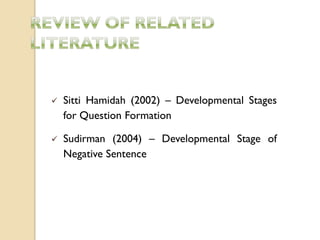
Sitti Hamidah (2002) – Developmental Stages
for Question Formation



Sudirman (2004) – Developmental Stage of
Negative Sentence
CHAPTER III
RESEARCH METHOD
 qualitative research
 data will be narrative evidence
 table of analyzing data only for supporting
the data
 The fourth semester students of English
Department of Mulawarman University in
academic year 2011/2012
 25% of the subjects
 Random system
 Reading passage test in titled “Thomas
and the Gorillas” from Reading Power
Second Edition book by Beatrice S.
Mickulecky
 Giving the reading test to the students
 Asking them to make various questions
 Collecting the data in form of various
questions
 Making table of collecting the data based
on Pienemann, Johnston and Brindley‟s
stage (1988)
 Analyzing by listing in the stage table
systematically
 Counting how many students made
question and how many questions
students made for each stage
 Finding the highest total number of
students and questions that students can
make it

Developmental Stages for Question Formation

  • 1.
    The Description ofDevelopmental Stages for Question Formation of the Fourth Semester Students of English Department of Mulawarman University in Academic Year 2011/2012 By Nurul Achmad (08.0508.5141) Group Member: Alifa Prima Budiarga Indy Rahmawaty Muhammad Syuaib 1005085138 10050851 10050851
  • 2.
  • 3.
    CHAPTER II REVIEW OFRELATED LITERATURE
  • 4.
    Concept of DevelopmentalStage Concept of Formation Concept of Developmental Stage A degree in a process to do with development Concept of Question Formation A forming or structure of sentence that ask for information Concept of Developmental Stage for Question A degree of process progression in learning language especially for forming sentence that ask for
  • 5.
    Type of Questionsby Schramper WH-Questions What Kind of music do you like? Yes-no Questions Would Kelly be there next week? Question Tag Jacob is here, isn’t he? Negative Questions Isn’t the teacher here today?
  • 6.
    Type of Questionsby Pyle and Page WH-Questions What Kind of music do you like? Yes-no Questions Would Kelly be there next week? Question Tag Jacob is here, isn’t he? Embedded Question I don‟t know where she lives
  • 7.
    Developmental Stage forQuestion Formation by Diane and Michael Rising Intonation She work today? Uninverted WH (+/- auxiliary) What he (is) saying? „Overinversion‟ Do you know where is it? Differentiation Does she like where she lives?
  • 8.
    Developmental Stage forQuestion Formation by Pienemann, Johnston and Brindley Stage Description Sample Utterance 1 Single word of formulae Four children? 2 Declarative word orders (no inversion, no fronting) It‟s a monster in the right corner? The boys throw the shoes? Fronting Where the children are? Is the picture has two planets on top? 3
  • 9.
    Developmental Stage forQuestion Formation by Pienemann, Johnston and Brindley Stage Description 4 Inversion in wh- and yes-no question (auxiliary other than „do‟) Where is the sun? Is there fish in the water? 5 Inversion in wh-question (by using how) How do you get to Plasa Mulia? Complex Question It‟s better, isn‟t it? Why can‟t you go? Can you tell me what date is today? 6 Sample Utterance
  • 10.
     Sitti Hamidah (2002)– Developmental Stages for Question Formation  Sudirman (2004) – Developmental Stage of Negative Sentence
  • 11.
  • 12.
     qualitative research data will be narrative evidence  table of analyzing data only for supporting the data
  • 13.
     The fourthsemester students of English Department of Mulawarman University in academic year 2011/2012  25% of the subjects  Random system
  • 14.
     Reading passagetest in titled “Thomas and the Gorillas” from Reading Power Second Edition book by Beatrice S. Mickulecky
  • 15.
     Giving thereading test to the students  Asking them to make various questions  Collecting the data in form of various questions  Making table of collecting the data based on Pienemann, Johnston and Brindley‟s stage (1988)
  • 16.
     Analyzing bylisting in the stage table systematically  Counting how many students made question and how many questions students made for each stage  Finding the highest total number of students and questions that students can make it