Acculturation
Theory
MA-ELT
Pidgin and creole phenomena
and L2 acquisition
Some terms to keep in mind-
 Static paradigm and dynamic paradigm
 Pidginization and Depidginization
 Creolization and decreolization
 Nativization and denativization
Also keep in mind you have learnt about
Interlanguage and Interlangauge theory
What is Pidgin and Creole???
Acculturation Theory
“Acculturation as a process of involving modifications
in attitudes, knowledge and behavior”
 Addition of new elements to cultural background
 Elimination of certain existing elements and also
reorganization of others
 It demands social and psychological adaptation to
function with target language groups
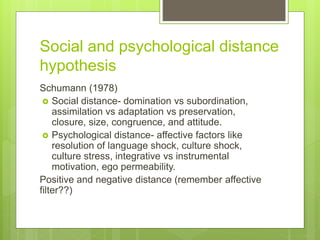
Social and psychological distance
hypothesis
Schumann (1978)
 Social distance- domination vs subordination,
assimilation vs adaptation vs preservation,
closure, size, congruence, and attitude.
 Psychological distance- affective factors like
resolution of language shock, culture shock,
culture stress, integrative vs instrumental
motivation, ego permeability.
Positive and negative distance (remember affective
filter??)
Factors affecting social and
psychological distance
Early, middle and late stages in
L2 acquisition
 Early stage- pidginization leading to
fossilization (pidginized, fossilized, no revision
of the interlanguage)
 Depidginization
 The case of Alberto
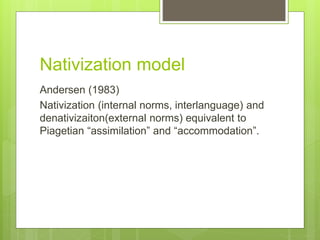
Nativization model
Andersen (1983)
Nativization (internal norms, interlanguage) and
denativizaiton(external norms) equivalent to
Piagetian “assimilation” and “accommodation”.
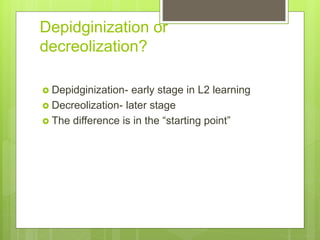
Depidginization or
decreolization?
 Depidginization- early stage in L2 learning
 Decreolization- later stage
 The difference is in the “starting point”
Decreolization toward TL
Stauble 1978
 Basilang
 Mesolang
 Acrolang
Decreolization progresses from basilect(closest
to creole)-mesolect-acrolect (closest to TL) –
Bickerton (1977)

Acculturation Theory

  • 1.
  • 2.
    Pidgin and creolephenomena and L2 acquisition Some terms to keep in mind-  Static paradigm and dynamic paradigm  Pidginization and Depidginization  Creolization and decreolization  Nativization and denativization Also keep in mind you have learnt about Interlanguage and Interlangauge theory
  • 3.
    What is Pidginand Creole???
  • 4.
    Acculturation Theory “Acculturation asa process of involving modifications in attitudes, knowledge and behavior”  Addition of new elements to cultural background  Elimination of certain existing elements and also reorganization of others  It demands social and psychological adaptation to function with target language groups
  • 5.
    Social and psychologicaldistance hypothesis Schumann (1978)  Social distance- domination vs subordination, assimilation vs adaptation vs preservation, closure, size, congruence, and attitude.  Psychological distance- affective factors like resolution of language shock, culture shock, culture stress, integrative vs instrumental motivation, ego permeability. Positive and negative distance (remember affective filter??)
  • 6.
    Factors affecting socialand psychological distance
  • 7.
    Early, middle andlate stages in L2 acquisition  Early stage- pidginization leading to fossilization (pidginized, fossilized, no revision of the interlanguage)  Depidginization  The case of Alberto
  • 8.
    Nativization model Andersen (1983) Nativization(internal norms, interlanguage) and denativizaiton(external norms) equivalent to Piagetian “assimilation” and “accommodation”.
  • 9.
    Depidginization or decreolization?  Depidginization-early stage in L2 learning  Decreolization- later stage  The difference is in the “starting point”
  • 10.
    Decreolization toward TL Stauble1978  Basilang  Mesolang  Acrolang Decreolization progresses from basilect(closest to creole)-mesolect-acrolect (closest to TL) – Bickerton (1977)