
CHAPTER 5 : ASKING QUESTION
By. Abyasa Widiarta
5-1 YES/NO QUESTIONS AND SHORT ANSWER
YES/NO QUESTION SHORT ANSWER (+LONG ANSWER
(a) Do you like tea? Yes, I do. (I like tea.)
No, I don’t. (I don’t like tea.)
A yes/no question is a
question that can be
answered by yes or no.
In a affirmative short
answer (yes), a helping verb
is NOT contracted with the
subject.
In (c): INCORRECT: yes, I’ve
In (d): INCORRECT: yes, it’s.
In (e); INCORRECT: yes, he’ll
The spoken emphasis in a
short answer is on the verb.
(b) Did Sue call? Yes, she did. (Sue called.)
No, she didn’t (Sue didn’t call.)
(c) Have you met Al? Yes, I have. (I have met Al.)
No, I haven’t. (I haven’t met Al.)
(d) Is it raining ? Yes, it is. (it’s raining.)
No, it isn’t (it isn’t raining.)
(e) Will Rob be here? Yes, he will. (Rob will be here.)
No, he won’t (Rob won’
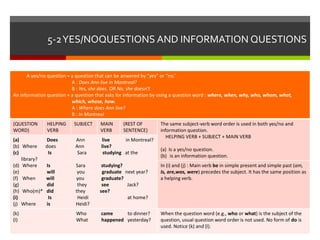
5-2YES/NOQUESTIONS AND INFORMATION QUESTIONS
A yes/no question = a question that can be anwered by “yes” or “no.’
A : Does Ann live in Montreal?
B : Yes, she does. OR No, she doesn’t
An information question = a question that asks for information by using a question word : where, when, why, who, whom, what,
which, whose, how.
A : Where does Ann live?
B : In Montreal
(QUESTION
WORD)
HELPING
VERB
SUBJECT MAIN
VERB
(REST OF
SENTENCE)
The same subject-verb word order is used in both yes/no and
information question.
HELPING VERB + SUBJECT + MAIN VERB
(a) Is a yes/no question.
(b) is an information question.
(a) Does Ann live in Montreal?
(b) Where does Ann live?
(c) Is Sara studying at the
library?
(d) Where Is Sara studying?
(e) will you graduate next year?
(f) When will you graduate?
(g) did they see Jack?
(h) Who(m)* did they see?
(i) Is Heidi at home?
(j) Where is Heidi?
In (i) and (j) : Main verb be in simple present and simple past (am,
Is, are,was, were) precedes the subject. It has the same position as
a helping verb.
(k) Who came to dinner?
(l) What happened yesterday?
When the question word (e.g., who or what) is the subject of the
question, usual question word order is not used. No form of do is
used. Notice (k) and (l).
5-3 WHERE, WHY, WHEN ANDWHATTIME
QUESTION ANSWER
(a) Where did you go? Paris.
(b) Why did you stay home? Because I didn’t feel well.
Seven-thirty.
(c) What time did he come? Around five o'clock.
A quarter past ten.
Last night.
Seven-thirty
(d) When did he come? Two days ago.
Monday morning.
In 1998.
Where asks about place.
Why ask about reason.
A question with what time
asks about time on a dock.
A question with when can be
answered by any time
expression, as in
the sample answers in (d).
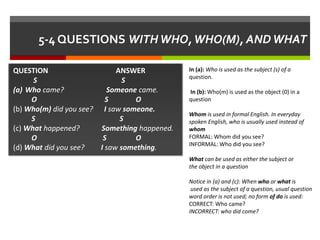
5-4 QUESTIONS WITHWHO,WHO(M), ANDWHAT
QUESTION ANSWER
S S
(a) Who came? Someone came.
O S O
(b) Who(m) did you see? I saw someone.
S S
(c) What happened? Something happened.
O S O
(d) What did you see? I saw something.
In (a): Who is used as the subject (s) of a
question.
In (b): Who(m) is used as the object (0) in a
question
Whom is used in formal English. In everyday
spoken English, who is usually used instead of
whom
FORMAL: Whom did you see?
INFORMAL: Who did you see?
What can be used as either the subject or
the object in a question
Notice in (a) and (c): When who or what is
used as the subject of a question, usual question
word order is not used; no form of do is used:
CORRECT: Who came?
INCORRECT: who did come?
5-5 SPOKEN AND WRITTEN CONTRACTIONS WITH
QUESTION WORDS
is (a) "When's he coming?"
"Why's she late?"
are (b) "What're these?"
“Who're they?"
Did (c) "Who'd you see?"
"What'd you do?"
will (d) "Where‘ ll you be?"
"When‘ ll they be here?"
Is, are, did and will are usually contracted
with question words in speaking. These
contractions are usually NOT written.
SPOKEN WRITTEN
(e) ”Where’s Ed?" (f) Where’s Ed?
"What's that?" What’s that?
"Who's he?" Who's he?
Only contractions with is and where, what, or
who are commonly used in writing.
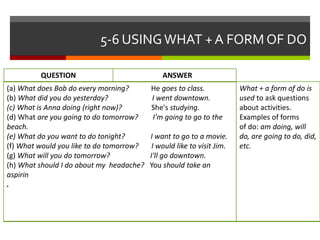
5-6 USINGWHAT +A FORM OF DO
QUESTION ANSWER
What + a form of do is
used to ask questions
about activities.
Examples of forms
of do: am doing, will
do, are going to do, did,
etc.
(a) What does Bob do every morning? He goes to class.
(b) What did you do yesterday? I went downtown.
(c) What is Anna doing (right now)? She's studying.
(d) What are you going to do tomorrow? I'm going to go to the
beach.
(e) What do you want to do tonight? I want to go to a movie.
(f) What would you like to do tomorrow? I would like to visit Jim.
(g) What will you do tomorrow? I'll go downtown.
(h) What should I do about my headache? You should take an
aspirin
.
5-7 USINGWHAT KIND OF
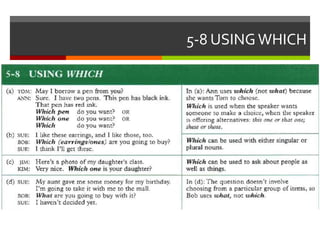
5-8 USINGWHICH
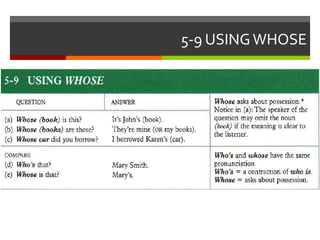
5-9 USINGWHOSE
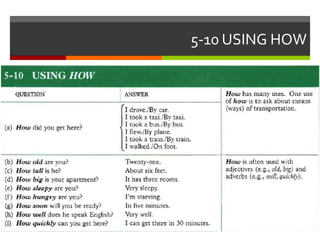
5-10 USING HOW
5-11 USING HOW OFTEN
5-12 USING HOW FAR
5-13 USING LENGTH OFTIME : IT +TAKE AND HOW
LONG
5-14 MORE QUESTIONWITH HOW
5-15 USING HOW ABOUT ANDWHAT ABOUT
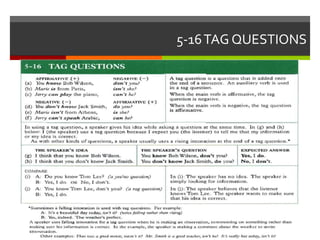
5-16TAG QUESTIONS

Chapter5

  • 1.
     CHAPTER 5 :ASKING QUESTION By. Abyasa Widiarta
  • 2.
    5-1 YES/NO QUESTIONSAND SHORT ANSWER YES/NO QUESTION SHORT ANSWER (+LONG ANSWER (a) Do you like tea? Yes, I do. (I like tea.) No, I don’t. (I don’t like tea.) A yes/no question is a question that can be answered by yes or no. In a affirmative short answer (yes), a helping verb is NOT contracted with the subject. In (c): INCORRECT: yes, I’ve In (d): INCORRECT: yes, it’s. In (e); INCORRECT: yes, he’ll The spoken emphasis in a short answer is on the verb. (b) Did Sue call? Yes, she did. (Sue called.) No, she didn’t (Sue didn’t call.) (c) Have you met Al? Yes, I have. (I have met Al.) No, I haven’t. (I haven’t met Al.) (d) Is it raining ? Yes, it is. (it’s raining.) No, it isn’t (it isn’t raining.) (e) Will Rob be here? Yes, he will. (Rob will be here.) No, he won’t (Rob won’
  • 3.
    5-2YES/NOQUESTIONS AND INFORMATIONQUESTIONS A yes/no question = a question that can be anwered by “yes” or “no.’ A : Does Ann live in Montreal? B : Yes, she does. OR No, she doesn’t An information question = a question that asks for information by using a question word : where, when, why, who, whom, what, which, whose, how. A : Where does Ann live? B : In Montreal (QUESTION WORD) HELPING VERB SUBJECT MAIN VERB (REST OF SENTENCE) The same subject-verb word order is used in both yes/no and information question. HELPING VERB + SUBJECT + MAIN VERB (a) Is a yes/no question. (b) is an information question. (a) Does Ann live in Montreal? (b) Where does Ann live? (c) Is Sara studying at the library? (d) Where Is Sara studying? (e) will you graduate next year? (f) When will you graduate? (g) did they see Jack? (h) Who(m)* did they see? (i) Is Heidi at home? (j) Where is Heidi? In (i) and (j) : Main verb be in simple present and simple past (am, Is, are,was, were) precedes the subject. It has the same position as a helping verb. (k) Who came to dinner? (l) What happened yesterday? When the question word (e.g., who or what) is the subject of the question, usual question word order is not used. No form of do is used. Notice (k) and (l).
  • 4.
    5-3 WHERE, WHY,WHEN ANDWHATTIME QUESTION ANSWER (a) Where did you go? Paris. (b) Why did you stay home? Because I didn’t feel well. Seven-thirty. (c) What time did he come? Around five o'clock. A quarter past ten. Last night. Seven-thirty (d) When did he come? Two days ago. Monday morning. In 1998. Where asks about place. Why ask about reason. A question with what time asks about time on a dock. A question with when can be answered by any time expression, as in the sample answers in (d).
  • 5.
    5-4 QUESTIONS WITHWHO,WHO(M),ANDWHAT QUESTION ANSWER S S (a) Who came? Someone came. O S O (b) Who(m) did you see? I saw someone. S S (c) What happened? Something happened. O S O (d) What did you see? I saw something. In (a): Who is used as the subject (s) of a question. In (b): Who(m) is used as the object (0) in a question Whom is used in formal English. In everyday spoken English, who is usually used instead of whom FORMAL: Whom did you see? INFORMAL: Who did you see? What can be used as either the subject or the object in a question Notice in (a) and (c): When who or what is used as the subject of a question, usual question word order is not used; no form of do is used: CORRECT: Who came? INCORRECT: who did come?
  • 6.
    5-5 SPOKEN ANDWRITTEN CONTRACTIONS WITH QUESTION WORDS is (a) "When's he coming?" "Why's she late?" are (b) "What're these?" “Who're they?" Did (c) "Who'd you see?" "What'd you do?" will (d) "Where‘ ll you be?" "When‘ ll they be here?" Is, are, did and will are usually contracted with question words in speaking. These contractions are usually NOT written. SPOKEN WRITTEN (e) ”Where’s Ed?" (f) Where’s Ed? "What's that?" What’s that? "Who's he?" Who's he? Only contractions with is and where, what, or who are commonly used in writing.
  • 7.
    5-6 USINGWHAT +AFORM OF DO QUESTION ANSWER What + a form of do is used to ask questions about activities. Examples of forms of do: am doing, will do, are going to do, did, etc. (a) What does Bob do every morning? He goes to class. (b) What did you do yesterday? I went downtown. (c) What is Anna doing (right now)? She's studying. (d) What are you going to do tomorrow? I'm going to go to the beach. (e) What do you want to do tonight? I want to go to a movie. (f) What would you like to do tomorrow? I would like to visit Jim. (g) What will you do tomorrow? I'll go downtown. (h) What should I do about my headache? You should take an aspirin .
  • 8.
  • 9.
  • 10.
  • 11.
  • 12.
  • 13.
  • 14.
    5-13 USING LENGTHOFTIME : IT +TAKE AND HOW LONG
  • 15.
  • 16.
    5-15 USING HOWABOUT ANDWHAT ABOUT
  • 17.