Academic
Language and Its
Characteristics
A Comparison
with Social
Language
Introduction
Brief overview of the importance
of language in academic and
social contexts.
Definition of academic language.
Definition of social language.
What is Academic Language?
 Language used in educational
settings.
 Used for acquiring new knowledge,
discussing complex topics, and
expressing ideas formally.
 Includes specialized vocabulary,
complex sentence structures, and
precise expression.
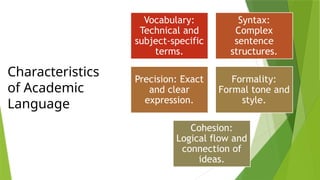
Characteristics
of Academic
Language
Vocabulary:
Technical and
subject-specific
terms.
Syntax:
Complex
sentence
structures.
Precision: Exact
and clear
expression.
Formality:
Formal tone and
style.
Cohesion:
Logical flow and
connection of
ideas.
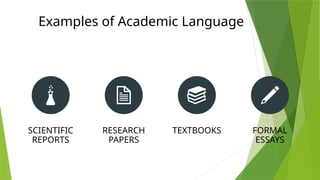
Examples of Academic Language
SCIENTIFIC
REPORTS
RESEARCH
PAPERS
TEXTBOOKS FORMAL
ESSAYS
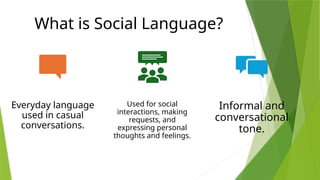
What is Social Language?
Everyday language
used in casual
conversations.
Used for social
interactions, making
requests, and
expressing personal
thoughts and feelings.
Informal and
conversational
tone.
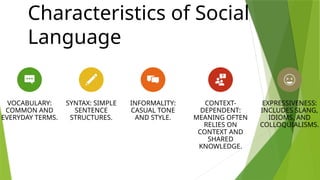
Characteristics of Social
Language
VOCABULARY:
COMMON AND
EVERYDAY TERMS.
SYNTAX: SIMPLE
SENTENCE
STRUCTURES.
INFORMALITY:
CASUAL TONE
AND STYLE.
CONTEXT-
DEPENDENT:
MEANING OFTEN
RELIES ON
CONTEXT AND
SHARED
KNOWLEDGE.
EXPRESSIVENESS:
INCLUDES SLANG,
IDIOMS, AND
COLLOQUIALISMS.
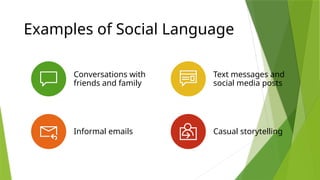
Examples of Social Language
Conversations with
friends and family
Text messages and
social media posts
Informal emails Casual storytelling
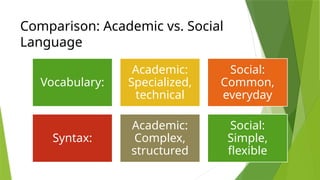
Comparison: Academic vs. Social
Language
Vocabulary:
Academic:
Specialized,
technical
Social:
Common,
everyday
Syntax:
Academic:
Complex,
structured
Social:
Simple,
flexible
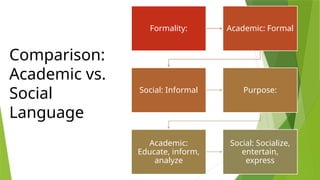
Comparison:
Academic vs.
Social
Language
Formality: Academic: Formal
Social: Informal Purpose:
Academic:
Educate, inform,
analyze
Social: Socialize,
entertain,
express
Importance
of Academic
Language
Essential for academic
success.
Critical for understanding and
producing scholarly work.
Helps in developing critical
thinking and analytical skills.
Developing Academic
Language Skills
 Read academic texts regularly.
 Practice writing formal essays
and reports.
 Engage in academic discussions
and debates.
 Learn subject-specific
vocabulary.
Conclusion
Recap of the key differences between academic
and social language.
Importance of mastering both for effective
communication.
Encouragement to practice and develop
academic language skills.
RECITATION #1:
Directions: Using the Venn
diagram, compare and
contrast the characteristics of
Academic Language and Social
Language

Academic Language and Its Characteristics.pptx