Nature and Characteristicsof an Academic
Text
An academic text is a written language that provides
information, which contain ideas and concepts that are related
to the particular discipline. Essay, Research Paper, Report,
Project, Article, Thesis, and Dissertation are considered as
academic texts.
2
3.
STRU CTUR E
Thebasic structure that is used by an academic text is
consist of three (3) parts introduction, body, and conclusion
which is formal and logical.
This kind of structure enables the reader to follow the
argument and navigate the text. In academic writing a
clear structure and a logical flow are imperative to a cohesive
text. 3
4.
TONE
This refers tothe attitude conveyed in a piece of
writing. The arguments of others are fairly presented and
with an appropriate narrative tone. When presenting a
position or argument that disagrees with one’s
perspectives, describe the argument accurately
without loaded or biased language.
4
5.
LA NGUAGE
It isimportant to use unambiguous language. Clear
topic sentences enable a reader to follow your line of
thinking without difficulty. Formal language and the third
person point-of-view should be used. Technical language
appropriate to area of study may also be used,
however, it does not mean using “big words” just for the
sake of doing so.
5
6.
CITATIO N
Citing sourcesin the body of the paper and providing
a list of references as either footnotes or endnotes is a
very important aspect of an academic text.
It is essential to always acknowledge the source of
any ideas, research findings, data, or quoted text that
have been used in a paper as a defense against allegations
of plagiarism.
6
7.
COMPLEXITY
An academic textaddresses complex issues that
require higher-order thinking skills to comprehend.
7
8.
EVIDENCE-BA SED ARGUMEN TS
What is valued in an academic text is that opinions
are based on a sound understanding of the pertinent body
of knowledge and academic debates that exist within, and
often external to a specific discipline.
8
9.
TH ESIS-DRIVEN
The startingpoint of an academic text is a particular
perspective, idea or position applied to the chosen research
problem, such as establishing, proving, or disproving
solutions to the questions posed for the topic.
9
1. COM PLEX
-Written language has no longer words, it is lexically more
varied vocabulary.
- Written texts are shorter and the language has more
grammatical complexity,
including more subordinate clauses and more passives.
11
12.
2. FORMAL
- Shouldavoid colloquial words and expressions.
12
3. PRECISE
- Facts are given accurately and precisely
13.
4. O BJECTIVE
- has fewer words that emphasize on the information you
want to give and the arguments you want.
- to make mostly use nouns (adjectives), rather than verbs
(adverbs).
13
14.
5. EXPLICI T
-It is the responsibility of the writer in English to make it
clear to the reader how the various parts of the text are
related.
14
15.
6. ACCURATE
- Usesvocabulary accurately
- Most subjects have words with narrow specific meanings.
15
16.
7. HEDGI NG
-It is necessary to make decisions about your stance on a
particular subject, or the strength of the claims you are
making.
16
8. RESPO NSIBLE
- You must be responsible for and must be able to provide
evidence and justification for any claims you make
17.
9. ORGANIZE
- Well-organized.
-It flows easily from one section to the next in a logical
fashion
17
10. PLAN
- Well-planned.
- It usually takes place after research and evaluation,
according to specific purpose
18.
PURPOSES IN READINGAN
ACADEMI C TEXT
1. To locate a main idea;
2. To scan for information;
3. To identify gaps in existing studies;
4. To connect new ideas to existing ones;
5. To gain more pieces of information;
6. To support a particular writing assignment; and,
7. To deeply understand an existing idea.
18
19.
FACTO RS TOCONSIDER IN
WRITING ACA DEMIC TEXT
1.State critical questions and issues;
2. Provide facts and evidence from credible sources;
3. Use precise and accurate words while avoiding jargon;
4. Take an objective point of view;
5. List references; and,
6. Use cautious language.
19
20.
ACADEMI C TEXT
-content associated with formal learning or
gaining such knowledge
- written by professionals in the given field
- well-edited and often takes years to publish
- contains words and terms specific to the field
(jargons)
20
21.
ACADEMI C TEXT
•contains a list resources of sources and references
• advance human understanding in a particular
discipline
• informative, argumentative, or objective in nature
• challenging for novice readers
21
22.
EXA MPLES OF ACADEMIC TEXT
• Textbooks
• Essays
• Theses and Dissertations
• Research and journal articles
• Some newspapers and magazine articles
• Case studies
• Reports 22
23.
TYPES OF ACADEMICTEXT
1. Descriptive
• Provides facts and information
• Identify, report, record, summarize, define
2. Analytical
• Organizes facts and information, into categories, groups,
parts, types, or relationships
• Analyzes, compares, contrasts, relates, examines
23
24.
TYPES OF ACADEMICTEXT
3. Persuasive
• Includes arguments, recommendation, interpretation,
or evaluation of the work of the others with the
addition on your own point of view
• Needs to be supported by evidences
• Argue, evaluate, discuss, take a position
24
25.
TYPES OF ACADEMICTEXT
4. Critical
• Requires you to consider AT LEAST two points of view,
including your own.
• Critique, debate, disagree, and evaluate
25
26.
NON-ACADEMIC TEXT
• Writtenfor the mass public
• Published quickly written by anyone
• Often doesn’t involve research or sources
• Uses informal and more conversational language,
rule breaker
• May contain slang
26
27.
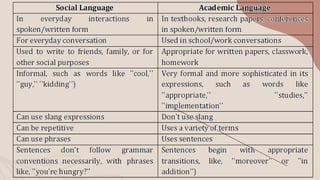
ACADEMIC LA NGUAGE
27
Academiclanguage is the language needed by students
to do the work in schools.
It includes, for example, discipline-specific vocabulary,
grammar and punctuation, and applications of rhetorical
conventions and devices that are typical for a content area
(e.g., essays, lab reports, discussions of a controversial issue.)
Students who master academic language are more likely
to be successful in academic and professional settings.
28.
ACADEMIC LA NGUAGE
28
Sociallanguage is the set of vocabulary that allows us
to communicate with others in the context of regular daily
conversations.
Here are some of the differences between social and
academic language includes: (refer to the next slide)
(Social & Academic Language Acquisition: Differences & Characteristics, 2020)
30.
C H AR A C T E R I S T I C S O F A C A D E M I C
L A N G U A G E
30
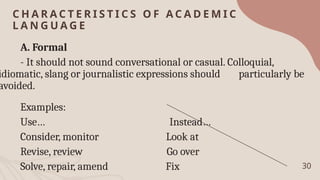
A. Formal
- It should not sound conversational or casual. Colloquial,
idiomatic, slang or journalistic expressions should particularly be
avoided.
Examples:
Use… Instead…
Consider, monitor Look at
Revise, review Go over
Solve, repair, amend Fix
31.
C H AR A C T E R I S T I C S O F A C A D E M I C
L A N G U A G E
31
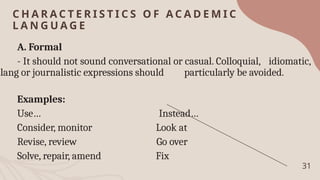
A. Formal
- It should not sound conversational or casual. Colloquial, idiomatic,
slang or journalistic expressions should particularly be avoided.
Examples:
Use… Instead…
Consider, monitor Look at
Revise, review Go over
Solve, repair, amend Fix
32.
C H AR A C T E R I S T I C S O F A C A D E M I C
L A N G U A G E
32
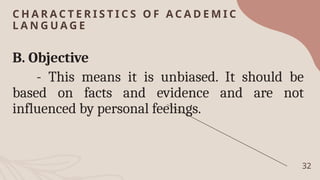
B. Objective
- This means it is unbiased. It should be
based on facts and evidence and are not
influenced by personal feelings.
33.
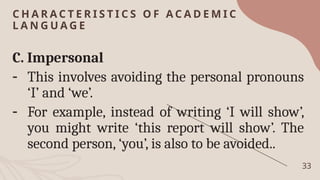
C H AR A C T E R I S T I C S O F A C A D E M I C
L A N G U A G E
33
C. Impersonal
- This involves avoiding the personal pronouns
‘I’ and ‘we’.
- For example, instead of writing ‘I will show’,
you might write ‘this report will show’. The
second person, ‘you’, is also to be avoided..
34.
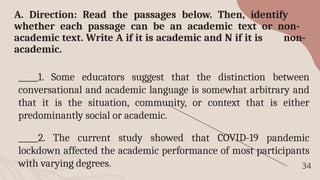
34
A. Direction: Readthe passages below. Then, identify
whether each passage can be an academic text or non-
academic text. Write A if it is academic and N if it is non-
academic.
_____1. Some educators suggest that the distinction between
conversational and academic language is somewhat arbitrary and
that it is the situation, community, or context that is either
predominantly social or academic.
_____2. The current study showed that COVID-19 pandemic
lockdown affected the academic performance of most participants
with varying degrees.
35.
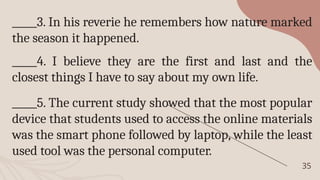
35
_____3. In hisreverie he remembers how nature marked
the season it happened.
_____4. I believe they are the first and last and the
closest things I have to say about my own life.
_____5. The current study showed that the most popular
device that students used to access the online materials
was the smart phone followed by laptop, while the least
used tool was the personal computer.
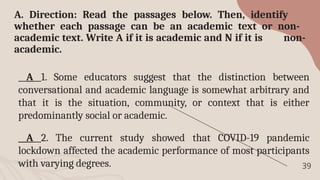
39
A. Direction: Readthe passages below. Then, identify
whether each passage can be an academic text or non-
academic text. Write A if it is academic and N if it is non-
academic.
__A__1. Some educators suggest that the distinction between
conversational and academic language is somewhat arbitrary and
that it is the situation, community, or context that is either
predominantly social or academic.
__A__2. The current study showed that COVID-19 pandemic
lockdown affected the academic performance of most participants
with varying degrees.
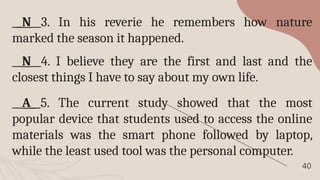
40.
40
__N__3. In hisreverie he remembers how nature
marked the season it happened.
__N__4. I believe they are the first and last and the
closest things I have to say about my own life.
__A__5. The current study showed that the most
popular device that students used to access the online
materials was the smart phone followed by laptop,
while the least used tool was the personal computer.