English for Academic and
Professional Purposes
At the end of this lesson, you are expected to
achieve the following
objectives:
a. differentiate academic texts from non-academic texts;
b. examine an academic text to establish its nature and
characteristics;
c. recognize the characteristics of language used in
academic texts;
d. analyze academic texts according to its language use;
and
e. evaluate academic texts based on its use of language.
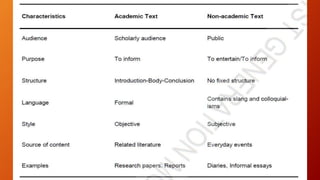
Nature and Characteristics of
an Academic Text
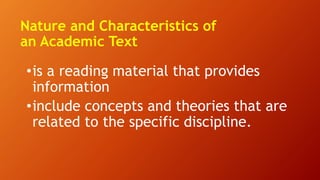
•is a reading material that provides
information
•include concepts and theories that are
related to the specific discipline.
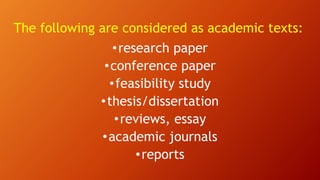
The following are considered as academic texts:
•research paper
•conference paper
•feasibility study
•thesis/dissertation
•reviews, essay
•academic journals
•reports
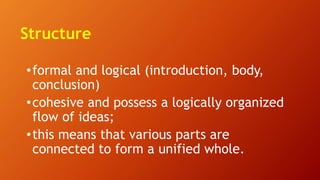
Structure
•formal and logical (introduction, body,
conclusion)
•cohesive and possess a logically organized
flow of ideas;
•this means that various parts are
connected to form a unified whole.
Tone
•refers to the attitude conveyed in a piece
of writing.
•the arguments of others are fairly
presented and with an appropriate
narrative tone
•when presenting a position or argument
that disagrees with one’s perspectives,
describe the argument accurately without
loaded or biased language.
Recall Activity
Language
• Use unambiguous language.
• Clear topic sentences enable a reader to follow your
line of thinking without difficulty.
• Formal language and the third person point-of view
should be used
• Technical language appropriate to the area of study
may also be used
• Avoid using “big words” just for the sake of doing so.
Citation
•Citing sources in the body of the paper
•Providing a list of references as either footnotes
or endnotes
•Acknowledge the source of any ideas, research
findings, data, or quoted text
•Avoid plagiarism.
Complexity
•An academic text addresses complex issues that
require higher-order thinking skills to
comprehend.
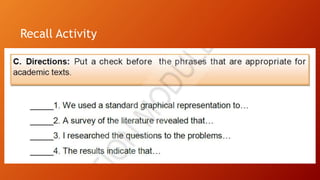
Recall Activity
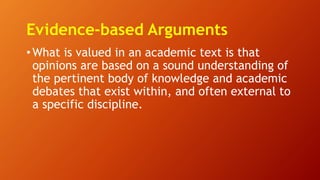
Evidence-based Arguments
•What is valued in an academic text is that
opinions are based on a sound understanding of
the pertinent body of knowledge and academic
debates that exist within, and often external to
a specific discipline.
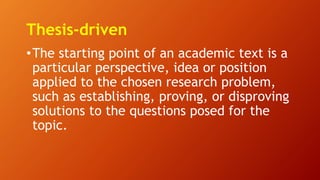
Thesis-driven
•The starting point of an academic text is a
particular perspective, idea or position
applied to the chosen research problem,
such as establishing, proving, or disproving
solutions to the questions posed for the
topic.
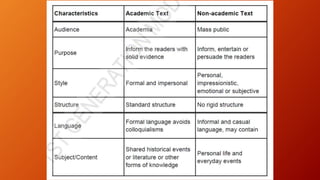
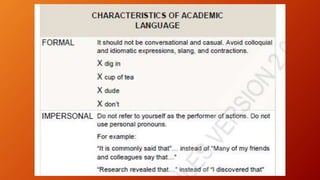
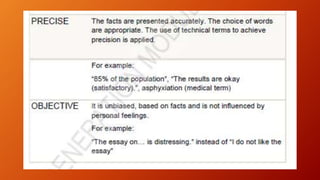
Academic Language
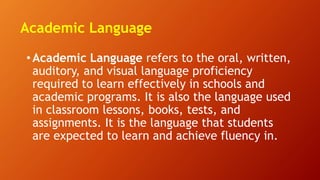
• Academic Language refers to the oral, written,
auditory, and visual language proficiency
required to learn effectively in schools and
academic programs. It is also the language used
in classroom lessons, books, tests, and
assignments. It is the language that students
are expected to learn and achieve fluency in.
Why is academic language so important?
•Students who master academic language are
more likely to be successful in academic and
professional settings
What is difference between academic
language and social language?
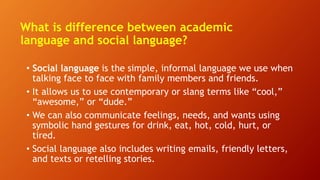
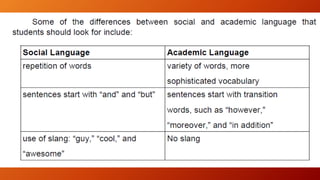
• Social language is the simple, informal language we use when
talking face to face with family members and friends.
• It allows us to use contemporary or slang terms like “cool,”
“awesome,” or “dude.”
• We can also communicate feelings, needs, and wants using
symbolic hand gestures for drink, eat, hot, cold, hurt, or
tired.
• Social language also includes writing emails, friendly letters,
and texts or retelling stories.
What is difference between academic
language and social language?
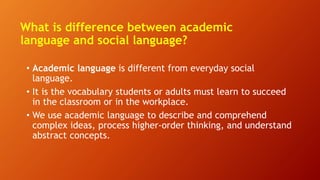
• Academic language is different from everyday social
language.
• It is the vocabulary students or adults must learn to succeed
in the classroom or in the workplace.
• We use academic language to describe and comprehend
complex ideas, process higher-order thinking, and understand
abstract concepts.
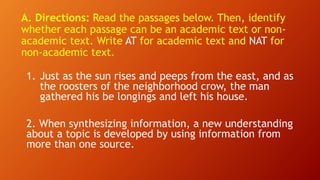
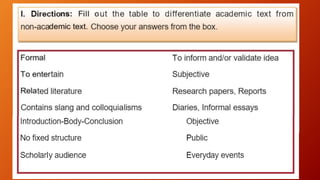
A. Directions: Read the passages below. Then, identify
whether each passage can be an academic text or non-
academic text. Write AT for academic text and NAT for
non-academic text.
1. Just as the sun rises and peeps from the east, and as
the roosters of the neighborhood crow, the man
gathered his be longings and left his house.
2. When synthesizing information, a new understanding
about a topic is developed by using information from
more than one source.
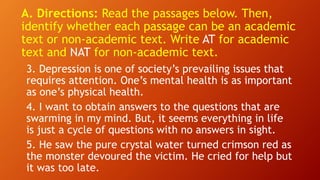
A. Directions: Read the passages below. Then,
identify whether each passage can be an academic
text or non-academic text. Write AT for academic
text and NAT for non-academic text.
3. Depression is one of society’s prevailing issues that
requires attention. One’s mental health is as important
as one’s physical health.
4. I want to obtain answers to the questions that are
swarming in my mind. But, it seems everything in life
is just a cycle of questions with no answers in sight.
5. He saw the pure crystal water turned crimson red as
the monster devoured the victim. He cried for help but
it was too late.
EAPP module 1.pptx
EAPP module 1.pptx
EAPP module 1.pptx

EAPP module 1.pptx

  • 1.
    English for Academicand Professional Purposes
  • 2.
    At the endof this lesson, you are expected to achieve the following objectives: a. differentiate academic texts from non-academic texts; b. examine an academic text to establish its nature and characteristics; c. recognize the characteristics of language used in academic texts; d. analyze academic texts according to its language use; and e. evaluate academic texts based on its use of language.
  • 11.
    Nature and Characteristicsof an Academic Text •is a reading material that provides information •include concepts and theories that are related to the specific discipline.
  • 12.
    The following areconsidered as academic texts: •research paper •conference paper •feasibility study •thesis/dissertation •reviews, essay •academic journals •reports
  • 13.
    Structure •formal and logical(introduction, body, conclusion) •cohesive and possess a logically organized flow of ideas; •this means that various parts are connected to form a unified whole.
  • 14.
    Tone •refers to theattitude conveyed in a piece of writing. •the arguments of others are fairly presented and with an appropriate narrative tone •when presenting a position or argument that disagrees with one’s perspectives, describe the argument accurately without loaded or biased language.
  • 15.
  • 16.
    Language • Use unambiguouslanguage. • Clear topic sentences enable a reader to follow your line of thinking without difficulty. • Formal language and the third person point-of view should be used • Technical language appropriate to the area of study may also be used • Avoid using “big words” just for the sake of doing so.
  • 17.
    Citation •Citing sources inthe body of the paper •Providing a list of references as either footnotes or endnotes •Acknowledge the source of any ideas, research findings, data, or quoted text •Avoid plagiarism.
  • 18.
    Complexity •An academic textaddresses complex issues that require higher-order thinking skills to comprehend.
  • 19.
  • 20.
    Evidence-based Arguments •What isvalued in an academic text is that opinions are based on a sound understanding of the pertinent body of knowledge and academic debates that exist within, and often external to a specific discipline.
  • 21.
    Thesis-driven •The starting pointof an academic text is a particular perspective, idea or position applied to the chosen research problem, such as establishing, proving, or disproving solutions to the questions posed for the topic.
  • 24.
    Academic Language • AcademicLanguage refers to the oral, written, auditory, and visual language proficiency required to learn effectively in schools and academic programs. It is also the language used in classroom lessons, books, tests, and assignments. It is the language that students are expected to learn and achieve fluency in.
  • 25.
    Why is academiclanguage so important? •Students who master academic language are more likely to be successful in academic and professional settings
  • 26.
    What is differencebetween academic language and social language? • Social language is the simple, informal language we use when talking face to face with family members and friends. • It allows us to use contemporary or slang terms like “cool,” “awesome,” or “dude.” • We can also communicate feelings, needs, and wants using symbolic hand gestures for drink, eat, hot, cold, hurt, or tired. • Social language also includes writing emails, friendly letters, and texts or retelling stories.
  • 27.
    What is differencebetween academic language and social language? • Academic language is different from everyday social language. • It is the vocabulary students or adults must learn to succeed in the classroom or in the workplace. • We use academic language to describe and comprehend complex ideas, process higher-order thinking, and understand abstract concepts.
  • 34.
    A. Directions: Readthe passages below. Then, identify whether each passage can be an academic text or non- academic text. Write AT for academic text and NAT for non-academic text. 1. Just as the sun rises and peeps from the east, and as the roosters of the neighborhood crow, the man gathered his be longings and left his house. 2. When synthesizing information, a new understanding about a topic is developed by using information from more than one source.
  • 35.
    A. Directions: Readthe passages below. Then, identify whether each passage can be an academic text or non-academic text. Write AT for academic text and NAT for non-academic text. 3. Depression is one of society’s prevailing issues that requires attention. One’s mental health is as important as one’s physical health. 4. I want to obtain answers to the questions that are swarming in my mind. But, it seems everything in life is just a cycle of questions with no answers in sight. 5. He saw the pure crystal water turned crimson red as the monster devoured the victim. He cried for help but it was too late.

Editor's Notes

  • #28 Academic language is what students read in textbooks and on tests and what they hear during instruction in the classroom. Students with limited or low academic language skills are more than likely to have low academic performance in classroom settings.