Taller Focalizado I
Styles, Gender and Social
Class
Andrea Alejandra Egea Pato
I.S.F.D. N° 1 | Prof. de Inglés
Style
The variations of speech that occurs
within individual speakers who come from
a single location.
Style and
Formality
At times, we are more careful or
relaxed in our speaking or writing.
The varying levels of attention to
variety forms a natural continuum.
Explanation: the stylistic variation is
the result of the care that speakers
and writers take with their expression.
The more formal de situation, the
more attention we pay to our
language.
Accommodation and
Normativism
Audience design: a speaker who can
control more than one variety chooses a
level of speech according to the
audience he or she is addressing.
Accommodation: we automatically
adjust our speech to be more like that of
our interlocutor.
Normativism: the approach taken by
purists who claim that there is one
‘correct’ version and that all variation is
incorrect and bad.
Specialized
varieties
 Register: the special variety especially
marked by a special set of vocabulary
associated with a profession,
occupation or social group and forming
part of its jargon.
 A specialized jargon serves to label
new and needed concepts and also to
establish bonds between members and
enforce boundaries for outsiders
 Cant: thieves and underworld jargon,
which goal is to make it hard for
outsiders to comprehend
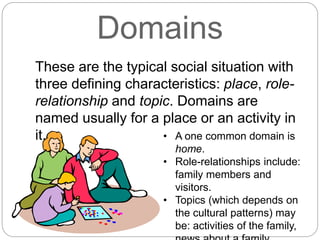
Domains
These are the typical social situation with
three defining characteristics: place, role-
relationship and topic. Domains are
named usually for a place or an activity in
it. • A one common domain is
home.
• Role-relationships include:
family members and
visitors.
• Topics (which depends on
the cultural patterns) may
be: activities of the family,
Slang and
Solidarity
 Slang is one way of estabilishing social identity.
 Its main characteristics are:
 the special kinds of ‘intimate’ or in-group speech.
 The rejection of formal rules.
 Its freshness and epheremerality.
 Free usage of taboo expressions., e.g. fuck, shit.
 It’s the feature of speech of the young and the
powerless.
 Solidarity is an important social force that has a
major impact on language, which underlies the
notion of accomodation.
 By choosing the form of language associated with a
specific group, we are claiming to be counted as a
member of that group.
Language and
Gender
 Traditionally, the word gender was restricted
to the grammatical distinctions between men
and women.
 Children pick up social stereotypes that
underlies women and men discrimination.
 Women’s talk is associated with the home and
domestic activities.
 Men’s talk is associated with the outside world and
economic activities.
 Studies of gender have shown the power of
stereotyping:
 Generic masculine: however well-meaning and
neutral the speaker’s intention may be, it reinforces
the secondary status of women.
 Anthropocentic speech: it is the prejudicial use of
language which assumes that men are more
Social
Stratification
 It is the study of class distinction.
 Free variation: the notion that the choice
of variant was uncontrolled and without
significance.
 Variations in speech provide clear evidence of
social status.
 Each social level (determined on the basis of
income, occupation and education) had a similar
gradation according to style or degree of formality.
 Hypercorrection: there is a tendency to
over-use socially desirable features in
careful speech and reading.
Accomodation and Audience
Design
 Audience design: in this view, the
speaker, consciously or not, chooses a
stylistic level appropriate for the audience
he or she wishes to address. The
announcer is identifying himself or herself
with the audience or caliming membership
of the group that it constitutes.
 Accomodation: it is the tendency for the
intention of people talking together to
move slightly closer together by modifying
their speech in the direction of the new
norm.

Styles, Gender and Social Class

  • 1.
    Taller Focalizado I Styles,Gender and Social Class Andrea Alejandra Egea Pato I.S.F.D. N° 1 | Prof. de Inglés
  • 2.
    Style The variations ofspeech that occurs within individual speakers who come from a single location.
  • 3.
    Style and Formality At times,we are more careful or relaxed in our speaking or writing. The varying levels of attention to variety forms a natural continuum. Explanation: the stylistic variation is the result of the care that speakers and writers take with their expression. The more formal de situation, the more attention we pay to our language.
  • 4.
    Accommodation and Normativism Audience design:a speaker who can control more than one variety chooses a level of speech according to the audience he or she is addressing. Accommodation: we automatically adjust our speech to be more like that of our interlocutor. Normativism: the approach taken by purists who claim that there is one ‘correct’ version and that all variation is incorrect and bad.
  • 5.
    Specialized varieties  Register: thespecial variety especially marked by a special set of vocabulary associated with a profession, occupation or social group and forming part of its jargon.  A specialized jargon serves to label new and needed concepts and also to establish bonds between members and enforce boundaries for outsiders  Cant: thieves and underworld jargon, which goal is to make it hard for outsiders to comprehend
  • 6.
    Domains These are thetypical social situation with three defining characteristics: place, role- relationship and topic. Domains are named usually for a place or an activity in it. • A one common domain is home. • Role-relationships include: family members and visitors. • Topics (which depends on the cultural patterns) may be: activities of the family,
  • 7.
    Slang and Solidarity  Slangis one way of estabilishing social identity.  Its main characteristics are:  the special kinds of ‘intimate’ or in-group speech.  The rejection of formal rules.  Its freshness and epheremerality.  Free usage of taboo expressions., e.g. fuck, shit.  It’s the feature of speech of the young and the powerless.  Solidarity is an important social force that has a major impact on language, which underlies the notion of accomodation.  By choosing the form of language associated with a specific group, we are claiming to be counted as a member of that group.
  • 8.
    Language and Gender  Traditionally,the word gender was restricted to the grammatical distinctions between men and women.  Children pick up social stereotypes that underlies women and men discrimination.  Women’s talk is associated with the home and domestic activities.  Men’s talk is associated with the outside world and economic activities.  Studies of gender have shown the power of stereotyping:  Generic masculine: however well-meaning and neutral the speaker’s intention may be, it reinforces the secondary status of women.  Anthropocentic speech: it is the prejudicial use of language which assumes that men are more
  • 9.
    Social Stratification  It isthe study of class distinction.  Free variation: the notion that the choice of variant was uncontrolled and without significance.  Variations in speech provide clear evidence of social status.  Each social level (determined on the basis of income, occupation and education) had a similar gradation according to style or degree of formality.  Hypercorrection: there is a tendency to over-use socially desirable features in careful speech and reading.
  • 10.
    Accomodation and Audience Design Audience design: in this view, the speaker, consciously or not, chooses a stylistic level appropriate for the audience he or she wishes to address. The announcer is identifying himself or herself with the audience or caliming membership of the group that it constitutes.  Accomodation: it is the tendency for the intention of people talking together to move slightly closer together by modifying their speech in the direction of the new norm.