The Pre-Writing
Process: Thesis
Statement and
Organizing Your
Paper
A Guide to Effective
Writing Preparation
Understanding the Thesis
Statement
- Definition: A concise
summary of the main
point or claim of your
paper.
- Purpose: Guides
the direction of
your research and
writing.
- Characteristics:
- Clear and specific
- Debatable
- Supported by evidence
• Think of a broad topic you are interested
in. Write down a potential thesis
statement for a paper on this topic.
Exercise:
Crafting a Strong Thesis
Statement
- Be Specific: Avoid
vague language.
- Be Debatable: Ensure it
presents a claim that can be
challenged.
- Be Clear:
Communicate your
main idea effectively.
Example:
• "Social media
has a
significant
impact on the
mental health
of teenagers,
leading to
increased
anxiety and
depression."
Exercise:
• Revise the thesis
statement you wrote
on the previous slide
to make it more
specific, debatable,
and clear.
Importance of Organizing Your
Paper
- Provides a roadmap for your
writing.
- Helps maintain logical flow and
coherence.
- Ensures all points support your
thesis.
Creating an Outline
- Introduction:
Present your thesis
and set the context.
- Body Paragraphs:
Develop each point
that supports your
thesis.
- Topic sentences
- Evidence and
examples
- Analysis and
interpretation
- Conclusion:
Summarize your
main points and
restate the thesis.
Exercise:
• Outline the main
sections and key
points for a paper
based on your
thesis statement.
Developing
Body
Paragraphs
- Topic Sentence:
Introduces the main idea of
the paragraph.
- Supporting Evidence:
Provide facts, quotes, and
examples.
- Analysis: Explain how the
evidence supports your
thesis.
Exercise:
• Write a topic sentence
for the first body
paragraph of your
paper, along with one
piece of supporting
evidence.
Ensuring Flow and
Coherence
- Use transition words and
phrases.
- Maintain a logical progression
of ideas.
- Ensure each paragraph
connects back to your thesis.
Exercise:
• Identify and write
down at least
three transition
phrases you can
use in your paper.
Revising Your Outline
- Review and adjust your outline
as needed.
- Ensure all points are relevant
and support your thesis.
- Make sure your paper has a
logical structure.
Exercise:
• Revisit your outline and make any
necessary revisions to improve clarity and
coherence.
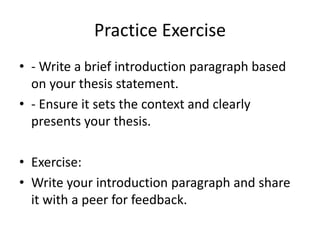
Practice Exercise
• - Write a brief introduction paragraph based
on your thesis statement.
• - Ensure it sets the context and clearly
presents your thesis.
• Exercise:
• Write your introduction paragraph and share
it with a peer for feedback.
Summary and Q&A
• - Recap:
• - Importance of a strong thesis statement.
• - Organizing your paper with an outline.
• - Developing coherent and well-supported body
paragraphs.
• - Questions:
• - Open the floor for any questions or clarifications.
• Exercise:
• Ask any remaining questions you have about the pre-
writing process.
Conclusion
• Thank you for participating in this session on
the pre-writing process. Remember, a strong
thesis and a well-organized paper are key to
successful writing.
• Contact Information:
• [Your Email]
• [Your Contact Number]
Directions: Using your outline/
draft. Finalize your paper. Revise
and edit your paper as much as
possible.

Pre-Writing_Process_Presentation Grade 11.pptx

  • 1.
    The Pre-Writing Process: Thesis Statementand Organizing Your Paper A Guide to Effective Writing Preparation
  • 2.
    Understanding the Thesis Statement -Definition: A concise summary of the main point or claim of your paper. - Purpose: Guides the direction of your research and writing. - Characteristics: - Clear and specific - Debatable - Supported by evidence
  • 3.
    • Think ofa broad topic you are interested in. Write down a potential thesis statement for a paper on this topic. Exercise:
  • 4.
    Crafting a StrongThesis Statement - Be Specific: Avoid vague language. - Be Debatable: Ensure it presents a claim that can be challenged. - Be Clear: Communicate your main idea effectively.
  • 5.
    Example: • "Social media hasa significant impact on the mental health of teenagers, leading to increased anxiety and depression."
  • 6.
    Exercise: • Revise thethesis statement you wrote on the previous slide to make it more specific, debatable, and clear.
  • 7.
    Importance of OrganizingYour Paper - Provides a roadmap for your writing. - Helps maintain logical flow and coherence. - Ensures all points support your thesis.
  • 8.
    Creating an Outline -Introduction: Present your thesis and set the context. - Body Paragraphs: Develop each point that supports your thesis. - Topic sentences - Evidence and examples - Analysis and interpretation - Conclusion: Summarize your main points and restate the thesis.
  • 9.
    Exercise: • Outline themain sections and key points for a paper based on your thesis statement.
  • 10.
    Developing Body Paragraphs - Topic Sentence: Introducesthe main idea of the paragraph. - Supporting Evidence: Provide facts, quotes, and examples. - Analysis: Explain how the evidence supports your thesis.
  • 11.
    Exercise: • Write atopic sentence for the first body paragraph of your paper, along with one piece of supporting evidence.
  • 12.
    Ensuring Flow and Coherence -Use transition words and phrases. - Maintain a logical progression of ideas. - Ensure each paragraph connects back to your thesis.
  • 13.
    Exercise: • Identify andwrite down at least three transition phrases you can use in your paper.
  • 14.
    Revising Your Outline -Review and adjust your outline as needed. - Ensure all points are relevant and support your thesis. - Make sure your paper has a logical structure.
  • 15.
    Exercise: • Revisit youroutline and make any necessary revisions to improve clarity and coherence.
  • 16.
    Practice Exercise • -Write a brief introduction paragraph based on your thesis statement. • - Ensure it sets the context and clearly presents your thesis. • Exercise: • Write your introduction paragraph and share it with a peer for feedback.
  • 17.
    Summary and Q&A •- Recap: • - Importance of a strong thesis statement. • - Organizing your paper with an outline. • - Developing coherent and well-supported body paragraphs. • - Questions: • - Open the floor for any questions or clarifications. • Exercise: • Ask any remaining questions you have about the pre- writing process.
  • 18.
    Conclusion • Thank youfor participating in this session on the pre-writing process. Remember, a strong thesis and a well-organized paper are key to successful writing. • Contact Information: • [Your Email] • [Your Contact Number]
  • 19.
    Directions: Using youroutline/ draft. Finalize your paper. Revise and edit your paper as much as possible.