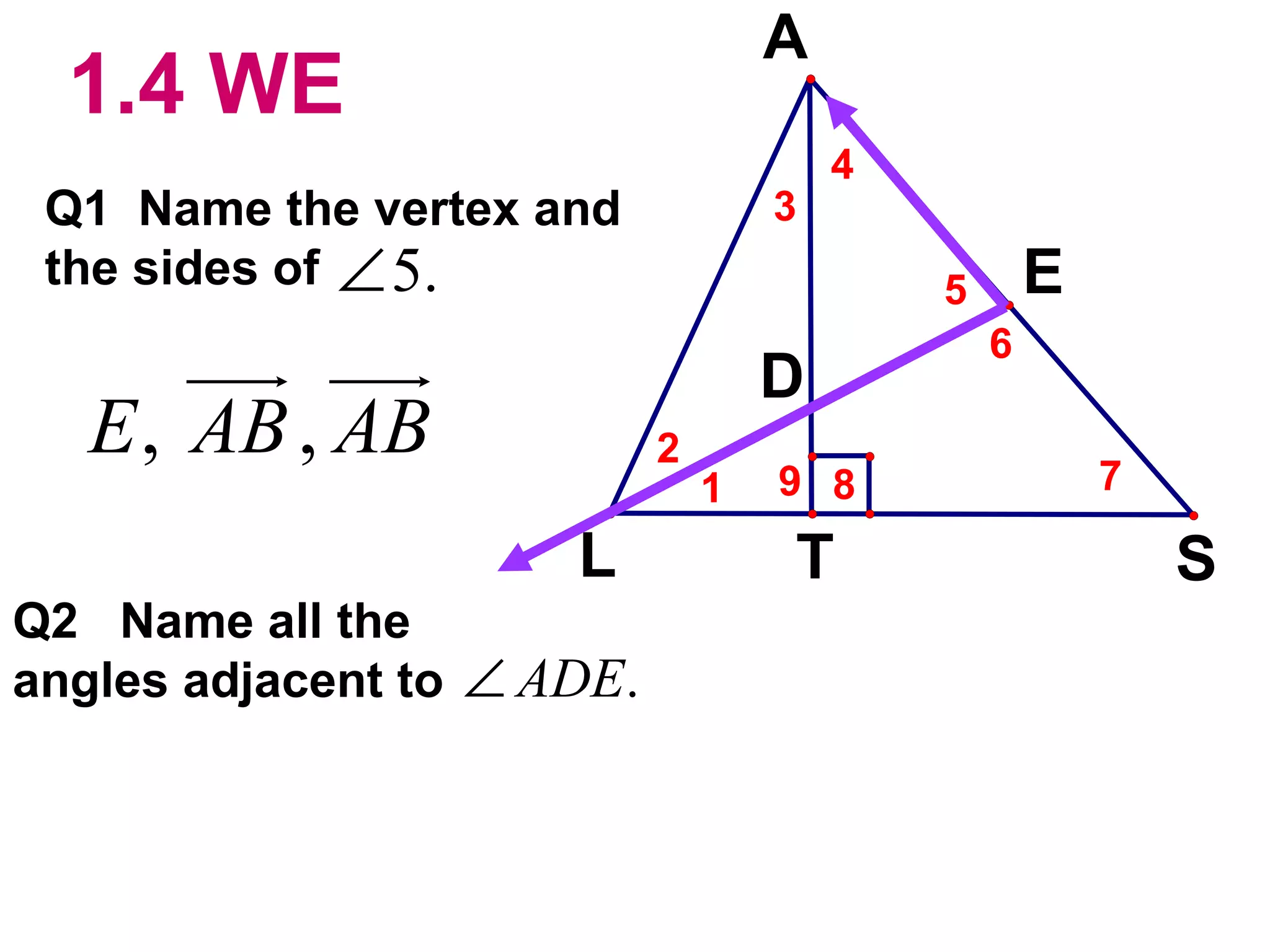
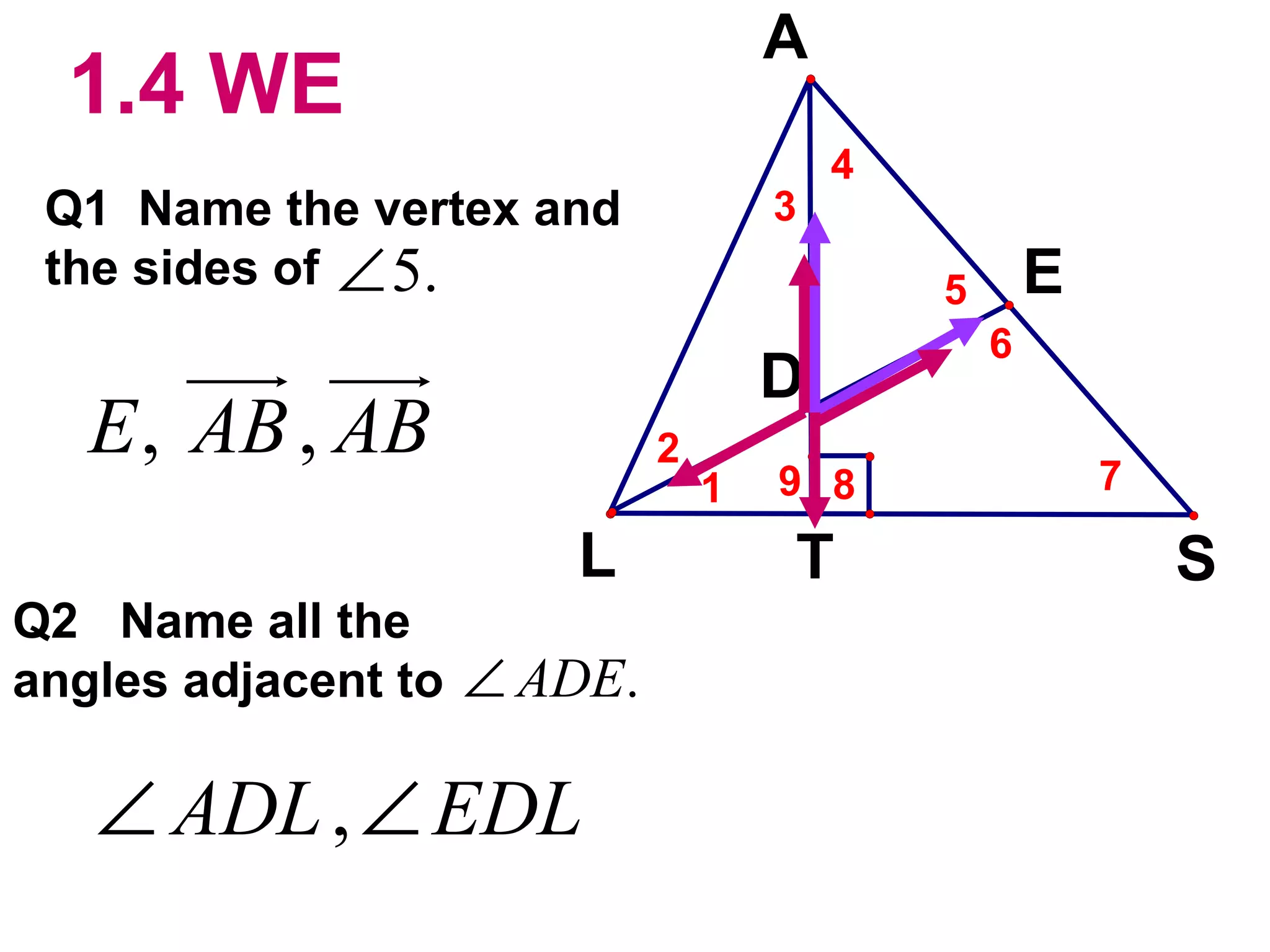
1.4 WE Q1  Name the vertex and  the sides of Q2  Name all the angles adjacent to
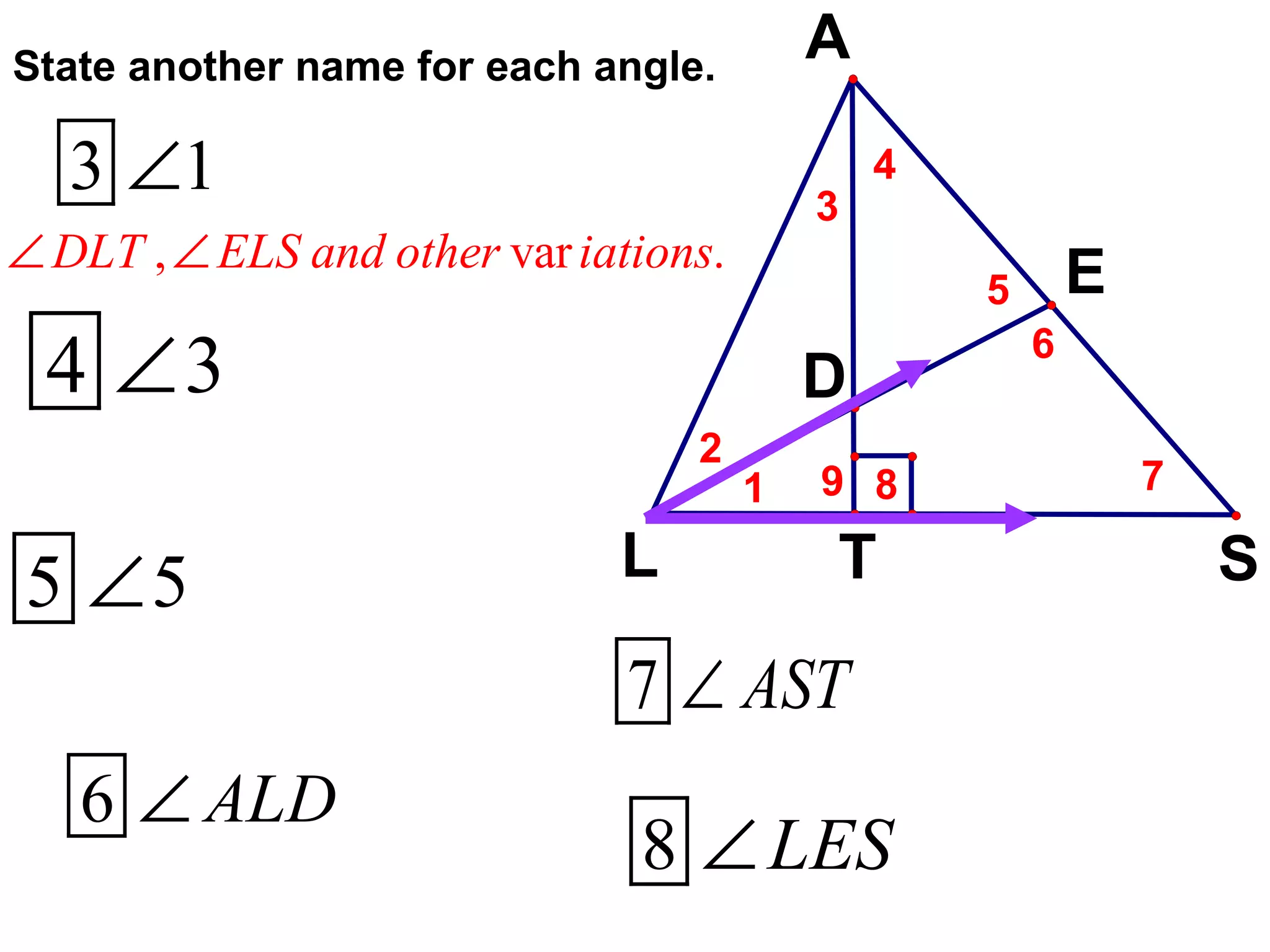
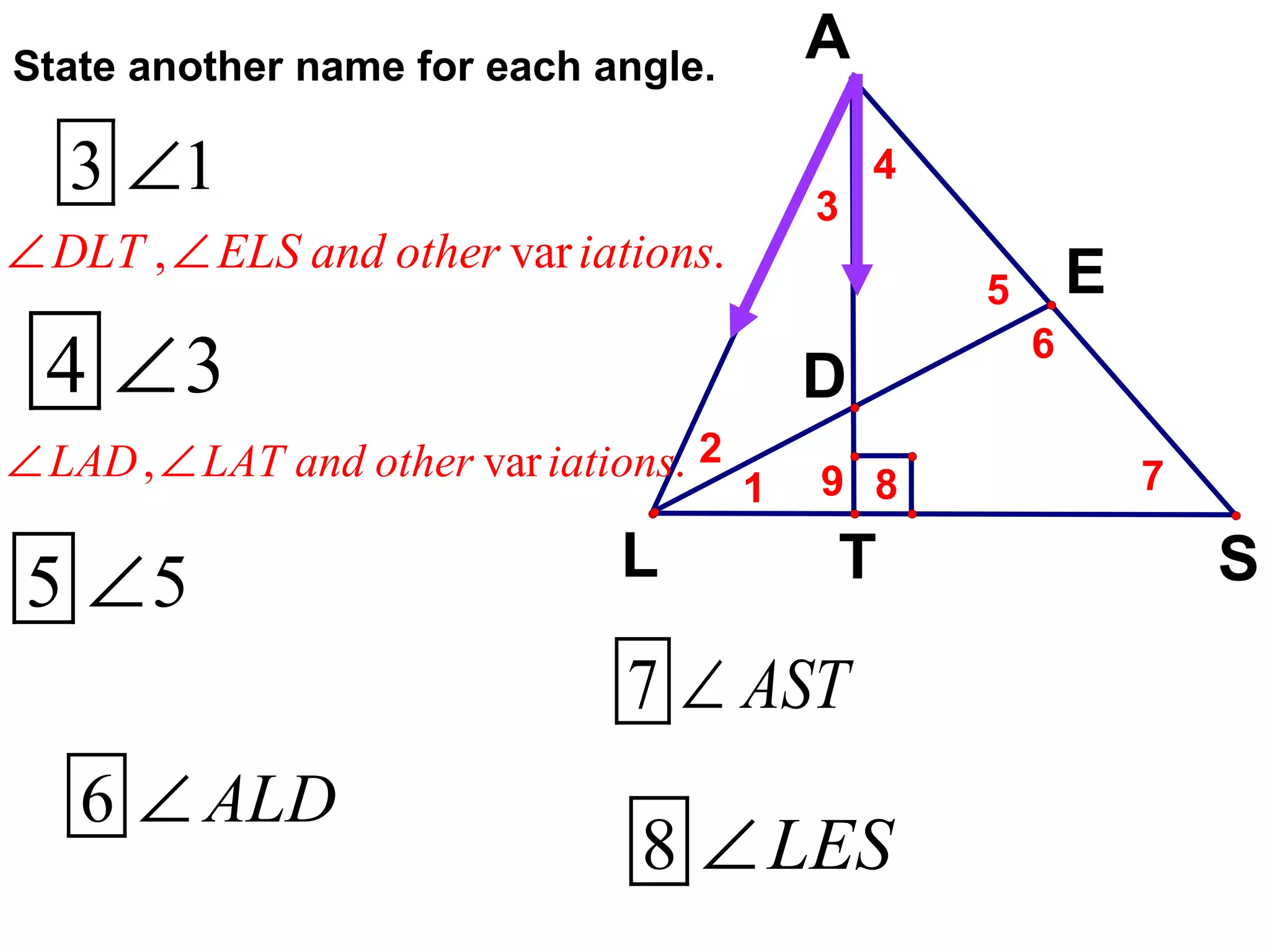
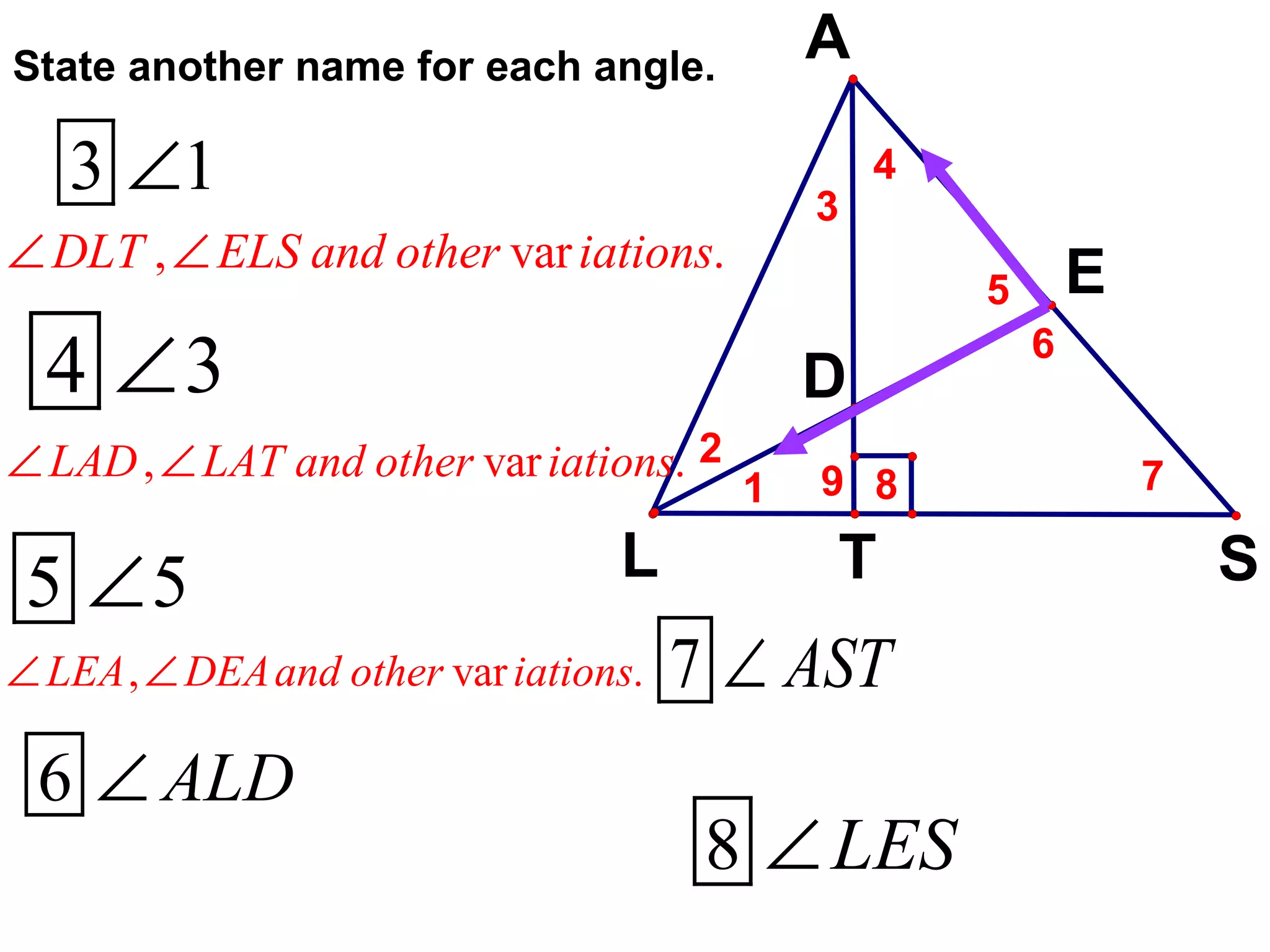
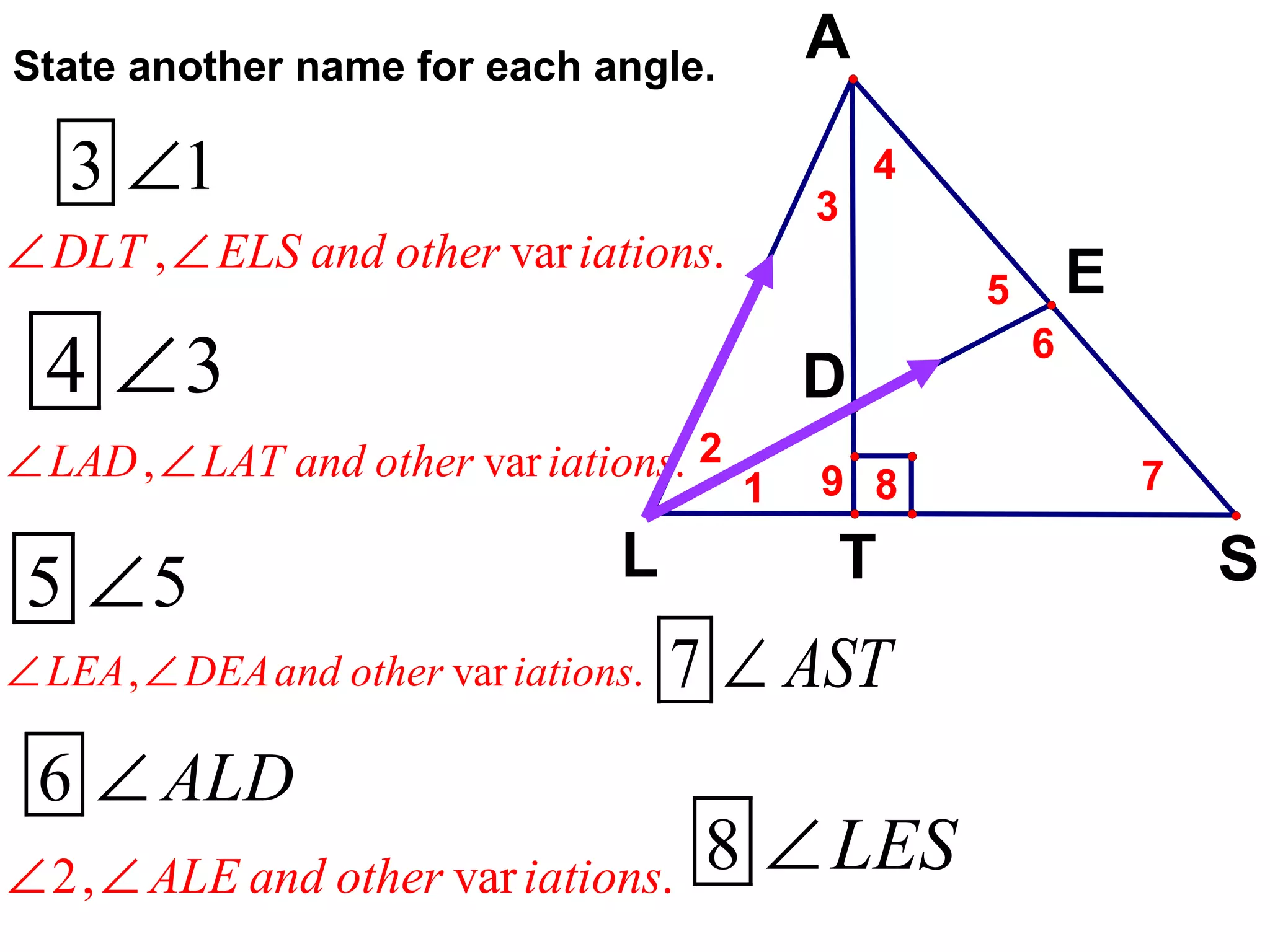
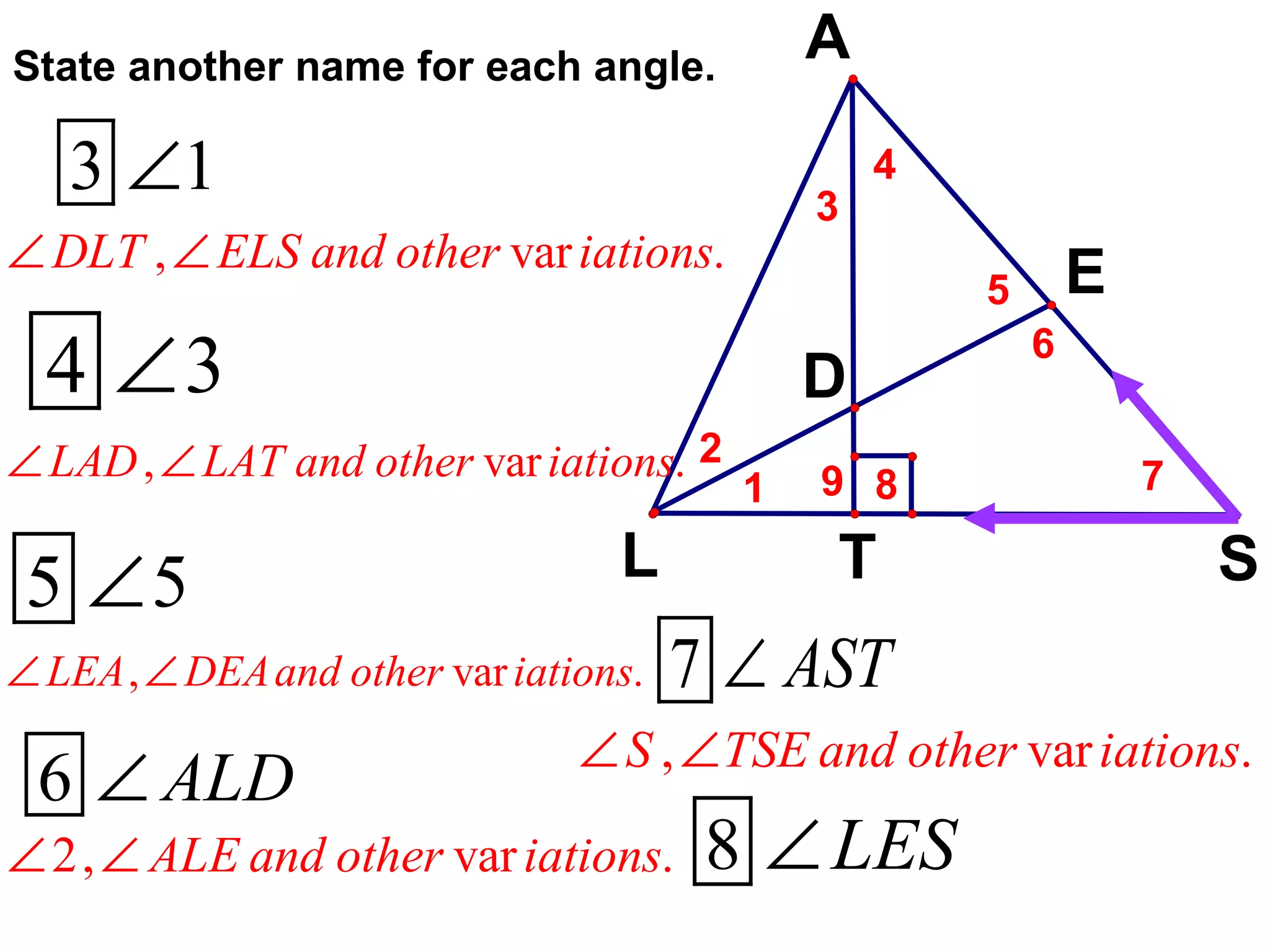
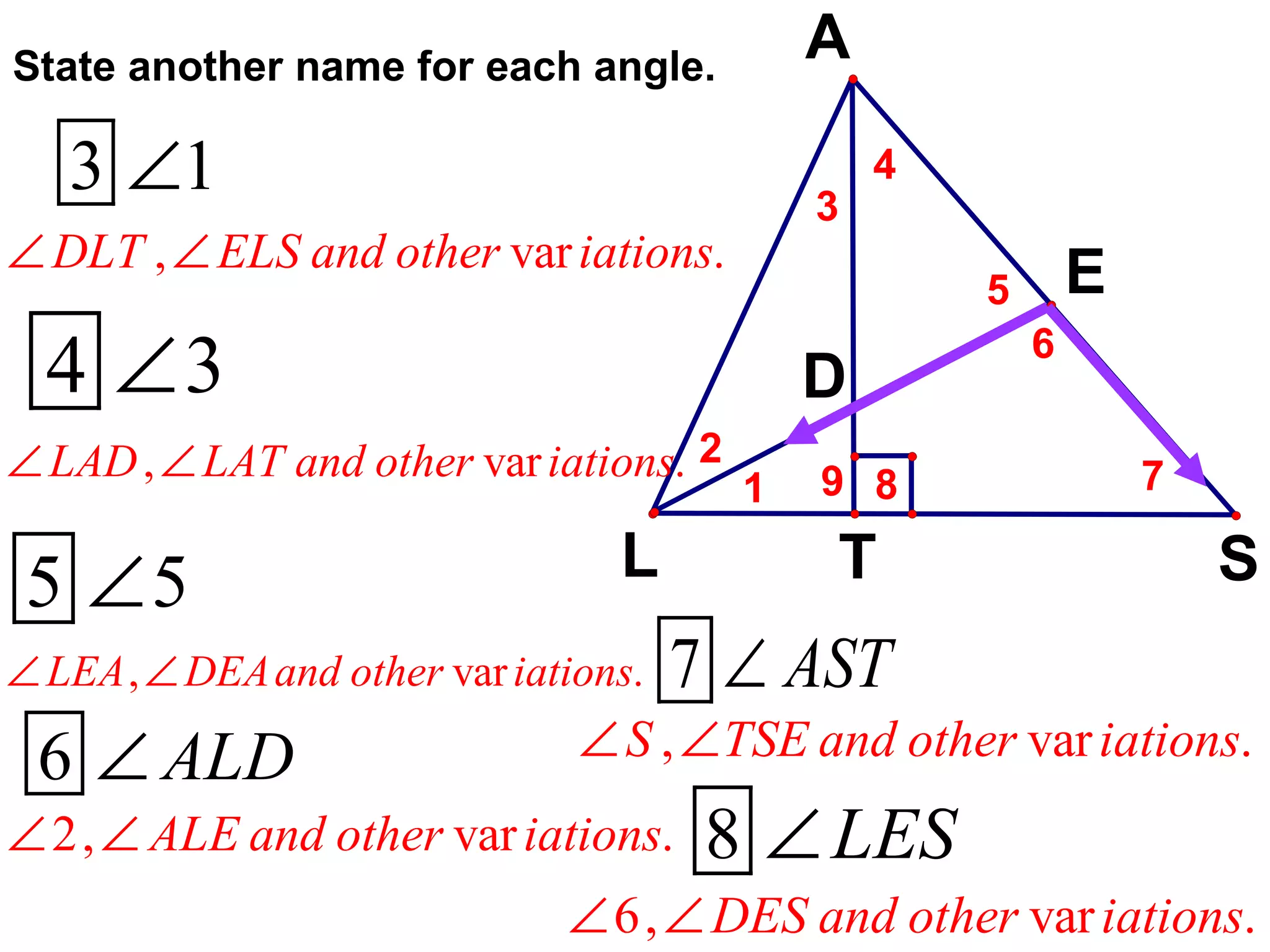
State another name for each angle.
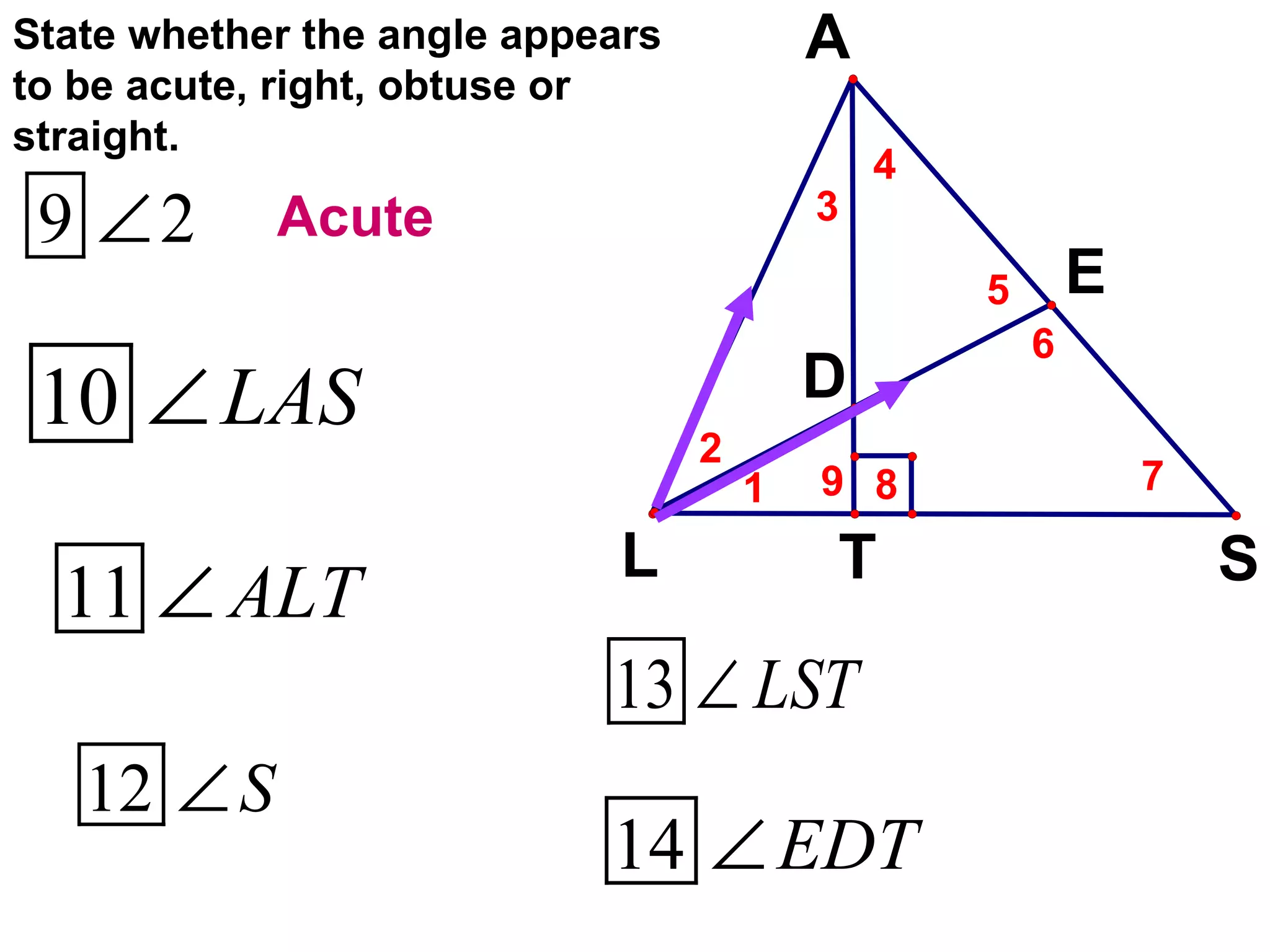
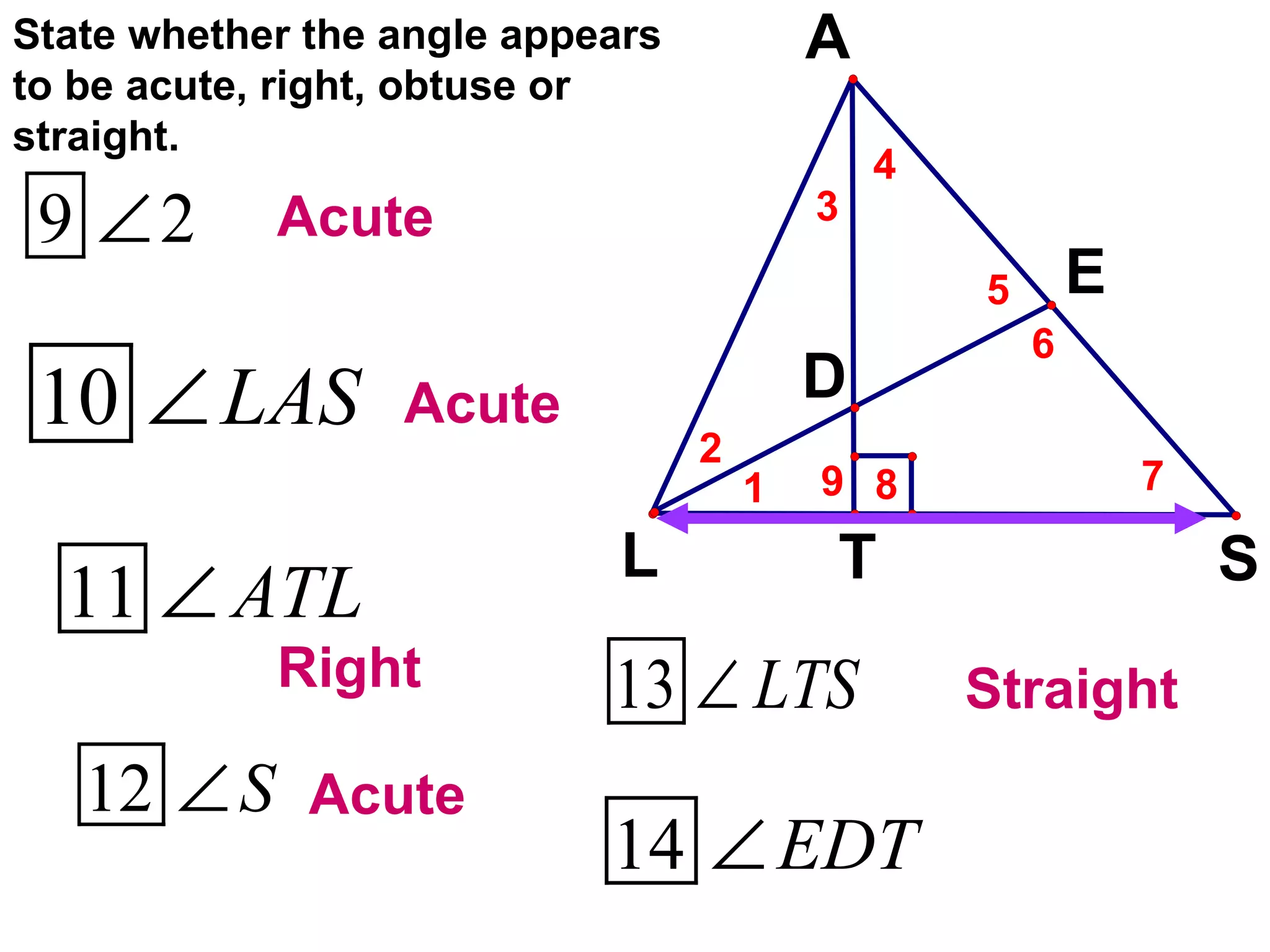
State whether the angle appears to be acute, right, obtuse or straight. Acute
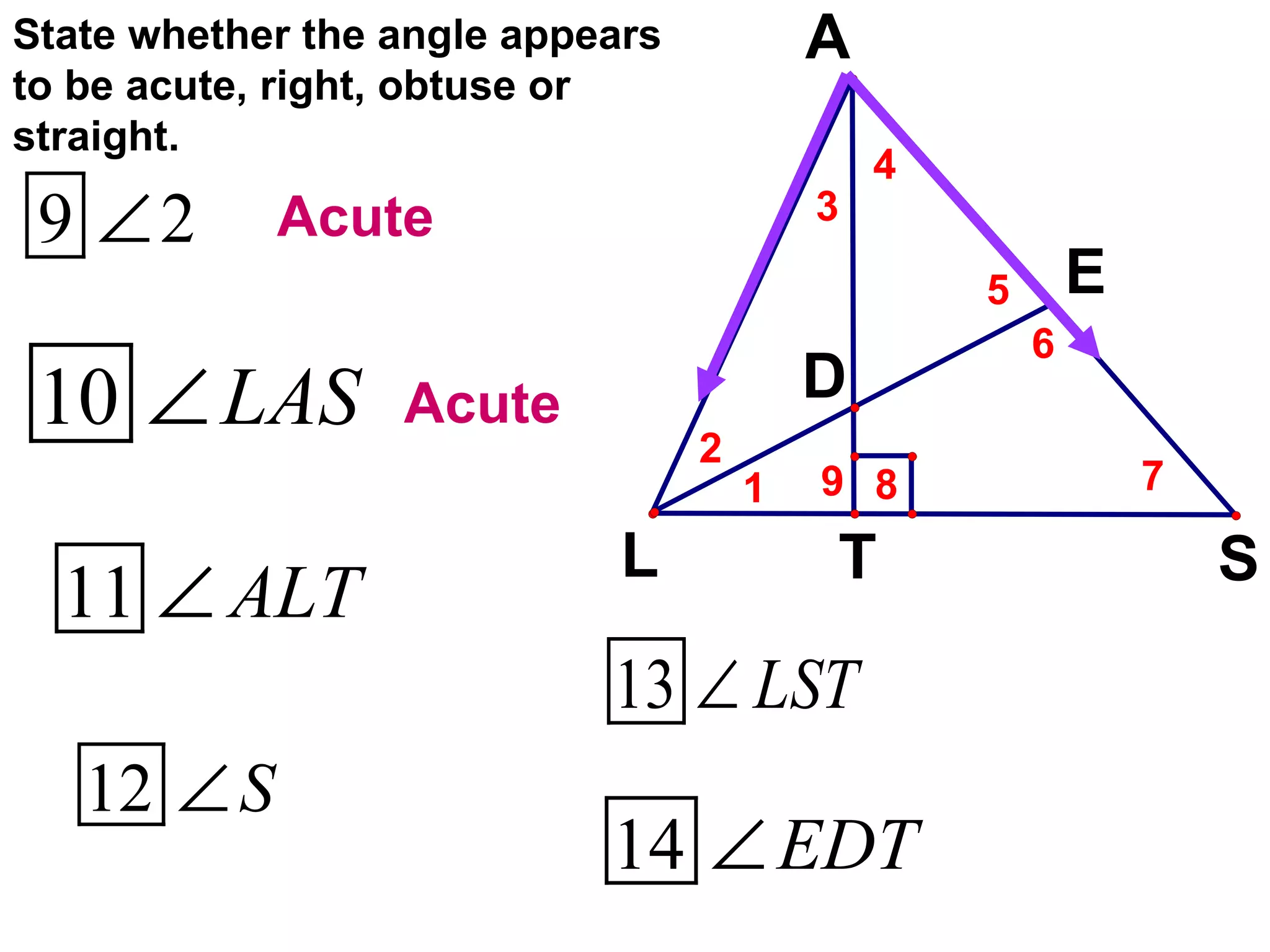
State whether the angle appears to be acute, right, obtuse or straight. Acute Acute
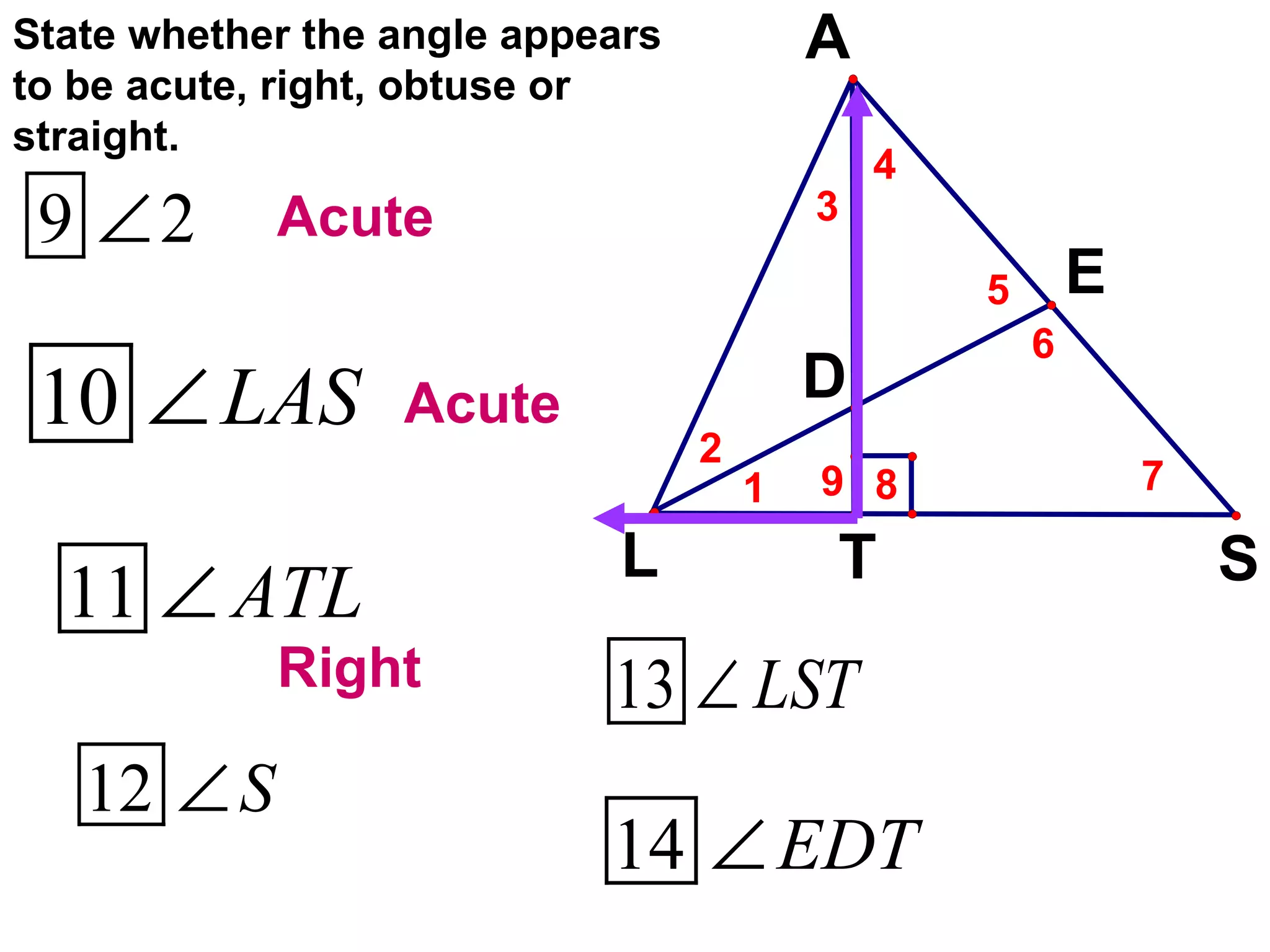
State whether the angle appears to be acute, right, obtuse or straight. Acute Acute Right
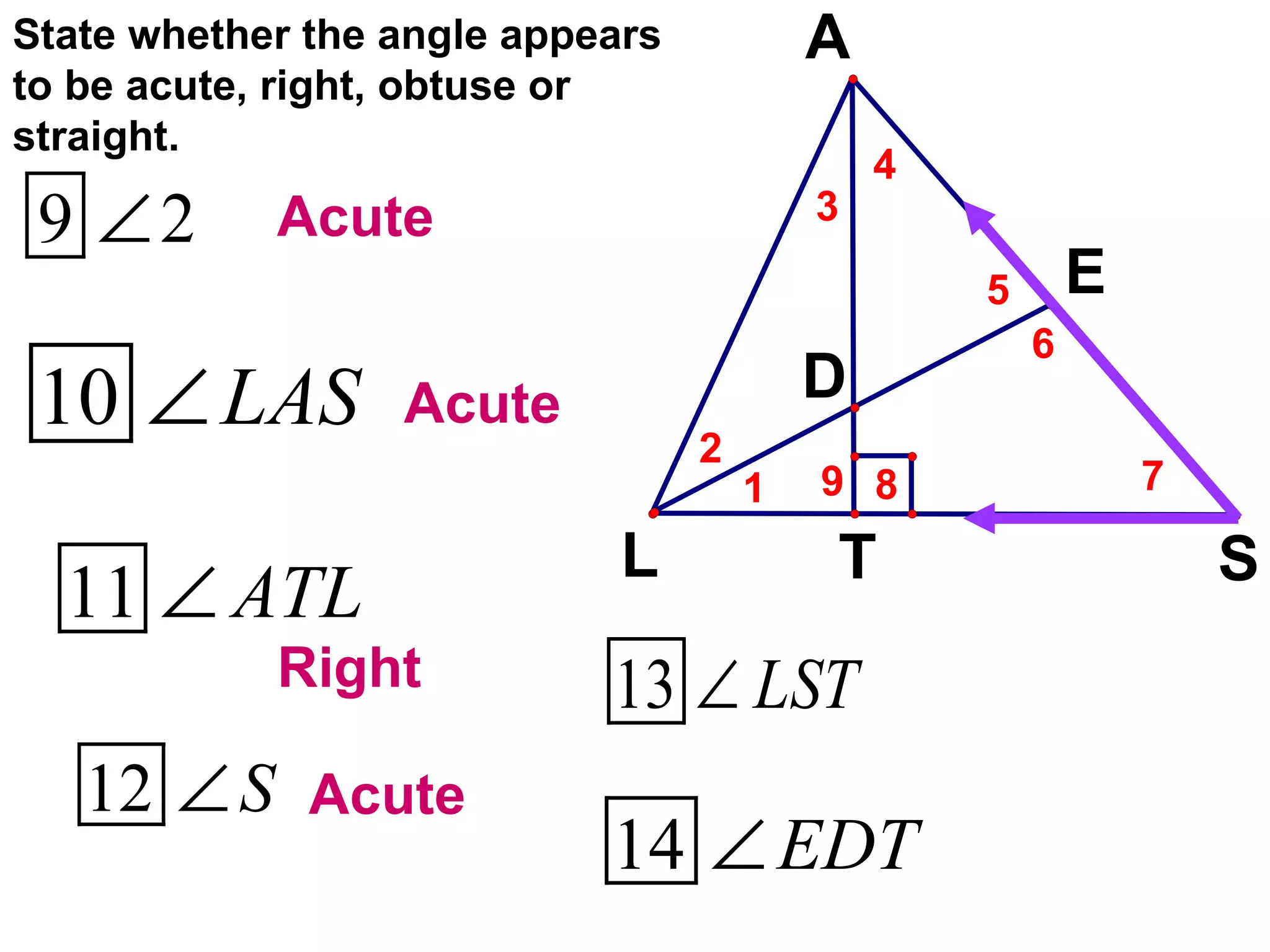
State whether the angle appears to be acute, right, obtuse or straight. Acute Acute Right Acute
State whether the angle appears to be acute, right, obtuse or straight. Acute Acute Right Acute Straight
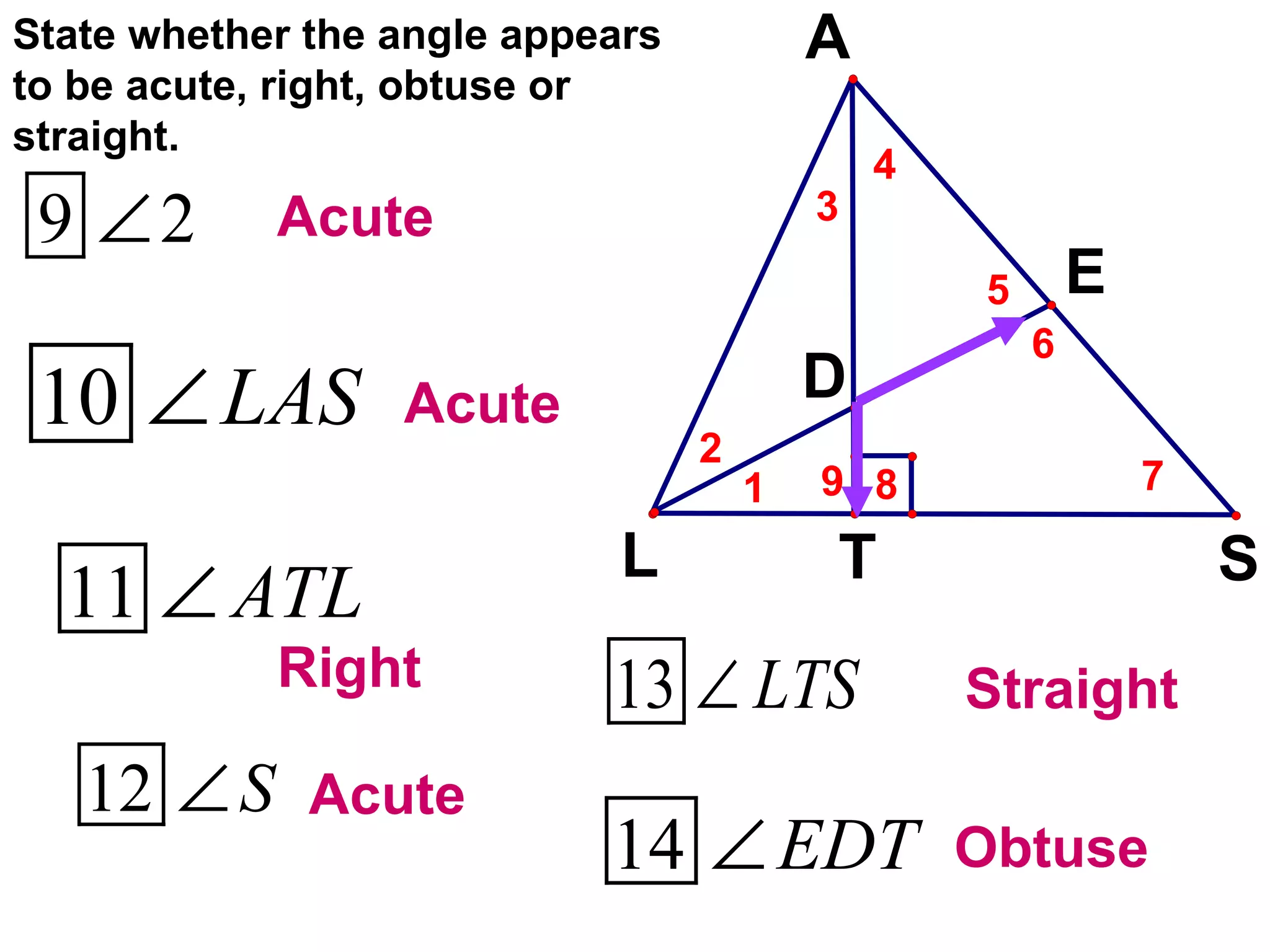
State whether the angle appears to be acute, right, obtuse or straight. Acute Acute Right Acute Straight Obtuse
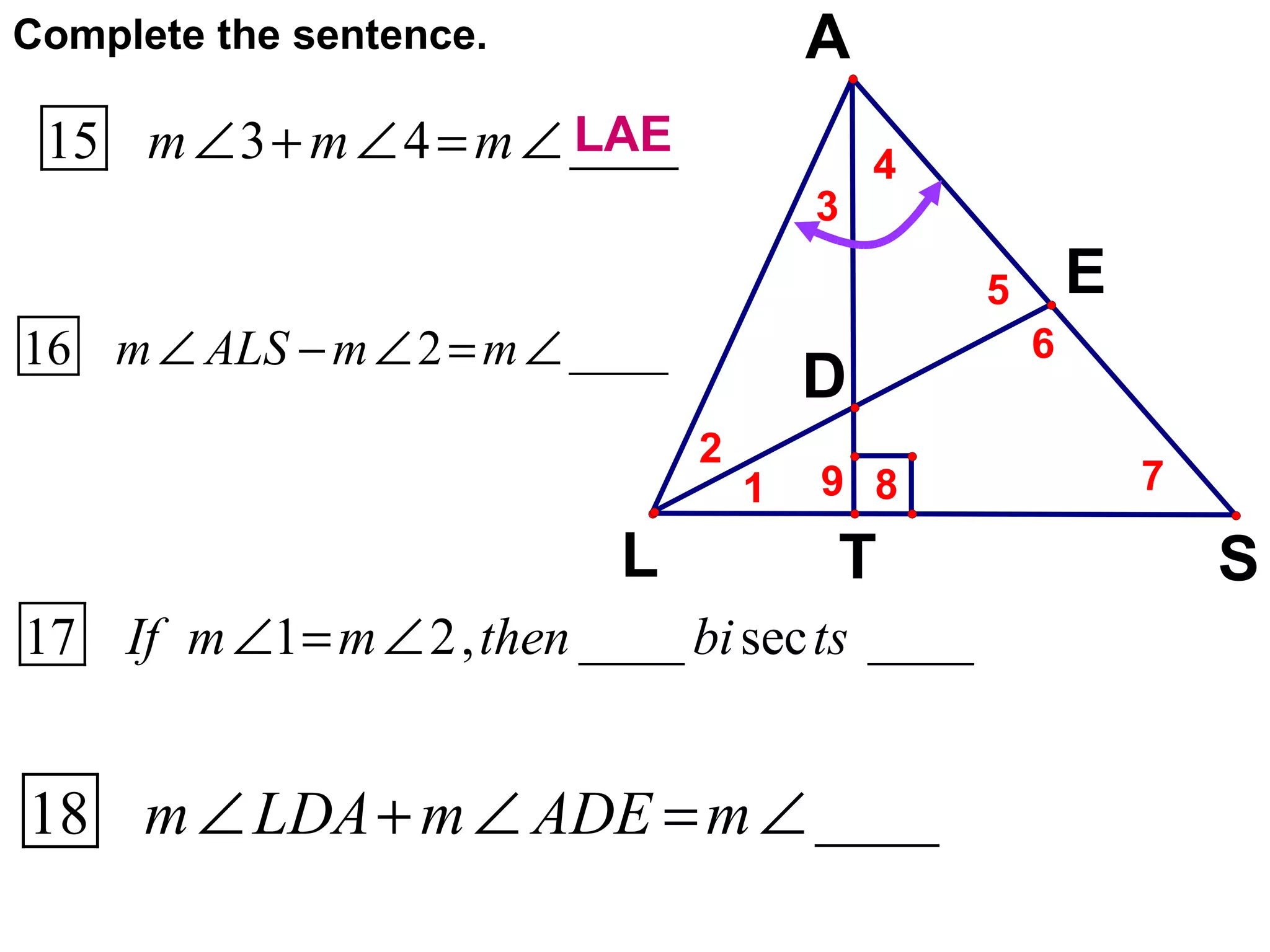
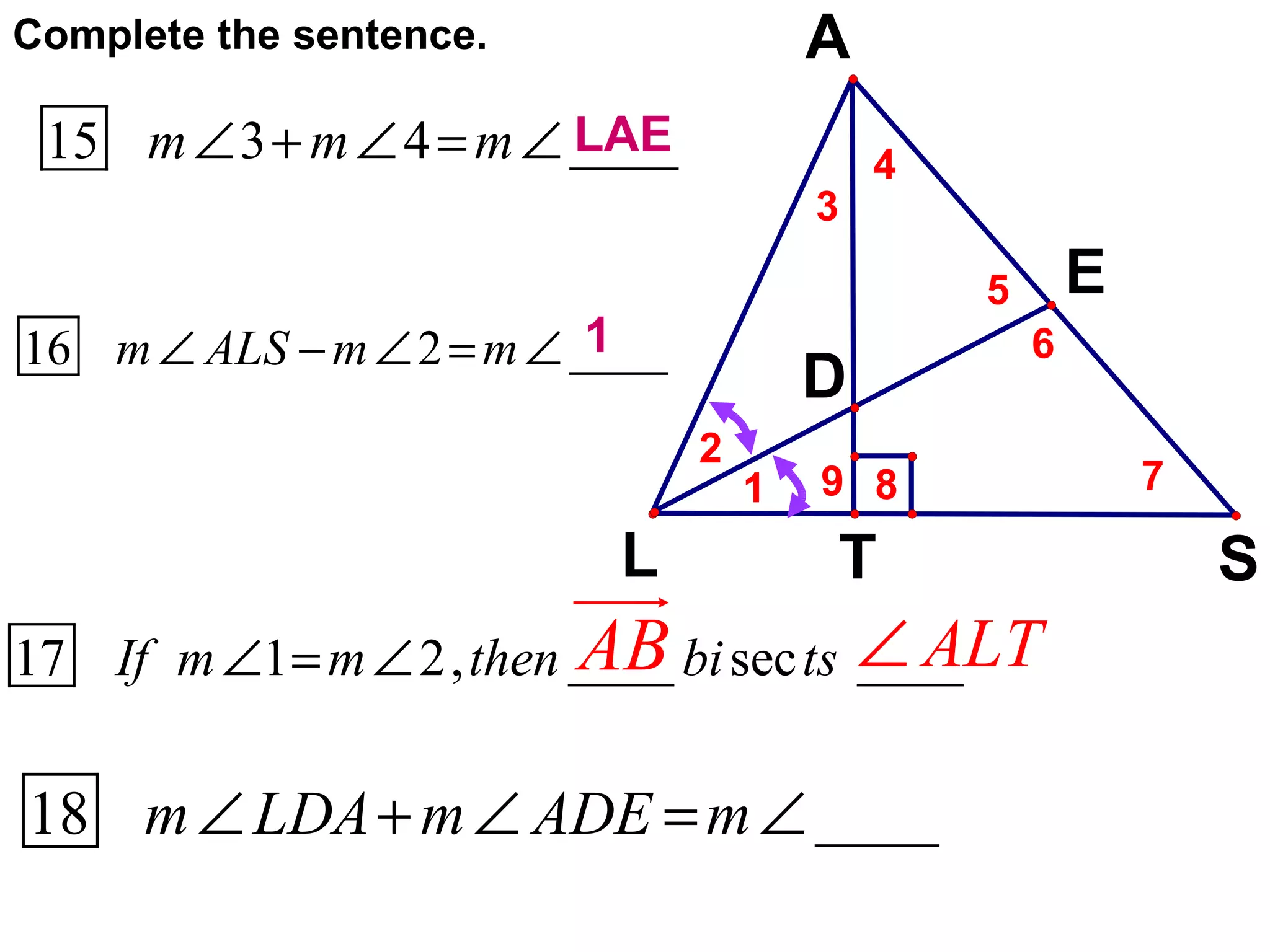
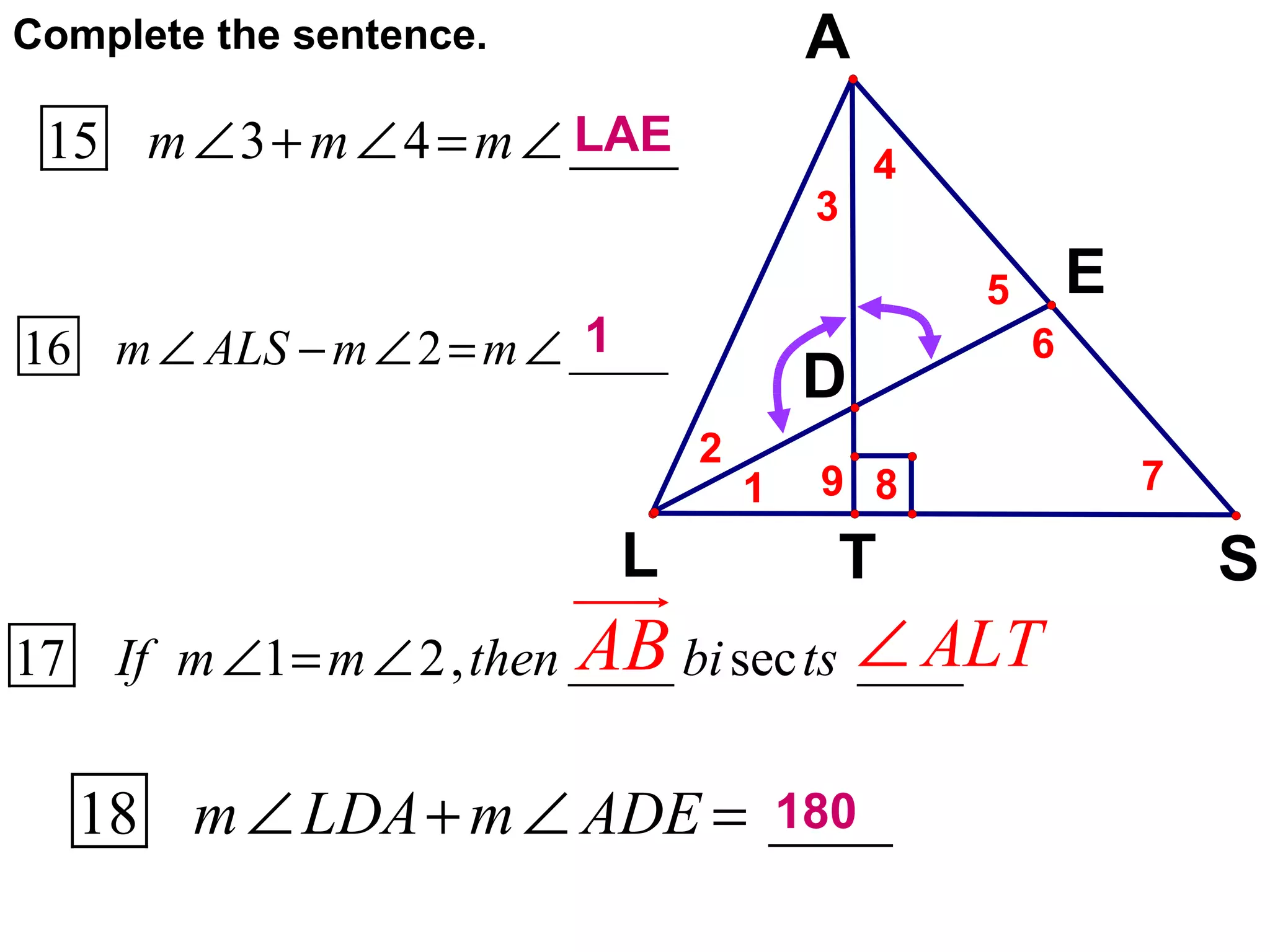
Complete the sentence. LAE
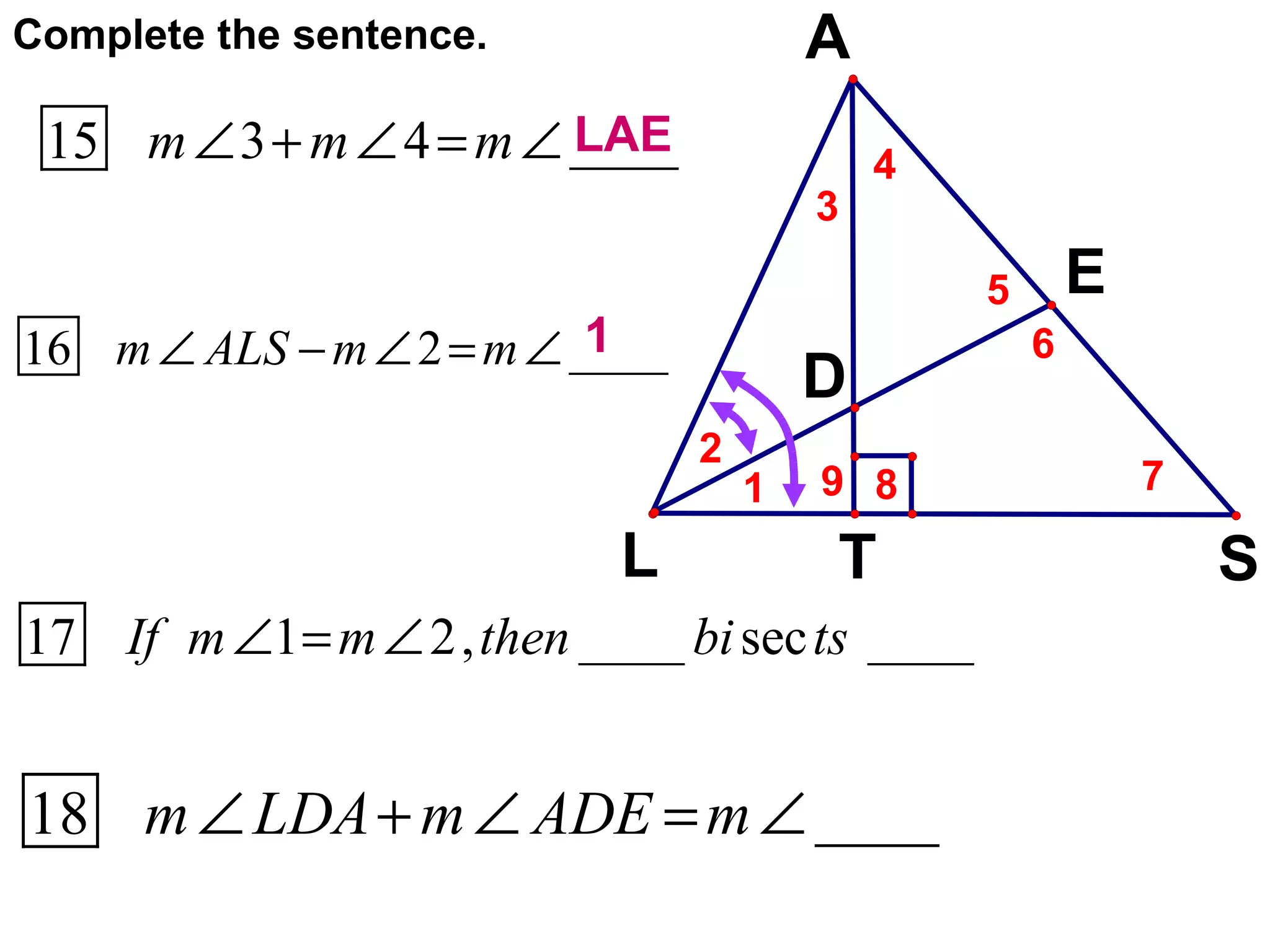
Complete the sentence. LAE 1
Complete the sentence. LAE 1 180
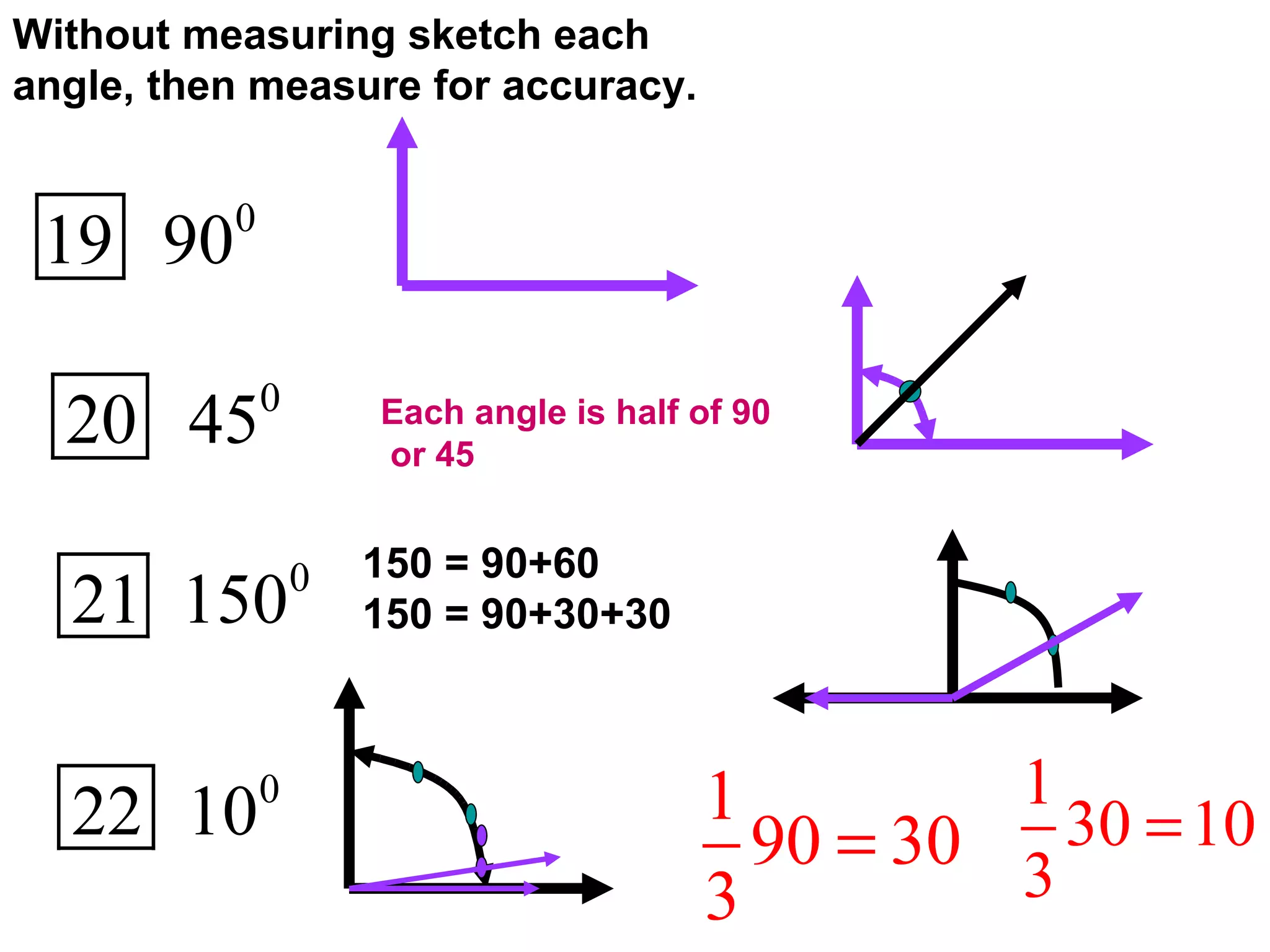
Without measuring sketch each angle, then measure for accuracy. Each angle is half of 90 or 45 150 = 90+60 150 = 90+30+30
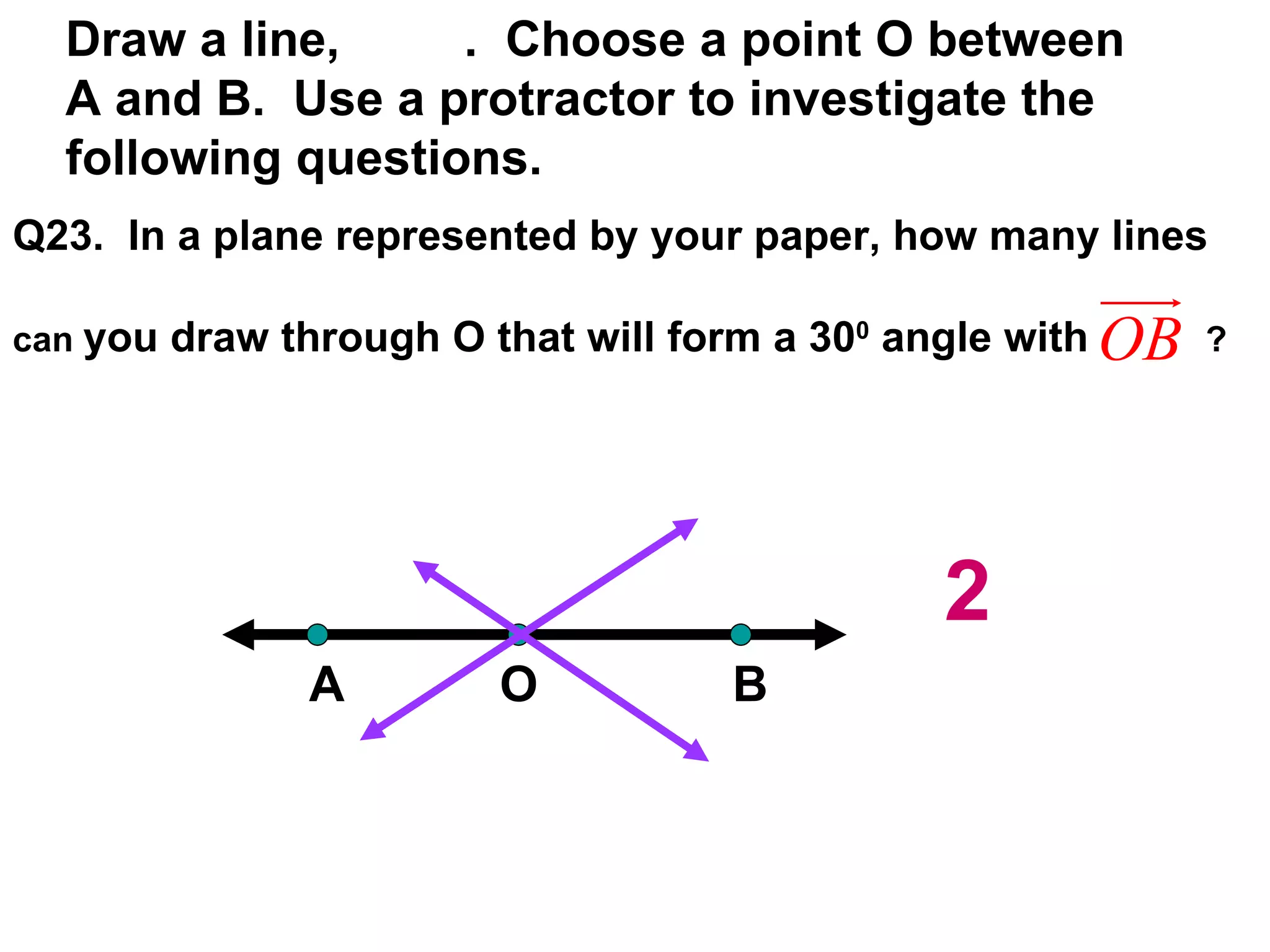
Draw a line,  .  Choose a point O between A and B.  Use a protractor to investigate the following questions. Q23.  In a plane represented by your paper, how many lines  can  you draw through O that will form a 30 0  angle with   ? A O B 2
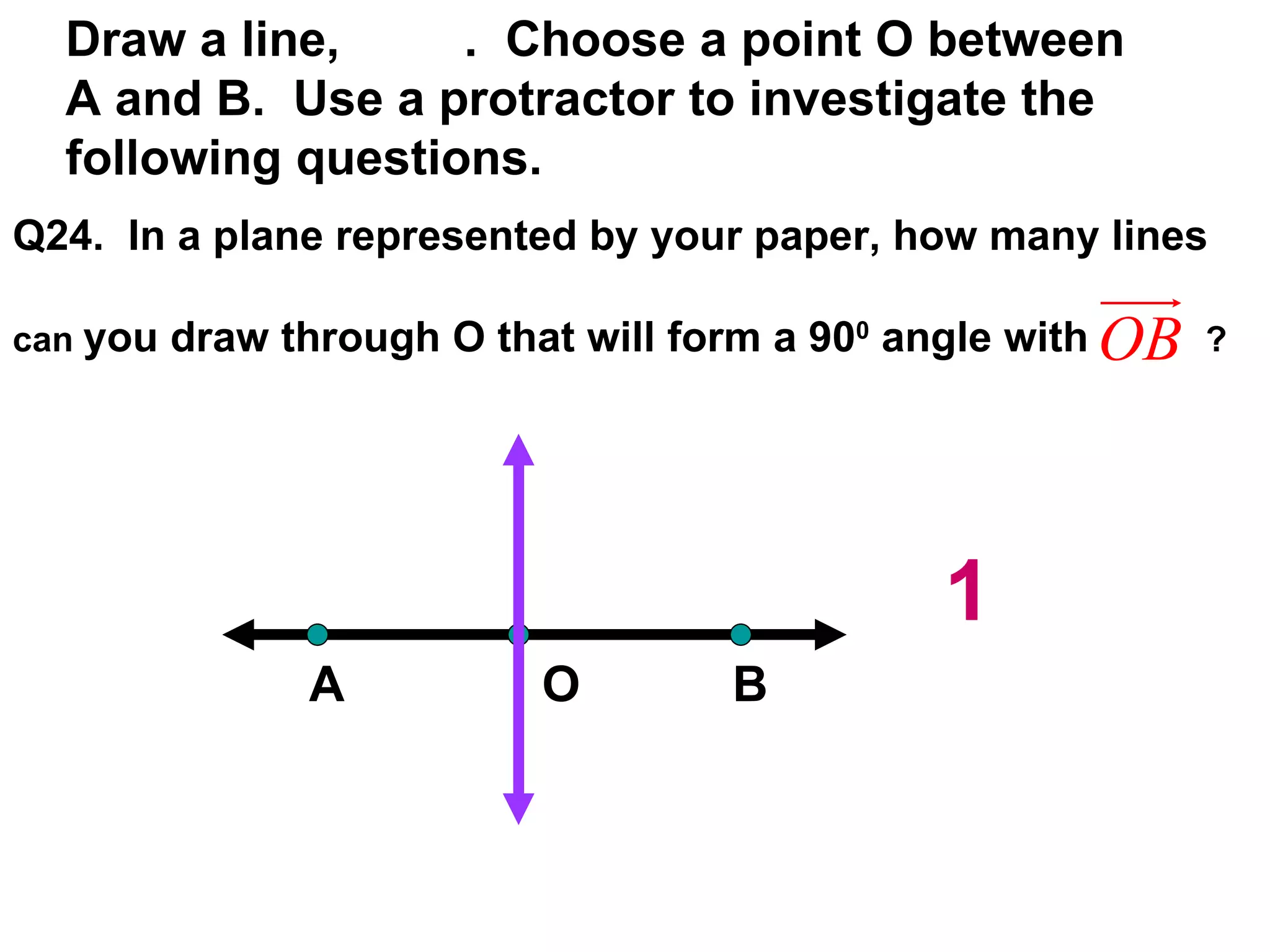
Draw a line,  .  Choose a point O between A and B.  Use a protractor to investigate the following questions. Q24.  In a plane represented by your paper, how many lines  can  you draw through O that will form a 90 0  angle with   ? A O B 1
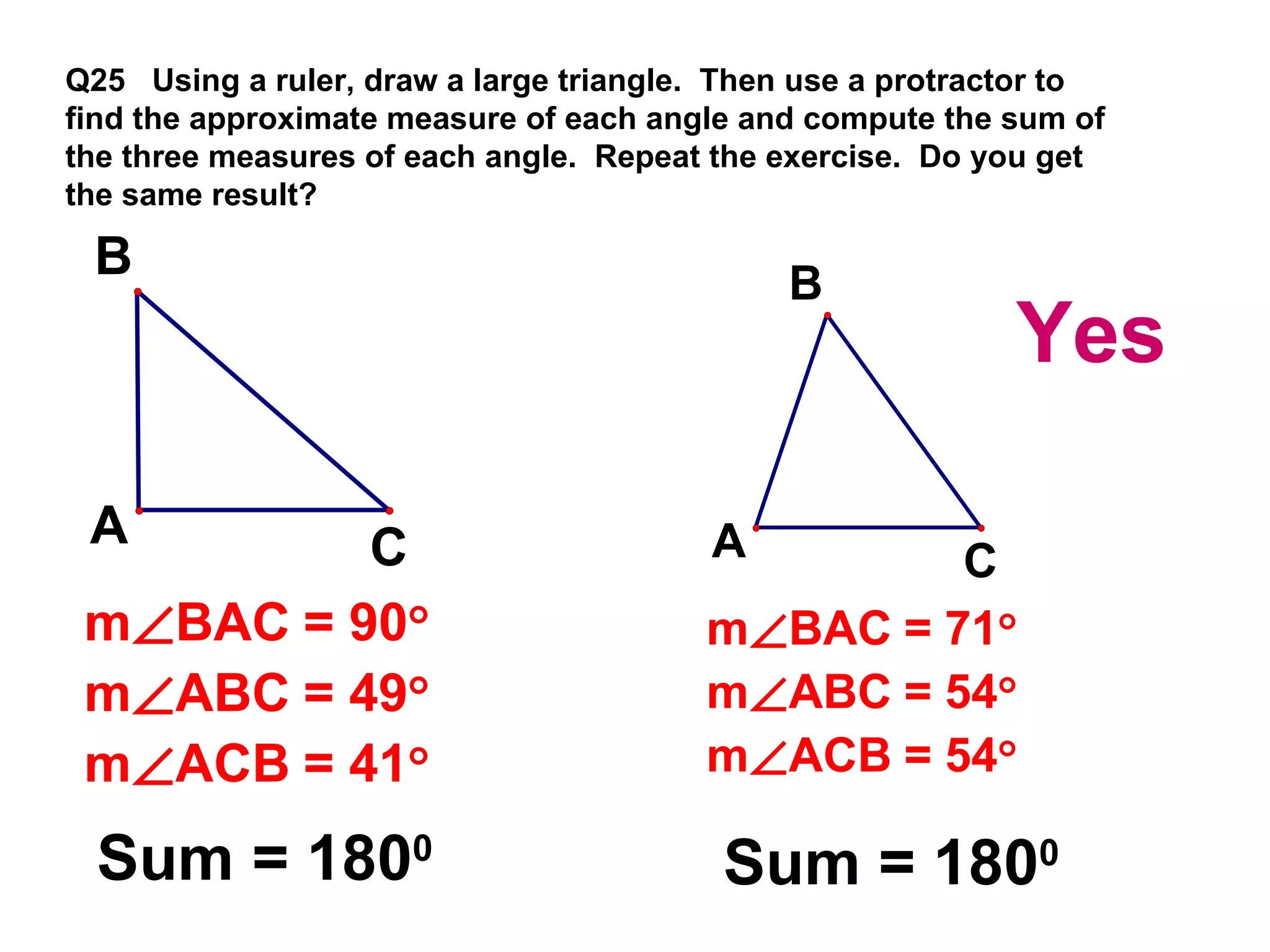
Q25  Using a ruler, draw a large triangle.  Then use a protractor to find the approximate measure of each angle and compute the sum of the three measures of each angle.  Repeat the exercise.  Do you get the same result? Sum = 180 0 Sum = 180 0 Yes
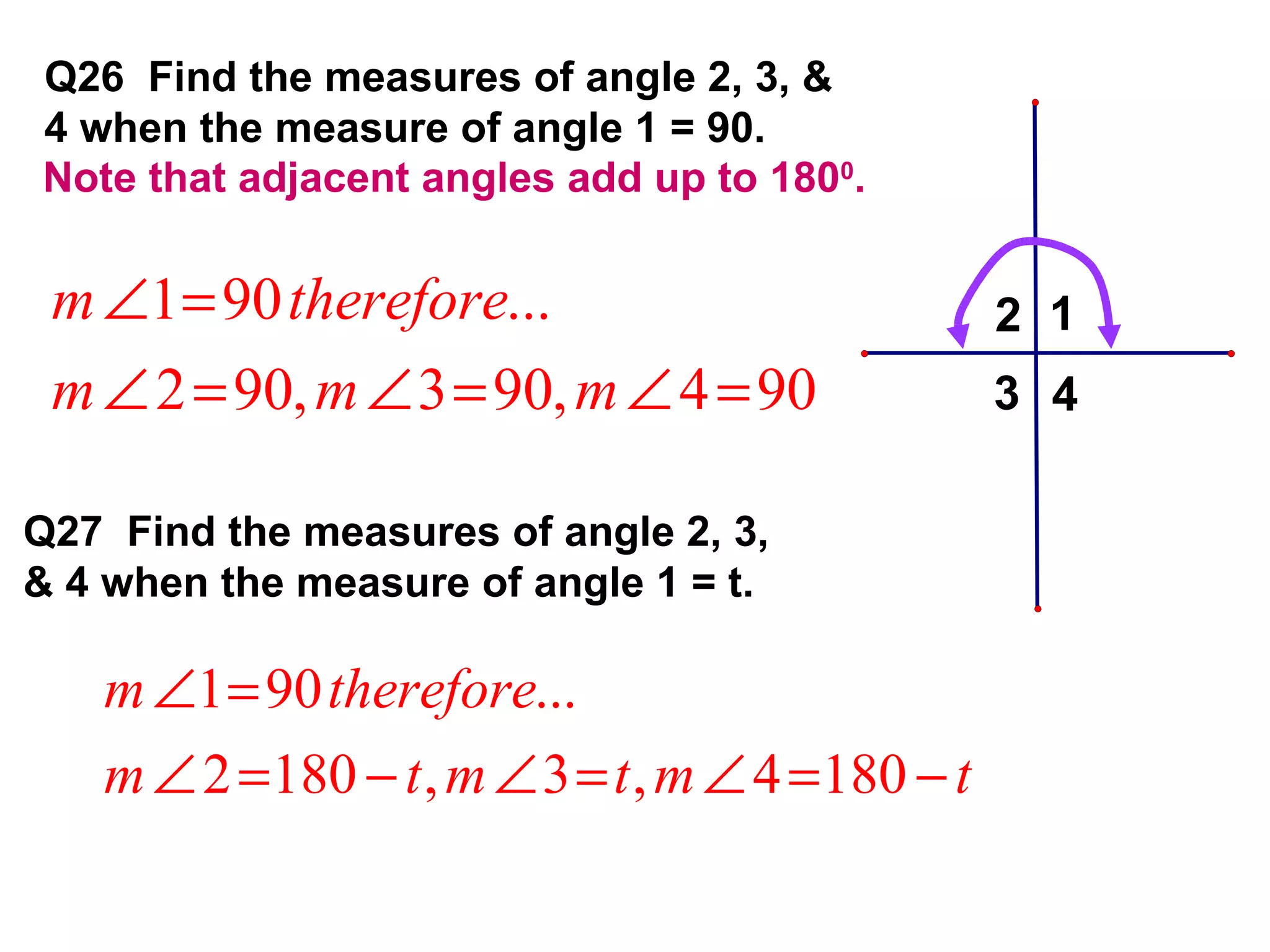
Q26  Find the measures of angle 2, 3, & 4 when the measure of angle 1 = 90. Q27  Find the measures of angle 2, 3, & 4 when the measure of angle 1 = t. Note that adjacent angles add up to 180 0 .
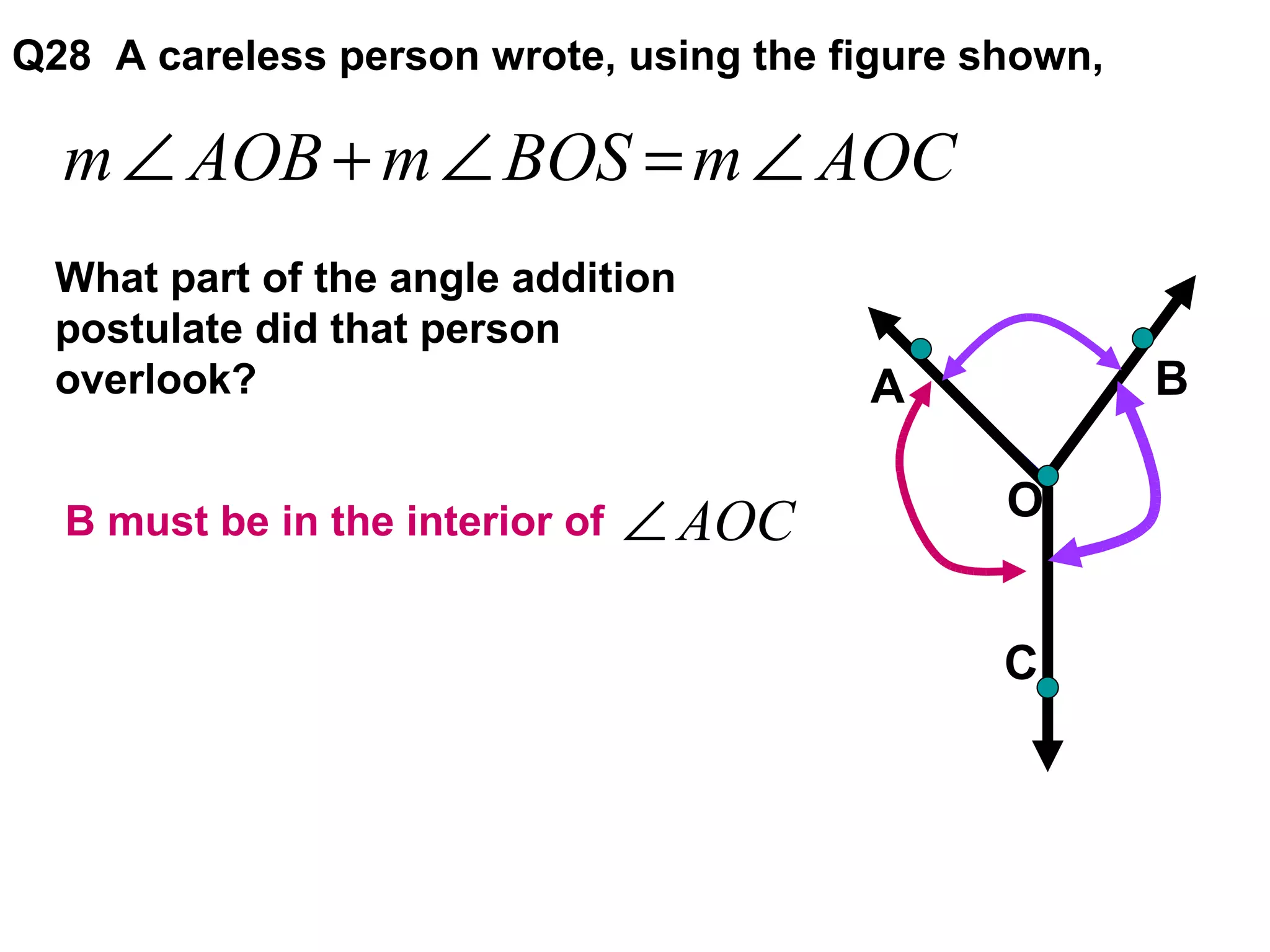
Q28  A careless person wrote, using the figure shown, What part of the angle addition postulate did that person overlook? B must be in the interior of
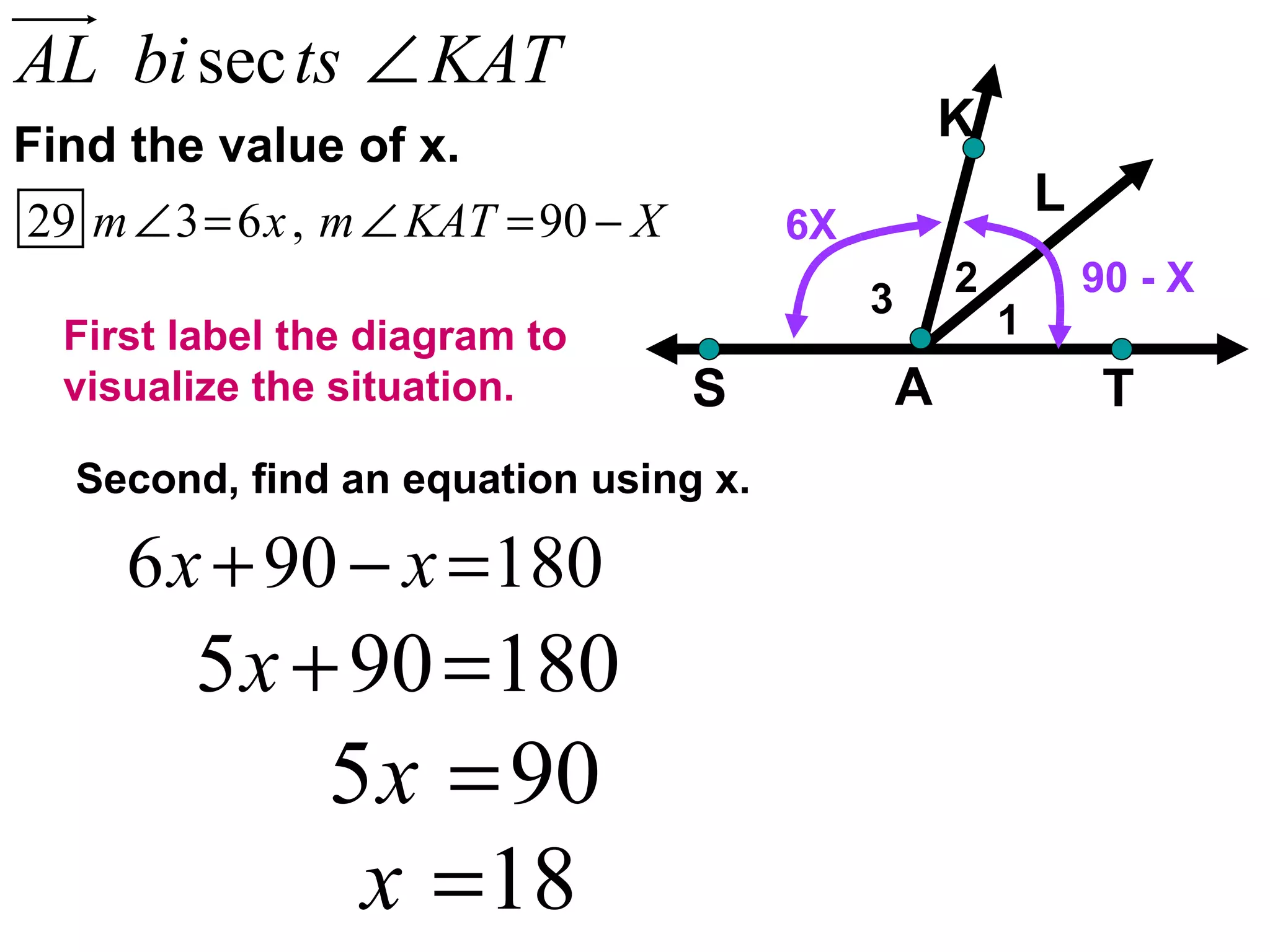
Find the value of x. 3 2 1 6X 90 - X First label the diagram to visualize the situation. Second, find an equation using x.
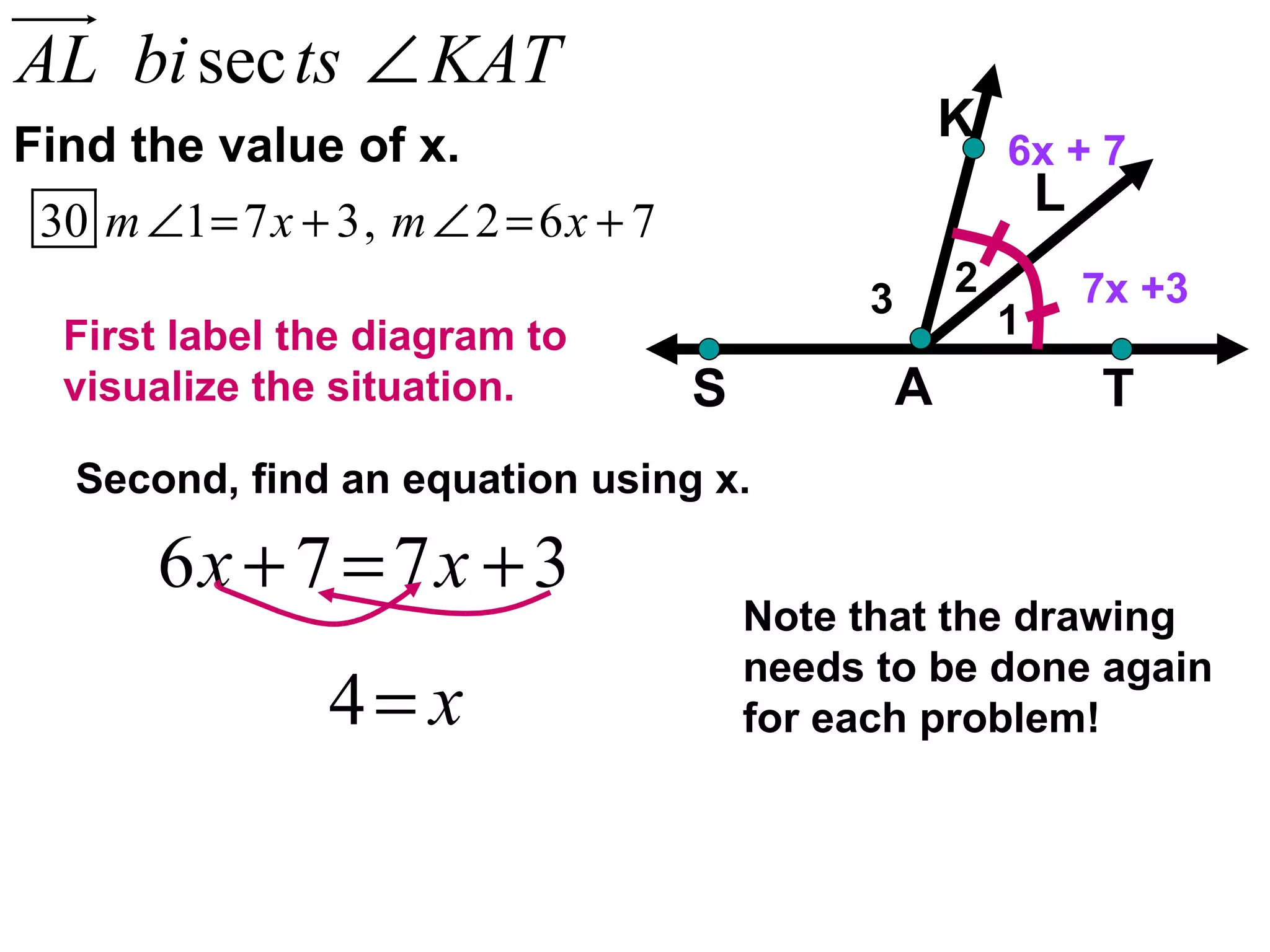
Find the value of x. 3 2 1 First label the diagram to visualize the situation. Second, find an equation using x. 6x + 7 7x +3 Note that the drawing needs to be done again for each problem!
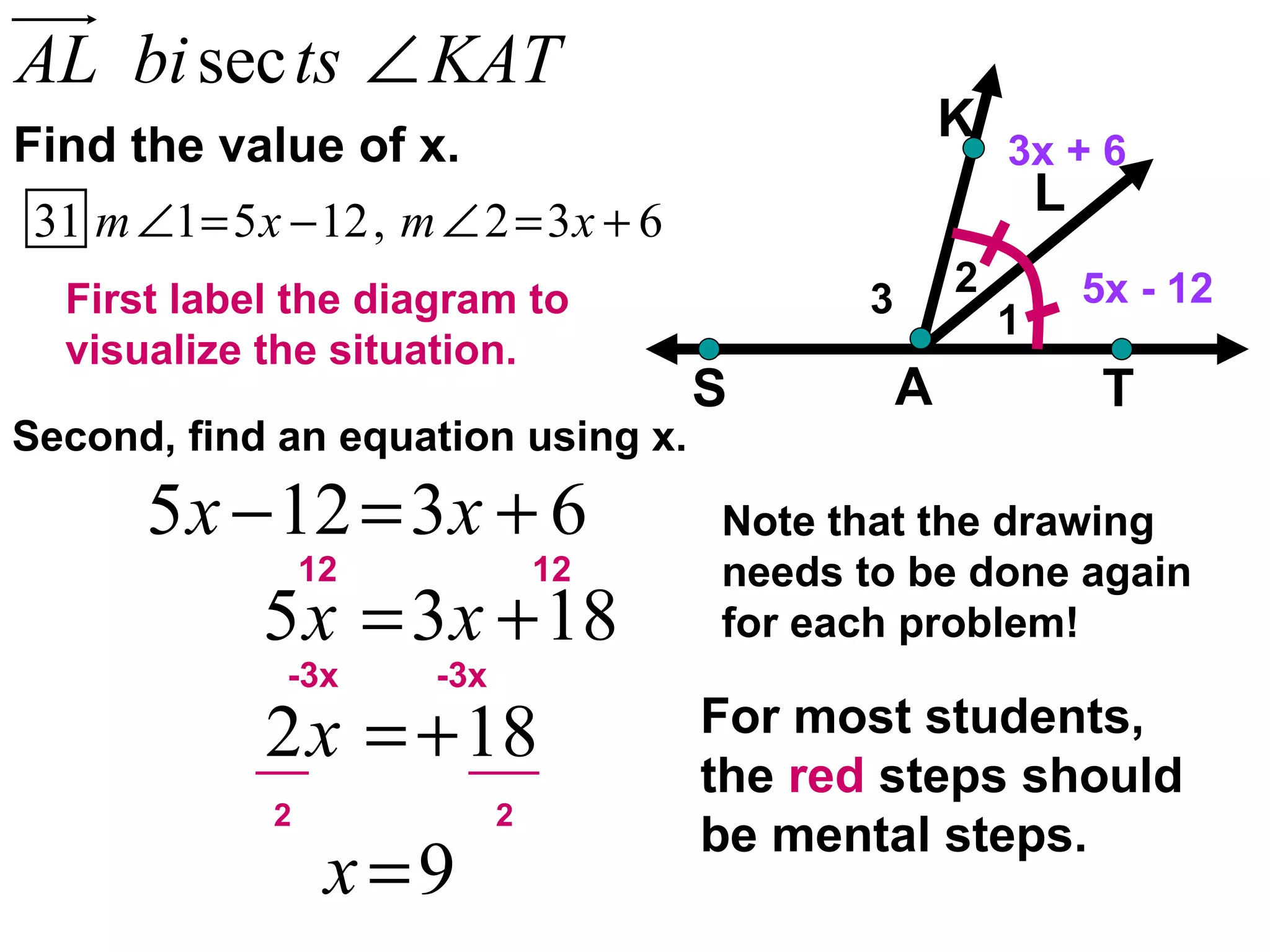
Find the value of x. 3 2 1 First label the diagram to visualize the situation. Second, find an equation using x. 3x + 6 5x - 12 12  12 -3x  -3x ___  ____ 2  2 For most students, the  red  steps should be mental steps. Note that the drawing needs to be done again for each problem!
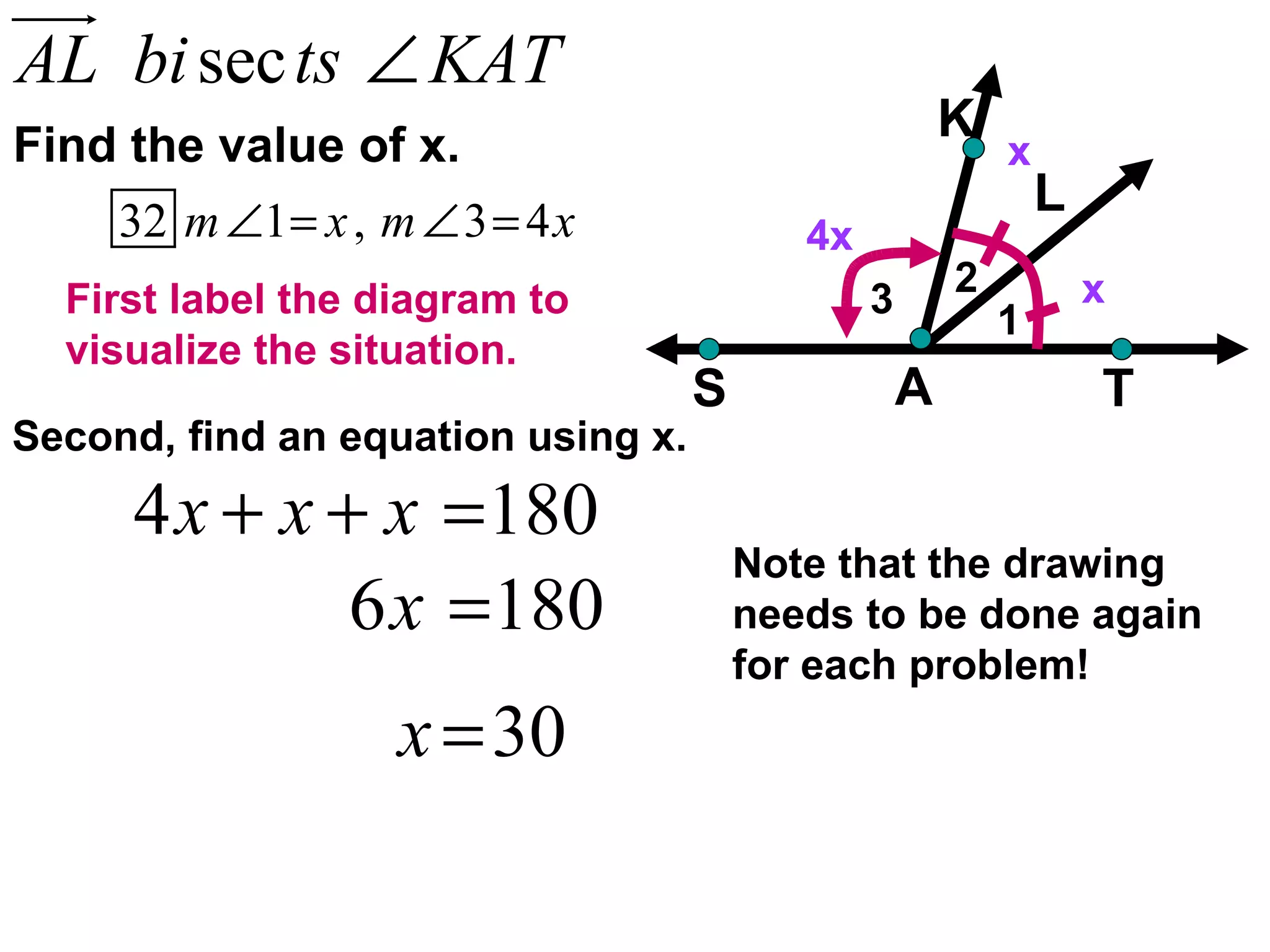
Find the value of x. 3 2 1 First label the diagram to visualize the situation. Second, find an equation using x. x x 4x Note that the drawing needs to be done again for each problem!
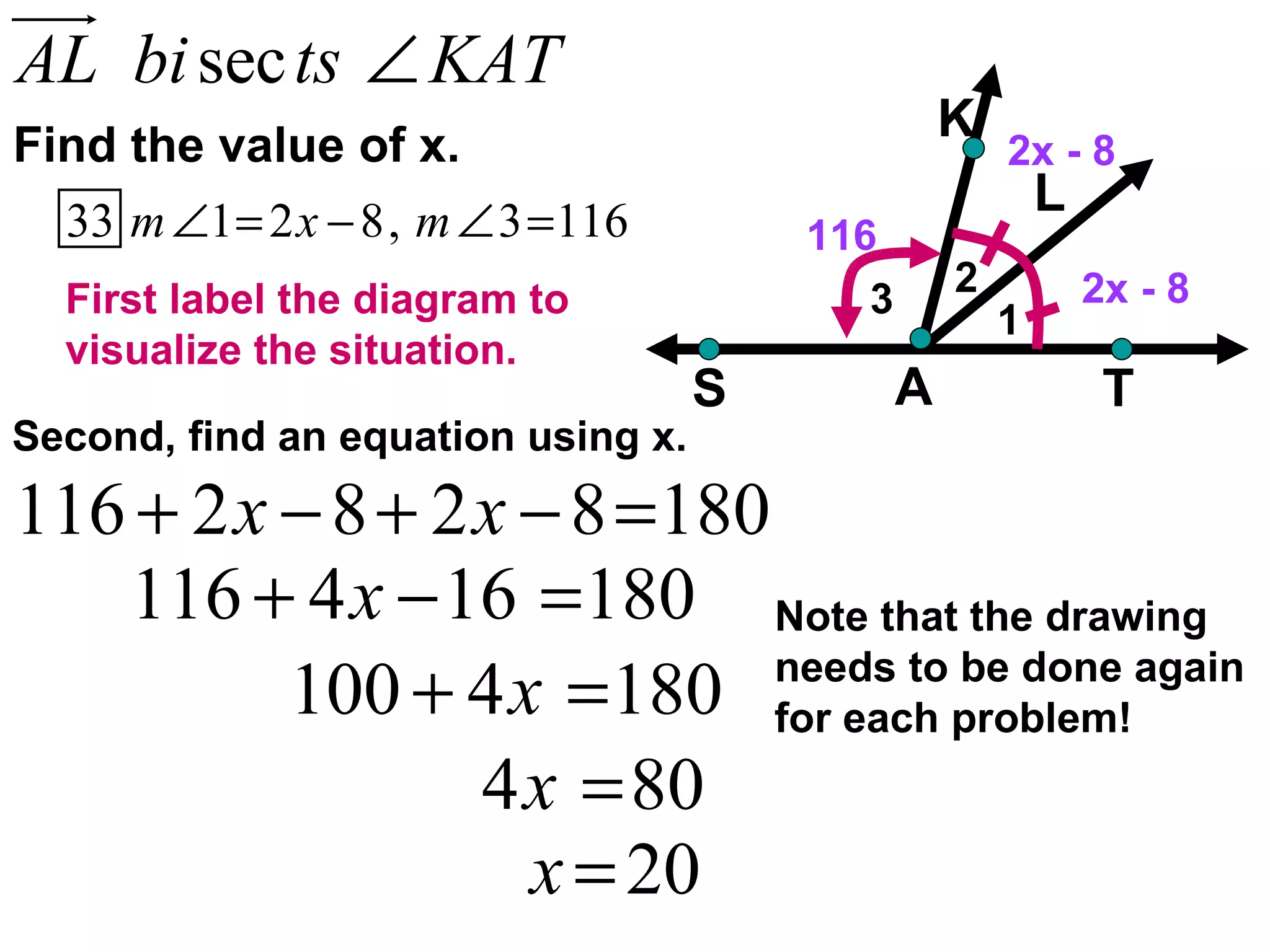
Find the value of x. 3 2 1 First label the diagram to visualize the situation. Second, find an equation using x. 2x - 8 2x - 8 116 Note that the drawing needs to be done again for each problem!
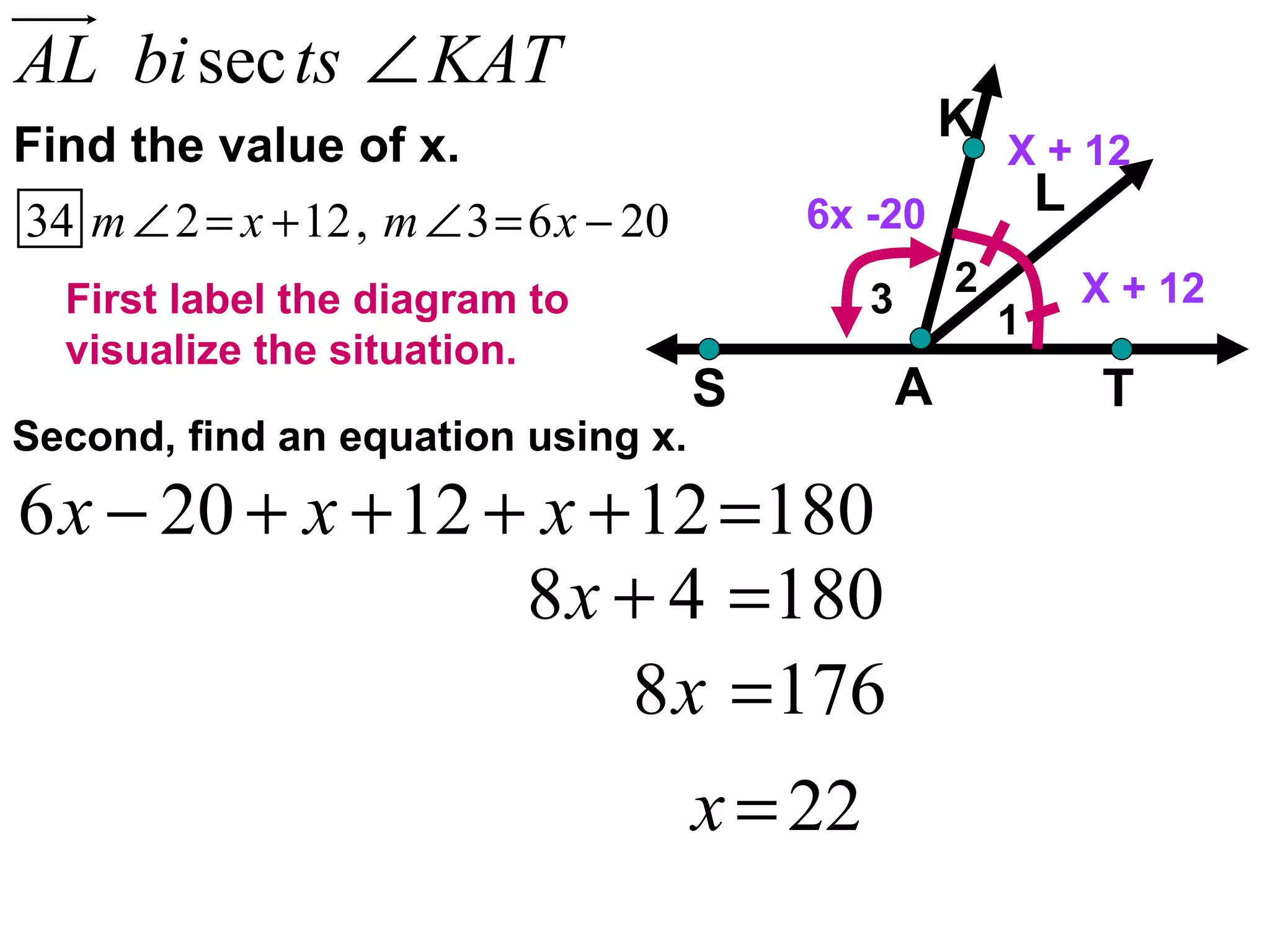
Find the value of x. 3 2 1 First label the diagram to visualize the situation. Second, find an equation using x. X + 12 X + 12 6x -20
C’est fini. The End

Ac1.4cMorePracticeProblems

  • 1.
    1.4 WE Q1 Name the vertex and the sides of Q2 Name all the angles adjacent to
  • 2.
    1.4 WE Q1 Name the vertex and the sides of Q2 Name all the angles adjacent to
  • 3.
    State another namefor each angle.
  • 4.
    State another namefor each angle.
  • 5.
    State another namefor each angle.
  • 6.
    State another namefor each angle.
  • 7.
    State another namefor each angle.
  • 8.
    State another namefor each angle.
  • 9.
    State whether theangle appears to be acute, right, obtuse or straight. Acute
  • 10.
    State whether theangle appears to be acute, right, obtuse or straight. Acute Acute
  • 11.
    State whether theangle appears to be acute, right, obtuse or straight. Acute Acute Right
  • 12.
    State whether theangle appears to be acute, right, obtuse or straight. Acute Acute Right Acute
  • 13.
    State whether theangle appears to be acute, right, obtuse or straight. Acute Acute Right Acute Straight
  • 14.
    State whether theangle appears to be acute, right, obtuse or straight. Acute Acute Right Acute Straight Obtuse
  • 15.
  • 16.
  • 17.
  • 18.
  • 19.
    Without measuring sketcheach angle, then measure for accuracy. Each angle is half of 90 or 45 150 = 90+60 150 = 90+30+30
  • 20.
    Draw a line, . Choose a point O between A and B. Use a protractor to investigate the following questions. Q23. In a plane represented by your paper, how many lines can you draw through O that will form a 30 0 angle with ? A O B 2
  • 21.
    Draw a line, . Choose a point O between A and B. Use a protractor to investigate the following questions. Q24. In a plane represented by your paper, how many lines can you draw through O that will form a 90 0 angle with ? A O B 1
  • 22.
    Q25 Usinga ruler, draw a large triangle. Then use a protractor to find the approximate measure of each angle and compute the sum of the three measures of each angle. Repeat the exercise. Do you get the same result? Sum = 180 0 Sum = 180 0 Yes
  • 23.
    Q26 Findthe measures of angle 2, 3, & 4 when the measure of angle 1 = 90. Q27 Find the measures of angle 2, 3, & 4 when the measure of angle 1 = t. Note that adjacent angles add up to 180 0 .
  • 24.
    Q28 Acareless person wrote, using the figure shown, What part of the angle addition postulate did that person overlook? B must be in the interior of
  • 25.
    Find the valueof x. 3 2 1 6X 90 - X First label the diagram to visualize the situation. Second, find an equation using x.
  • 26.
    Find the valueof x. 3 2 1 First label the diagram to visualize the situation. Second, find an equation using x. 6x + 7 7x +3 Note that the drawing needs to be done again for each problem!
  • 27.
    Find the valueof x. 3 2 1 First label the diagram to visualize the situation. Second, find an equation using x. 3x + 6 5x - 12 12 12 -3x -3x ___ ____ 2 2 For most students, the red steps should be mental steps. Note that the drawing needs to be done again for each problem!
  • 28.
    Find the valueof x. 3 2 1 First label the diagram to visualize the situation. Second, find an equation using x. x x 4x Note that the drawing needs to be done again for each problem!
  • 29.
    Find the valueof x. 3 2 1 First label the diagram to visualize the situation. Second, find an equation using x. 2x - 8 2x - 8 116 Note that the drawing needs to be done again for each problem!
  • 30.
    Find the valueof x. 3 2 1 First label the diagram to visualize the situation. Second, find an equation using x. X + 12 X + 12 6x -20
  • 31.