IX 
MATHEMATICS 
GOVERNMENT OF KERALA 
DEPARTMENT OF EDUCATION 
6 
5 
4 
3 
2 
1 
0
MATHEMATICS 
STANDARD IX 
GOVERNMENT OF KERALA 
DEPARTMENT OF EDUCATION
Dear children. 
We use a lot of math, knowingly or unknowingly, in our 
daily life. We try to discuss such mathematical ideas from this class onwards. 
By looking a little deeper into ideas, this book tries to develop the habit of 
generalization. 
In it, you will find examples which make you think about 
the relations between cause and effect. It also gives you various opportunities 
to form your own opinions and express them with confidence. 
With the help of the teacher, you can observe things in 
new ways, discover new facts through experiments and find the reasons for 
many things. 
Let the learning of math be full of joy for you. 
With love, 
DIRECTOR 
SCERT
1. POLYGON 
INTRODUCTION 
POLYGON 
It is a closed plane figure, bounded by straight-lie segment. 
The line segments forming a polygon intersect only at end 
Points and each end point are shared by only two line segments. 
The segments which make up a polygon are called the sides of the polygon 
and the end points of the segments are called the vertices of the polygon. 
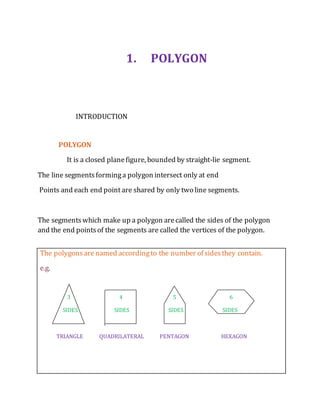
The polygons are named according to the number of sides they contain. 
e.g. 
3 4 5 6 
SIDES SIDES SIDES SIDES 
TRIANGLE QUADRILATERAL PENTAGON HEXAGON
Remember: 
A line segment joining any two consecutive vertices of a polygon is called its 
diagonal. 
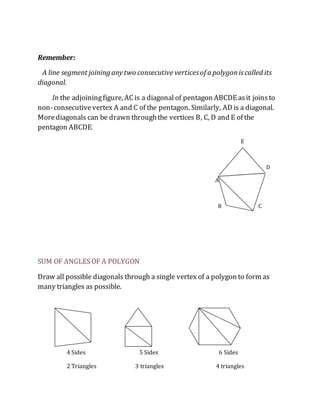
In the adjoining figure, AC is a diagonal of pentagon ABCDE as it joins to 
non- consecutive vertex A and C of the pentagon. Similarly, AD is a diagonal. 
More diagonals can be drawn through the vertices B, C, D and E of the 
pentagon ABCDE. 
E 
D 
A 
B C 
SUM OF ANGLES OF A POLYGON 
Draw all possible diagonals through a single vertex of a polygon to form as 
many triangles as possible. 
4 Sides 5 Sides 6 Sides 
2 Triangles 3 triangles 4 triangles
It is observed that the number of triangles formed is two less than the number 
of sides in the polygon. 
So, if a polygon n sides, the number of triangles formed will be n-2. 
Since, The sum of the angles of a triangle = 180^0 
There for The sum of the angles of (n-2) triangles = (n-2)180^0 
Sum of interior angles of a polygon with n sides = (n-2)180^0 
= (2n-4)90^0 
= (2n-4) right angles 
EXERCISE: 
If a polygon has 7 sides, it has……………. vertices 
SUM OF EXTERIOR ANGLES OF A POLYGON 
If the sides of a polygon are produced in order, the sum of exterior angles so 
formed is always 360^0 
3 3 
2 4 
2 
4 
1 5 1 
5 
[<1+<2+<3+<4+<5=360^0] [<1+<2+<3+<4+<5+<6=360^0]
Example 1: Is it possible to have a polygon, the sum of whose interior angles is 
9 right angles. 
Solution: 
Let the number of sides be n. 
There for sum of its interior angles = (2n-4)90^0 
According to the given statement: 
(2n-4)90^0=9*90^0 [9 right angles=9*90^0] 
2n-4=9 
n=6.5 which is not possible 
EXERCISE: 
One angle of a 7 sided polygon is 114^0 and each of the other 6 angles is 
x^0. Find the magnitude of x ^0. 
REGULAR POLYGON 
A polygon said to be a regular polygon, if all its 
(1) Interior angles are equal, 
(2) Sides are equal and 
(3) Exterior angles are equal. 
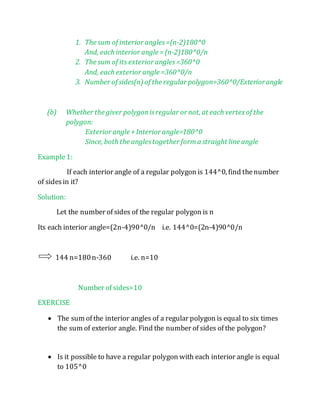
(a) If a regular polygon has n sides:
1. The sum of interior angles =(n-2)180^0 
And, each interior angle = (n-2)180^0/n 
2. The sum of its exterior angles =360^0 
And, each exterior angle =360^0/n 
3. Number of sides(n) of the regular polygon=360^0/Exterior angle 
(b) Whether the giver polygon is regular or not, at each vertex of the 
polygon: 
Exterior angle + Interior angle=180^0 
Since, both the angles together form a straight line angle 
Example 1: 
If each interior angle of a regular polygon is 144^0, find the number 
of sides in it? 
Solution: 
Let the number of sides of the regular polygon is n 
Its each interior angle=(2n-4)90^0/n i.e. 144^0=(2n-4)90^0/n 
144 n=180 n-360 i.e. n=10 
Number of sides=10 
EXERCISE 
 The sum of the interior angles of a regular polygon is equal to six times 
the sum of exterior angle. Find the number of sides of the polygon? 
 Is it possible to have a regular polygon with each interior angle is equal 
to 105^0
Podi
Podi

Podi

  • 1.
    IX MATHEMATICS GOVERNMENTOF KERALA DEPARTMENT OF EDUCATION 6 5 4 3 2 1 0
  • 2.
    MATHEMATICS STANDARD IX GOVERNMENT OF KERALA DEPARTMENT OF EDUCATION
  • 3.
    Dear children. Weuse a lot of math, knowingly or unknowingly, in our daily life. We try to discuss such mathematical ideas from this class onwards. By looking a little deeper into ideas, this book tries to develop the habit of generalization. In it, you will find examples which make you think about the relations between cause and effect. It also gives you various opportunities to form your own opinions and express them with confidence. With the help of the teacher, you can observe things in new ways, discover new facts through experiments and find the reasons for many things. Let the learning of math be full of joy for you. With love, DIRECTOR SCERT
  • 4.
    1. POLYGON INTRODUCTION POLYGON It is a closed plane figure, bounded by straight-lie segment. The line segments forming a polygon intersect only at end Points and each end point are shared by only two line segments. The segments which make up a polygon are called the sides of the polygon and the end points of the segments are called the vertices of the polygon. The polygons are named according to the number of sides they contain. e.g. 3 4 5 6 SIDES SIDES SIDES SIDES TRIANGLE QUADRILATERAL PENTAGON HEXAGON
  • 5.
    Remember: A linesegment joining any two consecutive vertices of a polygon is called its diagonal. In the adjoining figure, AC is a diagonal of pentagon ABCDE as it joins to non- consecutive vertex A and C of the pentagon. Similarly, AD is a diagonal. More diagonals can be drawn through the vertices B, C, D and E of the pentagon ABCDE. E D A B C SUM OF ANGLES OF A POLYGON Draw all possible diagonals through a single vertex of a polygon to form as many triangles as possible. 4 Sides 5 Sides 6 Sides 2 Triangles 3 triangles 4 triangles
  • 6.
    It is observedthat the number of triangles formed is two less than the number of sides in the polygon. So, if a polygon n sides, the number of triangles formed will be n-2. Since, The sum of the angles of a triangle = 180^0 There for The sum of the angles of (n-2) triangles = (n-2)180^0 Sum of interior angles of a polygon with n sides = (n-2)180^0 = (2n-4)90^0 = (2n-4) right angles EXERCISE: If a polygon has 7 sides, it has……………. vertices SUM OF EXTERIOR ANGLES OF A POLYGON If the sides of a polygon are produced in order, the sum of exterior angles so formed is always 360^0 3 3 2 4 2 4 1 5 1 5 [<1+<2+<3+<4+<5=360^0] [<1+<2+<3+<4+<5+<6=360^0]
  • 7.
    Example 1: Isit possible to have a polygon, the sum of whose interior angles is 9 right angles. Solution: Let the number of sides be n. There for sum of its interior angles = (2n-4)90^0 According to the given statement: (2n-4)90^0=9*90^0 [9 right angles=9*90^0] 2n-4=9 n=6.5 which is not possible EXERCISE: One angle of a 7 sided polygon is 114^0 and each of the other 6 angles is x^0. Find the magnitude of x ^0. REGULAR POLYGON A polygon said to be a regular polygon, if all its (1) Interior angles are equal, (2) Sides are equal and (3) Exterior angles are equal. (a) If a regular polygon has n sides:
  • 8.
    1. The sumof interior angles =(n-2)180^0 And, each interior angle = (n-2)180^0/n 2. The sum of its exterior angles =360^0 And, each exterior angle =360^0/n 3. Number of sides(n) of the regular polygon=360^0/Exterior angle (b) Whether the giver polygon is regular or not, at each vertex of the polygon: Exterior angle + Interior angle=180^0 Since, both the angles together form a straight line angle Example 1: If each interior angle of a regular polygon is 144^0, find the number of sides in it? Solution: Let the number of sides of the regular polygon is n Its each interior angle=(2n-4)90^0/n i.e. 144^0=(2n-4)90^0/n 144 n=180 n-360 i.e. n=10 Number of sides=10 EXERCISE  The sum of the interior angles of a regular polygon is equal to six times the sum of exterior angle. Find the number of sides of the polygon?  Is it possible to have a regular polygon with each interior angle is equal to 105^0