ABRASIVE JET
MACHINING (AJM)
Presented By – Mohammed Tayeeb
Introduction
 A stream of abrasive grains (Al2O3 or SiC) is carried by high
pressure gas or air (compressed).
 Impinges on the work surface at very high velocity through a
nozzle of 0.3 to 0.5 mm diameter.
 Sand Blasting (SB) - a similar process
 The major differences between are SB and AJM
(i) smaller diameter abrasives
(ii) a more finely controlled delivery system
 Material removal – by mechanical abrasion action of the high
velocity abrasive particles.
 Best suited for hole drilling in superhard materials.
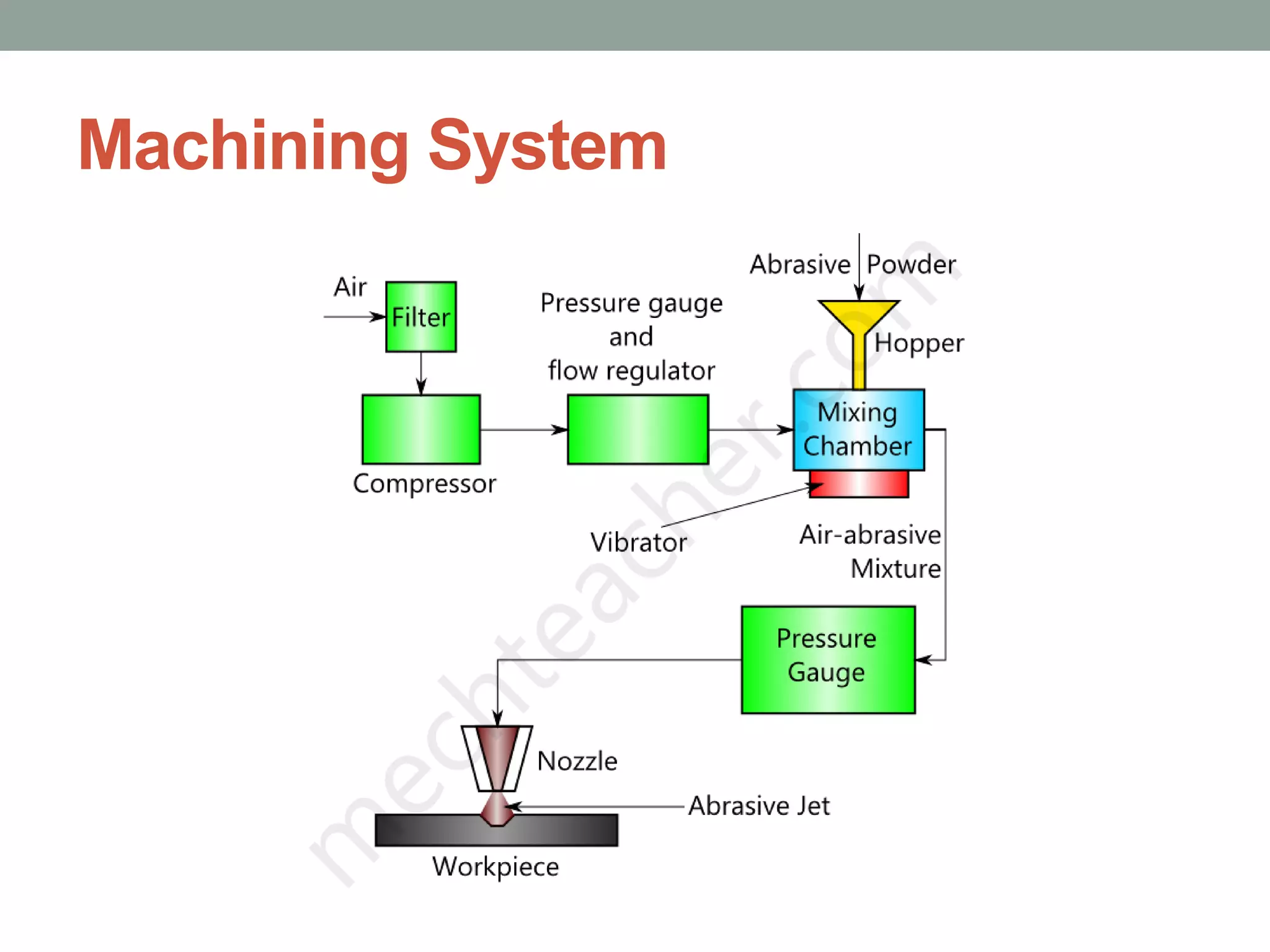
Machining System
Process Parameters
MRR, machining accuracy, surface roughness
and nozzle wear are influenced by
 Size and distance of the nozzle.
 Composition, strength, size, and shape of abrasives
 Flow rate
 Composition, pressure, and velocity of the carrier gas.
MRR is mainly dependent on the flow rate and
size of abrasives.
Applications
 Drilling holes, cutting slots, cleaning hard surfaces,
deburring, polishing,and radiusing.
 Deburring of cross holes, slots, and threads in small
precision parts that require a burr-free finish, such as
hydraulic valves, aircraft fuel systems, and medical
appliances.
 Machining intricate shapes or holes in sensitive, brittle,
thin, or difficult-to-machine materials.
 Insulation stripping and wire cleaning without affecting the
conductor.
Advantages
 Because AJM is a cool
machining process, it is
best suited for machining
brittle and heat-sensitive
materials like glass,
quartz, sapphire, and
ceramics.
 The process is used for
machining superalloys and
refractory materials.
 It is not reactive with any
workpiece material.
 No tool changes are
required.
Disadvantages
 The tapering effect may
occurs especially when
drilling in metals.
 The removal rate is slow
 The abrasive get
impended on the work
surafce.
 Soft metals can’t be
machined by the process.
THANK YOU

Abrasive Jet Machining (AJM)

  • 1.
  • 2.
    Introduction  A streamof abrasive grains (Al2O3 or SiC) is carried by high pressure gas or air (compressed).  Impinges on the work surface at very high velocity through a nozzle of 0.3 to 0.5 mm diameter.  Sand Blasting (SB) - a similar process  The major differences between are SB and AJM (i) smaller diameter abrasives (ii) a more finely controlled delivery system  Material removal – by mechanical abrasion action of the high velocity abrasive particles.  Best suited for hole drilling in superhard materials.
  • 3.
  • 4.
    Process Parameters MRR, machiningaccuracy, surface roughness and nozzle wear are influenced by  Size and distance of the nozzle.  Composition, strength, size, and shape of abrasives  Flow rate  Composition, pressure, and velocity of the carrier gas. MRR is mainly dependent on the flow rate and size of abrasives.
  • 5.
    Applications  Drilling holes,cutting slots, cleaning hard surfaces, deburring, polishing,and radiusing.  Deburring of cross holes, slots, and threads in small precision parts that require a burr-free finish, such as hydraulic valves, aircraft fuel systems, and medical appliances.  Machining intricate shapes or holes in sensitive, brittle, thin, or difficult-to-machine materials.  Insulation stripping and wire cleaning without affecting the conductor.
  • 6.
    Advantages  Because AJMis a cool machining process, it is best suited for machining brittle and heat-sensitive materials like glass, quartz, sapphire, and ceramics.  The process is used for machining superalloys and refractory materials.  It is not reactive with any workpiece material.  No tool changes are required. Disadvantages  The tapering effect may occurs especially when drilling in metals.  The removal rate is slow  The abrasive get impended on the work surafce.  Soft metals can’t be machined by the process.
  • 7.