Pallavi Priyambada Badajena Guided By
Debashish Bose Rajendra Kumar Mohanty
Deepak Kumar Mohanty Lecturer
Dillip Kumar Sahoo Dept.Of Mechanical Engg.
Debesh Jena
 Introduction
 History
 Working Principle
 Diagram
 Equipments
 Process Parameters
 Process Characteristics
 Schematic Diagram
 Types of Abrasive
 Market Price Of Compressor
 Abrasive Particle
 Carrier Gas
 Nozzle And Jet Velocity
 Stand-off Distance
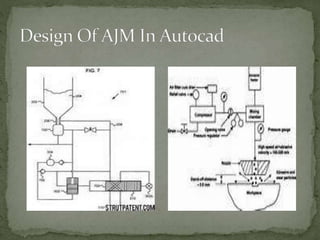
 Design Of AJM In Autocad
 Material Removal Rate
 Accuracy
 Surface Finish
 Application
 Advantages
 Disadvantages
 References
 There are many situations where the processes of
manufacturing we’ve learned cannot produce the
required dimensional accuracy and or surface finish.
 Fine finishes on ball/roller bearings, pistons, valves, gears,
cams, etc.
 The best methods for producing such accuracy and finishes
involve Abrasive Jet Machining
 Abrasive Jet Machining, It is an unconventional
machining process based on mechanical energy for
cutting, deburring and cleaning hard and brittle
materials.
 In 1979, Dr. Mohamed Hashish working at Flow
Research, began researching methods to increase the
cutting power of the abrasive jet so it could cut metals,
and other hard materials.
 Dr. Hashish, regarded as the father of the abrasive jet,
invented the process of adding abrasives to the plain
abrasive jet. He used garnet abrasives, a material
commonly used on sandpaper. With this method, the
jet (containing abrasives) could cut virtually any
material.
 Abrasive Jet Machining helps in removing materials
from the brittle and heat sensitive materials by the
application of high speed stream of abrasive particles.
 Micro-abrasive particles are propelled by inert gas at
velocities of upto 300 m/sec, which result in erosion
 The material removal is due to erosive action of a high
pressure jet.
 In particular drilling of holes of minimum diameter
and maximum depth with greater accuracy and surface
finish.
 Material is removed by fine abrasive particles, usually
about 0.001 in (0.025 mm) in diameter.
 Pressures for the gas range from 25 to 130 psig (170–
900 kPag) and speeds can be as high as 300 m/s.
 High pressure gas supply source
 Powder mixing chamber
 Control valve
 Nozzle
 Hood
 Exhaust systems
 A filter and water separator unit
 The abrasive powder is held in a hopper, which is fed
to the mixing chamber to mix with carrier gases.
 A jet stream of abrasive forms as the mixture comes
out of the nozzle.
 At the working table a dust collection hood is
provided, with a vacuum dust collector.
Nozzle
 Nozzle tips are made of hard materials like tungsten
carbide or sapphire.
 Tungsten carbide nozzles give a life of about 15 hours
with silicon carbide abrasive.
 The nozzle diameter is in the range of 0.13 to 1.25 mm
 MRR, machining accuracy, surface roughness and
nozzle wear are influenced by
 Size and distance of the nozzle.
 Composition, strength, size, and shape of abrasives
 Flow rate
 Composition, pressure, and velocity of the carrier gas.
 The mass flow rate of the gas decreases with an
increase in the abrasive flow rate
 Hence the mixing ratio increases and causes a
decrease in the removal rate because of the decreasing
energy available for material removal
 High nozzle pressures result in a greater removal rate,
but the nozzle life is decreased
 Refractory-Powder
 Refractory-Loose Grit Sand
 Bonded Abrasives
 Coated Abrasives
 Blasting/Lapping/Polishing Abrasives
 The market price of air compressor vary over a wide
range.
 Its value depends on the pressure with which the
abrasive particle is to be bombarded on the
workpiece(Glass).
 20-25cfm – Rs70,000
 10-12cfm – 35,000
 Material – Al2O3 / SiC / glass beads
 Shape – irregular / spherical
 Size – 10 ~ 50 μm
 Mass flow rate – 2 ~ 20 gm/min
 Composition – Air, CO2, N2
 Density – Air ~ 1.3 kg/m3
 Velocity – 500 ~ 700 m/s
 Pressure – 2 ~ 10 bar
 Flow rate – 5 ~ 30 lpm
 Material – WC / sapphire
 Diameter – (Internal) 0.2 ~ 0.8 mm
 Life – 10 ~ 300 hours
 Velocity – 100 ~ 300 m/s
 Stand-off distance – 0.5 ~ 5 mm
 Impingement Angle – 600 ~ 900
• The metal removal rate depends upon
 The diameter of nozzle
 Composition of abrasive-gas mixture
 Jet pressure
 Hardness of abrasive particles and that of work material
 Particle size
 Velocity of jet
 Distance of work piece from the jet
• In AJM, tolerances in the region of ±0.05 mm can be
achieved for precision works.
• In normal production jobs tolerance up to 0.1mm are
possible.
• The corner radius can be up to 0.1 mm, while taper is
about 0.05 mm per 10 mm of depth.
 Surface finish in AJM is in the range of 0.4 to 1.2 mm
depending upon the abrasive particle size.
 There is no heat affected zone, since the surface while
machining remains at room temperature, as the carrier
gas acts as the coolant.
 The effect of impact on the surface is less than 2 μm
 AJM can be used conveniently for fragile materials like
glass.
 Its applications include removing oxides from metal
surfaces, deburring, etching patterns, drilling and
cutting of thin sections.
 The process is not suitable for cutting soft materials
since the abrasive particles may get embedded into the
soft material.
 Cutting action is shock less.
 Ability to cut fragile and heat sensitive materials
without damage.
 Ability to cut intricate hole shapes in materials of any
hardness and brittleness.
 No variation due to surface irregularities and tool wear
as in conventional machining.
 Low capital cost.
 AJM units are easy to operate and maintain
 It is not suitable for mass material removal.
 It needs a dust control system.
 The abrasives may get embedded in softer material.
 The nozzle life is limited.
 The cutting motion is to be properly controlled.
 Boothroyd, Geoffrey; Knight, Winston A.
(1989),Fundamentals of machining and machine
tools(2nd ed.), Marcel Dekker, pp. 478–479,
 Todd, Robert H.; Allen, Dell K.; Alting, Leo
(1994), Manufacturing Processes Reference Guide,
Industrial Press Inc., pp. 2–5, .
 Chastagner, Matthew W.; Shih, Albert J.
(2007), "ABRASIVE JET MACHINING FOR EDGE
GENERATION", Transactions of NAMRI/SME35: 359–
366
ABRASIVE JET MACHINE

ABRASIVE JET MACHINE

  • 1.
    Pallavi Priyambada BadajenaGuided By Debashish Bose Rajendra Kumar Mohanty Deepak Kumar Mohanty Lecturer Dillip Kumar Sahoo Dept.Of Mechanical Engg. Debesh Jena
  • 2.
     Introduction  History Working Principle  Diagram  Equipments  Process Parameters  Process Characteristics  Schematic Diagram  Types of Abrasive  Market Price Of Compressor  Abrasive Particle  Carrier Gas  Nozzle And Jet Velocity  Stand-off Distance  Design Of AJM In Autocad  Material Removal Rate  Accuracy  Surface Finish  Application  Advantages  Disadvantages  References
  • 3.
     There aremany situations where the processes of manufacturing we’ve learned cannot produce the required dimensional accuracy and or surface finish.  Fine finishes on ball/roller bearings, pistons, valves, gears, cams, etc.  The best methods for producing such accuracy and finishes involve Abrasive Jet Machining  Abrasive Jet Machining, It is an unconventional machining process based on mechanical energy for cutting, deburring and cleaning hard and brittle materials.
  • 4.
     In 1979,Dr. Mohamed Hashish working at Flow Research, began researching methods to increase the cutting power of the abrasive jet so it could cut metals, and other hard materials.  Dr. Hashish, regarded as the father of the abrasive jet, invented the process of adding abrasives to the plain abrasive jet. He used garnet abrasives, a material commonly used on sandpaper. With this method, the jet (containing abrasives) could cut virtually any material.
  • 5.
     Abrasive JetMachining helps in removing materials from the brittle and heat sensitive materials by the application of high speed stream of abrasive particles.  Micro-abrasive particles are propelled by inert gas at velocities of upto 300 m/sec, which result in erosion  The material removal is due to erosive action of a high pressure jet.
  • 6.
     In particulardrilling of holes of minimum diameter and maximum depth with greater accuracy and surface finish.  Material is removed by fine abrasive particles, usually about 0.001 in (0.025 mm) in diameter.  Pressures for the gas range from 25 to 130 psig (170– 900 kPag) and speeds can be as high as 300 m/s.
  • 8.
     High pressuregas supply source  Powder mixing chamber  Control valve  Nozzle  Hood  Exhaust systems  A filter and water separator unit
  • 9.
     The abrasivepowder is held in a hopper, which is fed to the mixing chamber to mix with carrier gases.  A jet stream of abrasive forms as the mixture comes out of the nozzle.  At the working table a dust collection hood is provided, with a vacuum dust collector.
  • 10.
    Nozzle  Nozzle tipsare made of hard materials like tungsten carbide or sapphire.  Tungsten carbide nozzles give a life of about 15 hours with silicon carbide abrasive.  The nozzle diameter is in the range of 0.13 to 1.25 mm
  • 11.
     MRR, machiningaccuracy, surface roughness and nozzle wear are influenced by  Size and distance of the nozzle.  Composition, strength, size, and shape of abrasives  Flow rate  Composition, pressure, and velocity of the carrier gas.  The mass flow rate of the gas decreases with an increase in the abrasive flow rate
  • 12.
     Hence themixing ratio increases and causes a decrease in the removal rate because of the decreasing energy available for material removal  High nozzle pressures result in a greater removal rate, but the nozzle life is decreased
  • 15.
     Refractory-Powder  Refractory-LooseGrit Sand  Bonded Abrasives  Coated Abrasives  Blasting/Lapping/Polishing Abrasives
  • 16.
     The marketprice of air compressor vary over a wide range.  Its value depends on the pressure with which the abrasive particle is to be bombarded on the workpiece(Glass).  20-25cfm – Rs70,000  10-12cfm – 35,000
  • 17.
     Material –Al2O3 / SiC / glass beads  Shape – irregular / spherical  Size – 10 ~ 50 μm  Mass flow rate – 2 ~ 20 gm/min
  • 18.
     Composition –Air, CO2, N2  Density – Air ~ 1.3 kg/m3  Velocity – 500 ~ 700 m/s  Pressure – 2 ~ 10 bar  Flow rate – 5 ~ 30 lpm
  • 19.
     Material –WC / sapphire  Diameter – (Internal) 0.2 ~ 0.8 mm  Life – 10 ~ 300 hours  Velocity – 100 ~ 300 m/s
  • 20.
     Stand-off distance– 0.5 ~ 5 mm  Impingement Angle – 600 ~ 900
  • 22.
    • The metalremoval rate depends upon  The diameter of nozzle  Composition of abrasive-gas mixture  Jet pressure  Hardness of abrasive particles and that of work material  Particle size  Velocity of jet  Distance of work piece from the jet
  • 24.
    • In AJM,tolerances in the region of ±0.05 mm can be achieved for precision works. • In normal production jobs tolerance up to 0.1mm are possible. • The corner radius can be up to 0.1 mm, while taper is about 0.05 mm per 10 mm of depth.
  • 25.
     Surface finishin AJM is in the range of 0.4 to 1.2 mm depending upon the abrasive particle size.  There is no heat affected zone, since the surface while machining remains at room temperature, as the carrier gas acts as the coolant.  The effect of impact on the surface is less than 2 μm
  • 26.
     AJM canbe used conveniently for fragile materials like glass.  Its applications include removing oxides from metal surfaces, deburring, etching patterns, drilling and cutting of thin sections.  The process is not suitable for cutting soft materials since the abrasive particles may get embedded into the soft material.
  • 27.
     Cutting actionis shock less.  Ability to cut fragile and heat sensitive materials without damage.  Ability to cut intricate hole shapes in materials of any hardness and brittleness.  No variation due to surface irregularities and tool wear as in conventional machining.  Low capital cost.  AJM units are easy to operate and maintain
  • 28.
     It isnot suitable for mass material removal.  It needs a dust control system.  The abrasives may get embedded in softer material.  The nozzle life is limited.  The cutting motion is to be properly controlled.
  • 29.
     Boothroyd, Geoffrey;Knight, Winston A. (1989),Fundamentals of machining and machine tools(2nd ed.), Marcel Dekker, pp. 478–479,  Todd, Robert H.; Allen, Dell K.; Alting, Leo (1994), Manufacturing Processes Reference Guide, Industrial Press Inc., pp. 2–5, .  Chastagner, Matthew W.; Shih, Albert J. (2007), "ABRASIVE JET MACHINING FOR EDGE GENERATION", Transactions of NAMRI/SME35: 359– 366