PRESENTATION
ON
ABORTION
BY SUNNY ALVA KHARSHANDI
DEFINITION
Abortion is the termination of pregnancy before the
period of viability which is considered to occur at 20th
week.
ETIOLOGY
 OVO-FETAL FACTORS (60%)
(a)the ovo-fetal factors usually operate in early fetal
wastage.
(b)Interference with the circulation in the umbilical cord
(c)Low attachment of the placenta
(d)Twins or hydramnios
CONT.
MATERNAL FACTORS (15%)
A).Maternal illness
-Infection
-Maternal hypoxia and shock
-Chronic illness
-Endocrine factors
CONT
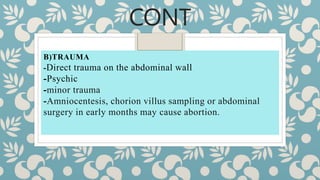
B)TRAUMA
-Direct trauma on the abdominal wall
-Psychic
-minor trauma
-Amniocentesis, chorion villus sampling or abdominal
surgery in early months may cause abortion.
CONT.
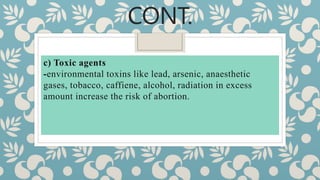
c) Toxic agents
-environmental toxins like lead, arsenic, anaesthetic
gases, tobacco, caffiene, alcohol, radiation in excess
amount increase the risk of abortion.
CONT.
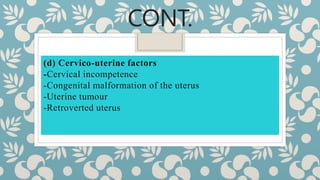
(d) Cervico-uterine factors
-Cervical incompetence
-Congenital malformation of the uterus
-Uterine tumour
-Retroverted uterus
CONT.
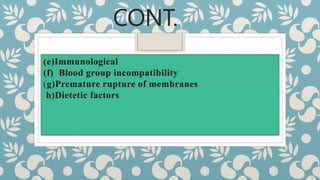
(e)Immunological
(f) Blood group incompatibility
(g)Premature rupture of membranes
h)Dietetic factors
PATERNALFACTORS
Unknown (25%)
MECHANISM OFABORTION
-Before 8weeks
-8-14weeks
-Beyond 14th week
SPONTANEOUS ABORTION
Spontaneous abortion is defined as non-induced embryonic
or foetal death or passage of products of conception before 20
weeks.
SYMPTOMS:
CAUSES
PREVENTION
COMPLICATIONS
ISOLATED ABORTION
RECURRENTABORTION
Recurrent abortion is the loss of three or more sequential
pregnancies before 20 weeks' gestation.
CAUSES
• Genetic factors
• Immunological factors
• Chromosomal abnormalities
• Hormone imbalance
• Life style
DIAGNOSIS
 Ultrasound scan
 Blood test for antiphospholipid antibodies
TREATMENT
• No treatment may be appropriate for many couples
• A supplement of the hormone progesterone
• Psychological support
THREATENEDABORTION
A threatened abortion is vaginal bleeding that occurs in
the first 20 weeks of pregnancy.
CAUSES
SYMPTOMS OFTHREATENEDABORTION
DIAGNOSIS
• ultrasound
• blood test
TREATMENT
• Bedrest
• administer rh immunoglobulins
• prescribe progesterone
• prescribe haemostatic drugs.
• Sedation and relief of pain may be ensured by phenobarbitone
30mg or diazepam 5 mg tablet twice daily.
• Mild laxatives 4 teaspoons at bedtime may be prescribed if
required. Enema should not be given.
PREVENTION
ADVICE ON DISCHARGE
INEVITABLEABORTION
It is the clinical type of abortion where the changes have
progressed to a state front where continuation of
pregnancy is impossible.
SYMPTOMS
SIGNS
 Maternal vital signs
 Uterine size
 Pelvic exam
COMPLICATIONS
 Blood loss
 Infection
MANAGEMENT
COMPLETEABORTION
When the products of conception are expelled in
mass, it is called complete abortion
SYMPTOMS
CLINICALFEATURES
Vaginal bleeding
Internal examination
MANAGEMENT
INCOMPLETEABORTION
when the entire products of conception are not
expelled, instead a part of it is left inside the
uterine cavity, it is called incomplete abortion
CLINICALFEATURES
(1)Continuation of pain in lower abdomen,
(2) Persistence of vaginal bleeding
(3) Internal examination reveals- (a) uterus smaller than the period of
amenorrhoea.
(b) patulous cervical os often admitting the tip of the finger and
(c) varying amount of bleeding.
(4) on examination the expelled mass is found incomplete.
MANAGEMENT:
In recent cases – the same principles are followed as that
of inevitable abortion.
Early abortion: dilatation and evacuation under general
anaesthesia is to be done.
Late abortion: the uterus is explored under general
anaesthesia by finger and the products left behind is either
removed by ovum forceps or by blunt curette.
MISSEDABORTION:
A missed abortion is a miscarriage in which your
foetus didn’t form or has died, but the placenta and
embryonic tissues are still in your uterus. It’s
known more commonly as a missed miscarriage.
It’s also sometimes called a silent miscarriage.
PATHOLOGY
SYMPTOMS:
SEPTICABORTION
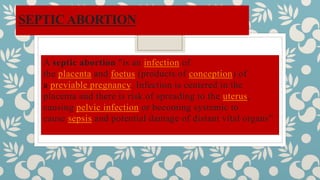
A septic abortion "is an infection of
the placenta and foetus (products of conception) of
a previable pregnancy. Infection is centered in the
placenta and there is risk of spreading to the uterus,
causing pelvic infection or becoming systemic to
cause sepsis and potential damage of distant vital organs”.
SIGNSAND SYMPTOMS
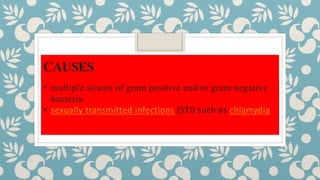
CAUSES
• multiple strains of gram positive and/or gram negative
bacteria.
• sexually transmitted infections (STI) such as chlamydia
RISK FACTORS:
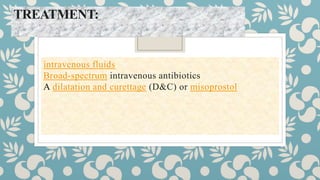
TREATMENT:
intravenous fluids
Broad-spectrum intravenous antibiotics
A dilatation and curettage (D&C) or misoprostol
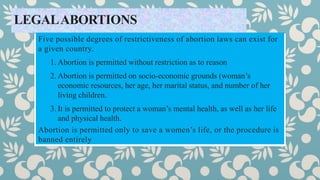
LEGALABORTIONS
Five possible degrees of restrictiveness of abortion laws can exist for
a given country.
1. Abortion is permitted without restriction as to reason
2. Abortion is permitted on socio-economic grounds (woman’s
economic resources, her age, her marital status, and number of her
living children.
3. It is permitted to protect a woman’s mental health, as well as her life
and physical health.
Abortion is permitted only to save a women’s life, or the procedure is
banned entirely
ILLEGALABORTION
An unsafe abortion is the termination of a pregnancy by
people lacking the necessary skills, or in an environment
lacking minimal medical standards, or both. An unsafe
abortion is a life threatening procedure.
METHODS OF UNSAFEABORTION
COMPLICATIONSAND THEIR TREATMENTS INCLUDE
• Infection: antibiotics prescribed
• Haemorrhage
ABORTIONAS HUMAN RIGHTS
PROFESSIONALRESPONSIBILITYOFANURSE IN
ABORTION:
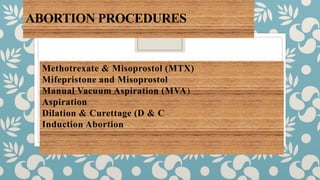
ABORTION PROCEDURES
Methotrexate & Misoprostol (MTX)
Mifepristone and Misoprostol
Manual Vacuum Aspiration (MVA)
Aspiration
Dilation & Curettage (D & C
Induction Abortion
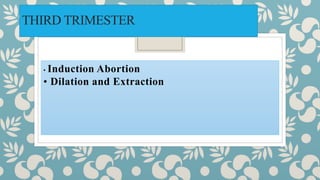
THIRD TRIMESTER
• Induction Abortion
• Dilation and Extraction
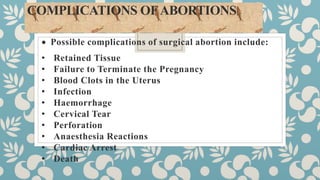
COMPLICATIONS OFABORTIONS:
 Possible complications of surgical abortion include:
• Retained Tissue
• Failure to Terminate the Pregnancy
• Blood Clots in the Uterus
• Infection
• Haemorrhage
• Cervical Tear
• Perforation
• Anaesthesia Reactions
• Cardiac Arrest
• Death
POSSIBLE COMPLICATIONS OF
NON-SURGICALABORTION
INCLUDE
Retained Tissue
Failure to Terminate the Pregnancy
Blood Clots in the Uterus
Infection
Haemorrhage
Death
MEDICAL MANAGEMENT
SURGICALMANAGEMENT
NURSING MANAGEMENT
Nursing Assessment
Nursing Interventions
Nursing Evaluation
THE BILLAMENDS THE MEDICAL
TERMINATION OFPREGNANCYACT, 2020.
CONCLUSION

abortion ppt.pptx