Lecture on Abortion
Dr.Ashenafi D.(MD)
Email : Ashenafidessalegn8@gmail.com
Outline
๏ƒผDefine abortion.
๏ƒผEpidemiology of abortion.
๏ƒผIntroduction
๏ƒผClassification of abortion.
๏ƒผEtiologies of spontaneous abortion.
๏ƒผDiagnosis of abortion.
๏ƒผcomplications of abortion.
๏ƒผManagement of abortion.
Definition of abortion
โ€ข Abortion (miscarriage) is termination of
pregnancy prior to completion of the 28th
gestational week.
โ€ข It also implies delivery of all or any part of
the products of conception, with or without a
fetus weighing less than 1000g.
โ€ข WHO considers a gestational age of 20
weeks and wt less than 500 g as the cut off
point.
Epidemiology of abortion
๏ƒ˜ Spontaneous abortion complicates 10-20% of
pregnancies
๏ƒ˜ Incidence of induced abortion varies from
country to country based on the availability
and accessibility of contraception
๏ƒ˜ WHO estimates that there are 80 million
abortions annually of which 40% are unsafely
induced
๏ƒ˜ Nearly 80,000 maternal deaths (20% of total
annual global maternal mortality) is due to
unsafe abortions .
Introduction
๏ฑIs the commonest gynecological & obstetric
disorder.
โ€ข About 15% of clinically recognized
pregnancies end in abortion.
โ€ข 60% of chemically evident pregnancies end
in spontaneous abortion.
โ€ข Most abortions (80%) occur before 12
weeks of pregnancy.
๏ƒ˜The majority of deaths from abortion result
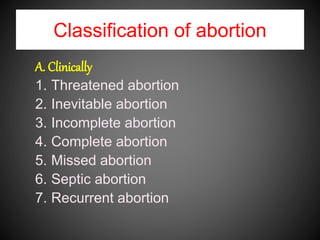
Classification of abortion
A. Clinically
1. Threatened abortion
2. Inevitable abortion
3. Incomplete abortion
4. Complete abortion
5. Missed abortion
6. Septic abortion
7. Recurrent abortion
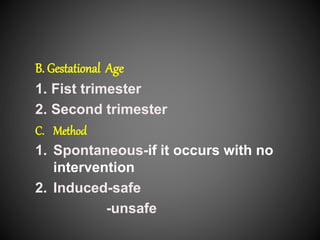
B. Gestational Age
1. Fist trimester
2. Second trimester
C. Method
1. Spontaneous-if it occurs with no
intervention
2. Induced-safe
-unsafe
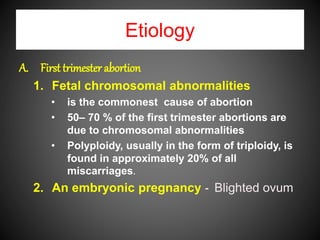
Etiology
A. First trimester abortion
1. Fetal chromosomal abnormalities
โ€ข is the commonest cause of abortion
โ€ข 50โ€“ 70 % of the first trimester abortions are
due to chromosomal abnormalities
โ€ข Polyploidy, usually in the form of triploidy, is
found in approximately 20% of all
miscarriages.
2. An embryonic pregnancy - Blighted ovum
4.Parental balanced translocation
5. Infections
genital tract infection , systemic infection
with pyrexia & TORCH syndrome
6.Endocrine disorders
Diabetes, thyroid disorders , PCOS &
Corpus luteum insufficiency
7. Uterine disorders
Uterine anomalies , sub mucus fibroid &
Asherman's syndrome
8. Thrombophilia: Congenital deficiency of
protein C & S, & anti-thrombin III
9. Immunological disorders : Anti
phospholipid syndrome and SLE
10.Cigarette smoking & chemical agents
11.Psychological disorders
B. Secondtrimester abortion
1. Multiple pregnancy
2. Cervical incompetence (congenital &
acquired )
3. Uterine anomalies and sub mucous fibroid
4. Genital tract infection and PROM
5. Systemic infections: HIV, Malaria, syphilis,
Rubella
6. Maternal health: Diabetes, Renal disease,
Spontaneous abortion
๏ƒ˜ An abortion is said to be spontaneous if it
occurs with no intervention. Incidence of
spontaneous abortion is between 10% and
20% of all pregnancies.
๏ƒ˜ It is most commonly due to fetal
chromosomal defects such as;
โ€ข Trisomies
โ€ข Monosomies &
โ€ข Polyploidy
๏ƒ˜ This usually occurs during the first trimester.
Induced abortion
๏ฑAn abortion is said to be induced if it
results from medical or surgical
intervention that can cause abortion.
๏ฑIt could be Safe or Unsafe abortion.
Safe abortion
๏ฑSafe abortion- is termination of
unwanted pregnancy by a qualified
person, with proper equipment, correct
technique & under sanitary standards.
๏ฑTherapeutic abortion- Subset of safe
abortion aimed to interrupt pregnancy to:
๏ƒผsave the life of the pregnant woman
๏ƒผpreserve the woman's physical or mental
health
๏ƒผterminate pregnancy with fatal congenital
Unsafe abortion-the termination of unwanted pregnancy either by a
person who doesnโ€™t have the skills or in an environment
lacking the minimal medical standards or both.
๏ƒ˜ Health consequences of unsafe abortion:
๏ถ Bleeding
๏ถ Infection
๏ถ Perforation of the uterus, intestine & other
internal organs
๏ถ Chronic pelvic pain
๏ถ Infertility
๏ถ Death
Clinical types of abortion
๏ƒ˜ Threatened abortion
๏ถMinimal vaginal bleeding and lower abdominal
cramps
๏ถwith or without uterine contractions and
๏ถwithout cervical dilatation and without expulsion of the
products of conception.
๏ถThe fetus is alive(60-80% continue the pregnancy)
๏ƒ˜ Inevitable abortion
๏ถHeavier vaginal bleeding and more severe cramps
๏ถwith dilatation of the cervix but without expulsion of
the products of conception
๏ถLeakage of liquor even without open cervix
๏ƒ˜Incomplete abortion
๏ถis a clinical condition in which
vaginal bleeding continues and
cervix remains open despite
expulsion of part of the products of
conception.
๏ƒ˜Complete abortion
๏ถComplete expulsion of all
conceptus parts
๏ถUterus well contracted and cervix
closed
๏ƒ˜Missed abortion
๏ถthe fetus dies in utero and is retained for at
least four weeks
๏ถThere is usually history of threatened
abortion preceding it.
๏ถPregnancy symptoms disappear
๏ถCessation of fetal movement is reported(if it
occurs >18wks)
๏ถFailure of uterine growth results in small for
gestational age uterus.
๏ƒ˜ Septic (infected) abortion
๏ถXized by offensive vaginal discharge
๏ถTemp>380C & lower abd.pain or tenderness
๏ถMajority follow unsafely induced abortions.
๏ถIt eventually results in death by causing septic
shock.
๏ƒ˜Recurrent(habitual) abortion
๏ถoccurrence of three or more consecutive
spontaneous abortions.
โ€ข Idiopathic in 50% of the cases ,known causes
include
1. Chromosomal disorders:
๏ƒ˜ Fetal chromosomal abnormalities & structural
abnormalities
๏ƒ˜ Parental balanced translocation
2. Anatomical disorders:
๏ƒ˜ Cervical incompetence: โ†’congenital and acquired
๏ƒ˜ Uterine causes: โ†’ sub mucous fibroids, uterine anomalies &
3.Medical disorders
๏ƒ˜ Endocrine disorders : diabetes , thyroid
disorders , PCOS & corpus luteum insufficiency
.
๏ƒ˜ Immunological disorders : Anticardiolipin
syndrome & SLE.
๏ƒ˜ Thrombophilia: congenital deficiency of Protein
C&S and antithrombin III, & presence of factor V
leiden.
๏ƒ˜ Infections
๏‚ง TORCH - CMV may be a cause of recurrent
abortion, but TORCH are not causes of recurrent
abortion.
Clinical pictures
๏ƒ˜Threatened Abortion
๏ถ Slight or mild, bright red vaginal
bleeding originating from the
choriodecidual interface
๏ถ Slight or absent pain
๏ถ Closed Cervix
๏ถ Pregnancy test is positive.
๏ถ Ultrasonography shows a living fetus
๏ƒ˜Inevitable Abortion
๏ถVaginal bleeding is excessive and may
accompanied with clots.
๏ถColicky Pain felt in the suprapubic region
radiating to the back
๏ถThe internal os of the cervix is dilated and
products of conception may be felt through it
๏ถRupture of membranes between 12-28
weeks is a sign of the inevitability of abortion
๏ƒ˜ Incomplete Abortion
๏ถThe patient usually noticed the passage of a
part of the conception products
๏ถBleeding is continuous.
๏ถOn examination, the uterus is less than the
period of amenorrhea but still large in size.
๏ถThe cervix is opened and retained contents
may be felt through it.
๏ถUltrasonography: shows the retained
contents.
๏ƒ˜Complete Abortion
๏ถThe bleeding is slight and gradually
diminishes
๏ถThe pain Stops
๏ถThe cervix is closed.
๏ถThe uterus is slightly larger than
normal
๏ถUltrasound : shows empty uterine
๏ƒ˜Missed Abortion
๏ถRegression of pregnancy symptoms as
nausea, vomiting and breast symptoms
๏ถThe abdomen does not increase and may
even decrease in size
๏ถThe fetal movements are not felt or ceases if
previously present
๏ถ Milk secretion may start particularly in
second trimester abortion because of the
decline in estrogens secretion
Diagnosis of Abortion
๏ƒ˜ Diagnosis of a pregnancy less than fetal viability
๏ƒ˜ Symptoms
๏ถ Vaginal bleeding
๏ถ Abdominal cramps
๏ถ Leakage of liquor or expulsion of conceptus tissue
๏ถ Regression of pregnancy symptoms in missed abortion
๏ƒ˜ Signs
๏ถ Hemodynamic instability
๏ถ Vaginal bleeding
๏ถ Cervical changes and reduced uterine size
๏ถ Visualization of expelled conceptus tissue
๏ƒ˜ Urine hCG โ€“positive
๏ƒ˜ U/S- Gestational sac
- fetal pole/cardiac activity
Risk factors related to abortion mortality
๏ถ Age
๏ถ General state of health
๏ถ Gestational age
๏ถ Method of termination
๏ถ Technical competence
๏ถ Availability and accessibility of
facilities
Complications of Abortion
๏ƒผHeavy bleeding and shock
๏ƒผUterine perforation
๏ƒผInfection and sepsis
๏ƒผInfertility later in life
๏ƒผEctopic pregnancy later in life
๏ƒผPsychological trauma โ€“
depression
Diagnostic workup of abortion
๏ƒ˜ Hemoglobin ( hematocrit)
๏ƒ˜ Blood group and RH type
๏ƒ˜ Pregnancy test if necessary
๏ƒ˜ Ultrasonography to document fetal viability
๏ƒ˜ Blood cross match if necessary
๏ƒ˜ In cases of septic abortion โ€“ as required
๏ถWBC and differential
๏ถCoagulation profile
๏ถLiver and renal function tests
๏ƒ˜FBS,VDRL,HBSAG
Management of Abortion
๏ƒ˜Depends on:
๏ถClinical type of abortion
๏ถGestational age: early versus late
๏ถPresence or absence of infection
๏ƒ˜General Measures
๏ฑSecure IV line
๏ฑPut on crystalloids
๏ฑAnalgesic
๏ฑUterotonic drugs
๏ฑProphylactic antibiotics
Choice of methods of termination
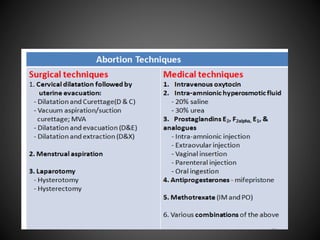
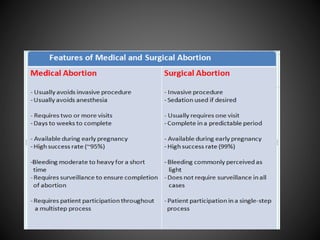
1. Medical termination
๏ƒผ Employed in very early (<7 to 9 weeks) and late
pregnancy terminations (โ‰ฅ 15 weeks).
๏ƒผ Surgical methods are recommended for pregnancies
between these gestational ages.
2.Surgical termination
๏ƒผ The primary factors in choosing a particular surgical
technique are:
- volume & content of intrauterine tissue and
- the experience of the surgeon
Medical termination of 1st
trimester pregnancy
โ€ข Three medications for early medical abortion
have been widely studied and used:
1. the antiprogestin mifepristone
2. the antimetabolite methotrexate, and
3. the prostaglandin misoprostol
โ€ข These agents cause abortion by increasing
uterine contractility
Eligibility criteria for medical abortion
โ€ข Pregnancy up to 49 days of gestation
โ€ข Agreement to undergo surgical abortion if the
procedure fails
โ€ข Agreement to complete therapy and all clinic visits
โ€ข A means of reaching an emergency facility within
one hour if problems occur
โ€ข Legally competent to sign a consent form for
obtaining an abortion
Contraindications to medical abortion
โ€ข Pregnancy greater than 49 days
โ€ข Allergy to mifepristone or misoprostol
โ€ข Pregnancy with an IUD in place or obstruction of the
cervical canal (e.g., stenosis, leiomyoma)
โ€ข Ectopic pregnancy, GTD
โ€ข Chronic adrenal failure
โ€ข Severe asthma
โ€ข Longterm concurrent corticosteroid treatment
โ€ข Hemorrhagic disorder or use of anticoagulant drugs
โ€ข Inability to sign the consent agreement because of
lack of competence
Regimens for Medical Termination of
9-12 wks of GA
๏ฑMifepristone, 2oomg orally followed by:
Misoprostol, 800 mcg vaginally or
sublingually 36-48hours,repeat 4x every 3
hours
๏ฑMisoprostol alone
800 mcg vaginally, repeated for up to
three doses
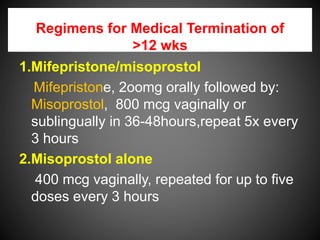
Regimens for Medical Termination of
>12 wks
1.Mifepristone/misoprostol
Mifepristone, 2oomg orally followed by:
Misoprostol, 800 mcg vaginally or
sublingually in 36-48hours,repeat 5x every
3 hours
2.Misoprostol alone
400 mcg vaginally, repeated for up to five
doses every 3 hours
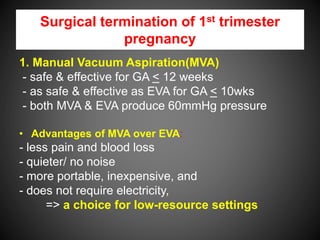
Surgical termination of 1st trimester
pregnancy
1. Manual Vacuum Aspiration(MVA)
- safe & effective for GA < 12 weeks
- as safe & effective as EVA for GA < 10wks
- both MVA & EVA produce 60mmHg pressure
โ€ข Advantages of MVA over EVA:
- less pain and blood loss
- quieter/ no noise
- more portable, inexpensive, and
- does not require electricity,
=> a choice for low-resource settings
2. Electric vacuum aspiration( EVA)
- Used for terminations at all GAs.
- A rigid curved suction curette/ cannula is used
- A metal curette may be used to verify completeness
3. Sharp curettage/ Dilatation and Curettage
- used in the absence of suction curettage equipments
Vacuum aspiration is preferable to sharp curettage
because:
- less pain and blood loss
- shorter duration of procedure & less skill
- less risk of uterine perforation or Ashermanโ€™s
syndrome
Medical/Surgical Management
๏ƒ˜Threatened abortion
๏ถBed rest, avoidance of coitus
๏ถAdvice to return if heavy bleeding or passage of
conceptus
๏ƒ˜Inevitable abortion
๏ถEarly โ€“ Suction curretage (manual vacuum
aspiration)
๏ถLate- Expel conceptus with oxytocin drip and
supplement with curretage as required
๏ƒ˜Incomplete abortion
๏ถEarly โ€“ Suction curretage
๏ถLate โ€“ Suction or metallic curretage as convinient
๏ƒ˜Missed abortion
๏ถEarly โ€“ Suction curretage
๏ถLate- Expel conceptus with oxytocin drip and
follow up with curretage as required
๏ƒ˜Recurrent abortion
๏ถManage accordingly and investigate for possible
causes to avoid recurrence
๏ƒ˜septic abortion
๏ถCover with broad spectrum antibiotics to cover
both gram positive as well as gram negative
aerobic and anaerobic organisms
๏ถPelvic infections are often polymicrobial
Components of Post abortion
care(PAC)
๏ถ Community service provider
partnership
๏ถ Counseling
๏ถ Emergency treatment of incomplete
abortion and its complications
๏ถ Post abortion family planning
services
๏ถ Linkage with other reproductive
Abortion law in Ethiopia
โ€ข The 1957 penal code allowed abortions only to
save the life or health of the woman.
โ€ข In 2004, the Ethiopian Parliament passed abortion
laws.
โ€ข Article 551 of the Penal Code of the FDRE
allows termination of pregnancy under the
following conditions:
1. Termination of pregnancy by a recognized
medical institution with in the period permitted by
a. The pregnancy is a result of rape or incest; or
b. The continuation of the pregnancy endangers the life of
the mother or the child or the health of the mother or where
the birth of the child is a risk to the life or health of the
mother; or
c. The fetus has an incurable and serious deformity; or
d. The pregnant woman, owing to a physical or mental
deficiency she suffers from or her minority, is physically
as well as mentally unfit to bring up the child.
2. In the case of grave and imminent danger which can be
averted only by an immediate intervention, an act of
terminating pregnancy in accordance with the provisions of
Article 75 of this Code is not punishable.
Abortion.pptx

Abortion.pptx

  • 1.
    Lecture on Abortion Dr.AshenafiD.(MD) Email : Ashenafidessalegn8@gmail.com
  • 2.
    Outline ๏ƒผDefine abortion. ๏ƒผEpidemiology ofabortion. ๏ƒผIntroduction ๏ƒผClassification of abortion. ๏ƒผEtiologies of spontaneous abortion. ๏ƒผDiagnosis of abortion. ๏ƒผcomplications of abortion. ๏ƒผManagement of abortion.
  • 3.
    Definition of abortion โ€ขAbortion (miscarriage) is termination of pregnancy prior to completion of the 28th gestational week. โ€ข It also implies delivery of all or any part of the products of conception, with or without a fetus weighing less than 1000g. โ€ข WHO considers a gestational age of 20 weeks and wt less than 500 g as the cut off point.
  • 4.
    Epidemiology of abortion ๏ƒ˜Spontaneous abortion complicates 10-20% of pregnancies ๏ƒ˜ Incidence of induced abortion varies from country to country based on the availability and accessibility of contraception ๏ƒ˜ WHO estimates that there are 80 million abortions annually of which 40% are unsafely induced ๏ƒ˜ Nearly 80,000 maternal deaths (20% of total annual global maternal mortality) is due to unsafe abortions .
  • 5.
    Introduction ๏ฑIs the commonestgynecological & obstetric disorder. โ€ข About 15% of clinically recognized pregnancies end in abortion. โ€ข 60% of chemically evident pregnancies end in spontaneous abortion. โ€ข Most abortions (80%) occur before 12 weeks of pregnancy. ๏ƒ˜The majority of deaths from abortion result
  • 6.
    Classification of abortion A.Clinically 1. Threatened abortion 2. Inevitable abortion 3. Incomplete abortion 4. Complete abortion 5. Missed abortion 6. Septic abortion 7. Recurrent abortion
  • 7.
    B. Gestational Age 1.Fist trimester 2. Second trimester C. Method 1. Spontaneous-if it occurs with no intervention 2. Induced-safe -unsafe
  • 8.
    Etiology A. First trimesterabortion 1. Fetal chromosomal abnormalities โ€ข is the commonest cause of abortion โ€ข 50โ€“ 70 % of the first trimester abortions are due to chromosomal abnormalities โ€ข Polyploidy, usually in the form of triploidy, is found in approximately 20% of all miscarriages. 2. An embryonic pregnancy - Blighted ovum
  • 9.
    4.Parental balanced translocation 5.Infections genital tract infection , systemic infection with pyrexia & TORCH syndrome 6.Endocrine disorders Diabetes, thyroid disorders , PCOS & Corpus luteum insufficiency 7. Uterine disorders Uterine anomalies , sub mucus fibroid & Asherman's syndrome
  • 10.
    8. Thrombophilia: Congenitaldeficiency of protein C & S, & anti-thrombin III 9. Immunological disorders : Anti phospholipid syndrome and SLE 10.Cigarette smoking & chemical agents 11.Psychological disorders
  • 11.
    B. Secondtrimester abortion 1.Multiple pregnancy 2. Cervical incompetence (congenital & acquired ) 3. Uterine anomalies and sub mucous fibroid 4. Genital tract infection and PROM 5. Systemic infections: HIV, Malaria, syphilis, Rubella 6. Maternal health: Diabetes, Renal disease,
  • 12.
    Spontaneous abortion ๏ƒ˜ Anabortion is said to be spontaneous if it occurs with no intervention. Incidence of spontaneous abortion is between 10% and 20% of all pregnancies. ๏ƒ˜ It is most commonly due to fetal chromosomal defects such as; โ€ข Trisomies โ€ข Monosomies & โ€ข Polyploidy ๏ƒ˜ This usually occurs during the first trimester.
  • 13.
    Induced abortion ๏ฑAn abortionis said to be induced if it results from medical or surgical intervention that can cause abortion. ๏ฑIt could be Safe or Unsafe abortion.
  • 14.
    Safe abortion ๏ฑSafe abortion-is termination of unwanted pregnancy by a qualified person, with proper equipment, correct technique & under sanitary standards. ๏ฑTherapeutic abortion- Subset of safe abortion aimed to interrupt pregnancy to: ๏ƒผsave the life of the pregnant woman ๏ƒผpreserve the woman's physical or mental health ๏ƒผterminate pregnancy with fatal congenital
  • 15.
    Unsafe abortion-the terminationof unwanted pregnancy either by a person who doesnโ€™t have the skills or in an environment lacking the minimal medical standards or both. ๏ƒ˜ Health consequences of unsafe abortion: ๏ถ Bleeding ๏ถ Infection ๏ถ Perforation of the uterus, intestine & other internal organs ๏ถ Chronic pelvic pain ๏ถ Infertility ๏ถ Death
  • 16.
    Clinical types ofabortion ๏ƒ˜ Threatened abortion ๏ถMinimal vaginal bleeding and lower abdominal cramps ๏ถwith or without uterine contractions and ๏ถwithout cervical dilatation and without expulsion of the products of conception. ๏ถThe fetus is alive(60-80% continue the pregnancy) ๏ƒ˜ Inevitable abortion ๏ถHeavier vaginal bleeding and more severe cramps ๏ถwith dilatation of the cervix but without expulsion of the products of conception ๏ถLeakage of liquor even without open cervix
  • 17.
    ๏ƒ˜Incomplete abortion ๏ถis aclinical condition in which vaginal bleeding continues and cervix remains open despite expulsion of part of the products of conception. ๏ƒ˜Complete abortion ๏ถComplete expulsion of all conceptus parts ๏ถUterus well contracted and cervix closed
  • 18.
    ๏ƒ˜Missed abortion ๏ถthe fetusdies in utero and is retained for at least four weeks ๏ถThere is usually history of threatened abortion preceding it. ๏ถPregnancy symptoms disappear ๏ถCessation of fetal movement is reported(if it occurs >18wks) ๏ถFailure of uterine growth results in small for gestational age uterus.
  • 19.
    ๏ƒ˜ Septic (infected)abortion ๏ถXized by offensive vaginal discharge ๏ถTemp>380C & lower abd.pain or tenderness ๏ถMajority follow unsafely induced abortions. ๏ถIt eventually results in death by causing septic shock.
  • 20.
    ๏ƒ˜Recurrent(habitual) abortion ๏ถoccurrence ofthree or more consecutive spontaneous abortions. โ€ข Idiopathic in 50% of the cases ,known causes include 1. Chromosomal disorders: ๏ƒ˜ Fetal chromosomal abnormalities & structural abnormalities ๏ƒ˜ Parental balanced translocation 2. Anatomical disorders: ๏ƒ˜ Cervical incompetence: โ†’congenital and acquired ๏ƒ˜ Uterine causes: โ†’ sub mucous fibroids, uterine anomalies &
  • 21.
    3.Medical disorders ๏ƒ˜ Endocrinedisorders : diabetes , thyroid disorders , PCOS & corpus luteum insufficiency . ๏ƒ˜ Immunological disorders : Anticardiolipin syndrome & SLE. ๏ƒ˜ Thrombophilia: congenital deficiency of Protein C&S and antithrombin III, & presence of factor V leiden. ๏ƒ˜ Infections ๏‚ง TORCH - CMV may be a cause of recurrent abortion, but TORCH are not causes of recurrent abortion.
  • 22.
    Clinical pictures ๏ƒ˜Threatened Abortion ๏ถSlight or mild, bright red vaginal bleeding originating from the choriodecidual interface ๏ถ Slight or absent pain ๏ถ Closed Cervix ๏ถ Pregnancy test is positive. ๏ถ Ultrasonography shows a living fetus
  • 23.
    ๏ƒ˜Inevitable Abortion ๏ถVaginal bleedingis excessive and may accompanied with clots. ๏ถColicky Pain felt in the suprapubic region radiating to the back ๏ถThe internal os of the cervix is dilated and products of conception may be felt through it ๏ถRupture of membranes between 12-28 weeks is a sign of the inevitability of abortion
  • 24.
    ๏ƒ˜ Incomplete Abortion ๏ถThepatient usually noticed the passage of a part of the conception products ๏ถBleeding is continuous. ๏ถOn examination, the uterus is less than the period of amenorrhea but still large in size. ๏ถThe cervix is opened and retained contents may be felt through it. ๏ถUltrasonography: shows the retained contents.
  • 25.
    ๏ƒ˜Complete Abortion ๏ถThe bleedingis slight and gradually diminishes ๏ถThe pain Stops ๏ถThe cervix is closed. ๏ถThe uterus is slightly larger than normal ๏ถUltrasound : shows empty uterine
  • 26.
    ๏ƒ˜Missed Abortion ๏ถRegression ofpregnancy symptoms as nausea, vomiting and breast symptoms ๏ถThe abdomen does not increase and may even decrease in size ๏ถThe fetal movements are not felt or ceases if previously present ๏ถ Milk secretion may start particularly in second trimester abortion because of the decline in estrogens secretion
  • 27.
    Diagnosis of Abortion ๏ƒ˜Diagnosis of a pregnancy less than fetal viability ๏ƒ˜ Symptoms ๏ถ Vaginal bleeding ๏ถ Abdominal cramps ๏ถ Leakage of liquor or expulsion of conceptus tissue ๏ถ Regression of pregnancy symptoms in missed abortion ๏ƒ˜ Signs ๏ถ Hemodynamic instability ๏ถ Vaginal bleeding ๏ถ Cervical changes and reduced uterine size ๏ถ Visualization of expelled conceptus tissue ๏ƒ˜ Urine hCG โ€“positive ๏ƒ˜ U/S- Gestational sac - fetal pole/cardiac activity
  • 28.
    Risk factors relatedto abortion mortality ๏ถ Age ๏ถ General state of health ๏ถ Gestational age ๏ถ Method of termination ๏ถ Technical competence ๏ถ Availability and accessibility of facilities
  • 29.
    Complications of Abortion ๏ƒผHeavybleeding and shock ๏ƒผUterine perforation ๏ƒผInfection and sepsis ๏ƒผInfertility later in life ๏ƒผEctopic pregnancy later in life ๏ƒผPsychological trauma โ€“ depression
  • 30.
    Diagnostic workup ofabortion ๏ƒ˜ Hemoglobin ( hematocrit) ๏ƒ˜ Blood group and RH type ๏ƒ˜ Pregnancy test if necessary ๏ƒ˜ Ultrasonography to document fetal viability ๏ƒ˜ Blood cross match if necessary ๏ƒ˜ In cases of septic abortion โ€“ as required ๏ถWBC and differential ๏ถCoagulation profile ๏ถLiver and renal function tests ๏ƒ˜FBS,VDRL,HBSAG
  • 31.
    Management of Abortion ๏ƒ˜Dependson: ๏ถClinical type of abortion ๏ถGestational age: early versus late ๏ถPresence or absence of infection ๏ƒ˜General Measures ๏ฑSecure IV line ๏ฑPut on crystalloids ๏ฑAnalgesic ๏ฑUterotonic drugs ๏ฑProphylactic antibiotics
  • 32.
    Choice of methodsof termination 1. Medical termination ๏ƒผ Employed in very early (<7 to 9 weeks) and late pregnancy terminations (โ‰ฅ 15 weeks). ๏ƒผ Surgical methods are recommended for pregnancies between these gestational ages. 2.Surgical termination ๏ƒผ The primary factors in choosing a particular surgical technique are: - volume & content of intrauterine tissue and - the experience of the surgeon
  • 35.
    Medical termination of1st trimester pregnancy โ€ข Three medications for early medical abortion have been widely studied and used: 1. the antiprogestin mifepristone 2. the antimetabolite methotrexate, and 3. the prostaglandin misoprostol โ€ข These agents cause abortion by increasing uterine contractility
  • 36.
    Eligibility criteria formedical abortion โ€ข Pregnancy up to 49 days of gestation โ€ข Agreement to undergo surgical abortion if the procedure fails โ€ข Agreement to complete therapy and all clinic visits โ€ข A means of reaching an emergency facility within one hour if problems occur โ€ข Legally competent to sign a consent form for obtaining an abortion
  • 37.
    Contraindications to medicalabortion โ€ข Pregnancy greater than 49 days โ€ข Allergy to mifepristone or misoprostol โ€ข Pregnancy with an IUD in place or obstruction of the cervical canal (e.g., stenosis, leiomyoma) โ€ข Ectopic pregnancy, GTD โ€ข Chronic adrenal failure โ€ข Severe asthma โ€ข Longterm concurrent corticosteroid treatment โ€ข Hemorrhagic disorder or use of anticoagulant drugs โ€ข Inability to sign the consent agreement because of lack of competence
  • 38.
    Regimens for MedicalTermination of 9-12 wks of GA ๏ฑMifepristone, 2oomg orally followed by: Misoprostol, 800 mcg vaginally or sublingually 36-48hours,repeat 4x every 3 hours ๏ฑMisoprostol alone 800 mcg vaginally, repeated for up to three doses
  • 39.
    Regimens for MedicalTermination of >12 wks 1.Mifepristone/misoprostol Mifepristone, 2oomg orally followed by: Misoprostol, 800 mcg vaginally or sublingually in 36-48hours,repeat 5x every 3 hours 2.Misoprostol alone 400 mcg vaginally, repeated for up to five doses every 3 hours
  • 40.
    Surgical termination of1st trimester pregnancy 1. Manual Vacuum Aspiration(MVA) - safe & effective for GA < 12 weeks - as safe & effective as EVA for GA < 10wks - both MVA & EVA produce 60mmHg pressure โ€ข Advantages of MVA over EVA: - less pain and blood loss - quieter/ no noise - more portable, inexpensive, and - does not require electricity, => a choice for low-resource settings
  • 41.
    2. Electric vacuumaspiration( EVA) - Used for terminations at all GAs. - A rigid curved suction curette/ cannula is used - A metal curette may be used to verify completeness 3. Sharp curettage/ Dilatation and Curettage - used in the absence of suction curettage equipments Vacuum aspiration is preferable to sharp curettage because: - less pain and blood loss - shorter duration of procedure & less skill - less risk of uterine perforation or Ashermanโ€™s syndrome
  • 42.
    Medical/Surgical Management ๏ƒ˜Threatened abortion ๏ถBedrest, avoidance of coitus ๏ถAdvice to return if heavy bleeding or passage of conceptus ๏ƒ˜Inevitable abortion ๏ถEarly โ€“ Suction curretage (manual vacuum aspiration) ๏ถLate- Expel conceptus with oxytocin drip and supplement with curretage as required ๏ƒ˜Incomplete abortion ๏ถEarly โ€“ Suction curretage ๏ถLate โ€“ Suction or metallic curretage as convinient
  • 43.
    ๏ƒ˜Missed abortion ๏ถEarly โ€“Suction curretage ๏ถLate- Expel conceptus with oxytocin drip and follow up with curretage as required ๏ƒ˜Recurrent abortion ๏ถManage accordingly and investigate for possible causes to avoid recurrence ๏ƒ˜septic abortion ๏ถCover with broad spectrum antibiotics to cover both gram positive as well as gram negative aerobic and anaerobic organisms ๏ถPelvic infections are often polymicrobial
  • 44.
    Components of Postabortion care(PAC) ๏ถ Community service provider partnership ๏ถ Counseling ๏ถ Emergency treatment of incomplete abortion and its complications ๏ถ Post abortion family planning services ๏ถ Linkage with other reproductive
  • 45.
    Abortion law inEthiopia โ€ข The 1957 penal code allowed abortions only to save the life or health of the woman. โ€ข In 2004, the Ethiopian Parliament passed abortion laws. โ€ข Article 551 of the Penal Code of the FDRE allows termination of pregnancy under the following conditions: 1. Termination of pregnancy by a recognized medical institution with in the period permitted by
  • 46.
    a. The pregnancyis a result of rape or incest; or b. The continuation of the pregnancy endangers the life of the mother or the child or the health of the mother or where the birth of the child is a risk to the life or health of the mother; or c. The fetus has an incurable and serious deformity; or d. The pregnant woman, owing to a physical or mental deficiency she suffers from or her minority, is physically as well as mentally unfit to bring up the child. 2. In the case of grave and imminent danger which can be averted only by an immediate intervention, an act of terminating pregnancy in accordance with the provisions of Article 75 of this Code is not punishable.

Editor's Notes

  • #5ย Abortion is an important cause of bleeding during pregnancy, as it is one of the five leading causes of maternal death in the developing world. The other causes being obstructed labor, hypertensive disorders of pregnancy, hemorrhage and infection.
  • #16ย bleaching agents=an agent that makes things white or colorless,benzoyl peroxide.chlorine water
  • #17ย Abortion is inevitable when cervical effacement, cervical dilatation, and/or rupture of the membranes is noted. In threatened abortion the fetus is alive and there is a chance of continuing the pregnancy to viability.
  • #18ย Before 14-16 weeks it is difficult to tell if an abortion is complete or not because to make sure it is complete one has to identify the fetus and the placenta with the membranes as fully formed structures. Before 14- 16 weeks these structures are not sufficiently well formed.
  • #19ย Decidual necrosis may result in brownish vaginal discharge. Pregnancy symptoms like morning sickness, breast tenderness and abdominal girth increment disappear.
  • #20ย Infection starts in the uterus and if untreated spreads to adjacent pelvic organs (pelvic peritonitis) or to the general peritoneum (generalized peritonitis) or the blood stream (sepsis)
  • #24ย Cervical abortion: is a variety of inevitable abortion in which the products of conception has been separated from the uterine cavity but retained in the cervical canal causing its distension