Mrs. Anu Abraham,
Professor,
Lourdes College of Nursing
INTRODUCTION
The concept of organization comes
from business and management.
Organization originally meant the process
of organizing an organization. Organizing
is one of the functions in the managerial
theory of leadership, and it is now
considered an important leadership
strategy. Organization refers to the
institution itself and the setting in which
the leader functions
MEANING
The term organization is
derived from the word ‘ organism’ which
means a structure of body divided into
parts that are held together by a fabric
of relationship as one organic whole.
Organization is the act of organizing or
the state of being organized. It also
refers to an organized structure as a
whole.
According to Urwick…
 Organization as a structure
 Organization as a group of people
 Organization as a process
DEFINITIONS
 An identifiable group of people
contributing their efforts towards the
attainment of goals is called an
organization
-Mc
Farland
 A group of people who are cooperating
under the direction of leadership for the
accomplishment of a common end
PRINCIPLES
 Hierarchy
 Span of control
 Integration Vs disintegration
 Centralization Vs decentralization
 Unity of command
 Delegation
Organization as a system
Organization in which most of the
managers operate is a system,
comprised of many interrelated
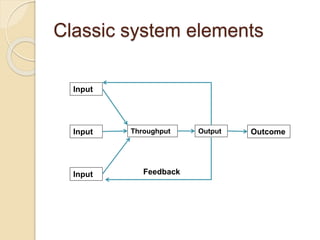
subsystems. The term system can be
defined as a whole, set of connected
things or parts. It is also viewed as a
collection of interrelated parts which
receives inputs, acts upon them in an
organized or planned manner and
thereby produces certain outputs.
Classic system elements
Input
Input
Input
Throughput Output Outcome
Feedback
Characteristics of organization as
a system
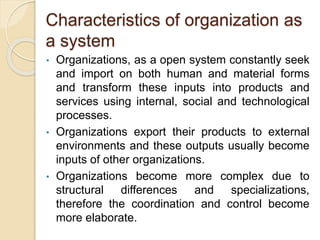
• Organizations, as a open system constantly seek
and import on both human and material forms
and transform these inputs into products and
services using internal, social and technological
processes.
• Organizations export their products to external
environments and these outputs usually become
inputs of other organizations.
• Organizations become more complex due to
structural differences and specializations,
therefore the coordination and control become
more elaborate.

Contd…
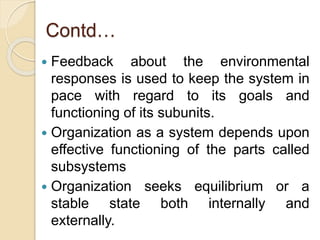
 Feedback about the environmental
responses is used to keep the system in
pace with regard to its goals and
functioning of its subunits.
 Organization as a system depends upon
effective functioning of the parts called
subsystems
 Organization seeks equilibrium or a
stable state both internally and
externally.
Hospital as an open system
Hospital being a part of a large
system of health care delivery system is
an open sub system. Health care
delivery system as a large system
transforms the general resources into
special services to meet their demand
and needs , i.e the health of the people
at large.
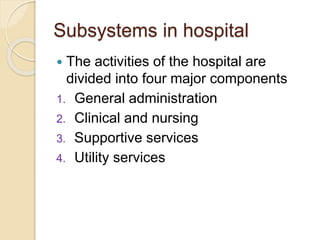
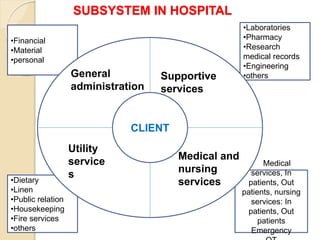
Subsystems in hospital
 The activities of the hospital are
divided into four major components
1. General administration
2. Clinical and nursing
3. Supportive services
4. Utility services
•Financial
•Material
•personal
Medical
services, In
patients, Out
patients, nursing
services: In
patients, Out
patients
Emergency
•Dietary
•Linen
•Public relation
•Housekeeping
•Fire services
•others
•Laboratories
•Pharmacy
•Research
medical records
•Engineering
•others
geCLIENT
General
administration
Supportive
services
Utility
service
s
Medical and
nursing
services
SUBSYSTEM IN HOSPITAL
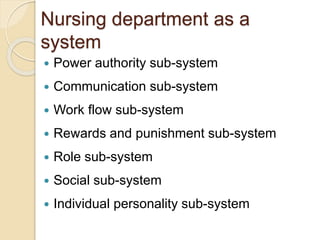
Nursing department as a
system
 Power authority sub-system
 Communication sub-system
 Work flow sub-system
 Rewards and punishment sub-system
 Role sub-system
 Social sub-system
 Individual personality sub-system
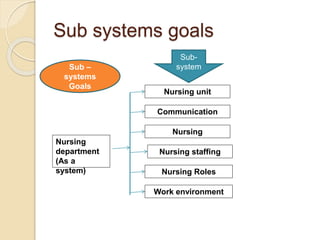
Sub systems goals
Nursing
department
(As a
system)
Sub –
systems
Goals
Nursing unit
Communication
Nursing
Nursing staffing
Nursing Roles
Work environment
Sub-
system
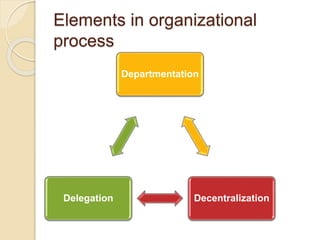
Elements in organizational
process
Departmentation
DecentralizationDelegation
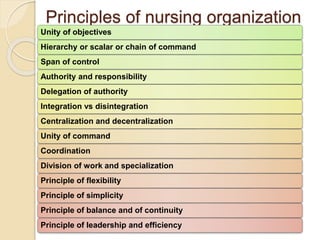
Principles of nursing organization
Unity of objectives
Hierarchy or scalar or chain of command
Span of control
Authority and responsibility
Delegation of authority
Integration vs disintegration
Centralization and decentralization
Unity of command
Coordination
Division of work and specialization
Principle of flexibility
Principle of simplicity
Principle of balance and of continuity
Principle of leadership and efficiency
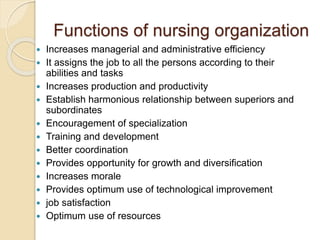
Functions of nursing organization
 Increases managerial and administrative efficiency
 It assigns the job to all the persons according to their
abilities and tasks
 Increases production and productivity
 Establish harmonious relationship between superiors and
subordinates
 Encouragement of specialization
 Training and development
 Better coordination
 Provides opportunity for growth and diversification
 Increases morale
 Provides optimum use of technological improvement
 job satisfaction
 Optimum use of resources
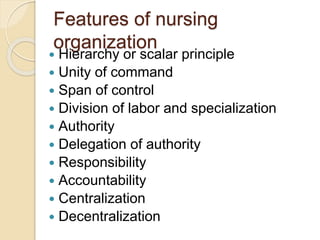
Features of nursing
organization
 Hierarchy or scalar principle
 Unity of command
 Span of control
 Division of labor and specialization
 Authority
 Delegation of authority
 Responsibility
 Accountability
 Centralization
 Decentralization
NURSING DELIVERY
SYSTEMS
 Nursing delivery systems are types
of organizations at the unit level. The
nurse-leader must consider all the
components of organization,
regardless of the delivery system in
which she functions.
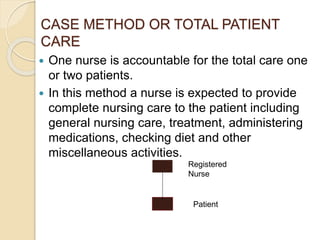
CASE METHOD OR TOTAL PATIENT
CARE
 One nurse is accountable for the total care one
or two patients.
 In this method a nurse is expected to provide
complete nursing care to the patient including
general nursing care, treatment, administering
medications, checking diet and other
miscellaneous activities.
Registered
Nurse
Patient
Advantages
 More individualized nursing care
 Better nurse-patient relationship
 Comprehensive care
 Patients feel more secure
 Opportunity for nursing education is
superior
 Job satisfaction of the nurse attending
the patient is achieved because
Disadvantages
 High cost
 Need qualified professional nurses
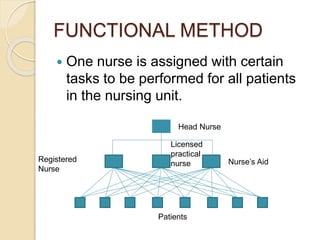
FUNCTIONAL METHOD
 One nurse is assigned with certain
tasks to be performed for all patients
in the nursing unit.
Head Nurse
Nurse’s AidRegistered
Nurse
Licensed
practical
nurse
Patients
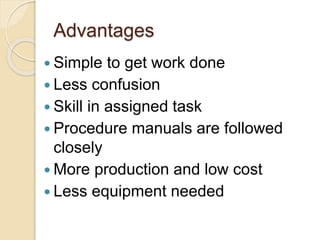
Advantages
 Simple to get work done
 Less confusion
 Skill in assigned task
 Procedure manuals are followed
closely
 More production and low cost
 Less equipment needed
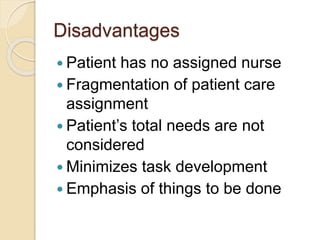
Disadvantages
 Patient has no assigned nurse
 Fragmentation of patient care
assignment
 Patient’s total needs are not
considered
 Minimizes task development
 Emphasis of things to be done
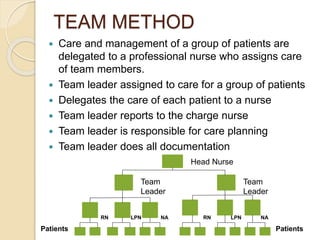
TEAM METHOD
 Care and management of a group of patients are
delegated to a professional nurse who assigns care
of team members.
 Team leader assigned to care for a group of patients
 Delegates the care of each patient to a nurse
 Team leader reports to the charge nurse
 Team leader is responsible for care planning
 Team leader does all documentation
Head Nurse
Team
Leader
Team
Leader
RN LPNNA
PatientsPatients
RNLPN NA
Advantages
 Utilization of all team members in
planning executing, decision making
and evaluating which contribute to
members development
 Enhances job satisfaction, results in
better patient care
 Charge nurse has time for overall
supervision
Disadvantages
 Unstable staffing patterns make a
team nursing is difficult
 Team leader must have complex skills
and knowledge
 Less individual responsibility and
independence regarding nursing
functions
PRIMARY CARE NURSING METHOD
A professional nurse is delegated as
primary care nurse for patients from
admission to discharge
 New patient care approach
 A professional nurse take care of a group of
patients (4 to 6)
 Plans care for complete 24 hours and writes
nursing care plan
 Care for patients from admission to discharge
 Charge nurse assigns new admissions to
primary care nurse
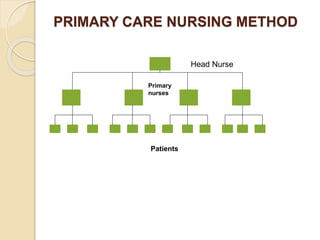
PRIMARY CARE NURSING METHOD
Head Nurse
Patients
Primary
nurses
Advantages
 Satisfaction for patients and nurses
 Nurses have the opportunity to
function autonomously as
professionals and use their capacities
 Leads to better staff development,
enhanced quality care
Disadvantages
 High cost
 Nurses need preparation for and
interest in primary nursing
 The quality of care depend on the
ongoing nursing care plans clarity of
direction and the ability of the primary
care nurse
 Associate nurse may be unwilling to
follow up primary plan of care
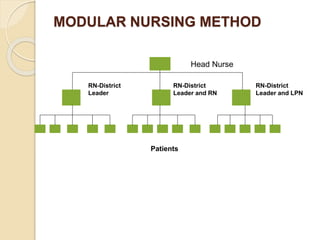
MODULAR NURSING
 Modular nursing staff are
geographically assigned to patients for
whom they coordinate and provide
comprehensive care
MODULAR NURSING METHOD
Head Nurse
Patients
RN-District
Leader and RN
RN-District
Leader
RN-District
Leader and LPN
Advantages
 Better communication and cooperation
among staff and less time spent
walking between patients
 Easier for less experienced nurses
because they have other nurses
directly available to them for support
 More nursing productivity
 Less time spent in direct nursing care
Disadvantages
 Accountability
 Less patient satisfaction
Thank You

Patient assignment method

  • 1.
  • 2.
    INTRODUCTION The concept oforganization comes from business and management. Organization originally meant the process of organizing an organization. Organizing is one of the functions in the managerial theory of leadership, and it is now considered an important leadership strategy. Organization refers to the institution itself and the setting in which the leader functions
  • 3.
    MEANING The term organizationis derived from the word ‘ organism’ which means a structure of body divided into parts that are held together by a fabric of relationship as one organic whole. Organization is the act of organizing or the state of being organized. It also refers to an organized structure as a whole.
  • 4.
    According to Urwick… Organization as a structure  Organization as a group of people  Organization as a process
  • 5.
    DEFINITIONS  An identifiablegroup of people contributing their efforts towards the attainment of goals is called an organization -Mc Farland  A group of people who are cooperating under the direction of leadership for the accomplishment of a common end
  • 6.
    PRINCIPLES  Hierarchy  Spanof control  Integration Vs disintegration  Centralization Vs decentralization  Unity of command  Delegation
  • 7.
    Organization as asystem Organization in which most of the managers operate is a system, comprised of many interrelated subsystems. The term system can be defined as a whole, set of connected things or parts. It is also viewed as a collection of interrelated parts which receives inputs, acts upon them in an organized or planned manner and thereby produces certain outputs.
  • 8.
  • 9.
    Characteristics of organizationas a system • Organizations, as a open system constantly seek and import on both human and material forms and transform these inputs into products and services using internal, social and technological processes. • Organizations export their products to external environments and these outputs usually become inputs of other organizations. • Organizations become more complex due to structural differences and specializations, therefore the coordination and control become more elaborate.
  • 10.
    Contd…  Feedback aboutthe environmental responses is used to keep the system in pace with regard to its goals and functioning of its subunits.  Organization as a system depends upon effective functioning of the parts called subsystems  Organization seeks equilibrium or a stable state both internally and externally.
  • 11.
    Hospital as anopen system Hospital being a part of a large system of health care delivery system is an open sub system. Health care delivery system as a large system transforms the general resources into special services to meet their demand and needs , i.e the health of the people at large.
  • 12.
    Subsystems in hospital The activities of the hospital are divided into four major components 1. General administration 2. Clinical and nursing 3. Supportive services 4. Utility services
  • 13.
    •Financial •Material •personal Medical services, In patients, Out patients,nursing services: In patients, Out patients Emergency •Dietary •Linen •Public relation •Housekeeping •Fire services •others •Laboratories •Pharmacy •Research medical records •Engineering •others geCLIENT General administration Supportive services Utility service s Medical and nursing services SUBSYSTEM IN HOSPITAL
  • 14.
    Nursing department asa system  Power authority sub-system  Communication sub-system  Work flow sub-system  Rewards and punishment sub-system  Role sub-system  Social sub-system  Individual personality sub-system
  • 15.
    Sub systems goals Nursing department (Asa system) Sub – systems Goals Nursing unit Communication Nursing Nursing staffing Nursing Roles Work environment Sub- system
  • 16.
  • 17.
    Principles of nursingorganization Unity of objectives Hierarchy or scalar or chain of command Span of control Authority and responsibility Delegation of authority Integration vs disintegration Centralization and decentralization Unity of command Coordination Division of work and specialization Principle of flexibility Principle of simplicity Principle of balance and of continuity Principle of leadership and efficiency
  • 18.
    Functions of nursingorganization  Increases managerial and administrative efficiency  It assigns the job to all the persons according to their abilities and tasks  Increases production and productivity  Establish harmonious relationship between superiors and subordinates  Encouragement of specialization  Training and development  Better coordination  Provides opportunity for growth and diversification  Increases morale  Provides optimum use of technological improvement  job satisfaction  Optimum use of resources
  • 19.
    Features of nursing organization Hierarchy or scalar principle  Unity of command  Span of control  Division of labor and specialization  Authority  Delegation of authority  Responsibility  Accountability  Centralization  Decentralization
  • 20.
    NURSING DELIVERY SYSTEMS  Nursingdelivery systems are types of organizations at the unit level. The nurse-leader must consider all the components of organization, regardless of the delivery system in which she functions.
  • 21.
    CASE METHOD ORTOTAL PATIENT CARE  One nurse is accountable for the total care one or two patients.  In this method a nurse is expected to provide complete nursing care to the patient including general nursing care, treatment, administering medications, checking diet and other miscellaneous activities. Registered Nurse Patient
  • 22.
    Advantages  More individualizednursing care  Better nurse-patient relationship  Comprehensive care  Patients feel more secure  Opportunity for nursing education is superior  Job satisfaction of the nurse attending the patient is achieved because
  • 23.
    Disadvantages  High cost Need qualified professional nurses
  • 24.
    FUNCTIONAL METHOD  Onenurse is assigned with certain tasks to be performed for all patients in the nursing unit. Head Nurse Nurse’s AidRegistered Nurse Licensed practical nurse Patients
  • 25.
    Advantages  Simple toget work done  Less confusion  Skill in assigned task  Procedure manuals are followed closely  More production and low cost  Less equipment needed
  • 26.
    Disadvantages  Patient hasno assigned nurse  Fragmentation of patient care assignment  Patient’s total needs are not considered  Minimizes task development  Emphasis of things to be done
  • 27.
    TEAM METHOD  Careand management of a group of patients are delegated to a professional nurse who assigns care of team members.  Team leader assigned to care for a group of patients  Delegates the care of each patient to a nurse  Team leader reports to the charge nurse  Team leader is responsible for care planning  Team leader does all documentation Head Nurse Team Leader Team Leader RN LPNNA PatientsPatients RNLPN NA
  • 28.
    Advantages  Utilization ofall team members in planning executing, decision making and evaluating which contribute to members development  Enhances job satisfaction, results in better patient care  Charge nurse has time for overall supervision
  • 29.
    Disadvantages  Unstable staffingpatterns make a team nursing is difficult  Team leader must have complex skills and knowledge  Less individual responsibility and independence regarding nursing functions
  • 30.
    PRIMARY CARE NURSINGMETHOD A professional nurse is delegated as primary care nurse for patients from admission to discharge  New patient care approach  A professional nurse take care of a group of patients (4 to 6)  Plans care for complete 24 hours and writes nursing care plan  Care for patients from admission to discharge  Charge nurse assigns new admissions to primary care nurse
  • 31.
    PRIMARY CARE NURSINGMETHOD Head Nurse Patients Primary nurses
  • 32.
    Advantages  Satisfaction forpatients and nurses  Nurses have the opportunity to function autonomously as professionals and use their capacities  Leads to better staff development, enhanced quality care
  • 33.
    Disadvantages  High cost Nurses need preparation for and interest in primary nursing  The quality of care depend on the ongoing nursing care plans clarity of direction and the ability of the primary care nurse  Associate nurse may be unwilling to follow up primary plan of care
  • 34.
    MODULAR NURSING  Modularnursing staff are geographically assigned to patients for whom they coordinate and provide comprehensive care
  • 35.
    MODULAR NURSING METHOD HeadNurse Patients RN-District Leader and RN RN-District Leader RN-District Leader and LPN
  • 36.
    Advantages  Better communicationand cooperation among staff and less time spent walking between patients  Easier for less experienced nurses because they have other nurses directly available to them for support  More nursing productivity  Less time spent in direct nursing care
  • 37.
  • 38.