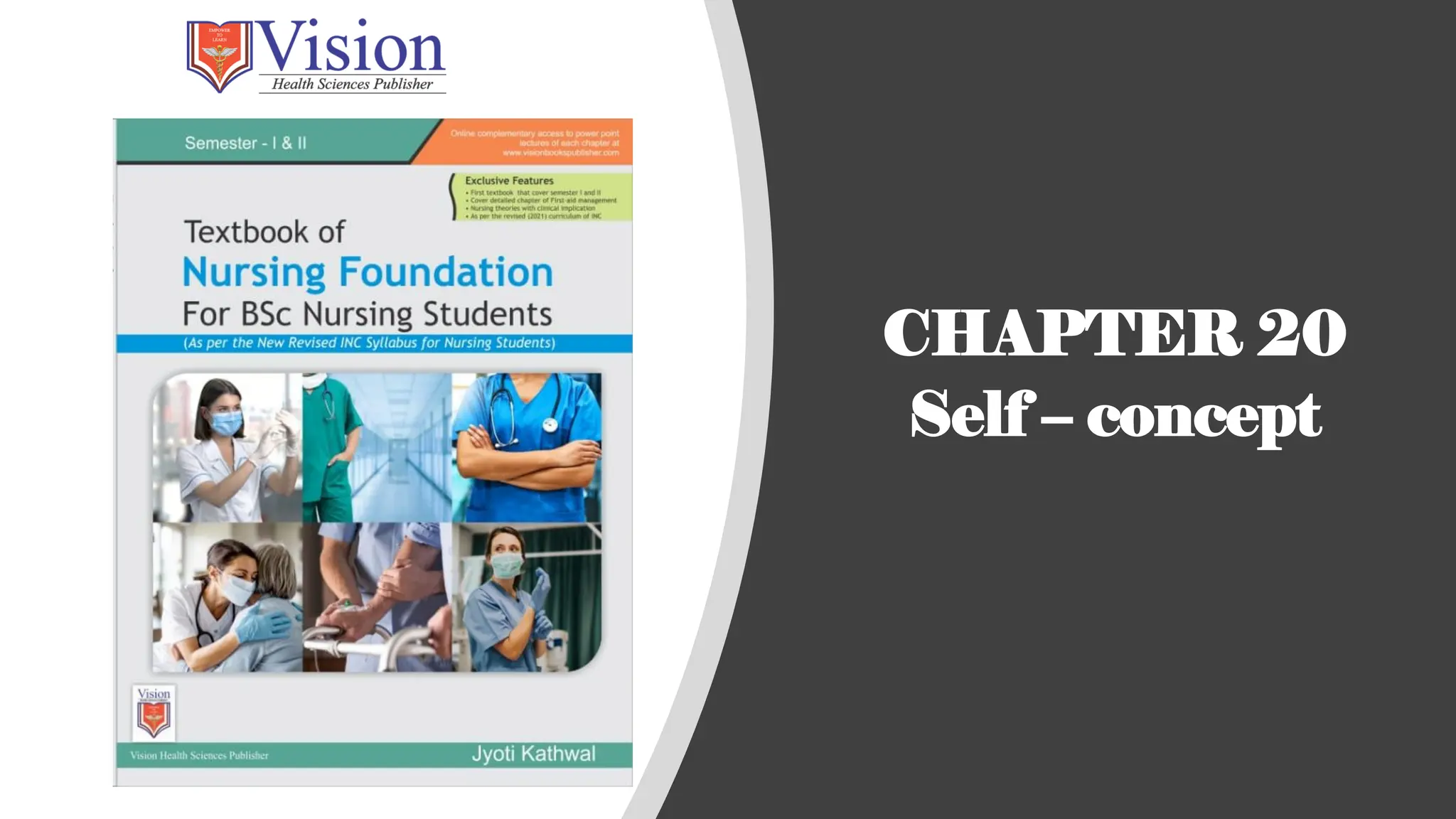
CHAPTER 20
Self – concept
Learning
Objectives
❑ Define self-concept and
components of self-concept.
❑ Describe three dimensions of
self-concept: self-knowledge,
self-expectations and self-
evaluation (self-esteem).
❑ Identify major steps in the
development of self-concept.
❑ Identify factors affecting
self-concept.
❑ Use appropriate interview
questions and approaches to
assess a patient’s self-
concept.
❑ Develop nursing diagnosis to
identify disturbances in self-
concept.
❑ Describe nursing strategies
that are effective in resolving
self-concept problems.
❑ Plan, implement, and
evaluate nursing care related
to selected nursing diagnosis
for disturbances in self-
concept.
CHAPTER
OUTLINE
❑Concept of Self-
concept
❑Components of
Self-concept
❑Dimensions of
Self-concept
❑Self-concept
Formation
❑Factors Affecting
Self-concept
❑ Nursing
Management of a
Patient with
Altered Self-
concept
MEANING OF SELF-CONCEPT
“Self-concept is the way a
person thinks about himself
or herself.”
—Brown, 1998
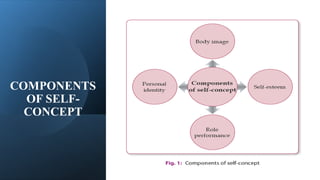
COMPONENTS
OF SELF-
CONCEPT
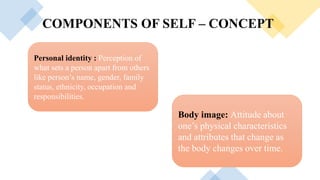
COMPONENTS OF SELF – CONCEPT
Personal identity : Perception of
what sets a person apart from others
like person’s name, gender, family
status, ethnicity, occupation and
responsibilities.
Body image: Attitude about
one’s physical characteristics
and attributes that change as
the body changes over time.
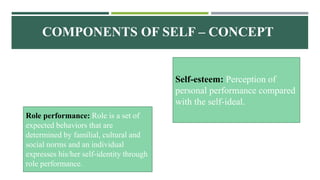
COMPONENTS OF SELF – CONCEPT
Self-esteem: Perception of
personal performance compared
with the self-ideal.
Role performance: Role is a set of
expected behaviors that are
determined by familial, cultural and
social norms and an individual
expresses his/her self-identity through
role performance.
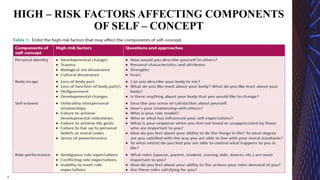
HIGH – RISK FACTORS AFFECTING COMPONENTS
OF SELF – CONCEPT
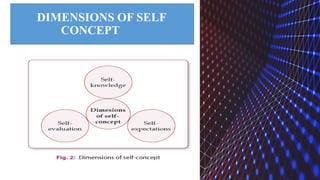
DIMENSIONS OF SELF
CONCEPT
SELF – KNOWLEDGE: “WHO AM I ?”
A person’s self-knowledge includes:
 Basic facts (age, gender, religion, race, occupation, cultural
background).
 The person’s position within social groups.
 Qualities or traits that describe the behaviors, feelings,
moods and other characteristics of a person (e.g., generous,
hot headed, ambitious, intelligent, etc.).
SELF – EXPECTATIONS: “WHO OR WHAT DO I
WANT TO BE?”
Self expectations develop through images of
role model such as parents image or celebrity.
These self expectations develop
unconsciously and may be healthy or
unhealthy.
SELF – EVALUATION: “HOW WELL DO I LIKE
MYSELF?”
Self-esteem is the evaluative and affective component of
the self-concept. According to Maslow (1954), all people
“have a need or desire for a stable, firmly based, usually
high evaluation of themselves, for self-respect or self-
esteem, and for the esteem of others.”
FORMATION OF SELF – CONCEPT
Self – concept is a social creation that develops as a result of interaction
with others.
According to Freud (1961), inborn traits are also important because they
affect a child’s
interpersonal experiences and shape self-concept.
According to the theoretical formulations, the formation of self-concept
includes the following:
• An infant learns that the physical self is different
from the environment. If basic needs are met, then the child begins
life with positive self-feeling.
• The child next incorporates other people’s attitudes
toward self and later, the child continues to behave in ways that confirm
this early self-concept.
• The child or adult internalizes the standards of society.
FACTORS AFFECTING
SELF – CONCEPT
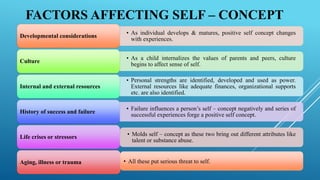
FACTORS AFFECTING SELF – CONCEPT
• As individual develops & matures, positive self concept changes
with experiences.
Developmental considerations
• As a child internalizes the values of parents and peers, culture
begins to affect sense of self.
Culture
• Personal strengths are identified, developed and used as power.
External resources like adequate finances, organizational supports
etc. are also identified.
Internal and external resources
• Failure influences a person’s self – concept negatively and series of
successful experiences forge a positive self concept.
History of success and failure
• Molds self – concept as these two bring out different attributes like
talent or substance abuse.
Life crises or stressors
Aging, illness or trauma • All these put serious threat to self.
NURSING
MANAGEMENT
OF PATIENTS
WITH
ALTERATIONS
IN SELF –
CONCEPT
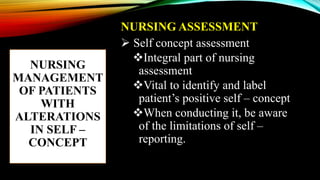
NURSING ASSESSMENT
➢ Self concept assessment
❖Integral part of nursing
assessment
❖Vital to identify and label
patient’s positive self – concept
❖When conducting it, be aware
of the limitations of self –
reporting.
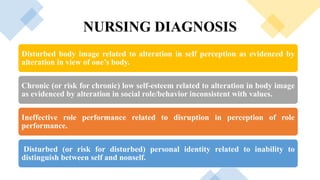
NURSING DIAGNOSIS
Disturbed (or risk for disturbed) personal identity related to inability to
distinguish between self and nonself.
Ineffective role performance related to disruption in perception of role
performance.
Chronic (or risk for chronic) low self-esteem related to alteration in body image
as evidenced by alteration in social role/behavior inconsistent with values.
Disturbed body image related to alteration in self perception as evidenced by
alteration in view of one’s body.
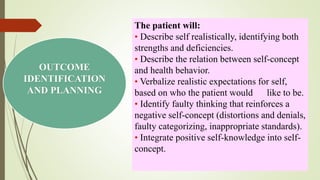
OUTCOME
IDENTIFICATION
AND PLANNING
The patient will:
• Describe self realistically, identifying both
strengths and deficiencies.
• Describe the relation between self-concept
and health behavior.
• Verbalize realistic expectations for self,
based on who the patient would like to be.
• Identify faulty thinking that reinforces a
negative self-concept (distortions and denials,
faulty categorizing, inappropriate standards).
• Integrate positive self-knowledge into self-
concept.
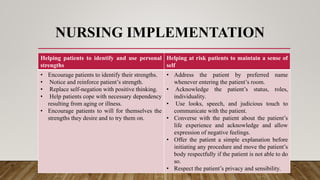
NURSING IMPLEMENTATION
Helping patients to identify and use personal
strengths
Helping at risk patients to maintain a sense of
self
• Encourage patients to identify their strengths.
• Notice and reinforce patient’s strength.
• Replace self-negation with positive thinking.
• Help patients cope with necessary dependency
resulting from aging or illness.
• Encourage patients to will for themselves the
strengths they desire and to try them on.
• Address the patient by preferred name
whenever entering the patient’s room.
• Acknowledge the patient’s status, roles,
individuality.
• Use looks, speech, and judicious touch to
communicate with the patient.
• Converse with the patient about the patient’s
life experience and acknowledge and allow
expression of negative feelings.
• Offer the patient a simple explanation before
initiating any procedure and move the patient’s
body respectfully if the patient is not able to do
so.
• Respect the patient’s privacy and sensibility.
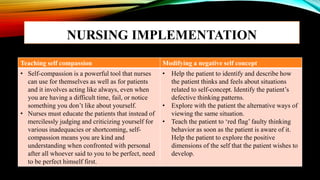
NURSING IMPLEMENTATION
Teaching self compassion Modifying a negative self concept
• Self-compassion is a powerful tool that nurses
can use for themselves as well as for patients
and it involves acting like always, even when
you are having a difficult time, fail, or notice
something you don’t like about yourself.
• Nurses must educate the patients that instead of
mercilessly judging and criticizing yourself for
various inadequacies or shortcoming, self-
compassion means you are kind and
understanding when confronted with personal
after all whoever said to you to be perfect, need
to be perfect himself first.
• Help the patient to identify and describe how
the patient thinks and feels about situations
related to self-concept. Identify the patient’s
defective thinking patterns.
• Explore with the patient the alternative ways of
viewing the same situation.
• Teach the patient to ‘red flag’ faulty thinking
behavior as soon as the patient is aware of it.
Help the patient to explore the positive
dimensions of the self that the patient wishes to
develop.
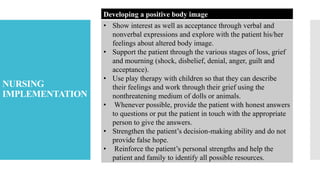
NURSING
IMPLEMENTATION
Developing a positive body image
• Show interest as well as acceptance through verbal and
nonverbal expressions and explore with the patient his/her
feelings about altered body image.
• Support the patient through the various stages of loss, grief
and mourning (shock, disbelief, denial, anger, guilt and
acceptance).
• Use play therapy with children so that they can describe
their feelings and work through their grief using the
nonthreatening medium of dolls or animals.
• Whenever possible, provide the patient with honest answers
to questions or put the patient in touch with the appropriate
person to give the answers.
• Strengthen the patient’s decision-making ability and do not
provide false hope.
• Reinforce the patient’s personal strengths and help the
patient and family to identify all possible resources.
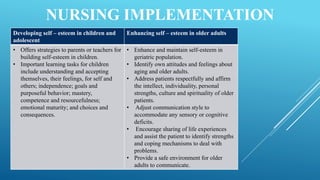
NURSING IMPLEMENTATION
Developing self – esteem in children and
adolescent
Enhancing self – esteem in older adults
• Offers strategies to parents or teachers for
building self-esteem in children.
• Important learning tasks for children
include understanding and accepting
themselves, their feelings, for self and
others; independence; goals and
purposeful behavior; mastery,
competence and resourcefulness;
emotional maturity; and choices and
consequences.
• Enhance and maintain self-esteem in
geriatric population.
• Identify own attitudes and feelings about
aging and older adults.
• Address patients respectfully and affirm
the intellect, individuality, personal
strengths, culture and spirituality of older
patients.
• Adjust communication style to
accommodate any sensory or cognitive
deficits.
• Encourage sharing of life experiences
and assist the patient to identify strengths
and coping mechanisms to deal with
problems.
• Provide a safe environment for older
adults to communicate.
NURSING
EVALUATION
The patient should be able to meet the
following outcomes:
• Patient is able to describe self
positively.
• Patient is comfortable with body
image and able to use it effectively
to meet human needs.
• Patient is able to meet realistic role
expectations without undue anxiety
and stress.
• Patient is capable of interacting
appropriately with environment
while recognizing self to be a
separate and distinct entity.
CHAPTER
FOCUS
POINTS
• Self-concept is the way a person thinks about himself
or herself. The four components of self-concept are
personal identity, body image, self-esteem and role
performance.
• Dimensions of self-concept include the self-
knowledge, self-expectations and self-evaluation.
• Almost every life experience can influence a person’s
self-concept. Key factors include developmental
considerations, culture, internal and external
resources, history of success and failure, stressors
and illness or trauma.
• Nurses must be comfortable with self and have an
adequate self-concept before they identify and
resolve self-concept disturbances in patients.
“Textbook of Foundation of
Nursing" by Jyoti Kathwal

SELF CONCEPT-20.pdf.self concept ppt.com

  • 1.
  • 2.
    Learning Objectives ❑ Define self-conceptand components of self-concept. ❑ Describe three dimensions of self-concept: self-knowledge, self-expectations and self- evaluation (self-esteem). ❑ Identify major steps in the development of self-concept. ❑ Identify factors affecting self-concept. ❑ Use appropriate interview questions and approaches to assess a patient’s self- concept. ❑ Develop nursing diagnosis to identify disturbances in self- concept. ❑ Describe nursing strategies that are effective in resolving self-concept problems. ❑ Plan, implement, and evaluate nursing care related to selected nursing diagnosis for disturbances in self- concept.
  • 3.
    CHAPTER OUTLINE ❑Concept of Self- concept ❑Componentsof Self-concept ❑Dimensions of Self-concept ❑Self-concept Formation ❑Factors Affecting Self-concept ❑ Nursing Management of a Patient with Altered Self- concept
  • 4.
    MEANING OF SELF-CONCEPT “Self-conceptis the way a person thinks about himself or herself.” —Brown, 1998
  • 5.
  • 6.
    COMPONENTS OF SELF– CONCEPT Personal identity : Perception of what sets a person apart from others like person’s name, gender, family status, ethnicity, occupation and responsibilities. Body image: Attitude about one’s physical characteristics and attributes that change as the body changes over time.
  • 7.
    COMPONENTS OF SELF– CONCEPT Self-esteem: Perception of personal performance compared with the self-ideal. Role performance: Role is a set of expected behaviors that are determined by familial, cultural and social norms and an individual expresses his/her self-identity through role performance.
  • 8.
    HIGH – RISKFACTORS AFFECTING COMPONENTS OF SELF – CONCEPT
  • 9.
  • 10.
    SELF – KNOWLEDGE:“WHO AM I ?” A person’s self-knowledge includes:  Basic facts (age, gender, religion, race, occupation, cultural background).  The person’s position within social groups.  Qualities or traits that describe the behaviors, feelings, moods and other characteristics of a person (e.g., generous, hot headed, ambitious, intelligent, etc.).
  • 11.
    SELF – EXPECTATIONS:“WHO OR WHAT DO I WANT TO BE?” Self expectations develop through images of role model such as parents image or celebrity. These self expectations develop unconsciously and may be healthy or unhealthy.
  • 12.
    SELF – EVALUATION:“HOW WELL DO I LIKE MYSELF?” Self-esteem is the evaluative and affective component of the self-concept. According to Maslow (1954), all people “have a need or desire for a stable, firmly based, usually high evaluation of themselves, for self-respect or self- esteem, and for the esteem of others.”
  • 13.
    FORMATION OF SELF– CONCEPT Self – concept is a social creation that develops as a result of interaction with others. According to Freud (1961), inborn traits are also important because they affect a child’s interpersonal experiences and shape self-concept. According to the theoretical formulations, the formation of self-concept includes the following: • An infant learns that the physical self is different from the environment. If basic needs are met, then the child begins life with positive self-feeling. • The child next incorporates other people’s attitudes toward self and later, the child continues to behave in ways that confirm this early self-concept. • The child or adult internalizes the standards of society.
  • 14.
  • 15.
    FACTORS AFFECTING SELF– CONCEPT • As individual develops & matures, positive self concept changes with experiences. Developmental considerations • As a child internalizes the values of parents and peers, culture begins to affect sense of self. Culture • Personal strengths are identified, developed and used as power. External resources like adequate finances, organizational supports etc. are also identified. Internal and external resources • Failure influences a person’s self – concept negatively and series of successful experiences forge a positive self concept. History of success and failure • Molds self – concept as these two bring out different attributes like talent or substance abuse. Life crises or stressors Aging, illness or trauma • All these put serious threat to self.
  • 16.
    NURSING MANAGEMENT OF PATIENTS WITH ALTERATIONS IN SELF– CONCEPT NURSING ASSESSMENT ➢ Self concept assessment ❖Integral part of nursing assessment ❖Vital to identify and label patient’s positive self – concept ❖When conducting it, be aware of the limitations of self – reporting.
  • 17.
    NURSING DIAGNOSIS Disturbed (orrisk for disturbed) personal identity related to inability to distinguish between self and nonself. Ineffective role performance related to disruption in perception of role performance. Chronic (or risk for chronic) low self-esteem related to alteration in body image as evidenced by alteration in social role/behavior inconsistent with values. Disturbed body image related to alteration in self perception as evidenced by alteration in view of one’s body.
  • 18.
    OUTCOME IDENTIFICATION AND PLANNING The patientwill: • Describe self realistically, identifying both strengths and deficiencies. • Describe the relation between self-concept and health behavior. • Verbalize realistic expectations for self, based on who the patient would like to be. • Identify faulty thinking that reinforces a negative self-concept (distortions and denials, faulty categorizing, inappropriate standards). • Integrate positive self-knowledge into self- concept.
  • 19.
    NURSING IMPLEMENTATION Helping patientsto identify and use personal strengths Helping at risk patients to maintain a sense of self • Encourage patients to identify their strengths. • Notice and reinforce patient’s strength. • Replace self-negation with positive thinking. • Help patients cope with necessary dependency resulting from aging or illness. • Encourage patients to will for themselves the strengths they desire and to try them on. • Address the patient by preferred name whenever entering the patient’s room. • Acknowledge the patient’s status, roles, individuality. • Use looks, speech, and judicious touch to communicate with the patient. • Converse with the patient about the patient’s life experience and acknowledge and allow expression of negative feelings. • Offer the patient a simple explanation before initiating any procedure and move the patient’s body respectfully if the patient is not able to do so. • Respect the patient’s privacy and sensibility.
  • 20.
    NURSING IMPLEMENTATION Teaching selfcompassion Modifying a negative self concept • Self-compassion is a powerful tool that nurses can use for themselves as well as for patients and it involves acting like always, even when you are having a difficult time, fail, or notice something you don’t like about yourself. • Nurses must educate the patients that instead of mercilessly judging and criticizing yourself for various inadequacies or shortcoming, self- compassion means you are kind and understanding when confronted with personal after all whoever said to you to be perfect, need to be perfect himself first. • Help the patient to identify and describe how the patient thinks and feels about situations related to self-concept. Identify the patient’s defective thinking patterns. • Explore with the patient the alternative ways of viewing the same situation. • Teach the patient to ‘red flag’ faulty thinking behavior as soon as the patient is aware of it. Help the patient to explore the positive dimensions of the self that the patient wishes to develop.
  • 21.
    NURSING IMPLEMENTATION Developing a positivebody image • Show interest as well as acceptance through verbal and nonverbal expressions and explore with the patient his/her feelings about altered body image. • Support the patient through the various stages of loss, grief and mourning (shock, disbelief, denial, anger, guilt and acceptance). • Use play therapy with children so that they can describe their feelings and work through their grief using the nonthreatening medium of dolls or animals. • Whenever possible, provide the patient with honest answers to questions or put the patient in touch with the appropriate person to give the answers. • Strengthen the patient’s decision-making ability and do not provide false hope. • Reinforce the patient’s personal strengths and help the patient and family to identify all possible resources.
  • 22.
    NURSING IMPLEMENTATION Developing self– esteem in children and adolescent Enhancing self – esteem in older adults • Offers strategies to parents or teachers for building self-esteem in children. • Important learning tasks for children include understanding and accepting themselves, their feelings, for self and others; independence; goals and purposeful behavior; mastery, competence and resourcefulness; emotional maturity; and choices and consequences. • Enhance and maintain self-esteem in geriatric population. • Identify own attitudes and feelings about aging and older adults. • Address patients respectfully and affirm the intellect, individuality, personal strengths, culture and spirituality of older patients. • Adjust communication style to accommodate any sensory or cognitive deficits. • Encourage sharing of life experiences and assist the patient to identify strengths and coping mechanisms to deal with problems. • Provide a safe environment for older adults to communicate.
  • 23.
    NURSING EVALUATION The patient shouldbe able to meet the following outcomes: • Patient is able to describe self positively. • Patient is comfortable with body image and able to use it effectively to meet human needs. • Patient is able to meet realistic role expectations without undue anxiety and stress. • Patient is capable of interacting appropriately with environment while recognizing self to be a separate and distinct entity.
  • 24.
    CHAPTER FOCUS POINTS • Self-concept isthe way a person thinks about himself or herself. The four components of self-concept are personal identity, body image, self-esteem and role performance. • Dimensions of self-concept include the self- knowledge, self-expectations and self-evaluation. • Almost every life experience can influence a person’s self-concept. Key factors include developmental considerations, culture, internal and external resources, history of success and failure, stressors and illness or trauma. • Nurses must be comfortable with self and have an adequate self-concept before they identify and resolve self-concept disturbances in patients.
  • 25.
    “Textbook of Foundationof Nursing" by Jyoti Kathwal