PRESENTATION
ON
INDEPENDENT NURSE PRACTITIONER
• PRESENTED BY:
• SUNNY ALVA KHARSHANDI
• 1ST YEAR MSC NURSING
DEFINITION
Independent nurse practitioner is “ a skilled health care provider
who utilizes critical judgement in the performance of
comprehensive health assessment differential diagnosis and the
presenting of pharmacological treatment in the direct management
if actual and chronic illness and disease”.
DEFINITION OF INDEPENDENT NURSE MIDWIFERY
PRACTITIONER
• Independent midwives are fully qualified practitioners who, in order to
fulfil the midwife’s role to its greatest potential, choose to work as
self- employed professionals- although they support its aims and
ideals.
HISTORICAL DEVELOPMENT OF INDEPENDENT
NURSE PRACTITIONER
 INP role originated as one strategy to increase access to primary care.
The following are brief historical background of INP.
 The first successful program to prepare INP’s was developed at the
university of Colorado in 1965
 During 1970-1971 federal legislation recommended certificate
program for nurse to deliver primary health care.
Cont.
 Gradually certificate program shifted to master’s degree.
 In response to health care reform in 1990s many INPs 3 program
were developed to meet the demand of primary care services.
 By 1994, 248 program centers were developed for INP in US.
 In 1995, 49000 nurses were employed as INPs.
Cont.
 American academy of nurse practitioner in 1993 developed standard
and guidelines for practice of INPs which are still followed.
 Today 200 universities and colleges are offering INP program all over
the world.
 70000 nurses are working as INP in US.
PHILOSOPHY OF INP
 The core philosophy of INP is to provide individuals care to patients of all ages.
 Its care focuses on patient’s conditions as well as the effects of illness on the lives
of the patients and their families.
 INPs make prevention, wellness and patient education priorities. This means
fewer prescriptions and less expensive treatment.
 Informing patients of their health care and encouraging them to participate in
decisions central to the care.
 In addition to care, INPs conduct research and are often active in patient
advocacy activities.
DEVELOPMENT OF INP (INDEPENDENT NURSE
MIDWIFERY PRACTITIONER )DEVELOPMENT IN INDIA
 The Indian Nursing Council (INC), the parent body of the nursing
councils in the country, has rolled out an initiative, which is in the
early implementation stage, and has been forwarded for approval to
the Union Health ministry.
• Independent nurse practitioners trained in midwifery has been
introduced to bring down the high Maternal Mortality Rate (MMR)
and Infant Mortality Rate (IMR) in rural areas.
 In order to ease the impact of the shortage of gynecologist in community
health centers, INC performed a pilot study for the ‘Independent Nurse
Practitioner Project’ in West Bengal at SSKM Hospital’s female medical and
surgical wards.
 The project provides an 18 months training in midwife besides an additional
training in emergency obstetric care to candidates who have completed their
BSc in nursing and have two to three years of clinical experience in ob-gyn
wards to take care of ANMS in rural sector. These nurses are called
independent nurse practitioners as they are trained to prescribe medicines
following approved protocols and take decisions independently in absence of
gynecologists.
 2 of the 4 trainees have been assigned to a CHC to manage obstetrics cases.
 The results of the pilot study has been submitted to health ministry
and the government of India is currently examining the proposal to
extend this project all over India. INC is finalizing a curriculum
with senior obstetrics and gynecologists for the training of

independent nurse practitioner module.
Explains T. Dileep Kumar, president , INC, “in rural areas, though a
community health center should be manned by physician, surgeon,
pediatrician and gynecologist, the community health center is usually
found facing a shortage of gynecologists.
BASIC REQUIREMENT FOR
INDEPENDENT NURSE PRACTITIONER
• The basic requirements are mentioned as below:
 Basic nursing education
 Registered nursing
 Advance nursing certificate (master degree in any specialization)
 Collaboration with any hospital/ agencies for referral and
reimbursement
EDUCATIONAL QUALIFICATION AND
CERTIFICATIONS
• The nurse who has an advanced education and is graduate of a nurse
practitioner programe. There are 2 types of courses for INP:
a) Short term program- aware a certificate.
b)Long term program- leading to a masters program.
Nurse Practitioner Courses In India:
• Currently in India there is just one nurse practitioner course. The
course is started in the stream of critical care. The INC has initiated
this Post Graduate Nurse Practitioner Critical Care Program, the first
Post-graduate nursing residency program in India. The program is
being approved by Government of India.
• Critical Care Nurse Practitioner Program is intended to prepare
registered BSc Nurses to provide advanced nursing care to adults who
are critically ill.
Eligibility For Nurse Practitioner in Critical Care:
 A registered BSc. Nurse / Post Basic BSc. Nurse with minimum one-
year clinical experience.
 Passes BSc. Nursing / Post Basic BSc Nursing from an institute
recognized by the INC with minimum 55% aggregate marks.
 One year clinical experience preferably in critical care setting.
PLACEMENT OF INDEPENDENT NURSE
PRACTITIONER
• With intense preparation, they are placed in a variety of setting like community clinics.
 Community health nurse practitioner
 Community health specialist.
 Family health specialist
 Rural health specialist
 School health nurse
 Occupational health nurse in industry
 Women health practitioner
 Mental health practitioner
 Acute care nurse practitioner
SPECIALTY OF NURSE PRACTITIONERS
 Allergy and immunology NP
 Cardiac NP
 Dermatology NP
 Geriatric NP
 Emergency room NP
 Endocrinology NP
 Holistic NP
 Hospice NP
 Gastroenterology NP
 Pediatric oncology NP
 Surgical NP
 Neurology NP
 Occupational health NP
 Orthopedics NP
 Pulmonary and respiratory NP
 Sports medicine NP
 Travel NP
 Urology NP
PURPOSE OF INP:
1. To substantiate the income.
2. To the professional autonomy.
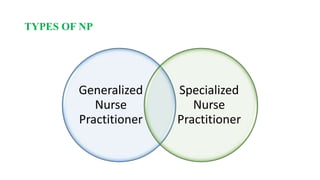
TYPES OF NP
Generalized
Nurse
Practitioner
Specialized
Nurse
Practitioner
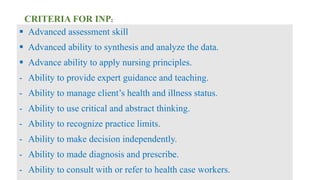
CRITERIA FOR INP:
 Advanced assessment skill
 Advanced ability to synthesis and analyze the data.
 Advance ability to apply nursing principles.
- Ability to provide expert guidance and teaching.
- Ability to manage client’s health and illness status.
- Ability to use critical and abstract thinking.
- Ability to recognize practice limits.
- Ability to make decision independently.
- Ability to made diagnosis and prescribe.
- Ability to consult with or refer to health case workers.
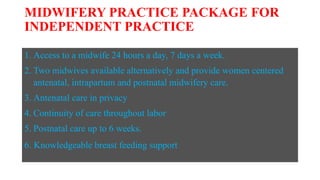
MIDWIFERY PRACTICE PACKAGE FOR
INDEPENDENT PRACTICE
1. Access to a midwife 24 hours a day, 7 days a week.
2. Two midwives available alternatively and provide women centered
antenatal, intrapartum and postnatal midwifery care.
3. Antenatal care in privacy
4. Continuity of care throughout labor
5. Postnatal care up to 6 weeks.
6. Knowledgeable breast feeding support
SCENARIO OF MIDWIFERY IN INDIA
 Prof. Uma Handa (ex Consultant Midwife, UNICEF) has a Bsc and
MSc in Nursing with specialization in obstetrics and gynecology
 Countries in which she has worked include Sri Lanka, UK,
Bangladesh and South Africa (University of Namibia-UNAM).
 Organizations is member of : Nursing Research Society of India
(Founder), Trained Nurses Association of India (TNAI), White
Ribbon Alliance India (WRAI), Society of Midwives and Executive
Committee member Birth India
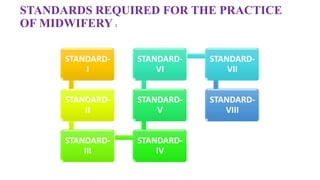
STANDARDS REQUIRED FOR THE PRACTICE
OF MIDWIFERY :
STANDARD-
I
STANDARD-
II
STANDARD-
III
STANDARD-
IV
STANDARD-
V
STANDARD-
VI
STANDARD-
VII
STANDARD-
VIII
STANDARD I
• midwifery care is provided by qualified practitioners. Midwifery
should be registered. Shows evidence of continuing competency as
required by certification agency by council
STANDARD II
• midwifery care occur in a safe environment with in the context of the
family, community and a system of health care
STANDARD III
• the midwives practices in accordance with the philosophy and the code of
professional body provides clients with a description of the scope of midwifery
services and information regarding the client’s rights and responsibilities.
STANDARD IV
• midwifery care is comprised of knowledge, skills and judgement that
foster the delivery of safe satisfying and culturally competent care.
The midwife collects and assesses client care data, develops and
implement individualized plan of management and evaluates outcome
of care.
STANDARD V
• midwifery care is based upon knowledge, skills and judgement which
are reflected in written practice guidelines. Midwife describes the
parameters of services for independent and collaborative midwifery
management and transfer of care when needed
STANDARD VI
• midwifery care is documented in a format that is accessible and competent. The
midwife uses records that facilitate communications and institutions. Provides
prompt and complete documentation of evaluation, course of management and
outcome of care.
STANDARD VII
• midwifery care is evaluated according to an established programme for quality
management that includes a plan to identify and resolve problems. The midwife
participates in programme of quality management for the evaluation of practice
within the setting in which it occurs.
STANDARD VIII
• midwife identifies the need for new procedure taking into
consideration consumer demand, standards for safe practice and
availability of other qualified personnel.
FUNCTIONS OF INDEPENDENT NURSE
PRACTITIONER
• prepared for advanced nursing practice by virtue of knowledge and skills obtained through a post-basic or
advanced education program of study acceptable to the State Board of Nurse Examiners.
• She is prepared to practice in an expanded role to provide primary care to women, to well- woman related
to reproductive health, conduct annual gynecological exams, provide education regarding family
planning, and provide menopausal care.
 She provides care in a variety of settings including, but not limited to homes, hospitals, institutions,
community agencies, public and private clinics, and private practice. She acts independently and /or in
collaboration with other health care professional to deliver health care services.
 She conducts comprehensive health assessments aimed at health promotion and disease prevention. She
is capable of solo practice with clinically competent skills and are legally approved to provide a defined
set of services without assistance or supervision of another professional.
 Midwifery practitioners are specialists in low-risk pregnancy, childbirth, and postpartum.
Cont.
• Midwifery nurse practitioners are uniquely qualified to resolve unmet needs in
primary health care by serving as an individual’s point of first contact with the
health care system.
• Midwifery practitioners refer women to general practitioners or obstetricians when
a pregnant woman requires care beyond their area of expertise.
• Nurse-midwives work together with OB/GYN doctors.
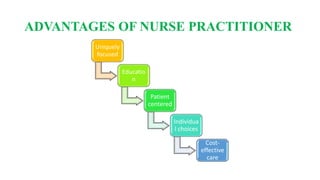
ADVANTAGES OF NURSE PRACTITIONER
Uniquely
focused
Educatio
n
Patient
centered
Individua
l choices
Cost-
effective
care
ISSUES IN INDEPENDENT NURSE PRACTICE:
• Curriculum for independent nurse practitioner development
• Prescriptive authority
• Public view of nursing
• Areas of practice
• Quality of care
• Cost effective care
Cont.
• Insufficient evidence-based practice and nursing research
• Need for establishment of a continuing nursing education system
• Need to establish a quality assurance system for the nursing
service
• Lack of involvement of nurses in health and nursing policy
formulation and planning.
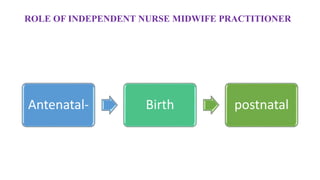
ROLE OF INDEPENDENT NURSE MIDWIFE PRACTITIONER
Antenatal- Birth postnatal
DUTIES AND RESPONSIBILITIES OF NURSE PRACTITIONER
IN MIDWIFERY
promotion of
health of
women
throughout
their life
practice within
the existing
peripheral
health system
available for
24 hours
DUTIES AND RESPONSIBILITIES RELATED TO ADMINISTRATION
• She will take administrative and technical support from the Chief Medical Officer
of Health in emergency.
• She will maintain working relationship with DMCHO, DPHNO, BPHN and
PHIN.
• She will help the mother to avail facilities of Janani Sishu Surakshya Yojona and
other ongoing National Health Programme.
• Refer to FRU if required.
Cont.
• She will counsel antenatal woman
• She will carry out laboratory test
DUTIES AND RESPONSIBILITIES RELATED TO
EDUCATION AND RESEARCH
• 1. She will perform evidence based research on maternal and child
care.
• 2. She will help in advocacy in maternal and child health.
RESEARCH ARTICLE
• VIEWS AND EXPERIENCES OF NURSE PRACTITIONERS AND
MEDICAL PRACTITIONERS WITH COLLABORATIVE PRACTICE IN
PRIMARY HEALTH CARE- AN INTEGRATIVE REVIEW.
• Verena Schadewaldt, Elizabeth Mclnnes, Anne Gardner.
• Abstract :
• Background: this integrative review synthesizes research studies that have
investigated the perceptions of nurse practitioners and medical practitioners
working in primary health care. The aggregation of evidence on barriers and
facilitators to working collaboratively and experiences about the processes of
collaboration is of value to understand success factors and factors that impede
collaborative working relationships.
• Methods :
• An integrative review, which used systematic review processes, was undertaken to summarize
qualitative and quantitative studies published between 190 and 2012. Databases searched were the
Cochrane Library, the Joanna Briggs Institute Library, PubMed, Medline, CINAHL, Informit and
pro-quest. Studies that met the inclusion criteria were assessed for quality. Study findings were
extracted relating to a) barriers and facilitators to collaborative working and b) views and
experiences about the process of collaboration. The findings were narratively synthesized,
supported by tabulation.
• Results :
• 27 studies conducted in seven different countries met the inclusion criteria. Content analysis
identified a number of barriers and facilitators collaboration between nurse practitioners and
medical practitioners. By means of data comparison five themes were developed in relation to
perceptions and understanding of collaboration.
Nurse practitioners and medical practitioners have differing views on the essentials of
collaboration and on supervision and autonomous nurse practitioner practice. Medical
practitioner who have a working experience with NPs express more positive attitudes
towards collaboration. Both professional groups report concerns and negative
experiences with collaborative practice but also value certain advantages of
collaboration.
Conclusion:
The review shows that working in collaboration is a slow progression. Exposure to
working together helps to overcome professional hurdles, dispel concerns and provide
clarity around roles and the meaning of collaboration of NOS and MPs. Guidelines on
liability and better funding strategies are necessary to facilitate collaborative practice
whether barriers lie in individual behaviour or in broader policies.
THANK YOU

INP power point.pptx

  • 1.
    PRESENTATION ON INDEPENDENT NURSE PRACTITIONER •PRESENTED BY: • SUNNY ALVA KHARSHANDI • 1ST YEAR MSC NURSING
  • 2.
    DEFINITION Independent nurse practitioneris “ a skilled health care provider who utilizes critical judgement in the performance of comprehensive health assessment differential diagnosis and the presenting of pharmacological treatment in the direct management if actual and chronic illness and disease”.
  • 3.
    DEFINITION OF INDEPENDENTNURSE MIDWIFERY PRACTITIONER • Independent midwives are fully qualified practitioners who, in order to fulfil the midwife’s role to its greatest potential, choose to work as self- employed professionals- although they support its aims and ideals.
  • 4.
    HISTORICAL DEVELOPMENT OFINDEPENDENT NURSE PRACTITIONER  INP role originated as one strategy to increase access to primary care. The following are brief historical background of INP.  The first successful program to prepare INP’s was developed at the university of Colorado in 1965  During 1970-1971 federal legislation recommended certificate program for nurse to deliver primary health care.
  • 5.
    Cont.  Gradually certificateprogram shifted to master’s degree.  In response to health care reform in 1990s many INPs 3 program were developed to meet the demand of primary care services.  By 1994, 248 program centers were developed for INP in US.  In 1995, 49000 nurses were employed as INPs.
  • 6.
    Cont.  American academyof nurse practitioner in 1993 developed standard and guidelines for practice of INPs which are still followed.  Today 200 universities and colleges are offering INP program all over the world.  70000 nurses are working as INP in US.
  • 7.
    PHILOSOPHY OF INP The core philosophy of INP is to provide individuals care to patients of all ages.  Its care focuses on patient’s conditions as well as the effects of illness on the lives of the patients and their families.  INPs make prevention, wellness and patient education priorities. This means fewer prescriptions and less expensive treatment.  Informing patients of their health care and encouraging them to participate in decisions central to the care.  In addition to care, INPs conduct research and are often active in patient advocacy activities.
  • 8.
    DEVELOPMENT OF INP(INDEPENDENT NURSE MIDWIFERY PRACTITIONER )DEVELOPMENT IN INDIA  The Indian Nursing Council (INC), the parent body of the nursing councils in the country, has rolled out an initiative, which is in the early implementation stage, and has been forwarded for approval to the Union Health ministry. • Independent nurse practitioners trained in midwifery has been introduced to bring down the high Maternal Mortality Rate (MMR) and Infant Mortality Rate (IMR) in rural areas.
  • 9.
     In orderto ease the impact of the shortage of gynecologist in community health centers, INC performed a pilot study for the ‘Independent Nurse Practitioner Project’ in West Bengal at SSKM Hospital’s female medical and surgical wards.  The project provides an 18 months training in midwife besides an additional training in emergency obstetric care to candidates who have completed their BSc in nursing and have two to three years of clinical experience in ob-gyn wards to take care of ANMS in rural sector. These nurses are called independent nurse practitioners as they are trained to prescribe medicines following approved protocols and take decisions independently in absence of gynecologists.  2 of the 4 trainees have been assigned to a CHC to manage obstetrics cases.
  • 10.
     The resultsof the pilot study has been submitted to health ministry and the government of India is currently examining the proposal to extend this project all over India. INC is finalizing a curriculum with senior obstetrics and gynecologists for the training of independent nurse practitioner module. Explains T. Dileep Kumar, president , INC, “in rural areas, though a community health center should be manned by physician, surgeon, pediatrician and gynecologist, the community health center is usually found facing a shortage of gynecologists.
  • 11.
    BASIC REQUIREMENT FOR INDEPENDENTNURSE PRACTITIONER • The basic requirements are mentioned as below:  Basic nursing education  Registered nursing  Advance nursing certificate (master degree in any specialization)  Collaboration with any hospital/ agencies for referral and reimbursement
  • 12.
    EDUCATIONAL QUALIFICATION AND CERTIFICATIONS •The nurse who has an advanced education and is graduate of a nurse practitioner programe. There are 2 types of courses for INP: a) Short term program- aware a certificate. b)Long term program- leading to a masters program.
  • 13.
    Nurse Practitioner CoursesIn India: • Currently in India there is just one nurse practitioner course. The course is started in the stream of critical care. The INC has initiated this Post Graduate Nurse Practitioner Critical Care Program, the first Post-graduate nursing residency program in India. The program is being approved by Government of India. • Critical Care Nurse Practitioner Program is intended to prepare registered BSc Nurses to provide advanced nursing care to adults who are critically ill.
  • 14.
    Eligibility For NursePractitioner in Critical Care:  A registered BSc. Nurse / Post Basic BSc. Nurse with minimum one- year clinical experience.  Passes BSc. Nursing / Post Basic BSc Nursing from an institute recognized by the INC with minimum 55% aggregate marks.  One year clinical experience preferably in critical care setting.
  • 15.
    PLACEMENT OF INDEPENDENTNURSE PRACTITIONER • With intense preparation, they are placed in a variety of setting like community clinics.  Community health nurse practitioner  Community health specialist.  Family health specialist  Rural health specialist  School health nurse  Occupational health nurse in industry  Women health practitioner  Mental health practitioner  Acute care nurse practitioner
  • 16.
    SPECIALTY OF NURSEPRACTITIONERS  Allergy and immunology NP  Cardiac NP  Dermatology NP  Geriatric NP  Emergency room NP  Endocrinology NP  Holistic NP  Hospice NP  Gastroenterology NP  Pediatric oncology NP  Surgical NP  Neurology NP  Occupational health NP  Orthopedics NP  Pulmonary and respiratory NP  Sports medicine NP  Travel NP  Urology NP
  • 17.
    PURPOSE OF INP: 1.To substantiate the income. 2. To the professional autonomy.
  • 18.
  • 19.
    CRITERIA FOR INP: Advanced assessment skill  Advanced ability to synthesis and analyze the data.  Advance ability to apply nursing principles. - Ability to provide expert guidance and teaching. - Ability to manage client’s health and illness status. - Ability to use critical and abstract thinking. - Ability to recognize practice limits. - Ability to make decision independently. - Ability to made diagnosis and prescribe. - Ability to consult with or refer to health case workers.
  • 20.
    MIDWIFERY PRACTICE PACKAGEFOR INDEPENDENT PRACTICE 1. Access to a midwife 24 hours a day, 7 days a week. 2. Two midwives available alternatively and provide women centered antenatal, intrapartum and postnatal midwifery care. 3. Antenatal care in privacy 4. Continuity of care throughout labor 5. Postnatal care up to 6 weeks. 6. Knowledgeable breast feeding support
  • 21.
    SCENARIO OF MIDWIFERYIN INDIA  Prof. Uma Handa (ex Consultant Midwife, UNICEF) has a Bsc and MSc in Nursing with specialization in obstetrics and gynecology  Countries in which she has worked include Sri Lanka, UK, Bangladesh and South Africa (University of Namibia-UNAM).  Organizations is member of : Nursing Research Society of India (Founder), Trained Nurses Association of India (TNAI), White Ribbon Alliance India (WRAI), Society of Midwives and Executive Committee member Birth India
  • 22.
    STANDARDS REQUIRED FORTHE PRACTICE OF MIDWIFERY : STANDARD- I STANDARD- II STANDARD- III STANDARD- IV STANDARD- V STANDARD- VI STANDARD- VII STANDARD- VIII
  • 23.
    STANDARD I • midwiferycare is provided by qualified practitioners. Midwifery should be registered. Shows evidence of continuing competency as required by certification agency by council
  • 24.
    STANDARD II • midwiferycare occur in a safe environment with in the context of the family, community and a system of health care
  • 25.
    STANDARD III • themidwives practices in accordance with the philosophy and the code of professional body provides clients with a description of the scope of midwifery services and information regarding the client’s rights and responsibilities.
  • 26.
    STANDARD IV • midwiferycare is comprised of knowledge, skills and judgement that foster the delivery of safe satisfying and culturally competent care. The midwife collects and assesses client care data, develops and implement individualized plan of management and evaluates outcome of care.
  • 27.
    STANDARD V • midwiferycare is based upon knowledge, skills and judgement which are reflected in written practice guidelines. Midwife describes the parameters of services for independent and collaborative midwifery management and transfer of care when needed
  • 28.
    STANDARD VI • midwiferycare is documented in a format that is accessible and competent. The midwife uses records that facilitate communications and institutions. Provides prompt and complete documentation of evaluation, course of management and outcome of care.
  • 29.
    STANDARD VII • midwiferycare is evaluated according to an established programme for quality management that includes a plan to identify and resolve problems. The midwife participates in programme of quality management for the evaluation of practice within the setting in which it occurs.
  • 30.
    STANDARD VIII • midwifeidentifies the need for new procedure taking into consideration consumer demand, standards for safe practice and availability of other qualified personnel.
  • 31.
    FUNCTIONS OF INDEPENDENTNURSE PRACTITIONER • prepared for advanced nursing practice by virtue of knowledge and skills obtained through a post-basic or advanced education program of study acceptable to the State Board of Nurse Examiners. • She is prepared to practice in an expanded role to provide primary care to women, to well- woman related to reproductive health, conduct annual gynecological exams, provide education regarding family planning, and provide menopausal care.  She provides care in a variety of settings including, but not limited to homes, hospitals, institutions, community agencies, public and private clinics, and private practice. She acts independently and /or in collaboration with other health care professional to deliver health care services.  She conducts comprehensive health assessments aimed at health promotion and disease prevention. She is capable of solo practice with clinically competent skills and are legally approved to provide a defined set of services without assistance or supervision of another professional.  Midwifery practitioners are specialists in low-risk pregnancy, childbirth, and postpartum.
  • 32.
    Cont. • Midwifery nursepractitioners are uniquely qualified to resolve unmet needs in primary health care by serving as an individual’s point of first contact with the health care system. • Midwifery practitioners refer women to general practitioners or obstetricians when a pregnant woman requires care beyond their area of expertise. • Nurse-midwives work together with OB/GYN doctors.
  • 33.
    ADVANTAGES OF NURSEPRACTITIONER Uniquely focused Educatio n Patient centered Individua l choices Cost- effective care
  • 34.
    ISSUES IN INDEPENDENTNURSE PRACTICE: • Curriculum for independent nurse practitioner development • Prescriptive authority • Public view of nursing • Areas of practice • Quality of care • Cost effective care
  • 35.
    Cont. • Insufficient evidence-basedpractice and nursing research • Need for establishment of a continuing nursing education system • Need to establish a quality assurance system for the nursing service • Lack of involvement of nurses in health and nursing policy formulation and planning.
  • 36.
    ROLE OF INDEPENDENTNURSE MIDWIFE PRACTITIONER Antenatal- Birth postnatal
  • 37.
    DUTIES AND RESPONSIBILITIESOF NURSE PRACTITIONER IN MIDWIFERY promotion of health of women throughout their life practice within the existing peripheral health system available for 24 hours
  • 38.
    DUTIES AND RESPONSIBILITIESRELATED TO ADMINISTRATION • She will take administrative and technical support from the Chief Medical Officer of Health in emergency. • She will maintain working relationship with DMCHO, DPHNO, BPHN and PHIN. • She will help the mother to avail facilities of Janani Sishu Surakshya Yojona and other ongoing National Health Programme. • Refer to FRU if required.
  • 39.
    Cont. • She willcounsel antenatal woman • She will carry out laboratory test
  • 40.
    DUTIES AND RESPONSIBILITIESRELATED TO EDUCATION AND RESEARCH • 1. She will perform evidence based research on maternal and child care. • 2. She will help in advocacy in maternal and child health.
  • 41.
    RESEARCH ARTICLE • VIEWSAND EXPERIENCES OF NURSE PRACTITIONERS AND MEDICAL PRACTITIONERS WITH COLLABORATIVE PRACTICE IN PRIMARY HEALTH CARE- AN INTEGRATIVE REVIEW. • Verena Schadewaldt, Elizabeth Mclnnes, Anne Gardner. • Abstract : • Background: this integrative review synthesizes research studies that have investigated the perceptions of nurse practitioners and medical practitioners working in primary health care. The aggregation of evidence on barriers and facilitators to working collaboratively and experiences about the processes of collaboration is of value to understand success factors and factors that impede collaborative working relationships.
  • 42.
    • Methods : •An integrative review, which used systematic review processes, was undertaken to summarize qualitative and quantitative studies published between 190 and 2012. Databases searched were the Cochrane Library, the Joanna Briggs Institute Library, PubMed, Medline, CINAHL, Informit and pro-quest. Studies that met the inclusion criteria were assessed for quality. Study findings were extracted relating to a) barriers and facilitators to collaborative working and b) views and experiences about the process of collaboration. The findings were narratively synthesized, supported by tabulation. • Results : • 27 studies conducted in seven different countries met the inclusion criteria. Content analysis identified a number of barriers and facilitators collaboration between nurse practitioners and medical practitioners. By means of data comparison five themes were developed in relation to perceptions and understanding of collaboration.
  • 43.
    Nurse practitioners andmedical practitioners have differing views on the essentials of collaboration and on supervision and autonomous nurse practitioner practice. Medical practitioner who have a working experience with NPs express more positive attitudes towards collaboration. Both professional groups report concerns and negative experiences with collaborative practice but also value certain advantages of collaboration. Conclusion: The review shows that working in collaboration is a slow progression. Exposure to working together helps to overcome professional hurdles, dispel concerns and provide clarity around roles and the meaning of collaboration of NOS and MPs. Guidelines on liability and better funding strategies are necessary to facilitate collaborative practice whether barriers lie in individual behaviour or in broader policies.
  • 44.