ABORTION
MUSINGUZI MARVIN
INTRODUCTION
 Abortion is the expulsion or extraction of an embryo or fetus weighing 500 g or less from
its mother when it is not capable of independent survival (i.e. before the period of
viability)
 Incidence 10–20% of all clinical pregnancies
 75% abortions occur before the 16th week
 Rates vary with maternal age; also high in women with past miscarriages
SPONTANEOUS
DEFINTION: It refers to the premature expulsion of the products of conceptions (embryo or
foetus) from the uterus, usually before the 20th week of pregnancy. An abortion may be
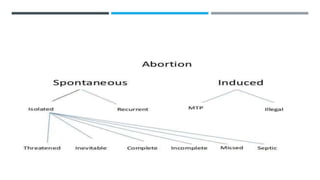
spontaneous (naturally occurring also called miscarriage) or induced (intentionally
performed). The expelled embryo or foetus is called abortus.
Isolated spontaneous abortions may result from certain viruses
—most notably cytomegalovirus, herpesvirus, parvovirus, and rubella virus
—or from disorders that can cause sporadic abortions or recurrent pregnancy loss (eg,
chromosomal or mendelian abnormalities, luteal phase defects).
SPONTANEOUS
A threatened abortion is vaginal bleeding that occurs in the first 20 weeks of pregnancy.
The bleeding is sometimes accompanied by abdominal cramps.
Inevitable abortion can come after a threatened miscarriage or without warning. There is
usually a lot more vaginal bleeding and strong lower stomach cramps
Complete abortion is a completed miscarriage. Typically, a history of vaginal bleeding,
abdominal pain, and passage of tissue exists. After the tissue passes, the patient notes that
the pain subsides and the vaginal bleeding significantly diminishes
SPONTANEOUS
An incomplete abortion is the partial loss of the products of conception within the first 20
weeks. Incomplete abortion usually presents with moderate to severe vaginal bleeding,
which may be associated with lower abdominal and/or pelvic pain
A missed abortion is a miscarriage in which the fetus doesn’t form or has died, but the
placenta and embryonic tissues are still in the uterus
SPONTANEOUS
Septic abortion is serious uterine infection during or shortly before or after
an abortion. Septic abortions usually result from induced abortions done by untrained
practitioners using nonsterile techniques; they are much more common when
induced abortion is illegal. Infection is less common after spontaneous abortion.
SPONTANEOUS
SPONTANEOUS
Habitual (or recurrent) abortion refers to a history of repeated miscarriage, defined as
three or more successive pregnancy losses
INDUCED ABORTION
 Nearly 40% of the nearly 182 million pregnancies each year in the developing world are
unwanted or ill-timed.
 46 million unwanted pregnancies end in abortion each year, 20 million of which are
unsafe or illegal.
 An unwanted pregnancy is a pregnancy that a woman or girl decides, of her own free will,
is undesired or un planned for.
INDUCED ABORTION
Illegal/ Unsafe abortion – defined as a procedure for terminating an unwanted pregnancy
either by persons lacking the necessary skills or in an environment lacking minimal medical
standards or both
Medical Termination of pregnancy-A medical abortion, also known as medication abortion,
occurs when medically-prescribed drugs are used to bring about an abortion or surgical
means .
BIOLOGICAL CAUSES
 A. Fetal Factors
 B. Maternal Factors
A. Fetal Factors
1. Genetic
– 50% of early miscarriage is due to chromosomal abnormalities
– Numerical defects like Trisomy, Polyploidy, Monosomy
– Structural defects like translocation, deletion, inversion
2. Multiple Pregnancies
3. Degeneration of villi
BIOLOGICAL CAUSES
B. Maternal Factors
1. ENDOCRINE AND METABOLIC FACTORS (10–15%):
– Luteal Phase Defect
– Thyroid abnormalities
– Diabetes mellitus
BIOLOGICAL CAUSES
2. Anatomical abnormalities (10–15%) Cervicouterine factors
– Cervical incompetence & insufficiency
– Congenital malformation of the uterus
– Uterine Fibroid
– Intrauterine adhesions
BIOLOGICAL CAUSES
3. Infections (5%)
– Viral: rubella, cytomegalo, HIV,..
– Parasitic: toxoplasma, malaria,..
– Bacterial: ureaplasma, chlamydia,..
4. IMMUNOLOGICAL DISORDERS (5–10%)
– Autoimmune disease
– Alloimmune disease
– Antifetal antibodies
BIOLOGICAL CAUSES
5. Environmental Factors
– Cigarette smoking
– Alcohol consumption
– Contraceptive agents
6. Maternal medical illness
– Cyanotic heart disease
– Hemoglobinopathies
BIOLOGICAL CAUSES
7. Unexplained (40-60%)
– In majority, the exact cause is not known
BIOLOGICAL CAUSES
LEGAL ISSUES WITH ABORTION
Approximately 20 million unsafe abortions take place each year. More than 200 women die
every day from complications of unsafe abortion % of abortion-related deaths and
complications occur in the developing world. unwanted pregnancy and unsafe abortion
WORLD’S ABORTION LAWS
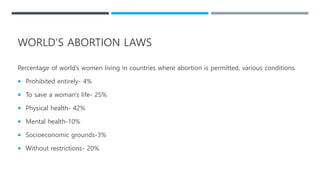
Percentage of world’s women living in countries where abortion is permitted, various conditions.
 Prohibited entirely- 4%
 To save a woman's life- 25%
 Physical health- 42%
 Mental health-10%
 Socioeconomic grounds-3%
 Without restrictions- 20%
CHALLENGES WITH ACCESS TO ABORTION SERVICES
It should be noted that even where abortion is permitted by law, women often encounter obstacles when
seeking to end a pregnancy, including:
 High cost
 Difficult access
 Inadequate facilities
 Social stigma
 Poorly trained and unsympathetic medical personnel.
 Lack of knowledge about abortion services
CONSEQUENCES OF UNSAFE ABORTION
 Some hospitals in developing countries
spend as much as 50% of their obstetric
and gynecological budgets treating
complications of unsafe abortion.
 Disability and its effects
 Economical lose
 Mortality and its consequences
 Social discrimination
 Social lose
 Adversely affects sexual relationships
ADDRESSING UNSAFE ABORTION
Unsafe abortion is a public health concern that affects the lives of tens of thousands of women, children, and
families each year.
1. Ensuring that changes in abortion laws are accompanied by supportive policies and service delivery
guidelines that promote safe
2. Availability of services in health centers
3. high quality services
4. Ensuring greater access to comprehensive sexual and reproductive health services including high quality
care for abortion complications and safe services for legal termination of pregnancy
5. Refraining from prosecuting women who have had abortions
ADDRESSING UNSAFE ABORTION
6. Advocacy for safe abortion services.
7. Educating the girl child.
8. Provision of youth and adolescent friendly services
9. Training of the health workers
10. Advocacy for Sexuality education for the youth
11. And many more
Service providers Must:
 Be well-informed about the status of the law
 Offer women high quality services and a choice of appropriate technologies
 Provide confidential, compassionate counseling
ADDRESSING UNSAFE ABORTION
As already noted before, Most of the induced abortions are induced. There fore, to reduce
the prevalence of un safe abortions un wanted/ unintended pregnancies must be addressed
SO…………..
What are the causes of unintended pregnancies?…….and
How can they be addressed?
CAUSES OF UNINTENDED PREGNANCIES
 Lack of information about sexuality
 Culture and social beliefs (early
marriage)
 Religion (contraceptive use)
 Poor parenting/ lack of family support
 Failure to access to contraceptives
(availability)
 Policies
 Sexual harassment and abuse
 Poverty
 Failure to educate the girl child
 Health concerns
 Personal beliefs attitudes and
perceptions
 Un friendly family planning services
 Etc
SO WHAT CAN BE DONE TO REDUCE THE PREVALENCE
OF UNINTENDED PREGNANCIES
Discuss this in groups of 3 in
……………………5 minutes………………………
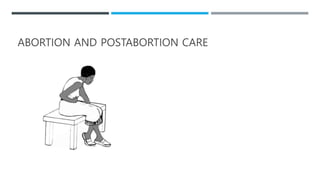
ABORTION AND POSTABORTION CARE
OBJECTIVE
 To equip learners with knowledge and good attitude in the management of women with
abortion.
COMPLICATIONS OF ABPORTION
 Haemorrhage
 Septicaemia
 Bacteraemia shock with rigors, nausea, vomiting, diarrhoea, hypotension, confusion,
delirium and coma
 Renal failure
Secondary
 infertility
MANAGEMENT OF A WOMAN WITH ABORTION
General management of abortion
 The woman with abortion must be admitted to gynaecological ward for close observation
and treatment
 History taking to obtain possible aetiological factors together with details of bleeding,
pain and products of conception expelled
 Perform a full physical examination
 Check and record vital signs i.e. temperature, pulse, respiration and blood pressure
 Observe aseptic technique when performing vaginal examinations
 Provide pads to observe severity of blood loss
 Put up intravenous fluids if the woman is bleeding severely i.e. normal saline, ringers
lactate
MANAGEMENT OF A WOMAN WITH ABORTION
 If necessary Check Hb, grouping and cross matching and arrange for blood donor
 Give antibiotics to treat infection in case of septic abortion
 MVA is the method of choice for the management of incomplete or inevitable abortion
for gestation of 14 weeks or less, because it has fewer complications compared to
curettage.
MANAGEMENT OF A WOMAN WITH ABORTION
6 Abortion.pptx
6 Abortion.pptx

6 Abortion.pptx

  • 1.
  • 2.
    INTRODUCTION  Abortion isthe expulsion or extraction of an embryo or fetus weighing 500 g or less from its mother when it is not capable of independent survival (i.e. before the period of viability)  Incidence 10–20% of all clinical pregnancies  75% abortions occur before the 16th week  Rates vary with maternal age; also high in women with past miscarriages
  • 4.
    SPONTANEOUS DEFINTION: It refersto the premature expulsion of the products of conceptions (embryo or foetus) from the uterus, usually before the 20th week of pregnancy. An abortion may be spontaneous (naturally occurring also called miscarriage) or induced (intentionally performed). The expelled embryo or foetus is called abortus.
  • 5.
    Isolated spontaneous abortionsmay result from certain viruses —most notably cytomegalovirus, herpesvirus, parvovirus, and rubella virus —or from disorders that can cause sporadic abortions or recurrent pregnancy loss (eg, chromosomal or mendelian abnormalities, luteal phase defects). SPONTANEOUS
  • 6.
    A threatened abortionis vaginal bleeding that occurs in the first 20 weeks of pregnancy. The bleeding is sometimes accompanied by abdominal cramps. Inevitable abortion can come after a threatened miscarriage or without warning. There is usually a lot more vaginal bleeding and strong lower stomach cramps Complete abortion is a completed miscarriage. Typically, a history of vaginal bleeding, abdominal pain, and passage of tissue exists. After the tissue passes, the patient notes that the pain subsides and the vaginal bleeding significantly diminishes SPONTANEOUS
  • 7.
    An incomplete abortionis the partial loss of the products of conception within the first 20 weeks. Incomplete abortion usually presents with moderate to severe vaginal bleeding, which may be associated with lower abdominal and/or pelvic pain A missed abortion is a miscarriage in which the fetus doesn’t form or has died, but the placenta and embryonic tissues are still in the uterus SPONTANEOUS
  • 8.
    Septic abortion isserious uterine infection during or shortly before or after an abortion. Septic abortions usually result from induced abortions done by untrained practitioners using nonsterile techniques; they are much more common when induced abortion is illegal. Infection is less common after spontaneous abortion. SPONTANEOUS
  • 9.
    SPONTANEOUS Habitual (or recurrent)abortion refers to a history of repeated miscarriage, defined as three or more successive pregnancy losses
  • 10.
    INDUCED ABORTION  Nearly40% of the nearly 182 million pregnancies each year in the developing world are unwanted or ill-timed.  46 million unwanted pregnancies end in abortion each year, 20 million of which are unsafe or illegal.  An unwanted pregnancy is a pregnancy that a woman or girl decides, of her own free will, is undesired or un planned for.
  • 11.
    INDUCED ABORTION Illegal/ Unsafeabortion – defined as a procedure for terminating an unwanted pregnancy either by persons lacking the necessary skills or in an environment lacking minimal medical standards or both Medical Termination of pregnancy-A medical abortion, also known as medication abortion, occurs when medically-prescribed drugs are used to bring about an abortion or surgical means .
  • 12.
    BIOLOGICAL CAUSES  A.Fetal Factors  B. Maternal Factors
  • 13.
    A. Fetal Factors 1.Genetic – 50% of early miscarriage is due to chromosomal abnormalities – Numerical defects like Trisomy, Polyploidy, Monosomy – Structural defects like translocation, deletion, inversion 2. Multiple Pregnancies 3. Degeneration of villi BIOLOGICAL CAUSES
  • 14.
    B. Maternal Factors 1.ENDOCRINE AND METABOLIC FACTORS (10–15%): – Luteal Phase Defect – Thyroid abnormalities – Diabetes mellitus BIOLOGICAL CAUSES
  • 15.
    2. Anatomical abnormalities(10–15%) Cervicouterine factors – Cervical incompetence & insufficiency – Congenital malformation of the uterus – Uterine Fibroid – Intrauterine adhesions BIOLOGICAL CAUSES
  • 16.
    3. Infections (5%) –Viral: rubella, cytomegalo, HIV,.. – Parasitic: toxoplasma, malaria,.. – Bacterial: ureaplasma, chlamydia,.. 4. IMMUNOLOGICAL DISORDERS (5–10%) – Autoimmune disease – Alloimmune disease – Antifetal antibodies BIOLOGICAL CAUSES
  • 17.
    5. Environmental Factors –Cigarette smoking – Alcohol consumption – Contraceptive agents 6. Maternal medical illness – Cyanotic heart disease – Hemoglobinopathies BIOLOGICAL CAUSES
  • 18.
    7. Unexplained (40-60%) –In majority, the exact cause is not known BIOLOGICAL CAUSES
  • 19.
    LEGAL ISSUES WITHABORTION Approximately 20 million unsafe abortions take place each year. More than 200 women die every day from complications of unsafe abortion % of abortion-related deaths and complications occur in the developing world. unwanted pregnancy and unsafe abortion
  • 20.
    WORLD’S ABORTION LAWS Percentageof world’s women living in countries where abortion is permitted, various conditions.  Prohibited entirely- 4%  To save a woman's life- 25%  Physical health- 42%  Mental health-10%  Socioeconomic grounds-3%  Without restrictions- 20%
  • 21.
    CHALLENGES WITH ACCESSTO ABORTION SERVICES It should be noted that even where abortion is permitted by law, women often encounter obstacles when seeking to end a pregnancy, including:  High cost  Difficult access  Inadequate facilities  Social stigma  Poorly trained and unsympathetic medical personnel.  Lack of knowledge about abortion services
  • 22.
    CONSEQUENCES OF UNSAFEABORTION  Some hospitals in developing countries spend as much as 50% of their obstetric and gynecological budgets treating complications of unsafe abortion.  Disability and its effects  Economical lose  Mortality and its consequences  Social discrimination  Social lose  Adversely affects sexual relationships
  • 23.
    ADDRESSING UNSAFE ABORTION Unsafeabortion is a public health concern that affects the lives of tens of thousands of women, children, and families each year. 1. Ensuring that changes in abortion laws are accompanied by supportive policies and service delivery guidelines that promote safe 2. Availability of services in health centers 3. high quality services 4. Ensuring greater access to comprehensive sexual and reproductive health services including high quality care for abortion complications and safe services for legal termination of pregnancy 5. Refraining from prosecuting women who have had abortions
  • 24.
    ADDRESSING UNSAFE ABORTION 6.Advocacy for safe abortion services. 7. Educating the girl child. 8. Provision of youth and adolescent friendly services 9. Training of the health workers 10. Advocacy for Sexuality education for the youth 11. And many more
  • 25.
    Service providers Must: Be well-informed about the status of the law  Offer women high quality services and a choice of appropriate technologies  Provide confidential, compassionate counseling ADDRESSING UNSAFE ABORTION
  • 26.
    As already notedbefore, Most of the induced abortions are induced. There fore, to reduce the prevalence of un safe abortions un wanted/ unintended pregnancies must be addressed SO………….. What are the causes of unintended pregnancies?…….and How can they be addressed?
  • 27.
    CAUSES OF UNINTENDEDPREGNANCIES  Lack of information about sexuality  Culture and social beliefs (early marriage)  Religion (contraceptive use)  Poor parenting/ lack of family support  Failure to access to contraceptives (availability)  Policies  Sexual harassment and abuse  Poverty  Failure to educate the girl child  Health concerns  Personal beliefs attitudes and perceptions  Un friendly family planning services  Etc
  • 28.
    SO WHAT CANBE DONE TO REDUCE THE PREVALENCE OF UNINTENDED PREGNANCIES Discuss this in groups of 3 in ……………………5 minutes………………………
  • 29.
  • 30.
    OBJECTIVE  To equiplearners with knowledge and good attitude in the management of women with abortion.
  • 31.
    COMPLICATIONS OF ABPORTION Haemorrhage  Septicaemia  Bacteraemia shock with rigors, nausea, vomiting, diarrhoea, hypotension, confusion, delirium and coma  Renal failure Secondary  infertility
  • 32.
    MANAGEMENT OF AWOMAN WITH ABORTION General management of abortion  The woman with abortion must be admitted to gynaecological ward for close observation and treatment  History taking to obtain possible aetiological factors together with details of bleeding, pain and products of conception expelled  Perform a full physical examination
  • 33.
     Check andrecord vital signs i.e. temperature, pulse, respiration and blood pressure  Observe aseptic technique when performing vaginal examinations  Provide pads to observe severity of blood loss  Put up intravenous fluids if the woman is bleeding severely i.e. normal saline, ringers lactate MANAGEMENT OF A WOMAN WITH ABORTION
  • 34.
     If necessaryCheck Hb, grouping and cross matching and arrange for blood donor  Give antibiotics to treat infection in case of septic abortion  MVA is the method of choice for the management of incomplete or inevitable abortion for gestation of 14 weeks or less, because it has fewer complications compared to curettage. MANAGEMENT OF A WOMAN WITH ABORTION