ABO BLOOD GROUP SUSTEM e content.pptx, Harjinder Singh
1.
H singh 1
ABOBLOOD GROUP SYSTEM
(A CASE OF MULTIPLE
ALLELISM)
-HARJINDER SINGH
2.
2
H singh
Sub. :Botany
Class : MSc. 2nd
Sem.
Paper: Genetics,
Cytogenetics and Plant
Breeding
Course: VII (H- 2003)
3.
H singh 3
MULTIPLEALLELES
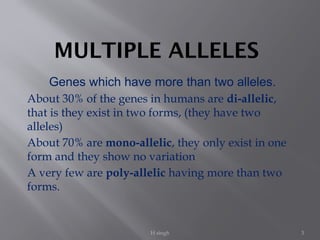
Genes which have more than two alleles.
About 30% of the genes in humans are di-allelic,
that is they exist in two forms, (they have two
alleles)
About 70% are mono-allelic, they only exist in one
form and they show no variation
A very few are poly-allelic having more than two
forms.
4.
H singh 4
Combinations
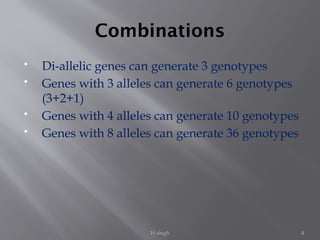
Di-allelic genes can generate 3 genotypes
Genes with 3 alleles can generate 6 genotypes
(3+2+1)
Genes with 4 alleles can generate 10 genotypes
Genes with 8 alleles can generate 36 genotypes
5.
H singh 5
Genesand the immune system
Poly-allelic alleles are usually associated with
tissue types
These genes are so varied that they provide us
with our genetic finger print
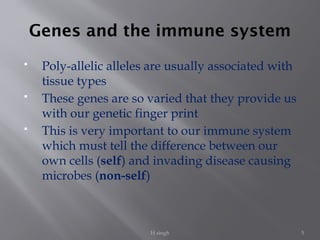
This is very important to our immune system
which must tell the difference between our
own cells (self) and invading disease causing
microbes (non-self)
6.
H singh 6
TheABO blood system
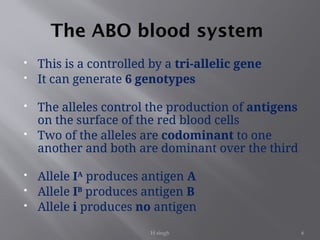
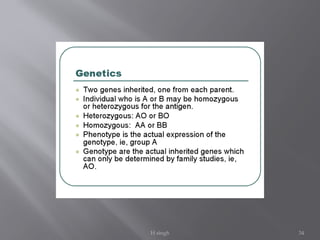
This is a controlled by a tri-allelic gene
It can generate 6 genotypes
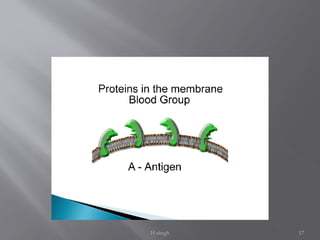
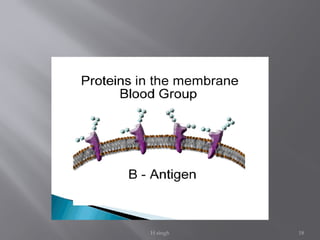
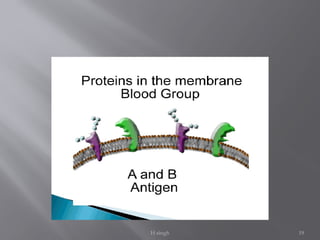
The alleles control the production of antigens
on the surface of the red blood cells
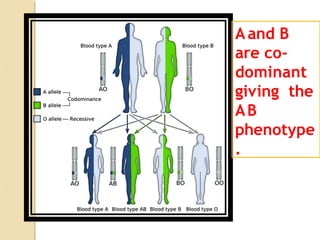
Two of the alleles are codominant to one
another and both are dominant over the third
Allele IA
produces antigen A
Allele IB
produces antigen B
Allele i produces no antigen
7.
The ABO bloodsystem
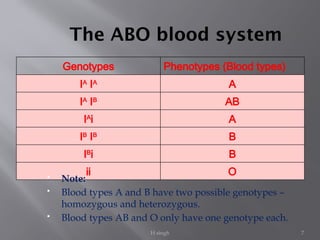
Genotypes Phenotypes (Blood types)
IA
IA
A
IA
IB
AB
IA
i A
IB
IB
B
IB
i B
ii O
Note:
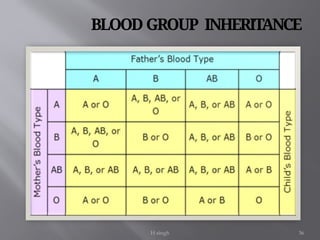
Blood types A and B have two possible genotypes –
homozygous and heterozygous.
Blood types AB and O only have one genotype each.
7
H singh
8.
H singh 8
ABOBLOOD GROUP
SYSTEM
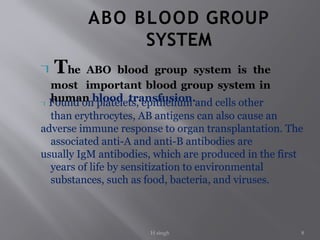
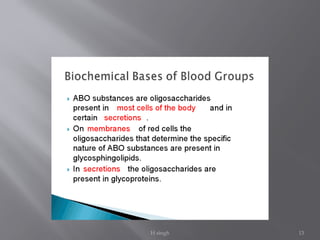
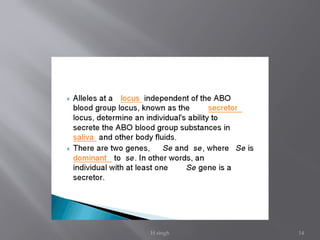
The ABO blood group system is the
most important blood group system in
human blood transfusion.
Found on platelets, epithelium and cells other
than erythrocytes, AB antigens can also cause an
adverse immune response to organ transplantation. The
associated anti-A and anti-B antibodies are
usually IgM antibodies, which are produced in the first
years of life by sensitization to environmental
substances, such as food, bacteria, and viruses.
9.
9
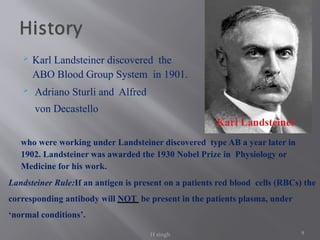
Karl Landsteinerdiscovered the
ABO Blood Group System in 1901.
Adriano Sturli and Alfred
von Decastello
who were working under Landsteiner discovered type AB a year later in
1902. Landsteiner was awarded the 1930 Nobel Prize in Physiology or
Medicine for his work.
Landsteiner Rule:If an antigen is present on a patients red blood cells (RBCs) the
corresponding antibody will NOT be present in the patients plasma, under
‘normal conditions’.
Karl Landsteiner
H singh
10.
10
Janský is creditedwith the first classification of blood
into the four types (A, B, AB, O) in 1907, which remains in
use today.
Reuben Ottenberg successfully transfused blood between
two people at Mount Sinai Hospital in New York. He was
the first person to record pre-transfusion testing for blood
compatibility in a clinical setting.
Later in 1954 he was the first to be awarded with Karl
Landsteiner Award H singh
11.
11
ABO BASICS
H singh
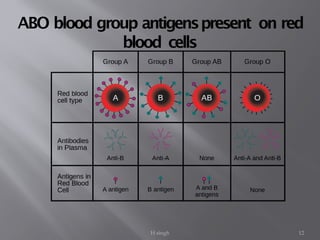
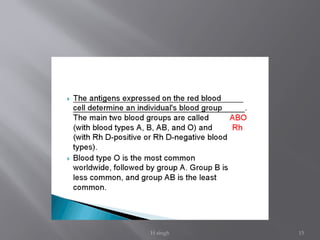
Basedon the presence or absence of antigen A and antigen B, blood
is divided into four groups:
‘A, B, AB and ‘O’ group.
Blood having antigen A belongs to ‘A’ group. This blood has β-
antibody in the serum.
Blood with antigen B and α-antibody belongs to ‘B’ group.
If both the antigens are present, blood group is called ‘AB’ group
and serum of this group does not contain
any antibody.
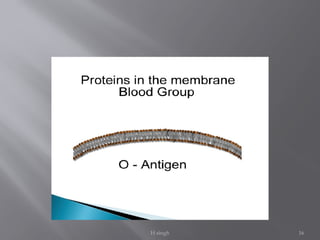
If both antigens are absent, the blood group is called ‘O’ group and
both α and β antibodies are present in the serum
12.
H singh 12
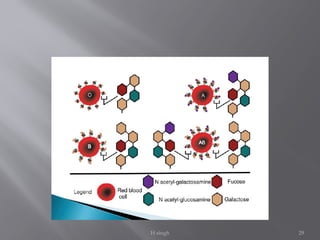
ABOblood group antigenspresent on red
blood cells
H singh 24
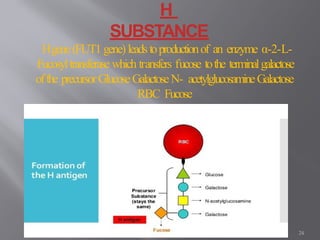
H
SUBSTANCE
Hgene(FUT1gene)leadstoproductionof an enzyme α-2-L-
Fucosyltransferase which transfers fucose tothe terminalgalactose
ofthe precursorGlucoseGalactoseN- acetylglucosamineGalactose
RBC Fucose
H singh 26
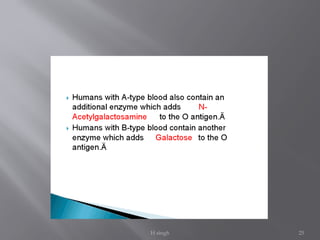
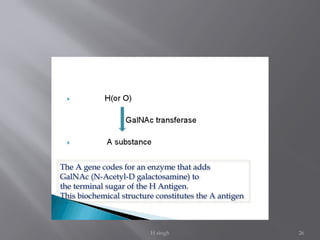
TheA gene codes for an enzyme that adds
GalNAc (N-Acetyl-D galactosamine) to
the terminal sugar of the H Antigen.
This biochemical structure constitutes the A antigen.
27.
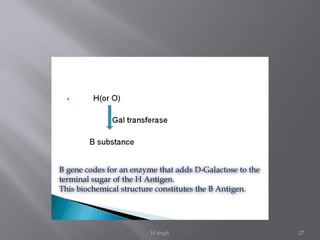
H singh 27
Bgene codes for an enzyme that adds D-Galactose to the
terminal sugar of the H Antigen.
This biochemical structure constitutes the B Antigen.
37
Blood transfusion
H singh3
7
Introduction
Precautions
Adverse effect Of Blood Transfusion
Exchange Transfusion
38.
38
Blood transfusion isthe process of transferring
blood or blood components from one person (the
donor) into the bloodstream of another person (the
recipient).
Richard Lower pioneered the first blood
transfusion from animal to human in 1665 at
the Royal Society.
In 1840 Dr. Blundell, performed the first
successful whole blood transfusion to
treat haemophilia.
H singh
39.
39
IMPORTANCE OFABO GROUPS
INBLOOD TRANSFUSION
During blood transfusion, only compatible blood must
be used.
The one who gives blood is called the ‘donor’ and the
one who receives the blood is called ‘recipient’.
While transfusing the blood, antigen of the donor and
the antibody of the recipient are considered.
H singh
40.
40
The antibody ofthe donor and antigen of the
recipient are ignored mostly.
Thus, RBC of ‘O’ group has no antigen and so
agglutination does not occur with any other group
of blood. So, ‘O’ group blood can be given to any
blood group persons and the people with this blood
group are called ‘universal donors’.
H singh
41.
41
Plasma of ABgroup blood has no antibody. This does
not cause agglutination of RBC from any other
group of blood.
People with AB group can receive blood from any
blood group persons. So, people with this blood
group are called ‘universal recipients’.
H singh
42.
42
In mismatched transfusion,
thetransfusion reactions occur between
donor’s RBC and recipient’s plasma.
So, if the donor’s plasma contains
agglutinins against recipient’s RBC,
agglutination does not occur because
these antibodies are diluted in the
recipient’s blood.
H singh
43.
43
Adverse effect ofBlood transfusion
H singh
Acute hemolytic reaction Delayed hemolytic
reaction Allergic reaction
Post-transfusion purpura
Transfusion associated acute lung injury HIV
Hepatitis C
Transfusions of blood products are
associated with several complications,
many of which can be grouped as
immunological or infectious such as:
45
The Rh bloodgroup system is one of thirty-
five current human blood group systems.
It is the most important blood group system
after ABO.
Rh blood group system consists of 50 defined
blood-group antigens, among them there are
six common types of Rh antigens.
Each of which is called an Rh factor.
•These types are designated C,D, E, c, d, and e.
H singh
46.
46
The type Dantigen is widely prevalent in the
population and considerably more antigenic than
the other Rh antigens.
Anyone who has this type of antigen is said to be
Rh positive, whereas a person who does not have
type D antigen is said to be Rh negative.
H singh
47.
47
•This antigen wasdiscovered by Karl
Landsteiner and Alexander Wiener in 1940.
•It was first discovered in Rhesus macaque and
hence the name 'Rh factor’.
H singh
48.
48
Erythroblastosis Fetalis (“HemolyticDisease of the Newborn”)
Erythroblastosis fetalis is a disease of the fetus and
newborn child characterized by agglutination and
phagocytosis of the fetus’s red blood cells.
In most instances of erythroblastosis fetalis, the
mother is Rh negative and the father Rh positive.
The baby has inherited the Rh-positive antigen from the
father, and the mother develops anti-Rh agglutinins
from exposure to the fetus’s Rh antigen.
In turn, the mother’s agglutinins diffuse through the
placenta into the fetus and cause red blood cell
agglutination.
H singh
49.
49
•Symptoms and signsin the newborn:
• Anemia that creates the newborn's pallor
(pale appearance).
• Jaundice or yellow discoloration of the
newborn's skin, sclera or mucous
membrane.
• Enlargement of the newborn's liver and
spleen.
•Severe edema of the entire body.
•Dyspnea or difficulty breathing.
H singh
50.
50
Thirty-five major bloodgroup systems were
recognized by the International Society of Blood
Transfusion (ISBT) in October 2012.
In addition to the ABO antigens and Rhesus
antigens, many other antigens are expressed on
the red blood cell surface membrane.
OTHER BLOOD GROUPS
aa
H singh
51.
51
An individual canbe AB Rh D positive, and at
the same time M and N positive (MNS system),
K positive (Kell system), and Lea or
•Leb positive (Lewis system). Many of the
blood group systems were named after the
patients in whom the corresponding antibodies
were initially encountered.
H singh
52.
52
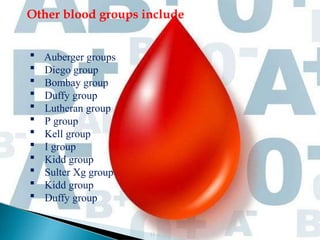
Other blood groupsinclude
H singh
Auberger groups
Diego group
Bombay group
Duffy group
Lutheran group
P group
Kell group
I group
Kidd group
Sulter Xg group
Kidd group
Duffy group
53.
H singh 53
BOMBAY
GROUP
•The h/h blood group, also known as Oh [
or theBombay
blood group,is a rare blood type.This blood [phenotype]was
first discovered in Bombay, now known
• as Mumbai, by Dr. Y
.M.Bhendein 1952.
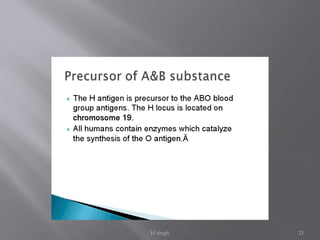
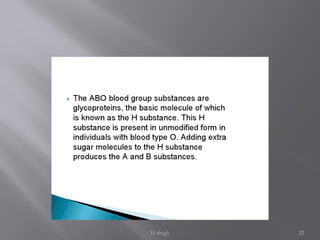
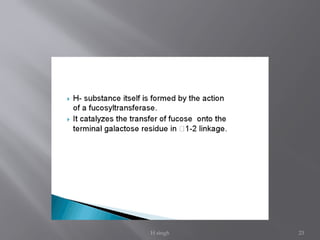
• The Hh blood group containsone antigen, theHantigen,which is
found on virtually all RBCs and is the building block for the
productionof the antigens within the ABO blood group.



![H singh 53
BOMBAY
GROUP
• The h/h blood group, also known as Oh [
or theBombay
blood group,is a rare blood type.This blood [phenotype]was
first discovered in Bombay, now known
• as Mumbai, by Dr. Y
.M.Bhendein 1952.
• The Hh blood group containsone antigen, theHantigen,which is
found on virtually all RBCs and is the building block for the
productionof the antigens within the ABO blood group.](https://image.slidesharecdn.com/abobloodgroupsustemecontent-250723074343-3379992b/85/ABO-BLOOD-GROUP-SUSTEM-e-content-pptx-Harjinder-Singh-53-320.jpg)