Abnormal Uterine Bleeding…
The Way Out
Amr Nadim, MSc, DUE,MD
Professor of Obstetrics, Gynecology
and Reproductive Health
Ain Shams Faculty of Medicine
It’s about two ladies
Patient Profile: Mrs. Aisha
Presenting patient
• Mrs. Aisha, 48 year old school teacher,
presenting with heavy bleeding during
menstruation
• Her general health is otherwise good
Medical Chart
Medical History Regular Menstrual cycle et it is now
coming at 40-45 days intervals
Bleeding is becoming heavy and
prolonged
Social History Fatigue with impact on her work and
QOL
Current Medication None
Adapted from Abnormal Uterine bleeding in a Healthy 48-year old : Knowing the right questions to ask. Peter HM Van De Weijer accessed at http://mp.peervoice.com/player/23145/51/1#3
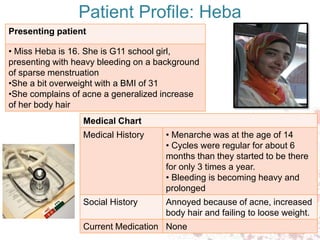
Patient Profile: Heba
Presenting patient
• Miss Heba is 16. She is G11 school girl,
presenting with heavy bleeding on a background
of sparse menstruation
•She a bit overweight with a BMI of 31
•She complains of acne a generalized increase
of her body hair
Medical Chart
Medical History • Menarche was at the age of 14
• Cycles were regular for about 6
months than they started to be there
for only 3 times a year.
• Bleeding is becoming heavy and
prolonged
Social History Annoyed because of acne, increased
body hair and failing to loose weight.
Current Medication None
Making the point about definitions
Menorrhagia The symptom of heavy menstrual bleeding; a term
specifically used to describe ovulatory bleeding
(that is, a normal, regular, and predictable cycle
ranging from 21 to 35 days, most often 28 days).
Metrorrhagia The symptom of bleeding between
menstrual periods; the
unpredictable timing of the flow
generally reflects anovulation.
Menometrorrhagia The symptom of heavy bleeding
between menstrual periods.
Heavy Menstrual
Bleeding
Menstrual bleeding that may be
Bleeding either Ovulatory (menorrhagia) or Anovulatory
Breakthrough
Bleeding
Bleeding that occurs despite the use of drugs such as
oral contraceptives that are given to control uterine
bleeding.
Chronic Acute Intermenstrual
Abnormal bleeding in
volume, regularity and/or
timing which has been there
for up to 6 month
An episode of HMB that is
judged severe enough to
require IMMEDIATE
intervention to prevent
further loss
Bleeding occurring between
predictable menses whether
predictable or randomly
occurring
YOU Will Have To Decide…
Amount
Duration
Timing
A menstrual Calendar is Mandatory
What is the prevalence of heavy menstrual
bleeding in women of reproductive age?
A. 1 in 3
B. 1 in 5
C. 1 in 10
D. 1 in 20
Adapted from Abnormal Uterine bleeding in a Healthy 48-year old : Knowing the right questions to ask. Peter HM Van De Weijer accessed at http://mp.peervoice.com/player/23145/51/1#3
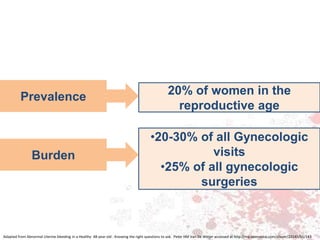
51015
Prevalence 20% of women in the
reproductive age
Burden
•20-30% of all Gynecologic
visits
•25% of all gynecologic
surgeries
Adapted from Abnormal Uterine bleeding in a Healthy 48-year old : Knowing the right questions to ask. Peter HM Van De Weijer accessed at http://mp.peervoice.com/player/23145/51/1#3
“The key to optimum
management of a patient
with
HMB, is to understand
the mechanism, the
pathogenesis, and all the
factors
involved in the problem.
This will help defining
which appropriate
Investigations are needed
and will allow one to tailor
therapy to individuals, and
with a
fairly successful
outcome.”
Absence of progestational effects in anovulatory cycles
UNPREDICTABLE BLEEDING
Progesterone Effects
Secretory transformation
Stabilizing the extracellular matrix by inhibiting proteases
Enhancing hemostasis
Jabbour et al. Endocrine regulation of menstruation. Endocrine Reviews 2005
A Woman Presenting with Heavy Menstrual Bleeding
Take Full History and Perform Examination and Order CBC
No structural or histological anomalies
suspected
There is a possible structure or histological
anomaly
Abnormal Bleeding..Making the
Diagnosis
No
abnormalities or
a fibroid <3 cm.
Consider
Endometrial
Biopsy
Uterus is enlarged
Abdominal/Pelvic .
Consider Imaging /
Hysteroscopy
No abnormalities or a
fibroid <3 cm.
Consider Medical
Treatment
Provide Information and Discuss
Treatment Options
Adapted from Abnormal Uterine bleeding in a Healthy 48-year old : Knowing the right questions to ask. Peter HM Van De Weijer accessed at http://mp.peervoice.com/player/23145/51/1#3
Abnormal Uterine Bleeding Diagnostic Tools
Reproduced from Abnormal Uterine bleeding in a Healthy 48-year old : Knowing the right questions to ask. Peter HM Van De Weijer accessed at
Patient Profile: Mrs. Aisha
Presenting patient
• Age of Menarche 14
•Menstrual pattern Bleeding 10/45 , heavy loss
•Medications or related medical illness None
•Evidence of bleeding disorder None
•Is it a bothersome condition Yes
Test Results
Pregnancy test Negative
CBC - Thyroid Function Normal
TVS No structural anomalies
Endometrial Thickness 8mm
Pipelle Biopsy Irregular shedding, No malignancy
Adapted from Abnormal Uterine bleeding in a Healthy 48-year old : Knowing the right questions to ask. Peter HM Van De Weijer accessed at http://mp.peervoice.com/player/23145/51/1#3
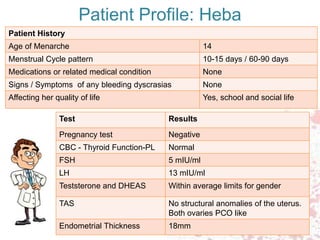
Patient Profile: Heba
Patient History
Age of Menarche 14
Menstrual Cycle pattern 10-15 days / 60-90 days
Medications or related medical condition None
Signs / Symptoms of any bleeding dyscrasias None
Affecting her quality of life Yes, school and social life
Test Results
Pregnancy test Negative
CBC - Thyroid Function-PL Normal
FSH 5 mIU/ml
LH 13 mIU/ml
Teststerone and DHEAS Within average limits for gender
TAS No structural anomalies of the uterus.
Both ovaries PCO like
Endometrial Thickness 18mm
What is the most likely cause for Mrs.
Aisha bleeding based on her history and
investigations?
A. Bleeding disorder
B. Anovulation
C. Submucous myoma
D. Atypical complex Hyperplasia
Adapted from Abnormal Uterine bleeding in a Healthy 48-year old : Knowing the right questions to ask. Peter HM Van De Weijer accessed at http://mp.peervoice.com/player/23145/51/1#3
51015
What is the most likely cause for Heba
bleeding pattern based on her history and
investigations?
A. Bleeding disorder
B. Anovulation
C. Submucous myoma
D. Atypical complex Hyperplasia
51015
Etiologies
• Systemic
• Reproductive Tract
• Iatrogenic
Organic
• Ovulatory
• AnovulatoryDysfunctional
Updates from FIGO, 2011
Munro MG, et al, FIGO classification system (PALM-COEIN) for causes of
abnormal uterine bleeding in nongravid women of reproductive age, Int J
Gynecol Obstet (2011)
Structural Non-Structural
FIGO System for AUB, 2011
Frequency
Regularity
Duration
Volume
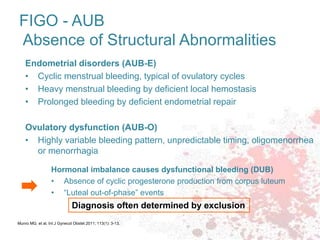
Endometrial disorders (AUB-E)
• Cyclic menstrual bleeding, typical of ovulatory cycles
• Heavy menstrual bleeding by deficient local hemostasis
• Prolonged bleeding by deficient endometrial repair
Ovulatory dysfunction (AUB-O)
• Highly variable bleeding pattern, unpredictable timing, oligomenorrhea
or menorrhagia
Hormonal imbalance causes dysfunctional bleeding (DUB)
• Absence of cyclic progesterone production from corpus luteum
• “Luteal out-of-phase” events
Diagnosis often determined by exclusion
FIGO - AUB
Absence of Structural Abnormalities
Munro MG, et al. Int J Gynecol Obstet 2011; 113(1): 3-13.
COEIN: Ovulatory
Anovulation Hypothyroidism
Luteal Phase Defect
COEIN: Ovulatory
Anovulatory Bleeding
 Anovulatory bleeding
Age-related: peri-menarche, perimenopause
Estrogenic: unopposed endogenous estrogen
Androgenic: PCOS; CAH, acute stress
Systemic: Renal disease, liver disease
 Is a Diagnosis of exclusion
Menometrorrhagia not caused by anatomic lesion,
medications, pregnancy
COEIN: Ovulatory
Low T4 high TRH  high TSH  normal T4
high PRL amenorrhea + galactorrhea
Hypothyroidism
 Bleeding can be excessive, light, or irregular
 Only severe, uncorrected thyroid disease
causes abnormal bleeding patterns
 Normal pattern when corrected to euthyroid
Primary hypothyroidism is associated with
Secondary amenorrhea
COEIN: Ovulatory
Luteal Phase Defect (LPD)
Luteal phase lasts 7-10 days (vs. 14 days) or
inadequate peak luteal phase progesterone
Diagnosis
Polymenorrhea (periods every 2 weeks)
Mid-luteal phase P level between 4-8 ng/ml
Endometrial biopsy >2 days out of phase
Management
Unexplained infertility: clomiphene, P supplement
Pregnancy not desired: observation or COCs
How should Mrs. Aisha be treated ?
A. Hysteroscopy/Dilatation and curettage
B. Endometrial Ablation
C. Progestagens
D. Hysterectomy
Adapted from Abnormal Uterine bleeding in a Healthy 48-year old : Knowing the right questions to ask. Peter HM Van De Weijer accessed at http://mp.peervoice.com/player/23145/51/1#3
51015
First : Pharmacologic Therapy
Should be offered before surgical therapy
Hormonal causes are amenable to
hormonal manipulation
Therapy choice depends on
Degree of bleeding
Women’s age
Need for contraception
Drug adverse effect profile
Pharmacologic treatment proposed
Progestagens high dose for 10 days
Tranexamic acid / Epsilon Amino Caproic
Acid
Second : Consider Surgical
Intervention
If Pharmacologic therapy fails consider
emergency surgical options:
Uterine Foley Baloon 30 ml saline
Uterine irrigation by aminocaproic acid
Curettage
Endometrial ablation
Hysterectomy
Adapted from Abnormal Uterine bleeding in a Healthy 48-year old : Knowing the right questions to ask. Peter HM Van De Weijer accessed at http://mp.peervoice.com/player/23145/51/1#3
Pharmacologic Therapy: Choices
Progestagen,
High Dose
10 days
Progestagen, Low Dose
(10 -14 days/cycle)
Combined Oral
Contraceptive Pills
Dydrogesterone
MPA
Lynestrenol
Norethindrone
Medrogestone
Levonorgestrel
Drosperinone
Desogestrel
Adapted from Abnormal Uterine bleeding in a Healthy 48-year old : Knowing the right questions to ask. Peter HM Van De Weijer accessed at http://mp.peervoice.com/player/23145/51/1#3
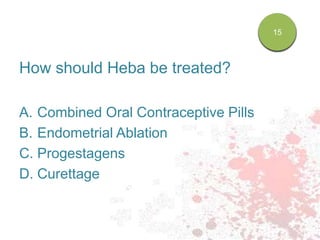
How should Heba be treated?
A. Combined Oral Contraceptive Pills
B. Endometrial Ablation
C. Progestagens
D. Curettage
51015
Pharmacologic Therapy:
Patient Factors Influencing the Choices
Reproduced from Abnormal Uterine bleeding in a Healthy 48-year old : Knowing the right questions to ask. Peter HM Van De Weijer accessed at
The Choice of a Progestagen
Progesterone Retroprogesterone
Progesterone Dydrogesterone
Progesterone Derivatives Testosterone Derivatives
17-OH-progesterone
Derivates
19-progesterone
Derivatives
19-nortestosterone Derivatives
Pregnane
• Hydroxyprogesterone
Caproate
• Hydroxyprogesterone
Heptanoate
• Gestonorone Caproate
• Chlormadinone Acetate
• Medrogestone
• Medroxyprogesterone
Acetate
• Cyproterone Acetate
Nor-Pregnane
• Nomegestrole Acetate
• Demegestone
• Promegestone
• Nestorone
• Trimegestone
Estranes
• Lynestrenol
• Levonorgestrel
• Norethisterone
• Norethisterone Acetate
• Ethinodiol Diacetate
• Norgestrienone
• Dienogest
Gonanes
• Norgestrel
• Desogestrel
• Gestodene
• Norgestimate
Spirolactone
Derivative
Drospirenone
Adapted from: Druckmann R. Journal Für Menopause. 2002:1-5.
• Dydrogesterone is a retroprogesterone, a steroisomer of progesterone, with
an additional double-bond between carbon 6 and 71
• Dydrogesterone, shaped by light, enhances the progestogenic
effects
• No estrogenic, androgenic, or glucocorticoid effects2
• Does not inhibit ovulation, at normal dosage2
• Anti-androgenic potential of dydrogesterone is less pronounced compared to
progesterone3
Dydrogesterone – a Unique Retrosteroid
1. Kuhl H. Climacteric 2005; 8 (Suppl 1): 3–63.
2. Schindler AE. Maturitas 2009; 65S: S3–S11.
3. Rižner TL et al. Steroids. 2011;76(6):607–15.
Progesterone Dydrogesterone
Receptor Binding of Progestogens1
1. Adapted from: Schindler AE, et al. Maturitas 2009; 65(Suppl 1): S3-S11.
2. Rižner TL, et al. Steroids. 2011; 76(6): 607-615.
• Anti-androgenic potential of dydrogesterone and DHD is less pronounced compared to
progesterone2
Lockwood CJ. Menopause 2011; 18(4): 408-411.
Progestagens Simply Improve The Endometrial Characteristics
Stops estrogen-induced growth of the endometrium
 Stabilizes endometrial vasculature and blocks unrestricted
vessel growth
 Initiates the clotting cascade
 Hemostatic and anti-fibrinolytic action (PAI-1 pathway)
 Inhibits matrix metallo-proteinase activity
Regulating withdrawal Bleeding
Reproduced from Abnormal Uterine bleeding in a Healthy 48-year old : Knowing the right questions to ask. Peter HM Van De Weijer accessed at
Acute Heavy Blood Loss
High dose Progestagens
( Norethisteron 5 mg 2-3 times X 10 days)
or 4 tabs OC during 5 days
± tranexamic acid 1-1.5 g tds
or ( curettage )
Adapted from Peter van de Weijer, Dysfunctional Uterine Bleeding, 2010
Surgical Therapy For Abnormal Uterine Bleeding
Caused By Structural Abnormalities
Transvaginal Ultrasound
or
Any imaging Modality
Uterine Myoma
Or
Adenomyosis
No Intrauterine
Pathology
Surgical Management
Myomectomy
Embolization
Hysterectomy
Endometrial Ablation
Adapted from Abnormal Uterine bleeding in a Healthy 48-year old : Knowing the right questions to ask. Peter HM Van De Weijer accessed at http://mp.peervoice.com/player/23145/51/1#3
Patient Treatment and Follow-Up: Mrs. Aisha
Treatment
 since anovulation is the most likely cause, Mrs. Aisha was
given a progestagen from day 5 to 25 of her menstrual cycle
for three cycles.
She agreed to try this medication for at least 3 months.
Follow-up
 Responded well to treatment.
Withdrawal bleed lasted for 5 days after 3 months
Heavy clots ceased
Feels full of energy again
Understands that there is no need for surgical
intervention
Adapted from Abnormal Uterine bleeding in a Healthy 48-year old : Knowing the right questions to ask. Peter HM Van De Weijer accessed at http://mp.peervoice.com/player/23145/51/1#3
Patient Treatment and Follow-Up: Heba
Treatment
 since anovulation is the most likely cause, Mrs. Aisha was
given a progestagen from day 5 to 25 of her menstrual cycle
for three cycles.
She agreed to try this medication for at least 3 months.
Follow-up
 Responded well to treatment.
Withdrawal bleed lasted for 5 days after 3 months
Heavy clots ceased
She enrolled for group therapy to reduce weight
and exercise
Understands that in 2 years she may start using
COCs which will help her control acne and
hirsutism
Coming to an end…
• Abnormal uterine bleeding is a rather common
presentation. It is met with among 1 out of 5
women in the reproductive age.
• FIGO updated classification of the causes of
bleeding helps to ask the right questions, chose
the proper investigations and tailor treatment for
a particular patient
• Progestagens act by stabilizing the endometrium
and promoting endometrial repair.
• Choosing the proper progestagen will help in
treating the condition while maintaining a high level
of compliance by minimizing the side effects.
• Treatment should be continued for at least 3
months to bring the endometrium back to its
normal pattern
It’s been about two ladies…

Abnormal uterine bleeding for abbot

  • 1.
    Abnormal Uterine Bleeding… TheWay Out Amr Nadim, MSc, DUE,MD Professor of Obstetrics, Gynecology and Reproductive Health Ain Shams Faculty of Medicine
  • 2.
  • 3.
    Patient Profile: Mrs.Aisha Presenting patient • Mrs. Aisha, 48 year old school teacher, presenting with heavy bleeding during menstruation • Her general health is otherwise good Medical Chart Medical History Regular Menstrual cycle et it is now coming at 40-45 days intervals Bleeding is becoming heavy and prolonged Social History Fatigue with impact on her work and QOL Current Medication None Adapted from Abnormal Uterine bleeding in a Healthy 48-year old : Knowing the right questions to ask. Peter HM Van De Weijer accessed at http://mp.peervoice.com/player/23145/51/1#3
  • 4.
    Patient Profile: Heba Presentingpatient • Miss Heba is 16. She is G11 school girl, presenting with heavy bleeding on a background of sparse menstruation •She a bit overweight with a BMI of 31 •She complains of acne a generalized increase of her body hair Medical Chart Medical History • Menarche was at the age of 14 • Cycles were regular for about 6 months than they started to be there for only 3 times a year. • Bleeding is becoming heavy and prolonged Social History Annoyed because of acne, increased body hair and failing to loose weight. Current Medication None
  • 5.
    Making the pointabout definitions Menorrhagia The symptom of heavy menstrual bleeding; a term specifically used to describe ovulatory bleeding (that is, a normal, regular, and predictable cycle ranging from 21 to 35 days, most often 28 days). Metrorrhagia The symptom of bleeding between menstrual periods; the unpredictable timing of the flow generally reflects anovulation. Menometrorrhagia The symptom of heavy bleeding between menstrual periods. Heavy Menstrual Bleeding Menstrual bleeding that may be Bleeding either Ovulatory (menorrhagia) or Anovulatory Breakthrough Bleeding Bleeding that occurs despite the use of drugs such as oral contraceptives that are given to control uterine bleeding. Chronic Acute Intermenstrual Abnormal bleeding in volume, regularity and/or timing which has been there for up to 6 month An episode of HMB that is judged severe enough to require IMMEDIATE intervention to prevent further loss Bleeding occurring between predictable menses whether predictable or randomly occurring
  • 6.
    YOU Will HaveTo Decide… Amount Duration Timing
  • 7.
  • 8.
    What is theprevalence of heavy menstrual bleeding in women of reproductive age? A. 1 in 3 B. 1 in 5 C. 1 in 10 D. 1 in 20 Adapted from Abnormal Uterine bleeding in a Healthy 48-year old : Knowing the right questions to ask. Peter HM Van De Weijer accessed at http://mp.peervoice.com/player/23145/51/1#3 51015
  • 9.
    Prevalence 20% ofwomen in the reproductive age Burden •20-30% of all Gynecologic visits •25% of all gynecologic surgeries Adapted from Abnormal Uterine bleeding in a Healthy 48-year old : Knowing the right questions to ask. Peter HM Van De Weijer accessed at http://mp.peervoice.com/player/23145/51/1#3
  • 10.
    “The key tooptimum management of a patient with HMB, is to understand the mechanism, the pathogenesis, and all the factors involved in the problem. This will help defining which appropriate Investigations are needed and will allow one to tailor therapy to individuals, and with a fairly successful outcome.”
  • 12.
    Absence of progestationaleffects in anovulatory cycles UNPREDICTABLE BLEEDING Progesterone Effects Secretory transformation Stabilizing the extracellular matrix by inhibiting proteases Enhancing hemostasis
  • 13.
    Jabbour et al.Endocrine regulation of menstruation. Endocrine Reviews 2005
  • 14.
    A Woman Presentingwith Heavy Menstrual Bleeding Take Full History and Perform Examination and Order CBC No structural or histological anomalies suspected There is a possible structure or histological anomaly Abnormal Bleeding..Making the Diagnosis No abnormalities or a fibroid <3 cm. Consider Endometrial Biopsy Uterus is enlarged Abdominal/Pelvic . Consider Imaging / Hysteroscopy No abnormalities or a fibroid <3 cm. Consider Medical Treatment Provide Information and Discuss Treatment Options Adapted from Abnormal Uterine bleeding in a Healthy 48-year old : Knowing the right questions to ask. Peter HM Van De Weijer accessed at http://mp.peervoice.com/player/23145/51/1#3
  • 15.
    Abnormal Uterine BleedingDiagnostic Tools Reproduced from Abnormal Uterine bleeding in a Healthy 48-year old : Knowing the right questions to ask. Peter HM Van De Weijer accessed at
  • 16.
    Patient Profile: Mrs.Aisha Presenting patient • Age of Menarche 14 •Menstrual pattern Bleeding 10/45 , heavy loss •Medications or related medical illness None •Evidence of bleeding disorder None •Is it a bothersome condition Yes Test Results Pregnancy test Negative CBC - Thyroid Function Normal TVS No structural anomalies Endometrial Thickness 8mm Pipelle Biopsy Irregular shedding, No malignancy Adapted from Abnormal Uterine bleeding in a Healthy 48-year old : Knowing the right questions to ask. Peter HM Van De Weijer accessed at http://mp.peervoice.com/player/23145/51/1#3
  • 17.
    Patient Profile: Heba PatientHistory Age of Menarche 14 Menstrual Cycle pattern 10-15 days / 60-90 days Medications or related medical condition None Signs / Symptoms of any bleeding dyscrasias None Affecting her quality of life Yes, school and social life Test Results Pregnancy test Negative CBC - Thyroid Function-PL Normal FSH 5 mIU/ml LH 13 mIU/ml Teststerone and DHEAS Within average limits for gender TAS No structural anomalies of the uterus. Both ovaries PCO like Endometrial Thickness 18mm
  • 18.
    What is themost likely cause for Mrs. Aisha bleeding based on her history and investigations? A. Bleeding disorder B. Anovulation C. Submucous myoma D. Atypical complex Hyperplasia Adapted from Abnormal Uterine bleeding in a Healthy 48-year old : Knowing the right questions to ask. Peter HM Van De Weijer accessed at http://mp.peervoice.com/player/23145/51/1#3 51015
  • 19.
    What is themost likely cause for Heba bleeding pattern based on her history and investigations? A. Bleeding disorder B. Anovulation C. Submucous myoma D. Atypical complex Hyperplasia 51015
  • 20.
    Etiologies • Systemic • ReproductiveTract • Iatrogenic Organic • Ovulatory • AnovulatoryDysfunctional
  • 21.
  • 22.
    Munro MG, etal, FIGO classification system (PALM-COEIN) for causes of abnormal uterine bleeding in nongravid women of reproductive age, Int J Gynecol Obstet (2011) Structural Non-Structural FIGO System for AUB, 2011
  • 23.
  • 24.
    Endometrial disorders (AUB-E) •Cyclic menstrual bleeding, typical of ovulatory cycles • Heavy menstrual bleeding by deficient local hemostasis • Prolonged bleeding by deficient endometrial repair Ovulatory dysfunction (AUB-O) • Highly variable bleeding pattern, unpredictable timing, oligomenorrhea or menorrhagia Hormonal imbalance causes dysfunctional bleeding (DUB) • Absence of cyclic progesterone production from corpus luteum • “Luteal out-of-phase” events Diagnosis often determined by exclusion FIGO - AUB Absence of Structural Abnormalities Munro MG, et al. Int J Gynecol Obstet 2011; 113(1): 3-13.
  • 25.
  • 27.
    COEIN: Ovulatory Anovulatory Bleeding Anovulatory bleeding Age-related: peri-menarche, perimenopause Estrogenic: unopposed endogenous estrogen Androgenic: PCOS; CAH, acute stress Systemic: Renal disease, liver disease  Is a Diagnosis of exclusion Menometrorrhagia not caused by anatomic lesion, medications, pregnancy
  • 28.
    COEIN: Ovulatory Low T4high TRH  high TSH  normal T4 high PRL amenorrhea + galactorrhea Hypothyroidism  Bleeding can be excessive, light, or irregular  Only severe, uncorrected thyroid disease causes abnormal bleeding patterns  Normal pattern when corrected to euthyroid Primary hypothyroidism is associated with Secondary amenorrhea
  • 29.
    COEIN: Ovulatory Luteal PhaseDefect (LPD) Luteal phase lasts 7-10 days (vs. 14 days) or inadequate peak luteal phase progesterone Diagnosis Polymenorrhea (periods every 2 weeks) Mid-luteal phase P level between 4-8 ng/ml Endometrial biopsy >2 days out of phase Management Unexplained infertility: clomiphene, P supplement Pregnancy not desired: observation or COCs
  • 30.
    How should Mrs.Aisha be treated ? A. Hysteroscopy/Dilatation and curettage B. Endometrial Ablation C. Progestagens D. Hysterectomy Adapted from Abnormal Uterine bleeding in a Healthy 48-year old : Knowing the right questions to ask. Peter HM Van De Weijer accessed at http://mp.peervoice.com/player/23145/51/1#3 51015
  • 31.
    First : PharmacologicTherapy Should be offered before surgical therapy Hormonal causes are amenable to hormonal manipulation Therapy choice depends on Degree of bleeding Women’s age Need for contraception Drug adverse effect profile Pharmacologic treatment proposed Progestagens high dose for 10 days Tranexamic acid / Epsilon Amino Caproic Acid Second : Consider Surgical Intervention If Pharmacologic therapy fails consider emergency surgical options: Uterine Foley Baloon 30 ml saline Uterine irrigation by aminocaproic acid Curettage Endometrial ablation Hysterectomy Adapted from Abnormal Uterine bleeding in a Healthy 48-year old : Knowing the right questions to ask. Peter HM Van De Weijer accessed at http://mp.peervoice.com/player/23145/51/1#3
  • 32.
    Pharmacologic Therapy: Choices Progestagen, HighDose 10 days Progestagen, Low Dose (10 -14 days/cycle) Combined Oral Contraceptive Pills Dydrogesterone MPA Lynestrenol Norethindrone Medrogestone Levonorgestrel Drosperinone Desogestrel Adapted from Abnormal Uterine bleeding in a Healthy 48-year old : Knowing the right questions to ask. Peter HM Van De Weijer accessed at http://mp.peervoice.com/player/23145/51/1#3
  • 33.
    How should Hebabe treated? A. Combined Oral Contraceptive Pills B. Endometrial Ablation C. Progestagens D. Curettage 51015
  • 34.
    Pharmacologic Therapy: Patient FactorsInfluencing the Choices Reproduced from Abnormal Uterine bleeding in a Healthy 48-year old : Knowing the right questions to ask. Peter HM Van De Weijer accessed at
  • 35.
    The Choice ofa Progestagen Progesterone Retroprogesterone Progesterone Dydrogesterone Progesterone Derivatives Testosterone Derivatives 17-OH-progesterone Derivates 19-progesterone Derivatives 19-nortestosterone Derivatives Pregnane • Hydroxyprogesterone Caproate • Hydroxyprogesterone Heptanoate • Gestonorone Caproate • Chlormadinone Acetate • Medrogestone • Medroxyprogesterone Acetate • Cyproterone Acetate Nor-Pregnane • Nomegestrole Acetate • Demegestone • Promegestone • Nestorone • Trimegestone Estranes • Lynestrenol • Levonorgestrel • Norethisterone • Norethisterone Acetate • Ethinodiol Diacetate • Norgestrienone • Dienogest Gonanes • Norgestrel • Desogestrel • Gestodene • Norgestimate Spirolactone Derivative Drospirenone Adapted from: Druckmann R. Journal Für Menopause. 2002:1-5.
  • 36.
    • Dydrogesterone isa retroprogesterone, a steroisomer of progesterone, with an additional double-bond between carbon 6 and 71 • Dydrogesterone, shaped by light, enhances the progestogenic effects • No estrogenic, androgenic, or glucocorticoid effects2 • Does not inhibit ovulation, at normal dosage2 • Anti-androgenic potential of dydrogesterone is less pronounced compared to progesterone3 Dydrogesterone – a Unique Retrosteroid 1. Kuhl H. Climacteric 2005; 8 (Suppl 1): 3–63. 2. Schindler AE. Maturitas 2009; 65S: S3–S11. 3. Rižner TL et al. Steroids. 2011;76(6):607–15. Progesterone Dydrogesterone
  • 37.
    Receptor Binding ofProgestogens1 1. Adapted from: Schindler AE, et al. Maturitas 2009; 65(Suppl 1): S3-S11. 2. Rižner TL, et al. Steroids. 2011; 76(6): 607-615. • Anti-androgenic potential of dydrogesterone and DHD is less pronounced compared to progesterone2
  • 38.
    Lockwood CJ. Menopause2011; 18(4): 408-411. Progestagens Simply Improve The Endometrial Characteristics Stops estrogen-induced growth of the endometrium  Stabilizes endometrial vasculature and blocks unrestricted vessel growth  Initiates the clotting cascade  Hemostatic and anti-fibrinolytic action (PAI-1 pathway)  Inhibits matrix metallo-proteinase activity
  • 39.
    Regulating withdrawal Bleeding Reproducedfrom Abnormal Uterine bleeding in a Healthy 48-year old : Knowing the right questions to ask. Peter HM Van De Weijer accessed at
  • 40.
    Acute Heavy BloodLoss High dose Progestagens ( Norethisteron 5 mg 2-3 times X 10 days) or 4 tabs OC during 5 days ± tranexamic acid 1-1.5 g tds or ( curettage ) Adapted from Peter van de Weijer, Dysfunctional Uterine Bleeding, 2010
  • 41.
    Surgical Therapy ForAbnormal Uterine Bleeding Caused By Structural Abnormalities Transvaginal Ultrasound or Any imaging Modality Uterine Myoma Or Adenomyosis No Intrauterine Pathology Surgical Management Myomectomy Embolization Hysterectomy Endometrial Ablation Adapted from Abnormal Uterine bleeding in a Healthy 48-year old : Knowing the right questions to ask. Peter HM Van De Weijer accessed at http://mp.peervoice.com/player/23145/51/1#3
  • 42.
    Patient Treatment andFollow-Up: Mrs. Aisha Treatment  since anovulation is the most likely cause, Mrs. Aisha was given a progestagen from day 5 to 25 of her menstrual cycle for three cycles. She agreed to try this medication for at least 3 months. Follow-up  Responded well to treatment. Withdrawal bleed lasted for 5 days after 3 months Heavy clots ceased Feels full of energy again Understands that there is no need for surgical intervention Adapted from Abnormal Uterine bleeding in a Healthy 48-year old : Knowing the right questions to ask. Peter HM Van De Weijer accessed at http://mp.peervoice.com/player/23145/51/1#3
  • 43.
    Patient Treatment andFollow-Up: Heba Treatment  since anovulation is the most likely cause, Mrs. Aisha was given a progestagen from day 5 to 25 of her menstrual cycle for three cycles. She agreed to try this medication for at least 3 months. Follow-up  Responded well to treatment. Withdrawal bleed lasted for 5 days after 3 months Heavy clots ceased She enrolled for group therapy to reduce weight and exercise Understands that in 2 years she may start using COCs which will help her control acne and hirsutism
  • 44.
    Coming to anend… • Abnormal uterine bleeding is a rather common presentation. It is met with among 1 out of 5 women in the reproductive age. • FIGO updated classification of the causes of bleeding helps to ask the right questions, chose the proper investigations and tailor treatment for a particular patient
  • 45.
    • Progestagens actby stabilizing the endometrium and promoting endometrial repair. • Choosing the proper progestagen will help in treating the condition while maintaining a high level of compliance by minimizing the side effects. • Treatment should be continued for at least 3 months to bring the endometrium back to its normal pattern
  • 46.
    It’s been abouttwo ladies…