Dr. MAHALAKSHMI VENKATESAN
 

DEPARTMENT OF OBSTETRICS AND GYNECOLOGY
ANTENATAL
CORTICOSTEROIDS
INTRODUCTION
• Over two dozen randomised trials have
con
fi
rmed that a course of antenatal
corticosteroid therapy (ACS) administered
to women at risk for preterm delivery
reduced the incidence and severity of
respiratory distress syndrome (RDS) and
mortality in offspring.
 

• Subsequent trials have shown that ACS
also improves circulatory stability in
preterm neonates, resulting in lower rates
of intraventricular haemorrhage and
necrotizing enterocolitis compared with
unexposed preterm neonates.
MECHANISM OF ACTION
• ACS accelerates development of type 1 and type 2
pneumocytes, leading to structural and biochemical changes
that improve both lung mechanics and gas exchange (eg,
surfactant production).
 

• Other effects include induction of pulmonary beta-receptors,
which play a role in surfactant release and absorption of
alveolar
fl
uid when stimulated; induction of fetal lung antioxidant
enzymes; and upregulation of genes for mediators of pulmonary
epithelial sodium and liquid absorption, which are important for
postnatal absorption of lung
fl
uid.
TIMING BEFORE DELIVERY
• Ideally,ACS is timed so that maximum ef
fi
cacy is achieved before
delivery, and this window is two to seven days after
administration of the
fi
rst dose. Observational data suggest
neonatal bene
fi
ts begin to accrue within a few hours of ACS
administration.
 

• Infants who received one dose of ACS in utero, but delivered
before the second dose was given, had better outcomes than
infants who did not receive any dose.
CHOICE OF DRUG, DOSING,AND SIDE
EFFECTS
BETAMETHASONE OR DEXAMETHASONE?
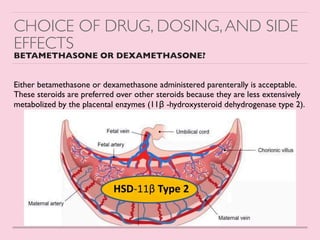
Either betamethasone or dexamethasone administered parenterally is acceptable.
These steroids are preferred over other steroids because they are less extensively
metabolized by the placental enzymes (11β -hydroxysteroid dehydrogenase type 2)
.
DOSING
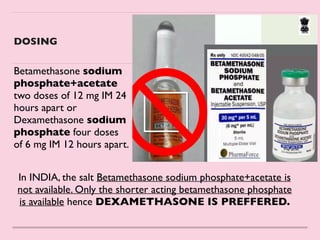
Betamethasone sodium
phosphate+acetate
two doses of 12 mg IM 24
hours apart or
Dexamethasone sodium
phosphate four doses
of 6 mg IM 12 hours apart.
In INDIA, the salt Betamethasone sodium phosphate+acetate is
not available. Only the shorter acting betamethasone phosphate
is available hence DEXAMETHASONE IS PREFFERED.
MATERNAL SIDE EFFECTS
• Transient hyperglycemia occurs in many women; the
steroid effect begins approximately 12 hours after the
fi
rst dose
and may last for
fi
ve days. Screening for gestational diabetes, if
indicated, should be performed either before ACS administration
or at least
fi
ve days after the
fi
rst dose.
 

• The total leukocyte count increases by approximately 30
percent within 24 hours after ACS injection, and the lymphocyte
count signi
fi
cantly decreases.These changes return to baseline
within three days but may complicate the diagnosis of infection
FETAL SIDE EFFECTS
• 22+0 to 34+6weeks Likely to reduce
birthweight if birth occurs more
than 7days after steroids. May increase
psychiatric and behavioural diagnoses if
children born at term
.

• 35+0 to 36+ 6 weeks - Likely to
increase neonatal hypoglycaemia
.

• Before planned caesarean birth at term
37–39week - May reduce
educational attainment at
school age
• Fetal heart rate (FHR) and biophysical
parameters – decrease in variability
on days 2 and 3 after administration, which
alone is not an indication for delivery.
Reduced fetal breathing and body
movements can result in a lower
biophysical pro
fi
le score or non-
reactive NST.
• Doppler
fl
ow studies – A transient
improvement in umbilical artery
end-diastolic
fl
ow (EDF) after ACS
administration has been described in 63 to
71 percent of patients in some studies.The
improvement began approximately eight
hours after the
fi
rst dose of ACS and lasted
a median of three days (range 1 to 10 days).
CANDIDATES FOR A FIRST ACS COURSE BY
GESTATIONAL AGE
22+0 to 22+6 weeks — After thorough counselling between the
patient and maternal-fetal medicine and neonatology specialists
ONLY if the patient is requesting aggressive neonatal intervention
.

One key concept at this gestational age is that ACS may provide a
survival bene
fi
t, but the risk of major long-term morbidity
in survivors is high. Major morbidities included severe
intraventricular haemorrhage, cystic periventricular leukomalacia,
necrotizing enterocolitis, culture-con
fi
rmed infection, severe
retinopathy of prematurity, and chronic lung disease.
23+0 to 33+6 weeks — In agreement all the guidelines
recommends administration of ACS for all pregnant patients at
23+0 to 33+6 weeks of gestation who are at increased risk of
preterm delivery within the next seven days.At this gestational age,
ACS improves neonatal survival and reduces major short-term
morbidity, although long-term neurodevelopmental issues remain a
concern
.

34+0 or more weeks —The use of ACS at ≥34+0 weeks is
controversial given the absence of a survival bene
fi
t, less absolute
respiratory bene
fi
t due to the lower risk of serious respiratory
problems at this gestational age, and greater concern about
potential long-term harm.
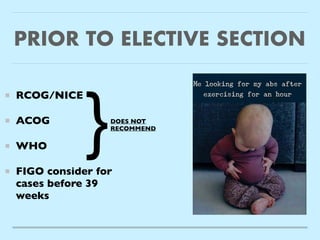
PRIOR TO ELECTIVE SECTION
RCOG/NICE
 

ACO
G

WH
O

FIGO consider for
cases before 39
weeks
}DOES NOT
RECOMMEND
USE OF RESCUE (SALVAGE, BOOSTER) ACS
• RCOG, NICE GUIDELINES DOES NOT RECOMMEND.
 

• The American College of Obstetricians and Gynecologists (ACOG) recommends
considering a single repeat course of ACS in patients <34+0 weeks of gestation who are
at high risk of preterm delivery within the next seven days if ACS was administered
more than 14 days previously
.

• WHO recommends a single repeat course of ACS in patients <34+0 weeks of gestation
if ACS was administered more than 7 days previously
.

Some clinicians prefer to withhold rescue steroids if the
fi
rst ACS course was
administered after 28 weeks, but this exception is based on limited evidence
.

Multiple courses of steroids (>1 rescue course) - After 32 weeks of gestation,
placental weight was signi
fi
cantly less, decrease in fetal growth and Increased incidence of
cerebral palsy in the repeat ACS group and was related inversely to the number of
courses.And in no circumstance should be exceeding 3 rescue doses.
SPECIAL POPULATIONS
• Frank Chorioamnionitis ACS is
CONTRAINDICATED.
 

• Multiple gestation — The same dosing schedule
is recommended for singleton and multiple
gestations.
 

• Hypertension —Betamethasone and
dexamethasone have low mineralocorticoid activity
compared with other corticosteroids; therefore,
hypertension is not a contraindication to therapy
.

• Diabetes — ACS should not be withheld from
women with diabetes when indicated.The steroid
effect on glucose levels begins approximately 12
hours after the
fi
rst dose and may last for
fi
ve days
.
RELATEDTRIALS
• ASTECS TRIAL (Antenatal steroids for term elective C-
Section) : No adverse effects was seen on health, behaviour and
academic achievement of children born following a a single
course of ACS at term.ACS did not reduce the prevalence of
asthma and allergy following elective C-Section.
 

• WHO ACTION - 2 TRIAL Antenatal dexamethasone did
not result in a reduction in neonatal death, stillbirth or severe
neonatal respiratory distress in this trial
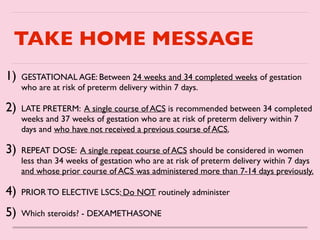
TAKE HOME MESSAGE
1) GESTATIONAL AGE: Between 24 weeks and 34 completed weeks of gestation
who are at risk of preterm delivery within 7 days
.

2) LATE PRETERM: A single course of ACS is recommended between 34 completed
weeks and 37 weeks of gestation who are at risk of preterm delivery within 7
days and who have not received a previous course of ACS.
 

3) REPEAT DOSE: A single repeat course of ACS should be considered in women
less than 34 weeks of gestation who are at risk of preterm delivery within 7 days
and whose prior course of ACS was administered more than 7-14 days previously.
4) PRIOR TO ELECTIVE LSCS: Do NOT routinely administe
r

5) Which steroids? - DEXAMETHASONE
THANK YOU

Antenatal corticosteroids

  • 1.
    Dr. MAHALAKSHMI VENKATESAN DEPARTMENT OF OBSTETRICS AND GYNECOLOGY ANTENATAL CORTICOSTEROIDS
  • 2.
    INTRODUCTION • Over twodozen randomised trials have con fi rmed that a course of antenatal corticosteroid therapy (ACS) administered to women at risk for preterm delivery reduced the incidence and severity of respiratory distress syndrome (RDS) and mortality in offspring. • Subsequent trials have shown that ACS also improves circulatory stability in preterm neonates, resulting in lower rates of intraventricular haemorrhage and necrotizing enterocolitis compared with unexposed preterm neonates.
  • 3.
    MECHANISM OF ACTION •ACS accelerates development of type 1 and type 2 pneumocytes, leading to structural and biochemical changes that improve both lung mechanics and gas exchange (eg, surfactant production). • Other effects include induction of pulmonary beta-receptors, which play a role in surfactant release and absorption of alveolar fl uid when stimulated; induction of fetal lung antioxidant enzymes; and upregulation of genes for mediators of pulmonary epithelial sodium and liquid absorption, which are important for postnatal absorption of lung fl uid.
  • 4.
    TIMING BEFORE DELIVERY •Ideally,ACS is timed so that maximum ef fi cacy is achieved before delivery, and this window is two to seven days after administration of the fi rst dose. Observational data suggest neonatal bene fi ts begin to accrue within a few hours of ACS administration. • Infants who received one dose of ACS in utero, but delivered before the second dose was given, had better outcomes than infants who did not receive any dose.
  • 5.
    CHOICE OF DRUG,DOSING,AND SIDE EFFECTS BETAMETHASONE OR DEXAMETHASONE? Either betamethasone or dexamethasone administered parenterally is acceptable. These steroids are preferred over other steroids because they are less extensively metabolized by the placental enzymes (11β -hydroxysteroid dehydrogenase type 2) .
  • 6.
    DOSING Betamethasone sodium phosphate+acetate two dosesof 12 mg IM 24 hours apart or Dexamethasone sodium phosphate four doses of 6 mg IM 12 hours apart. In INDIA, the salt Betamethasone sodium phosphate+acetate is not available. Only the shorter acting betamethasone phosphate is available hence DEXAMETHASONE IS PREFFERED.
  • 7.
    MATERNAL SIDE EFFECTS •Transient hyperglycemia occurs in many women; the steroid effect begins approximately 12 hours after the fi rst dose and may last for fi ve days. Screening for gestational diabetes, if indicated, should be performed either before ACS administration or at least fi ve days after the fi rst dose. • The total leukocyte count increases by approximately 30 percent within 24 hours after ACS injection, and the lymphocyte count signi fi cantly decreases.These changes return to baseline within three days but may complicate the diagnosis of infection
  • 8.
    FETAL SIDE EFFECTS •22+0 to 34+6weeks Likely to reduce birthweight if birth occurs more than 7days after steroids. May increase psychiatric and behavioural diagnoses if children born at term . • 35+0 to 36+ 6 weeks - Likely to increase neonatal hypoglycaemia . • Before planned caesarean birth at term 37–39week - May reduce educational attainment at school age
  • 9.
    • Fetal heartrate (FHR) and biophysical parameters – decrease in variability on days 2 and 3 after administration, which alone is not an indication for delivery. Reduced fetal breathing and body movements can result in a lower biophysical pro fi le score or non- reactive NST. • Doppler fl ow studies – A transient improvement in umbilical artery end-diastolic fl ow (EDF) after ACS administration has been described in 63 to 71 percent of patients in some studies.The improvement began approximately eight hours after the fi rst dose of ACS and lasted a median of three days (range 1 to 10 days).
  • 10.
    CANDIDATES FOR AFIRST ACS COURSE BY GESTATIONAL AGE 22+0 to 22+6 weeks — After thorough counselling between the patient and maternal-fetal medicine and neonatology specialists ONLY if the patient is requesting aggressive neonatal intervention . One key concept at this gestational age is that ACS may provide a survival bene fi t, but the risk of major long-term morbidity in survivors is high. Major morbidities included severe intraventricular haemorrhage, cystic periventricular leukomalacia, necrotizing enterocolitis, culture-con fi rmed infection, severe retinopathy of prematurity, and chronic lung disease.
  • 11.
    23+0 to 33+6weeks — In agreement all the guidelines recommends administration of ACS for all pregnant patients at 23+0 to 33+6 weeks of gestation who are at increased risk of preterm delivery within the next seven days.At this gestational age, ACS improves neonatal survival and reduces major short-term morbidity, although long-term neurodevelopmental issues remain a concern . 34+0 or more weeks —The use of ACS at ≥34+0 weeks is controversial given the absence of a survival bene fi t, less absolute respiratory bene fi t due to the lower risk of serious respiratory problems at this gestational age, and greater concern about potential long-term harm.
  • 12.
    PRIOR TO ELECTIVESECTION RCOG/NICE ACO G WH O FIGO consider for cases before 39 weeks }DOES NOT RECOMMEND
  • 13.
    USE OF RESCUE(SALVAGE, BOOSTER) ACS • RCOG, NICE GUIDELINES DOES NOT RECOMMEND. • The American College of Obstetricians and Gynecologists (ACOG) recommends considering a single repeat course of ACS in patients <34+0 weeks of gestation who are at high risk of preterm delivery within the next seven days if ACS was administered more than 14 days previously . • WHO recommends a single repeat course of ACS in patients <34+0 weeks of gestation if ACS was administered more than 7 days previously . Some clinicians prefer to withhold rescue steroids if the fi rst ACS course was administered after 28 weeks, but this exception is based on limited evidence . Multiple courses of steroids (>1 rescue course) - After 32 weeks of gestation, placental weight was signi fi cantly less, decrease in fetal growth and Increased incidence of cerebral palsy in the repeat ACS group and was related inversely to the number of courses.And in no circumstance should be exceeding 3 rescue doses.
  • 14.
    SPECIAL POPULATIONS • FrankChorioamnionitis ACS is CONTRAINDICATED. • Multiple gestation — The same dosing schedule is recommended for singleton and multiple gestations. • Hypertension —Betamethasone and dexamethasone have low mineralocorticoid activity compared with other corticosteroids; therefore, hypertension is not a contraindication to therapy . • Diabetes — ACS should not be withheld from women with diabetes when indicated.The steroid effect on glucose levels begins approximately 12 hours after the fi rst dose and may last for fi ve days .
  • 15.
    RELATEDTRIALS • ASTECS TRIAL(Antenatal steroids for term elective C- Section) : No adverse effects was seen on health, behaviour and academic achievement of children born following a a single course of ACS at term.ACS did not reduce the prevalence of asthma and allergy following elective C-Section. • WHO ACTION - 2 TRIAL Antenatal dexamethasone did not result in a reduction in neonatal death, stillbirth or severe neonatal respiratory distress in this trial
  • 16.
    TAKE HOME MESSAGE 1)GESTATIONAL AGE: Between 24 weeks and 34 completed weeks of gestation who are at risk of preterm delivery within 7 days . 2) LATE PRETERM: A single course of ACS is recommended between 34 completed weeks and 37 weeks of gestation who are at risk of preterm delivery within 7 days and who have not received a previous course of ACS. 3) REPEAT DOSE: A single repeat course of ACS should be considered in women less than 34 weeks of gestation who are at risk of preterm delivery within 7 days and whose prior course of ACS was administered more than 7-14 days previously. 4) PRIOR TO ELECTIVE LSCS: Do NOT routinely administe r 5) Which steroids? - DEXAMETHASONE
  • 17.