Endometrial HyperplasiaS.Laxiny,Medical Student,FHCS,EUSL.
Endometrial HyperplasiaEndometrial hyperplasia is a condition of excessive proliferation of the cells of the endometrium-Endometrial glands & surrounding tissue(Stroma).Endometrial hyperplasia is a non-cancerous condition.May involve part or all of the endometrium.
PathogenesisHyperplasia usually develops in the presence of continuous estrogen  stimulation  unopposed  by  progesterone.The female hormones—estrogen and progesterone—control the changes in the uterine lining. Estrogen builds up the uterine lining. Progesterone maintains and controls this growth. Estrogen without enough progesterone may cause the lining of the uterus to thicken.
Risks for developing Endometrial Hyperplasia Estrogen replacement therapy -Take estrogen without progesterone to replace the estrogen their body is no longer making and to relieve symptoms of menopausePolycystic ovary syndrome- women are anovulatory and have unopposed estrogen effect. Estrogen producing tumours(e.g. granulosa cell tumour).Irregular Menstrul Periods-Skipmenstrual periods or have no periods at all –continuous unopposed estrogen activity.Perimenopause  periodOverweight Diabetes Mellitus
Classification of endometrial hyperplasiaSimple hyperplasia (cystic without atypia) Complex hyperplasia (adenomatous without atypia)Atypical simple hyperplasia (cystic with atypia)Atypical complex  hyperplasia (adenomatous with atypia)
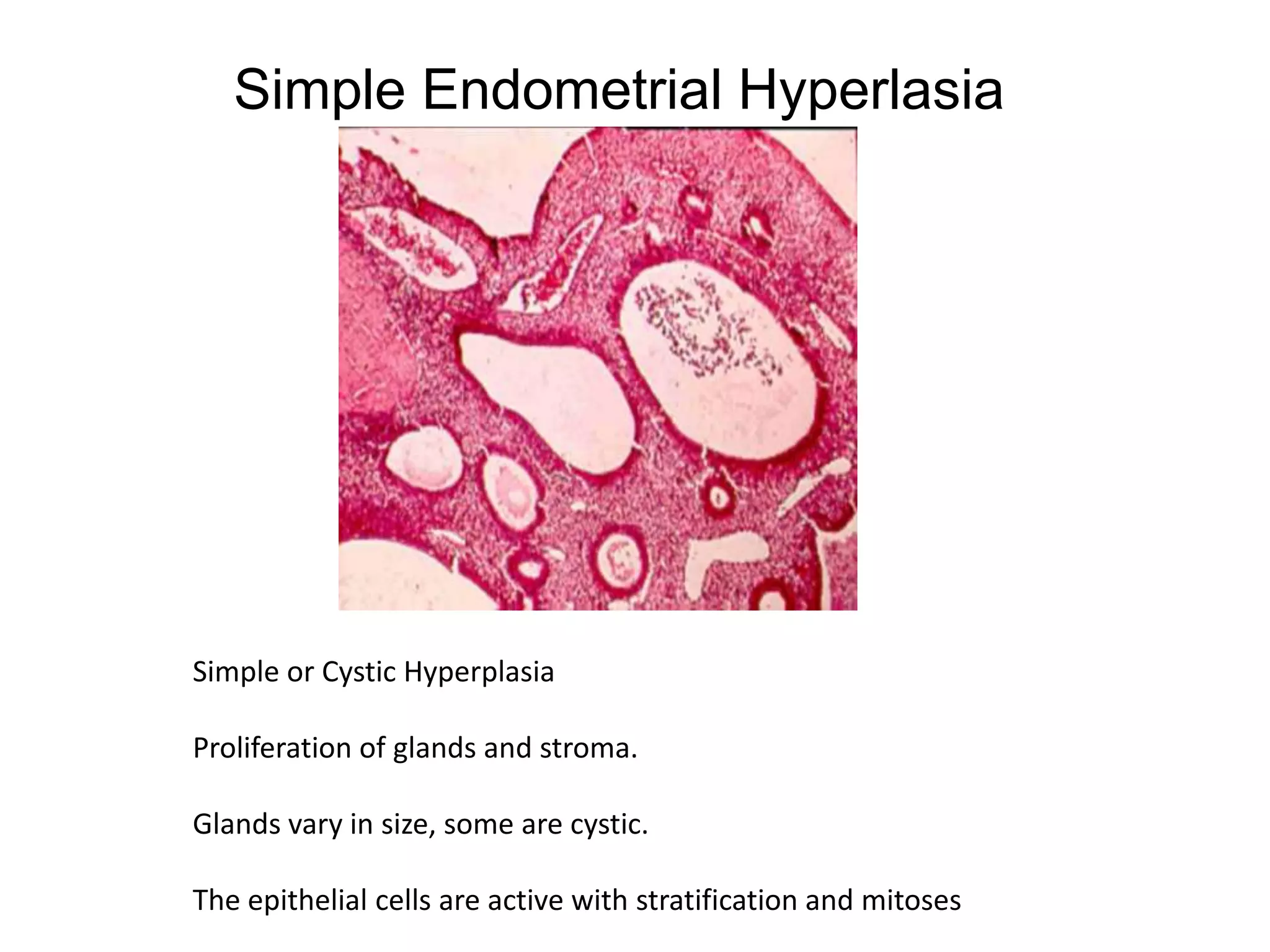
Simple Endometrial HyperlasiaSimple or Cystic HyperplasiaProliferation of glands and stroma.Glands vary in size, some are cystic.The epithelial cells are active with stratification and mitoses
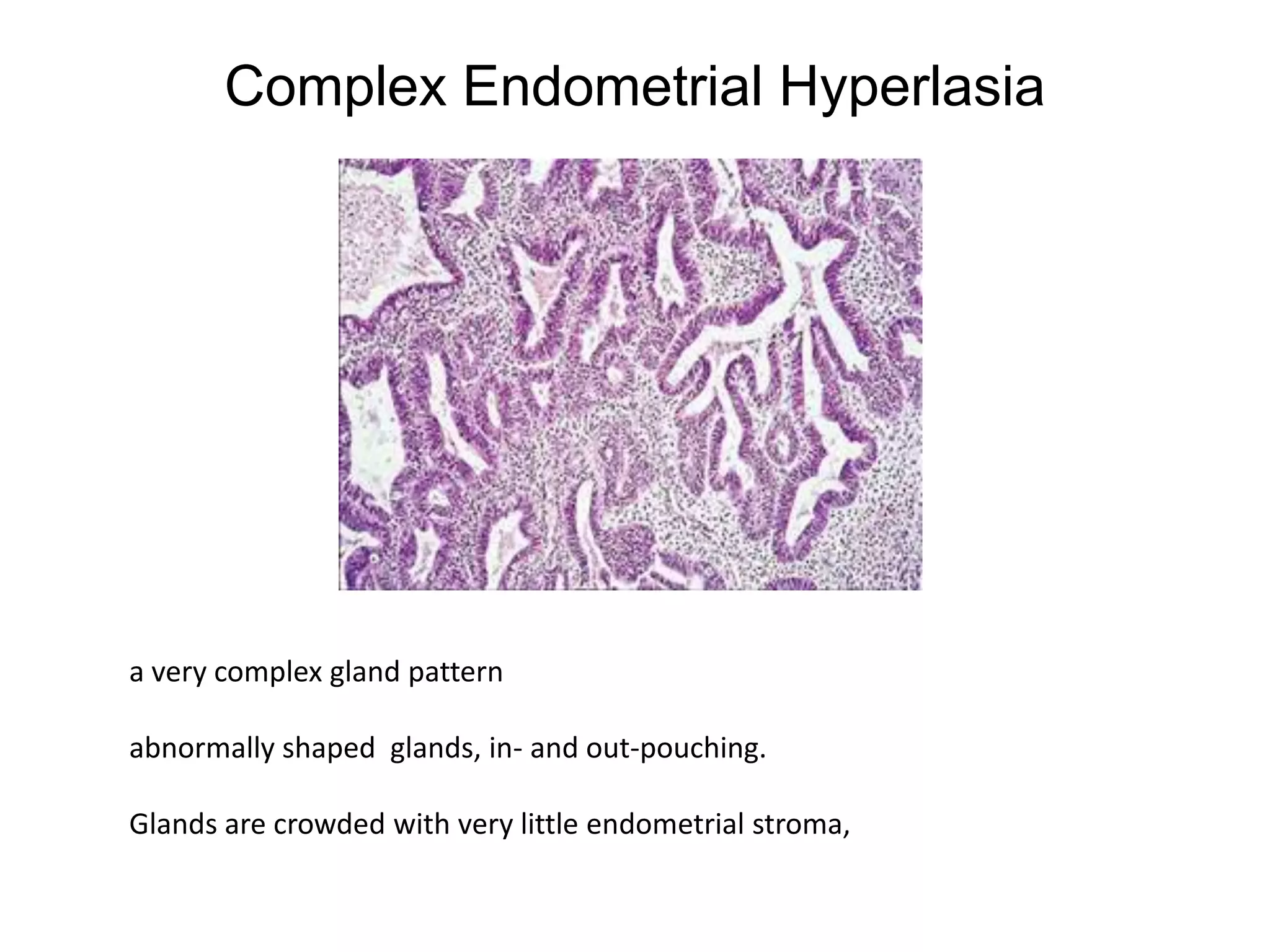
Complex Endometrial Hyperlasiaa very complex gland patternabnormally shaped  glands, in- and out-pouching.Glands are crowded with very little endometrial stroma,
AtypicalEndometrial Hyperplasia Increased gland densityNuclear atypia - hyperchromatic,  enlarged epithelial cells with an increased nuclear to cytoplasmic ratio. Resembles well differentiated carcinoma.
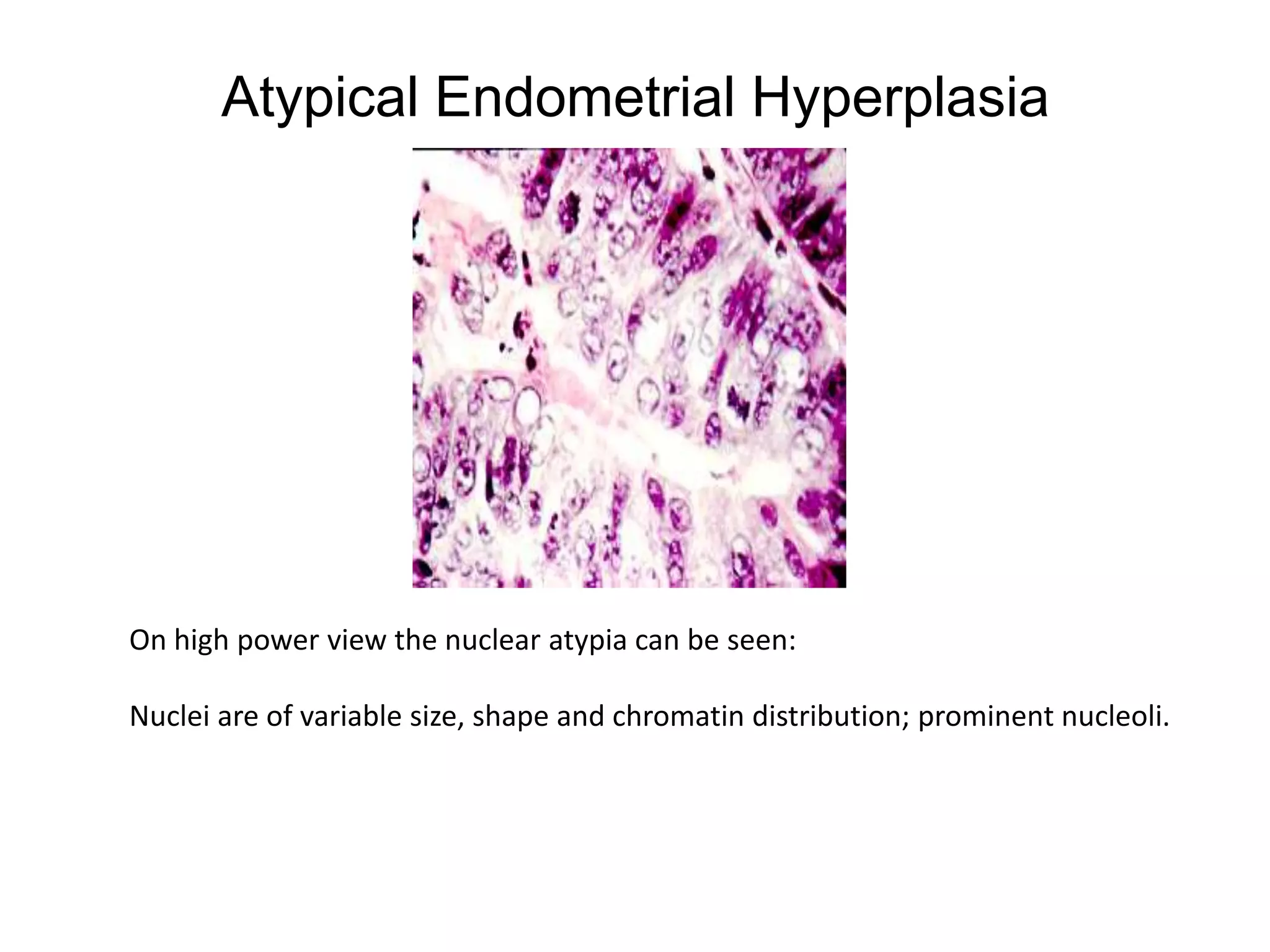
Atypical Endometrial HyperplasiaOn high power view the nuclear atypia can be seen:Nuclei are of variable size, shape and chromatin distribution; prominent nucleoli.
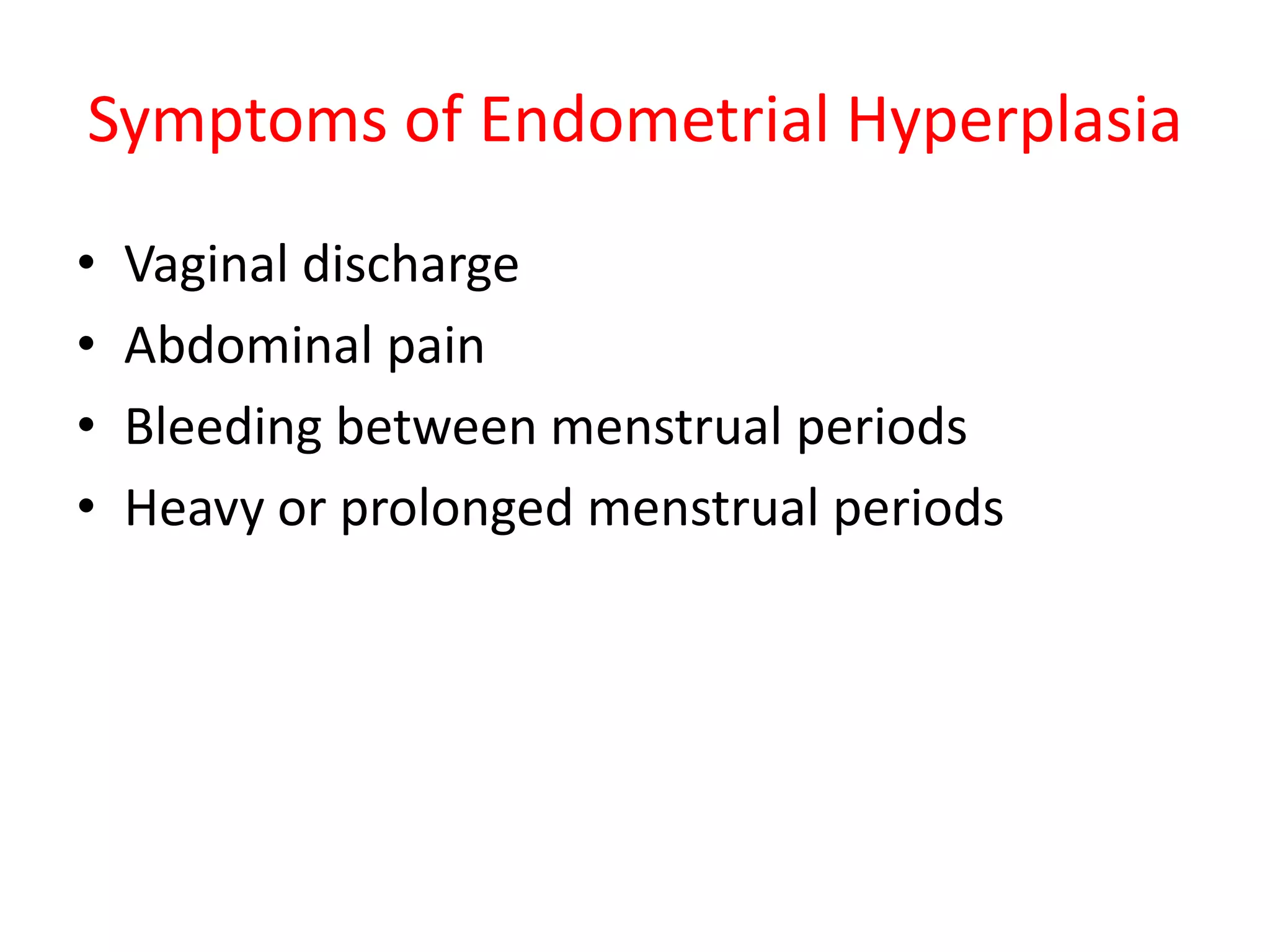
Symptoms of Endometrial HyperplasiaVaginal dischargeAbdominal painBleeding between menstrual periodsHeavy or prolonged menstrual periods
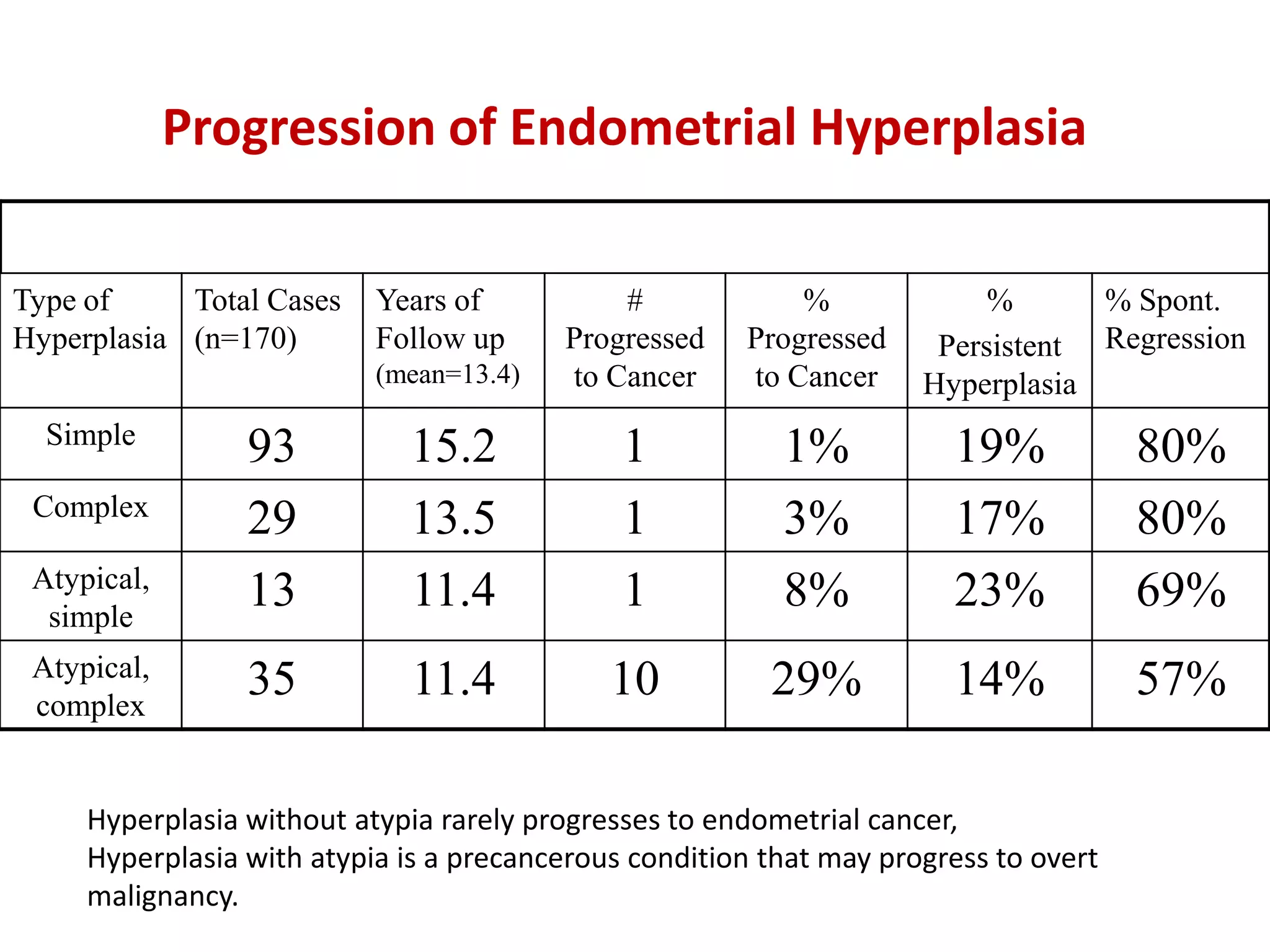
Progressionof Endometrial HyperplasiaHyperplasia without atypia rarely progresses to endometrial cancer, Hyperplasia with atypia is a precancerous condition that may progress to overt malignancy.
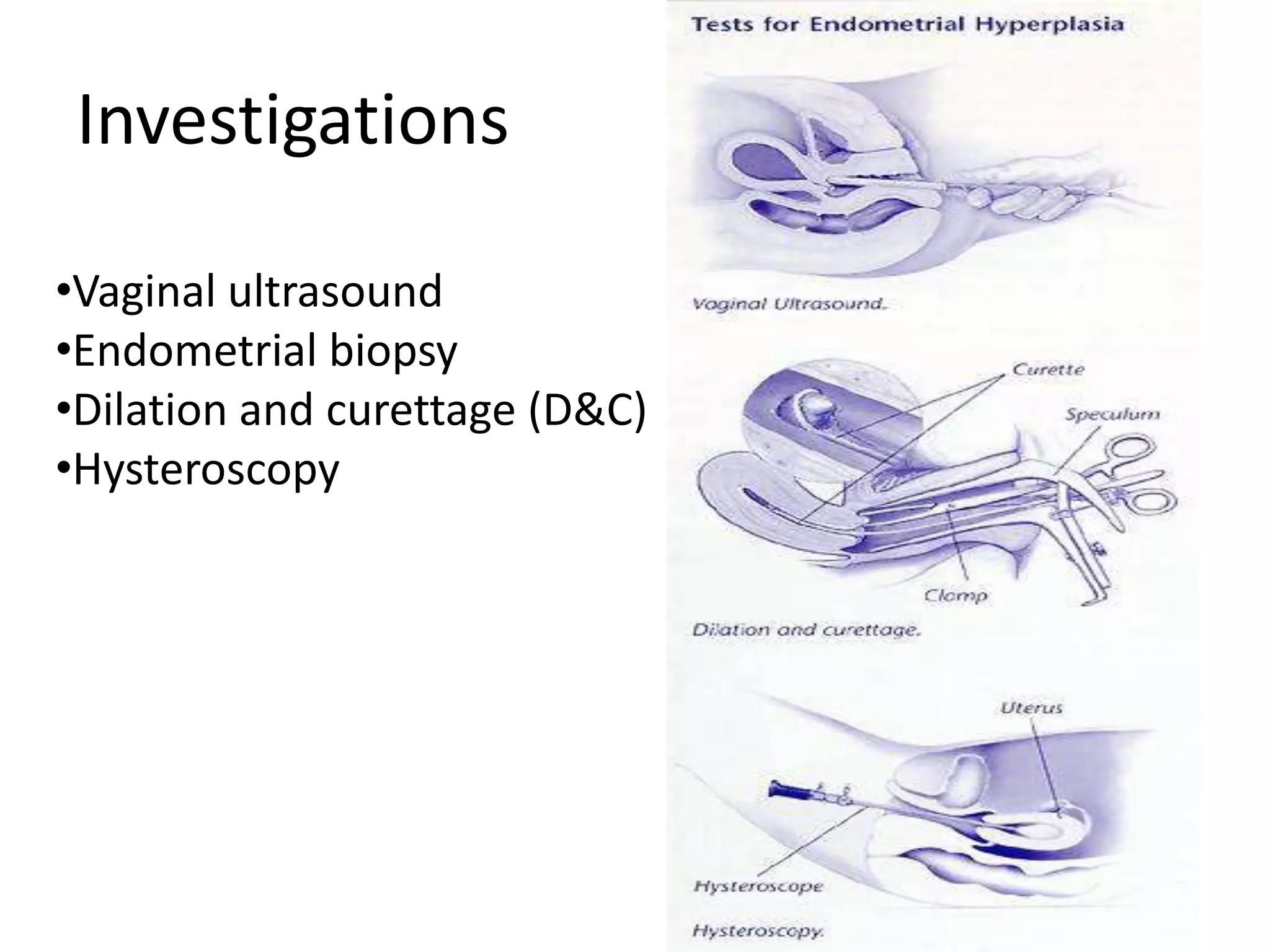
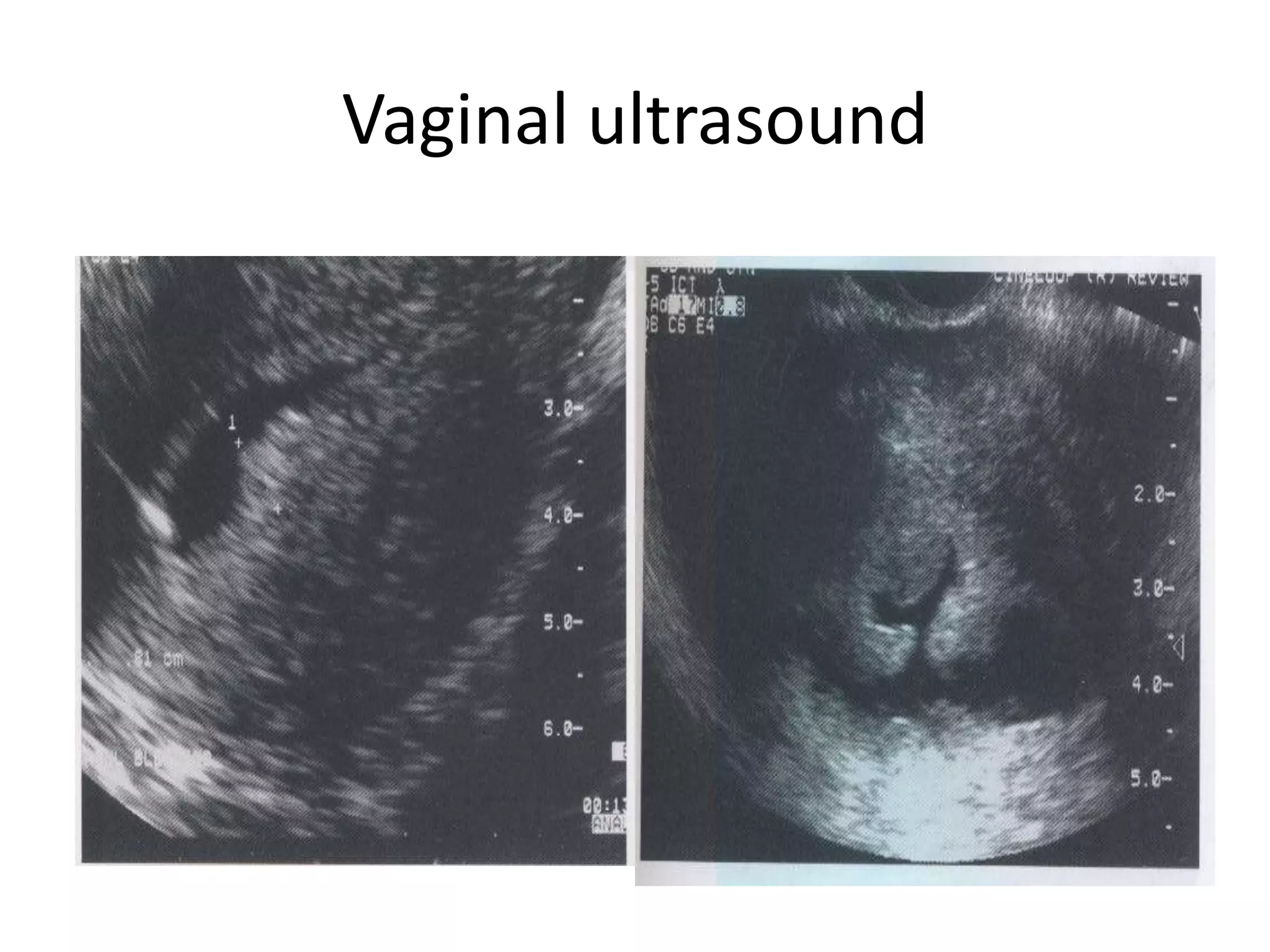
InvestigationsVaginal ultrasound
Endometrial biopsy
Dilation and curettage (D&C)
HysteroscopyVaginal ultrasound
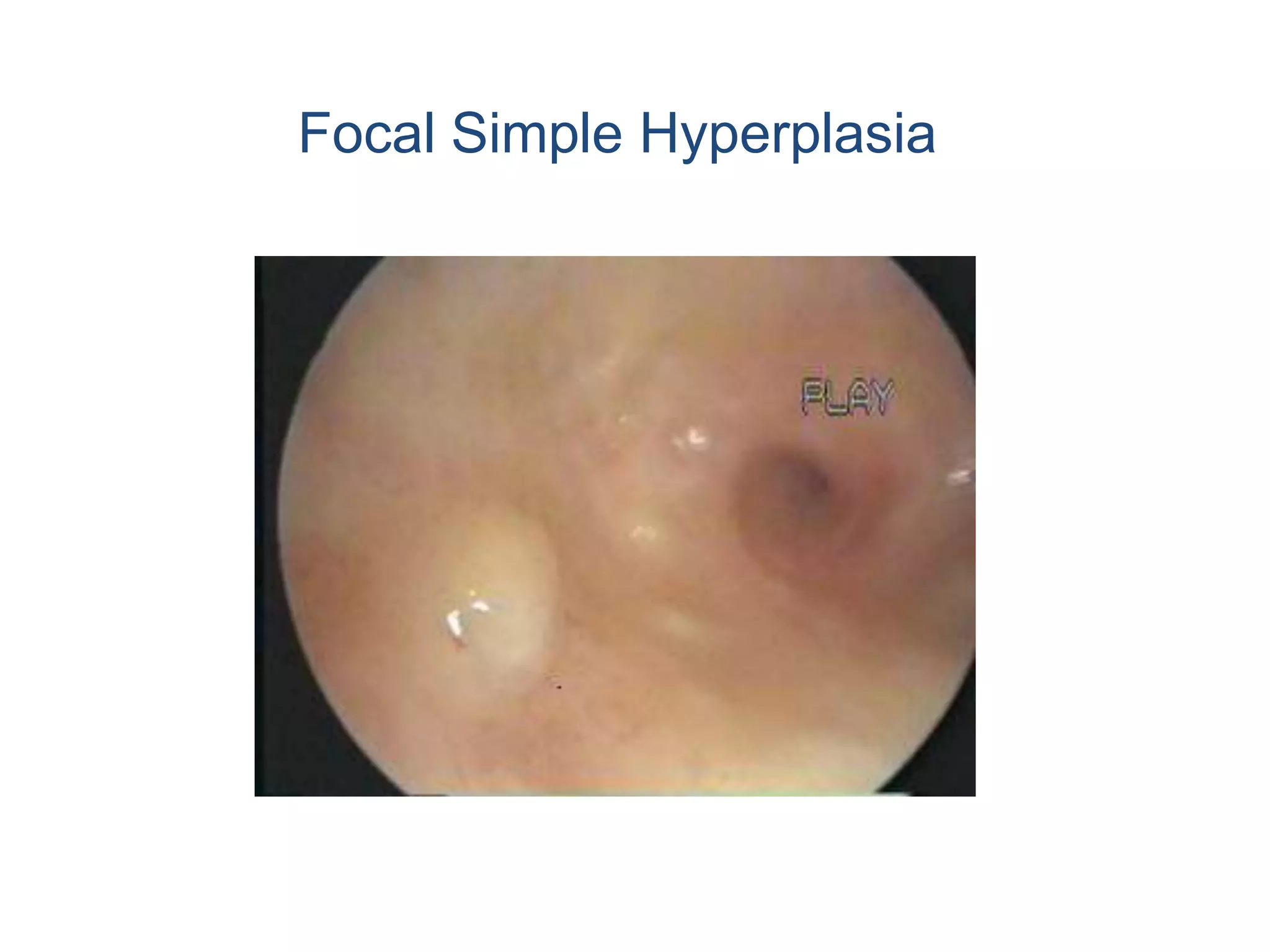
Focal Simple Hyperplasia
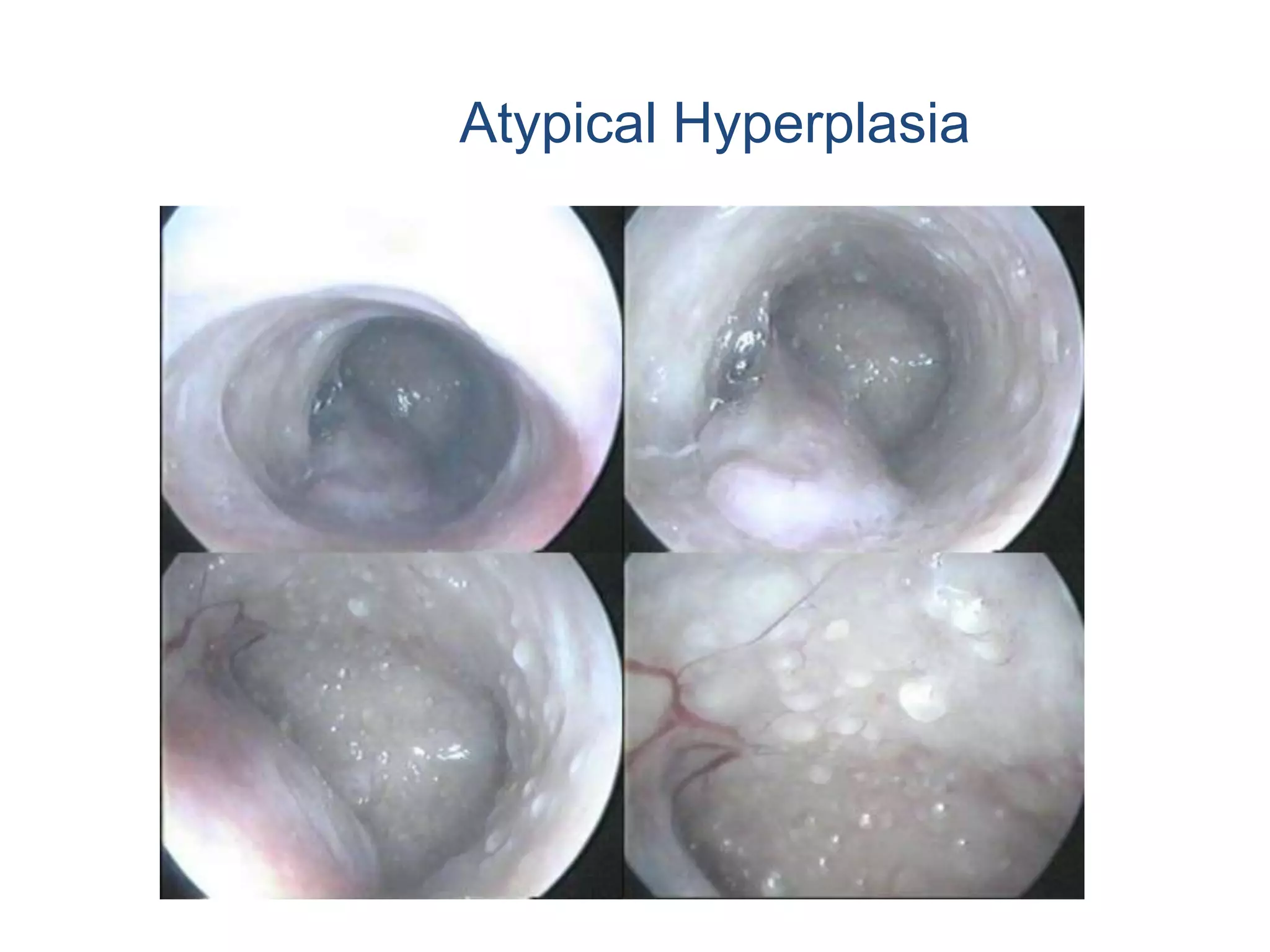
Atypical Hyperplasia
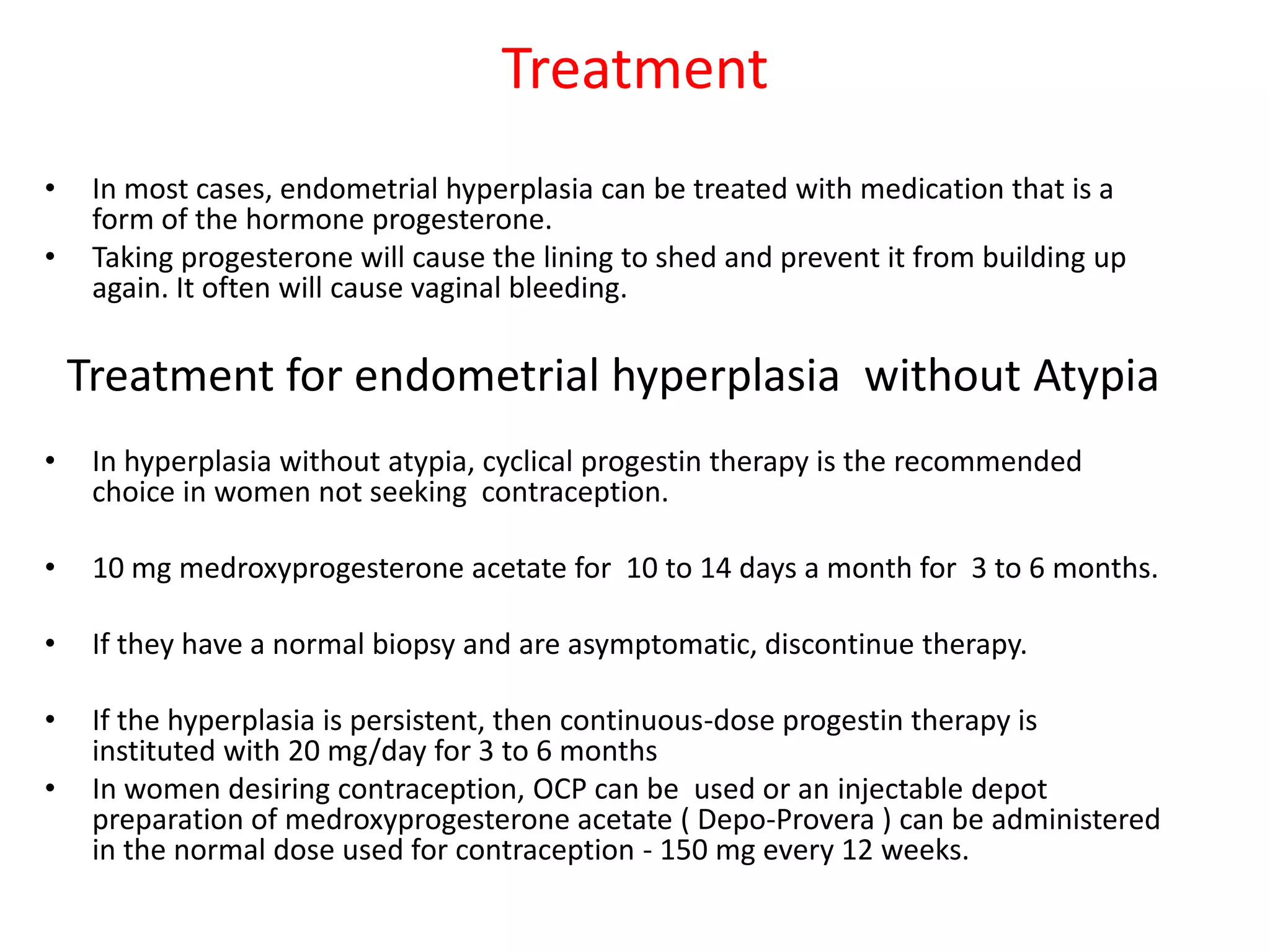
Treatment In most cases, endometrial hyperplasia can be treated with medication that is a form of the hormone progesterone. Taking progesterone will cause the lining to shed and prevent it from building up again. It often will cause vaginal bleeding.  Treatment for endometrial hyperplasia  without AtypiaIn hyperplasia without atypia, cyclical progestin therapy is the recommended choice in women not seeking  contraception.10 mg medroxyprogesterone acetate for  10 to 14 days a month for  3 to 6 months.If they have a normal biopsy and are asymptomatic, discontinue therapy.If the hyperplasia is persistent, then continuous-dose progestin therapy is instituted with 20 mg/day for 3 to 6 monthsIn women desiring contraception, OCP can be  used or an injectable depot preparation of medroxyprogesterone acetate ( Depo-Provera ) can be administered in the normal dose used for contraception - 150 mg every 12 weeks.
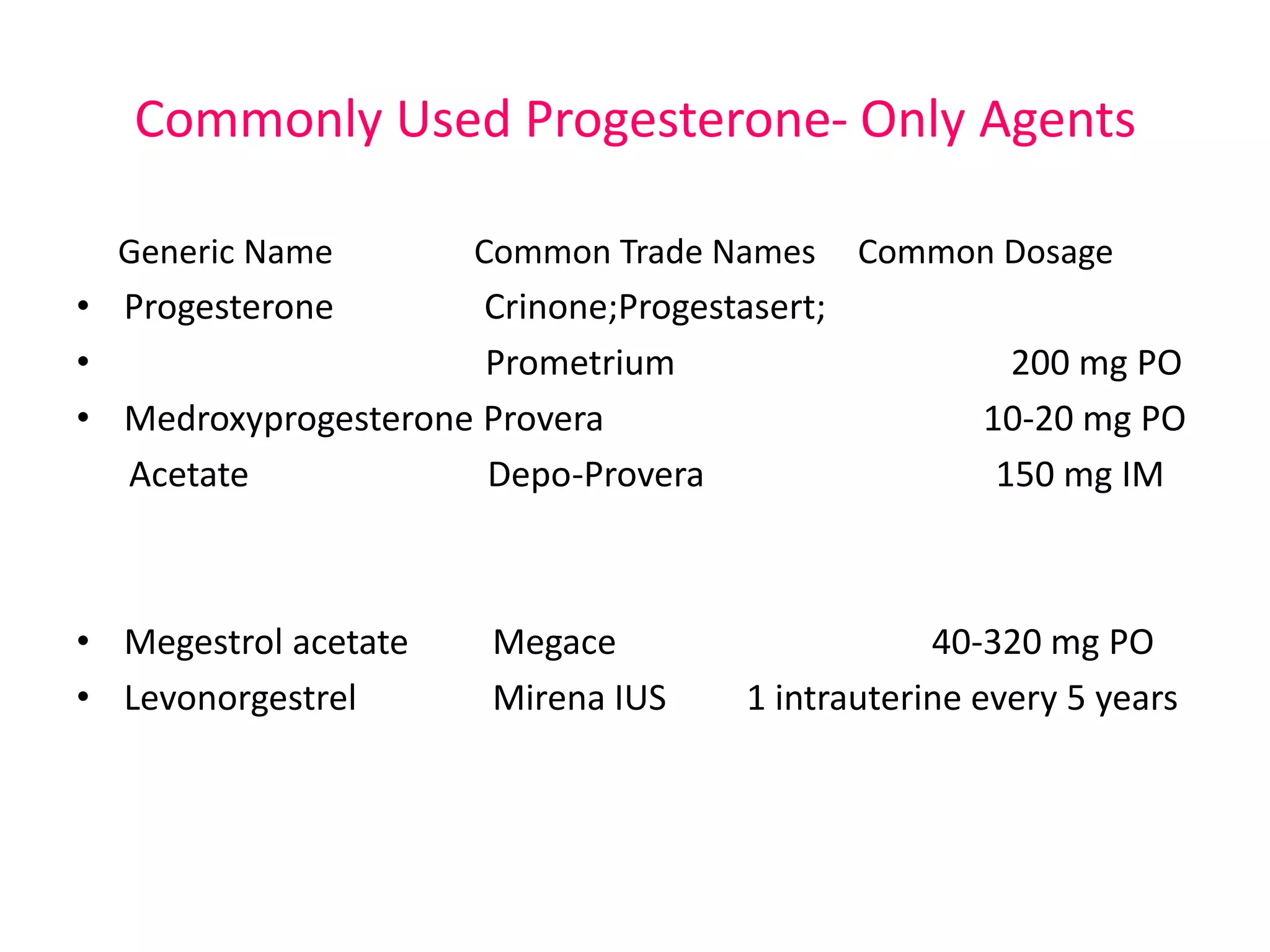
Commonly Used Progesterone- Only Agents      Generic Name	  Common Trade Names     Common DosageProgesterone                 Crinone;Progestasert; Prometrium                                      200 mg POMedroxyprogesteroneProvera                                           10-20 mg PO       Acetate                           Depo-Provera                                 150 mg IMMegestrol acetate	    Megace 	                         40-320 mg POLevonorgestrelMirena IUS 	    1 intrauterine every 5 years
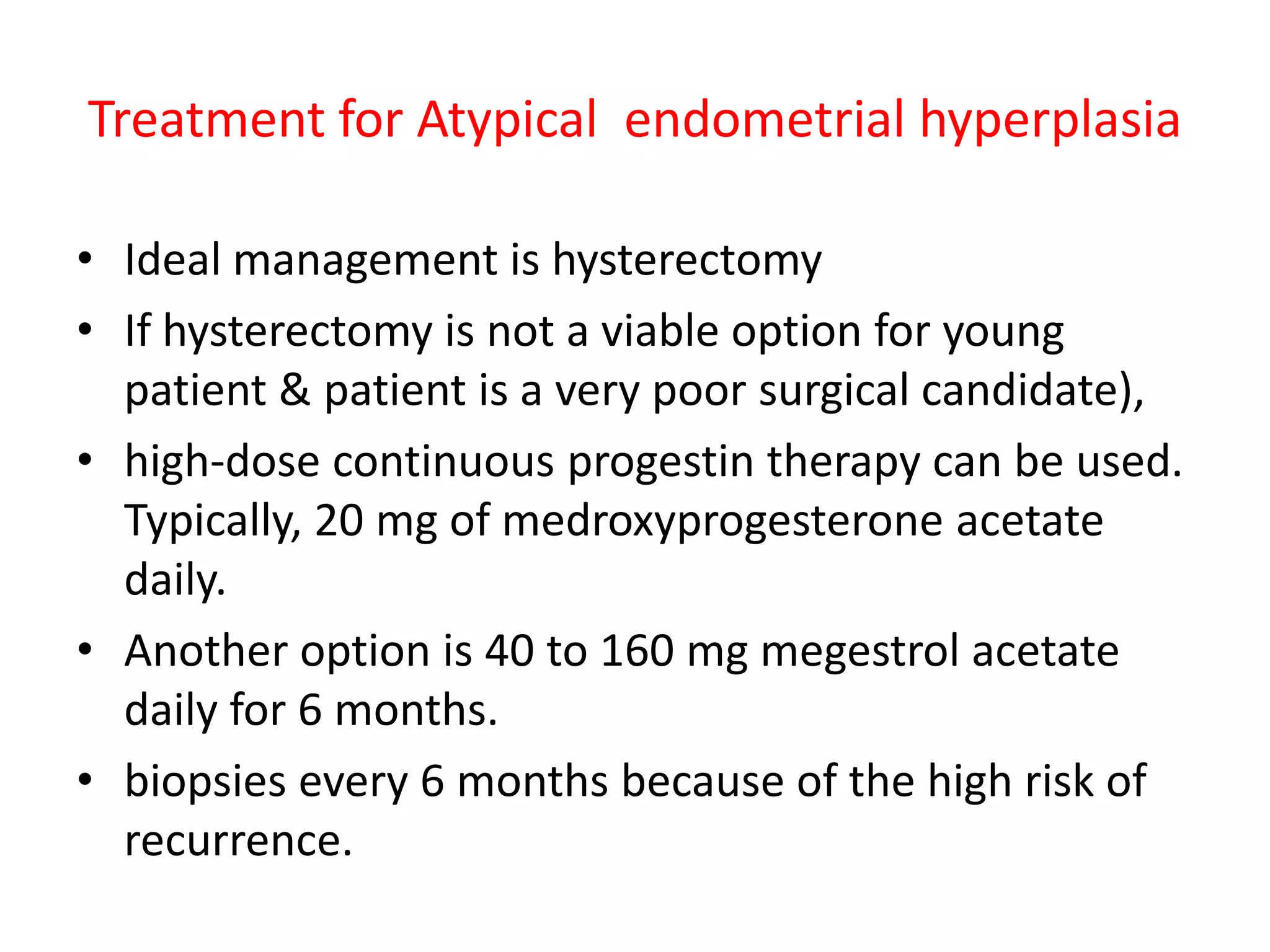
Treatment for Atypical  endometrial hyperplasiaIdeal management is hysterectomyIf hysterectomy is not a viable option for young patient & patient is a very poor surgical candidate), high-dose continuous progestin therapy can be used. Typically, 20 mg of medroxyprogesterone acetate daily. Another option is 40 to 160 mg megestrol acetate daily for 6 months. biopsies every 6 months because of the high risk of recurrence.

Endometrial hyperplasia.ppt

  • 1.
  • 2.
    Endometrial HyperplasiaEndometrial hyperplasiais a condition of excessive proliferation of the cells of the endometrium-Endometrial glands & surrounding tissue(Stroma).Endometrial hyperplasia is a non-cancerous condition.May involve part or all of the endometrium.
  • 3.
    PathogenesisHyperplasia usually developsin the presence of continuous estrogen stimulation unopposed by progesterone.The female hormones—estrogen and progesterone—control the changes in the uterine lining. Estrogen builds up the uterine lining. Progesterone maintains and controls this growth. Estrogen without enough progesterone may cause the lining of the uterus to thicken.
  • 4.
    Risks for developingEndometrial Hyperplasia Estrogen replacement therapy -Take estrogen without progesterone to replace the estrogen their body is no longer making and to relieve symptoms of menopausePolycystic ovary syndrome- women are anovulatory and have unopposed estrogen effect. Estrogen producing tumours(e.g. granulosa cell tumour).Irregular Menstrul Periods-Skipmenstrual periods or have no periods at all –continuous unopposed estrogen activity.Perimenopause periodOverweight Diabetes Mellitus
  • 5.
    Classification of endometrialhyperplasiaSimple hyperplasia (cystic without atypia) Complex hyperplasia (adenomatous without atypia)Atypical simple hyperplasia (cystic with atypia)Atypical complex hyperplasia (adenomatous with atypia)
  • 6.
    Simple Endometrial HyperlasiaSimpleor Cystic HyperplasiaProliferation of glands and stroma.Glands vary in size, some are cystic.The epithelial cells are active with stratification and mitoses
  • 7.
    Complex Endometrial Hyperlasiaavery complex gland patternabnormally shaped glands, in- and out-pouching.Glands are crowded with very little endometrial stroma,
  • 8.
    AtypicalEndometrial Hyperplasia Increasedgland densityNuclear atypia - hyperchromatic, enlarged epithelial cells with an increased nuclear to cytoplasmic ratio. Resembles well differentiated carcinoma.
  • 9.
    Atypical Endometrial HyperplasiaOnhigh power view the nuclear atypia can be seen:Nuclei are of variable size, shape and chromatin distribution; prominent nucleoli.
  • 10.
    Symptoms of EndometrialHyperplasiaVaginal dischargeAbdominal painBleeding between menstrual periodsHeavy or prolonged menstrual periods
  • 11.
    Progressionof Endometrial HyperplasiaHyperplasiawithout atypia rarely progresses to endometrial cancer, Hyperplasia with atypia is a precancerous condition that may progress to overt malignancy.
  • 12.
  • 13.
  • 14.
  • 15.
  • 16.
  • 17.
  • 18.
    Treatment In mostcases, endometrial hyperplasia can be treated with medication that is a form of the hormone progesterone. Taking progesterone will cause the lining to shed and prevent it from building up again. It often will cause vaginal bleeding. Treatment for endometrial hyperplasia without AtypiaIn hyperplasia without atypia, cyclical progestin therapy is the recommended choice in women not seeking contraception.10 mg medroxyprogesterone acetate for 10 to 14 days a month for 3 to 6 months.If they have a normal biopsy and are asymptomatic, discontinue therapy.If the hyperplasia is persistent, then continuous-dose progestin therapy is instituted with 20 mg/day for 3 to 6 monthsIn women desiring contraception, OCP can be used or an injectable depot preparation of medroxyprogesterone acetate ( Depo-Provera ) can be administered in the normal dose used for contraception - 150 mg every 12 weeks.
  • 19.
    Commonly Used Progesterone-Only Agents Generic Name Common Trade Names Common DosageProgesterone Crinone;Progestasert; Prometrium 200 mg POMedroxyprogesteroneProvera 10-20 mg PO Acetate Depo-Provera 150 mg IMMegestrol acetate Megace 40-320 mg POLevonorgestrelMirena IUS 1 intrauterine every 5 years
  • 20.
    Treatment for Atypical endometrial hyperplasiaIdeal management is hysterectomyIf hysterectomy is not a viable option for young patient & patient is a very poor surgical candidate), high-dose continuous progestin therapy can be used. Typically, 20 mg of medroxyprogesterone acetate daily. Another option is 40 to 160 mg megestrol acetate daily for 6 months. biopsies every 6 months because of the high risk of recurrence.
  • 21.
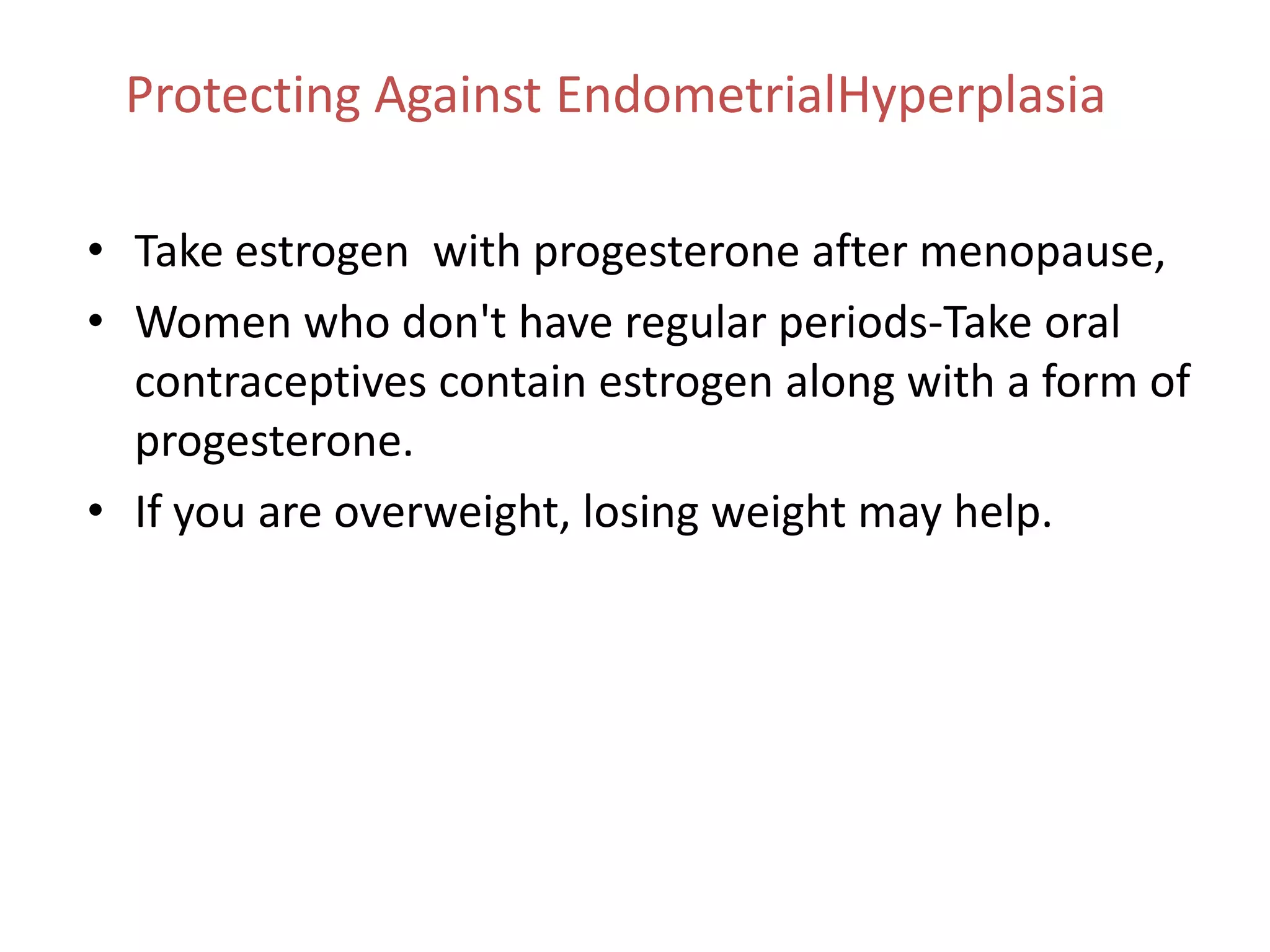
    Protecting Against EndometrialHyperplasiaTakeestrogen with progesterone after menopause, Women who don't have regular periods-Take oral contraceptives contain estrogen along with a form of progesterone. If you are overweight, losing weight may help.
  • 22.
    Thank You