ABILITY in
Organizational
Behaviour
Presented by:
Abigail T. Sumaylo, CPA
⦿ Ability refers to an
individual’s
capacity to
perform the
various tasks in a
job.
⦿ Ability is the skills
and qualities
which make it
possible to
achieve a goal.
What is Ability?
Ability is a current assessment of what one can do.
The issue is knowing how people differ in abilities
and using that knowledge to increase the likelihood
that an employee will perform his or her job well.
What we are acknowledging is that everyone has
strengths and weaknesses in terms of ability that
make him or her relatively superior or inferior to
others in performing certain tasks or activities.
What is Ability ?
We can say that ability is the quality or state of being
able, power to perform whether physical, mental,
moral intellectual, skill in doing, the sufficiency of
strength, available resources, etc.
It underpins and contributes to skills.
It can be essentially perceptual, essentially motor or a
combination of both.
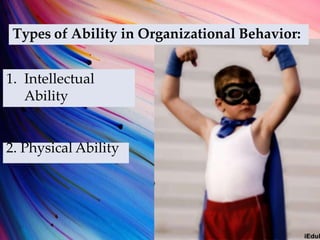
Types of Ability in Organizational Behavior:
1. Intellectual
Ability
2. Physical Ability
Intellectual Ability
mental activities
Intellectual ability is the capacity to do
thinking and reasoning and problem-solving.
It commonly refers to the ability measured by performance on
an intelligence test. It is also sometimes used in the context of
discussing the performance of someone in an academic or real-
world setting.
The seven most frequently cited dimensions making up
intellectual abilities are
comprehension, perceptual
number aptitude, verbal
speed, inductive reasoning,
deductive reasoning, and memory.
Number
aptR
ude
Ærbal
Comprehension
Œrceptual
s
p
e
e
d
Inductlve
easonifq
Dedtxtke
Dimensions of inteliectuai AbiliW
SpaDI
VüualizaÔn
Memoç
Abllnyto& speedyand
aœuraœ arhhmetk
Abllltyto un&rnand what ls reador
heard
AbllltytoOentlfyvlsudslmlbrRles
andÆffeenæsq
u
lc
k
lyanda
c
c
u
m
t
e
g
Abilityto @entify al¥gkal sequence In
aprobDm and thensolvetheproblem
AbllKytoiseb@candæseothe
ImpllœtDrsof a
naçument
Abilltyto imagine how anobject
wouo look ifIÖ poslùon in spæe
werechanged
AbllEytoŒŒlnandfecall pan
e
x
p
e
r
i
e
n
c
e
AocournantScompwlng&esdesæxona
sQoflœms
Plantmanager: followlfy corporaa
polklesonhirlng
FteIwenØaor: @ent¥ylngduesæ
supportac
h
a
r
g
eofanon
Market esealcher: forecasting &mand
for aproduct inthe next timeperDd
Supewüor: chooslngb
e
t
w
e
e
ntwo
dloerents
u
g
g
e
s
€
o
n
s
InterÔr decoraor: fedecoralng anoÔce g
Salespeeon: ememberlfy then
a
m
e
sŒ
c
a
æ
m
e
n
General Mental Ability
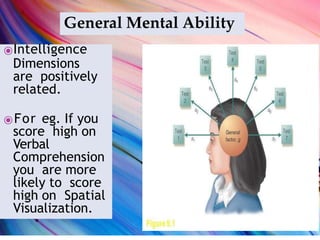
⦿Intelligence
Dimensions
are positively
related.
⦿For eg. If you
score high on
Verbal
Comprehension
you are more
likely to score
high on Spatial
Visualization.
Wonderlic Personnel Test
⦿ The test was
developed by
Eldon
Wonderlic.
⦿ It is a popular
group intelligence
test used to assess
the aptitude of
prospective
employees for
learning and
problem- solving in
a range of
occupations.
⦿ While intelligence is a big help in performing a
job well, it doesn’t make people happier or more
satisfied with their jobs.
⦿ The correlation between intelligence & job
satisfaction is about Zero.
Employee Aptitude Survey
Fact Sheet
⦿ The Employee
Aptitude Survey (EAS)
consists of 10 tests
specifically designed
to measure cognitive,
perceptual, and
psychomotor abilities
required for successful
performance in a wide
variety of occupations.
The tests are
published separately
and can be selected to
form custom batteries.
Physical Abilities
Physical Abilities
⦿ Physical ability is the capacity to do tasks that demand
stamina, desired, strength and similar characteristics.
⦿ It can identify individuals who are physically able to
perform the essentials function of a job without risking
injury to others
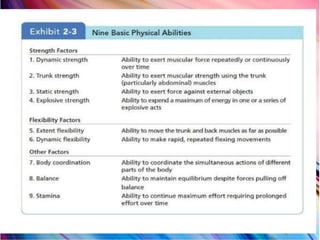
⦿ Research on the requirements needed in hundreds of
jobs has identified nine physical abilities involved in the
performance of physical tasks.
⦿ These are -dynamic strength, static strength, trunk
strength, explosive strength, extent flexibility, dynamic
flexibility, body – coordination, balance, and stamina.
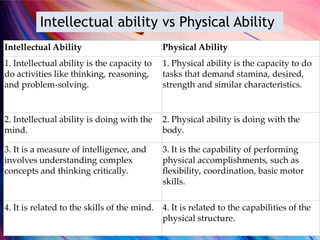
Intellectual ability vs Physical Ability
Intellectual Ability Physical Ability
1. Intellectual ability is the capacity to
do activities like thinking, reasoning,
and problem-solving.
1. Physical ability is the capacity to do
tasks that demand stamina, desired,
strength and similar characteristics.
2. Intellectual ability is doing with the
mind.
2. Physical ability is doing with the
body.
3. It is a measure of intelligence, and
involves understanding complex
concepts and thinking critically.
3. It is the capability of performing
physical accomplishments, such as
flexibility, coordination, basic motor
skills.
4. It is related to the skills of the mind. 4. It is related to the capabilities of the
physical structure.
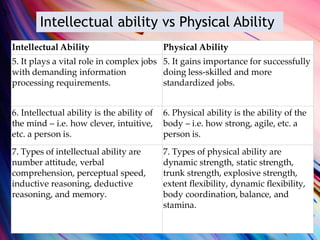
Intellectual ability vs Physical Ability
Intellectual Ability Physical Ability
5. It plays a vital role in complex jobs
with demanding information
processing requirements.
5. It gains importance for successfully
doing less-skilled and more
standardized jobs.
6. Intellectual ability is the ability of
the mind – i.e. how clever, intuitive,
etc. a person is.
6. Physical ability is the ability of the
body – i.e. how strong, agile, etc. a
person is.
7. Types of intellectual ability are
number attitude, verbal
comprehension, perceptual speed,
inductive reasoning, deductive
reasoning, and memory.
7. Types of physical ability are
dynamic strength, static strength,
trunk strength, explosive strength,
extent flexibility, dynamic flexibility,
body coordination, balance, and
stamina.
THE ABILITY – JOB FIT
Ability-
Job Fit
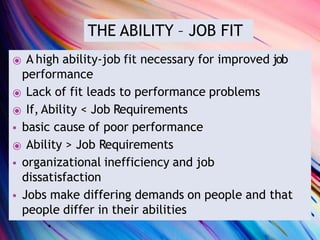
THE ABILITY – JOB FIT
⦿ A high ability-job fit necessary for improved job
performance
⦿ Lack of fit leads to performance problems
⦿ If, Ability < Job Requirements
 basic cause of poor performance
⦿ Ability > Job Requirements
 organizational inefficiency and job
dissatisfaction
 Jobs make differing demands on people and that
people differ in their abilities
MANAGERIAL IMPLICATIONS
⦿ Ability directly influences employees level of
performance.
⦿ An effective selection process & job analysis
should be done.
⦿ Managers need to focus on ability in selection,
promotion, and transfer.
⦿ Fine-tune job to fit incumbent’s abilities.
Case Study of Ability
Mr. Rahim Uddin Siddique is a 55 years old man and a
chartered accountant. He did his MBA from London Business
school in 1994. Presently he is holding a responsible post of a
charted accounting firm named ABC. Apart from this, he also
delivers lecture in a number of reputable private universities.
His colleagues and friends highly appreciate his
professionalism. Many people in the society honor him
because he is man of magnetic personality. Mr. Siddique is
also a member of Chittagong Club and actively involved in
social work . He is very keen to develop social network and
relationship. He likes to play long tennis and golf in his leisure
time. He likes to travel abroad with his family.
Case Study of Ability
After analyzing the above case answer the following
questions:
1. What kind of ability does Mr. Siddique have to prove
himself as true professional and as man of magnetic
personality?
2. What kind of ability make him a socially acceptable person?
3. What kind of ability support him to involve in traveling and
participate in golf and long tennis?
A1: Mr. Siddique have the following abilities to prove himself
as true professional and man of magnetic personality-
Intellectual Abilities
Number aptitude- Mr. Siddique computes financial
statements in his profession.
Verbal Comprehension- He follows policies adopted by
government budget.
Inductive reasoning- He forecasts the availability of his
client in Chittagong Club.
Deductive reasoning- He chooses to lecture in private
university to make him renowned.
Memory- He remembers different equations for accounting .
A1: Mr. Siddique have the following abilities to prove himself
as true professional and man of magnetic personality-
Physical Abilities
Dynamic strength- Mr. Siddique uses computer
and hand for doing his professional work.
Stamina- Some accounting problems requires
highest level of energy for long time.
Other Abilities
Time management- He can manage the time to
perform his post and lecturer job
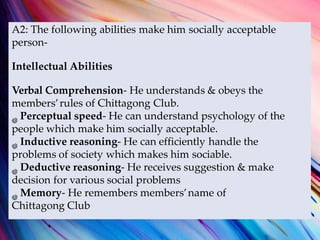
A2: The following abilities make him socially acceptable
person-
Intellectual Abilities
Verbal Comprehension- He understands & obeys the
members’rules of Chittagong Club.
Perceptual speed- He can understand psychology of the
people which make him socially acceptable.
Inductive reasoning- He can efficiently handle the
problems of society which makes him sociable.
Deductive reasoning- He receives suggestion & make
decision for various social problems
Memory- He remembers members’name of
Chittagong Club
A2: The following abilities make him socially
acceptable person-
Physical Abilities:
a.Dynamic strength- He is energetic enough to
participate in social programs
b.Stamina- He can perform his social role for a
longer period
c.Motivation- He can motive others members of
the society
d.Leading- He can lead his group members in
adopting and participating social programs
A3: These abilities support him to involve in
travelling and participate in golf and long tennis-
Intellectual Abilities
Perceptual speed- Mr. Siddique participates in those
games of higher class people so he can benefits in his
profession.
Inductive reasoning- He can handle the problems
of
managing tour in abroad.
Deductive reasoning- Mr. Siddique can decide one
places among several places to visit
Spatial visualization- He arranges tour to beautiful
places in abroad.
A3: These abilities support him to involve in
travelling and participate in golf and long tennis-
Physical Abilities
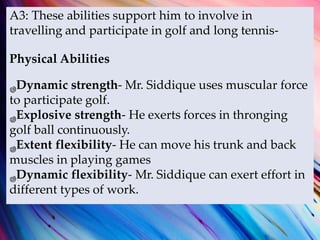
Dynamic strength- Mr. Siddique uses muscular force
to participate golf.
Explosive strength- He exerts forces in thronging
golf ball continuously.
Extent flexibility- He can move his trunk and back
muscles in playing games
Dynamic flexibility- Mr. Siddique can exert effort in
different types of work.
A3: These abilities support him to involve in
travelling and participate in golf and long tennis-
Physical Abilities
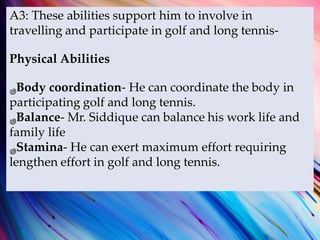
Body coordination- He can coordinate the body in
participating golf and long tennis.
Balance- Mr. Siddique can balance his work life and
family life
Stamina- He can exert maximum effort requiring
lengthen effort in golf and long tennis.
Other Abilities
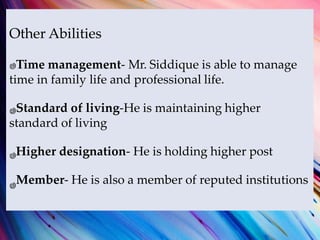
Time management- Mr. Siddique is able to manage
time in family life and professional life.
Standard of living-He is maintaining higher
standard of living
Higher designation- He is holding higher post
Member- He is also a member of reputed institutions

Ability.pptx

  • 1.
  • 3.
    ⦿ Ability refersto an individual’s capacity to perform the various tasks in a job. ⦿ Ability is the skills and qualities which make it possible to achieve a goal.
  • 4.
    What is Ability? Abilityis a current assessment of what one can do. The issue is knowing how people differ in abilities and using that knowledge to increase the likelihood that an employee will perform his or her job well. What we are acknowledging is that everyone has strengths and weaknesses in terms of ability that make him or her relatively superior or inferior to others in performing certain tasks or activities.
  • 5.
    What is Ability? We can say that ability is the quality or state of being able, power to perform whether physical, mental, moral intellectual, skill in doing, the sufficiency of strength, available resources, etc. It underpins and contributes to skills. It can be essentially perceptual, essentially motor or a combination of both.
  • 6.
    Types of Abilityin Organizational Behavior: 1. Intellectual Ability 2. Physical Ability
  • 7.
    Intellectual Ability mental activities Intellectualability is the capacity to do thinking and reasoning and problem-solving. It commonly refers to the ability measured by performance on an intelligence test. It is also sometimes used in the context of discussing the performance of someone in an academic or real- world setting. The seven most frequently cited dimensions making up intellectual abilities are comprehension, perceptual number aptitude, verbal speed, inductive reasoning, deductive reasoning, and memory.
  • 8.
    Number aptR ude Ærbal Comprehension Œrceptual s p e e d Inductlve easonifq Dedtxtke Dimensions of inteliectuaiAbiliW SpaDI VüualizaÔn Memoç Abllnyto& speedyand aœuraœ arhhmetk Abllltyto un&rnand what ls reador heard AbllltytoOentlfyvlsudslmlbrRles andÆffeenæsq u lc k lyanda c c u m t e g Abilityto @entify al¥gkal sequence In aprobDm and thensolvetheproblem AbllKytoiseb@candæseothe ImpllœtDrsof a naçument Abilltyto imagine how anobject wouo look ifIÖ poslùon in spæe werechanged AbllEytoŒŒlnandfecall pan e x p e r i e n c e AocournantScompwlng&esdesæxona sQoflœms Plantmanager: followlfy corporaa polklesonhirlng FteIwenØaor: @ent¥ylngduesæ supportac h a r g eofanon Market esealcher: forecasting &mand for aproduct inthe next timeperDd Supewüor: chooslngb e t w e e ntwo dloerents u g g e s € o n s InterÔr decoraor: fedecoralng anoÔce g Salespeeon: ememberlfy then a m e sŒ c a æ m e n
  • 9.
    General Mental Ability ⦿Intelligence Dimensions arepositively related. ⦿For eg. If you score high on Verbal Comprehension you are more likely to score high on Spatial Visualization.
  • 10.
    Wonderlic Personnel Test ⦿The test was developed by Eldon Wonderlic. ⦿ It is a popular group intelligence test used to assess the aptitude of prospective employees for learning and problem- solving in a range of occupations.
  • 12.
    ⦿ While intelligenceis a big help in performing a job well, it doesn’t make people happier or more satisfied with their jobs. ⦿ The correlation between intelligence & job satisfaction is about Zero.
  • 13.
    Employee Aptitude Survey FactSheet ⦿ The Employee Aptitude Survey (EAS) consists of 10 tests specifically designed to measure cognitive, perceptual, and psychomotor abilities required for successful performance in a wide variety of occupations. The tests are published separately and can be selected to form custom batteries.
  • 14.
  • 15.
    Physical Abilities ⦿ Physicalability is the capacity to do tasks that demand stamina, desired, strength and similar characteristics. ⦿ It can identify individuals who are physically able to perform the essentials function of a job without risking injury to others ⦿ Research on the requirements needed in hundreds of jobs has identified nine physical abilities involved in the performance of physical tasks. ⦿ These are -dynamic strength, static strength, trunk strength, explosive strength, extent flexibility, dynamic flexibility, body – coordination, balance, and stamina.
  • 17.
    Intellectual ability vsPhysical Ability Intellectual Ability Physical Ability 1. Intellectual ability is the capacity to do activities like thinking, reasoning, and problem-solving. 1. Physical ability is the capacity to do tasks that demand stamina, desired, strength and similar characteristics. 2. Intellectual ability is doing with the mind. 2. Physical ability is doing with the body. 3. It is a measure of intelligence, and involves understanding complex concepts and thinking critically. 3. It is the capability of performing physical accomplishments, such as flexibility, coordination, basic motor skills. 4. It is related to the skills of the mind. 4. It is related to the capabilities of the physical structure.
  • 18.
    Intellectual ability vsPhysical Ability Intellectual Ability Physical Ability 5. It plays a vital role in complex jobs with demanding information processing requirements. 5. It gains importance for successfully doing less-skilled and more standardized jobs. 6. Intellectual ability is the ability of the mind – i.e. how clever, intuitive, etc. a person is. 6. Physical ability is the ability of the body – i.e. how strong, agile, etc. a person is. 7. Types of intellectual ability are number attitude, verbal comprehension, perceptual speed, inductive reasoning, deductive reasoning, and memory. 7. Types of physical ability are dynamic strength, static strength, trunk strength, explosive strength, extent flexibility, dynamic flexibility, body coordination, balance, and stamina.
  • 19.
    THE ABILITY –JOB FIT Ability- Job Fit
  • 20.
    THE ABILITY –JOB FIT ⦿ A high ability-job fit necessary for improved job performance ⦿ Lack of fit leads to performance problems ⦿ If, Ability < Job Requirements  basic cause of poor performance ⦿ Ability > Job Requirements  organizational inefficiency and job dissatisfaction  Jobs make differing demands on people and that people differ in their abilities
  • 21.
    MANAGERIAL IMPLICATIONS ⦿ Abilitydirectly influences employees level of performance. ⦿ An effective selection process & job analysis should be done. ⦿ Managers need to focus on ability in selection, promotion, and transfer. ⦿ Fine-tune job to fit incumbent’s abilities.
  • 23.
    Case Study ofAbility Mr. Rahim Uddin Siddique is a 55 years old man and a chartered accountant. He did his MBA from London Business school in 1994. Presently he is holding a responsible post of a charted accounting firm named ABC. Apart from this, he also delivers lecture in a number of reputable private universities. His colleagues and friends highly appreciate his professionalism. Many people in the society honor him because he is man of magnetic personality. Mr. Siddique is also a member of Chittagong Club and actively involved in social work . He is very keen to develop social network and relationship. He likes to play long tennis and golf in his leisure time. He likes to travel abroad with his family.
  • 24.
    Case Study ofAbility After analyzing the above case answer the following questions: 1. What kind of ability does Mr. Siddique have to prove himself as true professional and as man of magnetic personality? 2. What kind of ability make him a socially acceptable person? 3. What kind of ability support him to involve in traveling and participate in golf and long tennis?
  • 25.
    A1: Mr. Siddiquehave the following abilities to prove himself as true professional and man of magnetic personality- Intellectual Abilities Number aptitude- Mr. Siddique computes financial statements in his profession. Verbal Comprehension- He follows policies adopted by government budget. Inductive reasoning- He forecasts the availability of his client in Chittagong Club. Deductive reasoning- He chooses to lecture in private university to make him renowned. Memory- He remembers different equations for accounting .
  • 26.
    A1: Mr. Siddiquehave the following abilities to prove himself as true professional and man of magnetic personality- Physical Abilities Dynamic strength- Mr. Siddique uses computer and hand for doing his professional work. Stamina- Some accounting problems requires highest level of energy for long time. Other Abilities Time management- He can manage the time to perform his post and lecturer job
  • 27.
    A2: The followingabilities make him socially acceptable person- Intellectual Abilities Verbal Comprehension- He understands & obeys the members’rules of Chittagong Club. Perceptual speed- He can understand psychology of the people which make him socially acceptable. Inductive reasoning- He can efficiently handle the problems of society which makes him sociable. Deductive reasoning- He receives suggestion & make decision for various social problems Memory- He remembers members’name of Chittagong Club
  • 28.
    A2: The followingabilities make him socially acceptable person- Physical Abilities: a.Dynamic strength- He is energetic enough to participate in social programs b.Stamina- He can perform his social role for a longer period c.Motivation- He can motive others members of the society d.Leading- He can lead his group members in adopting and participating social programs
  • 29.
    A3: These abilitiessupport him to involve in travelling and participate in golf and long tennis- Intellectual Abilities Perceptual speed- Mr. Siddique participates in those games of higher class people so he can benefits in his profession. Inductive reasoning- He can handle the problems of managing tour in abroad. Deductive reasoning- Mr. Siddique can decide one places among several places to visit Spatial visualization- He arranges tour to beautiful places in abroad.
  • 30.
    A3: These abilitiessupport him to involve in travelling and participate in golf and long tennis- Physical Abilities Dynamic strength- Mr. Siddique uses muscular force to participate golf. Explosive strength- He exerts forces in thronging golf ball continuously. Extent flexibility- He can move his trunk and back muscles in playing games Dynamic flexibility- Mr. Siddique can exert effort in different types of work.
  • 31.
    A3: These abilitiessupport him to involve in travelling and participate in golf and long tennis- Physical Abilities Body coordination- He can coordinate the body in participating golf and long tennis. Balance- Mr. Siddique can balance his work life and family life Stamina- He can exert maximum effort requiring lengthen effort in golf and long tennis.
  • 32.
    Other Abilities Time management-Mr. Siddique is able to manage time in family life and professional life. Standard of living-He is maintaining higher standard of living Higher designation- He is holding higher post Member- He is also a member of reputed institutions