Nonverbal intelligence pertains to cognitive skills and problem-solving that do not rely on verbal communication, emphasizing visual reasoning and motor skills. It is assessed through specialized tests designed for individuals with speech or language challenges, aiming to evaluate their abilities beyond typical verbal IQ measures. Understanding and enhancing nonverbal intelligence is crucial for effective problem-solving in educational settings and daily life, and various tools and tests exist to support its assessment.
NONVERBAL INTELLIGENCE
• Nonverbalintelligence describes thinking skills and
problem-solving abilities that do not fundamentally
require verbal language production and comprehension.
This type of intelligence involves manipulating or
problem solving about visual information and may vary in
the amount of internalized, abstract, or conceptual
reasoning and motor skills that are required to complete
a task. Nonverbal intelligence is often closely linked with
the Performance IQ domain of intellectual ability tests
that evaluates nonverbal abilities, a domain which is
often viewed in comparison to the Verbal IQ domain.
3.
Concepts and SkillsInvolved in
Nonverbal Tasks
Nonverbal tasks may involve concepts such as:
• Concrete or abstract ideas
• Internalized language-based reasoning
• Internalized reasoning without language
Nonverbal tasks involve skills such as:
• The ability to recognize visual sequences and remember them
• Understanding the meaning of visual information and
recognizing relationships between visual concepts
• Performing visual analogies
• Recognition of causal relationships in pictured situations
4.
Why Is ItImportant?
• In school, nonverbal intelligence is important because it enables
students to analyze and solve complex problems without relying
upon or being limited by language abilities. Many mathematical
concepts, physics problems, computer science tasks, and science
problems require strong reasoning skills.
• In addition, it is nonverbal intelligence that allows us to think
through, plan for, and implement projects. We also use nonverbal
intelligence to organize and manage our time and our belongings.
• Outside of school, nonverbal intelligence may otherwise be described
as "common sense." While a person with common sense may or may
not score high on a typical IQ test, it is common sense that gets us
through our days. A person who scores high on a typical IQ test may
not have the basic nonverbal skills to, for example, get to the grocery
store before the food runs out, put together a build-it-yourself piece
of furniture, or figure out how to organize papers in a notebook.
5.
How Is ItAssessed?
• Nonverbal intelligence is typically assessed in extended IQ
tests. It's important, however, to distinguish between IQ tests
which are nonverbal and IQ tests which assess nonverbal
intelligence.
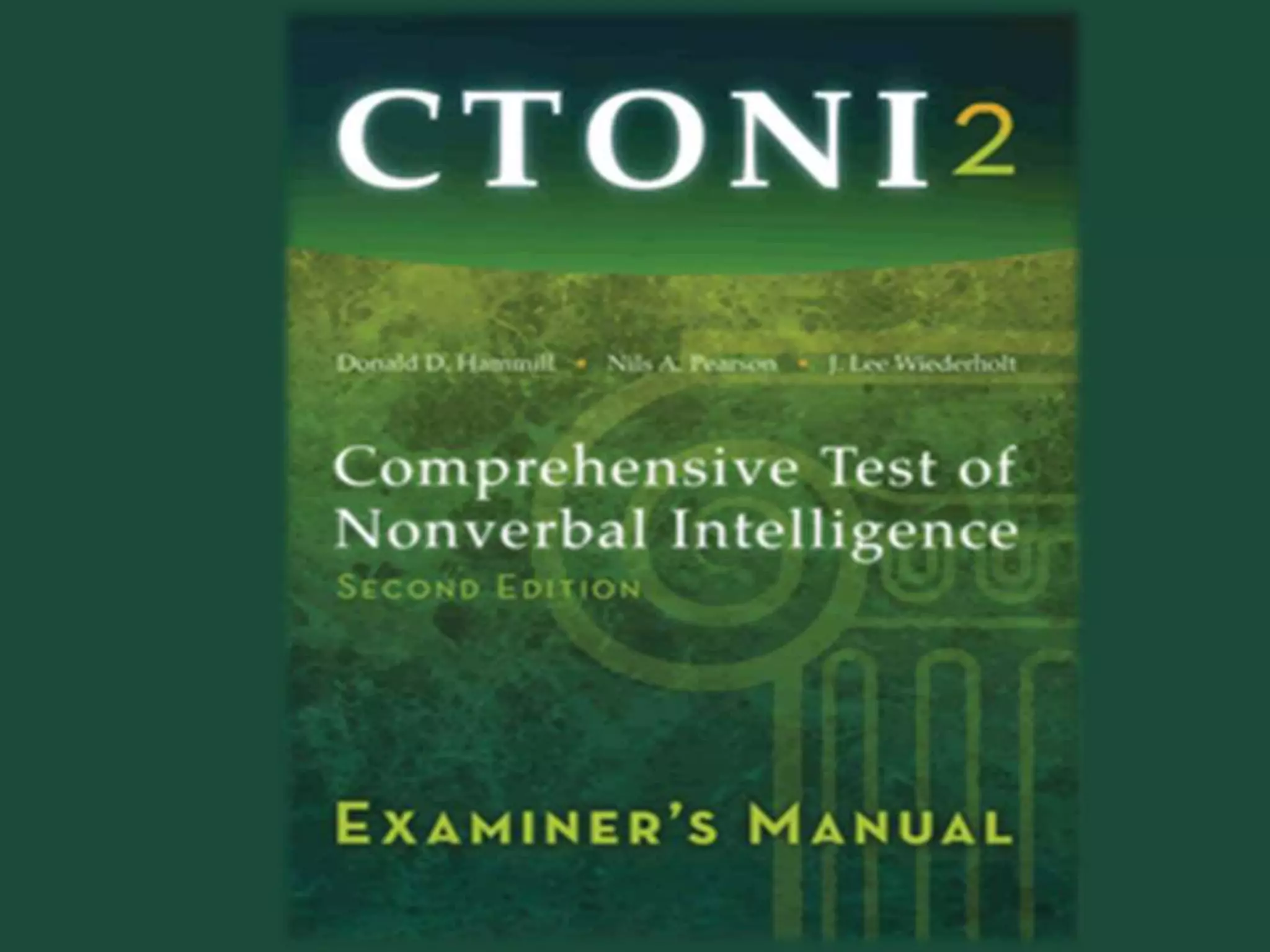
• Nonverbal IQ tests such as the TONI-4 (test of nonverbal
intelligence, 4th edition) are intended to assess the basic
intelligence of people with speech and language challenges
(people with autism, aphasia, and other disabilities). In other
words, the TONI-4 is a language-free test, so the children
taking the test answer with gestures like pointing, nodding, or
blinking.
• On the other hand, tests which assess nonverbal intelligence
are actually intended to discover an individual's ability to
manage nonverbal tasks.
6.
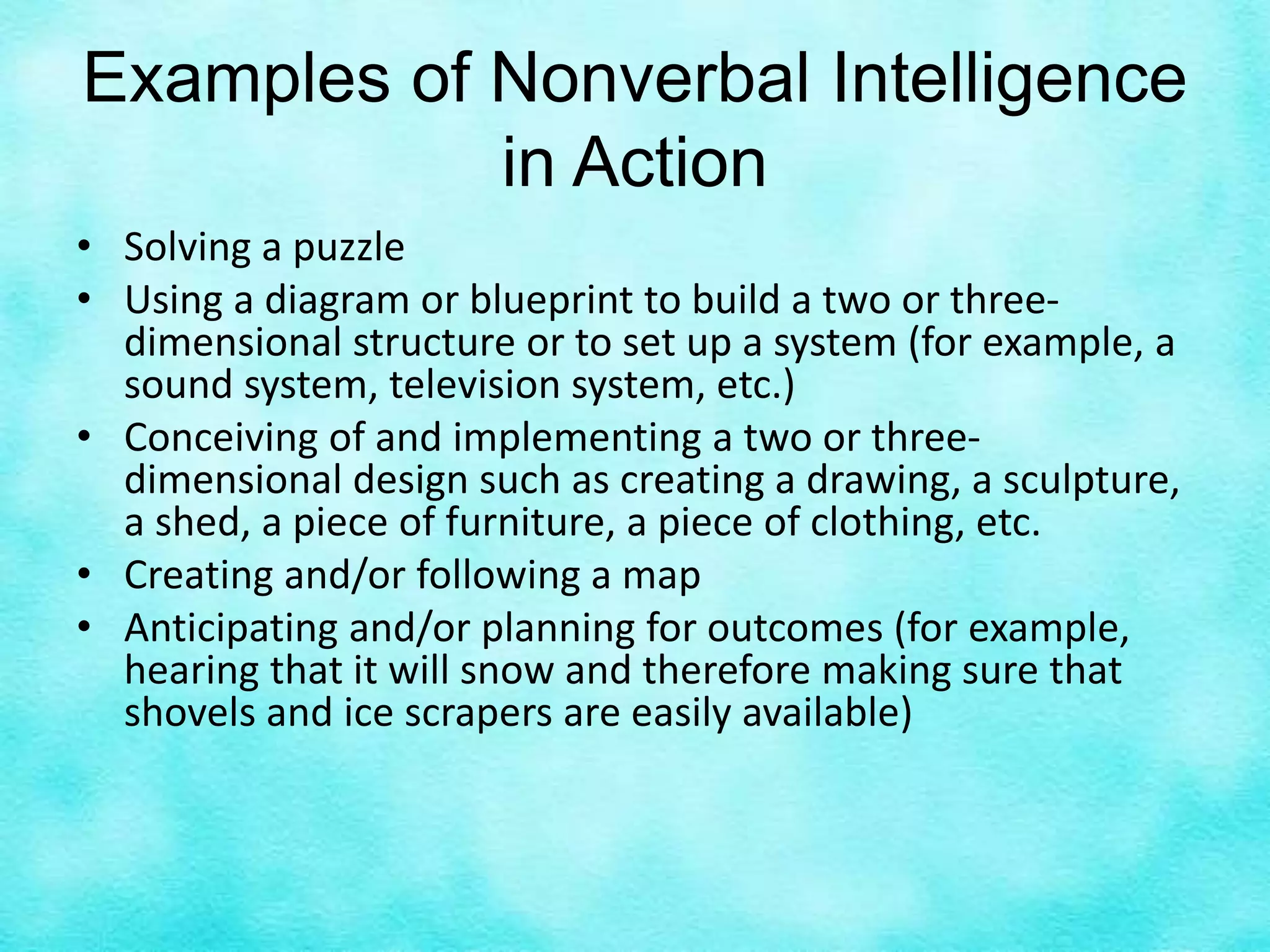
Examples of NonverbalIntelligence
in Action
• Solving a puzzle
• Using a diagram or blueprint to build a two or three-
dimensional structure or to set up a system (for example, a
sound system, television system, etc.)
• Conceiving of and implementing a two or three-
dimensional design such as creating a drawing, a sculpture,
a shed, a piece of furniture, a piece of clothing, etc.
• Creating and/or following a map
• Anticipating and/or planning for outcomes (for example,
hearing that it will snow and therefore making sure that
shovels and ice scrapers are easily available)
7.
Is It Possibleto Improve Nonverbal
Intelligence?
• Nonverbal intelligence may be improved by
working with hands-on tasks like picture
puzzles, blocks, and building toys, find-a-word
puzzles, mazes, and erector sets. There is also
a wide range of support systems available to
help enhance nonverbal abilities. These range
from time planners and alarms to
occupational therapy.
8.
Nonverbal Intelligence Tests
Nonverbalintelligence tests measure nonverbal
reasoning. They are used to assess students who
have language processing problems or those with
limited English proficiency. In these tests, tasks
are designed to remove verbal intelligence from
the assessment of a child's reasoning abilities and
to isolate and assess a student's visual learning
skills. These tests are not designed to test all
students for their nonverbal intelligence. They are
meant for students who have speech, language,
or hearing impairments or who are not verbally
communicative.
9.
Why Nonverbal IntelligenceTests
Are Needed
• Nonverbal assessments attempt to remove language barriers
in the estimation of a student's intellectual aptitude. This is
especially helpful in assessing students without speech or
who have limited language ability, those with deafness or who
are hard of hearing, and those with English language
limitations.
• Students with nonverbal autism are an example of a
population where standard IQ tests do not assess their
abilities well. Many who rank as intellectually disabled on
standard tests can be better assessed with a nonverbal
intelligence test.
10.
Why Nonverbal IntelligenceTests
Are Needed
• To accommodate students with speech or language
limitations, the test can be administered either orally or by
using pantomime. Students don't need to provide oral
responses, write, or manipulate objects to take these tests.
The tests vary in how they are administered. The best designs
don't require verbal directions or spoken responses.
• Nonverbal intelligence tests can be one element of a
comprehensive assessment of a child's abilities. They are only
one factor used in the determination of a disability under the
Individuals with Disabilities Education Act (IDEA). Students
who have verbal communication difficulties need a full range
of assessments, which can include observation, interviews,
record reviews, and a variety of tests. The tests often provide
instructions in multiple languages.
11.
Test Name
Author
Publisher
Publication Date
Administrationand Scoring Description Educational and Clinical
Application
Universal
Nonverbal
Intelligence Test
(UNIT)
Bracken and
McCallum
Riverside Press
1998
individual administration with 6
subtest and three possible format;
abbreviated, standard and
extended
age range between 5 and 18
administration time 15 to 45
minutes depending on format
administrated
based on two tier- model of
Intelligence
yields quotient for memory,
reasoning (symbolic and non
symbolic) and a full-scale IQ
Design to assess
students from diverse
cultural backgrounds,
LEP, language and or
hearing impairments,
learning disabilities,
mental retardation
and emotional
disorders
EXAMPLES OF NONVERBAL
INTELLIGENCE TESTS
13.
Test Name
Author
Publisher
Publication Date
Administrationand Scoring
Description
Educational and Clinical
Application
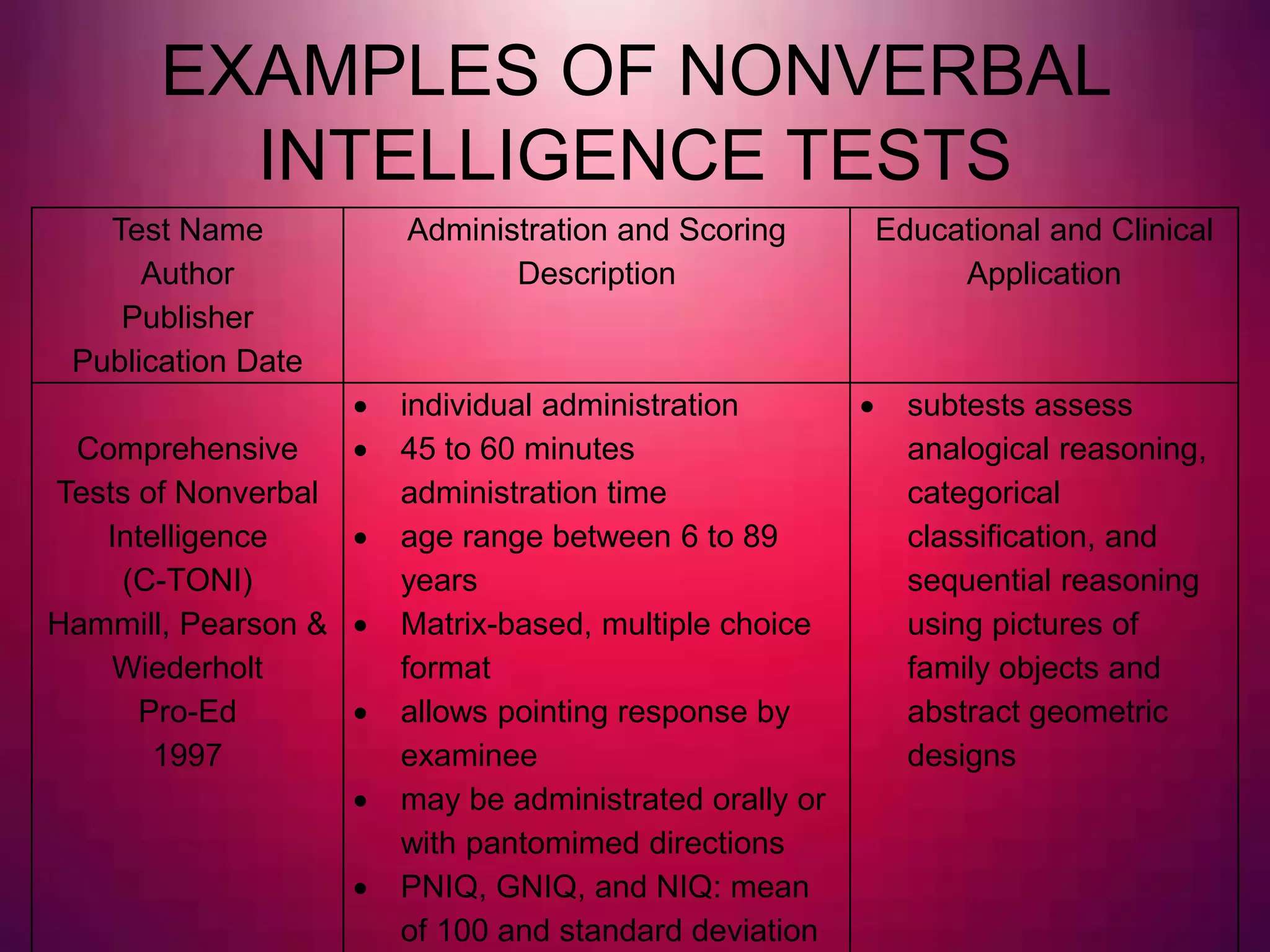
Comprehensive
Tests of Nonverbal
Intelligence
(C-TONI)
Hammill, Pearson &
Wiederholt
Pro-Ed
1997
individual administration
45 to 60 minutes
administration time
age range between 6 to 89
years
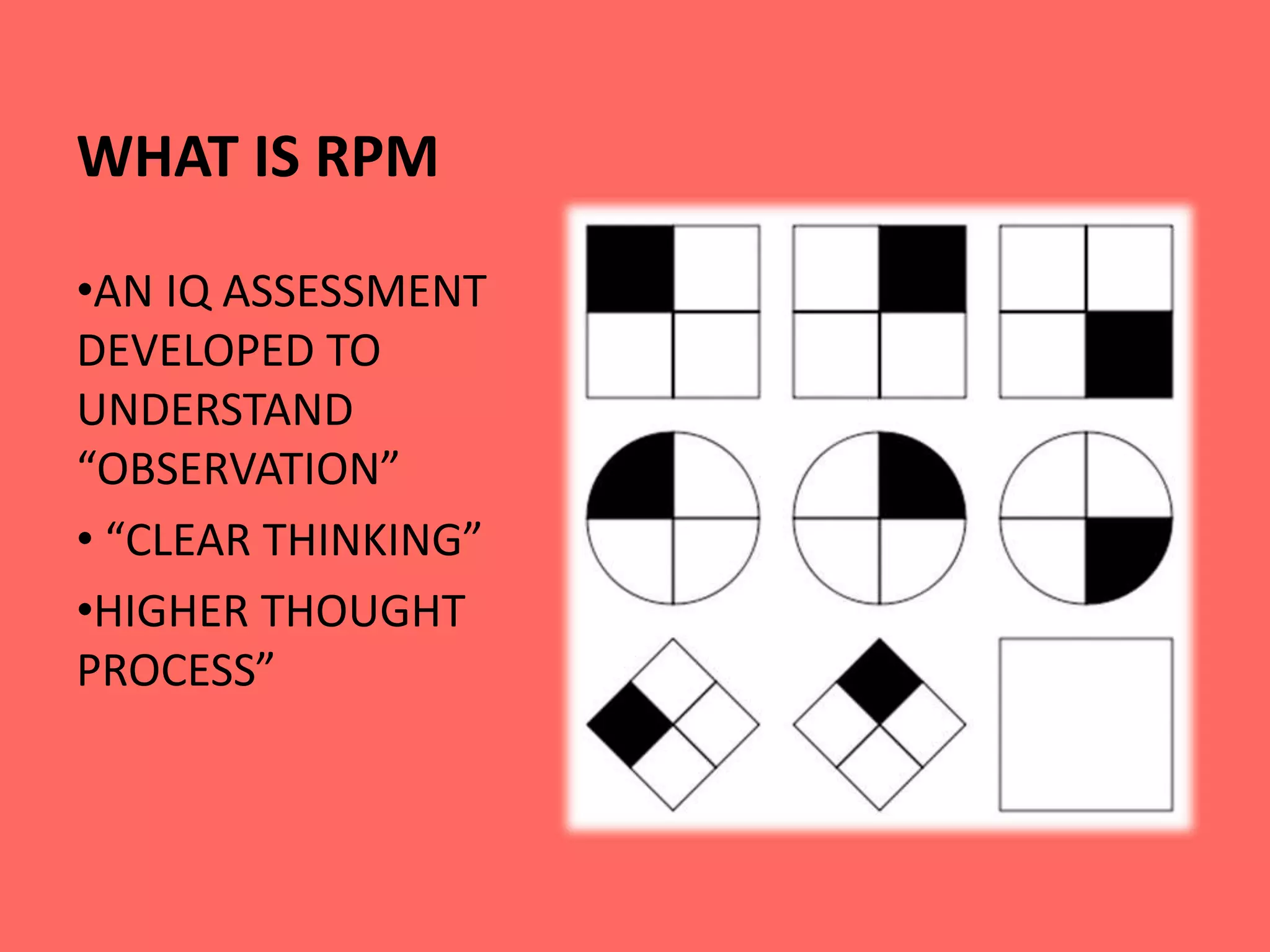
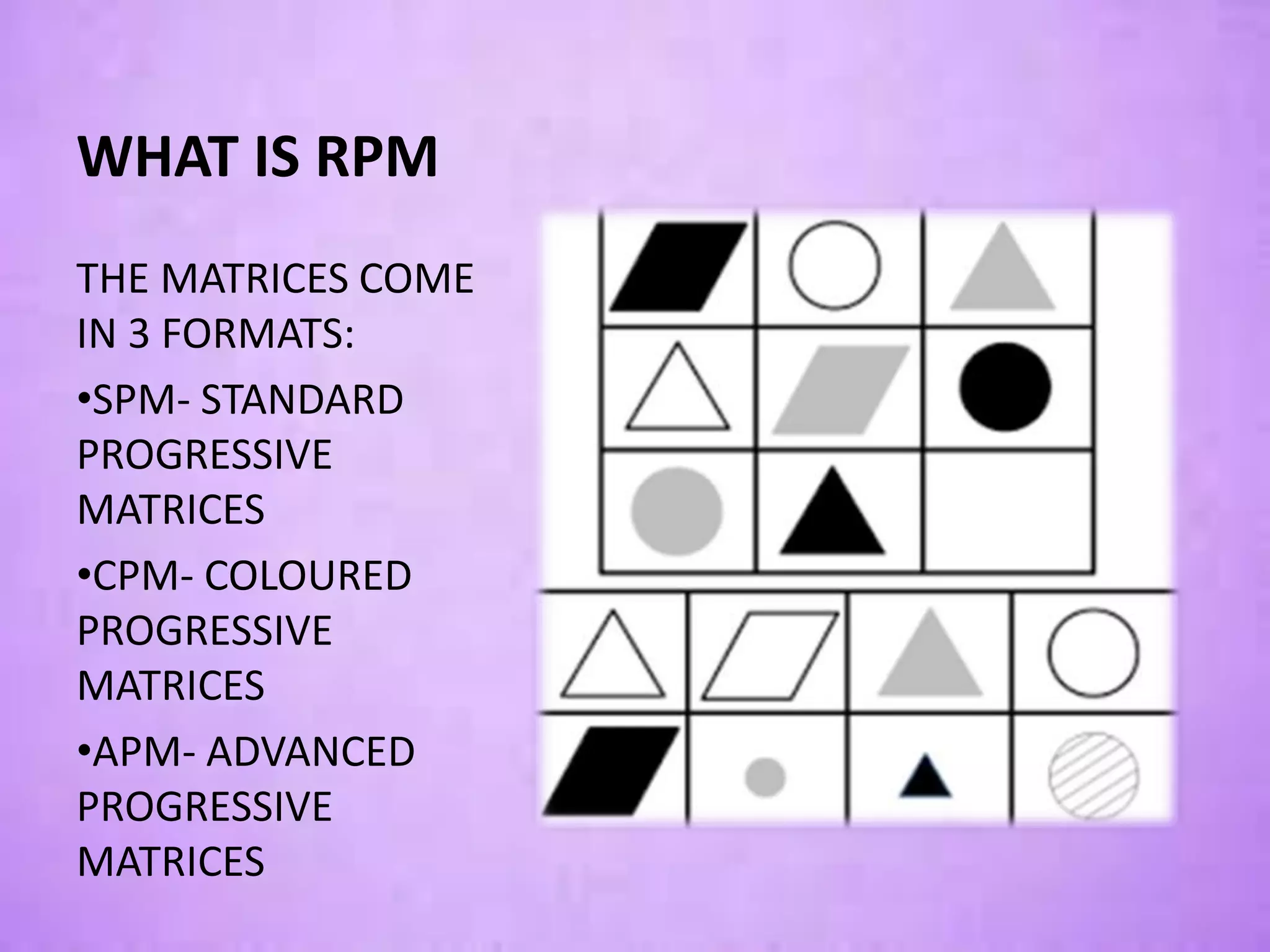
Matrix-based, multiple choice
format
allows pointing response by
examinee
may be administrated orally or
with pantomimed directions
PNIQ, GNIQ, and NIQ: mean
of 100 and standard deviation
subtests assess
analogical reasoning,
categorical
classification, and
sequential reasoning
using pictures of
family objects and
abstract geometric
designs
EXAMPLES OF NONVERBAL
INTELLIGENCE TESTS
15.
EXAMPLES OF NONVERBAL
INTELLIGENCETESTS
Test Name
Author
Publisher
Publication Date
Administration and Scoring Description Educational and
Clinical Application
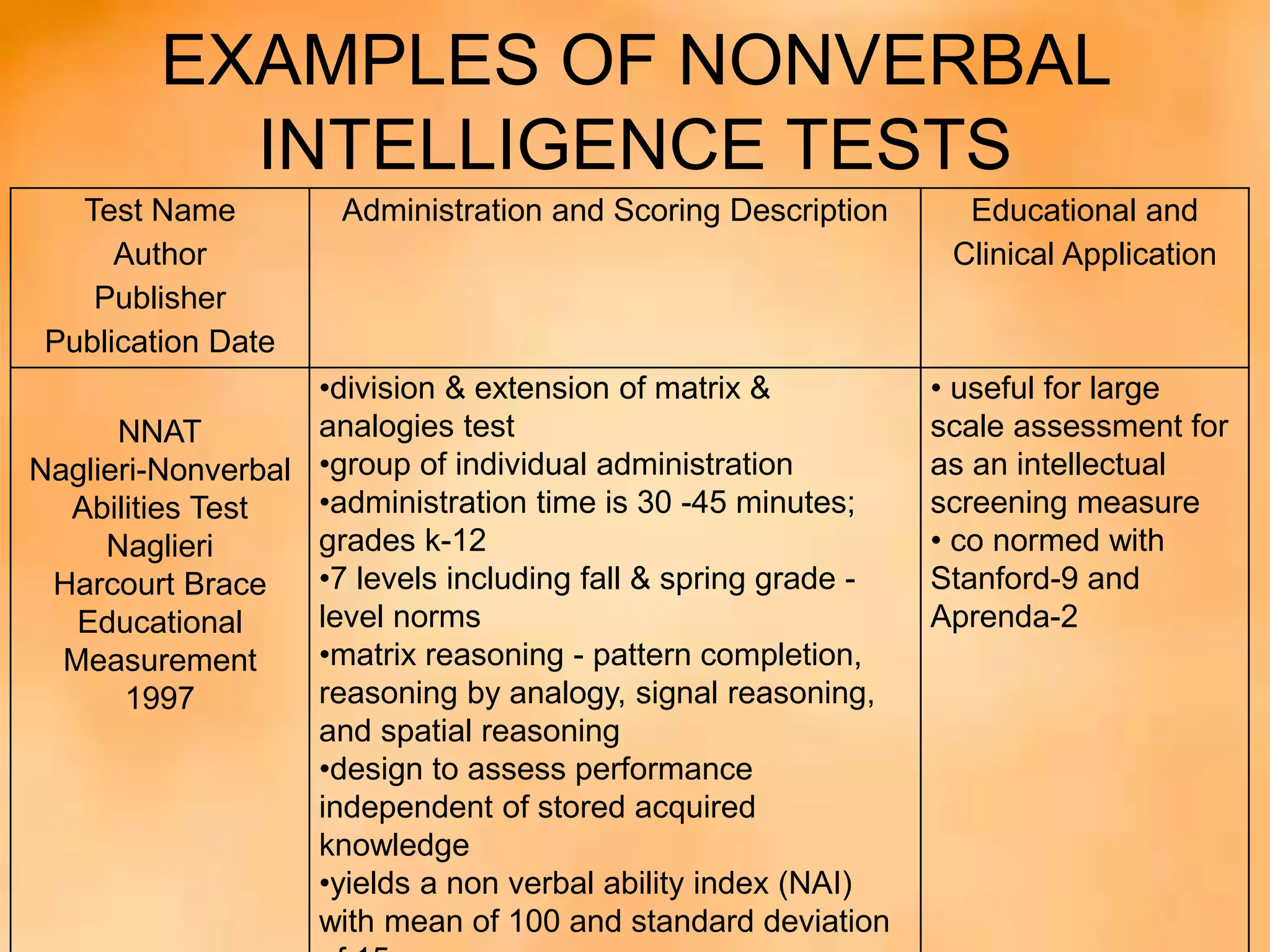
NNAT
Naglieri-Nonverbal
Abilities Test
Naglieri
Harcourt Brace
Educational
Measurement
1997
•division & extension of matrix &
analogies test
•group of individual administration
•administration time is 30 -45 minutes;
grades k-12
•7 levels including fall & spring grade -
level norms
•matrix reasoning - pattern completion,
reasoning by analogy, signal reasoning,
and spatial reasoning
•design to assess performance
independent of stored acquired
knowledge
•yields a non verbal ability index (NAI)
with mean of 100 and standard deviation
• useful for large
scale assessment for
as an intellectual
screening measure
• co normed with
Stanford-9 and
Aprenda-2







![[DSC Europe 25] Bogdan Daniel Maruneac - AI - It starts with you.pptx](https://cdn.slidesharecdn.com/ss_thumbnails/odov3snhrcqs9hx5ny2n-4-251205085715-f1daacfe-thumbnail.jpg?width=640&height=640&fit=bounds)


![[DSC Europe 25] Dragan Vucic - Building the Learning Organization - How AI Tr...](https://cdn.slidesharecdn.com/ss_thumbnails/8brigo2sbu6qur6gxrra-7-251205085715-6ae07d24-thumbnail.jpg?width=640&height=640&fit=bounds)


![[DSC Europe 25] Dragana Ilic - AI for Big Data in Astronomy.pptx](https://cdn.slidesharecdn.com/ss_thumbnails/8palya86qaatvjhva1ms-2-dragana-ilic-ai-ilic-251208151906-652b819c-thumbnail.jpg?width=640&height=640&fit=bounds)

![[DSC Europe 25] Petar Zivanov - AI meets documents From chatbots to AI-powere...](https://cdn.slidesharecdn.com/ss_thumbnails/xer2bb6nrdc8pdpev0pc-8-251204082258-7c2fa4a1-thumbnail.jpg?width=640&height=640&fit=bounds)
![[DSC Europe 25] Boris Perkovic - Lost in performance.pptx](https://cdn.slidesharecdn.com/ss_thumbnails/uq5hrp7vsuahqkxzifux-1-251204082258-fd2ee09d-thumbnail.jpg?width=640&height=640&fit=bounds)
![[DSC Europe 25] Vid Stimac - Policy Parsimony: Between Oversimplifying and Ov...](https://cdn.slidesharecdn.com/ss_thumbnails/eqlepagzqp2rhg3gbluh-dsc-stimac-251120-251205090438-059e7f54-thumbnail.jpg?width=640&height=640&fit=bounds)

