LOCATION
FACILITY
WHAT IS FACILITY LOCATION?
Facility location is the process of identifying the best geographic
location for a service or production facility.
Selecting suitable location for economic and effective operations.
THE NEED FOR SELECTING
A SUITABLE SITE OR LOCATION?
When the existing plant is to be re-located at some other place, to
remove the drawbacks of the present location or to gain the
benefits of a still better location.
While starting a new factory.
During the expansion of the existing plant.
Expiry of lease and the non-renewal.
OBJECTIVES IN
LOCATION DECISION
Reduce operating cost and capital investment
Effective plant layout
Coordinating with government policies
Employee Security, welfare and public needs
STEPS IN CHOOSING
THE BEST LOCATION
Develop a detailed list of selection criteria
Analyze qualitative & quantitative factors
Research competing communities and evaluate data
Consider incentives and bonuses
Finalize the decision, memorialize the deal
STEPS IN CHOOSING
THE BEST LOCATION
Develop a detailed list of selection criteria
The list should capture the most important qualifications for the new site.
 How close are the company’s customers?
 Where is the nearest port?
 How much land(space) is needed?
 What is the work force like?
 What are the minimum electricity needs for the new plant?
The criteria will address these and many other questions, and will vary tremendously
from project to project and company to company.
STEPS IN CHOOSING
THE BEST LOCATION
Analyze qualitative & quantitative factors
Qualitative factors do not have a direct effect on the company’s bottom line, but are nonetheless
crucial to its success.
 Size and surroundings of a community
 Local educational system
 Connectivity of the community to nearby markets
Quantitative factors, on the other hand, will produce a direct and calculable effect on a
company’s operations.
 Labor, Utility and Tax rates
 Building and Logistic costs
o To produce an accurate assessment of the operating costs at each site, these site-variable costs
have to be determined and projected out for a number of years.
STEPS IN CHOOSING
THE BEST LOCATION
Research competing communities and evaluate data
In most instances, a company and its consultants will request data from
potential candidate states and communities.
 Review public and subscription databases to generate a preliminary field
of potential sites
 Visits can be made to the sites that are deemed suitable.
The goal of the visits is to eliminate unsuitable sites and to narrow the field to
a small number of sites that meet all of the company’s selection criteria.
STEPS IN CHOOSING
THE BEST LOCATION
Consider incentives and bonuses
Starting up a new plant represents a huge investment on the part of the business, and a good incentives
package can reduce the investment risk and ultimately help the company open a successful and
profitable plant.
 Statutory Incentives - Those that are codified by state or local law, and that are made available to all
companies meeting the requirements of the law, such as a state jobs tax credit for any company that
creates a certain number of jobs annually.
 Discretionary incentives - Those that involve the discretion of the granting party. Prospects evaluate
statutory incentives, but final site negotiations naturally center on discretionary incentives.
Depending on the site, incentives may include free or reduced cost of land and building, below-market
rent, build-to-suit projects, cash grants, loans, loan guarantees, infrastructure improvements, site
remediation, utility hookups and discounts, property tax reductions and job training.
STEPS IN CHOOSING
THE BEST LOCATION
Finalize the decision, memorialize the deal
When the decision is made, the winning site and the prospect typically memorialize the deal with a
written agreement, often called a memorandum of understanding or a development agreement.
In the final agreement, the prospect agrees to locate its plant in the winning community, and usually
agrees to create a certain number of jobs and to make a minimum capital investment in the community.
In return, the other parties agree to provide certain incentives.
With the site selected and the final agreement signed, the company and the community can work
toward the next step in the process: the ribbon cutting.
SCOPE IN
LOCATION SELECTION
Within or outside the country
Selection of the region
Selection of locality or community
Selection of the exact site
SCOPE IN
LOCATION SELECTION
Within or outside the country
 Domestic OR International
 Which country?
o And the decision is taken on the basis of
 Political/legal concerns.
 Export or import quotas
 Currency exchange rate
 Cultural issues
SCOPE IN
LOCATION SELECTION
Selection of the region
 Availability of resources(raw materials, HR) and customers
 Market facilities
 Transportation and climate
 Government incentives
 Economic and environmental conditions
SCOPE IN
LOCATION SELECTION
Selection of locality or community
 Availability of work force
 Complementary business in the area
 Availability of safety needs and basic needs of employees
 Tax in the area
 Effectiveness in the initial stages
SCOPE IN
LOCATION SELECTION
Selection of the exact site
 Waste disposal
 Soil and topology
TYPES OF
FACILITIES
TYPES OF FACILITY
I
Heavy manufacturing facilities
 Large, require space, expensive
Larsen & Toubro
India
TYPES OF FACILITY
Light industry facilities
 Smaller , cleaner plants , less costly
TYPES OF FACILITY
Retail and service facilities
 Smallest and least costly
LOCATION ANALYSIS
TECHNIQUES
LOCATION FACTOR RATING
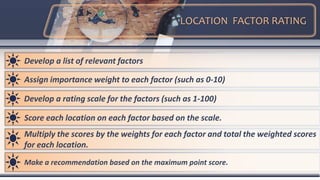
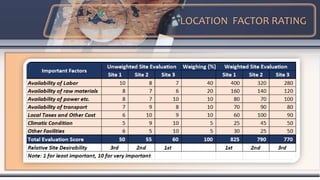
Develop a list of relevant factors
Assign importance weight to each factor (such as 0-10)
Develop a rating scale for the factors (such as 1-100)
Score each location on each factor based on the scale.
Multiply the scores by the weights for each factor and total the weighted scores
for each location.
Make a recommendation based on the maximum point score.
LOCATION FACTOR RATING
CENTER OF GRAVITY
METHOD
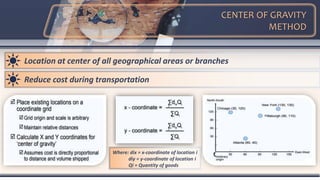
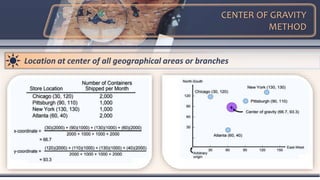
Location at center of all geographical areas or branches
Reduce cost during transportation
Where: dix = x-coordinate of location i
diy = y-coordinate of location i
Qi = Quantity of goods
CENTER OF GRAVITY
METHOD
Location at center of all geographical areas or branches
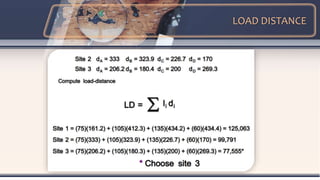
LOAD DISTANCE
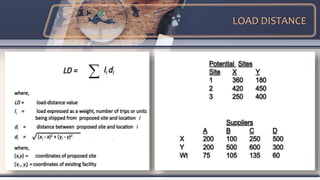
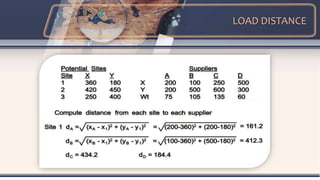
Calculation of distance with load
Choosing the load with lowest distance
Distance must be minimum
LOAD DISTANCE
LOAD DISTANCE
LOAD DISTANCE
BREAK EVEN ANALYSIS
Method of selection of point where total revenue equal total cost
THANK YOU!

Facility Location.pptx

  • 1.
  • 2.
    WHAT IS FACILITYLOCATION? Facility location is the process of identifying the best geographic location for a service or production facility. Selecting suitable location for economic and effective operations.
  • 3.
    THE NEED FORSELECTING A SUITABLE SITE OR LOCATION? When the existing plant is to be re-located at some other place, to remove the drawbacks of the present location or to gain the benefits of a still better location. While starting a new factory. During the expansion of the existing plant. Expiry of lease and the non-renewal.
  • 4.
    OBJECTIVES IN LOCATION DECISION Reduceoperating cost and capital investment Effective plant layout Coordinating with government policies Employee Security, welfare and public needs
  • 5.
    STEPS IN CHOOSING THEBEST LOCATION Develop a detailed list of selection criteria Analyze qualitative & quantitative factors Research competing communities and evaluate data Consider incentives and bonuses Finalize the decision, memorialize the deal
  • 6.
    STEPS IN CHOOSING THEBEST LOCATION Develop a detailed list of selection criteria The list should capture the most important qualifications for the new site.  How close are the company’s customers?  Where is the nearest port?  How much land(space) is needed?  What is the work force like?  What are the minimum electricity needs for the new plant? The criteria will address these and many other questions, and will vary tremendously from project to project and company to company.
  • 7.
    STEPS IN CHOOSING THEBEST LOCATION Analyze qualitative & quantitative factors Qualitative factors do not have a direct effect on the company’s bottom line, but are nonetheless crucial to its success.  Size and surroundings of a community  Local educational system  Connectivity of the community to nearby markets Quantitative factors, on the other hand, will produce a direct and calculable effect on a company’s operations.  Labor, Utility and Tax rates  Building and Logistic costs o To produce an accurate assessment of the operating costs at each site, these site-variable costs have to be determined and projected out for a number of years.
  • 8.
    STEPS IN CHOOSING THEBEST LOCATION Research competing communities and evaluate data In most instances, a company and its consultants will request data from potential candidate states and communities.  Review public and subscription databases to generate a preliminary field of potential sites  Visits can be made to the sites that are deemed suitable. The goal of the visits is to eliminate unsuitable sites and to narrow the field to a small number of sites that meet all of the company’s selection criteria.
  • 9.
    STEPS IN CHOOSING THEBEST LOCATION Consider incentives and bonuses Starting up a new plant represents a huge investment on the part of the business, and a good incentives package can reduce the investment risk and ultimately help the company open a successful and profitable plant.  Statutory Incentives - Those that are codified by state or local law, and that are made available to all companies meeting the requirements of the law, such as a state jobs tax credit for any company that creates a certain number of jobs annually.  Discretionary incentives - Those that involve the discretion of the granting party. Prospects evaluate statutory incentives, but final site negotiations naturally center on discretionary incentives. Depending on the site, incentives may include free or reduced cost of land and building, below-market rent, build-to-suit projects, cash grants, loans, loan guarantees, infrastructure improvements, site remediation, utility hookups and discounts, property tax reductions and job training.
  • 10.
    STEPS IN CHOOSING THEBEST LOCATION Finalize the decision, memorialize the deal When the decision is made, the winning site and the prospect typically memorialize the deal with a written agreement, often called a memorandum of understanding or a development agreement. In the final agreement, the prospect agrees to locate its plant in the winning community, and usually agrees to create a certain number of jobs and to make a minimum capital investment in the community. In return, the other parties agree to provide certain incentives. With the site selected and the final agreement signed, the company and the community can work toward the next step in the process: the ribbon cutting.
  • 11.
    SCOPE IN LOCATION SELECTION Withinor outside the country Selection of the region Selection of locality or community Selection of the exact site
  • 12.
    SCOPE IN LOCATION SELECTION Withinor outside the country  Domestic OR International  Which country? o And the decision is taken on the basis of  Political/legal concerns.  Export or import quotas  Currency exchange rate  Cultural issues
  • 13.
    SCOPE IN LOCATION SELECTION Selectionof the region  Availability of resources(raw materials, HR) and customers  Market facilities  Transportation and climate  Government incentives  Economic and environmental conditions
  • 14.
    SCOPE IN LOCATION SELECTION Selectionof locality or community  Availability of work force  Complementary business in the area  Availability of safety needs and basic needs of employees  Tax in the area  Effectiveness in the initial stages
  • 15.
    SCOPE IN LOCATION SELECTION Selectionof the exact site  Waste disposal  Soil and topology
  • 16.
  • 17.
    TYPES OF FACILITY I Heavymanufacturing facilities  Large, require space, expensive Larsen & Toubro India
  • 18.
    TYPES OF FACILITY Lightindustry facilities  Smaller , cleaner plants , less costly
  • 19.
    TYPES OF FACILITY Retailand service facilities  Smallest and least costly
  • 20.
  • 21.
    LOCATION FACTOR RATING Developa list of relevant factors Assign importance weight to each factor (such as 0-10) Develop a rating scale for the factors (such as 1-100) Score each location on each factor based on the scale. Multiply the scores by the weights for each factor and total the weighted scores for each location. Make a recommendation based on the maximum point score.
  • 22.
  • 23.
    CENTER OF GRAVITY METHOD Locationat center of all geographical areas or branches Reduce cost during transportation Where: dix = x-coordinate of location i diy = y-coordinate of location i Qi = Quantity of goods
  • 24.
    CENTER OF GRAVITY METHOD Locationat center of all geographical areas or branches
  • 25.
    LOAD DISTANCE Calculation ofdistance with load Choosing the load with lowest distance Distance must be minimum
  • 26.
  • 27.
  • 28.
  • 29.
    BREAK EVEN ANALYSIS Methodof selection of point where total revenue equal total cost
  • 30.

Editor's Notes

  • #10 It is often said that incentives cannot make a bad site good; they can only make a good site better. 
  • #11 It is often said that incentives cannot make a bad site good; they can only make a good site better. 
  • #18 L&T Heavy Engineering manufactures and supplies custom designed equipment & critical piping to process industries such as fertilizer, chemical, refinery, petrochemical, and oil & gas, as well as to sectors such as thermal & nuclear power.
  • #19 Light industry is industries that are usually less capital-income intensive than heavy industry, and is more raw material-oriented than business-oriented, since it typically produces smaller consumer goods. In simpler terms, it deals with the manufacturing of small or light articles or consumer goods. Example; Consumer Durables, Construction, Electronics, Business Products, Energy