This document is the result of primary research performed by Aberdeen Group. Aberdeen Group's methodologies provide for objective fact-based research and
represent the best analysis available at the time of publication. Unless otherwise noted, the entire contents of this publication are copyrighted by Aberdeen Group, Inc.
and may not be reproduced, distributed, archived, or transmitted in any form or by any means without prior written consent by Aberdeen Group, Inc.
November 2012
Convergence 2012: People and Parts Linked
Together to Solve Customer Issues
The successful delivery of service is contingent on a number of processes
and operations in order to resolve customer issues. Do you have the right
part? Is it in working condition? Is the field technician equipped to resolve
the issue, whether with the right skill set, the right tools, or even with the
right information to get on site in a timely manner? These are just a few of
the concerns that make it difficult to fix a customer issue right the first time.
Aberdeen surveyed 121 service organizations who stated that the
integration point between field service and parts management greatly
impacts their customer and their organizational performance. This analyst
insight will highlight the key trends, capabilities, and technologies that top-
performing service organizations leverage to more frequently and
predictably link spare parts management with the field service team to
ultimately fix customer issues the first time.
Focus on the Customer, But Still Monitor Costs
Customers continue to clamor for better service. This should be of no
shock, but service organizations are finding that providing the desired level
of service is still a major challenge. Over three-fourths of organizations
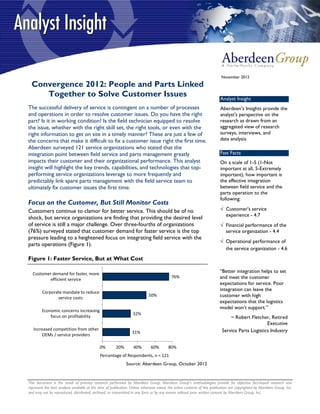
(76%) surveyed stated that customer demand for faster service is the top
pressure leading to a heightened focus on integrating field service with the
parts operations (Figure 1).
Figure 1: Faster Service, But at What Cost
31%
32%
50%
76%
0% 20% 40% 60% 80%
Increased competition from other
OEMs / service providers
Economic concerns increasing
focus on profitability
Corporate mandate to reduce
service costs
Customer demand for faster, more
efficient service
Percentage of Respondents, n = 121
Source: Aberdeen Group, October 2012
Analyst Insight
Aberdeen’s Insights provide the
analyst's perspective on the
research as drawn from an
aggregated view of research
surveys, interviews, and
data analysis
“Better integration helps to set
and meet the customer
expectations for service. Poor
integration can leave the
customer with high
expectations that the logistics
model won’t support.”
~ Robert Fletcher, Retired
Executive
Service Parts Logistics Industry
Fast Facts
On a scale of 1-5 (1-Not
important at all, 5-Extremely
important), how important is
the effective integration
between field service and the
parts operation to the
following:
√ Customer's service
experience - 4.7
√ Financial performance of the
service organization - 4.4
√ Operational performance of
the service organization - 4.6
Convergence 2012: People and Parts Linked Together to Solve Customer
Issues
Page 2
© 2012 Aberdeen Group. Telephone: 617 854 5200
www.aberdeen.com Fax: 617 723 7897
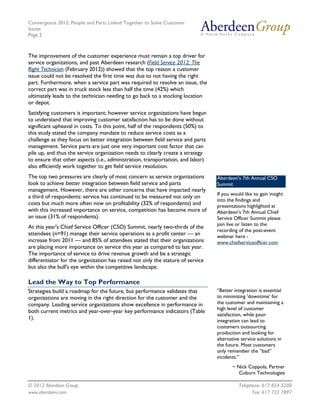
The improvement of the customer experience must remain a top driver for
service organizations, and past Aberdeen research (Field Service 2012: The
Right Technician (February 2012)) showed that the top reason a customer
issue could not be resolved the first time was due to not having the right
part. Furthermore, when a service part was required to resolve an issue, the
correct part was in truck stock less than half the time (42%) which
ultimately leads to the technician needing to go back to a stocking location
or depot.
Satisfying customers is important; however service organizations have begun
to understand that improving customer satisfaction has to be done without
significant upheaval in costs. To this point, half of the respondents (50%) to
this study stated the company mandate to reduce service costs as a
challenge as they focus on better integration between field service and parts
management. Service parts are just one very important cost factor that can
pile up, and thus the service organization needs to clearly create a strategy
to ensure that other aspects (i.e., administration, transportation, and labor)
also efficiently work together to get field service resolution.
The top two pressures are clearly of most concern as service organizations
look to achieve better integration between field service and parts
management. However, there are other concerns that have impacted nearly
a third of respondents: service has continued to be measured not only on
costs but much more often now on profitability (32% of respondents) and
with this increased importance on service, competition has become more of
an issue (31% of respondents).
At this year's Chief Service Officer (CSO) Summit, nearly two-thirds of the
attendees (n=91) manage their service operations as a profit center — an
increase from 2011 — and 85% of attendees stated that their organizations
are placing more importance on service this year as compared to last year.
The importance of service to drive revenue growth and be a strategic
differentiator for the organization has raised not only the stature of service
but also the bull's eye within the competitive landscape.
Lead the Way to Top Performance
Strategies build a roadmap for the future, but performance validates that
organizations are moving in the right direction for the customer and the
company. Leading service organizations show excellence in performance in
both current metrics and year-over-year key performance indicators (Table
1).
Aberdeen's 7th Annual CSO
Summit
If you would like to gain insight
into the findings and
presentations highlighted at
Aberdeen's 7th Annual Chief
Service Officer Summit please
join live or listen to the
recording of the post-event
webinar here -
www.chiefserviceofficer.com
“Better integration is essential
to minimizing 'downtime' for
the customer and maintaining a
high level of customer
satisfaction, while poor
integration can lead to
customers outsourcing
production and looking for
alternative service solutions in
the future. Most customers
only remember the “bad”
incidents.”
~ Nick Coppola, Partner
Coburn Technologies
Convergence 2012: People and Parts Linked Together to Solve Customer
Issues
Page 3
© 2012 Aberdeen Group. Telephone: 617 854 5200
www.aberdeen.com Fax: 617 723 7897
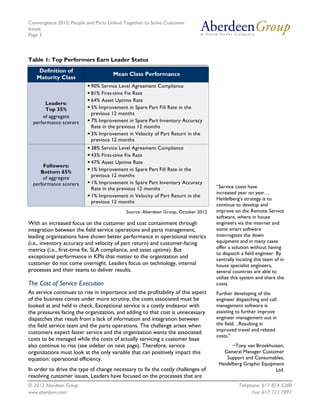
Table 1: Top Performers Earn Leader Status
Definition of
Maturity Class
Mean Class Performance
Leaders:
Top 35%
of aggregate
performance scorers
 90% Service Level Agreement Compliance
 81% First-time Fix Rate
 64% Asset Uptime Rate
 5% Improvement in Spare Part Fill Rate in the
previous 12 months
 7% Improvement in Spare Part Inventory Accuracy
Rate in the previous 12 months
 3% Improvement in Velocity of Part Return in the
previous 12 months
Followers:
Bottom 65%
of aggregate
performance scorers
 38% Service Level Agreement Compliance
 43% First-time Fix Rate
 47% Asset Uptime Rate
 1% Improvement in Spare Part Fill Rate in the
previous 12 months
 1% Improvement in Spare Part Inventory Accuracy
Rate in the previous 12 months
 1% Improvement in Velocity of Part Return in the
previous 12 months
Source: Aberdeen Group, October 2012
With an increased focus on the customer and cost containment through
integration between the field service operations and parts management,
leading organizations have shown better performance in operational metrics
(i.e., inventory accuracy and velocity of part return) and customer-facing
metrics (i.e., first-time fix, SLA compliance, and asset uptime). But
exceptional performance in KPIs that matter to the organization and
customer do not come overnight. Leaders focus on technology, internal
processes and their teams to deliver results.
The Cost of Service Execution
As service continues to rise in importance and the profitability of this aspect
of the business comes under more scrutiny, the costs associated must be
looked at and held in check. Exceptional service is a costly endeavor with
the pressures facing the organization, and adding to that cost is unnecessary
dispatches that result from a lack of information and integration between
the field service team and the parts operations. The challenge arises when
customers expect faster service and the organization wants the associated
costs to be managed while the costs of actually servicing a customer base
also continue to rise (see sidebar on next page). Therefore, service
organizations must look at the only variable that can positively impact this
equation: operational efficiency.
In order to drive the type of change necessary to fix the costly challenges of
resolving customer issues, Leaders have focused on the processes that are
“Service costs have
increased year on year…
Heidelberg’s strategy is to
continue to develop and
improve on the Remote Service
software, where in house
engineers via the internet and
some smart software
interrogates the down
equipment and in many cases
offer a solution without having
to dispatch a field engineer. By
centrally locating this team of in
house specialist engineers,
several countries are able to
utilize this system and share the
costs.
Further developing of the
engineer dispatching and call
management software is
assisting to further improve
engineer management out in
the field…Resulting in
improved travel and related
costs.”
~Tony van Broekhuizen,
General Manager Customer
Support and Consumables,
Heidelberg Graphic Equipment
Ltd.
Convergence 2012: People and Parts Linked Together to Solve Customer
Issues
Page 4
© 2012 Aberdeen Group. Telephone: 617 854 5200
www.aberdeen.com Fax: 617 723 7897
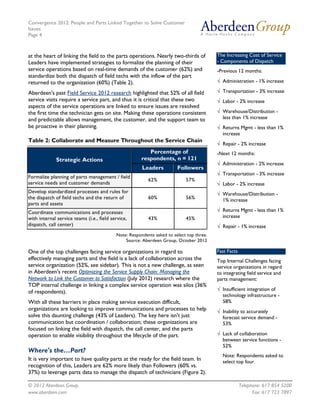
at the heart of linking the field to the parts operations. Nearly two-thirds of
Leaders have implemented strategies to formalize the planning of their
service operations based on real-time demands of the customer (62%) and
standardize both the dispatch of field techs with the inflow of the part
returned to the organization (60%) (Table 2).
Aberdeen's past Field Service 2012 research highlighted that 52% of all field
service visits require a service part, and thus it is critical that these two
aspects of the service operations are linked to ensure issues are resolved
the first time the technician gets on site. Making these operations consistent
and predictable allows management, the customer, and the support team to
be proactive in their planning.
Table 2: Collaborate and Measure Throughout the Service Chain
Note: Respondents asked to select top three.
Source: Aberdeen Group, October 2012
One of the top challenges facing service organizations in regard to
effectively managing parts and the field is a lack of collaboration across the
service organization (52%, see sidebar). This is not a new challenge, as seen
in Aberdeen's recent Optimizing the Service Supply Chain: Managing the
Network to Link the Customer to Satisfaction (July 2012) research where the
TOP internal challenge in linking a complex service operation was silos (36%
of respondents).
With all these barriers in place making service execution difficult,
organizations are looking to improve communications and processes to help
solve this daunting challenge (43% of Leaders). The key here isn't just
communication but coordination / collaboration; these organizations are
focused on linking the field with dispatch, the call center, and the parts
operation to enable visibility throughout the lifecycle of the part.
Where's the…Part?
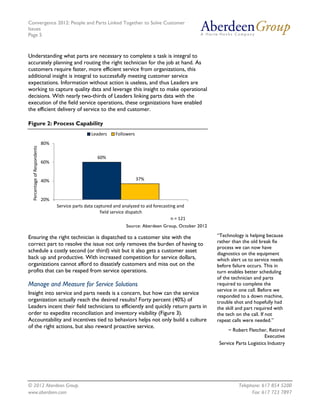
It is very important to have quality parts at the ready for the field team. In
recognition of this, Leaders are 62% more likely than Followers (60% vs.
37%) to leverage parts data to manage the dispatch of technicians (Figure 2).
Strategic Actions
Percentage of
respondents, n = 121
Leaders Followers
Formalize planning of parts management / field
service needs and customer demands
62% 57%
Develop standardized processes and rules for
the dispatch of field techs and the return of
parts and assets
60% 56%
Coordinate communications and processes
with internal service teams (i.e., field service,
dispatch, call center)
43% 45%
Fast Facts
Top Internal Challenges facing
service organizations in regard
to integrating field service and
parts management:
√ Insufficient integration of
technology infrastructure -
58%
√ Inability to accurately
forecast service demand -
53%
√ Lack of collaboration
between service functions -
52%
Note: Respondents asked to
select top four.
The Increasing Cost of Service
- Components of Dispatch
-Previous 12 months:
√ Administration - 1% increase
√ Transportation - 3% increase
√ Labor - 2% increase
√ Warehouse/Distribution -
less than 1% increase
√ Returns Mgmt - less than 1%
increase
√ Repair - 2% increase
-Next 12 months:
√ Administration - 2% increase
√ Transportation - 3% increase
√ Labor - 2% increase
√ Warehouse/Distribution -
1% increase
√ Returns Mgmt - less than 1%
increase
√ Repair - 1% increase
Convergence 2012: People and Parts Linked Together to Solve Customer
Issues
Page 5
© 2012 Aberdeen Group. Telephone: 617 854 5200
www.aberdeen.com Fax: 617 723 7897
Understanding what parts are necessary to complete a task is integral to
accurately planning and routing the right technician for the job at hand. As
customers require faster, more efficient service from organizations, this
additional insight is integral to successfully meeting customer service
expectations. Information without action is useless, and thus Leaders are
working to capture quality data and leverage this insight to make operational
decisions. With nearly two-thirds of Leaders linking parts data with the
execution of the field service operations, these organizations have enabled
the efficient delivery of service to the end customer.
Figure 2: Process Capability
60%
37%
20%
40%
60%
80%
Service parts data captured and analyzed to aid forecasting and
field service dispatch
PercentageofRespondents
n = 121
Leaders Followers
Source: Aberdeen Group, October 2012
Ensuring the right technician is dispatched to a customer site with the
correct part to resolve the issue not only removes the burden of having to
schedule a costly second (or third) visit but it also gets a customer asset
back up and productive. With increased competition for service dollars,
organizations cannot afford to dissatisfy customers and miss out on the
profits that can be reaped from service operations.
Manage and Measure for Service Solutions
Insight into service and parts needs is a concern, but how can the service
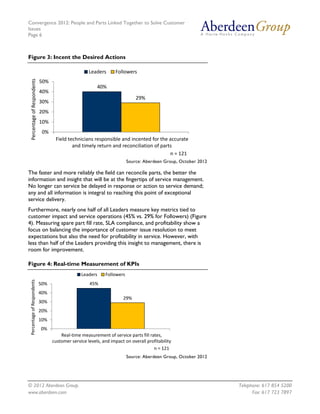
organization actually reach the desired results? Forty percent (40%) of
Leaders incent their field technicians to efficiently and quickly return parts in
order to expedite reconciliation and inventory visibility (Figure 3).
Accountability and incentives tied to behaviors helps not only build a culture
of the right actions, but also reward proactive service.
“Technology is helping because
rather than the old break fix
process we can now have
diagnostics on the equipment
which alert us to service needs
before failure occurs. This in
turn enables better scheduling
of the technician and parts
required to complete the
service in one call. Before we
responded to a down machine,
trouble shot and hopefully had
the skill and part required with
the tech on the call. If not
repeat calls were needed.”
~ Robert Fletcher, Retired
Executive
Service Parts Logistics Industry
Convergence 2012: People and Parts Linked Together to Solve Customer
Issues
Page 6
© 2012 Aberdeen Group. Telephone: 617 854 5200
www.aberdeen.com Fax: 617 723 7897
Figure 3: Incent the Desired Actions
40%
29%
0%
10%
20%
30%
40%
50%
Field technicians responsible and incented for the accurate
and timely return and reconciliation of parts
PercentageofRespondents
n = 121
Leaders Followers
Source: Aberdeen Group, October 2012
The faster and more reliably the field can reconcile parts, the better the
information and insight that will be at the fingertips of service management.
No longer can service be delayed in response or action to service demand;
any and all information is integral to reaching this point of exceptional
service delivery.
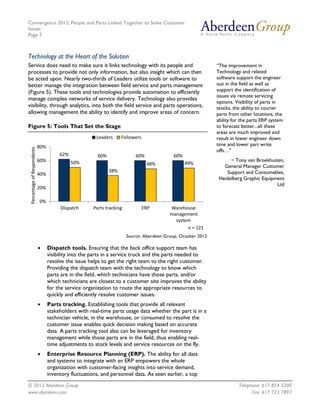
Furthermore, nearly one half of all Leaders measure key metrics tied to
customer impact and service operations (45% vs. 29% for Followers) (Figure
4). Measuring spare part fill rate, SLA compliance, and profitability show a
focus on balancing the importance of customer issue resolution to meet
expectations but also the need for profitability in service. However, with
less than half of the Leaders providing this insight to management, there is
room for improvement.
Figure 4: Real-time Measurement of KPIs
45%
29%
0%
10%
20%
30%
40%
50%
Real-time measurement of service parts fill rates,
customer service levels, and impact on overall profitability
PercentageofRespondents
n = 121
Leaders Followers
Source: Aberdeen Group, October 2012
Convergence 2012: People and Parts Linked Together to Solve Customer
Issues
Page 7
© 2012 Aberdeen Group. Telephone: 617 854 5200
www.aberdeen.com Fax: 617 723 7897
Technology at the Heart of the Solution
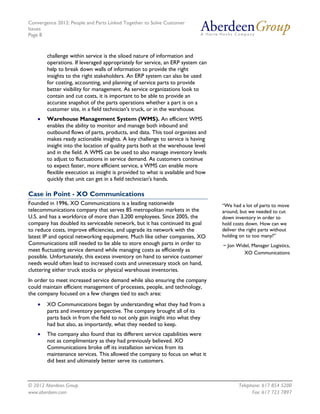
Service does need to make sure it links technology with its people and
processes to provide not only information, but also insight which can then
be acted upon. Nearly two-thirds of Leaders utilize tools or software to
better manage the integration between field service and parts management
(Figure 5). These tools and technologies provide automation to efficiently
manage complex networks of service delivery. Technology also provides
visibility, through analytics, into both the field service and parts operations,
allowing management the ability to identify and improve areas of concern.
Figure 5: Tools That Set the Stage
62% 60% 60% 60%
50%
38%
48% 49%
0%
20%
40%
60%
80%
Dispatch Parts tracking ERP Warehouse
management
system
PercentageofRespondents
n = 121
Leaders Followers
Source: Aberdeen Group, October 2012
• Dispatch tools. Ensuring that the back office support team has
visibility into the parts in a service truck and the parts needed to
resolve the issue helps to get the right team to the right customer.
Providing the dispatch team with the technology to know which
parts are in the field, which technicians have those parts, and/or
which technicians are closest to a customer site improves the ability
for the service organization to route the appropriate resources to
quickly and efficiently resolve customer issues.
• Parts tracking. Establishing tools that provide all relevant
stakeholders with real-time parts usage data whether the part is in a
technician vehicle, in the warehouse, or consumed to resolve the
customer issue enables quick decision making based on accurate
data. A parts tracking tool also can be leveraged for inventory
management while those parts are in the field, thus enabling real-
time adjustments to stock levels and service resources on the fly.
• Enterprise Resource Planning (ERP). The ability for all data
and systems to integrate with an ERP empowers the whole
organization with customer-facing insights into service demand,
inventory fluctuations, and personnel data. As seen earlier, a top
“The improvement in
Technology and related
software support the engineer
out in the field as well as
support the identification of
issues via remote servicing
options. Visibility of parts in
stocks, the ability to courier
parts from other locations, the
ability for the parts ERP system
to forecast better...all these
areas are much improved and
result in lower engineer down
time and lower part write
offs…"
~ Tony van Broekhuizen,
General Manager Customer
Support and Consumables,
Heidelberg Graphic Equipment
Ltd
Convergence 2012: People and Parts Linked Together to Solve Customer
Issues
Page 8
© 2012 Aberdeen Group. Telephone: 617 854 5200
www.aberdeen.com Fax: 617 723 7897
challenge within service is the siloed nature of information and
operations. If leveraged appropriately for service, an ERP system can
help to break down walls of information to provide the right
insights to the right stakeholders. An ERP system can also be used
for costing, accounting, and planning of service parts to provide
better visibility for management. As service organizations look to
contain and cut costs, it is important to be able to provide an
accurate snapshot of the parts operations whether a part is on a
customer site, in a field technician's truck, or in the warehouse.
• Warehouse Management System (WMS). An efficient WMS
enables the ability to monitor and manage both inbound and
outbound flows of parts, products, and data. This tool organizes and
makes ready actionable insights. A key challenge to service is having
insight into the location of quality parts both at the warehouse level
and in the field. A WMS can be used to also manage inventory levels
to adjust to fluctuations in service demand. As customers continue
to expect faster, more efficient service, a WMS can enable more
flexible execution as insight is provided to what is available and how
quickly that unit can get in a field technician's hands.
Case in Point - XO Communications
Founded in 1996, XO Communications is a leading nationwide
telecommunications company that serves 85 metropolitan markets in the
U.S. and has a workforce of more than 3,200 employees. Since 2005, the
company has doubled its serviceable network, but it has continued its goal
to reduce costs, improve efficiencies, and upgrade its network with the
latest IP and optical networking equipment. Much like other companies, XO
Communications still needed to be able to store enough parts in order to
meet fluctuating service demand while managing costs as efficiently as
possible. Unfortunately, this excess inventory on hand to service customer
needs would often lead to increased costs and unnecessary stock on hand,
cluttering either truck stocks or physical warehouse inventories.
In order to meet increased service demand while also ensuring the company
could maintain efficient management of processes, people, and technology,
the company focused on a few changes tied to each area:
• XO Communications began by understanding what they had from a
parts and inventory perspective. The company brought all of its
parts back in from the field to not only gain insight into what they
had but also, as importantly, what they needed to keep.
• The company also found that its different service capabilities were
not as complimentary as they had previously believed. XO
Communications broke off its installation services from its
maintenance services. This allowed the company to focus on what it
did best and ultimately better serve its customers.
“We had a lot of parts to move
around, but we needed to cut
down inventory in order to
hold costs down. How can we
deliver the right parts without
holding on to too many?”
~ Jon Widel, Manager Logistics,
XO Communications
Convergence 2012: People and Parts Linked Together to Solve Customer
Issues
Page 9
© 2012 Aberdeen Group. Telephone: 617 854 5200
www.aberdeen.com Fax: 617 723 7897
• As a final step in this initial transformation, XO outsourced the
storing of its parts and the repair of hardware units to a third party.
Once again, this allowed the company to focus on its core
competencies and streamline its service offerings as its coverage
areas expanded.
As a result of these process and organizational changes, the company has
been able to cut nearly $35M out of its operating costs, provide better
quality parts to its field support teams, and improve the efficiency of the
field workforce. XO Communications has also been able to focus on areas
beyond just operational cost containment; for example the company has
implemented training and a daily communications channel for the field. This
has enabled and empowered the field service team to continuously improve
the service operations through better training and an open feedback loop
for part, product, and service offering improvements.
As XO Communications continues to differentiate its services, the company
will add additional mobile technology for its field service workforce. The
company will also look to further equip more of its trucks with test
equipment and capabilities to enable enhanced proactive service. Service
differentiation begins with people, but also must be enhanced through
technology and processes.
Road to Improved Excellence
The service operation continues to become more complex and customers
are not seeking slower, less efficient service. The integration of the field
service organization and parts management remains a struggle for many
organizations, but a few areas should remain in focus for service in order to
make sure a field technician doesn’t end up on a customer site without the
part necessary to resolve the issue:
• Establish service leaders to lead the charge. Only a third of
Leaders have service leadership in place with oversight into parts
and the field (36% vs. 32% for Followers). Organizations that have a
service leader in place with oversight into these two aspects of the
operations have achieved a customer satisfaction score of 3.8 as
compared to 3.0 on a 1-5 scale (1-Not Satisfied, 5-Very Satisfied).
Throughout Aberdeen research, the importance of the CSO has
increased over the years where nearly 8 out of 10 organizations
have a VP-level or senior executive in place to support the service
organization, and the next step is to empower these service leaders
with the oversight and management of key aspects of the business
that impact the customer experience and, almost as importantly, the
operations that play a major role in regard to how service is
delivered.
• Break through the silos and don't just throw data over the
wall. Less than half of the Leaders (43%) have service organizations
that collaborate with the rest of the organization (i.e., sales,
marketing, and supply chain) (vs. 29% of Followers). This disconnect
“We have to roll with the
punches as the market changes.
We have moved into the IT
world.”
~ Jon Widel, Manager Logistics,
XO Communications
Convergence 2012: People and Parts Linked Together to Solve Customer
Issues
Page 10
© 2012 Aberdeen Group. Telephone: 617 854 5200
www.aberdeen.com Fax: 617 723 7897
hinders the entire organization from having the visibility and
actionable insight to get parts in the hands of the field service team,
whether it be inventory stocking the correct quantity to supply the
field with the parts needed or ensuring the sales teams have insight
into fast or slow moving parts to adjust strategy. Breaking through
silos can also ensure there is buy-in from the other leaders within
the organization to engineer, manufacture, market, and/or sale parts
that are easier to service.
• First Data, Then Insight, and Finally Action. Forty-three
percent (43%) of Leaders provide their service management with
the real-time insight into parts usage and field stock (35% of
Followers). Outdated data is great to track historical trends, but in
order to drive real-time action service leaders need to have visibility
into the situation on the ground in real-time. Organizations that
provide this level of insight to management have achieved a 61%
first-time fix rate and 65% SLA compliance as compared to 53% and
50%, respectively for those that do not. Having real-time data allows
service leaders to adjust strategies in order to continue to meet
fluctuations in demand and thus ensure the part and field tech reach
the customer when needed to resolve issues the first time.
For more information on this or other research topics, please visit
www.aberdeen.com.
Related Research
Optimizing the Service Supply Chain:
Managing the Network to Link the
Customer to Satisfaction; July 2012
Service to Services: Revenue and the
Development of New Opportunities; June
2012
Best Practices in Return, Refurbishment
and Repair; April 2012
Field Service 2012: The Right Technician;
February 2012
State of Service Management: Forecast
for 2012; January 2012
Service Parts Logistics 2011: Driving
Improved Service Performance via Tighter
Integration; June 2011
Author: Aly Pinder Jr., Senior Research Associate, Service Management Practice
(aly.pinder@aberdeen.com) Twitter LinkedIn Blog
For more than two decades, Aberdeen's research has been helping corporations worldwide become Best-in-Class.
Having benchmarked the performance of more than 644,000 companies, Aberdeen is uniquely positioned to provide
organizations with the facts that matter — the facts that enable companies to get ahead and drive results. That's why
our research is relied on by more than 2.5 million readers in over 40 countries, 90% of the Fortune 1,000, and 93% of
the Technology 500.
As a Harte-Hanks Company, Aberdeen’s research provides insight and analysis to the Harte-Hanks community of
local, regional, national and international marketing executives. Combined, we help our customers leverage the power
of insight to deliver innovative multichannel marketing programs that drive business-changing results. For additional
information, visit Aberdeen http://www.aberdeen.com or call (617) 854-5200, or to learn more about Harte-Hanks, call
(800) 456-9748 or go to http://www.harte-hanks.com.
This document is the result of primary research performed by Aberdeen Group. Aberdeen Group's methodologies
provide for objective fact-based research and represent the best analysis available at the time of publication. Unless
otherwise noted, the entire contents of this publication are copyrighted by Aberdeen Group, Inc. and may not be
reproduced, distributed, archived, or transmitted in any form or by any means without prior written consent by
Aberdeen Group, Inc. (2012a)

Aberdeen Group presentation at Spare parts 2013

  • 1.
    This document isthe result of primary research performed by Aberdeen Group. Aberdeen Group's methodologies provide for objective fact-based research and represent the best analysis available at the time of publication. Unless otherwise noted, the entire contents of this publication are copyrighted by Aberdeen Group, Inc. and may not be reproduced, distributed, archived, or transmitted in any form or by any means without prior written consent by Aberdeen Group, Inc. November 2012 Convergence 2012: People and Parts Linked Together to Solve Customer Issues The successful delivery of service is contingent on a number of processes and operations in order to resolve customer issues. Do you have the right part? Is it in working condition? Is the field technician equipped to resolve the issue, whether with the right skill set, the right tools, or even with the right information to get on site in a timely manner? These are just a few of the concerns that make it difficult to fix a customer issue right the first time. Aberdeen surveyed 121 service organizations who stated that the integration point between field service and parts management greatly impacts their customer and their organizational performance. This analyst insight will highlight the key trends, capabilities, and technologies that top- performing service organizations leverage to more frequently and predictably link spare parts management with the field service team to ultimately fix customer issues the first time. Focus on the Customer, But Still Monitor Costs Customers continue to clamor for better service. This should be of no shock, but service organizations are finding that providing the desired level of service is still a major challenge. Over three-fourths of organizations (76%) surveyed stated that customer demand for faster service is the top pressure leading to a heightened focus on integrating field service with the parts operations (Figure 1). Figure 1: Faster Service, But at What Cost 31% 32% 50% 76% 0% 20% 40% 60% 80% Increased competition from other OEMs / service providers Economic concerns increasing focus on profitability Corporate mandate to reduce service costs Customer demand for faster, more efficient service Percentage of Respondents, n = 121 Source: Aberdeen Group, October 2012 Analyst Insight Aberdeen’s Insights provide the analyst's perspective on the research as drawn from an aggregated view of research surveys, interviews, and data analysis “Better integration helps to set and meet the customer expectations for service. Poor integration can leave the customer with high expectations that the logistics model won’t support.” ~ Robert Fletcher, Retired Executive Service Parts Logistics Industry Fast Facts On a scale of 1-5 (1-Not important at all, 5-Extremely important), how important is the effective integration between field service and the parts operation to the following: √ Customer's service experience - 4.7 √ Financial performance of the service organization - 4.4 √ Operational performance of the service organization - 4.6
  • 2.
    Convergence 2012: Peopleand Parts Linked Together to Solve Customer Issues Page 2 © 2012 Aberdeen Group. Telephone: 617 854 5200 www.aberdeen.com Fax: 617 723 7897 The improvement of the customer experience must remain a top driver for service organizations, and past Aberdeen research (Field Service 2012: The Right Technician (February 2012)) showed that the top reason a customer issue could not be resolved the first time was due to not having the right part. Furthermore, when a service part was required to resolve an issue, the correct part was in truck stock less than half the time (42%) which ultimately leads to the technician needing to go back to a stocking location or depot. Satisfying customers is important; however service organizations have begun to understand that improving customer satisfaction has to be done without significant upheaval in costs. To this point, half of the respondents (50%) to this study stated the company mandate to reduce service costs as a challenge as they focus on better integration between field service and parts management. Service parts are just one very important cost factor that can pile up, and thus the service organization needs to clearly create a strategy to ensure that other aspects (i.e., administration, transportation, and labor) also efficiently work together to get field service resolution. The top two pressures are clearly of most concern as service organizations look to achieve better integration between field service and parts management. However, there are other concerns that have impacted nearly a third of respondents: service has continued to be measured not only on costs but much more often now on profitability (32% of respondents) and with this increased importance on service, competition has become more of an issue (31% of respondents). At this year's Chief Service Officer (CSO) Summit, nearly two-thirds of the attendees (n=91) manage their service operations as a profit center — an increase from 2011 — and 85% of attendees stated that their organizations are placing more importance on service this year as compared to last year. The importance of service to drive revenue growth and be a strategic differentiator for the organization has raised not only the stature of service but also the bull's eye within the competitive landscape. Lead the Way to Top Performance Strategies build a roadmap for the future, but performance validates that organizations are moving in the right direction for the customer and the company. Leading service organizations show excellence in performance in both current metrics and year-over-year key performance indicators (Table 1). Aberdeen's 7th Annual CSO Summit If you would like to gain insight into the findings and presentations highlighted at Aberdeen's 7th Annual Chief Service Officer Summit please join live or listen to the recording of the post-event webinar here - www.chiefserviceofficer.com “Better integration is essential to minimizing 'downtime' for the customer and maintaining a high level of customer satisfaction, while poor integration can lead to customers outsourcing production and looking for alternative service solutions in the future. Most customers only remember the “bad” incidents.” ~ Nick Coppola, Partner Coburn Technologies
  • 3.
    Convergence 2012: Peopleand Parts Linked Together to Solve Customer Issues Page 3 © 2012 Aberdeen Group. Telephone: 617 854 5200 www.aberdeen.com Fax: 617 723 7897 Table 1: Top Performers Earn Leader Status Definition of Maturity Class Mean Class Performance Leaders: Top 35% of aggregate performance scorers  90% Service Level Agreement Compliance  81% First-time Fix Rate  64% Asset Uptime Rate  5% Improvement in Spare Part Fill Rate in the previous 12 months  7% Improvement in Spare Part Inventory Accuracy Rate in the previous 12 months  3% Improvement in Velocity of Part Return in the previous 12 months Followers: Bottom 65% of aggregate performance scorers  38% Service Level Agreement Compliance  43% First-time Fix Rate  47% Asset Uptime Rate  1% Improvement in Spare Part Fill Rate in the previous 12 months  1% Improvement in Spare Part Inventory Accuracy Rate in the previous 12 months  1% Improvement in Velocity of Part Return in the previous 12 months Source: Aberdeen Group, October 2012 With an increased focus on the customer and cost containment through integration between the field service operations and parts management, leading organizations have shown better performance in operational metrics (i.e., inventory accuracy and velocity of part return) and customer-facing metrics (i.e., first-time fix, SLA compliance, and asset uptime). But exceptional performance in KPIs that matter to the organization and customer do not come overnight. Leaders focus on technology, internal processes and their teams to deliver results. The Cost of Service Execution As service continues to rise in importance and the profitability of this aspect of the business comes under more scrutiny, the costs associated must be looked at and held in check. Exceptional service is a costly endeavor with the pressures facing the organization, and adding to that cost is unnecessary dispatches that result from a lack of information and integration between the field service team and the parts operations. The challenge arises when customers expect faster service and the organization wants the associated costs to be managed while the costs of actually servicing a customer base also continue to rise (see sidebar on next page). Therefore, service organizations must look at the only variable that can positively impact this equation: operational efficiency. In order to drive the type of change necessary to fix the costly challenges of resolving customer issues, Leaders have focused on the processes that are “Service costs have increased year on year… Heidelberg’s strategy is to continue to develop and improve on the Remote Service software, where in house engineers via the internet and some smart software interrogates the down equipment and in many cases offer a solution without having to dispatch a field engineer. By centrally locating this team of in house specialist engineers, several countries are able to utilize this system and share the costs. Further developing of the engineer dispatching and call management software is assisting to further improve engineer management out in the field…Resulting in improved travel and related costs.” ~Tony van Broekhuizen, General Manager Customer Support and Consumables, Heidelberg Graphic Equipment Ltd.
  • 4.
    Convergence 2012: Peopleand Parts Linked Together to Solve Customer Issues Page 4 © 2012 Aberdeen Group. Telephone: 617 854 5200 www.aberdeen.com Fax: 617 723 7897 at the heart of linking the field to the parts operations. Nearly two-thirds of Leaders have implemented strategies to formalize the planning of their service operations based on real-time demands of the customer (62%) and standardize both the dispatch of field techs with the inflow of the part returned to the organization (60%) (Table 2). Aberdeen's past Field Service 2012 research highlighted that 52% of all field service visits require a service part, and thus it is critical that these two aspects of the service operations are linked to ensure issues are resolved the first time the technician gets on site. Making these operations consistent and predictable allows management, the customer, and the support team to be proactive in their planning. Table 2: Collaborate and Measure Throughout the Service Chain Note: Respondents asked to select top three. Source: Aberdeen Group, October 2012 One of the top challenges facing service organizations in regard to effectively managing parts and the field is a lack of collaboration across the service organization (52%, see sidebar). This is not a new challenge, as seen in Aberdeen's recent Optimizing the Service Supply Chain: Managing the Network to Link the Customer to Satisfaction (July 2012) research where the TOP internal challenge in linking a complex service operation was silos (36% of respondents). With all these barriers in place making service execution difficult, organizations are looking to improve communications and processes to help solve this daunting challenge (43% of Leaders). The key here isn't just communication but coordination / collaboration; these organizations are focused on linking the field with dispatch, the call center, and the parts operation to enable visibility throughout the lifecycle of the part. Where's the…Part? It is very important to have quality parts at the ready for the field team. In recognition of this, Leaders are 62% more likely than Followers (60% vs. 37%) to leverage parts data to manage the dispatch of technicians (Figure 2). Strategic Actions Percentage of respondents, n = 121 Leaders Followers Formalize planning of parts management / field service needs and customer demands 62% 57% Develop standardized processes and rules for the dispatch of field techs and the return of parts and assets 60% 56% Coordinate communications and processes with internal service teams (i.e., field service, dispatch, call center) 43% 45% Fast Facts Top Internal Challenges facing service organizations in regard to integrating field service and parts management: √ Insufficient integration of technology infrastructure - 58% √ Inability to accurately forecast service demand - 53% √ Lack of collaboration between service functions - 52% Note: Respondents asked to select top four. The Increasing Cost of Service - Components of Dispatch -Previous 12 months: √ Administration - 1% increase √ Transportation - 3% increase √ Labor - 2% increase √ Warehouse/Distribution - less than 1% increase √ Returns Mgmt - less than 1% increase √ Repair - 2% increase -Next 12 months: √ Administration - 2% increase √ Transportation - 3% increase √ Labor - 2% increase √ Warehouse/Distribution - 1% increase √ Returns Mgmt - less than 1% increase √ Repair - 1% increase
  • 5.
    Convergence 2012: Peopleand Parts Linked Together to Solve Customer Issues Page 5 © 2012 Aberdeen Group. Telephone: 617 854 5200 www.aberdeen.com Fax: 617 723 7897 Understanding what parts are necessary to complete a task is integral to accurately planning and routing the right technician for the job at hand. As customers require faster, more efficient service from organizations, this additional insight is integral to successfully meeting customer service expectations. Information without action is useless, and thus Leaders are working to capture quality data and leverage this insight to make operational decisions. With nearly two-thirds of Leaders linking parts data with the execution of the field service operations, these organizations have enabled the efficient delivery of service to the end customer. Figure 2: Process Capability 60% 37% 20% 40% 60% 80% Service parts data captured and analyzed to aid forecasting and field service dispatch PercentageofRespondents n = 121 Leaders Followers Source: Aberdeen Group, October 2012 Ensuring the right technician is dispatched to a customer site with the correct part to resolve the issue not only removes the burden of having to schedule a costly second (or third) visit but it also gets a customer asset back up and productive. With increased competition for service dollars, organizations cannot afford to dissatisfy customers and miss out on the profits that can be reaped from service operations. Manage and Measure for Service Solutions Insight into service and parts needs is a concern, but how can the service organization actually reach the desired results? Forty percent (40%) of Leaders incent their field technicians to efficiently and quickly return parts in order to expedite reconciliation and inventory visibility (Figure 3). Accountability and incentives tied to behaviors helps not only build a culture of the right actions, but also reward proactive service. “Technology is helping because rather than the old break fix process we can now have diagnostics on the equipment which alert us to service needs before failure occurs. This in turn enables better scheduling of the technician and parts required to complete the service in one call. Before we responded to a down machine, trouble shot and hopefully had the skill and part required with the tech on the call. If not repeat calls were needed.” ~ Robert Fletcher, Retired Executive Service Parts Logistics Industry
  • 6.
    Convergence 2012: Peopleand Parts Linked Together to Solve Customer Issues Page 6 © 2012 Aberdeen Group. Telephone: 617 854 5200 www.aberdeen.com Fax: 617 723 7897 Figure 3: Incent the Desired Actions 40% 29% 0% 10% 20% 30% 40% 50% Field technicians responsible and incented for the accurate and timely return and reconciliation of parts PercentageofRespondents n = 121 Leaders Followers Source: Aberdeen Group, October 2012 The faster and more reliably the field can reconcile parts, the better the information and insight that will be at the fingertips of service management. No longer can service be delayed in response or action to service demand; any and all information is integral to reaching this point of exceptional service delivery. Furthermore, nearly one half of all Leaders measure key metrics tied to customer impact and service operations (45% vs. 29% for Followers) (Figure 4). Measuring spare part fill rate, SLA compliance, and profitability show a focus on balancing the importance of customer issue resolution to meet expectations but also the need for profitability in service. However, with less than half of the Leaders providing this insight to management, there is room for improvement. Figure 4: Real-time Measurement of KPIs 45% 29% 0% 10% 20% 30% 40% 50% Real-time measurement of service parts fill rates, customer service levels, and impact on overall profitability PercentageofRespondents n = 121 Leaders Followers Source: Aberdeen Group, October 2012
  • 7.
    Convergence 2012: Peopleand Parts Linked Together to Solve Customer Issues Page 7 © 2012 Aberdeen Group. Telephone: 617 854 5200 www.aberdeen.com Fax: 617 723 7897 Technology at the Heart of the Solution Service does need to make sure it links technology with its people and processes to provide not only information, but also insight which can then be acted upon. Nearly two-thirds of Leaders utilize tools or software to better manage the integration between field service and parts management (Figure 5). These tools and technologies provide automation to efficiently manage complex networks of service delivery. Technology also provides visibility, through analytics, into both the field service and parts operations, allowing management the ability to identify and improve areas of concern. Figure 5: Tools That Set the Stage 62% 60% 60% 60% 50% 38% 48% 49% 0% 20% 40% 60% 80% Dispatch Parts tracking ERP Warehouse management system PercentageofRespondents n = 121 Leaders Followers Source: Aberdeen Group, October 2012 • Dispatch tools. Ensuring that the back office support team has visibility into the parts in a service truck and the parts needed to resolve the issue helps to get the right team to the right customer. Providing the dispatch team with the technology to know which parts are in the field, which technicians have those parts, and/or which technicians are closest to a customer site improves the ability for the service organization to route the appropriate resources to quickly and efficiently resolve customer issues. • Parts tracking. Establishing tools that provide all relevant stakeholders with real-time parts usage data whether the part is in a technician vehicle, in the warehouse, or consumed to resolve the customer issue enables quick decision making based on accurate data. A parts tracking tool also can be leveraged for inventory management while those parts are in the field, thus enabling real- time adjustments to stock levels and service resources on the fly. • Enterprise Resource Planning (ERP). The ability for all data and systems to integrate with an ERP empowers the whole organization with customer-facing insights into service demand, inventory fluctuations, and personnel data. As seen earlier, a top “The improvement in Technology and related software support the engineer out in the field as well as support the identification of issues via remote servicing options. Visibility of parts in stocks, the ability to courier parts from other locations, the ability for the parts ERP system to forecast better...all these areas are much improved and result in lower engineer down time and lower part write offs…" ~ Tony van Broekhuizen, General Manager Customer Support and Consumables, Heidelberg Graphic Equipment Ltd
  • 8.
    Convergence 2012: Peopleand Parts Linked Together to Solve Customer Issues Page 8 © 2012 Aberdeen Group. Telephone: 617 854 5200 www.aberdeen.com Fax: 617 723 7897 challenge within service is the siloed nature of information and operations. If leveraged appropriately for service, an ERP system can help to break down walls of information to provide the right insights to the right stakeholders. An ERP system can also be used for costing, accounting, and planning of service parts to provide better visibility for management. As service organizations look to contain and cut costs, it is important to be able to provide an accurate snapshot of the parts operations whether a part is on a customer site, in a field technician's truck, or in the warehouse. • Warehouse Management System (WMS). An efficient WMS enables the ability to monitor and manage both inbound and outbound flows of parts, products, and data. This tool organizes and makes ready actionable insights. A key challenge to service is having insight into the location of quality parts both at the warehouse level and in the field. A WMS can be used to also manage inventory levels to adjust to fluctuations in service demand. As customers continue to expect faster, more efficient service, a WMS can enable more flexible execution as insight is provided to what is available and how quickly that unit can get in a field technician's hands. Case in Point - XO Communications Founded in 1996, XO Communications is a leading nationwide telecommunications company that serves 85 metropolitan markets in the U.S. and has a workforce of more than 3,200 employees. Since 2005, the company has doubled its serviceable network, but it has continued its goal to reduce costs, improve efficiencies, and upgrade its network with the latest IP and optical networking equipment. Much like other companies, XO Communications still needed to be able to store enough parts in order to meet fluctuating service demand while managing costs as efficiently as possible. Unfortunately, this excess inventory on hand to service customer needs would often lead to increased costs and unnecessary stock on hand, cluttering either truck stocks or physical warehouse inventories. In order to meet increased service demand while also ensuring the company could maintain efficient management of processes, people, and technology, the company focused on a few changes tied to each area: • XO Communications began by understanding what they had from a parts and inventory perspective. The company brought all of its parts back in from the field to not only gain insight into what they had but also, as importantly, what they needed to keep. • The company also found that its different service capabilities were not as complimentary as they had previously believed. XO Communications broke off its installation services from its maintenance services. This allowed the company to focus on what it did best and ultimately better serve its customers. “We had a lot of parts to move around, but we needed to cut down inventory in order to hold costs down. How can we deliver the right parts without holding on to too many?” ~ Jon Widel, Manager Logistics, XO Communications
  • 9.
    Convergence 2012: Peopleand Parts Linked Together to Solve Customer Issues Page 9 © 2012 Aberdeen Group. Telephone: 617 854 5200 www.aberdeen.com Fax: 617 723 7897 • As a final step in this initial transformation, XO outsourced the storing of its parts and the repair of hardware units to a third party. Once again, this allowed the company to focus on its core competencies and streamline its service offerings as its coverage areas expanded. As a result of these process and organizational changes, the company has been able to cut nearly $35M out of its operating costs, provide better quality parts to its field support teams, and improve the efficiency of the field workforce. XO Communications has also been able to focus on areas beyond just operational cost containment; for example the company has implemented training and a daily communications channel for the field. This has enabled and empowered the field service team to continuously improve the service operations through better training and an open feedback loop for part, product, and service offering improvements. As XO Communications continues to differentiate its services, the company will add additional mobile technology for its field service workforce. The company will also look to further equip more of its trucks with test equipment and capabilities to enable enhanced proactive service. Service differentiation begins with people, but also must be enhanced through technology and processes. Road to Improved Excellence The service operation continues to become more complex and customers are not seeking slower, less efficient service. The integration of the field service organization and parts management remains a struggle for many organizations, but a few areas should remain in focus for service in order to make sure a field technician doesn’t end up on a customer site without the part necessary to resolve the issue: • Establish service leaders to lead the charge. Only a third of Leaders have service leadership in place with oversight into parts and the field (36% vs. 32% for Followers). Organizations that have a service leader in place with oversight into these two aspects of the operations have achieved a customer satisfaction score of 3.8 as compared to 3.0 on a 1-5 scale (1-Not Satisfied, 5-Very Satisfied). Throughout Aberdeen research, the importance of the CSO has increased over the years where nearly 8 out of 10 organizations have a VP-level or senior executive in place to support the service organization, and the next step is to empower these service leaders with the oversight and management of key aspects of the business that impact the customer experience and, almost as importantly, the operations that play a major role in regard to how service is delivered. • Break through the silos and don't just throw data over the wall. Less than half of the Leaders (43%) have service organizations that collaborate with the rest of the organization (i.e., sales, marketing, and supply chain) (vs. 29% of Followers). This disconnect “We have to roll with the punches as the market changes. We have moved into the IT world.” ~ Jon Widel, Manager Logistics, XO Communications
  • 10.
    Convergence 2012: Peopleand Parts Linked Together to Solve Customer Issues Page 10 © 2012 Aberdeen Group. Telephone: 617 854 5200 www.aberdeen.com Fax: 617 723 7897 hinders the entire organization from having the visibility and actionable insight to get parts in the hands of the field service team, whether it be inventory stocking the correct quantity to supply the field with the parts needed or ensuring the sales teams have insight into fast or slow moving parts to adjust strategy. Breaking through silos can also ensure there is buy-in from the other leaders within the organization to engineer, manufacture, market, and/or sale parts that are easier to service. • First Data, Then Insight, and Finally Action. Forty-three percent (43%) of Leaders provide their service management with the real-time insight into parts usage and field stock (35% of Followers). Outdated data is great to track historical trends, but in order to drive real-time action service leaders need to have visibility into the situation on the ground in real-time. Organizations that provide this level of insight to management have achieved a 61% first-time fix rate and 65% SLA compliance as compared to 53% and 50%, respectively for those that do not. Having real-time data allows service leaders to adjust strategies in order to continue to meet fluctuations in demand and thus ensure the part and field tech reach the customer when needed to resolve issues the first time. For more information on this or other research topics, please visit www.aberdeen.com. Related Research Optimizing the Service Supply Chain: Managing the Network to Link the Customer to Satisfaction; July 2012 Service to Services: Revenue and the Development of New Opportunities; June 2012 Best Practices in Return, Refurbishment and Repair; April 2012 Field Service 2012: The Right Technician; February 2012 State of Service Management: Forecast for 2012; January 2012 Service Parts Logistics 2011: Driving Improved Service Performance via Tighter Integration; June 2011 Author: Aly Pinder Jr., Senior Research Associate, Service Management Practice (aly.pinder@aberdeen.com) Twitter LinkedIn Blog For more than two decades, Aberdeen's research has been helping corporations worldwide become Best-in-Class. Having benchmarked the performance of more than 644,000 companies, Aberdeen is uniquely positioned to provide organizations with the facts that matter — the facts that enable companies to get ahead and drive results. That's why our research is relied on by more than 2.5 million readers in over 40 countries, 90% of the Fortune 1,000, and 93% of the Technology 500. As a Harte-Hanks Company, Aberdeen’s research provides insight and analysis to the Harte-Hanks community of local, regional, national and international marketing executives. Combined, we help our customers leverage the power of insight to deliver innovative multichannel marketing programs that drive business-changing results. For additional information, visit Aberdeen http://www.aberdeen.com or call (617) 854-5200, or to learn more about Harte-Hanks, call (800) 456-9748 or go to http://www.harte-hanks.com. This document is the result of primary research performed by Aberdeen Group. Aberdeen Group's methodologies provide for objective fact-based research and represent the best analysis available at the time of publication. Unless otherwise noted, the entire contents of this publication are copyrighted by Aberdeen Group, Inc. and may not be reproduced, distributed, archived, or transmitted in any form or by any means without prior written consent by Aberdeen Group, Inc. (2012a)