Global Inventory Management Strategy, 
Design & Execution: 
Optimisation & Flexibility Amidst Constant Change 
Joel Marusiak 
IM Solutions Manager - EMEA 
February 8th 2013
Your future, our history 
• Your business is time sensitive? 
• Your product is service critical? 
• You require an agile partner that 
addresses all your needs? 
You answered YES to these questions? 
Then join our customers and chose 
Neovia Logistics to manage your value chain.
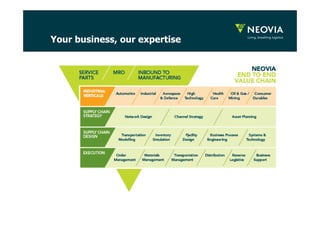
Your business, our expertise
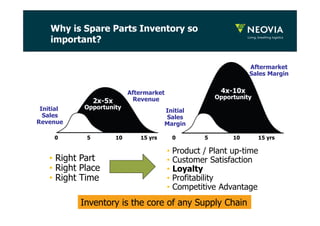
Why is Spare Parts Inventory so 
important? 
Initial 
Sales 
Revenue 
Aftermarket 
Revenue 
Initial 
Sales 
Margin 
2x-5x 
Opportunity 
4x-10x 
Aftermarket 
Sales Margin 
Opportunity 
0 5 10 15 yrs 0 5 10 15 yrs 
• Right Part 
• Right Place 
• Right Time 
• Product / Plant up-time 
• Customer Satisfaction 
• Loyalty 
• Profitability 
• Competitive Advantage 
Inventory is the core of any Supply Chain
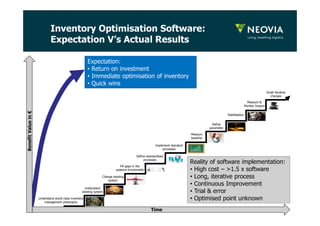
Inventory Optimisation Software: 
Expectation V’s Actual Results 
Benefit Value in € 
Expectation: 
• Return on investment 
• Immediate optimisation of inventory 
• Quick wins 
Time 
Reality of software implementation: 
• High cost – >1.5 x software 
• Long, iterative process 
• Continuous Improvement 
• Trial & error 
• Optimised point unknown 
Define standardised 
processes 
Fill gaps in the 
systems functionality 
Change existing 
system 
Understand world class inventory 
management philosophy 
Understand 
existing system 
Measure & 
Monitor Impact 
Stabilisation 
Refine 
parameter 
Implement standard 
processes 
Measure 
baseline 
Small iterative 
changes
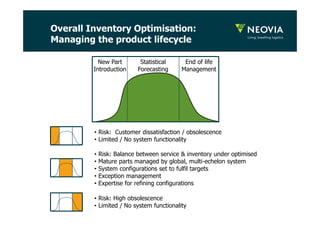
Overall Inventory Optimisation: 
Managing the product lifecycle 
New Part 
Introduction 
Statistical 
Forecasting 
End of life 
Management 
• Risk: Customer dissatisfaction / obsolescence 
• Limited / No system functionality 
• Risk: Balance between service & inventory under optimised 
• Mature parts managed by global, multi-echelon system 
• System configurations set to fulfil targets 
• Exception management 
• Expertise for refining configurations 
• Risk: High obsolescence 
• Limited / No system functionality
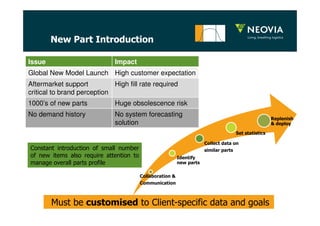
New Part Introduction 
Issue Impact 
Global New Model Launch High customer expectation 
Aftermarket support 
High fill rate required 
critical to brand perception 
1000’s of new parts Huge obsolescence risk 
No demand history No system forecasting 
solution 
Collaboration & 
Communication 
Identify 
new parts 
Set statistics 
Collect data on 
similar parts 
Must be customised to Client-specific data and goals 
Replenish 
& deploy 
Constant introduction of small number 
of new items also require attention to 
manage overall parts profile
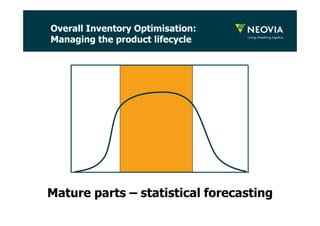
Overall Inventory Optimisation: 
Managing the product lifecycle 
Mature parts – statistical forecasting
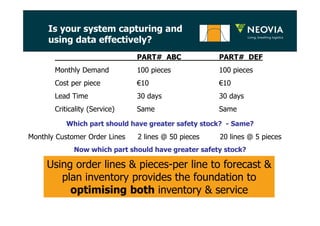
Is your system capturing and 
using data effectively? 
PART# ABC PART# DEF 
Monthly Demand 100 pieces 100 pieces 
Cost per piece €10 €10 
Lead Time 30 days 30 days 
Criticality (Service) Same Same 
Which part should have greater safety stock? - Same? 
Monthly Customer Order Lines 2 lines @ 50 pieces 20 lines @ 5 pieces 
Now which part should have greater safety stock? 
Part DEF impacts more customers with 
Using order lines & pieces-per line to forecast & 
lower inventory investment 
plan inventory provides the foundation to 
optimising both inventory & service
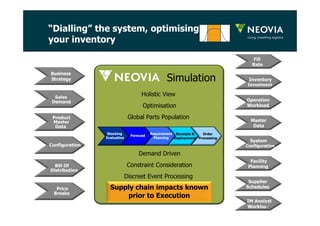
“Dialling” the system, optimising 
your inventory 
FFiillll 
Fill 
RRaattee 
Rate 
IInnvveennttoorryy 
Inventory 
IInnvveessttmmeenntt 
Investment 
OOppeerraattiioonn 
Operation 
WWoorrkkllooaadd 
Workload 
MMaasstteerr 
Master 
DDaattaa 
Data 
SSyysstteemm 
System 
CCoonnffiigguurraattiioonn 
Configuration 
Facility 
Planning 
FFaacciilliittyy 
PPllaannnniinngg 
SSuupppplliieerr 
Supplier 
SScchheedduulleess 
Schedules 
IIMM IM AAnnaallyysstt 
Analyst 
Workload 
WWoorrkkllooaadd 
BBuussiinneessss 
Business 
SSttrraatteeggyy 
Strategy 
SSaalleess 
Sales 
DDeemmaanndd 
Demand 
PPrroodduucctt 
Product 
MMaasstteerr 
Master 
Data 
DDaattaa 
CCoonnffiigguurraattiioonn 
Configuration 
BBiillll Bill OOff 
Of 
DDiissttrriibbuuttiioonn 
Distribution 
PPrriiccee 
Price 
BBrreeaakkss 
Breaks 
10 
SSiimmuullaattiioonn 
Simulation 
Holistic View 
Optimisation 
HHoolliissttiicc VViieeww 
OOppttiimmiissaattiioonn 
Global GGlloobbaall Parts PPaarrttss PPooppuullaattiioonn 
Population 
Forecast 
DDeemmaanndd DDrriivveenn 
CCoonnssttrraaiinntt CCoonnssiiddeerraattiioonn 
DDiissccrreeeett EEvveenntt PPrroocceessssiinngg 
Order 
Processing 
FFoorreeccaasstt 
Stocking 
Evaluation 
Receipts & 
Deployments 
Requirement 
Planning 
Demand Driven 
Constraint Consideration 
Discreet Event Processing 
Supply chain impacts known 
prior to Execution
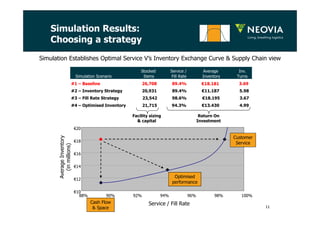
Simulation Results: 
Choosing a strategy 
Simulation Establishes Optimal Service V’s Inventory Exchange Curve & Supply Chain view 
Stocked 
Items 
Service / 
Fill Rate 
Average 
Inventory 
Inv. 
Turns 
€20 
€18 
€16 
€14 
€12 
€10 
88% 90% 92% 94% 96% 98% 100% 
Service / Fill Rate 
Average Inventory 
(in millions) 
Simulation Scenario 
#1 – Baseline 26,708 89.4% €18.181 3.69 
#2 – Inventory Strategy 20,931 89.4% €11.187 5.98 
#3 – Fill Rate Strategy 23,542 98.6% €18.195 3.67 
#4 – Optimised Inventory 21,715 94.3% €13.430 4.99 
Cash Flow 
& Space 
Customer 
Service 
Optimised 
performance 
Facility sizing 
& capital 
Return On 
Investment 
11
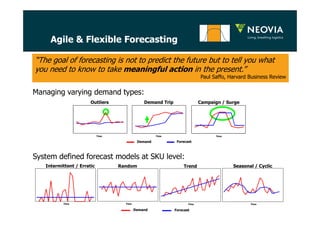
“The goal of forecasting is not to predict the future but to tell you what 
you need to know to take meaningful action in the present.” 
Managing varying demand types: 
Demand Forecast 
System defined forecast models at SKU level: 
Paul Saffo, Harvard Business Review 
Agile & Flexible Forecasting 
Demand Forecast 
Intermittent / Erratic 
Time 
Random 
Time 
Seasonal / Cyclic 
Time 
Trend 
Time 
Demand Trip 
Time 
Outliers 
Time 
Campaign / Surge 
Time
Change 
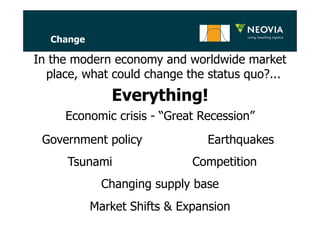
In the modern economy and worldwide market 
place, what could change the status quo?... 
Everything! 
Economic crisis - “Great Recession” 
Earthquakes 
Government policy 
Tsunami 
Competition 
Changing supply base 
Market Shifts & Expansion
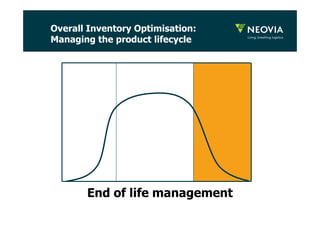
Overall Inventory Optimisation: 
Managing the product lifecycle 
End of life management
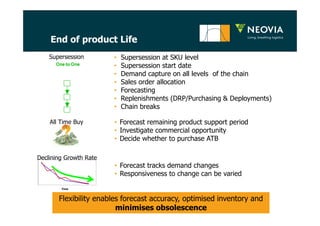
End of product Life 
Supersession • Supersession at SKU level 
• Forecast tracks demand changes 
• Responsiveness to change can be varied 
Flexibility enables forecast accuracy, optimised inventory and 
minimises obsolescence 
Declining Growth Rate 
Time 
• Forecast remaining product support period 
• Investigate commercial opportunity 
• Decide whether to purchase ATB 
All Time Buy 
• Supersession start date 
• Demand capture on all levels of the chain 
• Sales order allocation 
• Forecasting 
• Replenishments (DRP/Purchasing & Deployments) 
• Chain breaks
16 
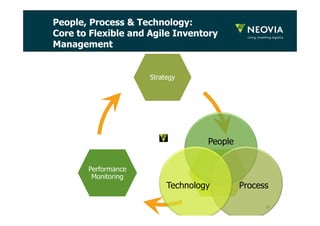
People, Process & Technology: 
Core to Flexible and Agile Inventory 
Management 
Strategy 
Execution 
Performance 
Monitoring 
People 
Technology Process
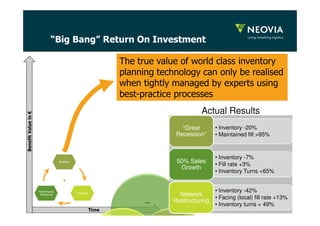
“Big Bang” Return On Investment 
Benefits: 
• Rapidly optimised inventory 
• Cash flow increased 
• Maximised customer service 
• Minimal disruption to supply chain 
• Immediate Return On Investment 
Benefit Value in € 
Time 
Strategy 
Execution 
Performance 
Monitoring 
The true value of world class inventory 
planning technology can only be realised 
when tightly managed by experts using 
best-practice processes 
People 
Actual Results 
• Inventory -20% 
• Maintained fill >95% 
“Great 
Recession” 
• Inventory -7% 
• Fill rate +3% 
• Inventory Turns +65% 
50% Sales 
Growth 
• Inventory -42% 
• Facing (local) fill rate +13% 
• Inventory turns + 49% 
Network 
Restructuring
Thank you for listening 
18 
Joel Marusiak 
IM Solutions Manager – EMEA 
Neovia Logistics 
Please feel free to get in touch… 
joel.marusiak@neovialogistics.com 
Strategy 
Forecasting 
& Inventory 
Planning 
Replenishment 
& Deployment 
Client 
Collaboration 
Performance 
Monitoring & 
Analytics

Joel Marusiak, Neovia Logistics presenatation at Spare Parts 2013

  • 1.
    Global Inventory ManagementStrategy, Design & Execution: Optimisation & Flexibility Amidst Constant Change Joel Marusiak IM Solutions Manager - EMEA February 8th 2013
  • 2.
    Your future, ourhistory • Your business is time sensitive? • Your product is service critical? • You require an agile partner that addresses all your needs? You answered YES to these questions? Then join our customers and chose Neovia Logistics to manage your value chain.
  • 3.
  • 4.
    Why is SpareParts Inventory so important? Initial Sales Revenue Aftermarket Revenue Initial Sales Margin 2x-5x Opportunity 4x-10x Aftermarket Sales Margin Opportunity 0 5 10 15 yrs 0 5 10 15 yrs • Right Part • Right Place • Right Time • Product / Plant up-time • Customer Satisfaction • Loyalty • Profitability • Competitive Advantage Inventory is the core of any Supply Chain
  • 5.
    Inventory Optimisation Software: Expectation V’s Actual Results Benefit Value in € Expectation: • Return on investment • Immediate optimisation of inventory • Quick wins Time Reality of software implementation: • High cost – >1.5 x software • Long, iterative process • Continuous Improvement • Trial & error • Optimised point unknown Define standardised processes Fill gaps in the systems functionality Change existing system Understand world class inventory management philosophy Understand existing system Measure & Monitor Impact Stabilisation Refine parameter Implement standard processes Measure baseline Small iterative changes
  • 6.
    Overall Inventory Optimisation: Managing the product lifecycle New Part Introduction Statistical Forecasting End of life Management • Risk: Customer dissatisfaction / obsolescence • Limited / No system functionality • Risk: Balance between service & inventory under optimised • Mature parts managed by global, multi-echelon system • System configurations set to fulfil targets • Exception management • Expertise for refining configurations • Risk: High obsolescence • Limited / No system functionality
  • 7.
    New Part Introduction Issue Impact Global New Model Launch High customer expectation Aftermarket support High fill rate required critical to brand perception 1000’s of new parts Huge obsolescence risk No demand history No system forecasting solution Collaboration & Communication Identify new parts Set statistics Collect data on similar parts Must be customised to Client-specific data and goals Replenish & deploy Constant introduction of small number of new items also require attention to manage overall parts profile
  • 8.
    Overall Inventory Optimisation: Managing the product lifecycle Mature parts – statistical forecasting
  • 9.
    Is your systemcapturing and using data effectively? PART# ABC PART# DEF Monthly Demand 100 pieces 100 pieces Cost per piece €10 €10 Lead Time 30 days 30 days Criticality (Service) Same Same Which part should have greater safety stock? - Same? Monthly Customer Order Lines 2 lines @ 50 pieces 20 lines @ 5 pieces Now which part should have greater safety stock? Part DEF impacts more customers with Using order lines & pieces-per line to forecast & lower inventory investment plan inventory provides the foundation to optimising both inventory & service
  • 10.
    “Dialling” the system,optimising your inventory FFiillll Fill RRaattee Rate IInnvveennttoorryy Inventory IInnvveessttmmeenntt Investment OOppeerraattiioonn Operation WWoorrkkllooaadd Workload MMaasstteerr Master DDaattaa Data SSyysstteemm System CCoonnffiigguurraattiioonn Configuration Facility Planning FFaacciilliittyy PPllaannnniinngg SSuupppplliieerr Supplier SScchheedduulleess Schedules IIMM IM AAnnaallyysstt Analyst Workload WWoorrkkllooaadd BBuussiinneessss Business SSttrraatteeggyy Strategy SSaalleess Sales DDeemmaanndd Demand PPrroodduucctt Product MMaasstteerr Master Data DDaattaa CCoonnffiigguurraattiioonn Configuration BBiillll Bill OOff Of DDiissttrriibbuuttiioonn Distribution PPrriiccee Price BBrreeaakkss Breaks 10 SSiimmuullaattiioonn Simulation Holistic View Optimisation HHoolliissttiicc VViieeww OOppttiimmiissaattiioonn Global GGlloobbaall Parts PPaarrttss PPooppuullaattiioonn Population Forecast DDeemmaanndd DDrriivveenn CCoonnssttrraaiinntt CCoonnssiiddeerraattiioonn DDiissccrreeeett EEvveenntt PPrroocceessssiinngg Order Processing FFoorreeccaasstt Stocking Evaluation Receipts & Deployments Requirement Planning Demand Driven Constraint Consideration Discreet Event Processing Supply chain impacts known prior to Execution
  • 11.
    Simulation Results: Choosinga strategy Simulation Establishes Optimal Service V’s Inventory Exchange Curve & Supply Chain view Stocked Items Service / Fill Rate Average Inventory Inv. Turns €20 €18 €16 €14 €12 €10 88% 90% 92% 94% 96% 98% 100% Service / Fill Rate Average Inventory (in millions) Simulation Scenario #1 – Baseline 26,708 89.4% €18.181 3.69 #2 – Inventory Strategy 20,931 89.4% €11.187 5.98 #3 – Fill Rate Strategy 23,542 98.6% €18.195 3.67 #4 – Optimised Inventory 21,715 94.3% €13.430 4.99 Cash Flow & Space Customer Service Optimised performance Facility sizing & capital Return On Investment 11
  • 12.
    “The goal offorecasting is not to predict the future but to tell you what you need to know to take meaningful action in the present.” Managing varying demand types: Demand Forecast System defined forecast models at SKU level: Paul Saffo, Harvard Business Review Agile & Flexible Forecasting Demand Forecast Intermittent / Erratic Time Random Time Seasonal / Cyclic Time Trend Time Demand Trip Time Outliers Time Campaign / Surge Time
  • 13.
    Change In themodern economy and worldwide market place, what could change the status quo?... Everything! Economic crisis - “Great Recession” Earthquakes Government policy Tsunami Competition Changing supply base Market Shifts & Expansion
  • 14.
    Overall Inventory Optimisation: Managing the product lifecycle End of life management
  • 15.
    End of productLife Supersession • Supersession at SKU level • Forecast tracks demand changes • Responsiveness to change can be varied Flexibility enables forecast accuracy, optimised inventory and minimises obsolescence Declining Growth Rate Time • Forecast remaining product support period • Investigate commercial opportunity • Decide whether to purchase ATB All Time Buy • Supersession start date • Demand capture on all levels of the chain • Sales order allocation • Forecasting • Replenishments (DRP/Purchasing & Deployments) • Chain breaks
  • 16.
    16 People, Process& Technology: Core to Flexible and Agile Inventory Management Strategy Execution Performance Monitoring People Technology Process
  • 17.
    “Big Bang” ReturnOn Investment Benefits: • Rapidly optimised inventory • Cash flow increased • Maximised customer service • Minimal disruption to supply chain • Immediate Return On Investment Benefit Value in € Time Strategy Execution Performance Monitoring The true value of world class inventory planning technology can only be realised when tightly managed by experts using best-practice processes People Actual Results • Inventory -20% • Maintained fill >95% “Great Recession” • Inventory -7% • Fill rate +3% • Inventory Turns +65% 50% Sales Growth • Inventory -42% • Facing (local) fill rate +13% • Inventory turns + 49% Network Restructuring
  • 18.
    Thank you forlistening 18 Joel Marusiak IM Solutions Manager – EMEA Neovia Logistics Please feel free to get in touch… joel.marusiak@neovialogistics.com Strategy Forecasting & Inventory Planning Replenishment & Deployment Client Collaboration Performance Monitoring & Analytics