ABDOMINAL PARACENTESIS
INTRODUCTION
The accumulation of large amount of fluid within the peritoneal cavity exerts pressure on
the diaphragm and abdominal organs and vasculature, leading to respiratory compromise and
increased work of breathing. Paracentesis relieves intra abdominal and diaphragmatic pressures,
diminishing the work of breathing.
DEFINITION:
Paracentesis is a procedure in which fluid is removed from the peritoneal cavity for
diagnostic and therapeutic purposes.
PURPOSES:
1. To obtain fluid samples from the peritoneal space for diagnostic examination.
2. Evacuate fluid from the peritoneal space.
3. Alleviate respiratory compromise related to pressure on the diaphragm caused by
ascetic fluid.
Indications:
It is used for a number of reasons:
1. To relieve abdominal pressure from ascites
2. To diagnose spontaneous bacterial peritonitis and other infections (e.g. Abdominal tb)
3. To diagnose metastatic cancer
4. To diagnose blood in peritoneal space in trauma
5. To puncture the tympanic membrane for diagnostic purposes, such as taking a bacterial
swab from the middle ear (tympanocentesis).
6. To reduce intra-ocular pressure in central retinal artery occlusion (oculocaentesi) and any
hyphaema in the anterior chamber of the eye where blood does not get absorbed in a
week’s time.
Contraindications:
Mild hematologic abnormalities do not increase the risk of bleeding. The risk of bleeding may be
increased if.
 prothrombin time > 21 seconds
 international normalized ratio > 1.6
 Platelet count < 50,000 per cubic millimeter.
Absolute contraindication is acute abdomen that requires surgery. Relative contraindications are:
 Pregnancy
 Distended urinary bladder
 Abdominal wall cellulitis
 Distended bowel
 Intra-abdominal adhesions.
PREPARATION OF THE ARTICLES:
A tray containing;
 Sterile gloves, gown and mask
 Povidone iodine solution
 Sterile drape
 Lidocaine 2%
 5cc syringe and needle
 25 gauge needle
 10cc syringe-2
 50cc syringe-2
 Trocar with stylet
 Sterile tubes for specimen
 Surgical blade
 Three way stop cock
 Sterile 1L collection bottle
 Suture material with needle
 Gauze and tape
PREPARATION OF THE PATIENT:
 Explain the procedure to the patient.
 Obtain an informed consent
 Obtain coagulation profile and platelet count before beginning the procedure.
 Ask the client to void immediately prior to the procedure to decrease the risk of bladder
puncture.
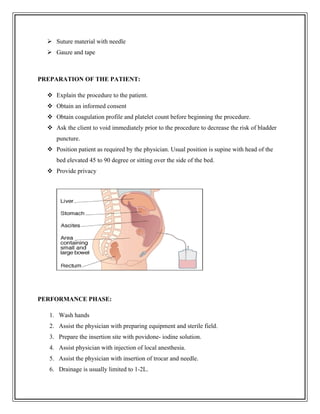
 Position patient as required by the physician. Usual position is supine with head of the
bed elevated 45 to 90 degree or sitting over the side of the bed.
 Provide privacy
PERFORMANCE PHASE:
1. Wash hands
2. Assist the physician with preparing equipment and sterile field.
3. Prepare the insertion site with povidone- iodine solution.
4. Assist physician with injection of local anesthesia.
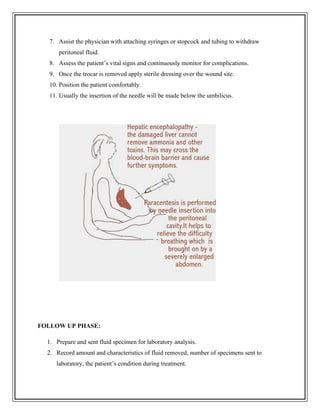
5. Assist the physician with insertion of trocar and needle.
6. Drainage is usually limited to 1-2L.
7. Assist the physician with attaching syringes or stopcock and tubing to withdraw
peritoneal fluid.
8. Assess the patient’s vital signs and continuously monitor for complications.
9. Once the trocar is removed apply sterile dressing over the wound site.
10. Position the patient comfortably.
11. Usually the insertion of the needle will be made below the umbilicus.
FOLLOW UP PHASE:
1. Prepare and sent fluid specimen for laboratory analysis.
2. Record amount and characteristics of fluid removed, number of specimens sent to
laboratory, the patient’s condition during treatment.
3. Check blood pressure and vital signs every half hour for two hours, every hour for four
hours and every four hour for 24 hours.
4. Watch for leakage or scrotal edema after paracentesis.
5. Observe the site for bleeding.
6. Wash hands
7. Replace the articles.
COMPLICATIONS:
1. Perforation of bowel or bladder
2. Local or systemic infection
3. Hypovolemia, hypotension
4. Bleeding from paracentesis site
5. Ascetic leak from paracentesis site
Nurses reponsibilities:
1. Record immediately post procedure and two hourly thereafter and refer to medical team
if observations are abnormal.
2. Assess pain two hourly, record scores on MEWS observation chart and follow analgesic
algorithm on back of the analgesic assessment chart.
3. Evaluate effectiveness of analgesia if required and refer to medical team if analgesic is
ineffective or inadequate.
4. Monitor drainage on the fluid balance chart free flowing up to 5 litres unless adverse
symptoms present.
5. If patient shows adverse signs clamp drain, inform medical team and reopen after medical
intervention and advice.
6. Encourage patient to change position i.e. sitting upright, or onto alternate sides to
encourage drainage of fluid.
7. Encourage patient to eat and drink as able.
8. Remove drains 6 hours post procedure.
9. Apply dressing to drain site and advise patient to remove dressing after 48 hours.
10. Encourage patient to mobilise as able following removal of drain.
11. Patient can be discharged 30 minutes after drain has been removed.
12. Document date, time and amount of fluid drained in the nursing and medical note.
CONCLUSION:
Paracentesis is performed to relieve intra abdominal and diaphragmatic pressures and
diminishing the work of breathing. It can be performed for both diagnostic and therapeutic
purposes. The nurse who assists for paracentesis should know the anatomy and physiology of the
lower quadrant of the abdomen and the normal and abnormal composition of peritoneal fluid.
BIBLIOGRAPHY:
1. Sandra MN. The Lippincott manual of nursing practice. 7th
ed. Lippincott: Jaypee
brothers; 2003. P. 645-6.
2. Rochelle LB, Maribeth. American association of critical care nurses, procedure
manual for critical care. Philadelphia: WB Saunders company; 1993. P. 549-53.
3. Black JM, Jane HH. Medical surgical nursing. 7th
ed. . Missouri: Elsevier; 2005.
P.1509-21.
THORACENTESIS
Definition:-
 A Thoracentesis is a procedure that involves using a needle to drain fluid from either
within the lungs or the surrounding pleural cavity (around your lungs).
 It is done using Ultrasound imaging (US) guidance.
 It can be done to determine the source of fluid buildup, to improve your recovery and
quality of life, or for both reasons.
Indications: -
1) Pleural effusion which needs diagnostic work-up
2) Symptomatic treatment of a large pleural effusion
Contraindications:-
1) Uncooperative patient
2) Uncorrected bleeding diathesis
3) Chest wall cellulitis at the site of puncture
Relative contraindications:-
1) Bullous disease, e.g. emphysema
2) Positive end-expiratory pressure (PEEP) mechanical ventilation Only one functioning lung
3) Small volume of fluid (less than 1 cm thickness on a lateral decubitus film)
EQUIPMENT:-
 Numerous prepackaged thoracentesis kits (e.g., Safe-T-Centesis Catheter Drainage
Tray, Cardinal Health).
 antiseptic solution (chlorhexidine or povidone–iodine),
 sterile gauze,
 sterile drape,
 sterile gloves,
 a small syringe for anesthetic injection,
 25- and 22-gauge needles for anesthetic injection, and local anesthetic (e.g., lidocaine).
Catheter,
 a large syringe (35 to 60 ml) for the aspiration of pleural fluid,
 three-way stopcock,
 high-pressure drainage tubing,
 sterile occlusive dressing
 specimen tubes,
PREPARATION:-
1. Explain the procedure to the patient, and obtain written informed consent.
2. Verify the patient’s identity,
3. Ensure that the needle-insertion site is correctly marked.
4. Take a time-out immediately before the procedure for final verification by all mem-bers
of the care team that the patient, the procedure, and the site are all correct. (More
information is available at
5. Thoracentesis is a sterile procedure, and you should wash your hands before the
procedure and wear sterile gloves during the procedure.
6. Enlist the help of one or two assistants.
7. They will be needed to help position and monitor the patient and fill the evacuated
container and specimen tubes.
8. Place the patient in a sitting position on the edge of the bed, leaning forward with his or
her arms resting on a bedside table.
9. If the patient is unable to sit up-right, the lateral recumbent or supine position may be
used. The level of the effusion should be estimated on the basis of diminished or absent
sounds on auscultation,Dullness to percussion, and decreased or absent fremitus.
10. You should insert the needle one or two intercostal spaces below the level of the effusion,
5 to 10 cm lateral to the spine.
11. To avoid intraabdominal injury, do not insert the needle below the ninth rib.
12. Mark the appropriate site, and then prepare the skin with antiseptic Solution and apply a
sterile drape.
13. Anesthetize the epidermis overlying the superior edge of the rib that lies below the
selected intercostal space, using 1% or 2% lidocaine and a small (25-gauge needle.
14. Insert a larger (22-gauge) needle and then “walk” it along the superior edge of the rib,
alternately injecting anesthetic and pulling back on the plunger every 2 or 3 mm to rule
out intravascular placement and to check for proper intrapleural placement.
15. To avoid injury to the intercostal nerve and vessels, the needle must not touch the inferior
surface of the rib.
16. Once pleural fluid is aspirated, stop advancing the needle and inject additional lidocaine
to anesthetize the highly sensitive parietal pleura.
17. Note the depth of penetration before withdrawing the needle.
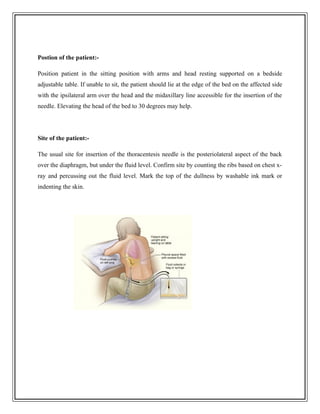
Postion of the patient:-
Position patient in the sitting position with arms and head resting supported on a bedside
adjustable table. If unable to sit, the patient should lie at the edge of the bed on the affected side
with the ipsilateral arm over the head and the midaxillary line accessible for the insertion of the
needle. Elevating the head of the bed to 30 degrees may help.
Site of the patient:-
The usual site for insertion of the thoracentesis needle is the posteriolateral aspect of the back
over the diaphragm, but under the fluid level. Confirm site by counting the ribs based on chest x-
ray and percussing out the fluid level. Mark the top of the dullness by washable ink mark or
indenting the skin.
Procedure Step-by-Step:-
1. Explain the procedure to the patient and obtain a written informed consent, if possible.
Explain the risks, benefits and alternatives (RBA). Benefits may include less SOB,
obtaining a diagnosis, and risks may include pneumothorax, bleeding, or even death.
2. Using ultrasonography to identify a site for diagnostic thoracentesis is associated with
significantly lower risk of pneumothorax, than using the physical exam for site selection.
3. Get the standard thoracentesis kit. In addition to the kit, you will need two 1-liter vacuum
bottles and Bethadine for cleaning the area. Prepare the necessary equipment for the
pleural tap.
4. Find the anatomical landmarks before you perform the thoracentesis.
5. Clean the area with iodine.
6. Open the kit and make sure that you know which tube and needle are used for.
7. Practice sliding the flexible catheter.
8. Prepare for local anesthesia.
9. Prepare the area.
10. Perform the procedure (under supervision, if you are not certified). Anesthetize the skin
and pleura, try to reach the effusion fluid.
11. Prepare the flexible catheter.
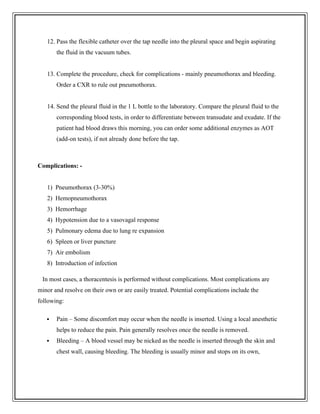
12. Pass the flexible catheter over the tap needle into the pleural space and begin aspirating
the fluid in the vacuum tubes.
13. Complete the procedure, check for complications - mainly pneumothorax and bleeding.
Order a CXR to rule out pneumothorax.
14. Send the pleural fluid in the 1 L bottle to the laboratory. Compare the pleural fluid to the
corresponding blood tests, in order to differentiate between transudate and exudate. If the
patient had blood draws this morning, you can order some additional enzymes as AOT
(add-on tests), if not already done before the tap.
Complications: -
1) Pneumothorax (3-30%)
2) Hemopneumothorax
3) Hemorrhage
4) Hypotension due to a vasovagal response
5) Pulmonary edema due to lung re expansion
6) Spleen or liver puncture
7) Air embolism
8) Introduction of infection
In most cases, a thoracentesis is performed without complications. Most complications are
minor and resolve on their own or are easily treated. Potential complications include the
following:
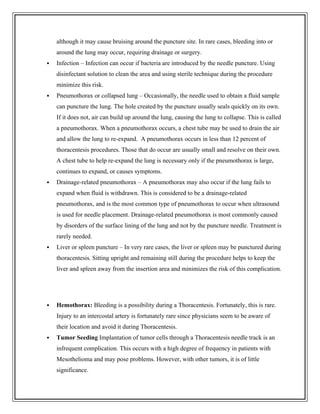
 Pain – Some discomfort may occur when the needle is inserted. Using a local anesthetic
helps to reduce the pain. Pain generally resolves once the needle is removed.
 Bleeding – A blood vessel may be nicked as the needle is inserted through the skin and
chest wall, causing bleeding. The bleeding is usually minor and stops on its own,
although it may cause bruising around the puncture site. In rare cases, bleeding into or
around the lung may occur, requiring drainage or surgery.
 Infection – Infection can occur if bacteria are introduced by the needle puncture. Using
disinfectant solution to clean the area and using sterile technique during the procedure
minimize this risk.
 Pneumothorax or collapsed lung – Occasionally, the needle used to obtain a fluid sample
can puncture the lung. The hole created by the puncture usually seals quickly on its own.
If it does not, air can build up around the lung, causing the lung to collapse. This is called
a pneumothorax. When a pneumothorax occurs, a chest tube may be used to drain the air
and allow the lung to re-expand. A pneumothorax occurs in less than 12 percent of
thoracentesis procedures. Those that do occur are usually small and resolve on their own.
A chest tube to help re-expand the lung is necessary only if the pneumothorax is large,
continues to expand, or causes symptoms.
 Drainage-related pneumothorax – A pneumothorax may also occur if the lung fails to
expand when fluid is withdrawn. This is considered to be a drainage-related
pneumothorax, and is the most common type of pneumothorax to occur when ultrasound
is used for needle placement. Drainage-related pneumothorax is most commonly caused
by disorders of the surface lining of the lung and not by the puncture needle. Treatment is
rarely needed.
 Liver or spleen puncture – In very rare cases, the liver or spleen may be punctured during
thoracentesis. Sitting upright and remaining still during the procedure helps to keep the
liver and spleen away from the insertion area and minimizes the risk of this complication.
 Hemothorax: Bleeding is a possibility during a Thoracentesis. Fortunately, this is rare.
Injury to an intercostal artery is fortunately rare since physicians seem to be aware of
their location and avoid it during Thoracentesis.
 Tumor Seeding Implantation of tumor cells through a Thoracentesis needle track is an
infrequent complication. This occurs with a high degree of frequency in patients with
Mesothelioma and may pose problems. However, with other tumors, it is of little
significance.
 Extravasation of Fluid
Subcutaneous Seroma: If the fluid is under tension, extravasation can occur along the
needle track to the subcutaneous tissue. In some patients, this is massive, disfiguring
chest and abdominal wall. Anticipate this complication in massive effusions, particularly
when the fluid spurts out or fills the syringe forcefully during the Thoracentesis. You
may want to release the pressure by evacuating some fluid and following it up with a firm
pressure bandage. Should this occur, reassure the patient. Usually, it gets reabsorbed in a
matter of days.
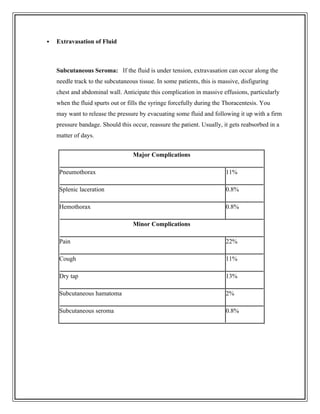
Major Complications
Pneumothorax 11%
Splenic laceration 0.8%
Hemothorax 0.8%
Minor Complications
Pain 22%
Cough 11%
Dry tap 13%
Subcutaneous hamatoma 2%
Subcutaneous seroma 0.8%
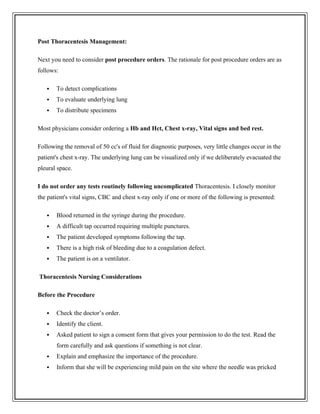
Post Thoracentesis Management:
Next you need to consider post procedure orders. The rationale for post procedure orders are as
follows:
 To detect complications
 To evaluate underlying lung
 To distribute specimens
Most physicians consider ordering a Hb and Hct, Chest x-ray, Vital signs and bed rest.
Following the removal of 50 cc's of fluid for diagnostic purposes, very little changes occur in the
patient's chest x-ray. The underlying lung can be visualized only if we deliberately evacuated the
pleural space.
I do not order any tests routinely following uncomplicated Thoracentesis. I closely monitor
the patient's vital signs, CBC and chest x-ray only if one or more of the following is presented:
 Blood returned in the syringe during the procedure.
 A difficult tap occurred requiring multiple punctures.
 The patient developed symptoms following the tap.
 There is a high risk of bleeding due to a coagulation defect.
 The patient is on a ventilator.
Thoracentesis Nursing Considerations
Before the Procedure
 Check the doctor’s order.
 Identify the client.
 Asked patient to sign a consent form that gives your permission to do the test. Read the
form carefully and ask questions if something is not clear.
 Explain and emphasize the importance of the procedure.
 Inform that she will be experiencing mild pain on the site where the needle was pricked
 Inform the client that the procedure takes only few minutes, depending primarily on the
time it takes for fluid to drain from the pleural cavity.
 Inform the client not to cough while the needle is inserted in order to avoid puncturing
the lung
 Explain when and where the procedure will occur and who will be present.
 Explain the procedure to the patient and SO, reinforcing what the physician has
previously explained to the patient
 The patient may have a diagnostic procedure, such as a chest x-ray, chest fluoroscopy,
ultrasound, or CT scan, performed prior to the procedure to assist the physician in
identifying the specific location of the fluid in the chest that is to be removed.
 The patient may receive a sedative prior to the procedure to help the patient relax.
 Asked the patient to remove any clothing, jewelry, or other objects that may interfere
with the procedure.
 The area around the puncture site may be shaved.
 Vital signs (heart rate, blood pressure, breathing rate, and oxygen level) are to be
monitored before the procedure.
During the Procedure
 Support the client verbally and describe the steps of the procedure as needed.
 Vital signs (heart rate, blood pressure, breathing rate, and oxygen level) are to be
monitored during the procedure.
 The patient may receive supplemental oxygen as needed, through a face mask or nasal
cannula (tube).
 Observe the client for signs of distress, such as dyspnea, pallor, and coughing
 Place the patient in a sitting position with arms raised and resting on an overbed table.
This position aids in spreading out the spaces between the ribs for needle insertion. If the
patient is unable to sit, the patient may be placed in a side-lying position on the edge of
the bed on unaffected side.
 The skin at the puncture site will be cleansed with an antiseptic solution.
 The patient will receive a local anesthetic at the site where the thoracentesis is to be
performed.
 Don’t remove more than 1000 ml of fluid from the pleural cavity within first 30 minutes.
 Place a small sterile dressing over the site of the puncture.
After the Procedure
 Observe changes in the client’s cough, sputum, respiratory depth, and breath sounds, and
note complaints of chest pain.
 Position the client appropriately
 Some agency protocols recommend that the client lie on the unaffected side with the
head of the bed elevated 30 degrees for at least 30 minutes because this position
facilitates expansion of the affected lung and eases respirations
 Position the patient in a side-lying position with the unaffected side down for an hour or
longer.
 Include date and time performed; the primary care provider’s name; the amount, color,
and clarity of fluid drained; and nursing assessments and interventions provided.
 Transport the specimens to the laboratory.
 The dressing over the puncture site will be monitored for bleeding or other drainage.
 Monitor patient’s blood pressure, pulse, and breathing until are stable.
 Document all relevant information.

ABDOMINAL PARACENTESIS ,THORACENTESIS PROCEDURE

  • 1.
    ABDOMINAL PARACENTESIS INTRODUCTION The accumulationof large amount of fluid within the peritoneal cavity exerts pressure on the diaphragm and abdominal organs and vasculature, leading to respiratory compromise and increased work of breathing. Paracentesis relieves intra abdominal and diaphragmatic pressures, diminishing the work of breathing. DEFINITION: Paracentesis is a procedure in which fluid is removed from the peritoneal cavity for diagnostic and therapeutic purposes. PURPOSES: 1. To obtain fluid samples from the peritoneal space for diagnostic examination. 2. Evacuate fluid from the peritoneal space. 3. Alleviate respiratory compromise related to pressure on the diaphragm caused by ascetic fluid. Indications: It is used for a number of reasons: 1. To relieve abdominal pressure from ascites 2. To diagnose spontaneous bacterial peritonitis and other infections (e.g. Abdominal tb) 3. To diagnose metastatic cancer 4. To diagnose blood in peritoneal space in trauma 5. To puncture the tympanic membrane for diagnostic purposes, such as taking a bacterial swab from the middle ear (tympanocentesis). 6. To reduce intra-ocular pressure in central retinal artery occlusion (oculocaentesi) and any hyphaema in the anterior chamber of the eye where blood does not get absorbed in a week’s time.
  • 2.
    Contraindications: Mild hematologic abnormalitiesdo not increase the risk of bleeding. The risk of bleeding may be increased if.  prothrombin time > 21 seconds  international normalized ratio > 1.6  Platelet count < 50,000 per cubic millimeter. Absolute contraindication is acute abdomen that requires surgery. Relative contraindications are:  Pregnancy  Distended urinary bladder  Abdominal wall cellulitis  Distended bowel  Intra-abdominal adhesions. PREPARATION OF THE ARTICLES: A tray containing;  Sterile gloves, gown and mask  Povidone iodine solution  Sterile drape  Lidocaine 2%  5cc syringe and needle  25 gauge needle  10cc syringe-2  50cc syringe-2  Trocar with stylet  Sterile tubes for specimen  Surgical blade  Three way stop cock  Sterile 1L collection bottle
  • 3.
     Suture materialwith needle  Gauze and tape PREPARATION OF THE PATIENT:  Explain the procedure to the patient.  Obtain an informed consent  Obtain coagulation profile and platelet count before beginning the procedure.  Ask the client to void immediately prior to the procedure to decrease the risk of bladder puncture.  Position patient as required by the physician. Usual position is supine with head of the bed elevated 45 to 90 degree or sitting over the side of the bed.  Provide privacy PERFORMANCE PHASE: 1. Wash hands 2. Assist the physician with preparing equipment and sterile field. 3. Prepare the insertion site with povidone- iodine solution. 4. Assist physician with injection of local anesthesia. 5. Assist the physician with insertion of trocar and needle. 6. Drainage is usually limited to 1-2L.
  • 4.
    7. Assist thephysician with attaching syringes or stopcock and tubing to withdraw peritoneal fluid. 8. Assess the patient’s vital signs and continuously monitor for complications. 9. Once the trocar is removed apply sterile dressing over the wound site. 10. Position the patient comfortably. 11. Usually the insertion of the needle will be made below the umbilicus. FOLLOW UP PHASE: 1. Prepare and sent fluid specimen for laboratory analysis. 2. Record amount and characteristics of fluid removed, number of specimens sent to laboratory, the patient’s condition during treatment.
  • 5.
    3. Check bloodpressure and vital signs every half hour for two hours, every hour for four hours and every four hour for 24 hours. 4. Watch for leakage or scrotal edema after paracentesis. 5. Observe the site for bleeding. 6. Wash hands 7. Replace the articles. COMPLICATIONS: 1. Perforation of bowel or bladder 2. Local or systemic infection 3. Hypovolemia, hypotension 4. Bleeding from paracentesis site 5. Ascetic leak from paracentesis site Nurses reponsibilities: 1. Record immediately post procedure and two hourly thereafter and refer to medical team if observations are abnormal. 2. Assess pain two hourly, record scores on MEWS observation chart and follow analgesic algorithm on back of the analgesic assessment chart. 3. Evaluate effectiveness of analgesia if required and refer to medical team if analgesic is ineffective or inadequate. 4. Monitor drainage on the fluid balance chart free flowing up to 5 litres unless adverse symptoms present. 5. If patient shows adverse signs clamp drain, inform medical team and reopen after medical intervention and advice. 6. Encourage patient to change position i.e. sitting upright, or onto alternate sides to encourage drainage of fluid. 7. Encourage patient to eat and drink as able.
  • 6.
    8. Remove drains6 hours post procedure. 9. Apply dressing to drain site and advise patient to remove dressing after 48 hours. 10. Encourage patient to mobilise as able following removal of drain. 11. Patient can be discharged 30 minutes after drain has been removed. 12. Document date, time and amount of fluid drained in the nursing and medical note. CONCLUSION: Paracentesis is performed to relieve intra abdominal and diaphragmatic pressures and diminishing the work of breathing. It can be performed for both diagnostic and therapeutic purposes. The nurse who assists for paracentesis should know the anatomy and physiology of the lower quadrant of the abdomen and the normal and abnormal composition of peritoneal fluid. BIBLIOGRAPHY: 1. Sandra MN. The Lippincott manual of nursing practice. 7th ed. Lippincott: Jaypee brothers; 2003. P. 645-6. 2. Rochelle LB, Maribeth. American association of critical care nurses, procedure manual for critical care. Philadelphia: WB Saunders company; 1993. P. 549-53. 3. Black JM, Jane HH. Medical surgical nursing. 7th ed. . Missouri: Elsevier; 2005. P.1509-21.
  • 7.
    THORACENTESIS Definition:-  A Thoracentesisis a procedure that involves using a needle to drain fluid from either within the lungs or the surrounding pleural cavity (around your lungs).  It is done using Ultrasound imaging (US) guidance.  It can be done to determine the source of fluid buildup, to improve your recovery and quality of life, or for both reasons. Indications: - 1) Pleural effusion which needs diagnostic work-up 2) Symptomatic treatment of a large pleural effusion Contraindications:- 1) Uncooperative patient 2) Uncorrected bleeding diathesis 3) Chest wall cellulitis at the site of puncture Relative contraindications:- 1) Bullous disease, e.g. emphysema 2) Positive end-expiratory pressure (PEEP) mechanical ventilation Only one functioning lung 3) Small volume of fluid (less than 1 cm thickness on a lateral decubitus film)
  • 8.
    EQUIPMENT:-  Numerous prepackagedthoracentesis kits (e.g., Safe-T-Centesis Catheter Drainage Tray, Cardinal Health).  antiseptic solution (chlorhexidine or povidone–iodine),  sterile gauze,  sterile drape,  sterile gloves,  a small syringe for anesthetic injection,  25- and 22-gauge needles for anesthetic injection, and local anesthetic (e.g., lidocaine). Catheter,  a large syringe (35 to 60 ml) for the aspiration of pleural fluid,  three-way stopcock,  high-pressure drainage tubing,  sterile occlusive dressing  specimen tubes, PREPARATION:- 1. Explain the procedure to the patient, and obtain written informed consent. 2. Verify the patient’s identity, 3. Ensure that the needle-insertion site is correctly marked. 4. Take a time-out immediately before the procedure for final verification by all mem-bers of the care team that the patient, the procedure, and the site are all correct. (More information is available at
  • 9.
    5. Thoracentesis isa sterile procedure, and you should wash your hands before the procedure and wear sterile gloves during the procedure. 6. Enlist the help of one or two assistants. 7. They will be needed to help position and monitor the patient and fill the evacuated container and specimen tubes. 8. Place the patient in a sitting position on the edge of the bed, leaning forward with his or her arms resting on a bedside table. 9. If the patient is unable to sit up-right, the lateral recumbent or supine position may be used. The level of the effusion should be estimated on the basis of diminished or absent sounds on auscultation,Dullness to percussion, and decreased or absent fremitus. 10. You should insert the needle one or two intercostal spaces below the level of the effusion, 5 to 10 cm lateral to the spine. 11. To avoid intraabdominal injury, do not insert the needle below the ninth rib. 12. Mark the appropriate site, and then prepare the skin with antiseptic Solution and apply a sterile drape. 13. Anesthetize the epidermis overlying the superior edge of the rib that lies below the selected intercostal space, using 1% or 2% lidocaine and a small (25-gauge needle. 14. Insert a larger (22-gauge) needle and then “walk” it along the superior edge of the rib, alternately injecting anesthetic and pulling back on the plunger every 2 or 3 mm to rule out intravascular placement and to check for proper intrapleural placement. 15. To avoid injury to the intercostal nerve and vessels, the needle must not touch the inferior surface of the rib. 16. Once pleural fluid is aspirated, stop advancing the needle and inject additional lidocaine to anesthetize the highly sensitive parietal pleura. 17. Note the depth of penetration before withdrawing the needle.
  • 10.
    Postion of thepatient:- Position patient in the sitting position with arms and head resting supported on a bedside adjustable table. If unable to sit, the patient should lie at the edge of the bed on the affected side with the ipsilateral arm over the head and the midaxillary line accessible for the insertion of the needle. Elevating the head of the bed to 30 degrees may help. Site of the patient:- The usual site for insertion of the thoracentesis needle is the posteriolateral aspect of the back over the diaphragm, but under the fluid level. Confirm site by counting the ribs based on chest x- ray and percussing out the fluid level. Mark the top of the dullness by washable ink mark or indenting the skin.
  • 11.
    Procedure Step-by-Step:- 1. Explainthe procedure to the patient and obtain a written informed consent, if possible. Explain the risks, benefits and alternatives (RBA). Benefits may include less SOB, obtaining a diagnosis, and risks may include pneumothorax, bleeding, or even death. 2. Using ultrasonography to identify a site for diagnostic thoracentesis is associated with significantly lower risk of pneumothorax, than using the physical exam for site selection. 3. Get the standard thoracentesis kit. In addition to the kit, you will need two 1-liter vacuum bottles and Bethadine for cleaning the area. Prepare the necessary equipment for the pleural tap. 4. Find the anatomical landmarks before you perform the thoracentesis. 5. Clean the area with iodine. 6. Open the kit and make sure that you know which tube and needle are used for. 7. Practice sliding the flexible catheter. 8. Prepare for local anesthesia. 9. Prepare the area. 10. Perform the procedure (under supervision, if you are not certified). Anesthetize the skin and pleura, try to reach the effusion fluid. 11. Prepare the flexible catheter.
  • 12.
    12. Pass theflexible catheter over the tap needle into the pleural space and begin aspirating the fluid in the vacuum tubes. 13. Complete the procedure, check for complications - mainly pneumothorax and bleeding. Order a CXR to rule out pneumothorax. 14. Send the pleural fluid in the 1 L bottle to the laboratory. Compare the pleural fluid to the corresponding blood tests, in order to differentiate between transudate and exudate. If the patient had blood draws this morning, you can order some additional enzymes as AOT (add-on tests), if not already done before the tap. Complications: - 1) Pneumothorax (3-30%) 2) Hemopneumothorax 3) Hemorrhage 4) Hypotension due to a vasovagal response 5) Pulmonary edema due to lung re expansion 6) Spleen or liver puncture 7) Air embolism 8) Introduction of infection In most cases, a thoracentesis is performed without complications. Most complications are minor and resolve on their own or are easily treated. Potential complications include the following:  Pain – Some discomfort may occur when the needle is inserted. Using a local anesthetic helps to reduce the pain. Pain generally resolves once the needle is removed.  Bleeding – A blood vessel may be nicked as the needle is inserted through the skin and chest wall, causing bleeding. The bleeding is usually minor and stops on its own,
  • 13.
    although it maycause bruising around the puncture site. In rare cases, bleeding into or around the lung may occur, requiring drainage or surgery.  Infection – Infection can occur if bacteria are introduced by the needle puncture. Using disinfectant solution to clean the area and using sterile technique during the procedure minimize this risk.  Pneumothorax or collapsed lung – Occasionally, the needle used to obtain a fluid sample can puncture the lung. The hole created by the puncture usually seals quickly on its own. If it does not, air can build up around the lung, causing the lung to collapse. This is called a pneumothorax. When a pneumothorax occurs, a chest tube may be used to drain the air and allow the lung to re-expand. A pneumothorax occurs in less than 12 percent of thoracentesis procedures. Those that do occur are usually small and resolve on their own. A chest tube to help re-expand the lung is necessary only if the pneumothorax is large, continues to expand, or causes symptoms.  Drainage-related pneumothorax – A pneumothorax may also occur if the lung fails to expand when fluid is withdrawn. This is considered to be a drainage-related pneumothorax, and is the most common type of pneumothorax to occur when ultrasound is used for needle placement. Drainage-related pneumothorax is most commonly caused by disorders of the surface lining of the lung and not by the puncture needle. Treatment is rarely needed.  Liver or spleen puncture – In very rare cases, the liver or spleen may be punctured during thoracentesis. Sitting upright and remaining still during the procedure helps to keep the liver and spleen away from the insertion area and minimizes the risk of this complication.  Hemothorax: Bleeding is a possibility during a Thoracentesis. Fortunately, this is rare. Injury to an intercostal artery is fortunately rare since physicians seem to be aware of their location and avoid it during Thoracentesis.  Tumor Seeding Implantation of tumor cells through a Thoracentesis needle track is an infrequent complication. This occurs with a high degree of frequency in patients with Mesothelioma and may pose problems. However, with other tumors, it is of little significance.
  • 14.
     Extravasation ofFluid Subcutaneous Seroma: If the fluid is under tension, extravasation can occur along the needle track to the subcutaneous tissue. In some patients, this is massive, disfiguring chest and abdominal wall. Anticipate this complication in massive effusions, particularly when the fluid spurts out or fills the syringe forcefully during the Thoracentesis. You may want to release the pressure by evacuating some fluid and following it up with a firm pressure bandage. Should this occur, reassure the patient. Usually, it gets reabsorbed in a matter of days. Major Complications Pneumothorax 11% Splenic laceration 0.8% Hemothorax 0.8% Minor Complications Pain 22% Cough 11% Dry tap 13% Subcutaneous hamatoma 2% Subcutaneous seroma 0.8%
  • 15.
    Post Thoracentesis Management: Nextyou need to consider post procedure orders. The rationale for post procedure orders are as follows:  To detect complications  To evaluate underlying lung  To distribute specimens Most physicians consider ordering a Hb and Hct, Chest x-ray, Vital signs and bed rest. Following the removal of 50 cc's of fluid for diagnostic purposes, very little changes occur in the patient's chest x-ray. The underlying lung can be visualized only if we deliberately evacuated the pleural space. I do not order any tests routinely following uncomplicated Thoracentesis. I closely monitor the patient's vital signs, CBC and chest x-ray only if one or more of the following is presented:  Blood returned in the syringe during the procedure.  A difficult tap occurred requiring multiple punctures.  The patient developed symptoms following the tap.  There is a high risk of bleeding due to a coagulation defect.  The patient is on a ventilator. Thoracentesis Nursing Considerations Before the Procedure  Check the doctor’s order.  Identify the client.  Asked patient to sign a consent form that gives your permission to do the test. Read the form carefully and ask questions if something is not clear.  Explain and emphasize the importance of the procedure.  Inform that she will be experiencing mild pain on the site where the needle was pricked
  • 16.
     Inform theclient that the procedure takes only few minutes, depending primarily on the time it takes for fluid to drain from the pleural cavity.  Inform the client not to cough while the needle is inserted in order to avoid puncturing the lung  Explain when and where the procedure will occur and who will be present.  Explain the procedure to the patient and SO, reinforcing what the physician has previously explained to the patient  The patient may have a diagnostic procedure, such as a chest x-ray, chest fluoroscopy, ultrasound, or CT scan, performed prior to the procedure to assist the physician in identifying the specific location of the fluid in the chest that is to be removed.  The patient may receive a sedative prior to the procedure to help the patient relax.  Asked the patient to remove any clothing, jewelry, or other objects that may interfere with the procedure.  The area around the puncture site may be shaved.  Vital signs (heart rate, blood pressure, breathing rate, and oxygen level) are to be monitored before the procedure. During the Procedure  Support the client verbally and describe the steps of the procedure as needed.  Vital signs (heart rate, blood pressure, breathing rate, and oxygen level) are to be monitored during the procedure.  The patient may receive supplemental oxygen as needed, through a face mask or nasal cannula (tube).  Observe the client for signs of distress, such as dyspnea, pallor, and coughing  Place the patient in a sitting position with arms raised and resting on an overbed table. This position aids in spreading out the spaces between the ribs for needle insertion. If the patient is unable to sit, the patient may be placed in a side-lying position on the edge of the bed on unaffected side.  The skin at the puncture site will be cleansed with an antiseptic solution.
  • 17.
     The patientwill receive a local anesthetic at the site where the thoracentesis is to be performed.  Don’t remove more than 1000 ml of fluid from the pleural cavity within first 30 minutes.  Place a small sterile dressing over the site of the puncture. After the Procedure  Observe changes in the client’s cough, sputum, respiratory depth, and breath sounds, and note complaints of chest pain.  Position the client appropriately  Some agency protocols recommend that the client lie on the unaffected side with the head of the bed elevated 30 degrees for at least 30 minutes because this position facilitates expansion of the affected lung and eases respirations  Position the patient in a side-lying position with the unaffected side down for an hour or longer.  Include date and time performed; the primary care provider’s name; the amount, color, and clarity of fluid drained; and nursing assessments and interventions provided.  Transport the specimens to the laboratory.  The dressing over the puncture site will be monitored for bleeding or other drainage.  Monitor patient’s blood pressure, pulse, and breathing until are stable.  Document all relevant information.