
MOD001093MOD001093
ENTREPRENEURSHIP ANDENTREPRENEURSHIP AND
INNOVATION:INNOVATION:
NATIONAL &NATIONAL &
INTERNATIONAL CONTEXTINTERNATIONAL CONTEXT
OF SMESOF SMES
Prof.Stephen OngProf.Stephen Ong
BSc(Hons)Econs (LSE), MBA (Bradford)BSc(Hons)Econs (LSE), MBA (Bradford)
Visiting Professor, Shenzhen UniversityVisiting Professor, Shenzhen University
Academic Fellow, Entrepreneurship & Innovation,Academic Fellow, Entrepreneurship & Innovation,
The Lord Ashcroft International Business School, AngliaThe Lord Ashcroft International Business School, Anglia
Ruskin University Cambridge UKRuskin University Cambridge UK
MBA ANGLIA RUSKIN UNIVERSITYMBA ANGLIA RUSKIN UNIVERSITY
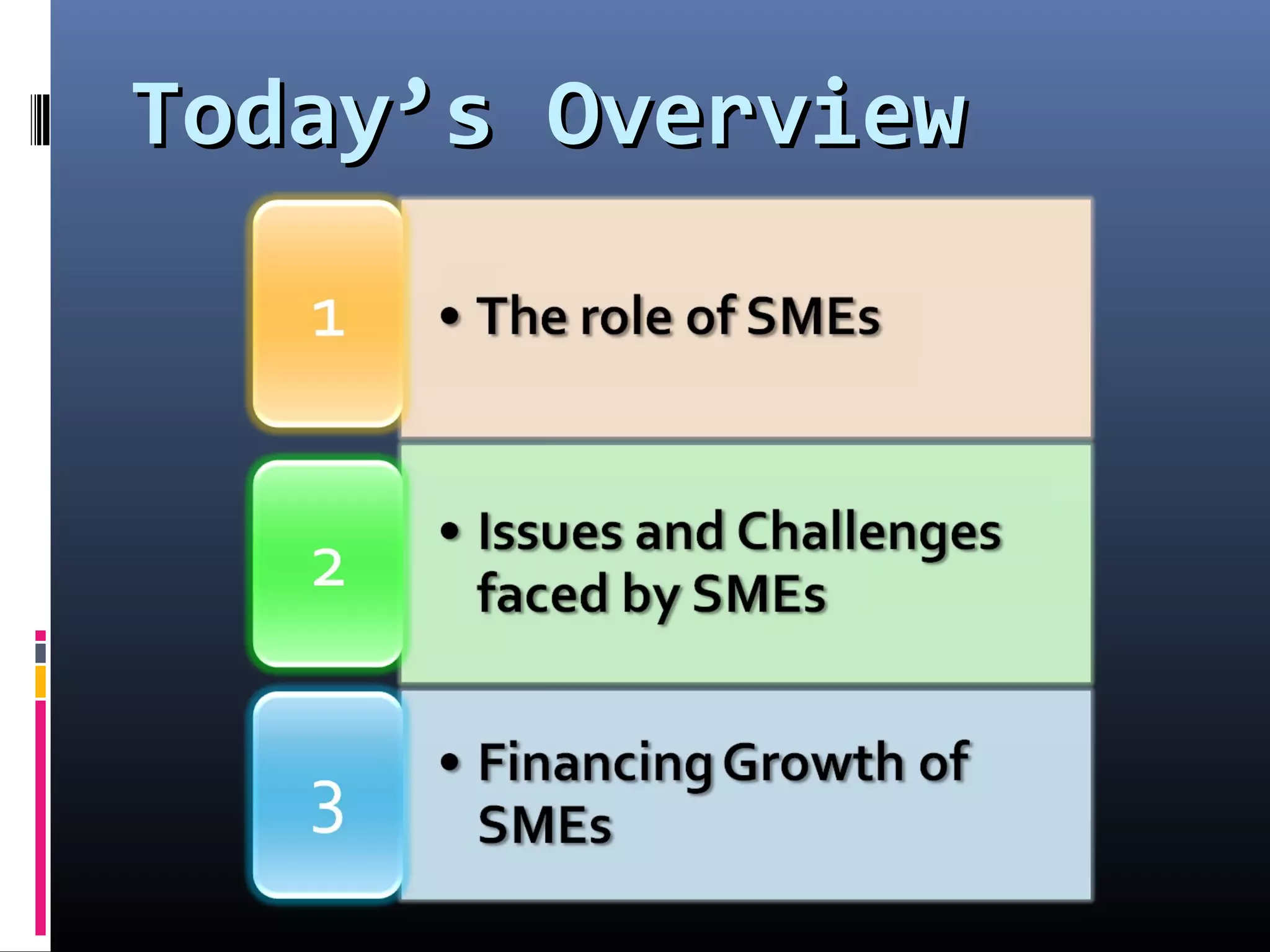
Today’s OverviewToday’s Overview
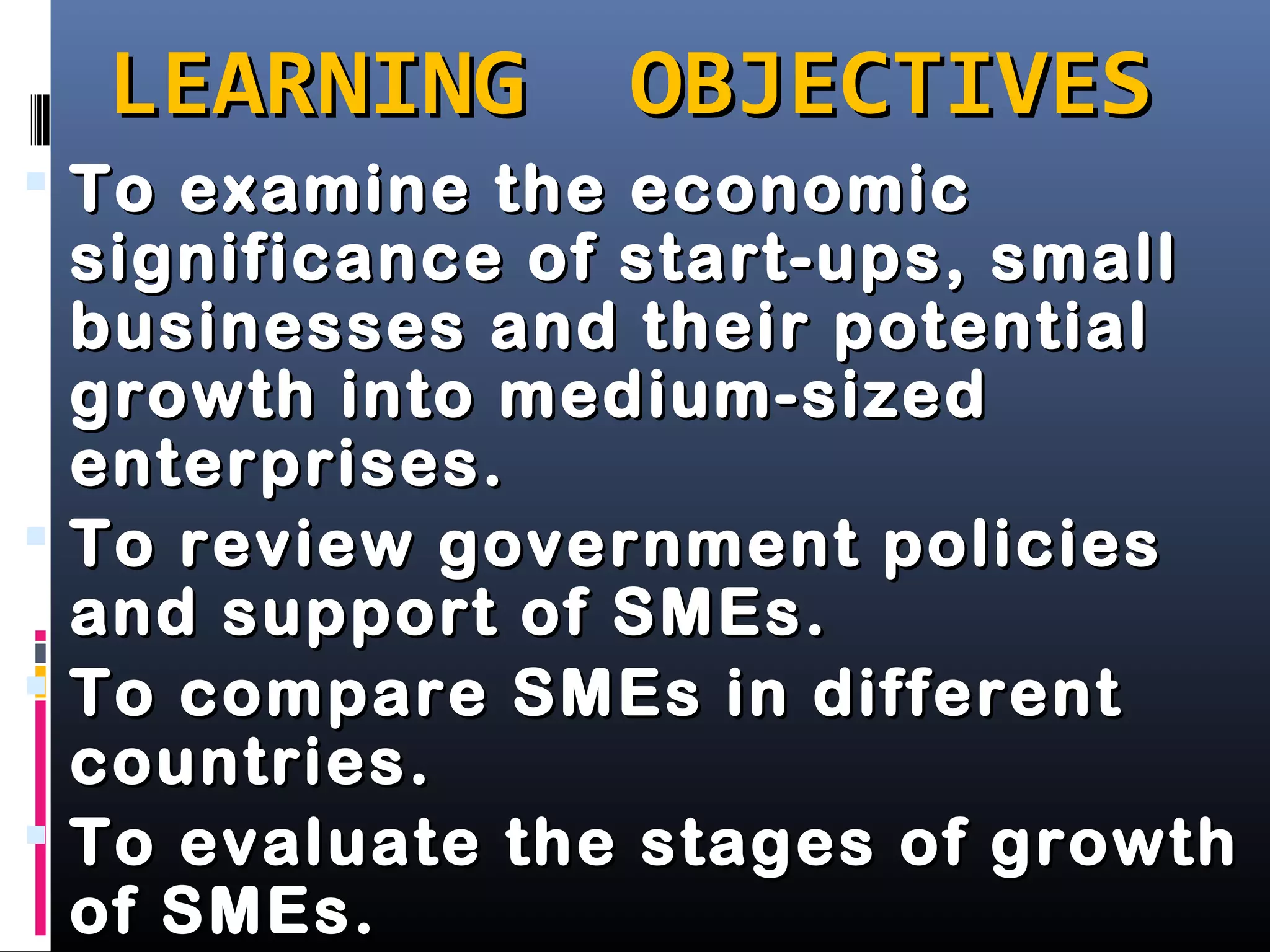
LEARNING OBJECTIVESLEARNING OBJECTIVES
 To examine the economicTo examine the economic
significance of start-ups, smallsignificance of start-ups, small
businesses and their potentialbusinesses and their potential
growth into medium-sizedgrowth into medium-sized
enterprises.enterprises.
 To review government policiesTo review government policies
and support of SMEs.and support of SMEs.
 To compare SMEs in differentTo compare SMEs in different
countries.countries.
 To evaluate the stages of growthTo evaluate the stages of growth
of SMEs.of SMEs.
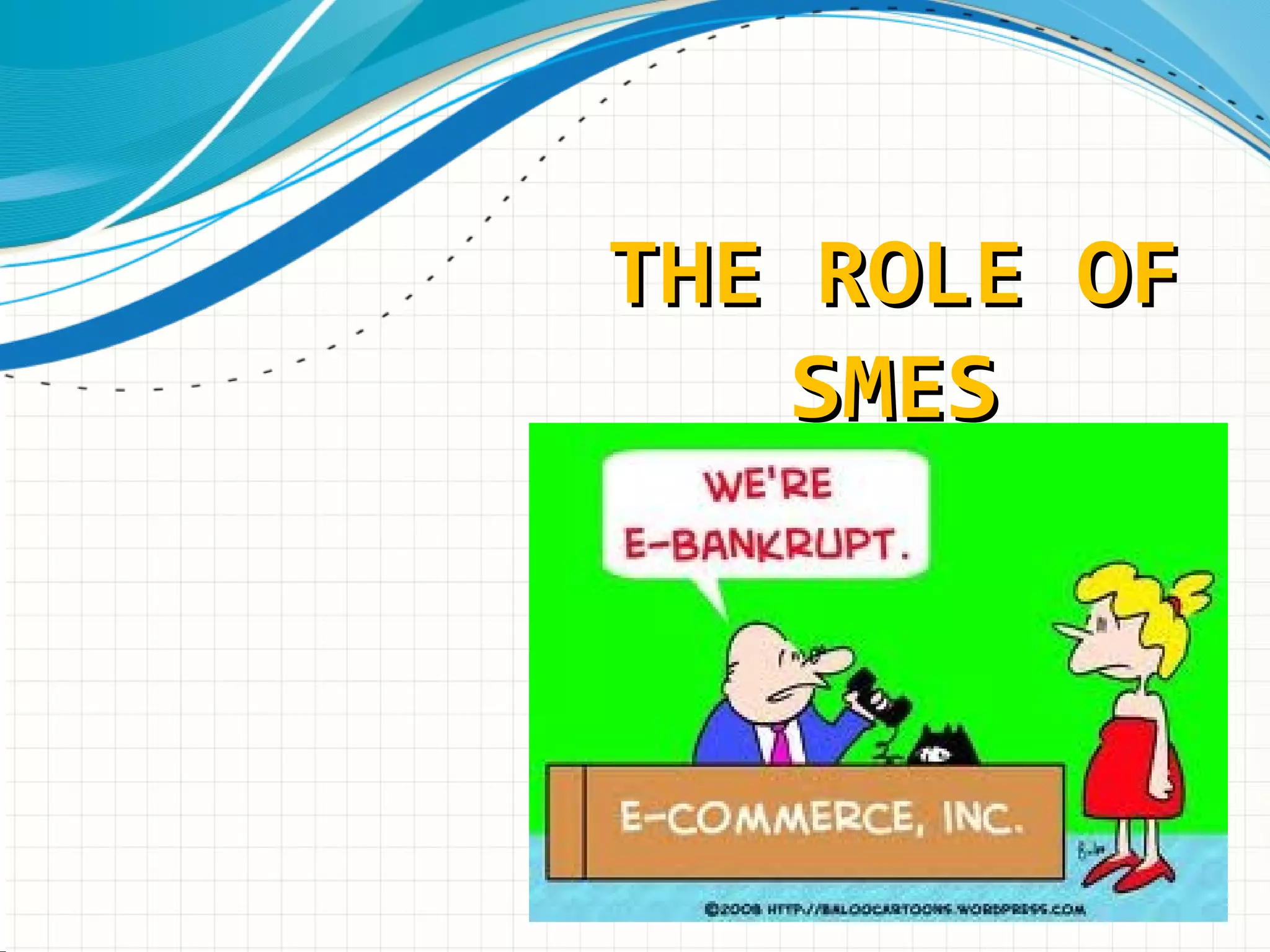
THE ROLE OFTHE ROLE OF
SMESSMES
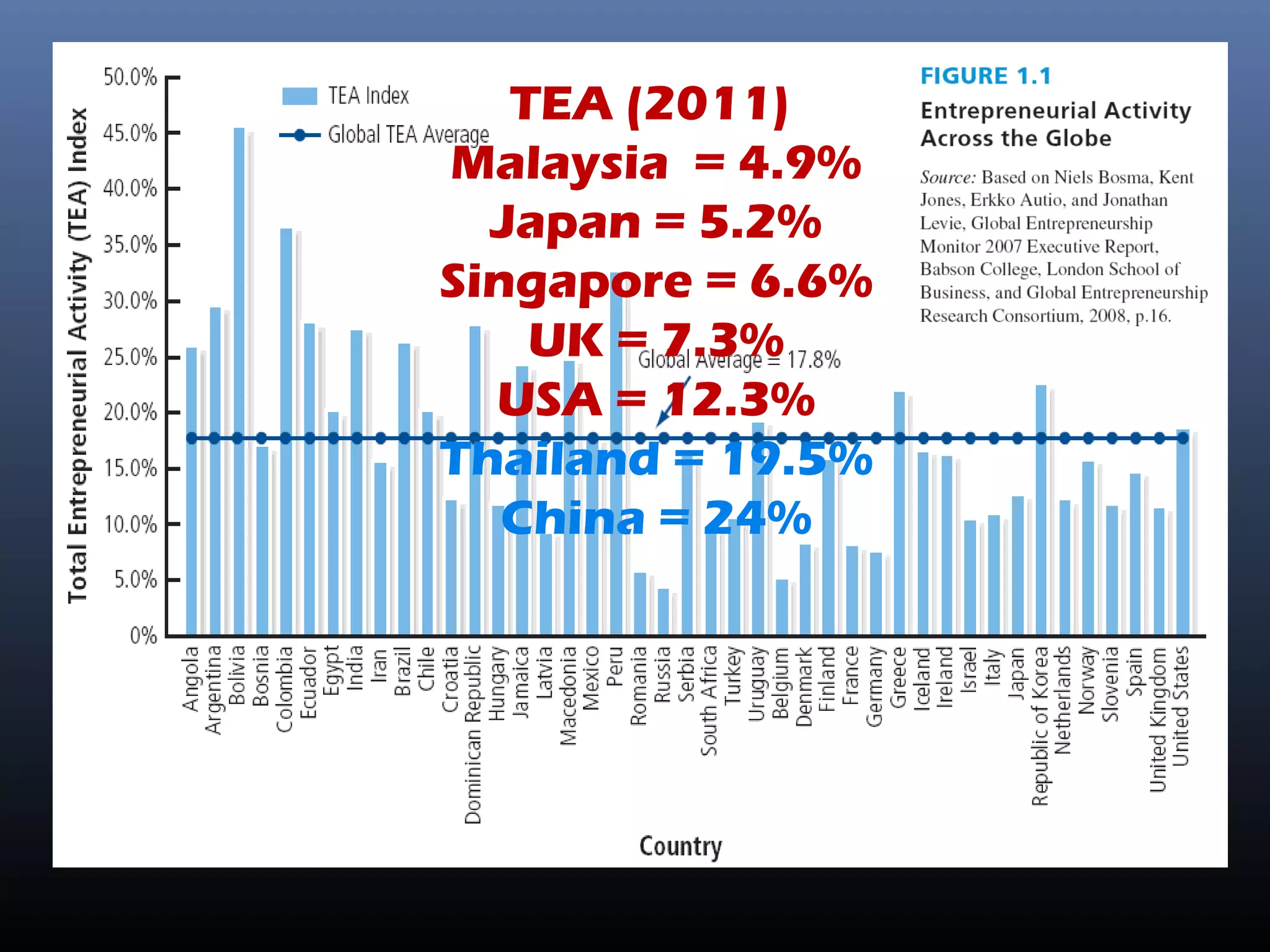
TEA (2011)
Malaysia = 4.9%
Japan = 5.2%
Singapore = 6.6%
UK = 7.3%
USA = 12.3%
Thailand = 19.5%
China = 24%
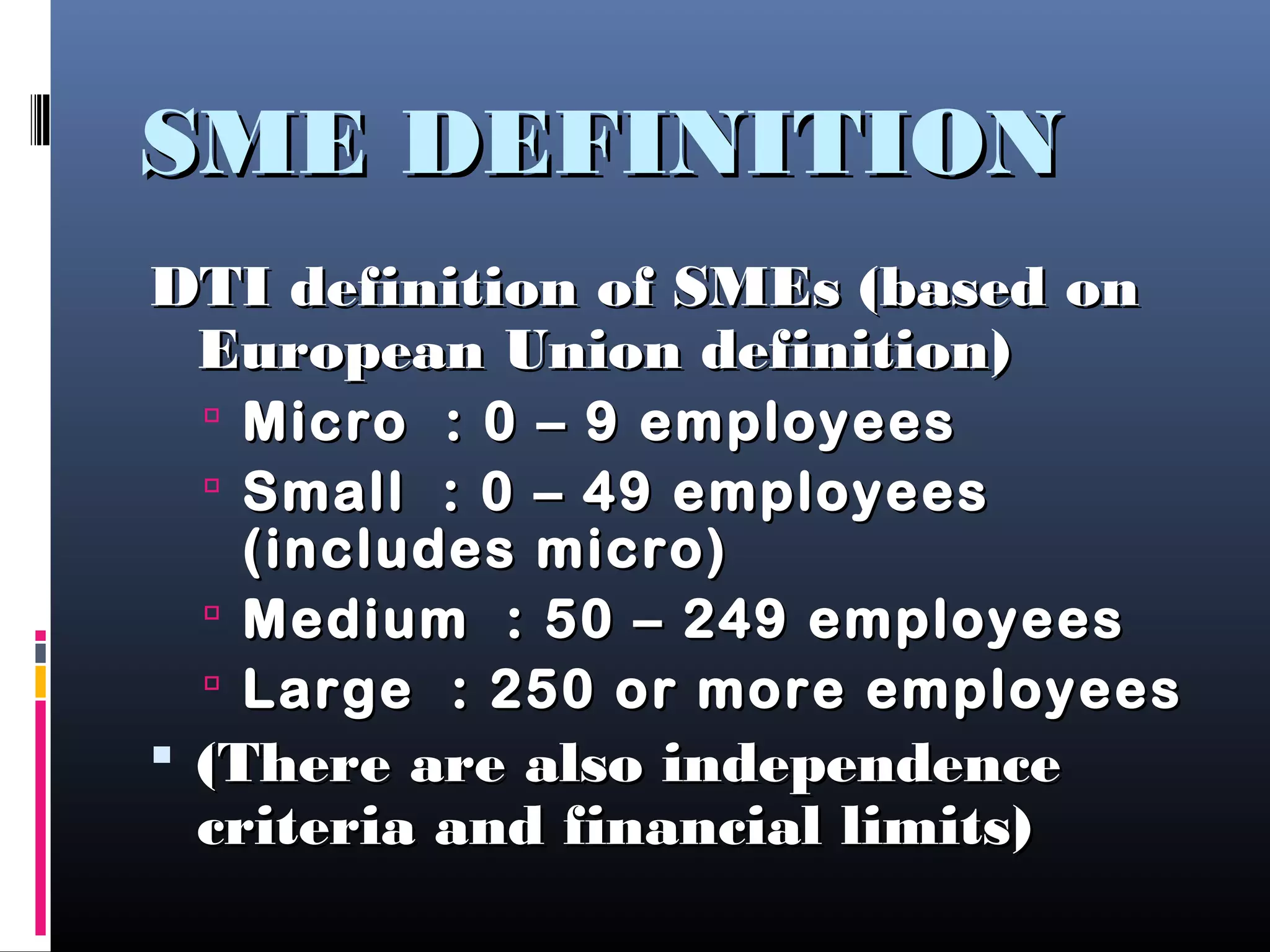
SME DEFINITIONSME DEFINITION
DTI definition of SMEs (based onDTI definition of SMEs (based on
European Union definition)European Union definition)
 Micro : 0 – 9 employeesMicro : 0 – 9 employees
 Small : 0 – 49 employeesSmall : 0 – 49 employees
(includes micro)(includes micro)
 Medium : 50 – 249 employeesMedium : 50 – 249 employees
 Large : 250 or more employeesLarge : 250 or more employees
 (There are also independence(There are also independence
criteria and financial limits)criteria and financial limits)
Entrepreneurship & Small
Business
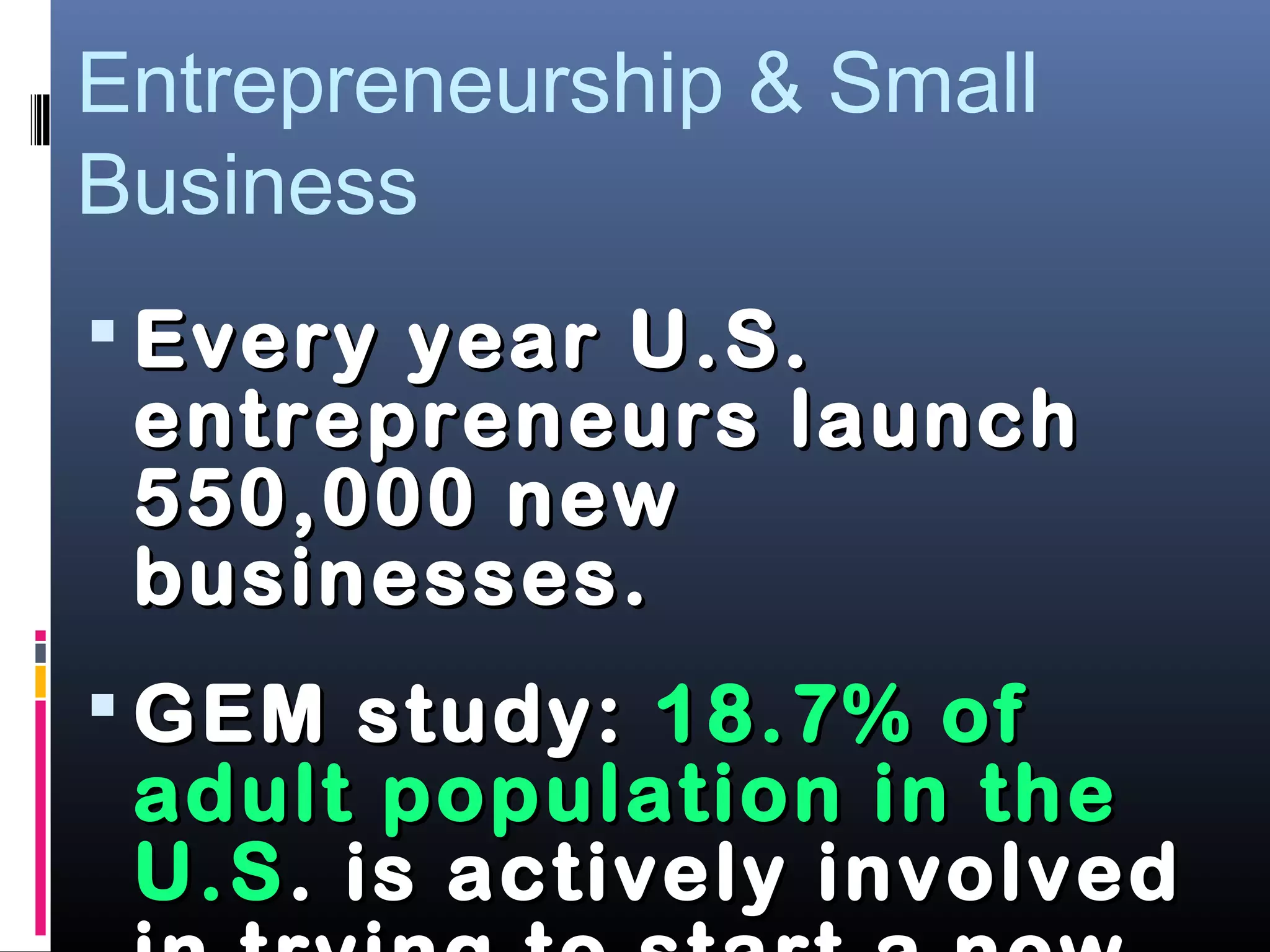
 Every year U.S.Every year U.S.
entrepreneurs launchentrepreneurs launch
550,000 new550,000 new
businesses.businesses.
 GEM study:GEM study: 18.7% of18.7% of
adult population in theadult population in the
U.SU.S. is actively involved. is actively involved
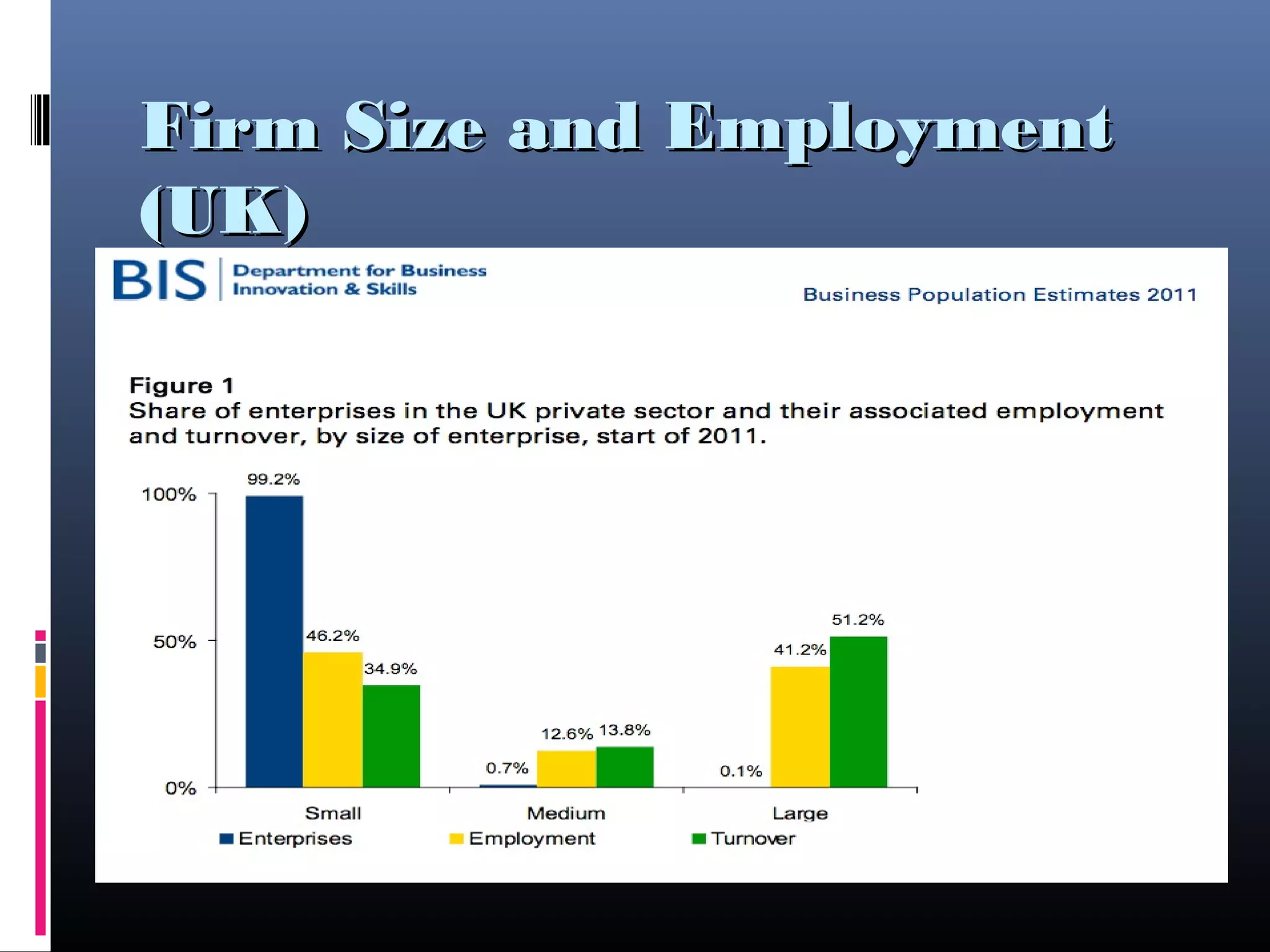
Firm Size and EmploymentFirm Size and Employment
(UK)(UK)
Small and medium-sizedSmall and medium-sized
enterprises - the backbone ofenterprises - the backbone of
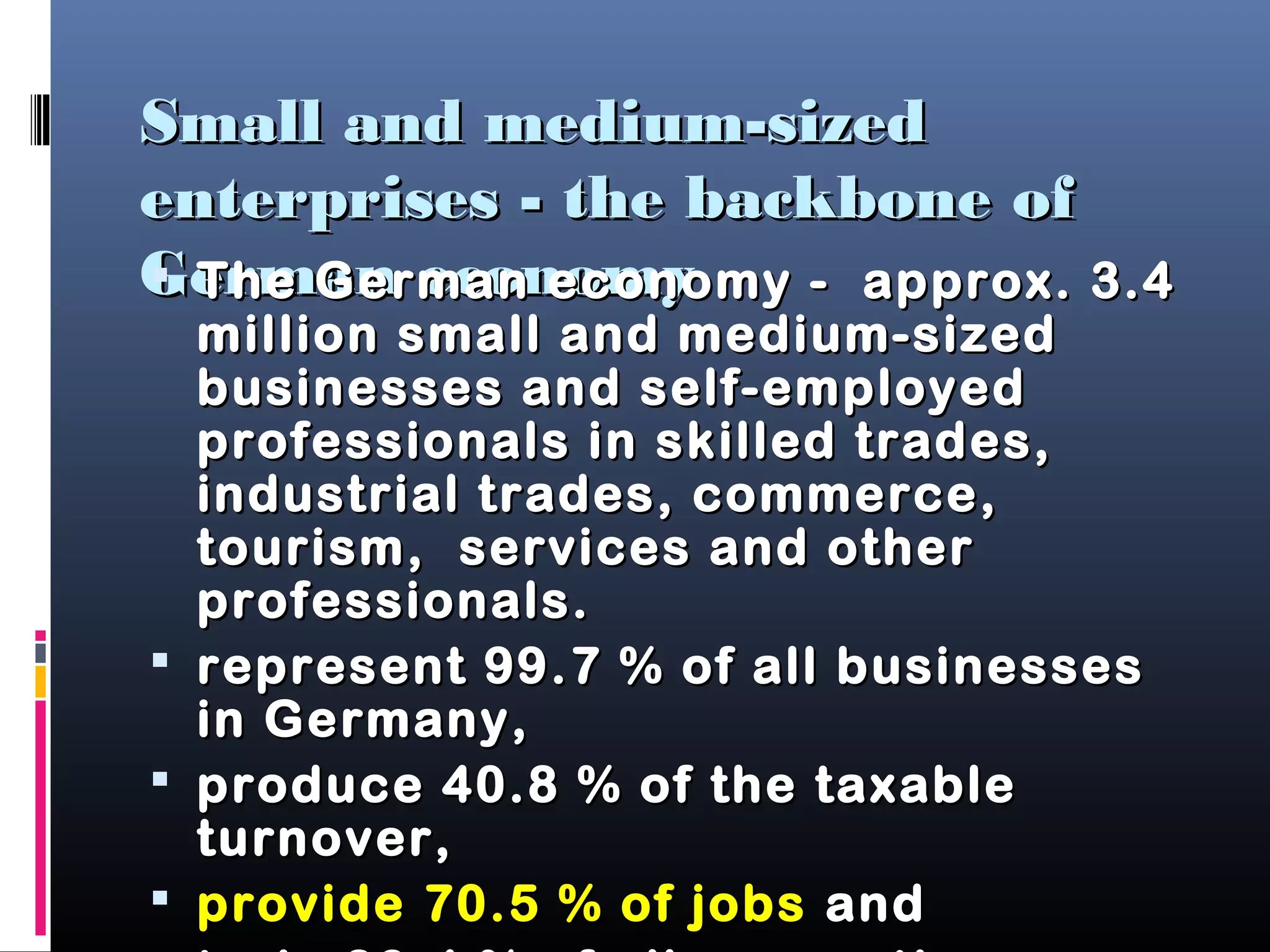
German economyGerman economy The German economy - approx. 3.4The German economy - approx. 3.4
million small and medium-sizedmillion small and medium-sized
businesses and self-employedbusinesses and self-employed
professionals in skilled trades,professionals in skilled trades,
industrial trades, commerce,industrial trades, commerce,
tourism, services and othertourism, services and other
professionals.professionals.
 represent 99.7 % of all businessesrepresent 99.7 % of all businesses
in Germany,in Germany,
 produce 40.8 % of the taxableproduce 40.8 % of the taxable
turnover,turnover,
 provide 70.5 % of jobsprovide 70.5 % of jobs andand
U.S. SmallU.S. Small
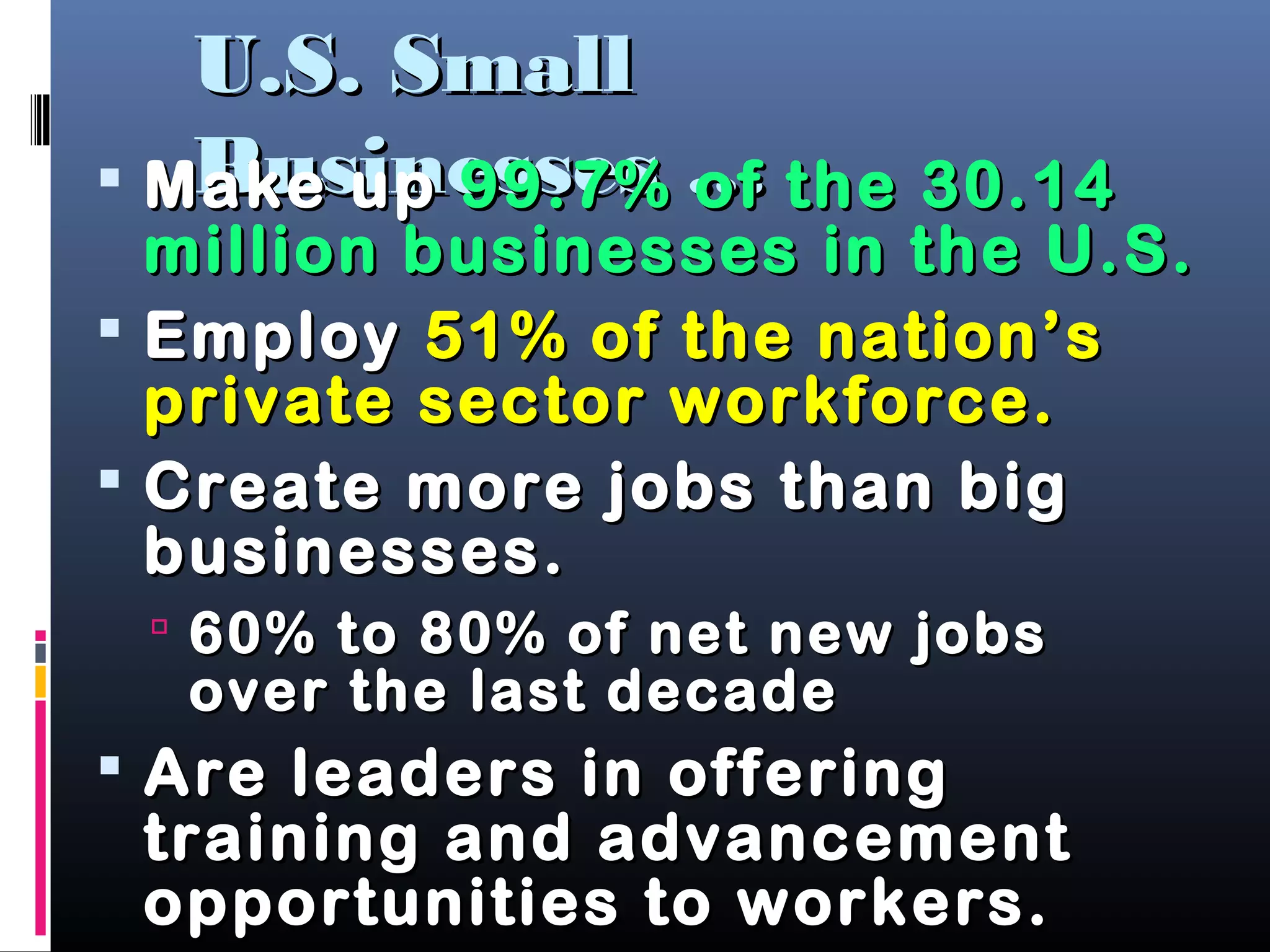
Businesses ...Businesses ... Make upMake up 99.7% of the 30.1499.7% of the 30.14
million businesses in the U.S.million businesses in the U.S.
 EmployEmploy 51% of the nation’s51% of the nation’s
private sector workforce.private sector workforce.
 Create more jobs than bigCreate more jobs than big
businesses.businesses.
 60% to 80% of net new jobs60% to 80% of net new jobs
over the last decadeover the last decade
 Are leaders in offeringAre leaders in offering
training and advancementtraining and advancement
opportunities to workers.opportunities to workers.
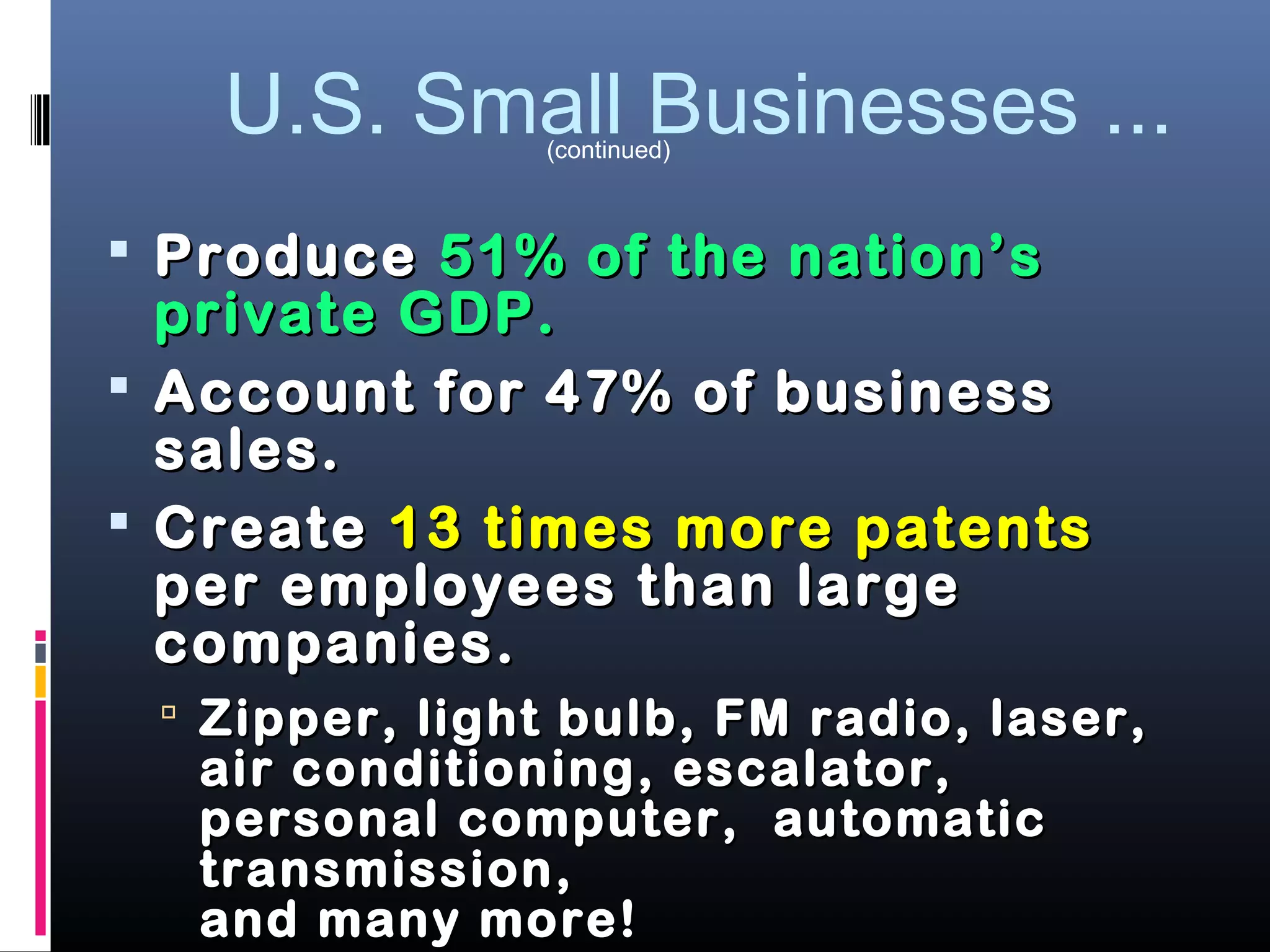
 ProduceProduce 51% of the nation’s51% of the nation’s
private GDP.private GDP.
 Account for 47% of businessAccount for 47% of business
sales.sales.
 CreateCreate 13 times more patents13 times more patents
per employees than largeper employees than large
companies.companies.
 Zipper, light bulb, FM radio, laser,Zipper, light bulb, FM radio, laser,
air conditioning, escalator,air conditioning, escalator,
personal computer, automaticpersonal computer, automatic
transmission,transmission,
and many more!and many more!
U.S. Small Businesses ...(continued)
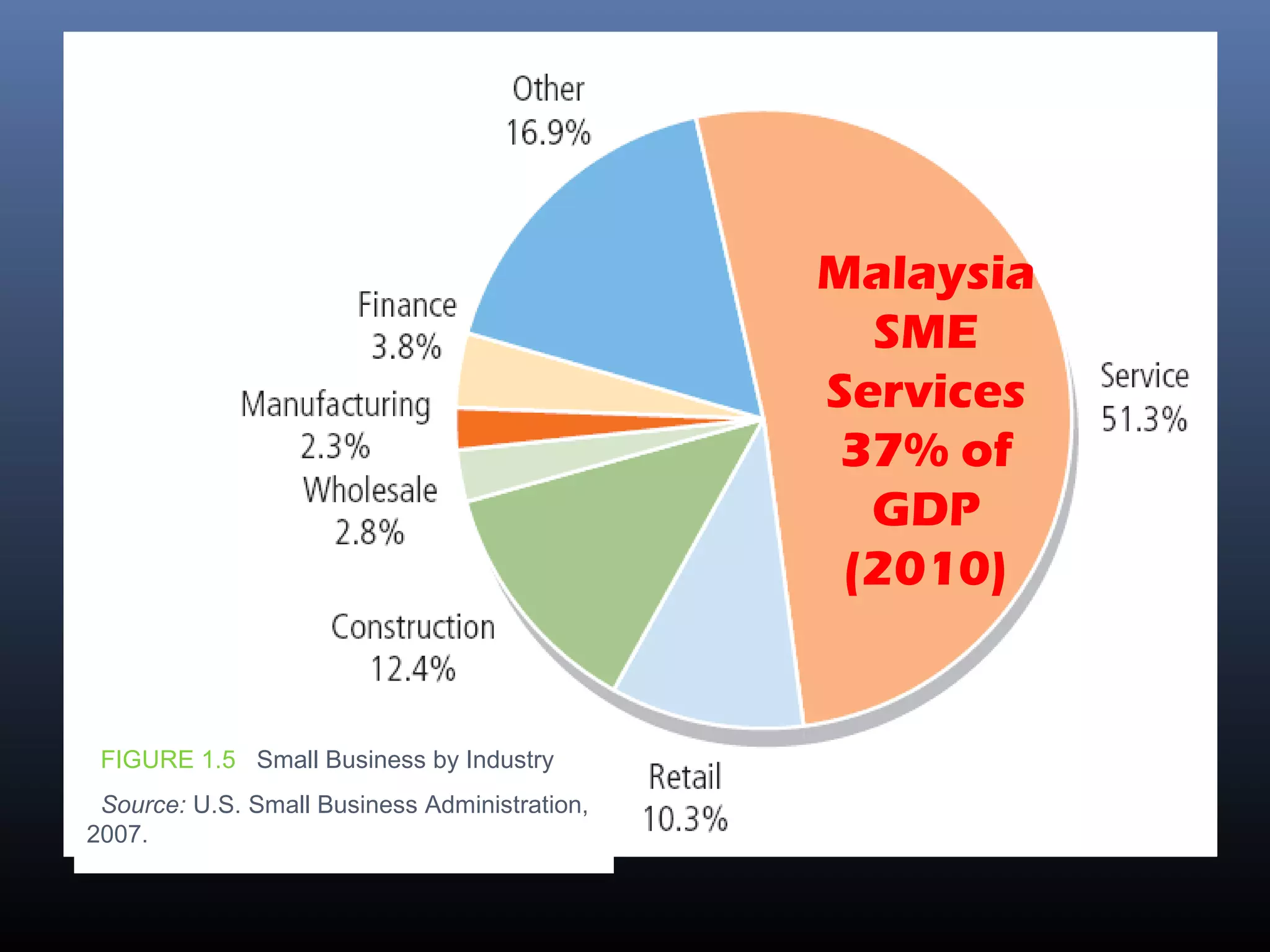
FIGURE 1.5 Small Business by Industry
Source: U.S. Small Business Administration,
2007.
Malaysia
SME
Services
37% of
GDP
(2010)
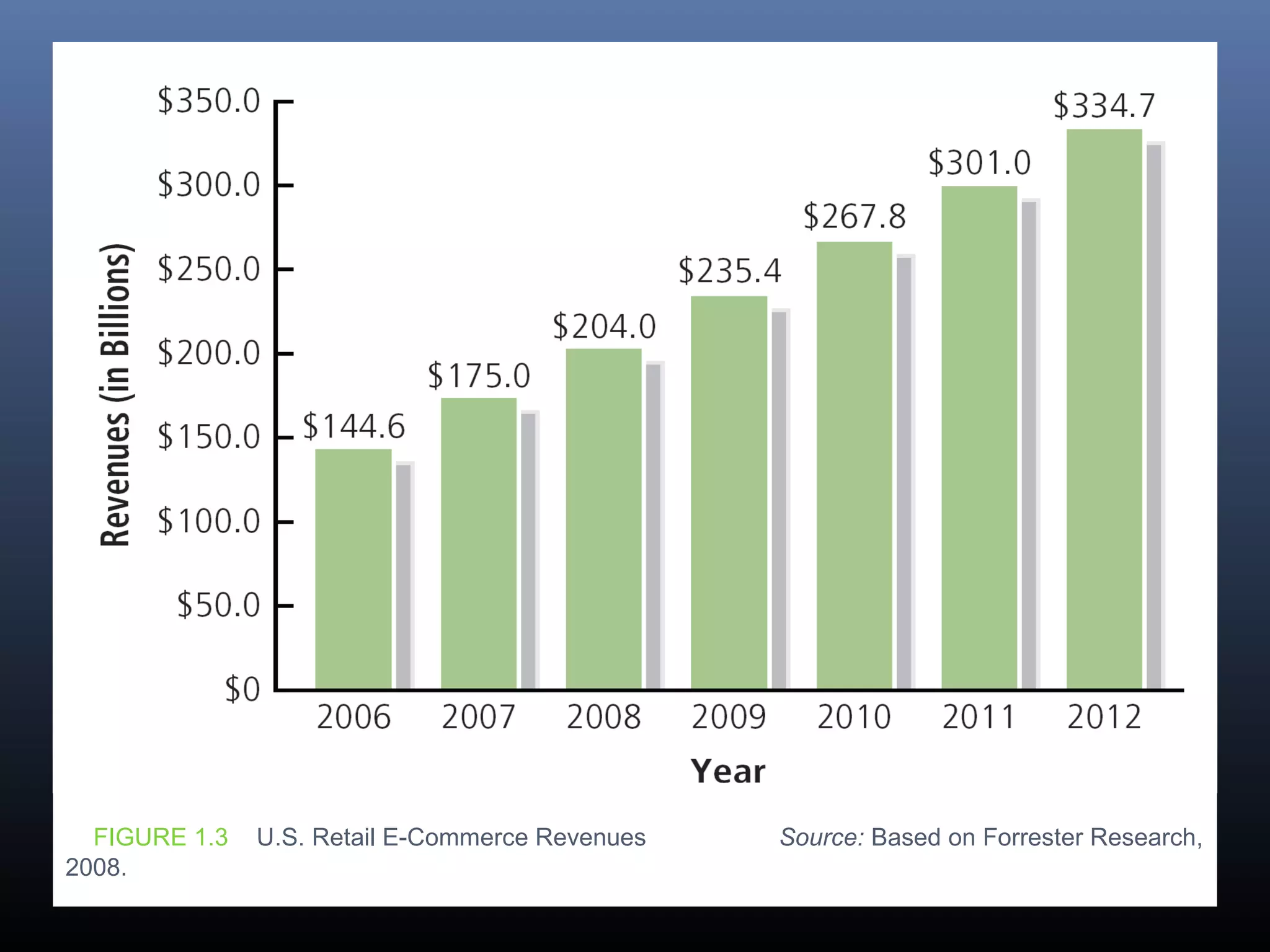
FIGURE 1.3 U.S. Retail E-Commerce Revenues Source: Based on Forrester Research,
2008.
FIGURE 1.4 Why Women Start Businesses
Source: U.S. Small Business Administration,
2007.
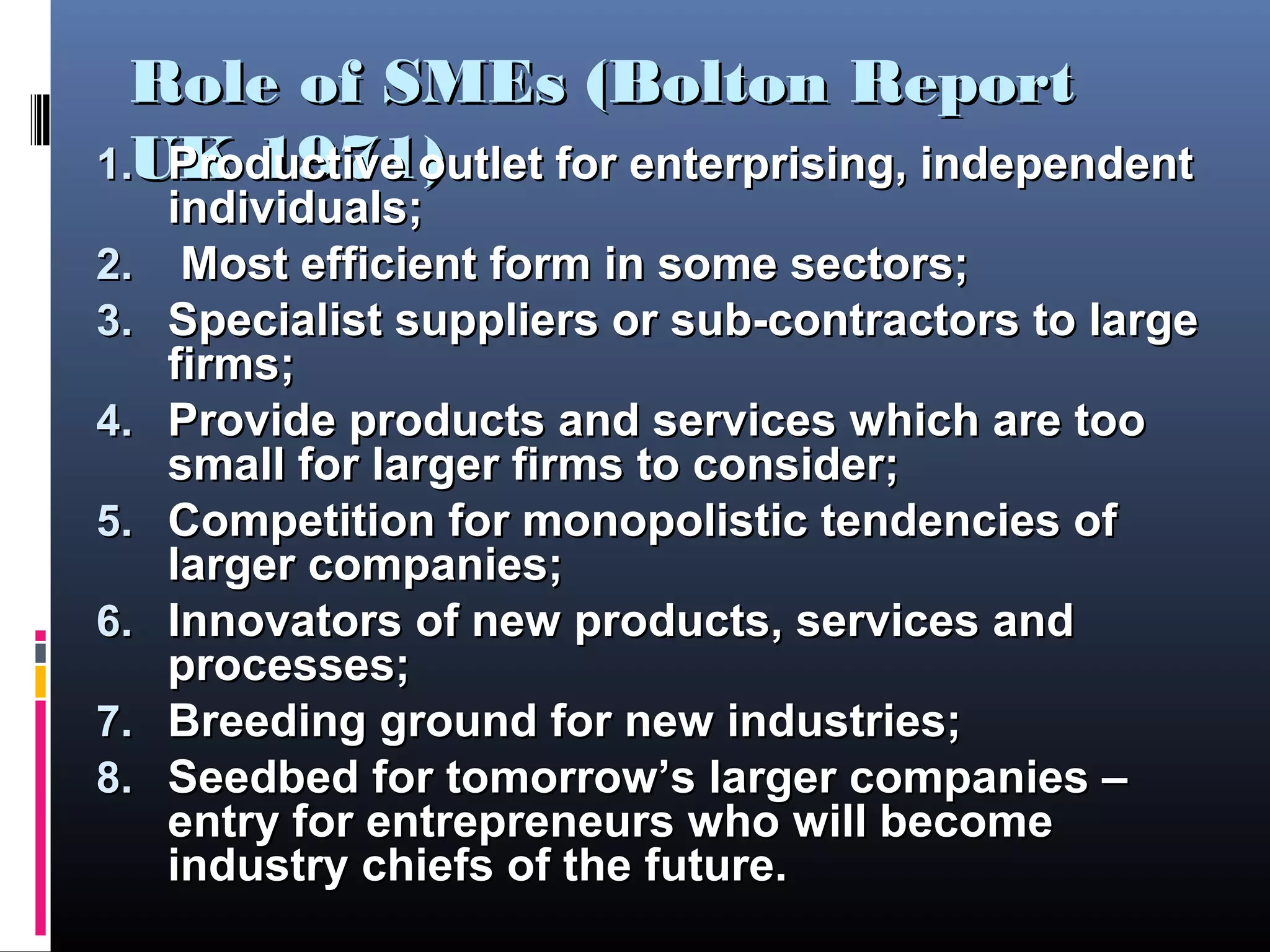
Role of SMEs (Bolton ReportRole of SMEs (Bolton Report
UK 1971)UK 1971)1.1. Productive outlet for enterprising, independentProductive outlet for enterprising, independent
individuals;individuals;
2.2. Most efficient form in some sectors;Most efficient form in some sectors;
3.3. Specialist suppliers or sub-contractors to largeSpecialist suppliers or sub-contractors to large
firms;firms;
4.4. Provide products and services which are tooProvide products and services which are too
small for larger firms to consider;small for larger firms to consider;
5.5. Competition for monopolistic tendencies ofCompetition for monopolistic tendencies of
larger companies;larger companies;
6.6. Innovators of new products, services andInnovators of new products, services and
processes;processes;
7.7. Breeding ground for new industries;Breeding ground for new industries;
8.8. Seedbed for tomorrow’s larger companies –Seedbed for tomorrow’s larger companies –
entry for entrepreneurs who will becomeentry for entrepreneurs who will become
industryindustry chiefs of the future.chiefs of the future.
Role of SMEs (Bolton ReportRole of SMEs (Bolton Report
UK 1971)UK 1971)
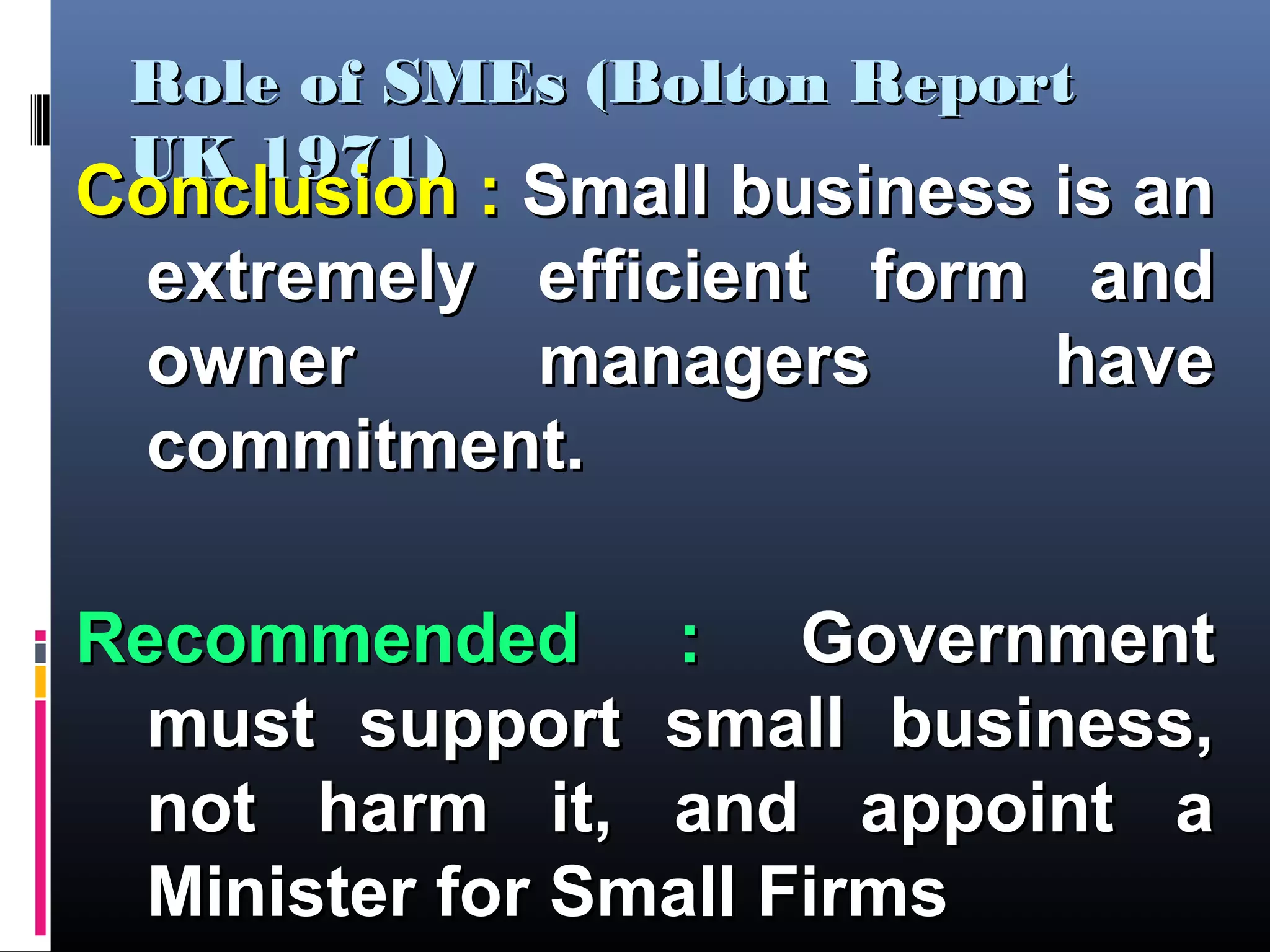
Conclusion :Conclusion : Small business is anSmall business is an
extremely efficient form andextremely efficient form and
owner managers haveowner managers have
commitment.commitment.
Recommended :Recommended : GovernmentGovernment
must support small business,must support small business,
not harm it, and appoint anot harm it, and appoint a
Minister for Small FirmsMinister for Small Firms
Comparison with largeComparison with large
firmsfirms
3 key differences between small3 key differences between small
and large firms:-and large firms:-
1.1.UncertaintyUncertainty – small customer– small customer
base and limited resources;base and limited resources;
2.2.InnovationInnovation – new products and– new products and
services key to start-upservices key to start-up
success;success;
3.3.EvolutionEvolution – constant– constant
structural change and marketstructural change and market
change as firms grow.change as firms grow.
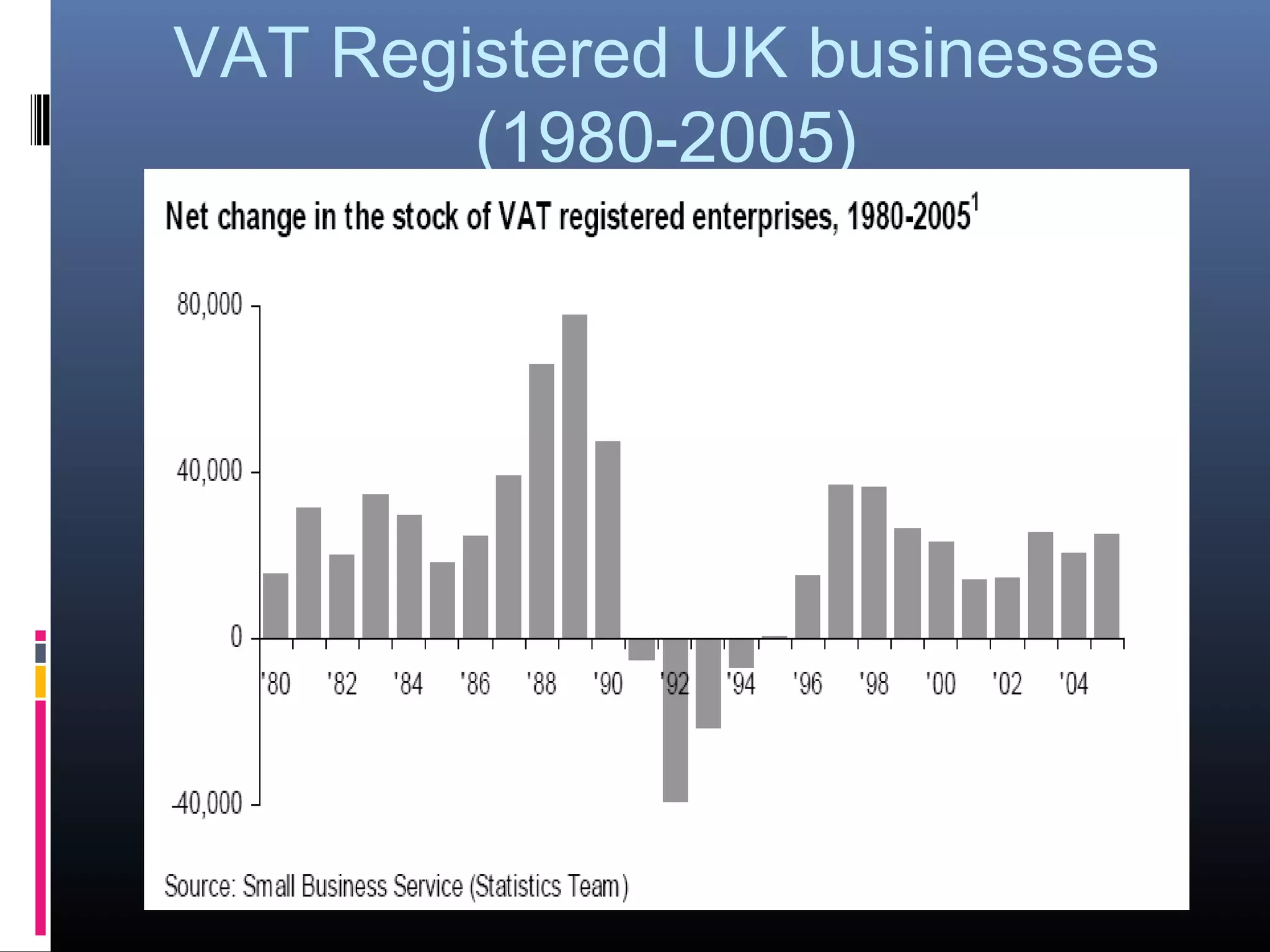
VAT Registered UK businesses
(1980-2005)
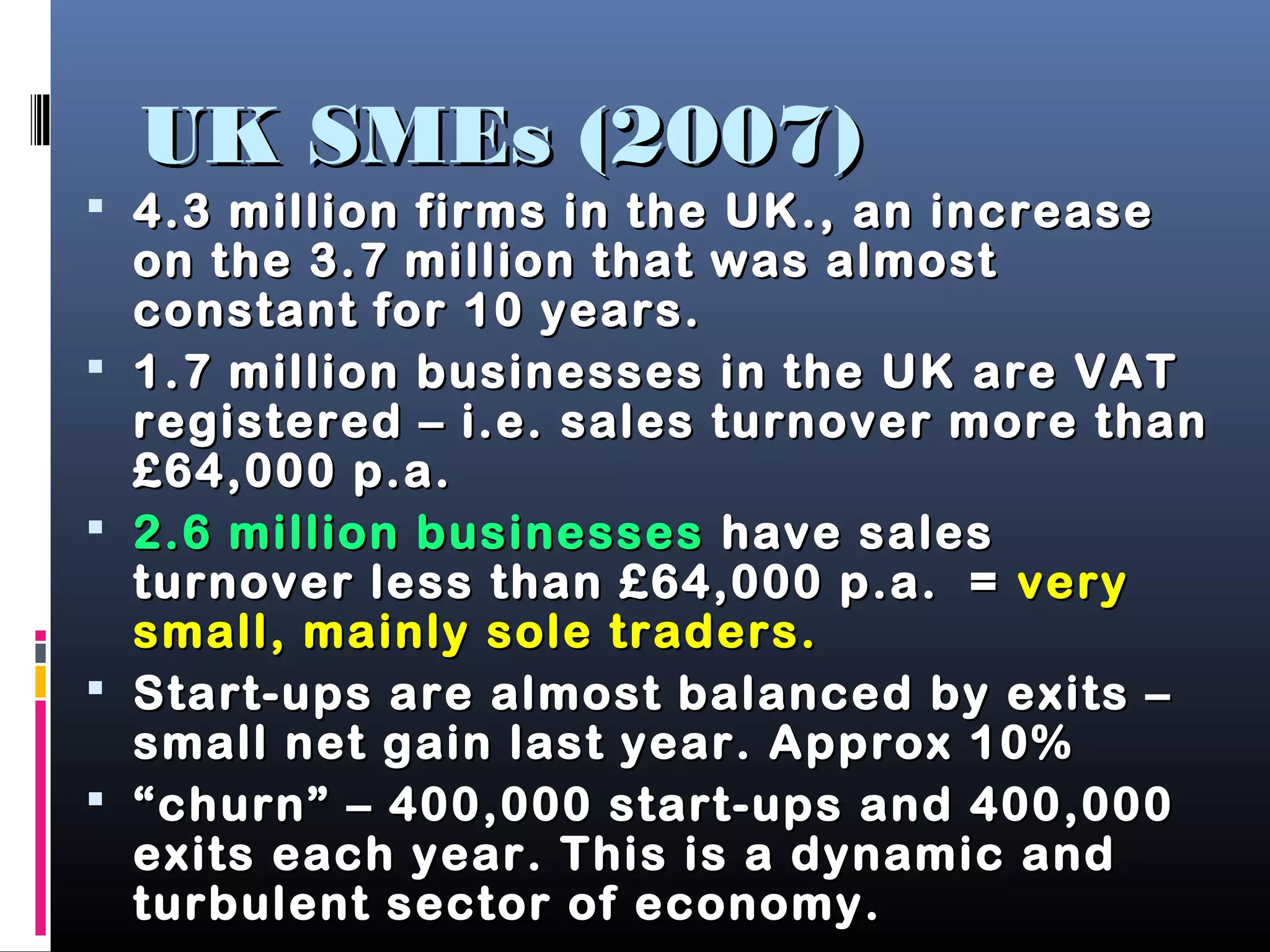
UK SMEs (2007)UK SMEs (2007)
 4.3 million firms in the UK., an increase4.3 million firms in the UK., an increase
on the 3.7 million that was almoston the 3.7 million that was almost
constant for 10 years.constant for 10 years.
 1.7 million businesses in the UK are VAT1.7 million businesses in the UK are VAT
registered – i.e. sales turnover more thanregistered – i.e. sales turnover more than
£64,000 p.a.£64,000 p.a.
 2.6 million businesses2.6 million businesses have saleshave sales
turnover less than £64,000 p.a. =turnover less than £64,000 p.a. = veryvery
small, mainly sole traders.small, mainly sole traders.
 Start-ups are almost balanced by exits –Start-ups are almost balanced by exits –
small net gain last year. Approx 10%small net gain last year. Approx 10%
 ““churn” – 400,000 start-ups and 400,000churn” – 400,000 start-ups and 400,000
exits each year. This is a dynamic andexits each year. This is a dynamic and
turbulent sector ofturbulent sector of economy.economy.
ISSUES &ISSUES &
CHALLENGESCHALLENGES
FACEDFACED
BY SMESBY SMES
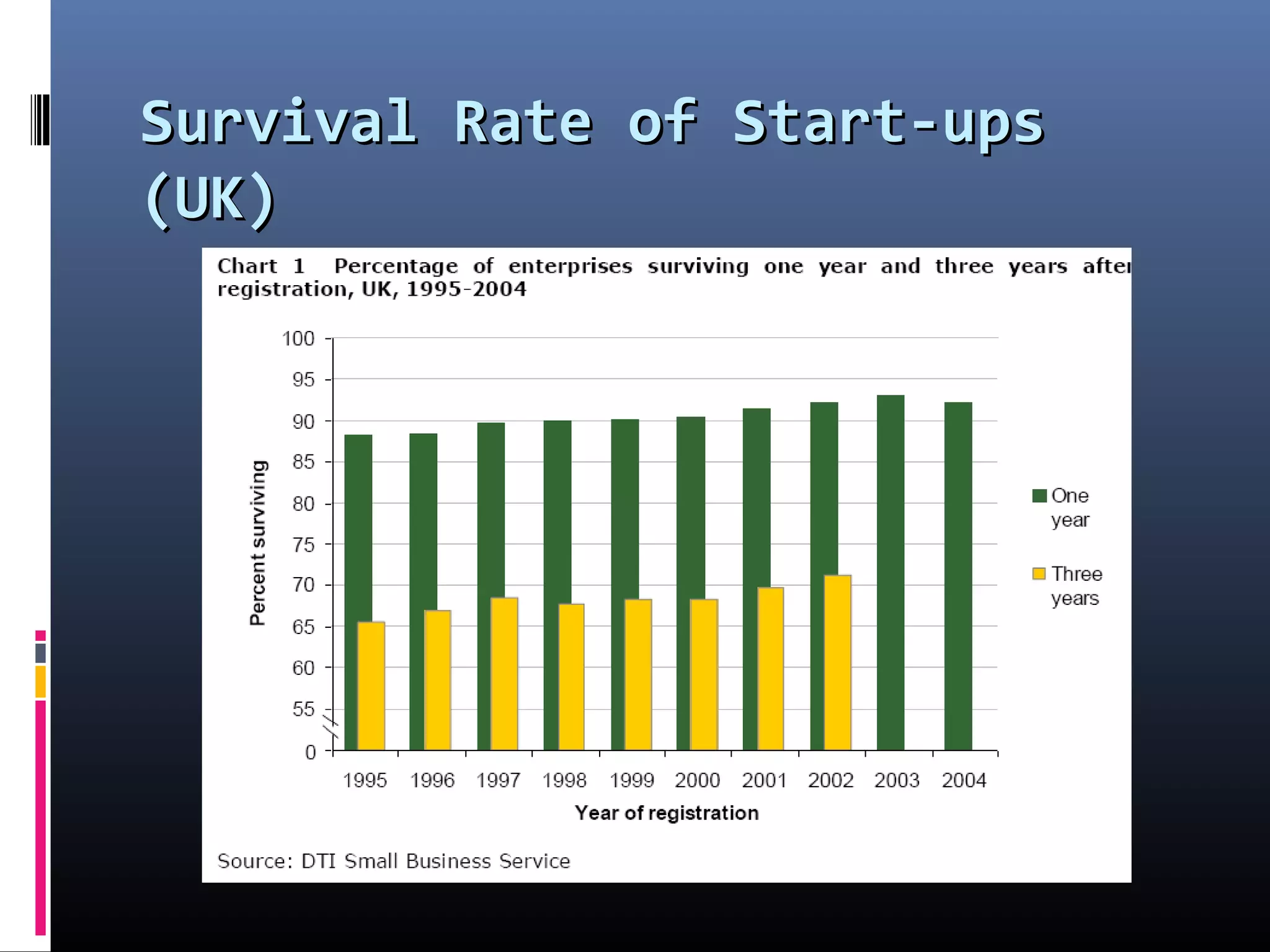
Survival Rate of Start-upsSurvival Rate of Start-ups
(UK)(UK)
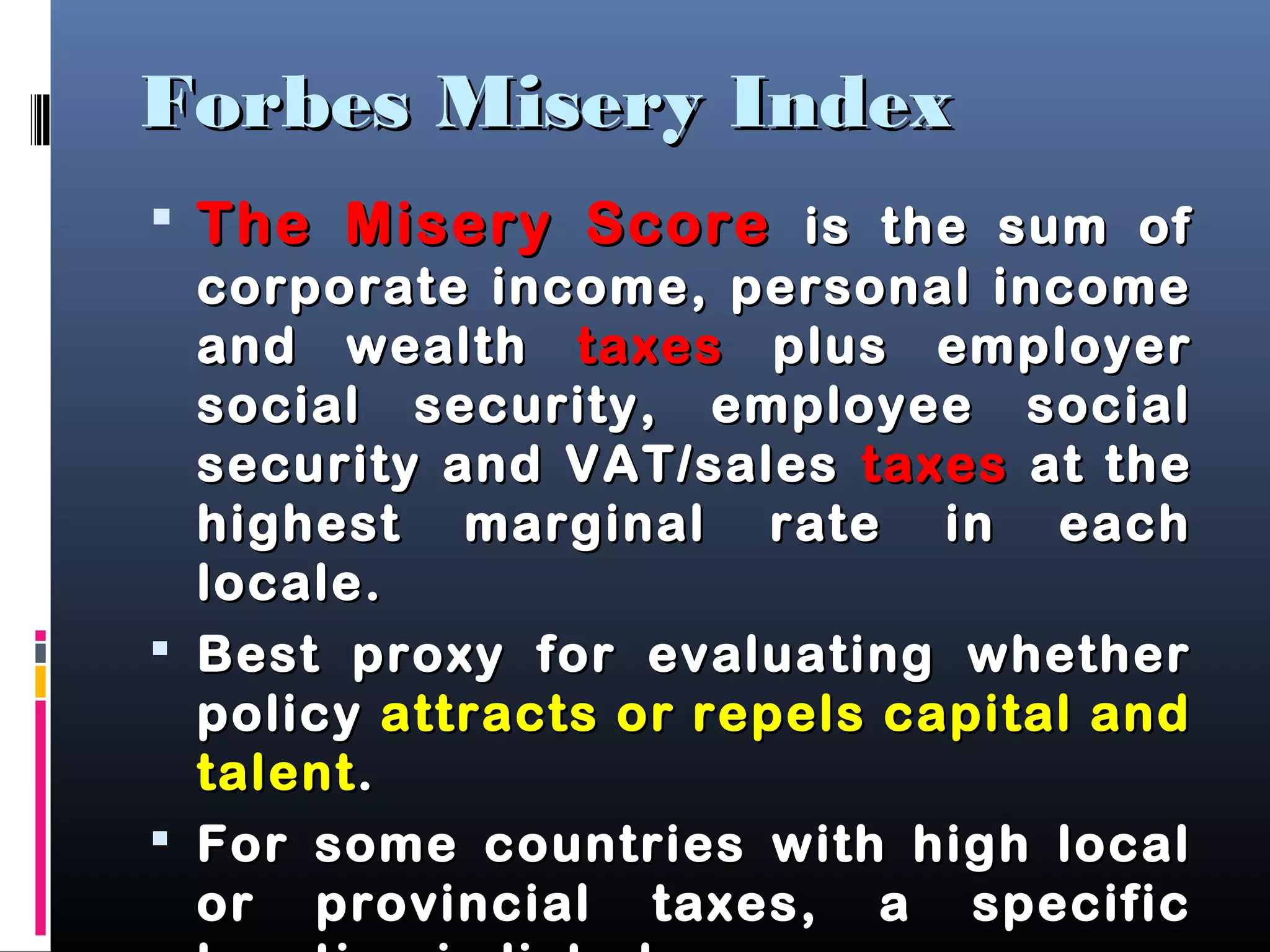
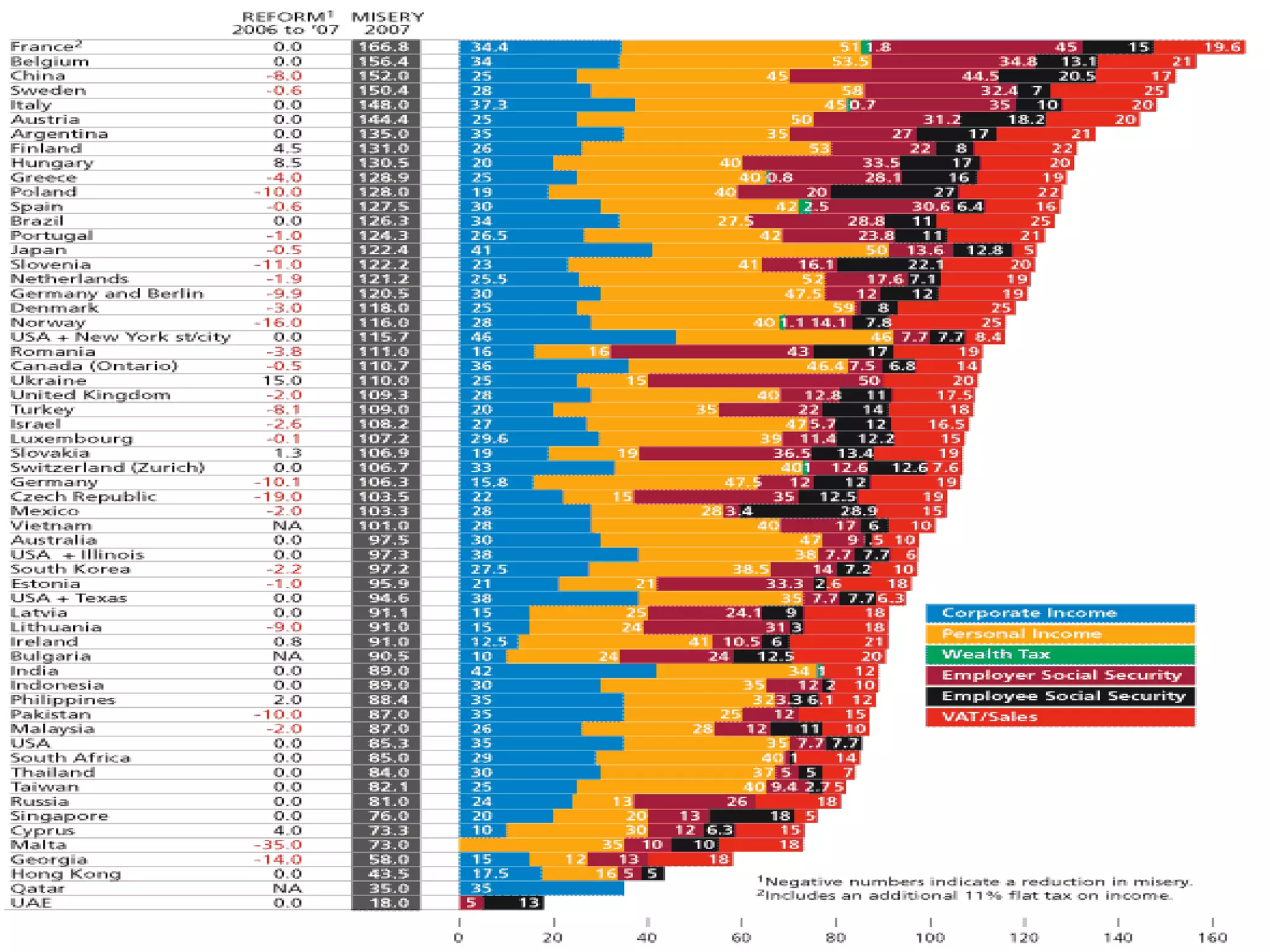
Forbes Misery IndexForbes Misery Index
 The Misery ScoreThe Misery Score is the sum ofis the sum of
corporate income, personal incomecorporate income, personal income
and wealthand wealth taxestaxes plus employerplus employer
social security, employee socialsocial security, employee social
security and VAT/salessecurity and VAT/sales taxestaxes at theat the
highest marginal rate in eachhighest marginal rate in each
locale.locale.
 Best proxy for evaluating whetherBest proxy for evaluating whether
policypolicy attracts or repels capital andattracts or repels capital and
talenttalent..
 For some countries with high localFor some countries with high local
or provincial taxes, a specificor provincial taxes, a specific
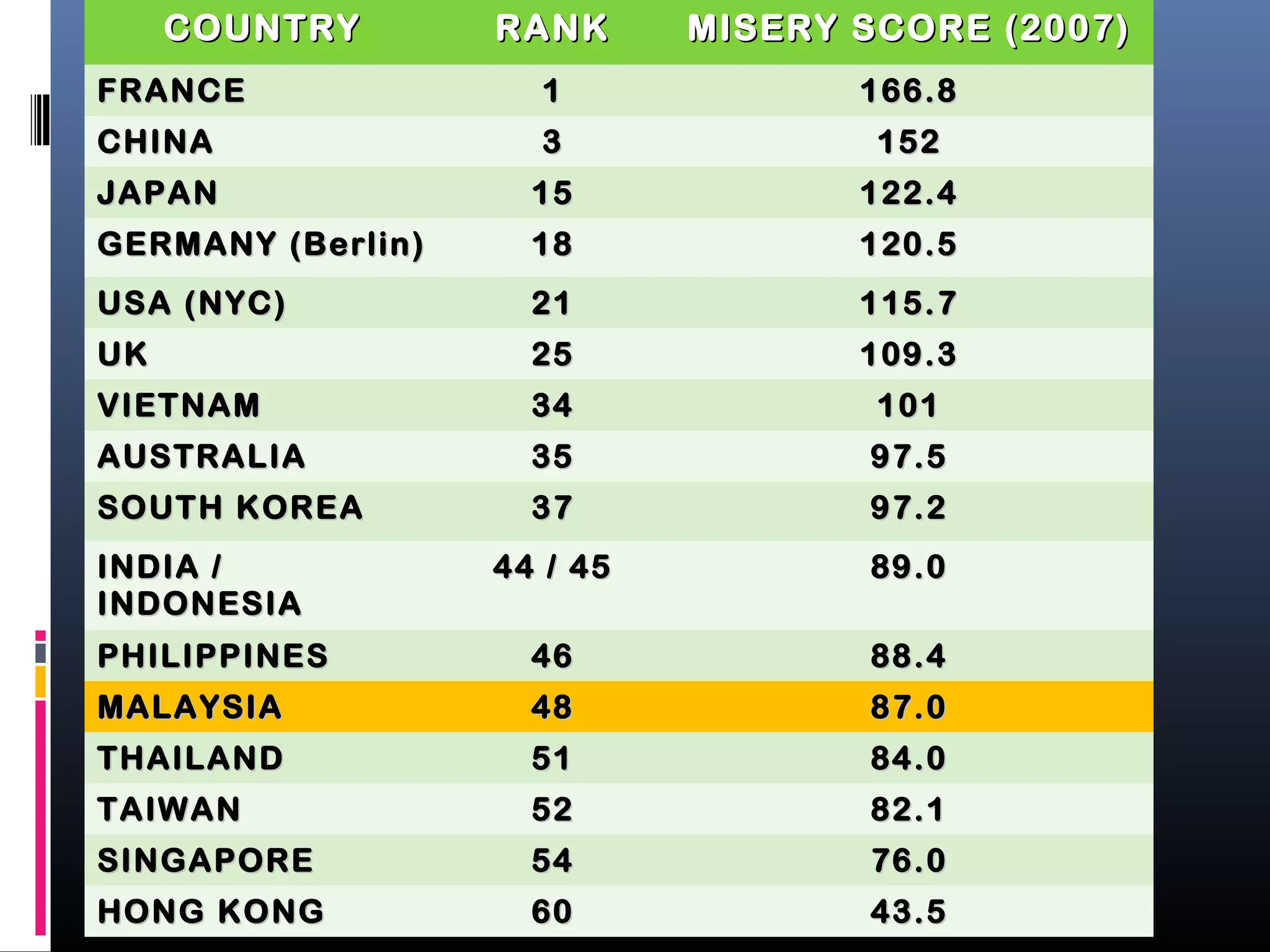
COUNTRYCOUNTRY RANKRANK MISERY SCORE (2007)MISERY SCORE (2007)
FRANCEFRANCE 11 166.8166.8
CHINACHINA 33 152152
JAPANJAPAN 1515 122.4122.4
GERMANY (Berlin)GERMANY (Berlin) 1818 120.5120.5
USA (NYC)USA (NYC) 2121 115.7115.7
UKUK 2525 109.3109.3
VIETNAMVIETNAM 3434 101101
AUSTRALIAAUSTRALIA 3535 97.597.5
SOUTH KOREASOUTH KOREA 3737 97.297.2
INDIA /INDIA /
INDONESIAINDONESIA
44 / 4544 / 45 89.089.0
PHILIPPINESPHILIPPINES 4646 88.488.4
MALAYSIAMALAYSIA 4848 87.087.0
THAILANDTHAILAND 5151 84.084.0
TAIWANTAIWAN 5252 82.182.1
SINGAPORESINGAPORE 5454 76.076.0
HONG KONGHONG KONG 6060 43.543.5
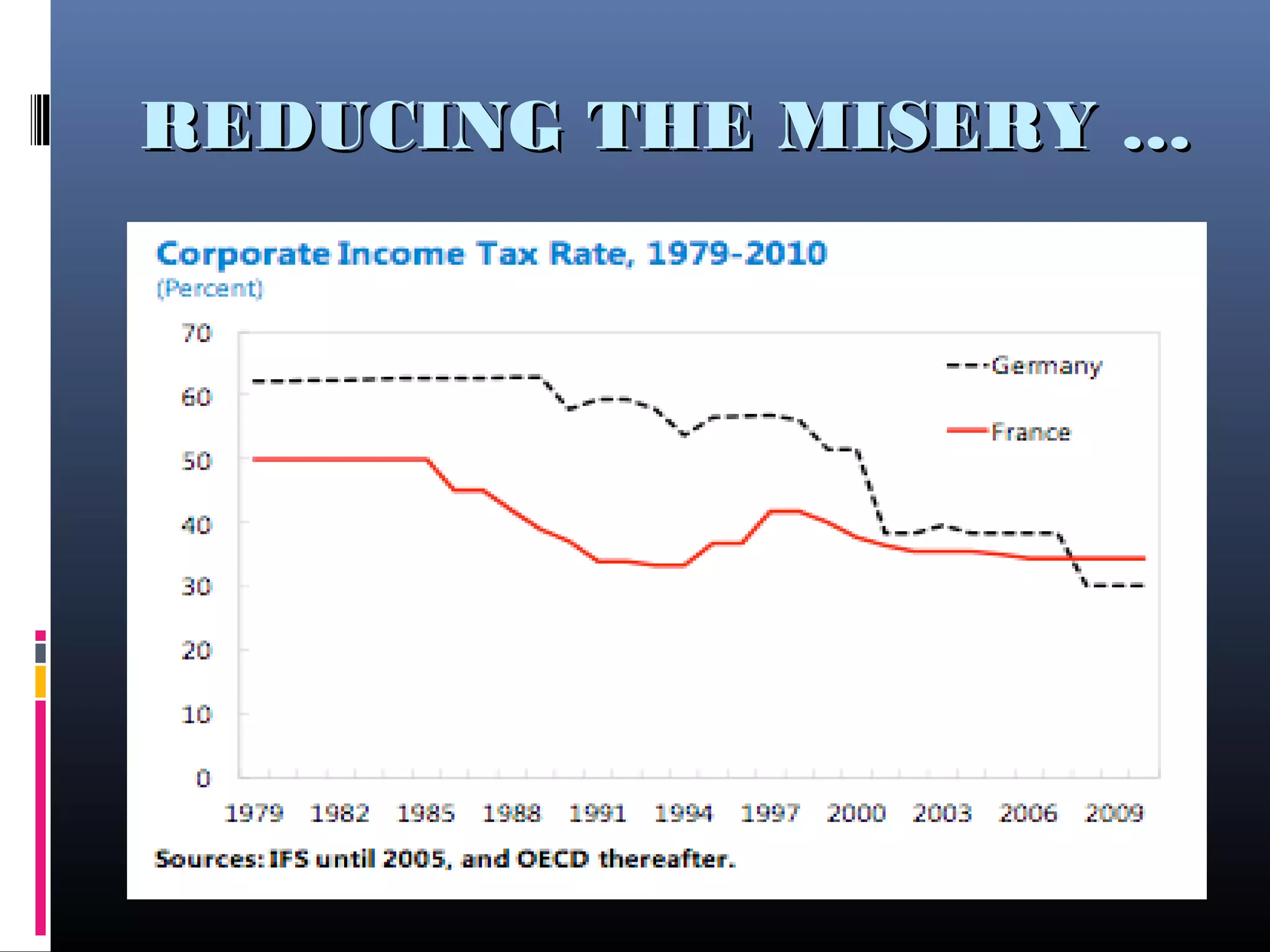
REDUCING THE MISERY …REDUCING THE MISERY …
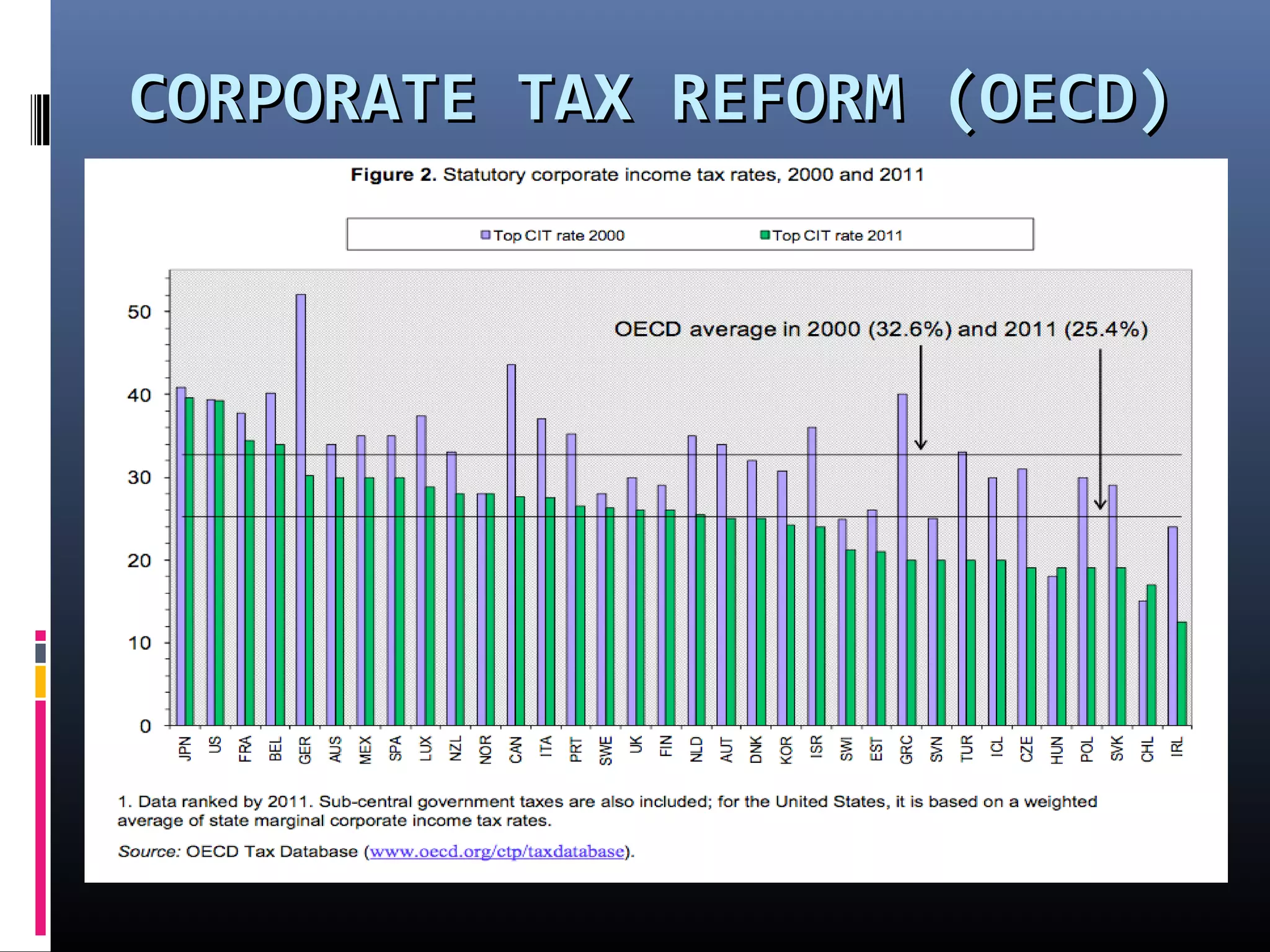
CORPORATE TAX REFORM (OECD)CORPORATE TAX REFORM (OECD)
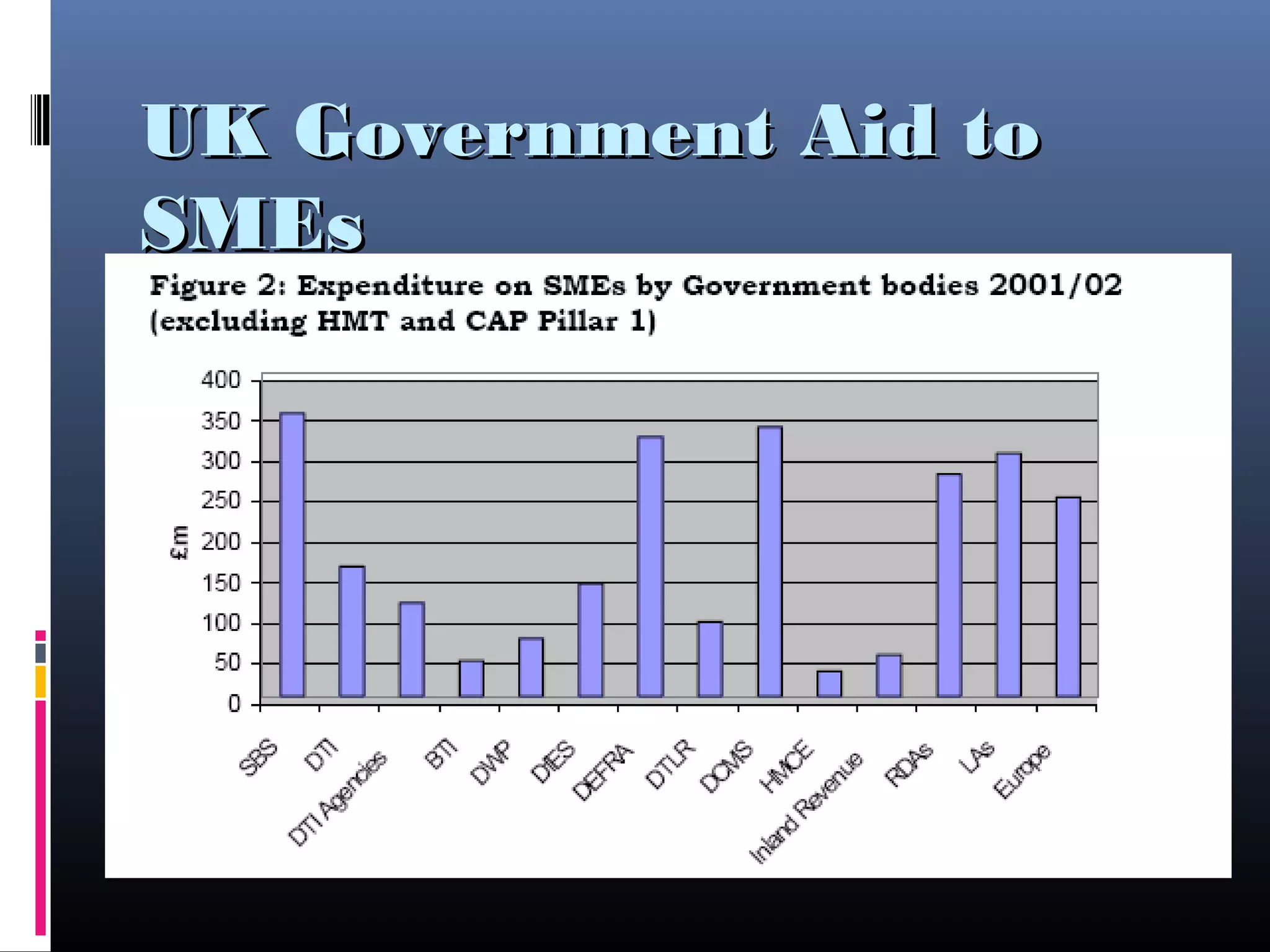
UK Government Aid toUK Government Aid to
SMEsSMEs
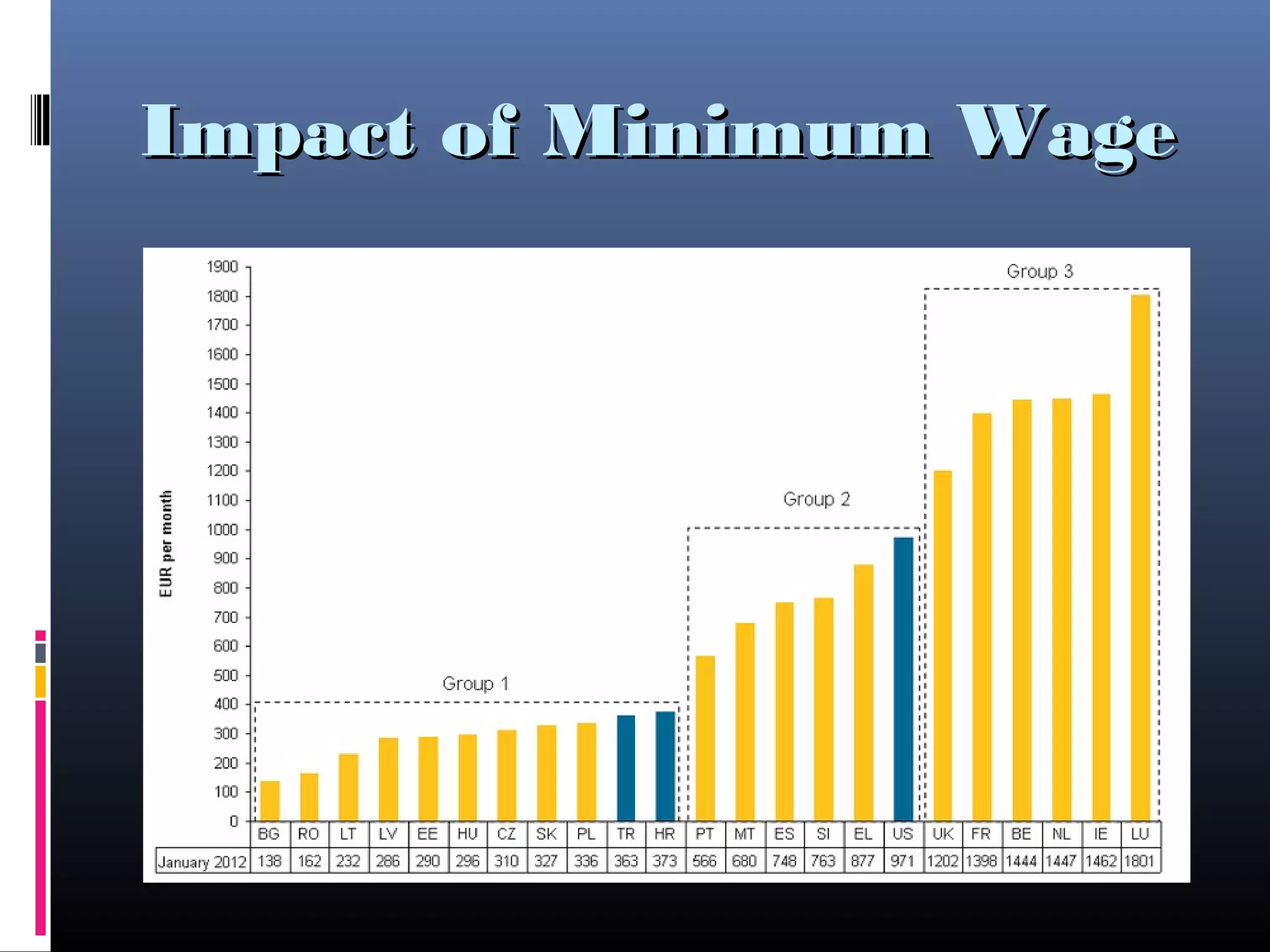
Impact of Minimum WageImpact of Minimum Wage
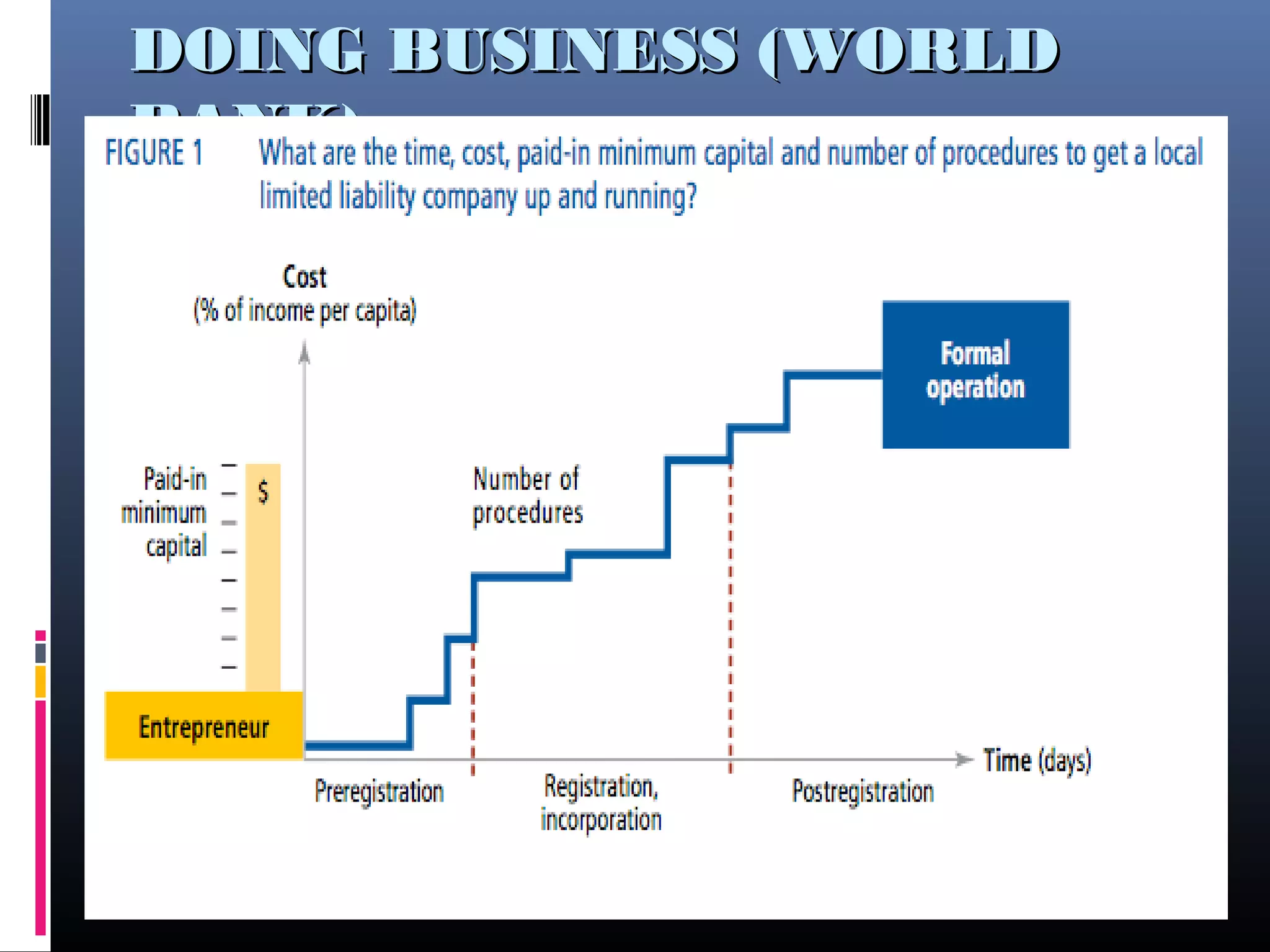
DOING BUSINESS (WORLDDOING BUSINESS (WORLD
BANK)BANK)
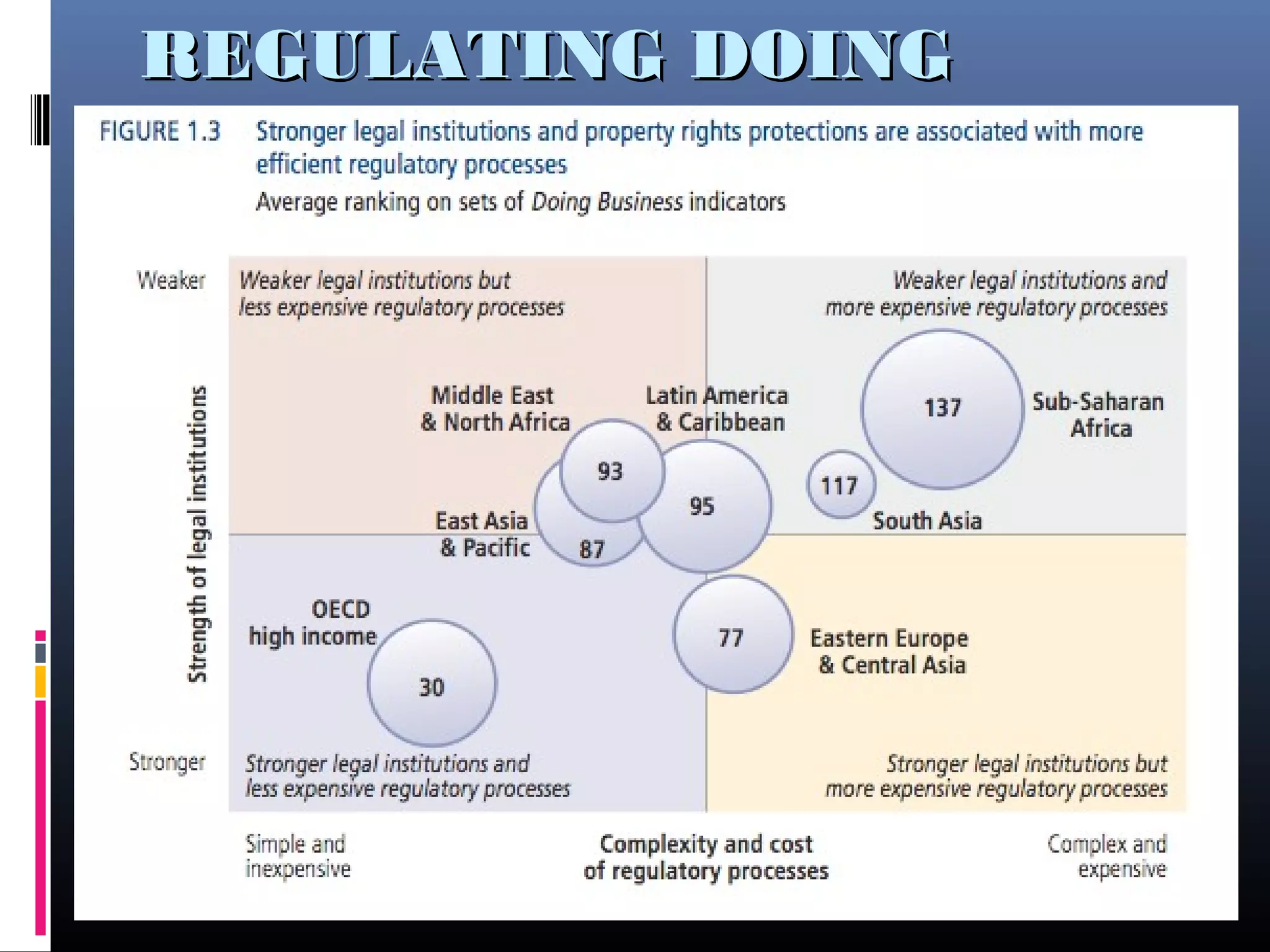
REGULATING DOINGREGULATING DOING
BUSINESSBUSINESS
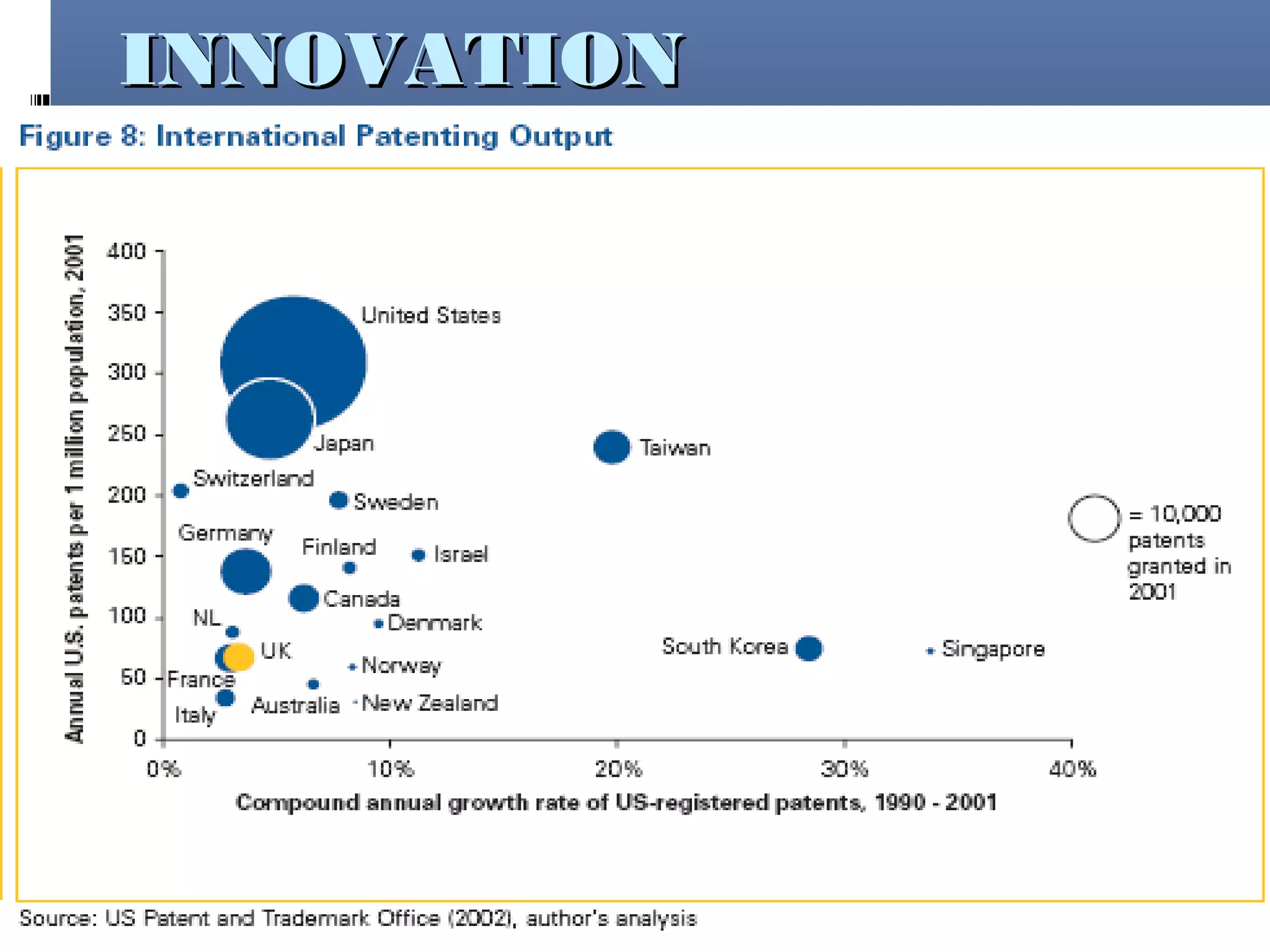
INNOVATIONINNOVATION
CHALLENGECHALLENGE
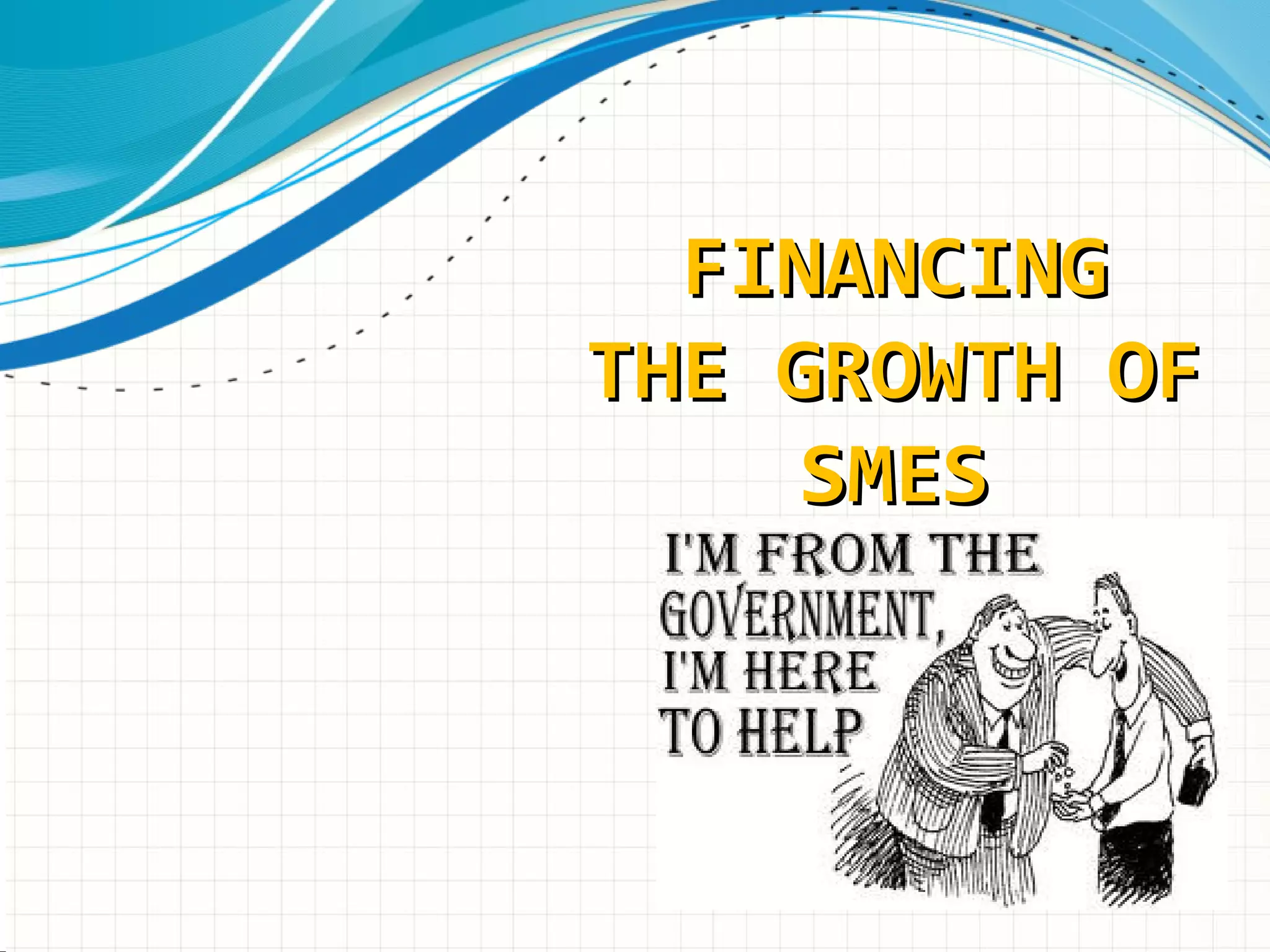
FINANCINGFINANCING
THE GROWTH OFTHE GROWTH OF
SMESSMES
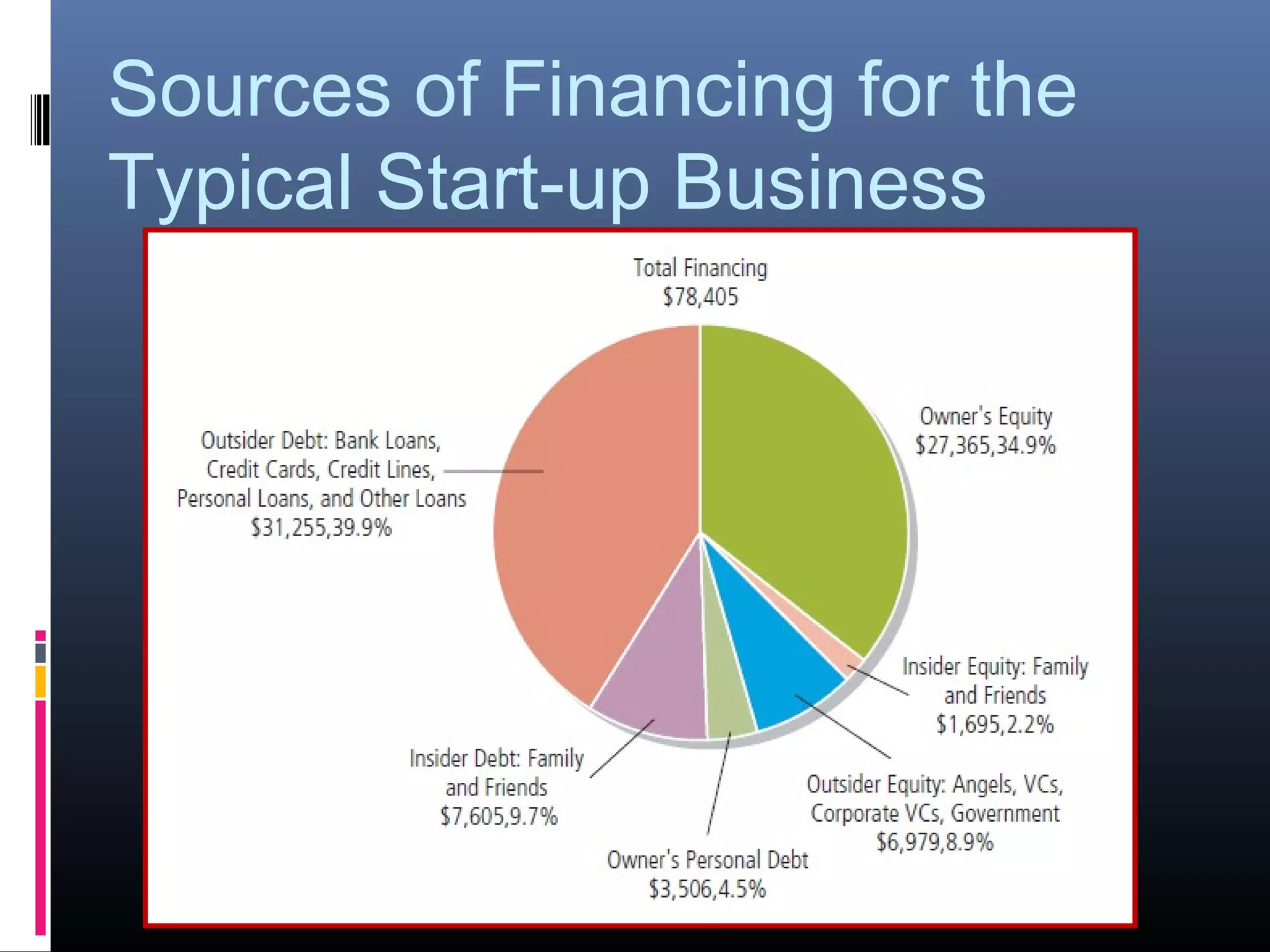
Sources of Financing for the
Typical Start-up Business
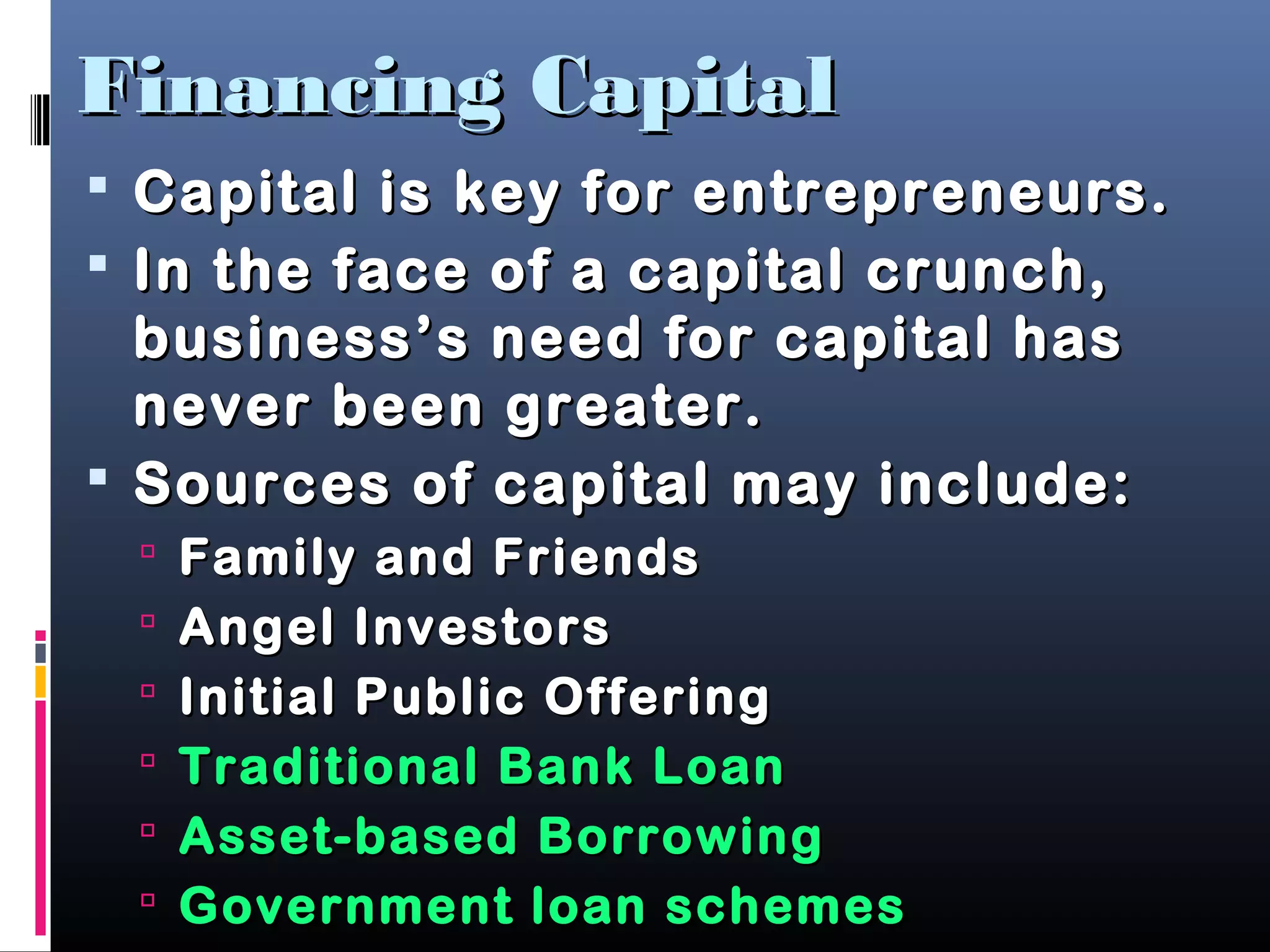
Financing CapitalFinancing Capital
 Capital is key for entrepreneurs.Capital is key for entrepreneurs.
 In the face of a capital crunch,In the face of a capital crunch,
business’s need for capital hasbusiness’s need for capital has
never been greater.never been greater.
 Sources of capital may include:Sources of capital may include:
 Family and FriendsFamily and Friends
 Angel InvestorsAngel Investors
 Initial Public OfferingInitial Public Offering
 Traditional Bank LoanTraditional Bank Loan
 Asset-based BorrowingAsset-based Borrowing
 Government loan schemesGovernment loan schemes
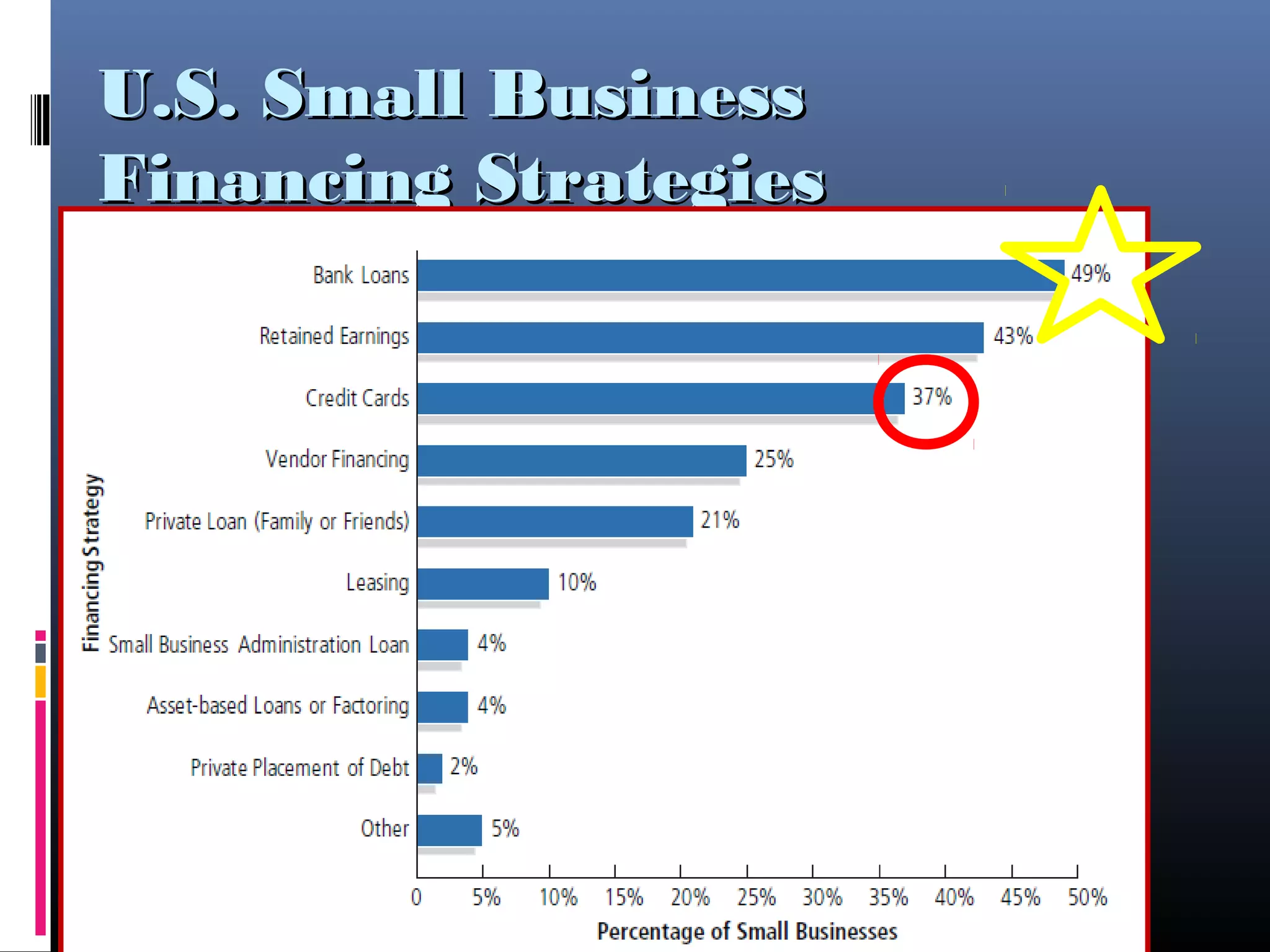
U.S. Small BusinessU.S. Small Business
Financing StrategiesFinancing Strategies
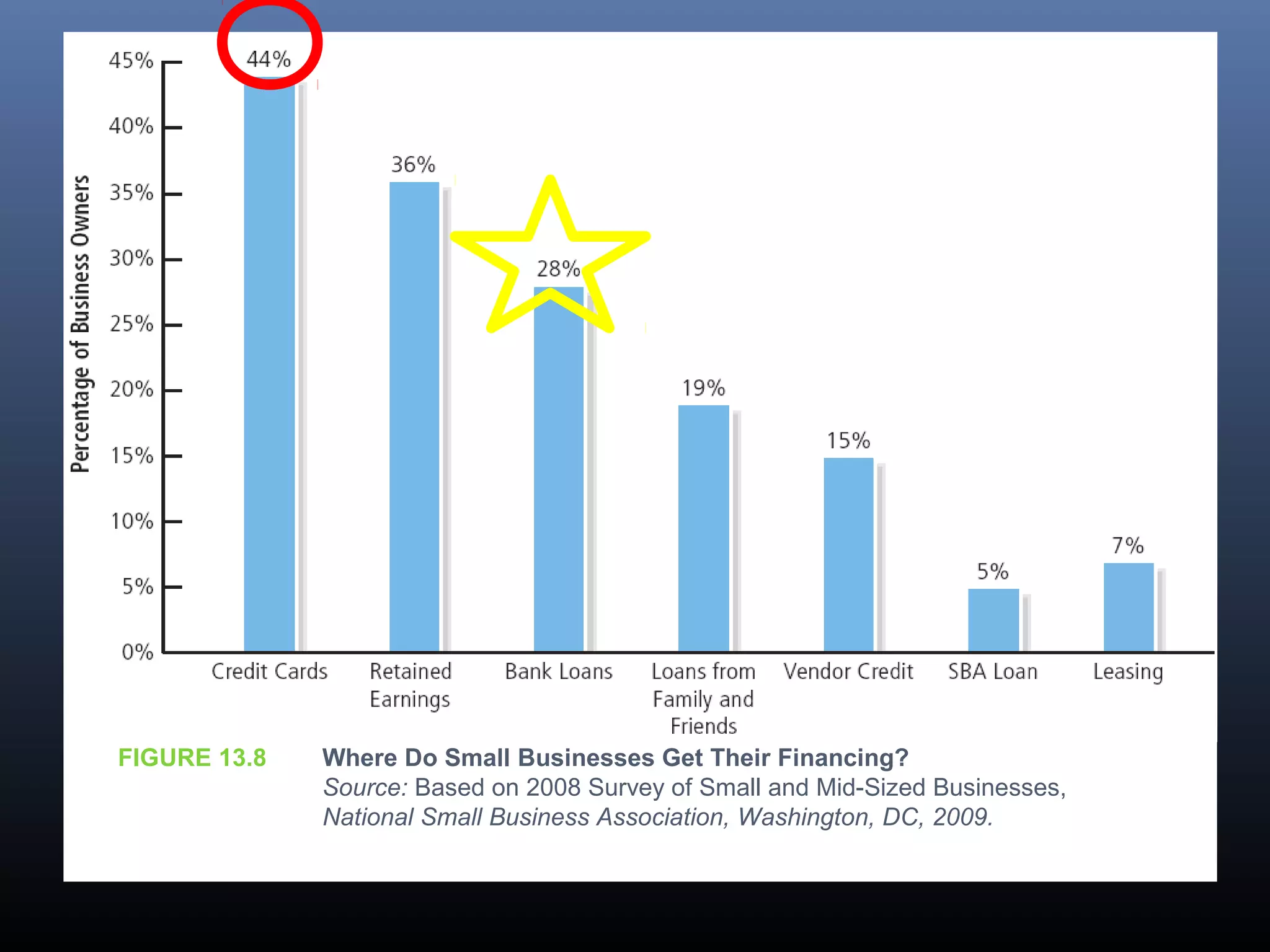
FIGURE 13.8 Where Do Small Businesses Get Their Financing?
Source: Based on 2008 Survey of Small and Mid-Sized Businesses,
National Small Business Association, Washington, DC, 2009.
13 - 38
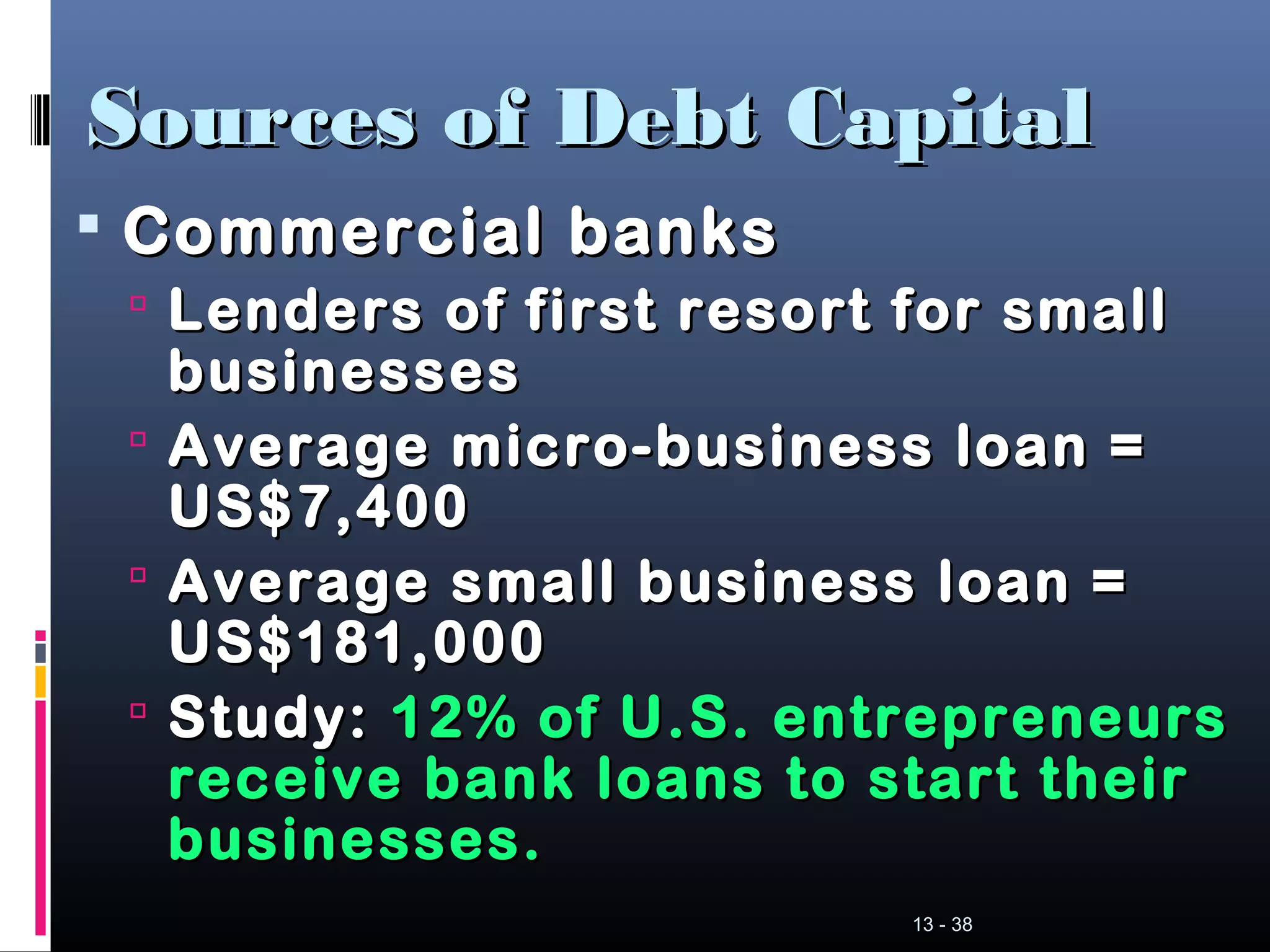
Sources of Debt CapitalSources of Debt Capital
 Commercial banksCommercial banks
 Lenders of first resort for smallLenders of first resort for small
businessesbusinesses
 Average micro-business loan =Average micro-business loan =
US$7,400US$7,400
 Average small business loan =Average small business loan =
US$181,000US$181,000
 Study:Study: 12% of U.S. entrepreneurs12% of U.S. entrepreneurs
receive bank loans to start theirreceive bank loans to start their
businesses.businesses.
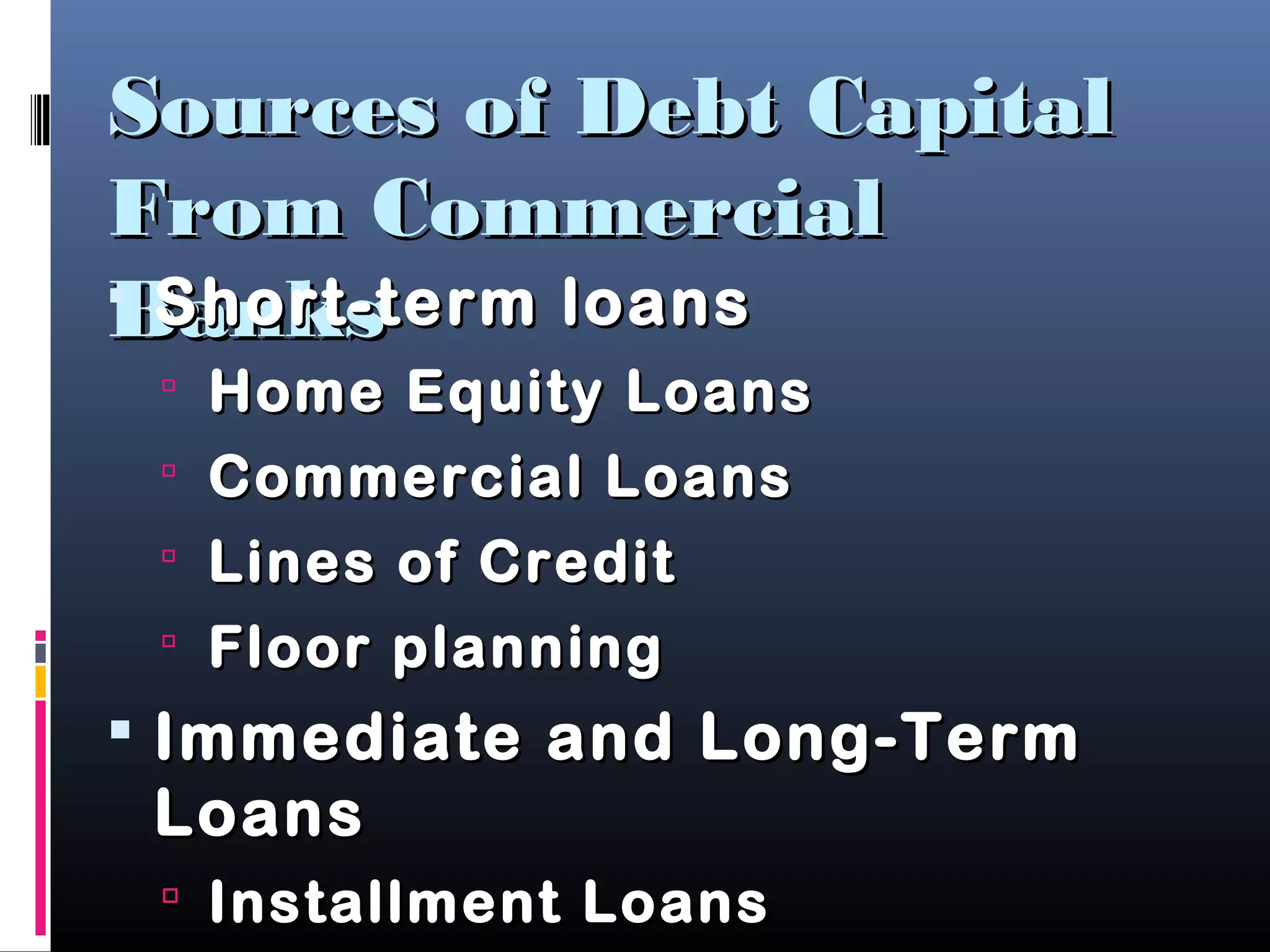
Sources of Debt CapitalSources of Debt Capital
From CommercialFrom Commercial
BanksBanks Short-term loansShort-term loans
 Home Equity LoansHome Equity Loans
 Commercial LoansCommercial Loans
 Lines of CreditLines of Credit
 Floor planningFloor planning
 Immediate and Long-TermImmediate and Long-Term
LoansLoans
 Installment LoansInstallment Loans
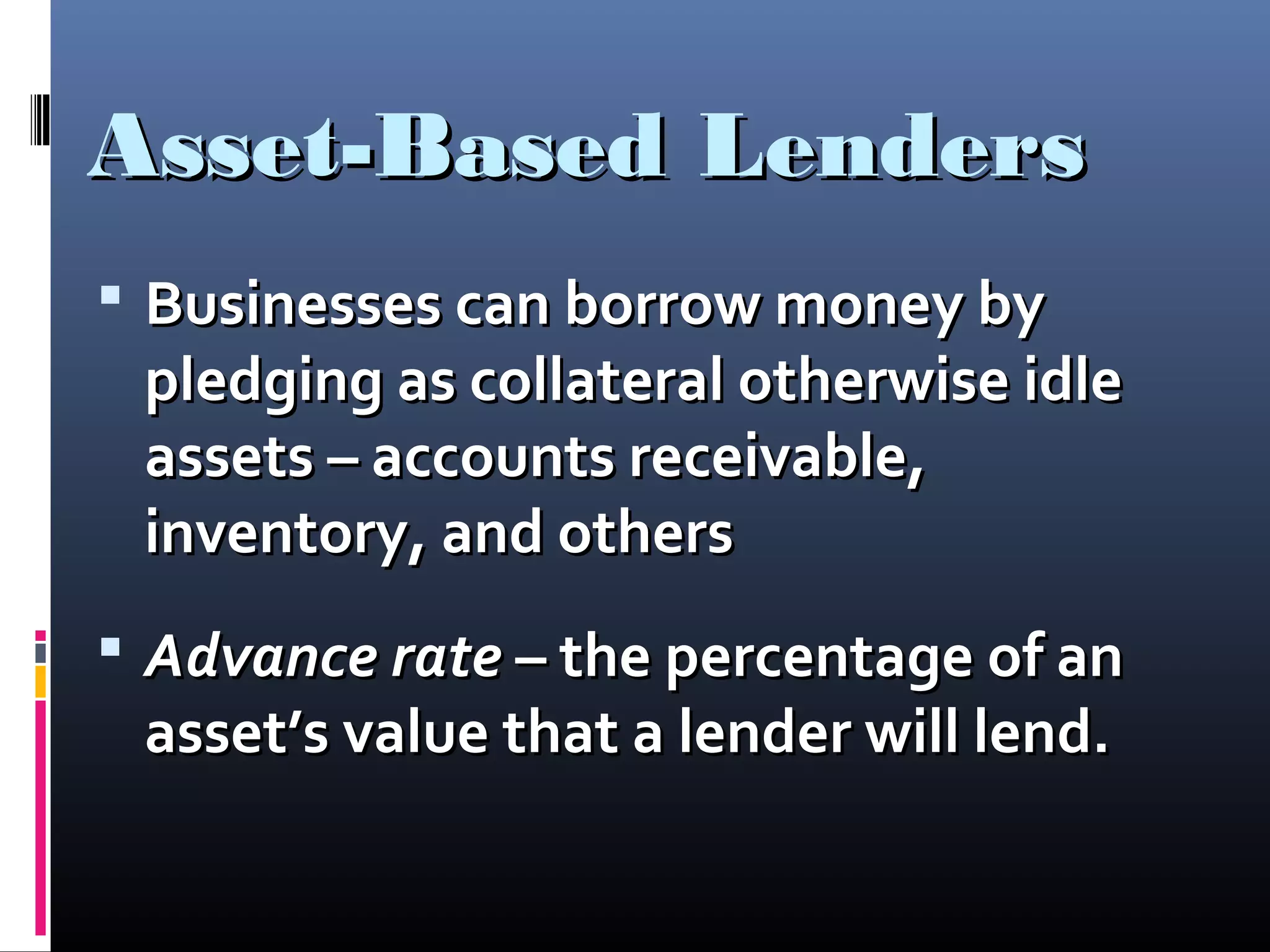
Asset-Based LendersAsset-Based Lenders
 Businesses can borrow money byBusinesses can borrow money by
pledging as collateral otherwise idlepledging as collateral otherwise idle
assets – accounts receivable,assets – accounts receivable,
inventory, and othersinventory, and others
 Advance rateAdvance rate – the percentage of an– the percentage of an
asset’s value that a lender will lend.asset’s value that a lender will lend.
Asset-Based BorrowingAsset-Based Borrowing
 Discounting accountsDiscounting accounts
receivablereceivable
Inventory financingInventory financing
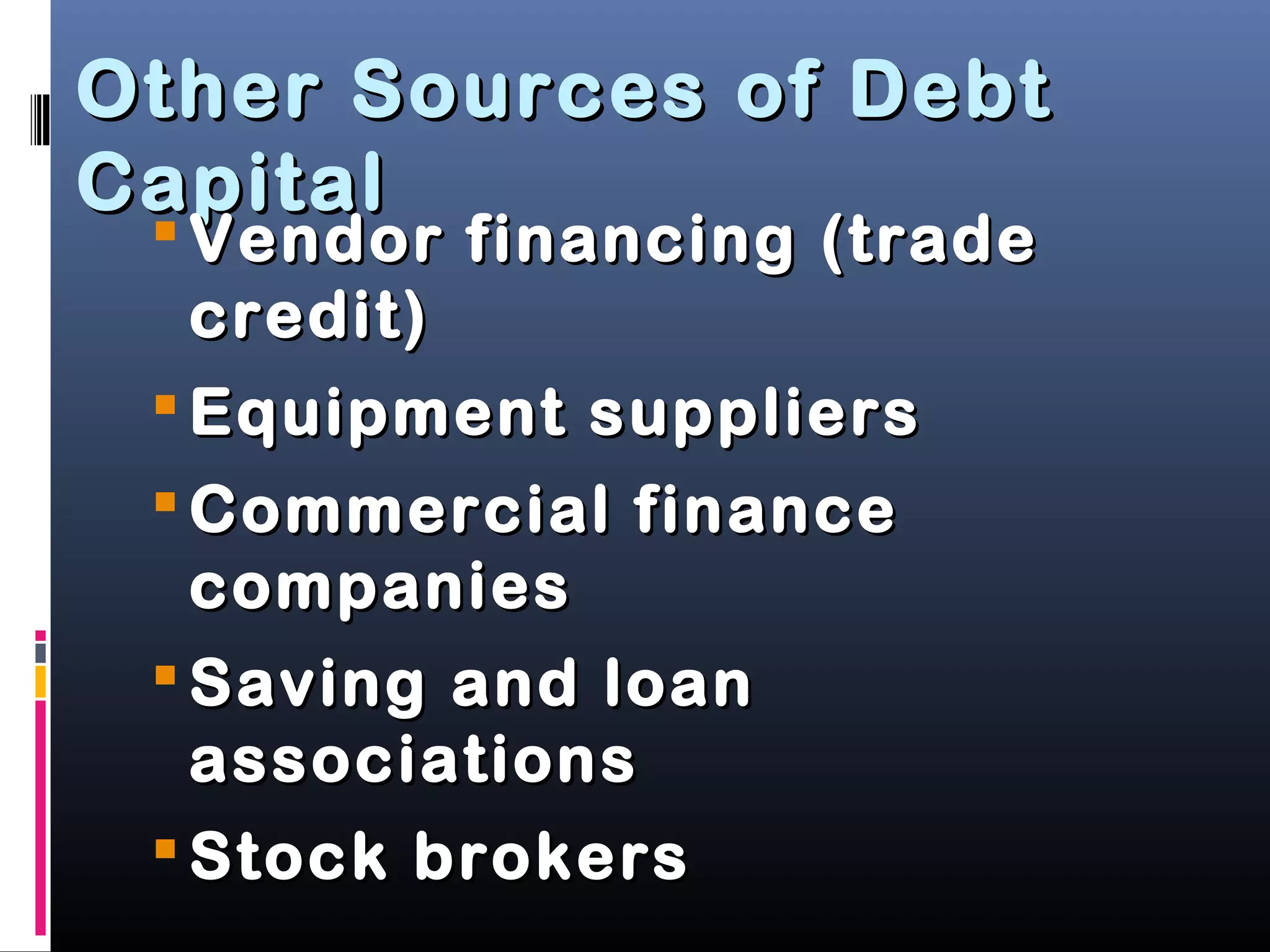
Other Sources of DebtOther Sources of Debt
CapitalCapital
 Vendor financing (tradeVendor financing (trade
credit)credit)
 Equipment suppliersEquipment suppliers
 Commercial financeCommercial finance
companiescompanies
 Saving and loanSaving and loan
associationsassociations
 Stock brokersStock brokers
Other Sources of DebtOther Sources of Debt
CapitalCapital
Credit unionsCredit unions
Private placementsPrivate placements
Small BusinessSmall Business
Investment CompaniesInvestment Companies
(SBIC)(SBIC)
Small Business LendingSmall Business Lending
Companies (SBLCs)Companies (SBLCs)
(continued)
U.S. Federally SponsoredU.S. Federally Sponsored
ProgrammesProgrammes
 Economic Development AdministrationEconomic Development Administration
(EDA)(EDA)
 Department of Housing and UrbanDepartment of Housing and Urban
Development (HUD)Development (HUD)
 U.S. Department of Agriculture’sU.S. Department of Agriculture’s
Rural Business (USDA) - CooperativeRural Business (USDA) - Cooperative
ServiceService
 Small Business Innovation ResearchSmall Business Innovation Research
(SBIR)(SBIR)
 Small Business Technology TransferSmall Business Technology Transfer
Example : U.S. SBA LoanExample : U.S. SBA Loan
ProgrammesProgrammes
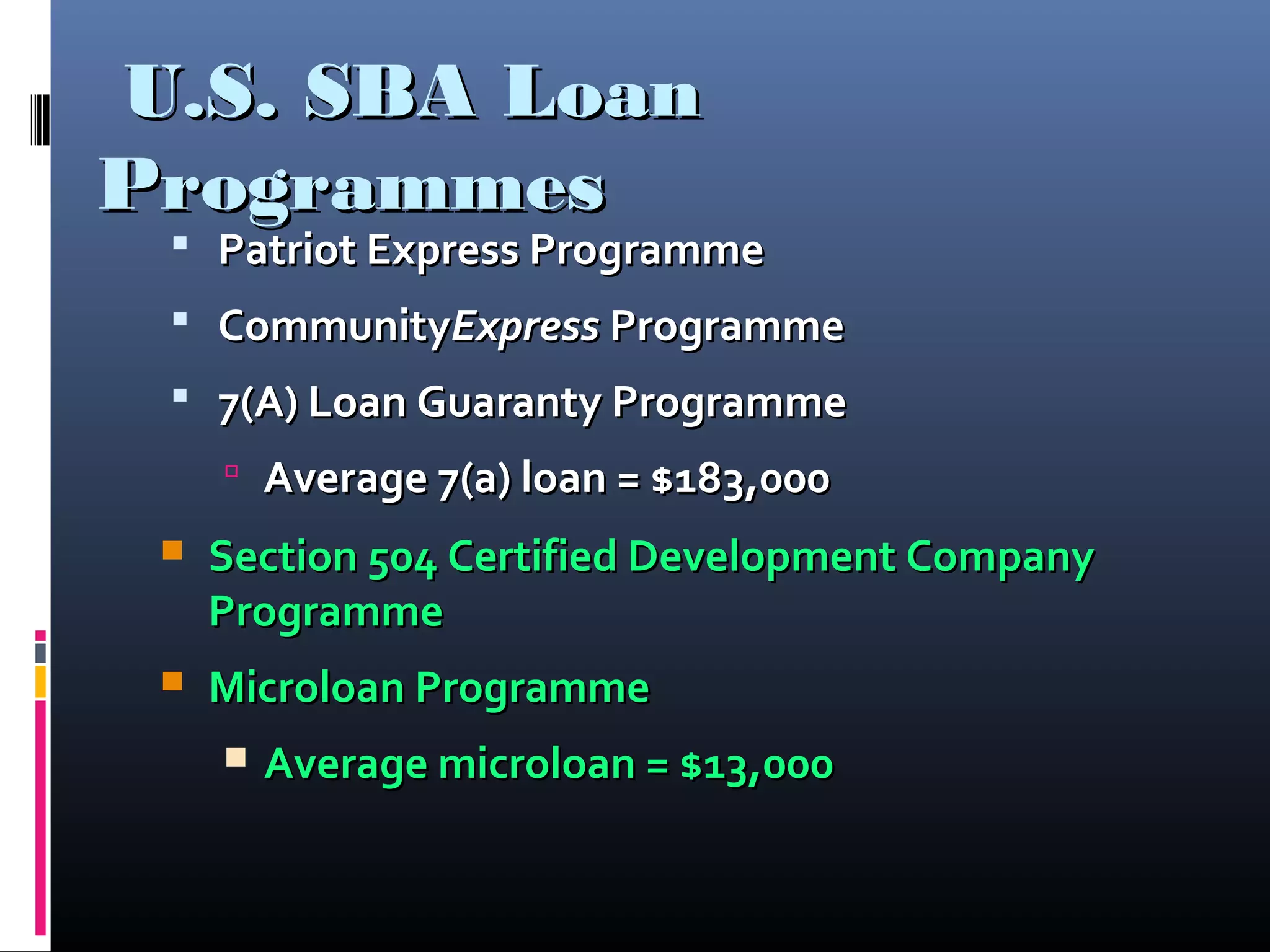
 Patriot Express ProgrammePatriot Express Programme
 CommunityCommunityExpressExpress ProgrammeProgramme
 7(A) Loan Guaranty Programme7(A) Loan Guaranty Programme
 Average 7(a) loan = $183,000Average 7(a) loan = $183,000
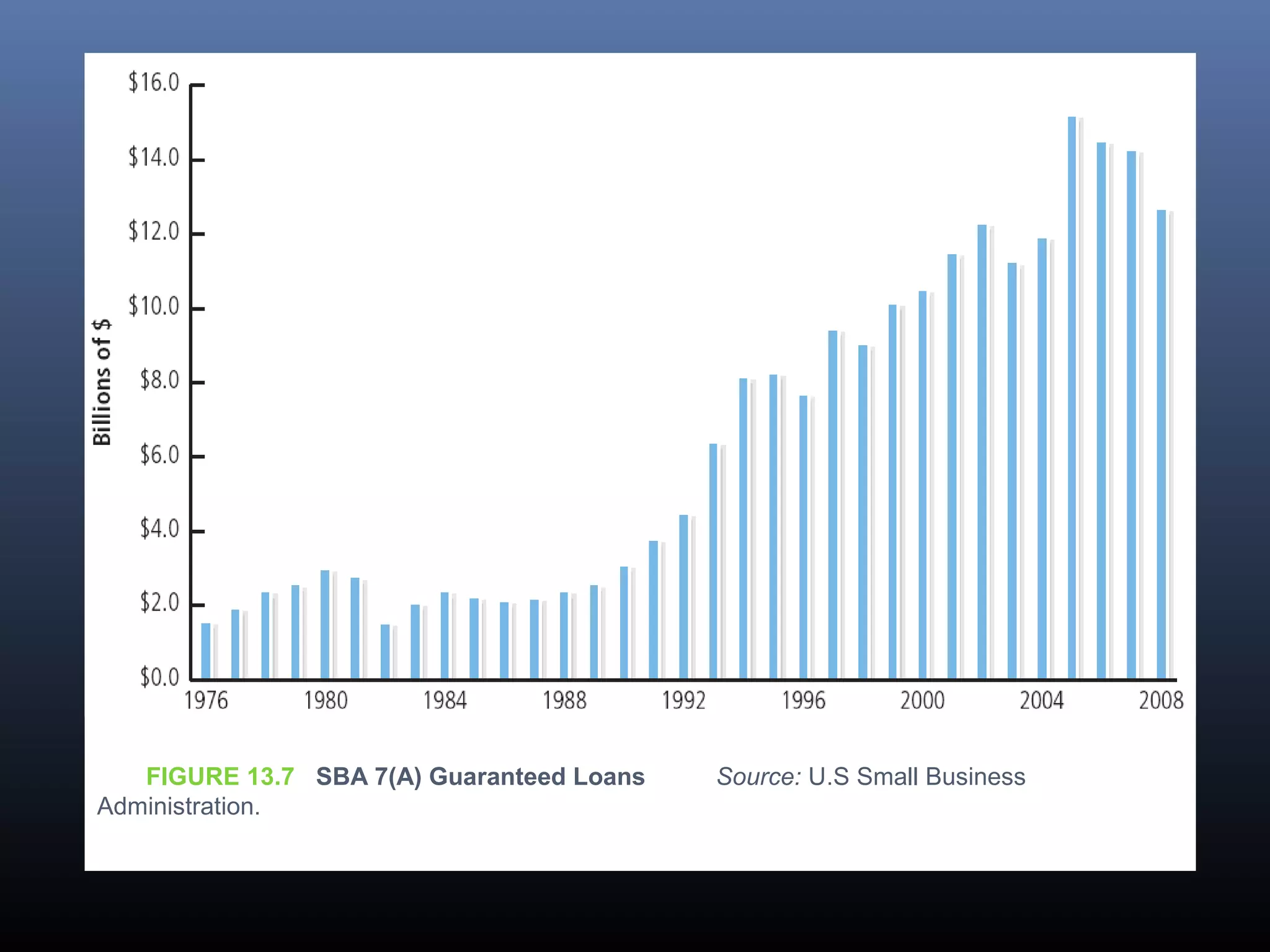
FIGURE 13.7 SBA 7(A) Guaranteed Loans Source: U.S Small Business
Administration.
U.S. SBA LoanU.S. SBA Loan
ProgrammesProgrammes
 Patriot Express ProgrammePatriot Express Programme
 CommunityCommunityExpressExpress ProgrammeProgramme
 7(A) Loan Guaranty Programme7(A) Loan Guaranty Programme
 Average 7(a) loan = $183,000Average 7(a) loan = $183,000
 Section 504 Certified Development CompanySection 504 Certified Development Company
ProgrammeProgramme
 Microloan ProgrammeMicroloan Programme
 Average microloan = $13,000Average microloan = $13,000
U.S. SBA LoanU.S. SBA Loan
ProgrammesProgrammes
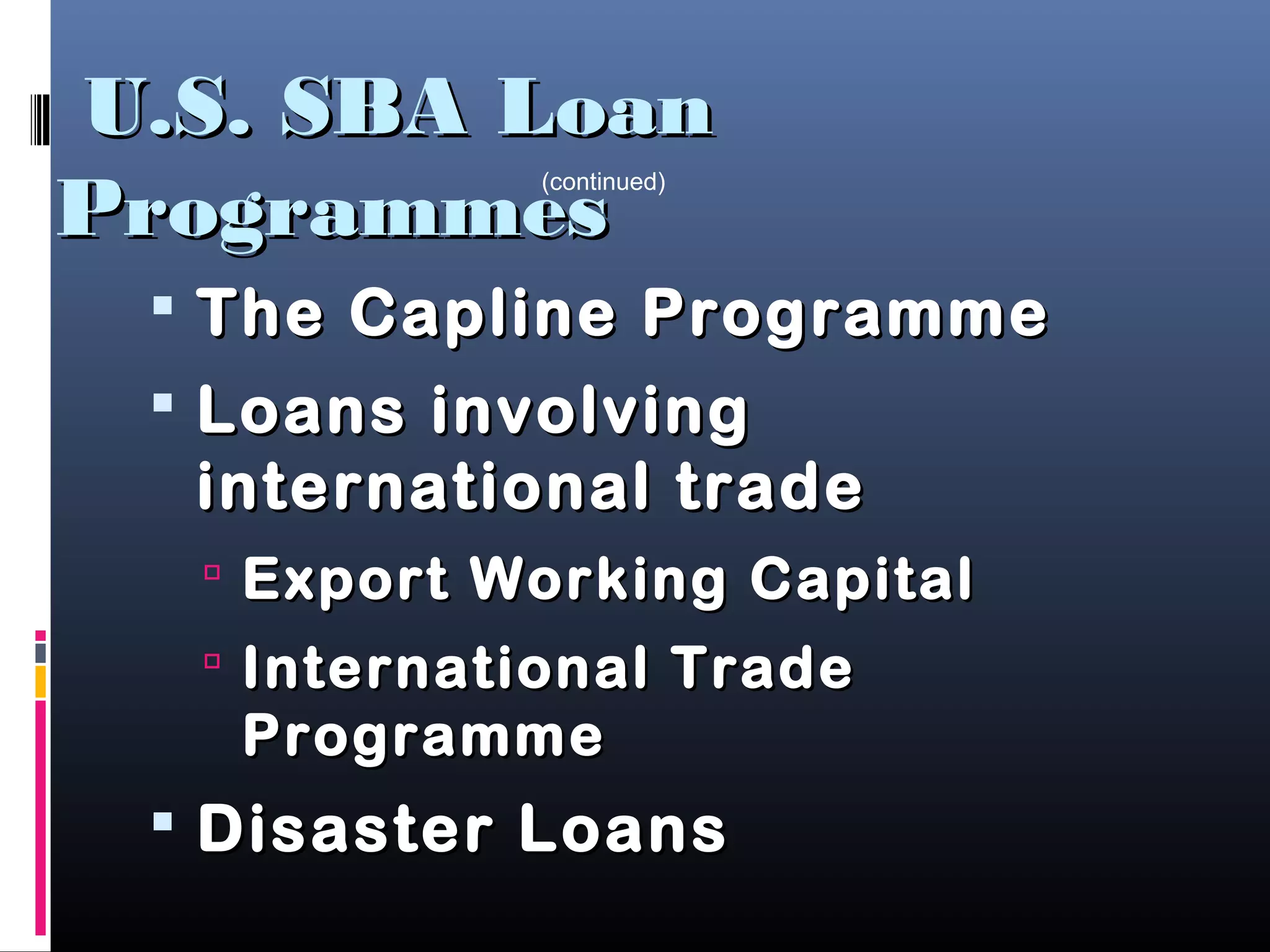
 The Capline ProgrammeThe Capline Programme
 Loans involvingLoans involving
international tradeinternational trade
 Export Working CapitalExport Working Capital
 International TradeInternational Trade
ProgrammeProgramme
 Disaster LoansDisaster Loans
(continued)
U.S. State and LocalU.S. State and Local
Loan ProgrammesLoan Programmes
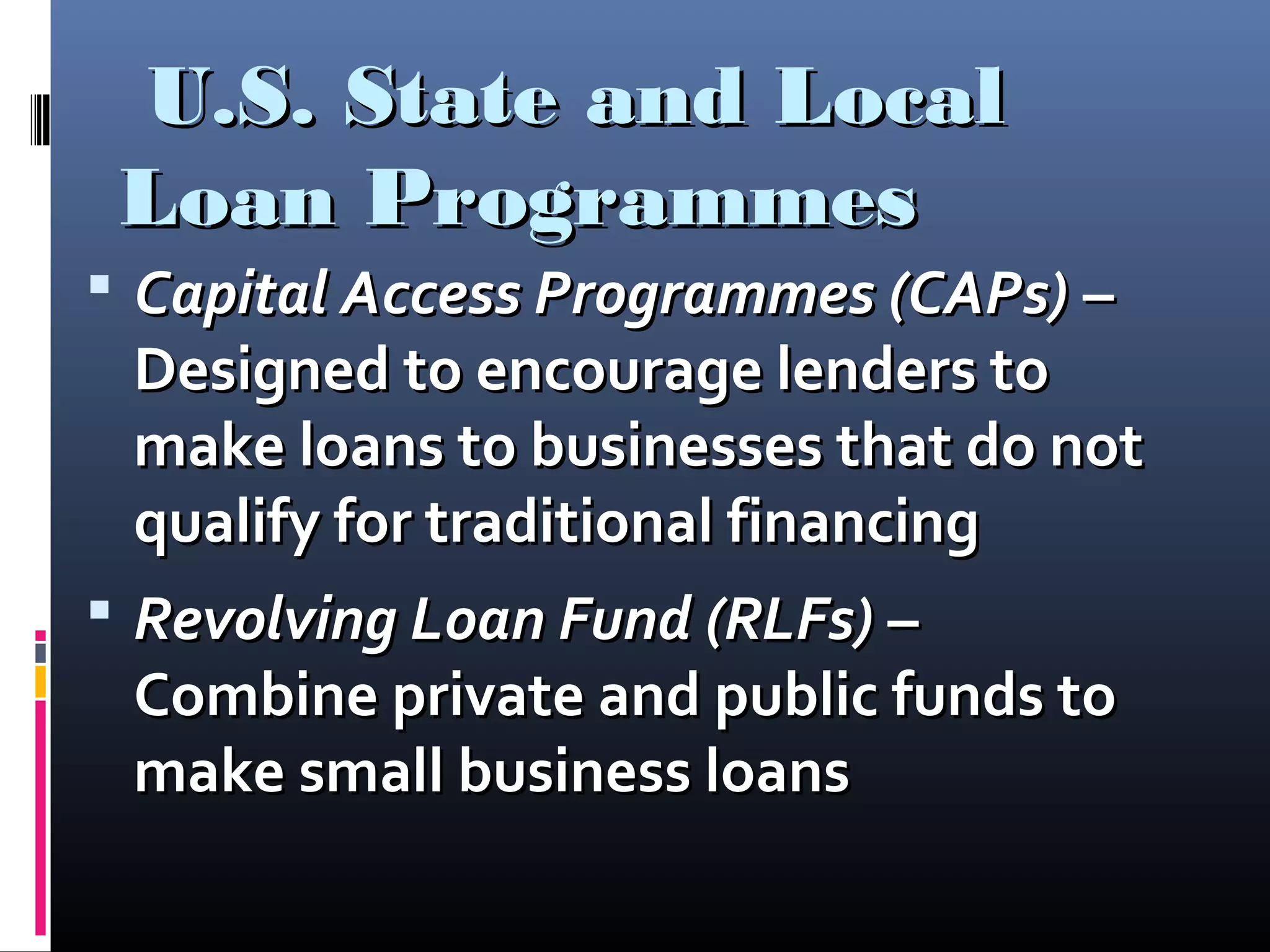
 Capital Access Programmes (CAPs)Capital Access Programmes (CAPs) ––
Designed to encourage lenders toDesigned to encourage lenders to
make loans to businesses that do notmake loans to businesses that do not
qualify for traditional financingqualify for traditional financing
 Revolving Loan Fund (RLFs)Revolving Loan Fund (RLFs) ––
Combine private and public funds toCombine private and public funds to
make small business loansmake small business loans
Six Common ReasonsSix Common Reasons
Bankers Reject SmallBankers Reject Small
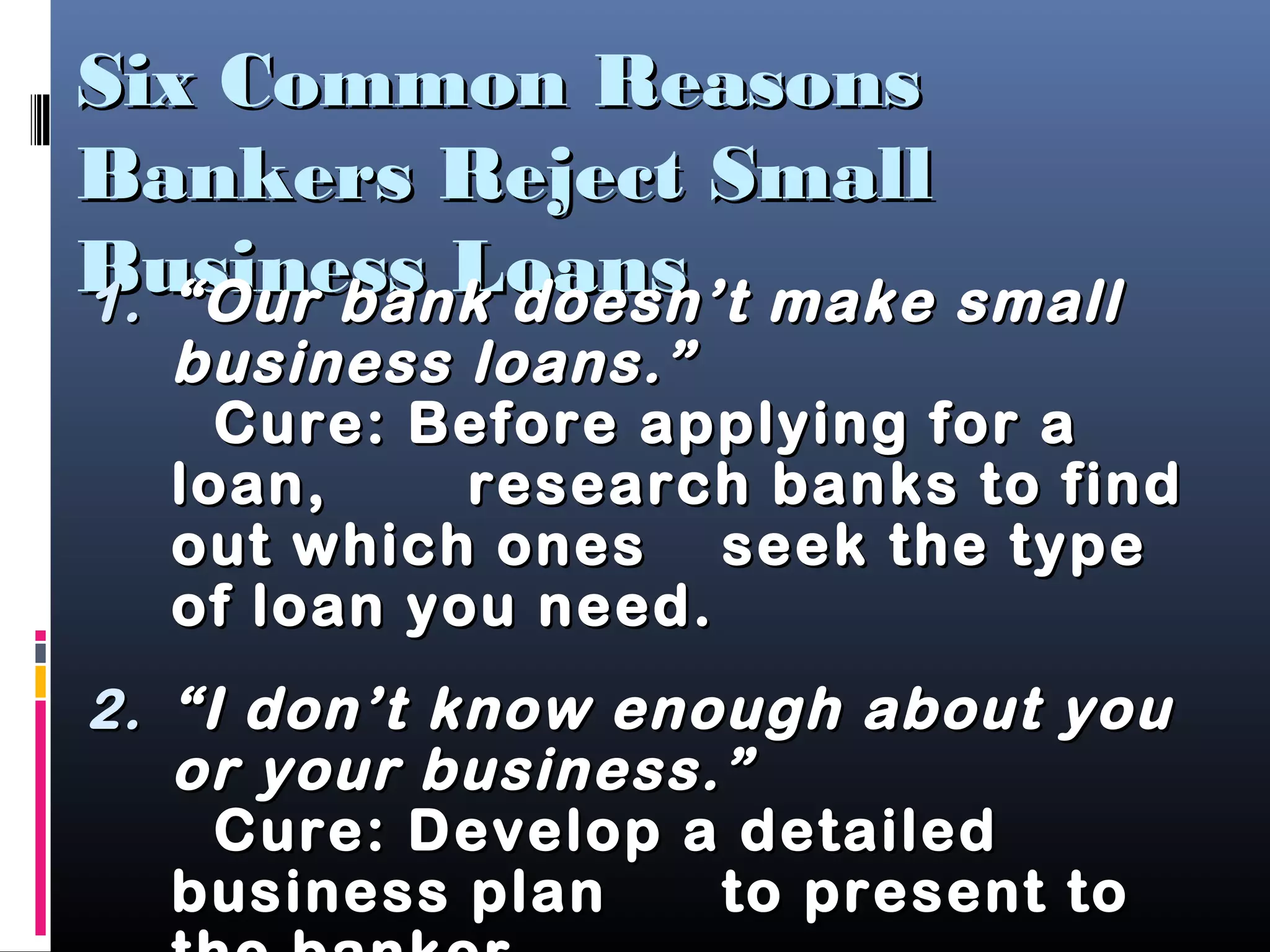
Business LoansBusiness Loans1.1. ““Our bank doesn’t make smallOur bank doesn’t make small
business loans.”business loans.”
Cure: Before applying for aCure: Before applying for a
loan,loan, research banks to findresearch banks to find
out which onesout which ones seek the typeseek the type
of loan you need.of loan you need.
2.2. ““I don’t know enough about youI don’t know enough about you
or your business.”or your business.”
Cure: Develop a detailedCure: Develop a detailed
business planbusiness plan to present toto present to
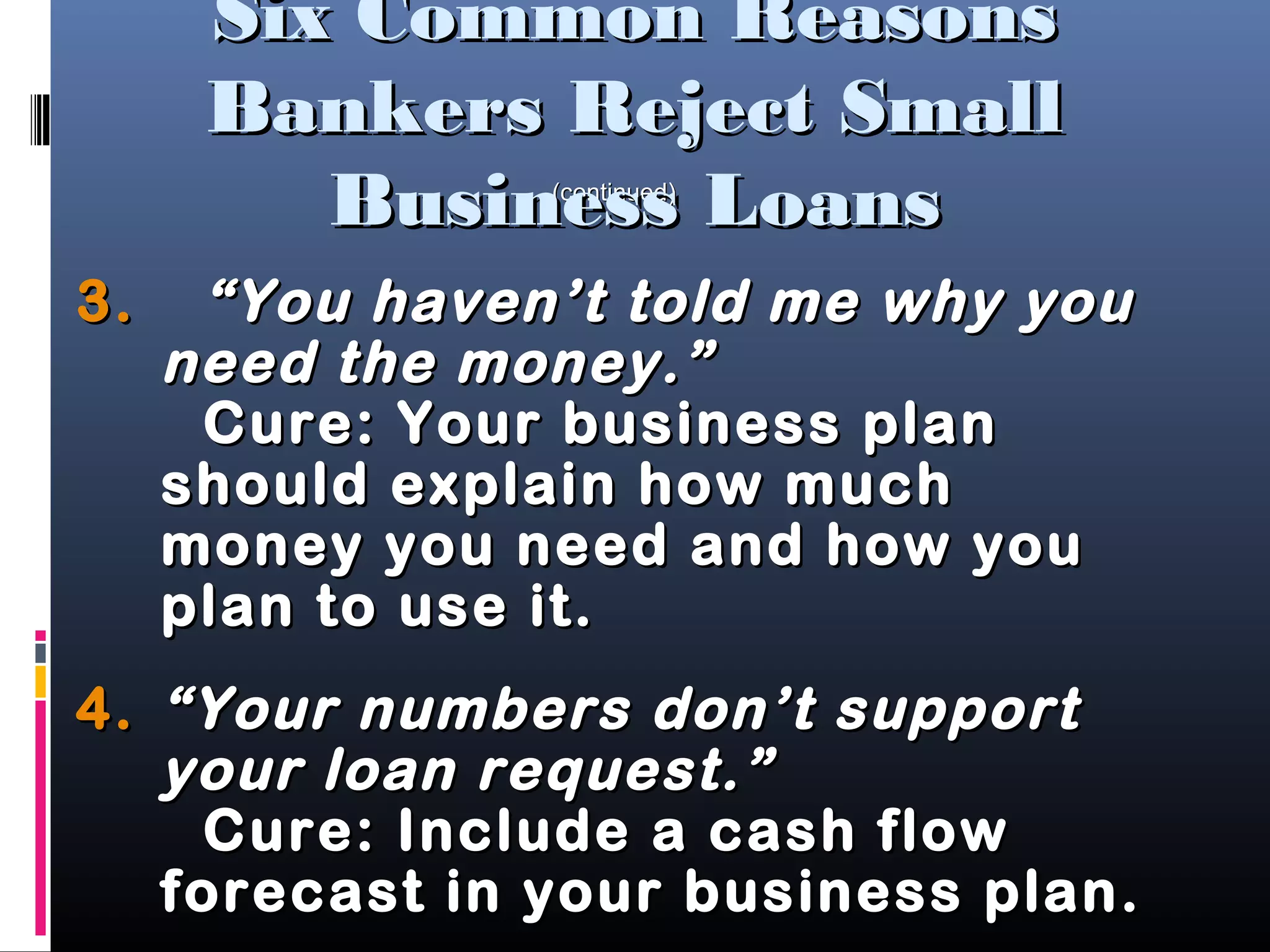
3.3. “You haven’t told me why you“You haven’t told me why you
need the money.”need the money.”
Cure: Your business planCure: Your business plan
should explain how muchshould explain how much
money you need and how youmoney you need and how you
plan to use it.plan to use it.
4.4. “Your numbers don’t support“Your numbers don’t support
your loan request.”your loan request.”
Cure: Include a cash flowCure: Include a cash flow
forecast in your business plan.forecast in your business plan.
(continued)(continued)
Six Common ReasonsSix Common Reasons
Bankers Reject SmallBankers Reject Small
Business LoansBusiness Loans
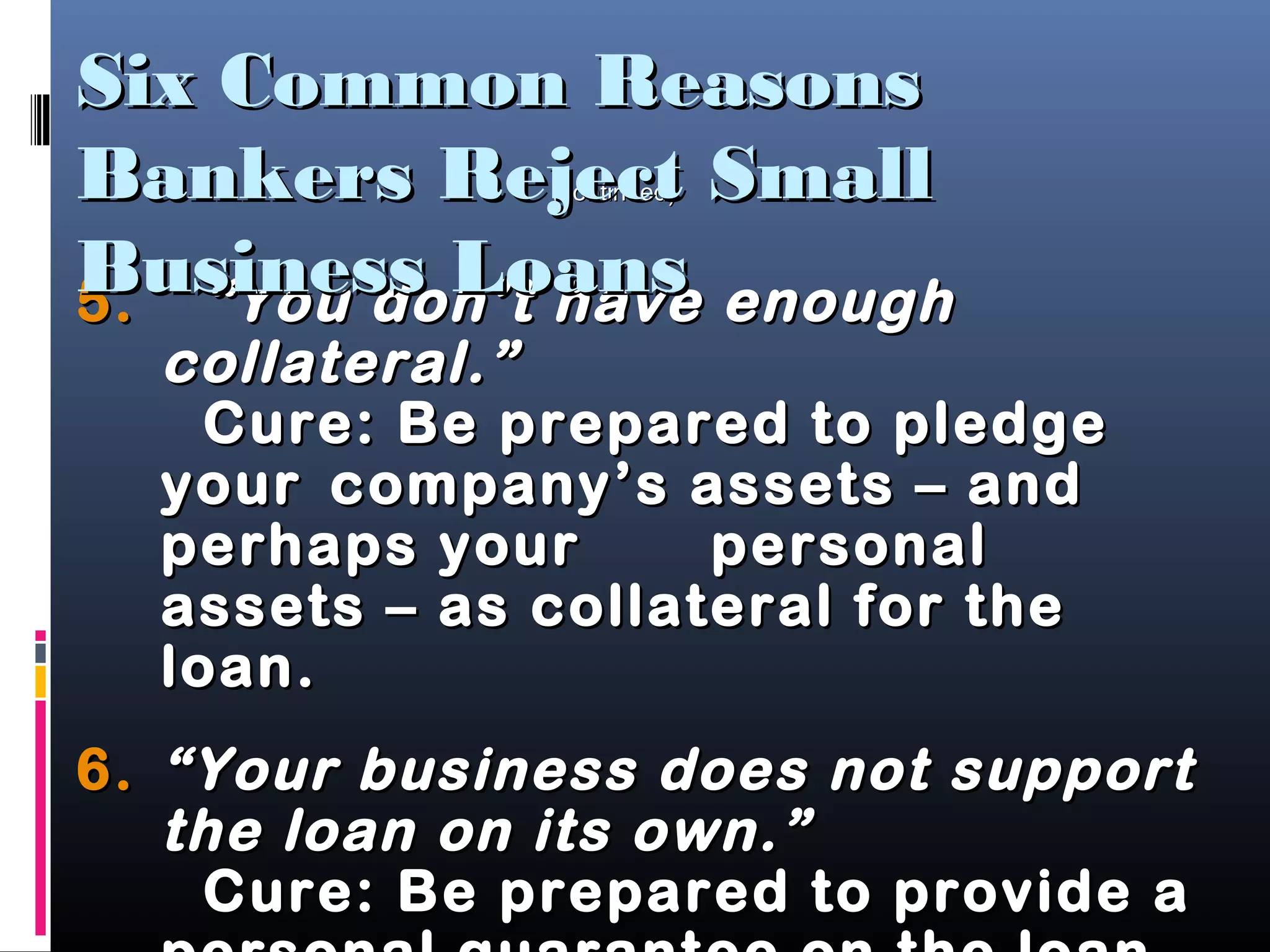
5.5. “You don’t have enough“You don’t have enough
collateral.”collateral.”
Cure: Be prepared to pledgeCure: Be prepared to pledge
youryour company’s assets – andcompany’s assets – and
perhaps yourperhaps your personalpersonal
assets – as collateral for theassets – as collateral for the
loan.loan.
6.6. “Your business does not support“Your business does not support
the loan on its own.”the loan on its own.”
Cure: Be prepared to provide aCure: Be prepared to provide a
(continued)(continued)
Six Common ReasonsSix Common Reasons
Bankers Reject SmallBankers Reject Small
Business LoansBusiness Loans
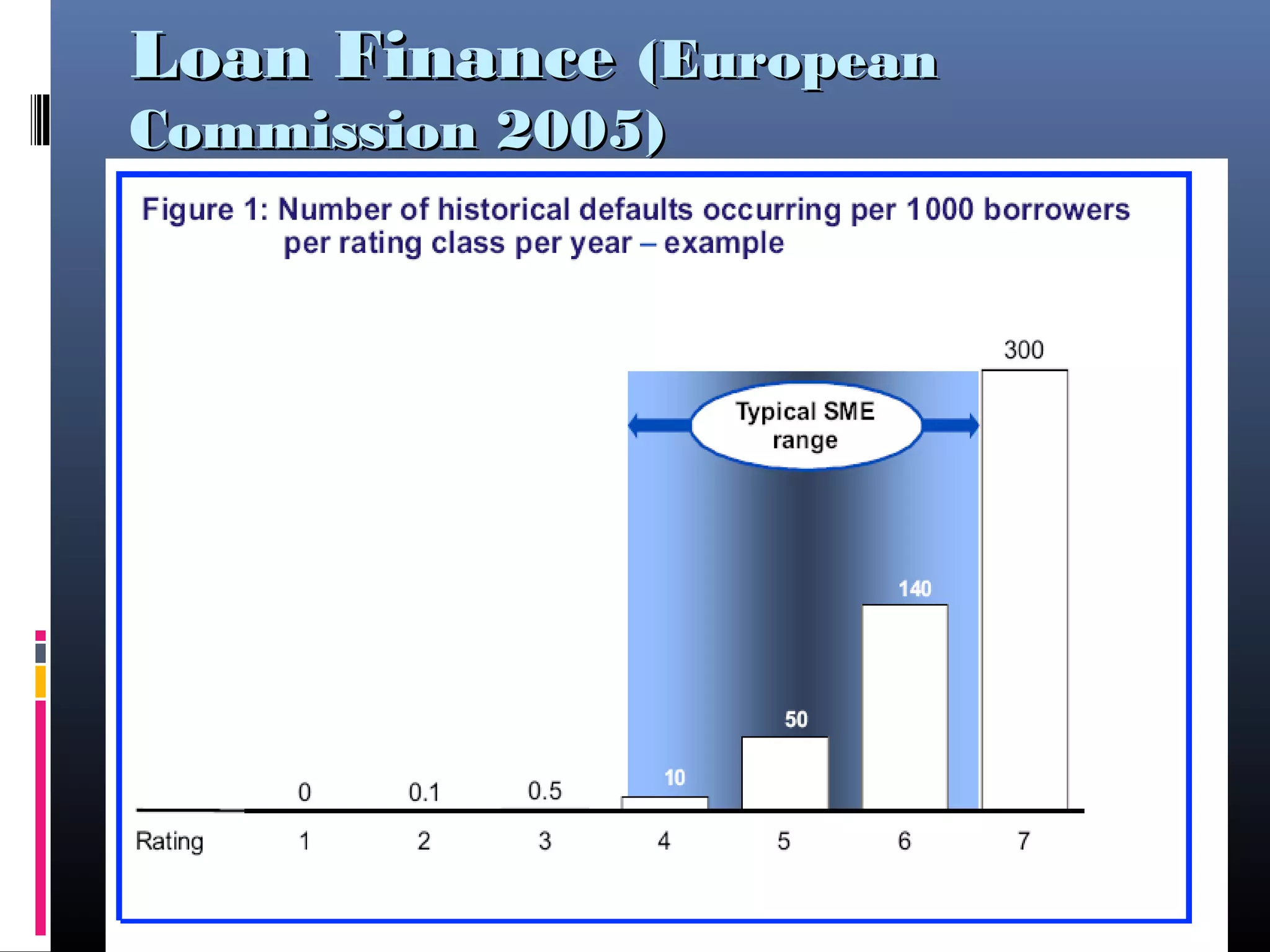
Loan FinanceLoan Finance (European(European
Commission 2005)Commission 2005)
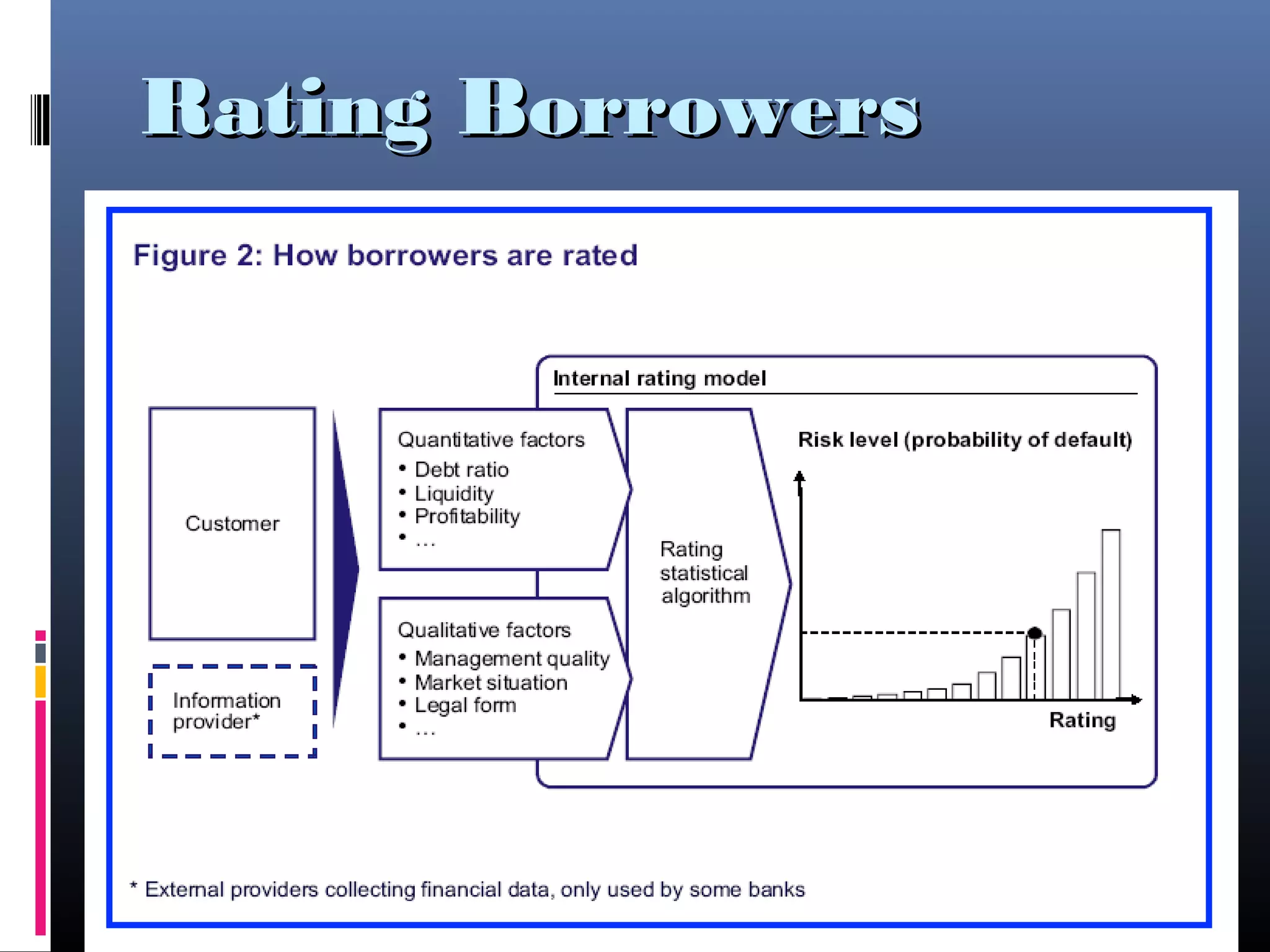
Rating BorrowersRating Borrowers
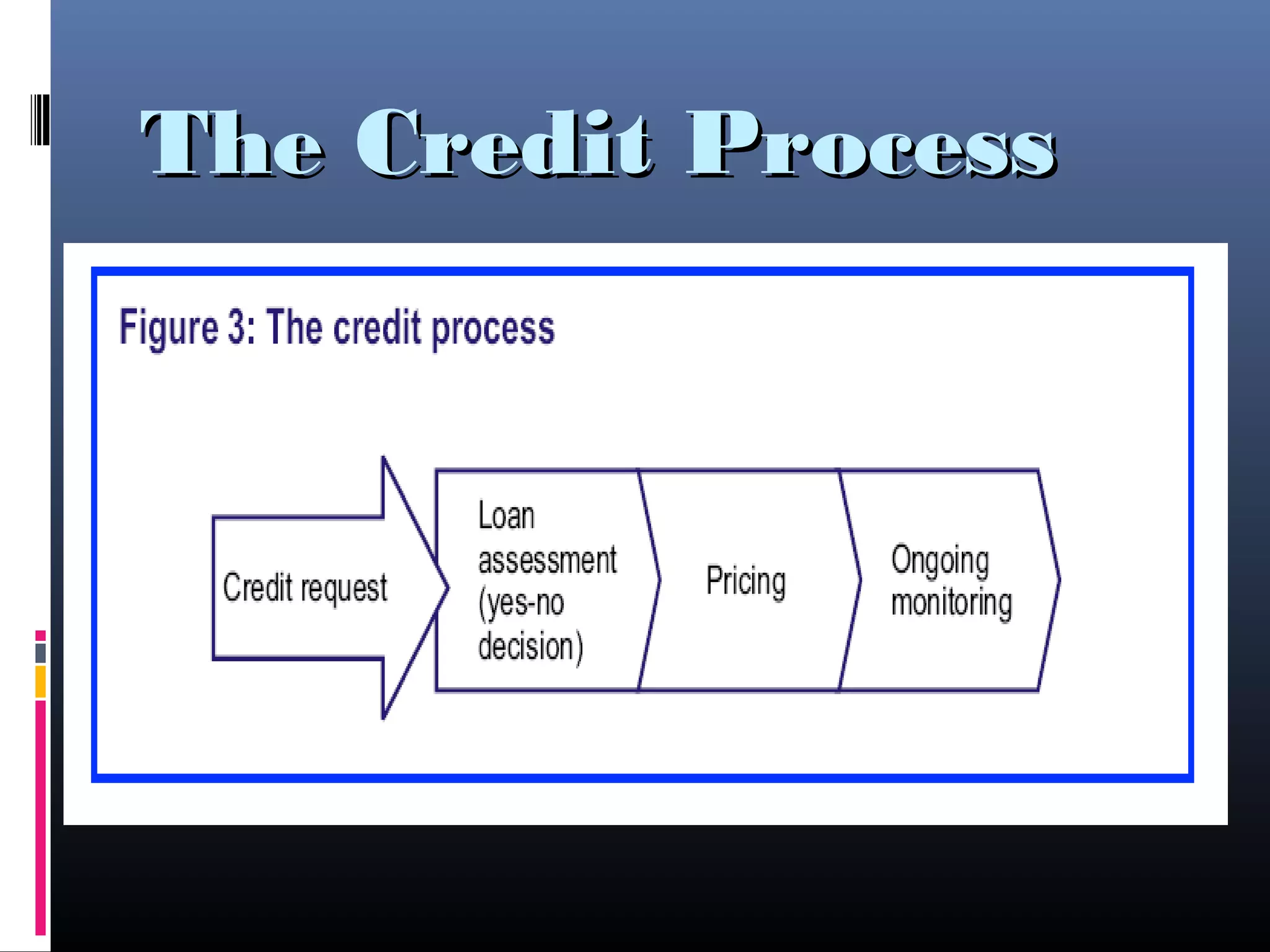
The Credit ProcessThe Credit Process
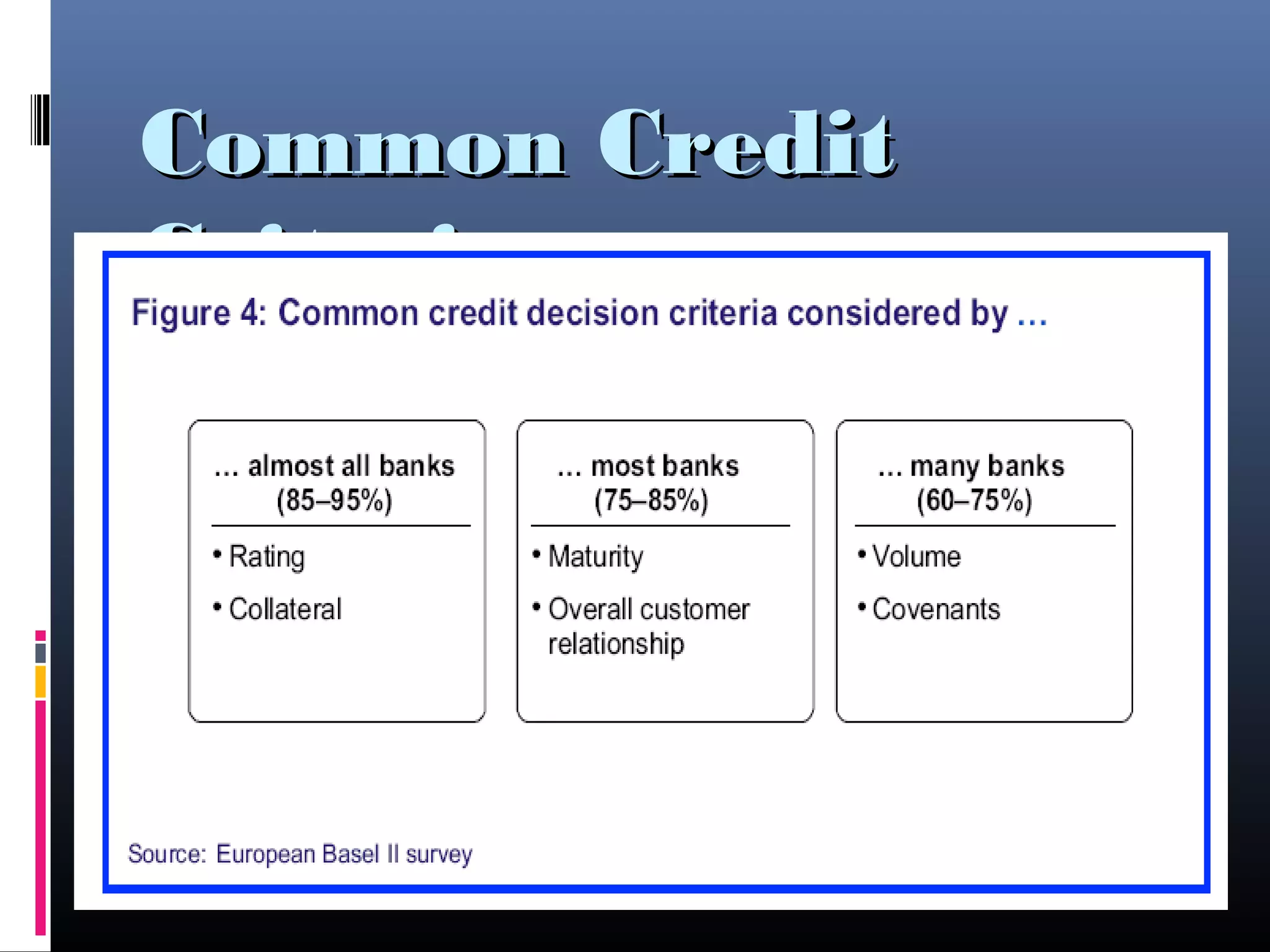
Common CreditCommon Credit
CriteriaCriteria
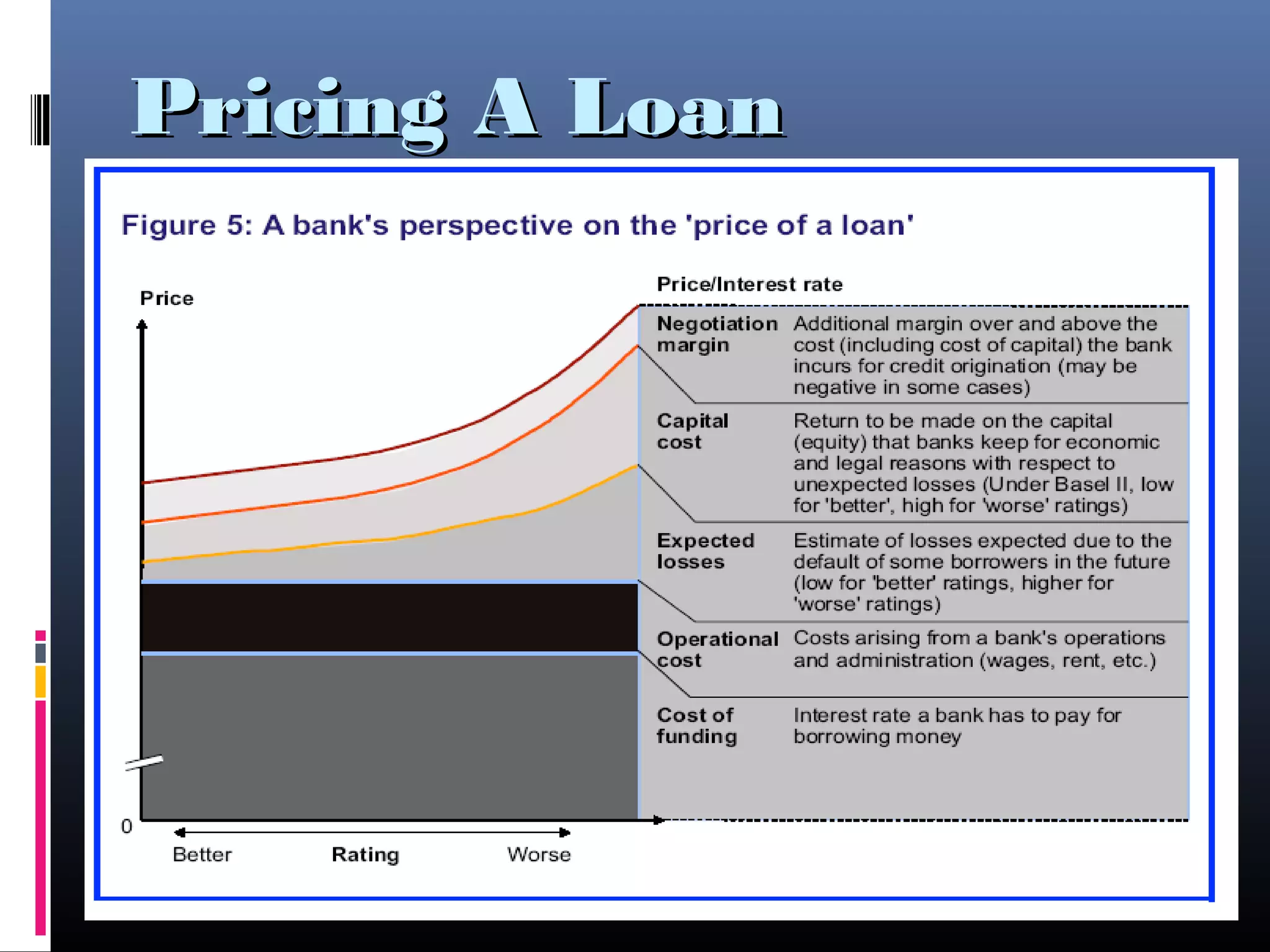
Pricing A LoanPricing A Loan
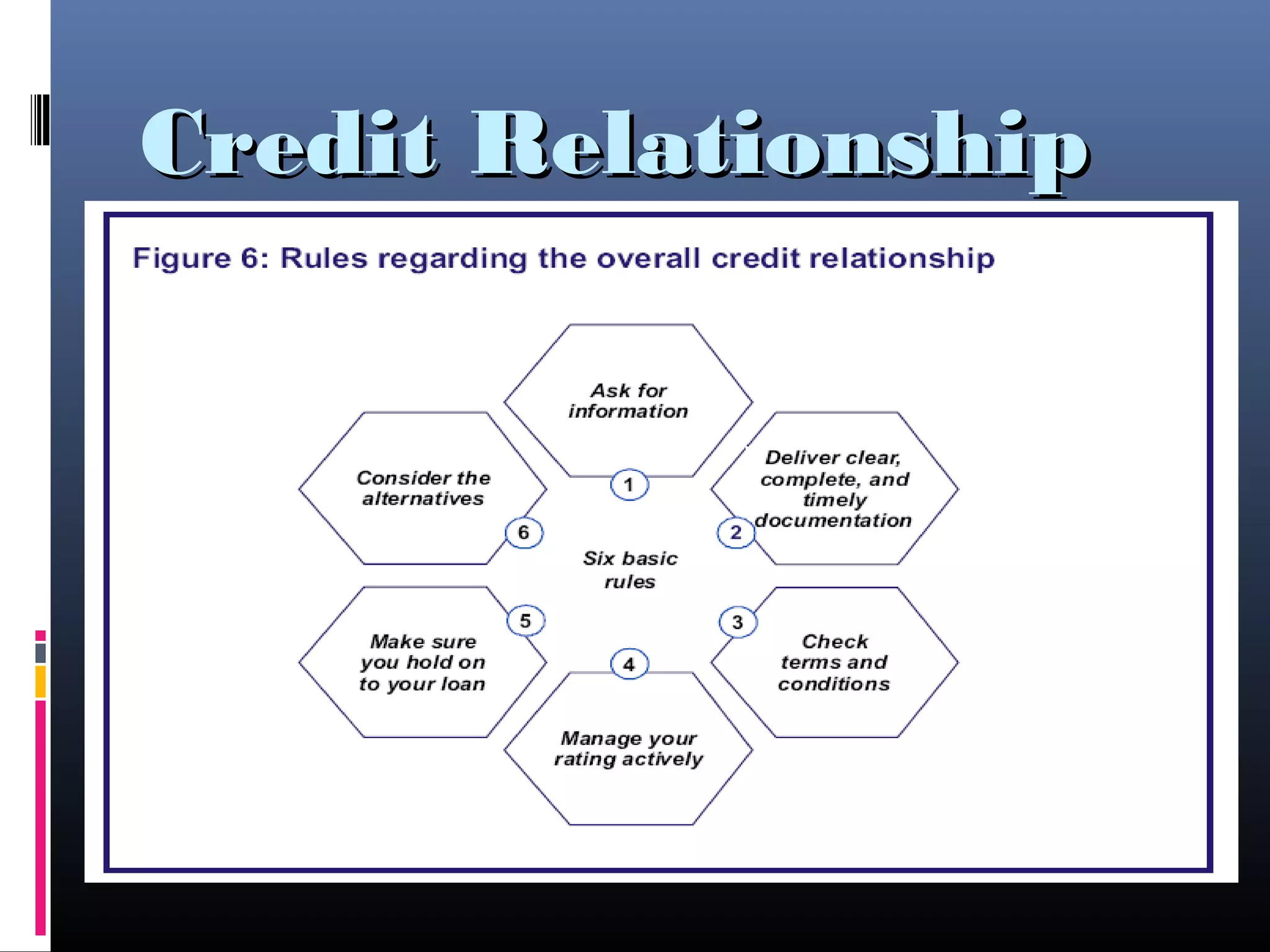
Credit RelationshipCredit Relationship
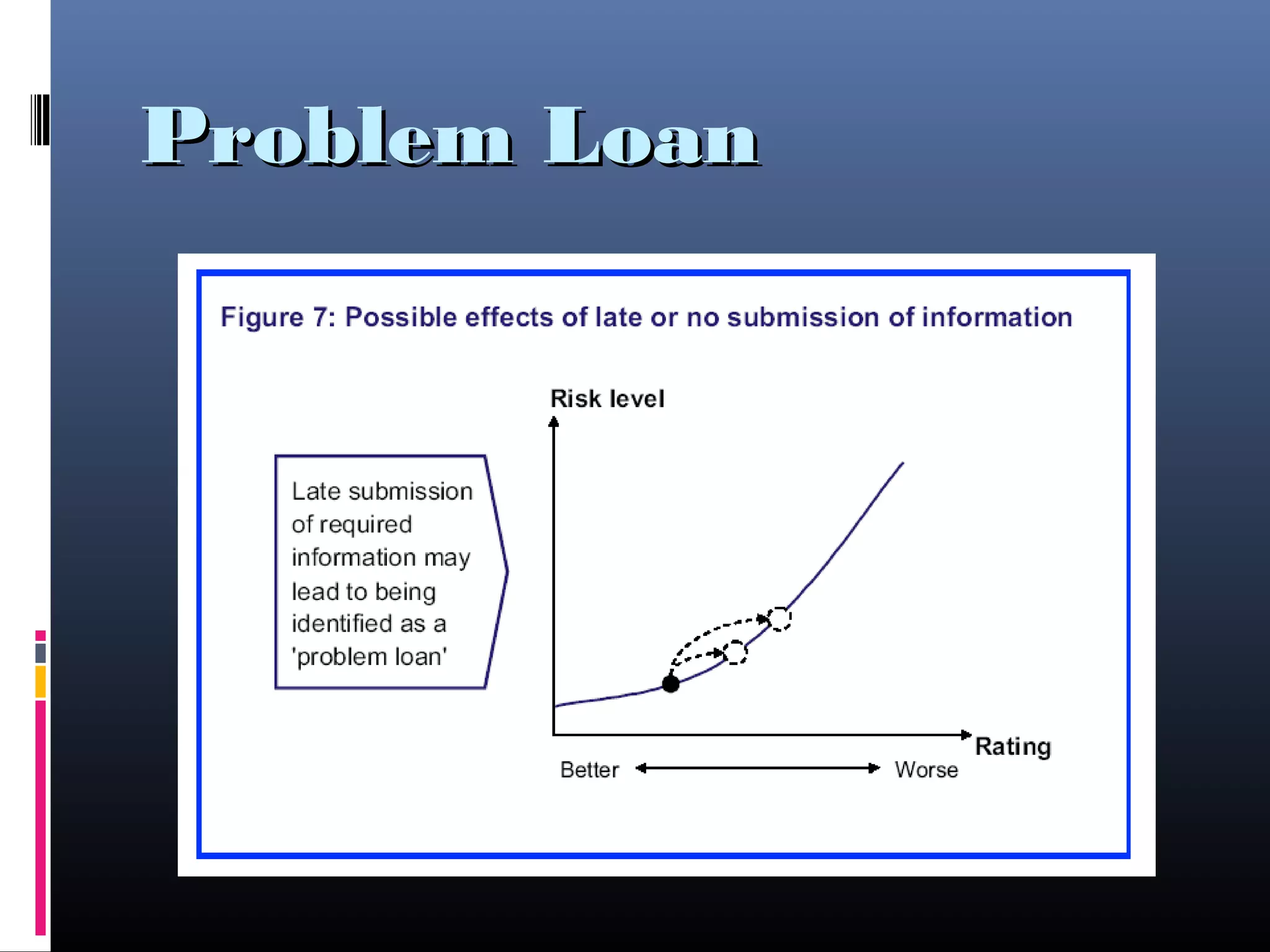
Problem LoanProblem Loan
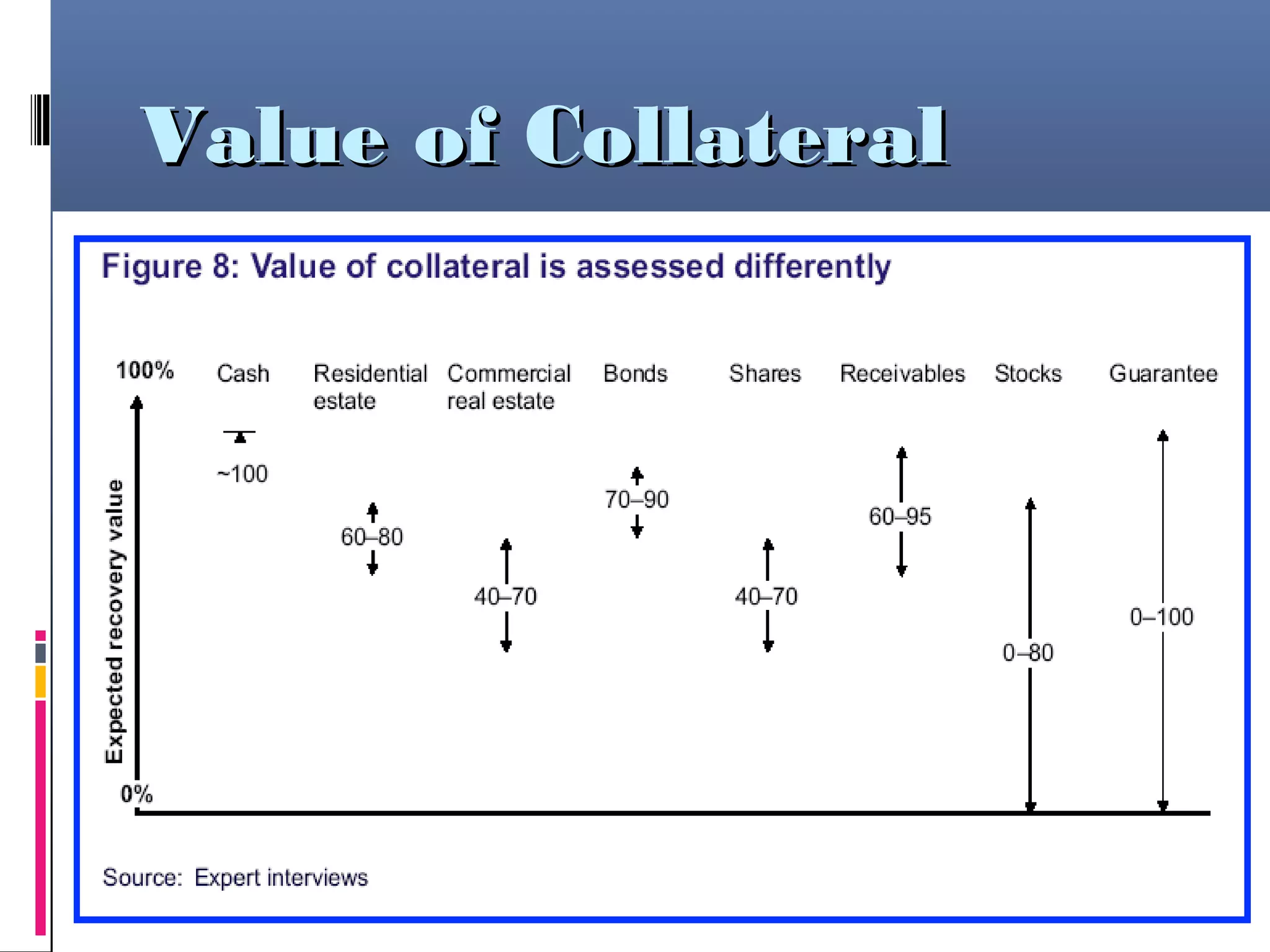
Value of CollateralValue of Collateral
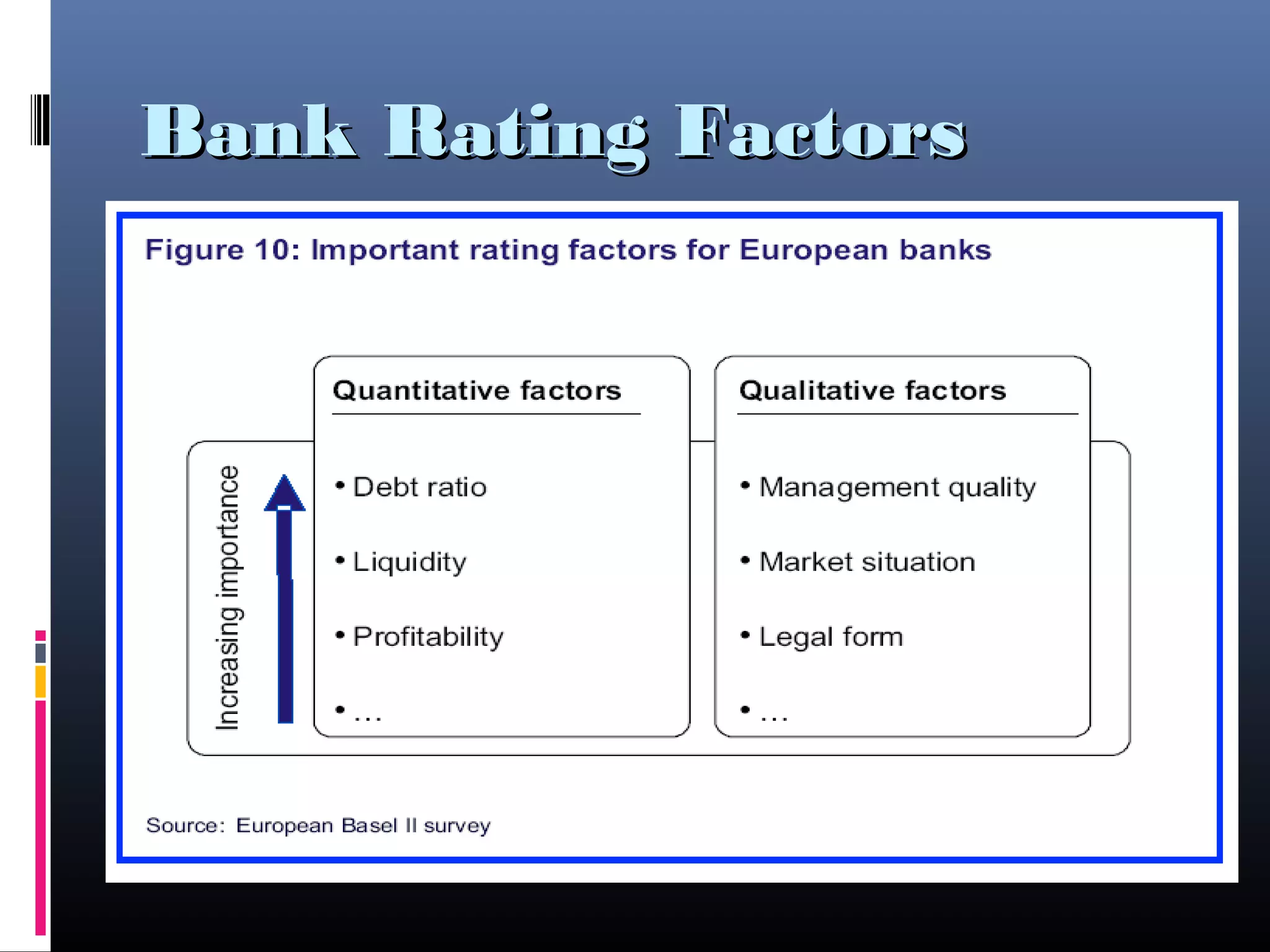
Bank Rating FactorsBank Rating Factors
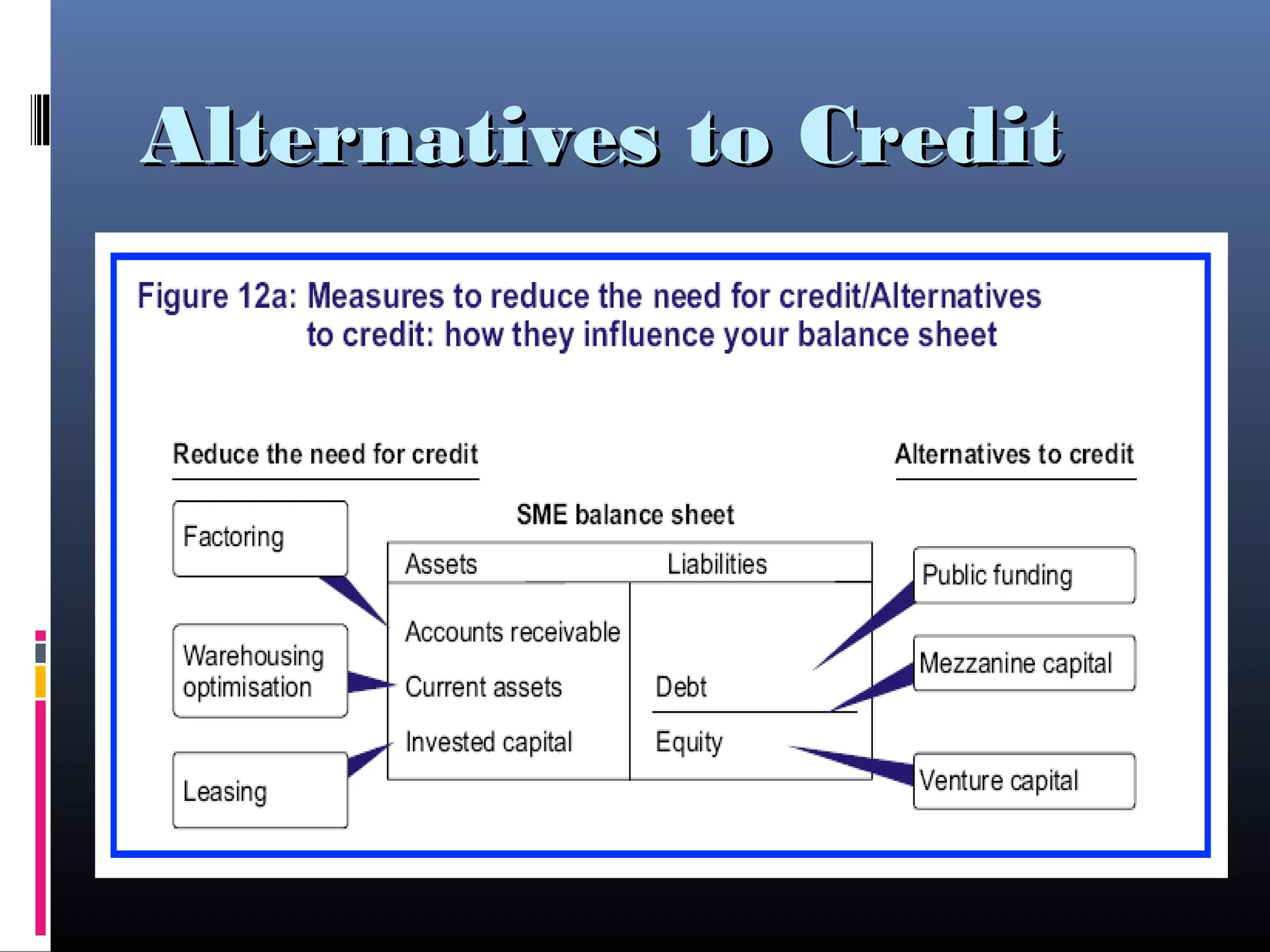
Alternatives to CreditAlternatives to Credit
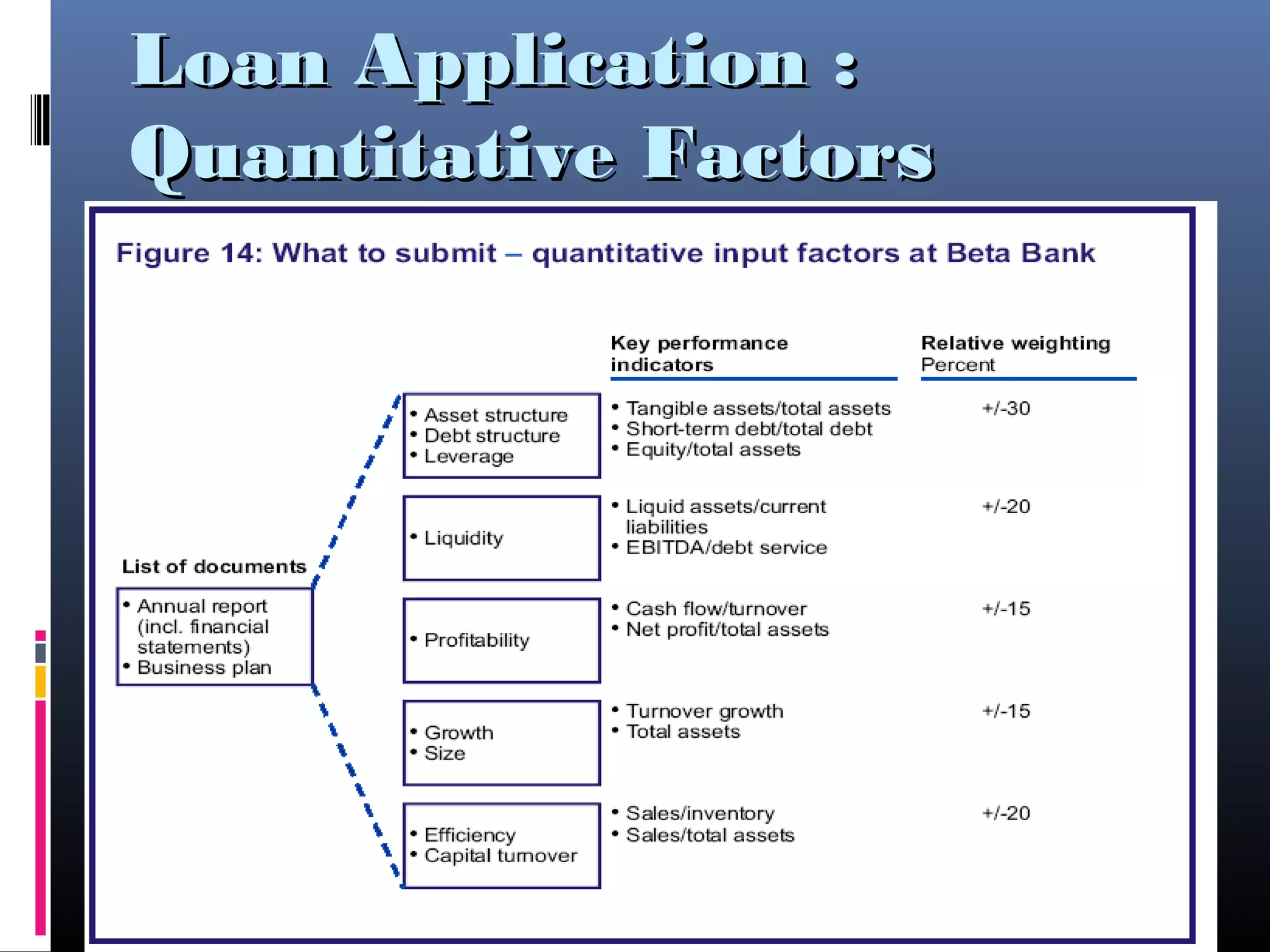
Loan Application :Loan Application :
Quantitative FactorsQuantitative Factors
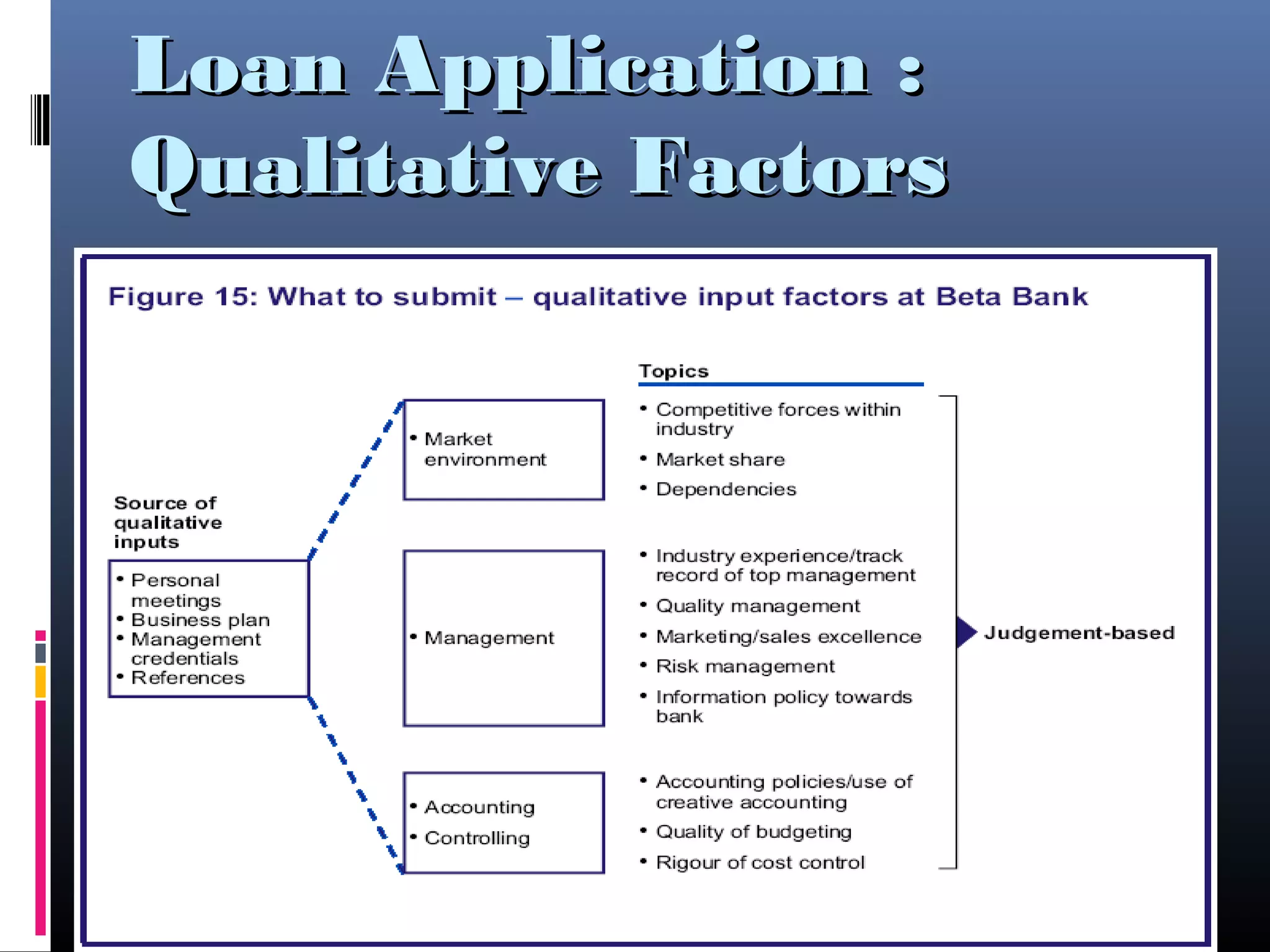
Loan Application :Loan Application :
Qualitative FactorsQualitative Factors
65
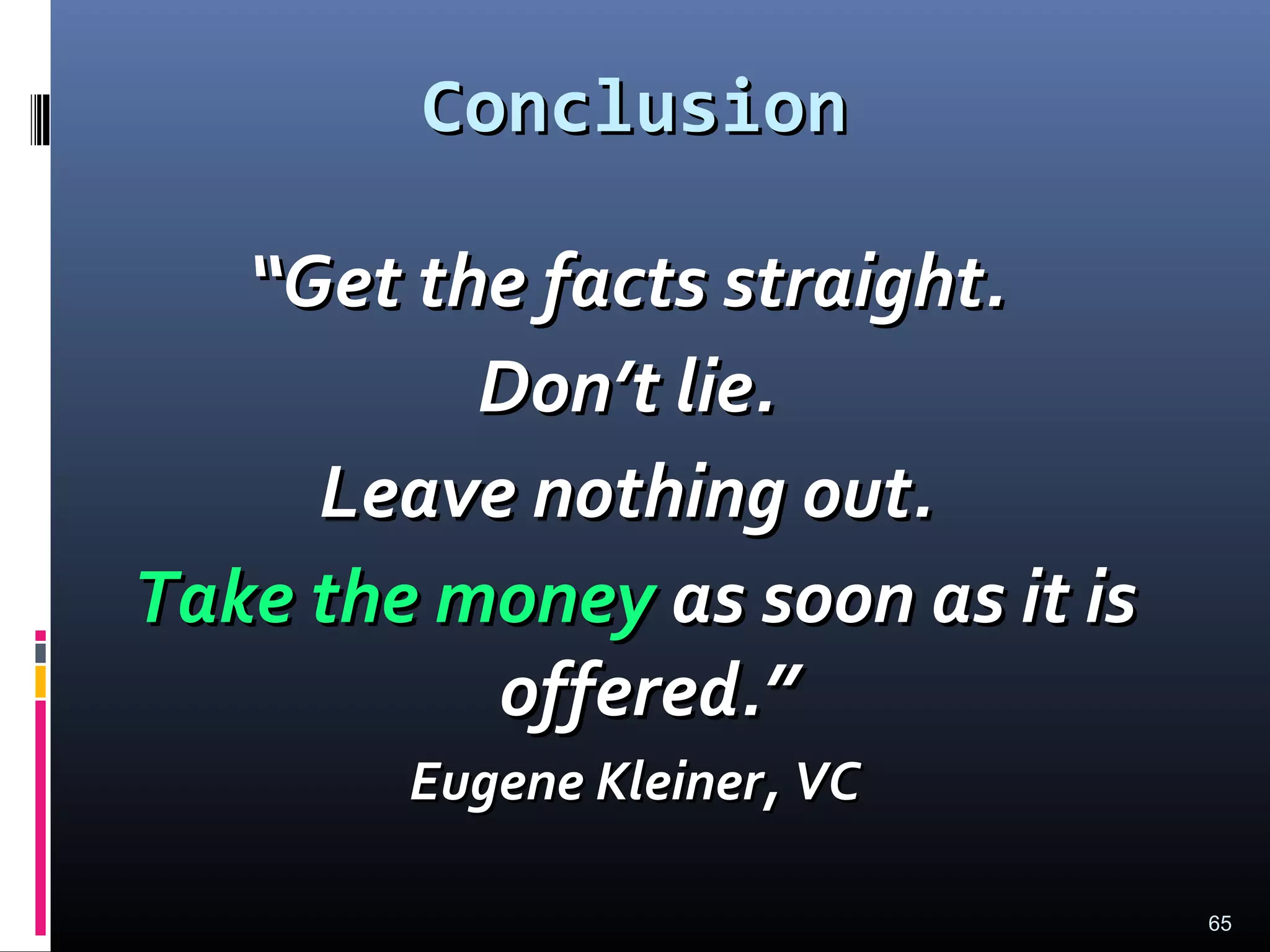
ConclusionConclusion
““Get the facts straight.Get the facts straight.
Don’t lie.Don’t lie.
Leave nothing out.Leave nothing out.
Take the moneyTake the money as soon as it isas soon as it is
offered.”offered.”
Eugene Kleiner, VCEugene Kleiner, VC
Further ReadingFurther Reading
 Stokes, D. & Wilson, N. (2010), ‘Small Business Management &Stokes, D. & Wilson, N. (2010), ‘Small Business Management &
Entrepreneurship’, South Western Cengage Learning, 6thEntrepreneurship’, South Western Cengage Learning, 6th
editionedition
 Barringer, Bruce R. & Ireland, R. Duane (2011)Barringer, Bruce R. & Ireland, R. Duane (2011) Entrepreneurship-Entrepreneurship-
Successfully launching new venturesSuccessfully launching new ventures 44thth
edition, Pearson.edition, Pearson.
 Global Entrepreneurship Monitor (GEM)Global Entrepreneurship Monitor (GEM) GEM Global 2012GEM Global 2012
report,report, http://www.gemconsortium.org/http://www.gemconsortium.org/
 Department for Business Innovation and Skills (UKDepartment for Business Innovation and Skills (UK
government),government), http://www.bis.gov.uk/http://www.bis.gov.uk/
 World Bank “Doing Business” report 2013,World Bank “Doing Business” report 2013,
http://www.doingbusiness.org/http://www.doingbusiness.org/
 World Economic Forum GCR “Global Competitiveness Report”World Economic Forum GCR “Global Competitiveness Report”
2012-2012-
2013,http://www3.weforum.org/docs/WEF_GlobalCompetitivene2013,http://www3.weforum.org/docs/WEF_GlobalCompetitivene
ssReport_2012-13.pdfssReport_2012-13.pdf
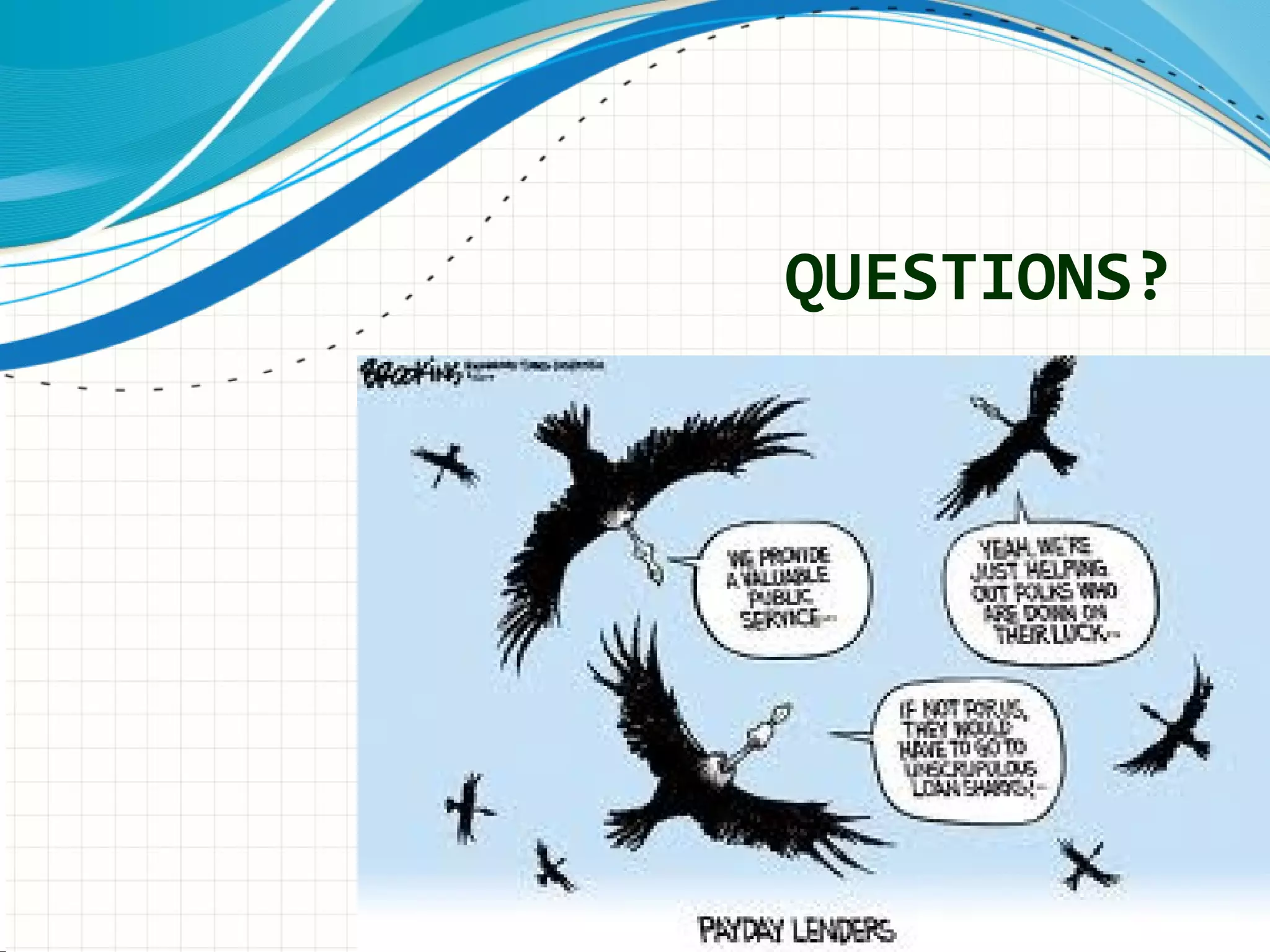
QUESTIONS?

Mod001093 context of sme 220315

  • 1.
    MOD001093MOD001093 ENTREPRENEURSHIP ANDENTREPRENEURSHIP AND INNOVATION:INNOVATION: NATIONAL&NATIONAL & INTERNATIONAL CONTEXTINTERNATIONAL CONTEXT OF SMESOF SMES Prof.Stephen OngProf.Stephen Ong BSc(Hons)Econs (LSE), MBA (Bradford)BSc(Hons)Econs (LSE), MBA (Bradford) Visiting Professor, Shenzhen UniversityVisiting Professor, Shenzhen University Academic Fellow, Entrepreneurship & Innovation,Academic Fellow, Entrepreneurship & Innovation, The Lord Ashcroft International Business School, AngliaThe Lord Ashcroft International Business School, Anglia Ruskin University Cambridge UKRuskin University Cambridge UK MBA ANGLIA RUSKIN UNIVERSITYMBA ANGLIA RUSKIN UNIVERSITY
  • 2.
  • 3.
    LEARNING OBJECTIVESLEARNING OBJECTIVES To examine the economicTo examine the economic significance of start-ups, smallsignificance of start-ups, small businesses and their potentialbusinesses and their potential growth into medium-sizedgrowth into medium-sized enterprises.enterprises.  To review government policiesTo review government policies and support of SMEs.and support of SMEs.  To compare SMEs in differentTo compare SMEs in different countries.countries.  To evaluate the stages of growthTo evaluate the stages of growth of SMEs.of SMEs.
  • 4.
    THE ROLE OFTHEROLE OF SMESSMES
  • 5.
    TEA (2011) Malaysia =4.9% Japan = 5.2% Singapore = 6.6% UK = 7.3% USA = 12.3% Thailand = 19.5% China = 24%
  • 6.
    SME DEFINITIONSME DEFINITION DTIdefinition of SMEs (based onDTI definition of SMEs (based on European Union definition)European Union definition)  Micro : 0 – 9 employeesMicro : 0 – 9 employees  Small : 0 – 49 employeesSmall : 0 – 49 employees (includes micro)(includes micro)  Medium : 50 – 249 employeesMedium : 50 – 249 employees  Large : 250 or more employeesLarge : 250 or more employees  (There are also independence(There are also independence criteria and financial limits)criteria and financial limits)
  • 7.
    Entrepreneurship & Small Business Every year U.S.Every year U.S. entrepreneurs launchentrepreneurs launch 550,000 new550,000 new businesses.businesses.  GEM study:GEM study: 18.7% of18.7% of adult population in theadult population in the U.SU.S. is actively involved. is actively involved
  • 8.
    Firm Size andEmploymentFirm Size and Employment (UK)(UK)
  • 9.
    Small and medium-sizedSmalland medium-sized enterprises - the backbone ofenterprises - the backbone of German economyGerman economy The German economy - approx. 3.4The German economy - approx. 3.4 million small and medium-sizedmillion small and medium-sized businesses and self-employedbusinesses and self-employed professionals in skilled trades,professionals in skilled trades, industrial trades, commerce,industrial trades, commerce, tourism, services and othertourism, services and other professionals.professionals.  represent 99.7 % of all businessesrepresent 99.7 % of all businesses in Germany,in Germany,  produce 40.8 % of the taxableproduce 40.8 % of the taxable turnover,turnover,  provide 70.5 % of jobsprovide 70.5 % of jobs andand
  • 10.
    U.S. SmallU.S. Small Businesses...Businesses ... Make upMake up 99.7% of the 30.1499.7% of the 30.14 million businesses in the U.S.million businesses in the U.S.  EmployEmploy 51% of the nation’s51% of the nation’s private sector workforce.private sector workforce.  Create more jobs than bigCreate more jobs than big businesses.businesses.  60% to 80% of net new jobs60% to 80% of net new jobs over the last decadeover the last decade  Are leaders in offeringAre leaders in offering training and advancementtraining and advancement opportunities to workers.opportunities to workers.
  • 11.
     ProduceProduce 51%of the nation’s51% of the nation’s private GDP.private GDP.  Account for 47% of businessAccount for 47% of business sales.sales.  CreateCreate 13 times more patents13 times more patents per employees than largeper employees than large companies.companies.  Zipper, light bulb, FM radio, laser,Zipper, light bulb, FM radio, laser, air conditioning, escalator,air conditioning, escalator, personal computer, automaticpersonal computer, automatic transmission,transmission, and many more!and many more! U.S. Small Businesses ...(continued)
  • 12.
    FIGURE 1.5 SmallBusiness by Industry Source: U.S. Small Business Administration, 2007. Malaysia SME Services 37% of GDP (2010)
  • 13.
    FIGURE 1.3 U.S.Retail E-Commerce Revenues Source: Based on Forrester Research, 2008.
  • 15.
    FIGURE 1.4 WhyWomen Start Businesses Source: U.S. Small Business Administration, 2007.
  • 16.
    Role of SMEs(Bolton ReportRole of SMEs (Bolton Report UK 1971)UK 1971)1.1. Productive outlet for enterprising, independentProductive outlet for enterprising, independent individuals;individuals; 2.2. Most efficient form in some sectors;Most efficient form in some sectors; 3.3. Specialist suppliers or sub-contractors to largeSpecialist suppliers or sub-contractors to large firms;firms; 4.4. Provide products and services which are tooProvide products and services which are too small for larger firms to consider;small for larger firms to consider; 5.5. Competition for monopolistic tendencies ofCompetition for monopolistic tendencies of larger companies;larger companies; 6.6. Innovators of new products, services andInnovators of new products, services and processes;processes; 7.7. Breeding ground for new industries;Breeding ground for new industries; 8.8. Seedbed for tomorrow’s larger companies –Seedbed for tomorrow’s larger companies – entry for entrepreneurs who will becomeentry for entrepreneurs who will become industryindustry chiefs of the future.chiefs of the future.
  • 17.
    Role of SMEs(Bolton ReportRole of SMEs (Bolton Report UK 1971)UK 1971) Conclusion :Conclusion : Small business is anSmall business is an extremely efficient form andextremely efficient form and owner managers haveowner managers have commitment.commitment. Recommended :Recommended : GovernmentGovernment must support small business,must support small business, not harm it, and appoint anot harm it, and appoint a Minister for Small FirmsMinister for Small Firms
  • 18.
    Comparison with largeComparisonwith large firmsfirms 3 key differences between small3 key differences between small and large firms:-and large firms:- 1.1.UncertaintyUncertainty – small customer– small customer base and limited resources;base and limited resources; 2.2.InnovationInnovation – new products and– new products and services key to start-upservices key to start-up success;success; 3.3.EvolutionEvolution – constant– constant structural change and marketstructural change and market change as firms grow.change as firms grow.
  • 19.
    VAT Registered UKbusinesses (1980-2005)
  • 20.
    UK SMEs (2007)UKSMEs (2007)  4.3 million firms in the UK., an increase4.3 million firms in the UK., an increase on the 3.7 million that was almoston the 3.7 million that was almost constant for 10 years.constant for 10 years.  1.7 million businesses in the UK are VAT1.7 million businesses in the UK are VAT registered – i.e. sales turnover more thanregistered – i.e. sales turnover more than £64,000 p.a.£64,000 p.a.  2.6 million businesses2.6 million businesses have saleshave sales turnover less than £64,000 p.a. =turnover less than £64,000 p.a. = veryvery small, mainly sole traders.small, mainly sole traders.  Start-ups are almost balanced by exits –Start-ups are almost balanced by exits – small net gain last year. Approx 10%small net gain last year. Approx 10%  ““churn” – 400,000 start-ups and 400,000churn” – 400,000 start-ups and 400,000 exits each year. This is a dynamic andexits each year. This is a dynamic and turbulent sector ofturbulent sector of economy.economy.
  • 21.
  • 22.
    Survival Rate ofStart-upsSurvival Rate of Start-ups (UK)(UK)
  • 23.
    Forbes Misery IndexForbesMisery Index  The Misery ScoreThe Misery Score is the sum ofis the sum of corporate income, personal incomecorporate income, personal income and wealthand wealth taxestaxes plus employerplus employer social security, employee socialsocial security, employee social security and VAT/salessecurity and VAT/sales taxestaxes at theat the highest marginal rate in eachhighest marginal rate in each locale.locale.  Best proxy for evaluating whetherBest proxy for evaluating whether policypolicy attracts or repels capital andattracts or repels capital and talenttalent..  For some countries with high localFor some countries with high local or provincial taxes, a specificor provincial taxes, a specific
  • 25.
    COUNTRYCOUNTRY RANKRANK MISERYSCORE (2007)MISERY SCORE (2007) FRANCEFRANCE 11 166.8166.8 CHINACHINA 33 152152 JAPANJAPAN 1515 122.4122.4 GERMANY (Berlin)GERMANY (Berlin) 1818 120.5120.5 USA (NYC)USA (NYC) 2121 115.7115.7 UKUK 2525 109.3109.3 VIETNAMVIETNAM 3434 101101 AUSTRALIAAUSTRALIA 3535 97.597.5 SOUTH KOREASOUTH KOREA 3737 97.297.2 INDIA /INDIA / INDONESIAINDONESIA 44 / 4544 / 45 89.089.0 PHILIPPINESPHILIPPINES 4646 88.488.4 MALAYSIAMALAYSIA 4848 87.087.0 THAILANDTHAILAND 5151 84.084.0 TAIWANTAIWAN 5252 82.182.1 SINGAPORESINGAPORE 5454 76.076.0 HONG KONGHONG KONG 6060 43.543.5
  • 26.
    REDUCING THE MISERY…REDUCING THE MISERY …
  • 27.
    CORPORATE TAX REFORM(OECD)CORPORATE TAX REFORM (OECD)
  • 28.
    UK Government AidtoUK Government Aid to SMEsSMEs
  • 29.
    Impact of MinimumWageImpact of Minimum Wage
  • 30.
    DOING BUSINESS (WORLDDOINGBUSINESS (WORLD BANK)BANK)
  • 31.
  • 32.
  • 33.
  • 34.
    Sources of Financingfor the Typical Start-up Business
  • 35.
    Financing CapitalFinancing Capital Capital is key for entrepreneurs.Capital is key for entrepreneurs.  In the face of a capital crunch,In the face of a capital crunch, business’s need for capital hasbusiness’s need for capital has never been greater.never been greater.  Sources of capital may include:Sources of capital may include:  Family and FriendsFamily and Friends  Angel InvestorsAngel Investors  Initial Public OfferingInitial Public Offering  Traditional Bank LoanTraditional Bank Loan  Asset-based BorrowingAsset-based Borrowing  Government loan schemesGovernment loan schemes
  • 36.
    U.S. Small BusinessU.S.Small Business Financing StrategiesFinancing Strategies
  • 37.
    FIGURE 13.8 WhereDo Small Businesses Get Their Financing? Source: Based on 2008 Survey of Small and Mid-Sized Businesses, National Small Business Association, Washington, DC, 2009.
  • 38.
    13 - 38 Sourcesof Debt CapitalSources of Debt Capital  Commercial banksCommercial banks  Lenders of first resort for smallLenders of first resort for small businessesbusinesses  Average micro-business loan =Average micro-business loan = US$7,400US$7,400  Average small business loan =Average small business loan = US$181,000US$181,000  Study:Study: 12% of U.S. entrepreneurs12% of U.S. entrepreneurs receive bank loans to start theirreceive bank loans to start their businesses.businesses.
  • 39.
    Sources of DebtCapitalSources of Debt Capital From CommercialFrom Commercial BanksBanks Short-term loansShort-term loans  Home Equity LoansHome Equity Loans  Commercial LoansCommercial Loans  Lines of CreditLines of Credit  Floor planningFloor planning  Immediate and Long-TermImmediate and Long-Term LoansLoans  Installment LoansInstallment Loans
  • 40.
    Asset-Based LendersAsset-Based Lenders Businesses can borrow money byBusinesses can borrow money by pledging as collateral otherwise idlepledging as collateral otherwise idle assets – accounts receivable,assets – accounts receivable, inventory, and othersinventory, and others  Advance rateAdvance rate – the percentage of an– the percentage of an asset’s value that a lender will lend.asset’s value that a lender will lend.
  • 41.
    Asset-Based BorrowingAsset-Based Borrowing Discounting accountsDiscounting accounts receivablereceivable Inventory financingInventory financing
  • 42.
    Other Sources ofDebtOther Sources of Debt CapitalCapital  Vendor financing (tradeVendor financing (trade credit)credit)  Equipment suppliersEquipment suppliers  Commercial financeCommercial finance companiescompanies  Saving and loanSaving and loan associationsassociations  Stock brokersStock brokers
  • 43.
    Other Sources ofDebtOther Sources of Debt CapitalCapital Credit unionsCredit unions Private placementsPrivate placements Small BusinessSmall Business Investment CompaniesInvestment Companies (SBIC)(SBIC) Small Business LendingSmall Business Lending Companies (SBLCs)Companies (SBLCs) (continued)
  • 44.
    U.S. Federally SponsoredU.S.Federally Sponsored ProgrammesProgrammes  Economic Development AdministrationEconomic Development Administration (EDA)(EDA)  Department of Housing and UrbanDepartment of Housing and Urban Development (HUD)Development (HUD)  U.S. Department of Agriculture’sU.S. Department of Agriculture’s Rural Business (USDA) - CooperativeRural Business (USDA) - Cooperative ServiceService  Small Business Innovation ResearchSmall Business Innovation Research (SBIR)(SBIR)  Small Business Technology TransferSmall Business Technology Transfer
  • 45.
    Example : U.S.SBA LoanExample : U.S. SBA Loan ProgrammesProgrammes  Patriot Express ProgrammePatriot Express Programme  CommunityCommunityExpressExpress ProgrammeProgramme  7(A) Loan Guaranty Programme7(A) Loan Guaranty Programme  Average 7(a) loan = $183,000Average 7(a) loan = $183,000
  • 46.
    FIGURE 13.7 SBA7(A) Guaranteed Loans Source: U.S Small Business Administration.
  • 47.
    U.S. SBA LoanU.S.SBA Loan ProgrammesProgrammes  Patriot Express ProgrammePatriot Express Programme  CommunityCommunityExpressExpress ProgrammeProgramme  7(A) Loan Guaranty Programme7(A) Loan Guaranty Programme  Average 7(a) loan = $183,000Average 7(a) loan = $183,000  Section 504 Certified Development CompanySection 504 Certified Development Company ProgrammeProgramme  Microloan ProgrammeMicroloan Programme  Average microloan = $13,000Average microloan = $13,000
  • 48.
    U.S. SBA LoanU.S.SBA Loan ProgrammesProgrammes  The Capline ProgrammeThe Capline Programme  Loans involvingLoans involving international tradeinternational trade  Export Working CapitalExport Working Capital  International TradeInternational Trade ProgrammeProgramme  Disaster LoansDisaster Loans (continued)
  • 49.
    U.S. State andLocalU.S. State and Local Loan ProgrammesLoan Programmes  Capital Access Programmes (CAPs)Capital Access Programmes (CAPs) –– Designed to encourage lenders toDesigned to encourage lenders to make loans to businesses that do notmake loans to businesses that do not qualify for traditional financingqualify for traditional financing  Revolving Loan Fund (RLFs)Revolving Loan Fund (RLFs) –– Combine private and public funds toCombine private and public funds to make small business loansmake small business loans
  • 50.
    Six Common ReasonsSixCommon Reasons Bankers Reject SmallBankers Reject Small Business LoansBusiness Loans1.1. ““Our bank doesn’t make smallOur bank doesn’t make small business loans.”business loans.” Cure: Before applying for aCure: Before applying for a loan,loan, research banks to findresearch banks to find out which onesout which ones seek the typeseek the type of loan you need.of loan you need. 2.2. ““I don’t know enough about youI don’t know enough about you or your business.”or your business.” Cure: Develop a detailedCure: Develop a detailed business planbusiness plan to present toto present to
  • 51.
    3.3. “You haven’ttold me why you“You haven’t told me why you need the money.”need the money.” Cure: Your business planCure: Your business plan should explain how muchshould explain how much money you need and how youmoney you need and how you plan to use it.plan to use it. 4.4. “Your numbers don’t support“Your numbers don’t support your loan request.”your loan request.” Cure: Include a cash flowCure: Include a cash flow forecast in your business plan.forecast in your business plan. (continued)(continued) Six Common ReasonsSix Common Reasons Bankers Reject SmallBankers Reject Small Business LoansBusiness Loans
  • 52.
    5.5. “You don’thave enough“You don’t have enough collateral.”collateral.” Cure: Be prepared to pledgeCure: Be prepared to pledge youryour company’s assets – andcompany’s assets – and perhaps yourperhaps your personalpersonal assets – as collateral for theassets – as collateral for the loan.loan. 6.6. “Your business does not support“Your business does not support the loan on its own.”the loan on its own.” Cure: Be prepared to provide aCure: Be prepared to provide a (continued)(continued) Six Common ReasonsSix Common Reasons Bankers Reject SmallBankers Reject Small Business LoansBusiness Loans
  • 53.
    Loan FinanceLoan Finance(European(European Commission 2005)Commission 2005)
  • 54.
  • 55.
    The Credit ProcessTheCredit Process
  • 56.
  • 57.
  • 58.
  • 59.
  • 60.
  • 61.
  • 62.
  • 63.
    Loan Application :LoanApplication : Quantitative FactorsQuantitative Factors
  • 64.
    Loan Application :LoanApplication : Qualitative FactorsQualitative Factors
  • 65.
    65 ConclusionConclusion ““Get the factsstraight.Get the facts straight. Don’t lie.Don’t lie. Leave nothing out.Leave nothing out. Take the moneyTake the money as soon as it isas soon as it is offered.”offered.” Eugene Kleiner, VCEugene Kleiner, VC
  • 66.
    Further ReadingFurther Reading Stokes, D. & Wilson, N. (2010), ‘Small Business Management &Stokes, D. & Wilson, N. (2010), ‘Small Business Management & Entrepreneurship’, South Western Cengage Learning, 6thEntrepreneurship’, South Western Cengage Learning, 6th editionedition  Barringer, Bruce R. & Ireland, R. Duane (2011)Barringer, Bruce R. & Ireland, R. Duane (2011) Entrepreneurship-Entrepreneurship- Successfully launching new venturesSuccessfully launching new ventures 44thth edition, Pearson.edition, Pearson.  Global Entrepreneurship Monitor (GEM)Global Entrepreneurship Monitor (GEM) GEM Global 2012GEM Global 2012 report,report, http://www.gemconsortium.org/http://www.gemconsortium.org/  Department for Business Innovation and Skills (UKDepartment for Business Innovation and Skills (UK government),government), http://www.bis.gov.uk/http://www.bis.gov.uk/  World Bank “Doing Business” report 2013,World Bank “Doing Business” report 2013, http://www.doingbusiness.org/http://www.doingbusiness.org/  World Economic Forum GCR “Global Competitiveness Report”World Economic Forum GCR “Global Competitiveness Report” 2012-2012- 2013,http://www3.weforum.org/docs/WEF_GlobalCompetitivene2013,http://www3.weforum.org/docs/WEF_GlobalCompetitivene ssReport_2012-13.pdfssReport_2012-13.pdf
  • 67.