MOD001093MOD001093
ENTREPRENEURSHIPENTREPRENEURSHIP
AND INNOVATION:AND INNOVATION:
CREATIVE THINKINGCREATIVE THINKING
Prof.Stephen OngProf.Stephen Ong
BSc(Hons)Econs (LSE), MBA (Bradford)BSc(Hons)Econs (LSE), MBA (Bradford)
Visiting Professor, Shenzhen UniversityVisiting Professor, Shenzhen University
Academic Fellow, Entrepreneurship & Innovation,Academic Fellow, Entrepreneurship & Innovation,
The Lord Ashcroft International Business School, AngliaThe Lord Ashcroft International Business School, Anglia
Ruskin University Cambridge UKRuskin University Cambridge UK
MBA ANGLIA RUSKIN UNIVERSITYMBA ANGLIA RUSKIN UNIVERSITY
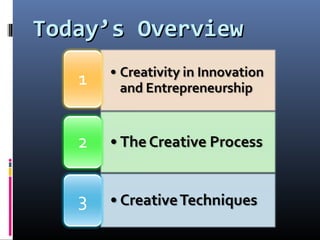
Today’s OverviewToday’s Overview
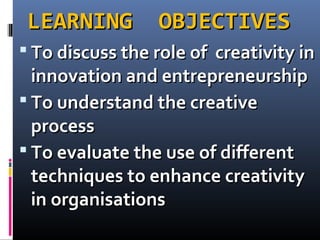
LEARNING OBJECTIVESLEARNING OBJECTIVES
 To discuss the role of creativity inTo discuss the role of creativity in
innovation and entrepreneurshipinnovation and entrepreneurship
 To understand the creativeTo understand the creative
processprocess
 To evaluate the use of differentTo evaluate the use of different
techniques to enhance creativitytechniques to enhance creativity
in organisationsin organisations
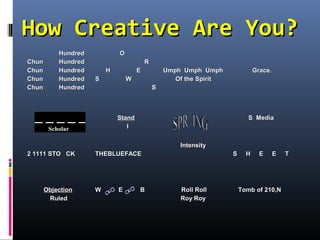
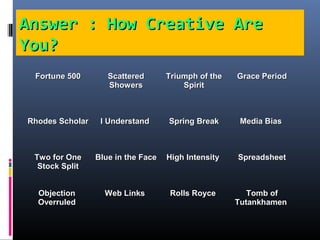
How Creative Are You?How Creative Are You?
HundredHundred
Chun HundredChun Hundred
OO
RR
H EH E
S WS W
SS
Umph Umph UmphUmph Umph Umph
Of the SpiritOf the Spirit
Grace.Grace.
StandStand
II
S MediaS Media
2 1111 STO CK2 1111 STO CK THEBLUEFACETHEBLUEFACE
IntensityIntensity
S H E E TS H E E T
ObjectionObjection
RuledRuled
W E BW E B Roll RollRoll Roll
Roy RoyRoy Roy
Tomb of 210,NTomb of 210,N
Scholar
Creativity and InnovationCreativity and Innovation
 CreativityCreativity – the ability to develop– the ability to develop
new ideas and to discover newnew ideas and to discover new
ways of looking at problems andways of looking at problems and
opportunities;opportunities; thinkingthinking new thingsnew things
 InnovationInnovation – the ability to apply– the ability to apply
creative solutions to problems orcreative solutions to problems or
opportunities to enhance or toopportunities to enhance or to
enrich people’s lives;enrich people’s lives; doingdoing newnew
things.things.
EntrepreneurshipEntrepreneurship
 EntrepreneurshipEntrepreneurship – the result of a– the result of a
disciplined, systematic process ofdisciplined, systematic process of
applyingapplying creativitycreativity and innovationand innovation toto
the needs and opportunities in thethe needs and opportunities in the
marketplace.marketplace.
 Entrepreneurs connect theirEntrepreneurs connect their creativecreative
ideas with the purposeful action andideas with the purposeful action and
structure of a business.structure of a business.
Failure: Part of theFailure: Part of the
Creative Process!Creative Process!
 For every 3,000 new product ideas:For every 3,000 new product ideas:
 Four make it to the development stage.Four make it to the development stage.
 Two are actually launched.Two are actually launched.
 One becomes a success in the market.One becomes a success in the market.
 On average, new products account for 40%On average, new products account for 40%
of companies’ sales!!of companies’ sales!!
 Creativity is an important source ofCreativity is an important source of
building a competitive advantage.building a competitive advantage.
Can WeCan We LearnLearn to Beto Be
Creative?Creative?
By overcoming paradigms and by suspendingBy overcoming paradigms and by suspending
conventional thinking long enough toconventional thinking long enough to
consider new and different alternatives!consider new and different alternatives!
Yes!
Answer : How Creative AreAnswer : How Creative Are
You?You?
Fortune 500Fortune 500 ScatteredScattered
ShowersShowers
Triumph of theTriumph of the
SpiritSpirit
Grace PeriodGrace Period
Rhodes ScholarRhodes Scholar I UnderstandI Understand Spring BreakSpring Break Media BiasMedia Bias
Two for OneTwo for One
Stock SplitStock Split
Blue in the FaceBlue in the Face High IntensityHigh Intensity SpreadsheetSpreadsheet
ObjectionObjection
OverruledOverruled
Web LinksWeb Links Rolls RoyceRolls Royce Tomb ofTomb of
TutankhamenTutankhamen
Right-Brained,Right-Brained,
Creative ThinkersCreative Thinkers
 Always ask: “Is there a better way?”Always ask: “Is there a better way?”
 Challenge custom, routine, andChallenge custom, routine, and
tradition.tradition.
 Are reflective.Are reflective.
 Are prolific thinkers.Are prolific thinkers.
 Play mental gamesPlay mental games..
Right-Brained,Right-Brained,
Creative ThinkersCreative Thinkers
 Realize that there may be more thanRealize that there may be more than
one “right” answer.one “right” answer.
 Know that mistakes are pit stops onKnow that mistakes are pit stops on
the way to success.the way to success.
 Recognize that problems areRecognize that problems are
springboards for new ideas.springboards for new ideas.
Right-Brained,Right-Brained,
Creative ThinkersCreative Thinkers
 Understand that failure is a naturalUnderstand that failure is a natural
part of the creative process.part of the creative process.
 Relate seemingly unrelated ideasRelate seemingly unrelated ideas
to a problem.to a problem.
 Have “helicopter skills.”Have “helicopter skills.”
Left-Brained orLeft-Brained or
Right-Brained?Right-Brained?
Entrepreneurship requiresEntrepreneurship requires bothboth left-and right-left-and right-
brained thinking.brained thinking.
 Right-brained thinking draws onRight-brained thinking draws on divergentdivergent
reasoning, the ability to create a multitude ofreasoning, the ability to create a multitude of
original, diverse ideas.original, diverse ideas.
 Left-brained thinking counts onLeft-brained thinking counts on convergentconvergent
reasoning, the ability to evaluate multiple ideasreasoning, the ability to evaluate multiple ideas
and to choose the best solution to a problem.and to choose the best solution to a problem.
Barriers to CreativityBarriers to Creativity
 Searching for the one “right”Searching for the one “right”
answeranswer
 Focusing on “being logical”Focusing on “being logical”
 Blindly following the rulesBlindly following the rules
 Constantly being practicalConstantly being practical
 Viewing play as frivolousViewing play as frivolous
Barriers to CreativityBarriers to Creativity
 Becoming overly specializedBecoming overly specialized
 Avoiding ambiguityAvoiding ambiguity
 Fearing looking foolishFearing looking foolish
 Fearing mistakes and failureFearing mistakes and failure
 Believing that “I’m notBelieving that “I’m not
creative”creative”
Questions to Spur theQuestions to Spur the
ImaginationImagination
 Is there a new way to do it?Is there a new way to do it?
 Can you borrow or adapt it?Can you borrow or adapt it?
 Can you give it a new twist?Can you give it a new twist?
 Do you merely need more of theDo you merely need more of the
same?same?
 Do you need less of the same?Do you need less of the same?
Questions to Spur theQuestions to Spur the
ImaginationImagination
 Is there a substitute?Is there a substitute?
 Can you rearrange the parts?Can you rearrange the parts?
 What if you do just the opposite?What if you do just the opposite?
 Can you combine ideas?Can you combine ideas?
 Can you put it to other uses?Can you put it to other uses?
(continued)
Questions to Spur theQuestions to Spur the
ImaginationImagination
 What else could you make from this?What else could you make from this?
 Are there other markets for it?Are there other markets for it?
 Can you reverse it?Can you reverse it?
 Can you eliminate it?Can you eliminate it?
 Can you put it to another use?Can you put it to another use?
 What idea seems impossible, but ifWhat idea seems impossible, but if
executed, would revolutionize yourexecuted, would revolutionize your
business?business?
(continued)
Tips for EnhancingTips for Enhancing
OrganizationalOrganizational
CreativityCreativity Include creativity as a core companyInclude creativity as a core company
valuevalue
 Embrace diversityEmbrace diversity
 Expect creativityExpect creativity
 Expect and tolerate failureExpect and tolerate failure
 Create an organizational structureCreate an organizational structure
that nourishes creativitythat nourishes creativity
Tips for EnhancingTips for Enhancing
Organizational CreativityOrganizational Creativity
 Encourage curiosityEncourage curiosity
 Create a change of scenery periodicallyCreate a change of scenery periodically
 View problems as opportunitiesView problems as opportunities
 Provide creativity trainingProvide creativity training
 Provide supportProvide support
 Develop a procedure for capturingDevelop a procedure for capturing
ideasideas
(continued)
Tips for EnhancingTips for Enhancing
OrganizationalOrganizational
CreativityCreativity
 Talk and interact with customersTalk and interact with customers
 Look for uses for your company’sLook for uses for your company’s
products or services in otherproducts or services in other
marketsmarkets
 Reward creativityReward creativity
 Model creative behaviourModel creative behaviour
Tips for EnhancingTips for Enhancing
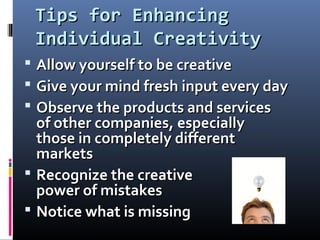
Individual CreativityIndividual Creativity
 Allow yourself to be creativeAllow yourself to be creative
 Give your mind fresh input every dayGive your mind fresh input every day
 Observe the products and servicesObserve the products and services
of other companies, especiallyof other companies, especially
those in completely differentthose in completely different
marketsmarkets
 Recognize the creativeRecognize the creative
power of mistakespower of mistakes
 Notice what is missingNotice what is missing
Tips for EnhancingTips for Enhancing
Individual CreativityIndividual Creativity
 Keep a journal to record yourKeep a journal to record your
thoughts and ideasthoughts and ideas
 Listen to other peopleListen to other people
 Listen to customersListen to customers
 Talk to a childTalk to a child
 Do something ordinary in anDo something ordinary in an
unusual wayunusual way
Tips for EnhancingTips for Enhancing
Individual CreativityIndividual Creativity
 Keep a toy box in your officeKeep a toy box in your office
 Do not throw away seeming “bad”Do not throw away seeming “bad”
ideasideas
 Read books on stimulatingRead books on stimulating
creativity or take a class oncreativity or take a class on
creativitycreativity
 Take some time offTake some time off
 Be persistentBe persistent
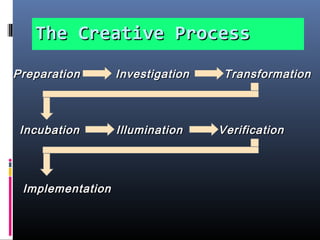
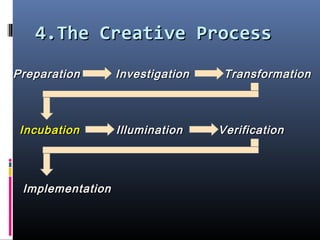
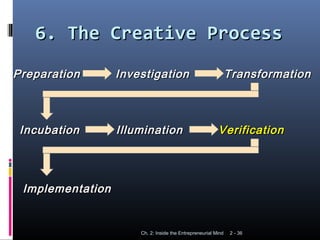
The Creative ProcessThe Creative Process
PreparationPreparation InvestigationInvestigation TransformationTransformation
IncubationIncubation IlluminationIllumination VerificationVerification
ImplementationImplementation
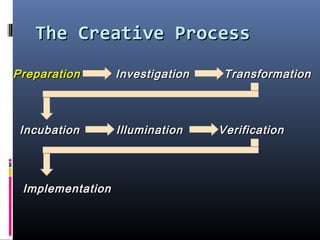
The Creative ProcessThe Creative Process
PreparationPreparation InvestigationInvestigation TransformationTransformation
IncubationIncubation IlluminationIllumination VerificationVerification
ImplementationImplementation
1. Preparation1. Preparation
Get your mind ready for creative thinking.Get your mind ready for creative thinking.
 Adopt the attitude of a lifelong student.Adopt the attitude of a lifelong student.
 Read … a lot … and not just in your field ofRead … a lot … and not just in your field of
expertise.expertise.
 Clip articles of interest to you and saveClip articles of interest to you and save
them.them.
 Take time to discuss your ideas with otherTake time to discuss your ideas with other
people.people.
1. Preparation
Get your mind ready for creative thinking.Get your mind ready for creative thinking.
 Join professional or trade associationsJoin professional or trade associations
and attend their meetings.and attend their meetings.
 Study other countries and theirStudy other countries and their
cultures.cultures.
 Travel to new places.Travel to new places.
 Develop your listening skills.Develop your listening skills.
 Eliminate creative distractions.Eliminate creative distractions.
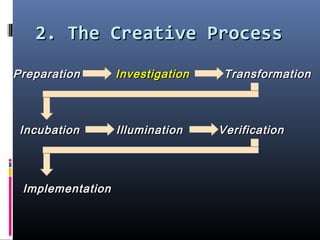
2. The Creative Process2. The Creative Process
PreparationPreparation InvestigationInvestigation TransformationTransformation
IncubationIncubation IlluminationIllumination VerificationVerification
ImplementationImplementation
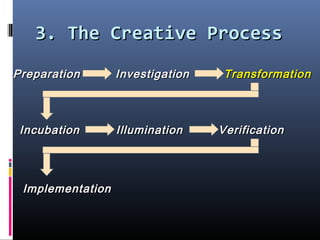
3. The Creative Process3. The Creative Process
PreparationPreparation InvestigationInvestigation TransformationTransformation
IncubationIncubation IlluminationIllumination VerificationVerification
ImplementationImplementation
3.Transformation3.Transformation
 Involves viewing both the similarities andInvolves viewing both the similarities and
the differences among the informationthe differences among the information
collected.collected.
 Two types of thinking are required:Two types of thinking are required:
 ConvergentConvergent – the ability to see the– the ability to see the
similarities and the connections amongsimilarities and the connections among
various and often diverse data and events.various and often diverse data and events.
 DivergentDivergent – the ability to see the differences– the ability to see the differences
among various data and events.among various data and events.
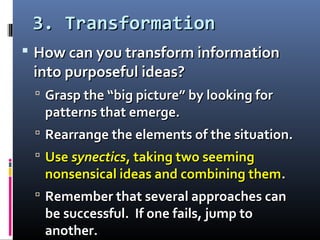
3. Transformation3. Transformation
 How can you transform informationHow can you transform information
into purposeful ideas?into purposeful ideas?
 Grasp the “big picture” by looking forGrasp the “big picture” by looking for
patterns that emerge.patterns that emerge.
 Rearrange the elements of the situation.Rearrange the elements of the situation.
 UseUse synecticssynectics, taking two seeming, taking two seeming
nonsensical ideas and combining themnonsensical ideas and combining them..
 Remember that several approaches canRemember that several approaches can
be successful. If one fails, jump tobe successful. If one fails, jump to
another.another.
4.The Creative Process4.The Creative Process
PreparationPreparation InvestigationInvestigation TransformationTransformation
IncubationIncubation IlluminationIllumination VerificationVerification
ImplementationImplementation
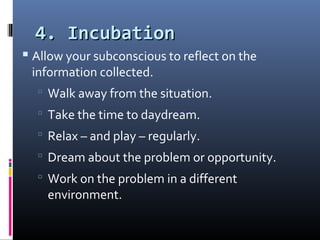
4. Incubation4. Incubation
 Allow your subconscious to reflect on the
information collected.
 Walk away from the situation.
 Take the time to daydream.
 Relax – and play – regularly.
 Dream about the problem or opportunity.
 Work on the problem in a different
environment.
2 - 35Ch. 2: Inside the Entrepreneurial Mind
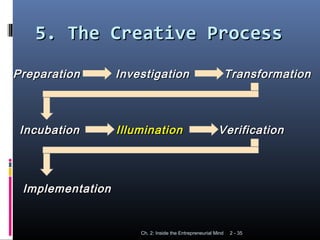
5. The Creative Process5. The Creative Process
PreparationPreparation InvestigationInvestigation TransformationTransformation
IncubationIncubation IlluminationIllumination VerificationVerification
ImplementationImplementation
2 - 36Ch. 2: Inside the Entrepreneurial Mind
6. The Creative Process6. The Creative Process
PreparationPreparation InvestigationInvestigation TransformationTransformation
IncubationIncubation IlluminationIllumination VerificationVerification
ImplementationImplementation
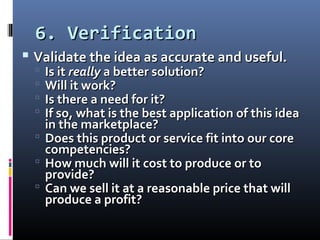
6. Verification6. Verification
 Validate the idea as accurate and useful.Validate the idea as accurate and useful.
 Is itIs it reallyreally a better solution?a better solution?
 Will it work?Will it work?
 Is there a need for it?Is there a need for it?
 If so, what is the best application of this ideaIf so, what is the best application of this idea
in the marketplace?in the marketplace?
 Does this product or service fit into our coreDoes this product or service fit into our core
competencies?competencies?
 How much will it cost to produce or toHow much will it cost to produce or to
provide?provide?
 Can we sell it at a reasonable price that willCan we sell it at a reasonable price that will
produce a profit?produce a profit?
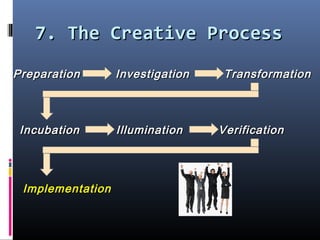
7. The Creative Process7. The Creative Process
PreparationPreparation InvestigationInvestigation TransformationTransformation
IncubationIncubation IlluminationIllumination VerificationVerification
ImplementationImplementation
Techniques for ImprovingTechniques for Improving
the Creative Processthe Creative Process
BrainstormingBrainstorming:
The goal is to create a large quantity of
novel and imaginative ideas.
Techniques for ImprovingTechniques for Improving
the Creative Processthe Creative Process
d.School Stanford Video :d.School Stanford Video :
““How NOT to brainstorm”How NOT to brainstorm”
https://www.youtube.com/watch?v=cmoWCSyujPYhttps://www.youtube.com/watch?v=cmoWCSyujPY
Brainstorming GuidelinesBrainstorming Guidelines
1.1. Keep the group small – “Two pizza rule.”Keep the group small – “Two pizza rule.”
2.2. Make the group as diverse as possible.Make the group as diverse as possible.
3.3. Emphasize that company rank isEmphasize that company rank is
irrelevant.irrelevant.
4.4. Have a well-defined problem, but don’tHave a well-defined problem, but don’t
reveal it ahead of time.reveal it ahead of time.
5.5. Limit the session to 40 to 60 minutes.Limit the session to 40 to 60 minutes.
6.6. Take a field trip.Take a field trip.
7.7. Appoint a recorder.Appoint a recorder.
Brainstorming Guidelines
8.8. Use a seating pattern that encouragesUse a seating pattern that encourages
interaction.interaction.
9.9. Throw logic out the window.Throw logic out the window.
10.10.EncourageEncourage allall ideas from the team.ideas from the team.
11.11.Shoot forShoot for quantityquantity of ideas overof ideas over qualityquality ofof
ideas.ideas.
12.12.ForbidForbid criticism.criticism.
13.13.Encourage idea “hitch-hiking.”Encourage idea “hitch-hiking.”
14.14.Dare to imagine the unreasonable.Dare to imagine the unreasonable.
Techniques for ImprovingTechniques for Improving
the Creative Processthe Creative Process
 BrainstormingBrainstorming
 The goal is to create a largeThe goal is to create a large quantityquantity ofof
novel and imaginative ideas.novel and imaginative ideas.
 Mind-mappingMind-mapping
 A graphical technique that encouragesA graphical technique that encourages
thinking on both sides of the brain,thinking on both sides of the brain,
visually displays relationships amongvisually displays relationships among
ideas, and improves the ability to see aideas, and improves the ability to see a
problem from many sides.problem from many sides.
Techniques for ImprovingTechniques for Improving
the Creative Processthe Creative Process
Tony Buzan Video :Tony Buzan Video :
““Mind Mapping”Mind Mapping”
https://www.youtube.com/watch?v=nMZCghZ1hB4https://www.youtube.com/watch?v=nMZCghZ1hB4
Techniques for ImprovingTechniques for Improving
the Creative Processthe Creative Process
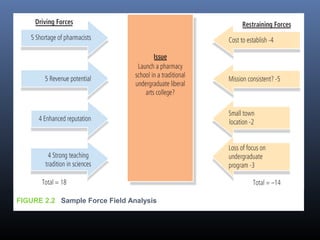
 Force Field AnalysisForce Field Analysis (Kurt Lewin)(Kurt Lewin)
 A useful technique for evaluating theA useful technique for evaluating the
forces that support and oppose aforces that support and oppose a
proposed change.proposed change.
 Three columns:Three columns:
 Center: Problem to be addressedCenter: Problem to be addressed
 Left: Driving forcesLeft: Driving forces
 Right: Restraining forcesRight: Restraining forces
 Score each force (-1 to +4) and add them.Score each force (-1 to +4) and add them.
FIGURE 2.2 Sample Force Field Analysis
Techniques for ImprovingTechniques for Improving
the Creative Processthe Creative Process
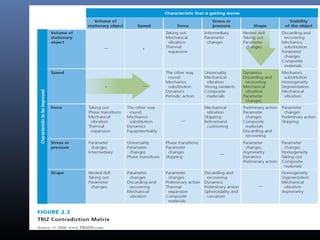
 TRIZ (Genrich Altshuller 1946)TRIZ (Genrich Altshuller 1946)
A systematic approachA systematic approach
designed to solve anydesigned to solve any
technical problem.technical problem.
Relies on 40 principles andRelies on 40 principles and
left-brained thinking to solveleft-brained thinking to solve
problems.problems.
Techniques for ImprovingTechniques for Improving
the Creative Processthe Creative Process
 Rapid PrototypingRapid Prototyping
Transforming an idea into anTransforming an idea into an
actual model that will pointactual model that will point
out flaws and lead to designout flaws and lead to design
improvements.improvements.
Techniques for ImprovingTechniques for Improving
the Creative Processthe Creative Process
Rapid Prototyping Video :Rapid Prototyping Video :
““3D Printing”3D Printing”
https://www.youtube.com/watch?v=GnFxujCyD70https://www.youtube.com/watch?v=GnFxujCyD70
Techniques for ImprovingTechniques for Improving
the Creative Processthe Creative Process
 SSM Soft Systems Methodology (OR)SSM Soft Systems Methodology (OR)
 Soft Systems AnalysisSoft Systems Analysis recognisesrecognises
COMPLEXITYCOMPLEXITY and defines not theand defines not the
problem but the problem situation.problem but the problem situation.
 The individual constructs are based onThe individual constructs are based on
perceptions, behavioural traits &perceptions, behavioural traits &
actions that go into our “World view”actions that go into our “World view”
oror Weltanschauung.Weltanschauung.
Techniques for ImprovingTechniques for Improving
the Creative Processthe Creative Process
 SSM Soft Systems MethodologySSM Soft Systems Methodology 7 Stage Model :7 Stage Model :
1.1. Problem SituationProblem Situation
2.2. Analyse SituationAnalyse Situation
3.3. Relevant Systems & Root DefinitionsRelevant Systems & Root Definitions
4.4. Conceptual Model (Checklist withConceptual Model (Checklist with
Customer,Actor,Transformation,Worldview,Owners,Environment)Customer,Actor,Transformation,Worldview,Owners,Environment)
5.5. Compare with Stage 2Compare with Stage 2
6.6. Consider feasible, desirable & acceptableConsider feasible, desirable & acceptable
changeschanges
7.7. Implement changes in Real WorldImplement changes in Real World
Techniques for ImprovingTechniques for Improving
the Creative Processthe Creative Process
 SCAMPER (Alex Osborn)SCAMPER (Alex Osborn)
 SCAMPER is a development ofSCAMPER is a development of
brainstorming, a checklist that helpsbrainstorming, a checklist that helps
you to think of changes you can makeyou to think of changes you can make
to an existing product to create a newto an existing product to create a new
one.one.
 You can use these changes either asYou can use these changes either as
direct suggestions or as starting pointsdirect suggestions or as starting points
for lateral thinking.for lateral thinking.
Techniques for ImprovingTechniques for Improving
the Creative Processthe Creative Process
 SCAMPER (Bob Eberle)SCAMPER (Bob Eberle)
 The changes SCAMPER stands for are:The changes SCAMPER stands for are:
 SSubstituteubstitute - components, materials, people- components, materials, people
 CCombineombine - mix, combine with other assemblies or services,- mix, combine with other assemblies or services,
integrateintegrate
 AAdaptdapt - alter, change function, use part of another element- alter, change function, use part of another element
 MModifyodify - increase or reduce in scale, change shape, modify- increase or reduce in scale, change shape, modify
attributes (e.g. colour)attributes (e.g. colour)
 PPutut to another useto another use
 EEliminateliminate - remove elements, simplify, reduce to core- remove elements, simplify, reduce to core
functionalityfunctionality
 RReverseeverse - turn inside out or upside down, also use of- turn inside out or upside down, also use of
Reversal.Reversal.
Techniques for ImprovingTechniques for Improving
the Creative Processthe Creative Process
 6 Thinking Hats (Edward de BONO)6 Thinking Hats (Edward de BONO)
 Technique used to look at decisions from aTechnique used to look at decisions from a
number of important perspectives.number of important perspectives.
 This forces you to move outside yourThis forces you to move outside your
habitual thinking style, and helps you to gethabitual thinking style, and helps you to get
a more rounded view of a situation.a more rounded view of a situation.
 Solve using all approaches and decisionsSolve using all approaches and decisions
and plans will mix ambition, skill inand plans will mix ambition, skill in
execution, public sensitivity, creativity andexecution, public sensitivity, creativity and
goodgood contingency planning.contingency planning.
Techniques for ImprovingTechniques for Improving
the Creative Processthe Creative Process
 6 Thinking Hats6 Thinking Hats
1.1. White HatWhite Hat :: Focus on data available. Look at informationFocus on data available. Look at information
and learn from it. Look for gaps in your knowledge, and eitherand learn from it. Look for gaps in your knowledge, and either
try to fill them or taketry to fill them or take account of them.account of them. Analyze past trends,Analyze past trends,
and try to extrapolate from historical data.and try to extrapolate from historical data.
2.2. Red HatRed Hat :: Use intuition, gut reaction, and emotion. ThinkUse intuition, gut reaction, and emotion. Think
how other people will react emotionally. Try to understandhow other people will react emotionally. Try to understand
the responses of people who do not fully know yourthe responses of people who do not fully know your
reasoning.reasoning.
3.3. Black HatBlack Hat : L: Look at all the bad points of the decision,ook at all the bad points of the decision,
cautiously and defensively. Try to see why it might not work.cautiously and defensively. Try to see why it might not work.
Highlight the weak points in a plan to eliminate, alter orHighlight the weak points in a plan to eliminate, alter or
prepare contingency plans toprepare contingency plans to counter them.counter them. Makes yourMakes your
plans 'tougher' and more resilient, spots fatal flaws and risksplans 'tougher' and more resilient, spots fatal flaws and risks
before a course of action.before a course of action.
Techniques for ImprovingTechniques for Improving
the Creative Processthe Creative Process
 6 Thinking Hats6 Thinking Hats
4.4. Yellow Hat:Yellow Hat: The yellow hat helps you to think positively. ItThe yellow hat helps you to think positively. It
is the optimistic viewpoint that helps you to see all theis the optimistic viewpoint that helps you to see all the
benefits of the decision and the value in it. Yellow Hatbenefits of the decision and the value in it. Yellow Hat
thinking helps you to keep going when everything looksthinking helps you to keep going when everything looks
gloomy and difficult.gloomy and difficult.
5.5. Green Hat:Green Hat: SStands for creativity. This is where you cantands for creativity. This is where you can
develop creative solutions to a problem. It is a freewheelingdevelop creative solutions to a problem. It is a freewheeling
way of thinking, in which there is little criticism of ideas. Away of thinking, in which there is little criticism of ideas. A
whole range of creativity tools can help you here.whole range of creativity tools can help you here.
6.6. Blue Hat:Blue Hat: SStands for process control. This is the hat worntands for process control. This is the hat worn
by people chairing meetings. When running into difficultiesby people chairing meetings. When running into difficulties
because ideas are running dry, they may direct activity intobecause ideas are running dry, they may direct activity into
Green Hat thinking. When contingency plans are needed,Green Hat thinking. When contingency plans are needed,
they will ask for Black Hat thinking, etcthey will ask for Black Hat thinking, etc
Techniques for ImprovingTechniques for Improving
the Creative Processthe Creative Process
6 Thinking Hats Video :6 Thinking Hats Video :
““Edward de Bono and 6 ThinkingEdward de Bono and 6 Thinking
Hats”Hats”
https://www.youtube.com/watch?v=o3ew6h5nHcchttps://www.youtube.com/watch?v=o3ew6h5nHcc
59
ConclusionConclusion
““Imagination is more importantImagination is more important
than knowledge … We can'tthan knowledge … We can't
solve problems by using thesolve problems by using the
same kind of thinking we usedsame kind of thinking we used
when we created them.”when we created them.” AlbertAlbert EinsteinEinstein
Further ReadingFurther Reading
 Buzan,Tony (2000) “The mind map book”, London: BBC
 Checkland ,P. & Scholes, J. (1999) Soft Systems Methodology in
Action, Wiley
 De Bono, Edward (1985) SixThinking Hats, Penguin Books, 2000
 Evans, P & Wurster, P. (1999) “Blown to Bits: How the New
Economics of InformationTransforms Strategy”, HBS
 Osborn, Alex (1963) Applied Imagination – Principles and
Procedures of Problem Solving, Charles Scribner's Sons; 3rd Revised
edition
 Scarborough, Norman, M. (2011) Essentials of Entrepreneurship and
Small Business Management. 6th
edition. Pearson.
 Trott,P. (2008). Innovation management and new product
development, (4th
edition). FT Prentice Hall.
 http://www.mindtools.com
 http://www.thinkbuzan.com
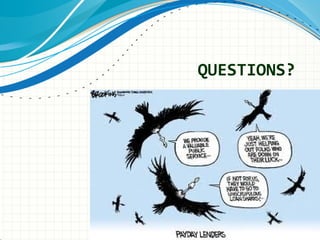
QUESTIONS?

Mod001093 creative thinking 080315

  • 1.
    MOD001093MOD001093 ENTREPRENEURSHIPENTREPRENEURSHIP AND INNOVATION:AND INNOVATION: CREATIVETHINKINGCREATIVE THINKING Prof.Stephen OngProf.Stephen Ong BSc(Hons)Econs (LSE), MBA (Bradford)BSc(Hons)Econs (LSE), MBA (Bradford) Visiting Professor, Shenzhen UniversityVisiting Professor, Shenzhen University Academic Fellow, Entrepreneurship & Innovation,Academic Fellow, Entrepreneurship & Innovation, The Lord Ashcroft International Business School, AngliaThe Lord Ashcroft International Business School, Anglia Ruskin University Cambridge UKRuskin University Cambridge UK MBA ANGLIA RUSKIN UNIVERSITYMBA ANGLIA RUSKIN UNIVERSITY
  • 2.
  • 3.
    LEARNING OBJECTIVESLEARNING OBJECTIVES To discuss the role of creativity inTo discuss the role of creativity in innovation and entrepreneurshipinnovation and entrepreneurship  To understand the creativeTo understand the creative processprocess  To evaluate the use of differentTo evaluate the use of different techniques to enhance creativitytechniques to enhance creativity in organisationsin organisations
  • 4.
    How Creative AreYou?How Creative Are You? HundredHundred Chun HundredChun Hundred Chun HundredChun Hundred Chun HundredChun Hundred Chun HundredChun Hundred OO RR H EH E S WS W SS Umph Umph UmphUmph Umph Umph Of the SpiritOf the Spirit Grace.Grace. StandStand II S MediaS Media 2 1111 STO CK2 1111 STO CK THEBLUEFACETHEBLUEFACE IntensityIntensity S H E E TS H E E T ObjectionObjection RuledRuled W E BW E B Roll RollRoll Roll Roy RoyRoy Roy Tomb of 210,NTomb of 210,N Scholar
  • 5.
    Creativity and InnovationCreativityand Innovation  CreativityCreativity – the ability to develop– the ability to develop new ideas and to discover newnew ideas and to discover new ways of looking at problems andways of looking at problems and opportunities;opportunities; thinkingthinking new thingsnew things  InnovationInnovation – the ability to apply– the ability to apply creative solutions to problems orcreative solutions to problems or opportunities to enhance or toopportunities to enhance or to enrich people’s lives;enrich people’s lives; doingdoing newnew things.things.
  • 6.
    EntrepreneurshipEntrepreneurship  EntrepreneurshipEntrepreneurship –the result of a– the result of a disciplined, systematic process ofdisciplined, systematic process of applyingapplying creativitycreativity and innovationand innovation toto the needs and opportunities in thethe needs and opportunities in the marketplace.marketplace.  Entrepreneurs connect theirEntrepreneurs connect their creativecreative ideas with the purposeful action andideas with the purposeful action and structure of a business.structure of a business.
  • 7.
    Failure: Part oftheFailure: Part of the Creative Process!Creative Process!  For every 3,000 new product ideas:For every 3,000 new product ideas:  Four make it to the development stage.Four make it to the development stage.  Two are actually launched.Two are actually launched.  One becomes a success in the market.One becomes a success in the market.  On average, new products account for 40%On average, new products account for 40% of companies’ sales!!of companies’ sales!!  Creativity is an important source ofCreativity is an important source of building a competitive advantage.building a competitive advantage.
  • 8.
    Can WeCan WeLearnLearn to Beto Be Creative?Creative? By overcoming paradigms and by suspendingBy overcoming paradigms and by suspending conventional thinking long enough toconventional thinking long enough to consider new and different alternatives!consider new and different alternatives! Yes!
  • 9.
    Answer : HowCreative AreAnswer : How Creative Are You?You? Fortune 500Fortune 500 ScatteredScattered ShowersShowers Triumph of theTriumph of the SpiritSpirit Grace PeriodGrace Period Rhodes ScholarRhodes Scholar I UnderstandI Understand Spring BreakSpring Break Media BiasMedia Bias Two for OneTwo for One Stock SplitStock Split Blue in the FaceBlue in the Face High IntensityHigh Intensity SpreadsheetSpreadsheet ObjectionObjection OverruledOverruled Web LinksWeb Links Rolls RoyceRolls Royce Tomb ofTomb of TutankhamenTutankhamen
  • 10.
    Right-Brained,Right-Brained, Creative ThinkersCreative Thinkers Always ask: “Is there a better way?”Always ask: “Is there a better way?”  Challenge custom, routine, andChallenge custom, routine, and tradition.tradition.  Are reflective.Are reflective.  Are prolific thinkers.Are prolific thinkers.  Play mental gamesPlay mental games..
  • 11.
    Right-Brained,Right-Brained, Creative ThinkersCreative Thinkers Realize that there may be more thanRealize that there may be more than one “right” answer.one “right” answer.  Know that mistakes are pit stops onKnow that mistakes are pit stops on the way to success.the way to success.  Recognize that problems areRecognize that problems are springboards for new ideas.springboards for new ideas.
  • 12.
    Right-Brained,Right-Brained, Creative ThinkersCreative Thinkers Understand that failure is a naturalUnderstand that failure is a natural part of the creative process.part of the creative process.  Relate seemingly unrelated ideasRelate seemingly unrelated ideas to a problem.to a problem.  Have “helicopter skills.”Have “helicopter skills.”
  • 13.
    Left-Brained orLeft-Brained or Right-Brained?Right-Brained? EntrepreneurshiprequiresEntrepreneurship requires bothboth left-and right-left-and right- brained thinking.brained thinking.  Right-brained thinking draws onRight-brained thinking draws on divergentdivergent reasoning, the ability to create a multitude ofreasoning, the ability to create a multitude of original, diverse ideas.original, diverse ideas.  Left-brained thinking counts onLeft-brained thinking counts on convergentconvergent reasoning, the ability to evaluate multiple ideasreasoning, the ability to evaluate multiple ideas and to choose the best solution to a problem.and to choose the best solution to a problem.
  • 14.
    Barriers to CreativityBarriersto Creativity  Searching for the one “right”Searching for the one “right” answeranswer  Focusing on “being logical”Focusing on “being logical”  Blindly following the rulesBlindly following the rules  Constantly being practicalConstantly being practical  Viewing play as frivolousViewing play as frivolous
  • 15.
    Barriers to CreativityBarriersto Creativity  Becoming overly specializedBecoming overly specialized  Avoiding ambiguityAvoiding ambiguity  Fearing looking foolishFearing looking foolish  Fearing mistakes and failureFearing mistakes and failure  Believing that “I’m notBelieving that “I’m not creative”creative”
  • 16.
    Questions to SpurtheQuestions to Spur the ImaginationImagination  Is there a new way to do it?Is there a new way to do it?  Can you borrow or adapt it?Can you borrow or adapt it?  Can you give it a new twist?Can you give it a new twist?  Do you merely need more of theDo you merely need more of the same?same?  Do you need less of the same?Do you need less of the same?
  • 17.
    Questions to SpurtheQuestions to Spur the ImaginationImagination  Is there a substitute?Is there a substitute?  Can you rearrange the parts?Can you rearrange the parts?  What if you do just the opposite?What if you do just the opposite?  Can you combine ideas?Can you combine ideas?  Can you put it to other uses?Can you put it to other uses? (continued)
  • 18.
    Questions to SpurtheQuestions to Spur the ImaginationImagination  What else could you make from this?What else could you make from this?  Are there other markets for it?Are there other markets for it?  Can you reverse it?Can you reverse it?  Can you eliminate it?Can you eliminate it?  Can you put it to another use?Can you put it to another use?  What idea seems impossible, but ifWhat idea seems impossible, but if executed, would revolutionize yourexecuted, would revolutionize your business?business? (continued)
  • 19.
    Tips for EnhancingTipsfor Enhancing OrganizationalOrganizational CreativityCreativity Include creativity as a core companyInclude creativity as a core company valuevalue  Embrace diversityEmbrace diversity  Expect creativityExpect creativity  Expect and tolerate failureExpect and tolerate failure  Create an organizational structureCreate an organizational structure that nourishes creativitythat nourishes creativity
  • 20.
    Tips for EnhancingTipsfor Enhancing Organizational CreativityOrganizational Creativity  Encourage curiosityEncourage curiosity  Create a change of scenery periodicallyCreate a change of scenery periodically  View problems as opportunitiesView problems as opportunities  Provide creativity trainingProvide creativity training  Provide supportProvide support  Develop a procedure for capturingDevelop a procedure for capturing ideasideas (continued)
  • 21.
    Tips for EnhancingTipsfor Enhancing OrganizationalOrganizational CreativityCreativity  Talk and interact with customersTalk and interact with customers  Look for uses for your company’sLook for uses for your company’s products or services in otherproducts or services in other marketsmarkets  Reward creativityReward creativity  Model creative behaviourModel creative behaviour
  • 22.
    Tips for EnhancingTipsfor Enhancing Individual CreativityIndividual Creativity  Allow yourself to be creativeAllow yourself to be creative  Give your mind fresh input every dayGive your mind fresh input every day  Observe the products and servicesObserve the products and services of other companies, especiallyof other companies, especially those in completely differentthose in completely different marketsmarkets  Recognize the creativeRecognize the creative power of mistakespower of mistakes  Notice what is missingNotice what is missing
  • 23.
    Tips for EnhancingTipsfor Enhancing Individual CreativityIndividual Creativity  Keep a journal to record yourKeep a journal to record your thoughts and ideasthoughts and ideas  Listen to other peopleListen to other people  Listen to customersListen to customers  Talk to a childTalk to a child  Do something ordinary in anDo something ordinary in an unusual wayunusual way
  • 24.
    Tips for EnhancingTipsfor Enhancing Individual CreativityIndividual Creativity  Keep a toy box in your officeKeep a toy box in your office  Do not throw away seeming “bad”Do not throw away seeming “bad” ideasideas  Read books on stimulatingRead books on stimulating creativity or take a class oncreativity or take a class on creativitycreativity  Take some time offTake some time off  Be persistentBe persistent
  • 25.
    The Creative ProcessTheCreative Process PreparationPreparation InvestigationInvestigation TransformationTransformation IncubationIncubation IlluminationIllumination VerificationVerification ImplementationImplementation
  • 26.
    The Creative ProcessTheCreative Process PreparationPreparation InvestigationInvestigation TransformationTransformation IncubationIncubation IlluminationIllumination VerificationVerification ImplementationImplementation
  • 27.
    1. Preparation1. Preparation Getyour mind ready for creative thinking.Get your mind ready for creative thinking.  Adopt the attitude of a lifelong student.Adopt the attitude of a lifelong student.  Read … a lot … and not just in your field ofRead … a lot … and not just in your field of expertise.expertise.  Clip articles of interest to you and saveClip articles of interest to you and save them.them.  Take time to discuss your ideas with otherTake time to discuss your ideas with other people.people.
  • 28.
    1. Preparation Get yourmind ready for creative thinking.Get your mind ready for creative thinking.  Join professional or trade associationsJoin professional or trade associations and attend their meetings.and attend their meetings.  Study other countries and theirStudy other countries and their cultures.cultures.  Travel to new places.Travel to new places.  Develop your listening skills.Develop your listening skills.  Eliminate creative distractions.Eliminate creative distractions.
  • 29.
    2. The CreativeProcess2. The Creative Process PreparationPreparation InvestigationInvestigation TransformationTransformation IncubationIncubation IlluminationIllumination VerificationVerification ImplementationImplementation
  • 30.
    3. The CreativeProcess3. The Creative Process PreparationPreparation InvestigationInvestigation TransformationTransformation IncubationIncubation IlluminationIllumination VerificationVerification ImplementationImplementation
  • 31.
    3.Transformation3.Transformation  Involves viewingboth the similarities andInvolves viewing both the similarities and the differences among the informationthe differences among the information collected.collected.  Two types of thinking are required:Two types of thinking are required:  ConvergentConvergent – the ability to see the– the ability to see the similarities and the connections amongsimilarities and the connections among various and often diverse data and events.various and often diverse data and events.  DivergentDivergent – the ability to see the differences– the ability to see the differences among various data and events.among various data and events.
  • 32.
    3. Transformation3. Transformation How can you transform informationHow can you transform information into purposeful ideas?into purposeful ideas?  Grasp the “big picture” by looking forGrasp the “big picture” by looking for patterns that emerge.patterns that emerge.  Rearrange the elements of the situation.Rearrange the elements of the situation.  UseUse synecticssynectics, taking two seeming, taking two seeming nonsensical ideas and combining themnonsensical ideas and combining them..  Remember that several approaches canRemember that several approaches can be successful. If one fails, jump tobe successful. If one fails, jump to another.another.
  • 33.
    4.The Creative Process4.TheCreative Process PreparationPreparation InvestigationInvestigation TransformationTransformation IncubationIncubation IlluminationIllumination VerificationVerification ImplementationImplementation
  • 34.
    4. Incubation4. Incubation Allow your subconscious to reflect on the information collected.  Walk away from the situation.  Take the time to daydream.  Relax – and play – regularly.  Dream about the problem or opportunity.  Work on the problem in a different environment.
  • 35.
    2 - 35Ch.2: Inside the Entrepreneurial Mind 5. The Creative Process5. The Creative Process PreparationPreparation InvestigationInvestigation TransformationTransformation IncubationIncubation IlluminationIllumination VerificationVerification ImplementationImplementation
  • 36.
    2 - 36Ch.2: Inside the Entrepreneurial Mind 6. The Creative Process6. The Creative Process PreparationPreparation InvestigationInvestigation TransformationTransformation IncubationIncubation IlluminationIllumination VerificationVerification ImplementationImplementation
  • 37.
    6. Verification6. Verification Validate the idea as accurate and useful.Validate the idea as accurate and useful.  Is itIs it reallyreally a better solution?a better solution?  Will it work?Will it work?  Is there a need for it?Is there a need for it?  If so, what is the best application of this ideaIf so, what is the best application of this idea in the marketplace?in the marketplace?  Does this product or service fit into our coreDoes this product or service fit into our core competencies?competencies?  How much will it cost to produce or toHow much will it cost to produce or to provide?provide?  Can we sell it at a reasonable price that willCan we sell it at a reasonable price that will produce a profit?produce a profit?
  • 38.
    7. The CreativeProcess7. The Creative Process PreparationPreparation InvestigationInvestigation TransformationTransformation IncubationIncubation IlluminationIllumination VerificationVerification ImplementationImplementation
  • 39.
    Techniques for ImprovingTechniquesfor Improving the Creative Processthe Creative Process BrainstormingBrainstorming: The goal is to create a large quantity of novel and imaginative ideas.
  • 40.
    Techniques for ImprovingTechniquesfor Improving the Creative Processthe Creative Process d.School Stanford Video :d.School Stanford Video : ““How NOT to brainstorm”How NOT to brainstorm” https://www.youtube.com/watch?v=cmoWCSyujPYhttps://www.youtube.com/watch?v=cmoWCSyujPY
  • 41.
    Brainstorming GuidelinesBrainstorming Guidelines 1.1.Keep the group small – “Two pizza rule.”Keep the group small – “Two pizza rule.” 2.2. Make the group as diverse as possible.Make the group as diverse as possible. 3.3. Emphasize that company rank isEmphasize that company rank is irrelevant.irrelevant. 4.4. Have a well-defined problem, but don’tHave a well-defined problem, but don’t reveal it ahead of time.reveal it ahead of time. 5.5. Limit the session to 40 to 60 minutes.Limit the session to 40 to 60 minutes. 6.6. Take a field trip.Take a field trip. 7.7. Appoint a recorder.Appoint a recorder.
  • 42.
    Brainstorming Guidelines 8.8. Usea seating pattern that encouragesUse a seating pattern that encourages interaction.interaction. 9.9. Throw logic out the window.Throw logic out the window. 10.10.EncourageEncourage allall ideas from the team.ideas from the team. 11.11.Shoot forShoot for quantityquantity of ideas overof ideas over qualityquality ofof ideas.ideas. 12.12.ForbidForbid criticism.criticism. 13.13.Encourage idea “hitch-hiking.”Encourage idea “hitch-hiking.” 14.14.Dare to imagine the unreasonable.Dare to imagine the unreasonable.
  • 43.
    Techniques for ImprovingTechniquesfor Improving the Creative Processthe Creative Process  BrainstormingBrainstorming  The goal is to create a largeThe goal is to create a large quantityquantity ofof novel and imaginative ideas.novel and imaginative ideas.  Mind-mappingMind-mapping  A graphical technique that encouragesA graphical technique that encourages thinking on both sides of the brain,thinking on both sides of the brain, visually displays relationships amongvisually displays relationships among ideas, and improves the ability to see aideas, and improves the ability to see a problem from many sides.problem from many sides.
  • 44.
    Techniques for ImprovingTechniquesfor Improving the Creative Processthe Creative Process Tony Buzan Video :Tony Buzan Video : ““Mind Mapping”Mind Mapping” https://www.youtube.com/watch?v=nMZCghZ1hB4https://www.youtube.com/watch?v=nMZCghZ1hB4
  • 45.
    Techniques for ImprovingTechniquesfor Improving the Creative Processthe Creative Process  Force Field AnalysisForce Field Analysis (Kurt Lewin)(Kurt Lewin)  A useful technique for evaluating theA useful technique for evaluating the forces that support and oppose aforces that support and oppose a proposed change.proposed change.  Three columns:Three columns:  Center: Problem to be addressedCenter: Problem to be addressed  Left: Driving forcesLeft: Driving forces  Right: Restraining forcesRight: Restraining forces  Score each force (-1 to +4) and add them.Score each force (-1 to +4) and add them.
  • 46.
    FIGURE 2.2 SampleForce Field Analysis
  • 47.
    Techniques for ImprovingTechniquesfor Improving the Creative Processthe Creative Process  TRIZ (Genrich Altshuller 1946)TRIZ (Genrich Altshuller 1946) A systematic approachA systematic approach designed to solve anydesigned to solve any technical problem.technical problem. Relies on 40 principles andRelies on 40 principles and left-brained thinking to solveleft-brained thinking to solve problems.problems.
  • 49.
    Techniques for ImprovingTechniquesfor Improving the Creative Processthe Creative Process  Rapid PrototypingRapid Prototyping Transforming an idea into anTransforming an idea into an actual model that will pointactual model that will point out flaws and lead to designout flaws and lead to design improvements.improvements.
  • 50.
    Techniques for ImprovingTechniquesfor Improving the Creative Processthe Creative Process Rapid Prototyping Video :Rapid Prototyping Video : ““3D Printing”3D Printing” https://www.youtube.com/watch?v=GnFxujCyD70https://www.youtube.com/watch?v=GnFxujCyD70
  • 51.
    Techniques for ImprovingTechniquesfor Improving the Creative Processthe Creative Process  SSM Soft Systems Methodology (OR)SSM Soft Systems Methodology (OR)  Soft Systems AnalysisSoft Systems Analysis recognisesrecognises COMPLEXITYCOMPLEXITY and defines not theand defines not the problem but the problem situation.problem but the problem situation.  The individual constructs are based onThe individual constructs are based on perceptions, behavioural traits &perceptions, behavioural traits & actions that go into our “World view”actions that go into our “World view” oror Weltanschauung.Weltanschauung.
  • 52.
    Techniques for ImprovingTechniquesfor Improving the Creative Processthe Creative Process  SSM Soft Systems MethodologySSM Soft Systems Methodology 7 Stage Model :7 Stage Model : 1.1. Problem SituationProblem Situation 2.2. Analyse SituationAnalyse Situation 3.3. Relevant Systems & Root DefinitionsRelevant Systems & Root Definitions 4.4. Conceptual Model (Checklist withConceptual Model (Checklist with Customer,Actor,Transformation,Worldview,Owners,Environment)Customer,Actor,Transformation,Worldview,Owners,Environment) 5.5. Compare with Stage 2Compare with Stage 2 6.6. Consider feasible, desirable & acceptableConsider feasible, desirable & acceptable changeschanges 7.7. Implement changes in Real WorldImplement changes in Real World
  • 53.
    Techniques for ImprovingTechniquesfor Improving the Creative Processthe Creative Process  SCAMPER (Alex Osborn)SCAMPER (Alex Osborn)  SCAMPER is a development ofSCAMPER is a development of brainstorming, a checklist that helpsbrainstorming, a checklist that helps you to think of changes you can makeyou to think of changes you can make to an existing product to create a newto an existing product to create a new one.one.  You can use these changes either asYou can use these changes either as direct suggestions or as starting pointsdirect suggestions or as starting points for lateral thinking.for lateral thinking.
  • 54.
    Techniques for ImprovingTechniquesfor Improving the Creative Processthe Creative Process  SCAMPER (Bob Eberle)SCAMPER (Bob Eberle)  The changes SCAMPER stands for are:The changes SCAMPER stands for are:  SSubstituteubstitute - components, materials, people- components, materials, people  CCombineombine - mix, combine with other assemblies or services,- mix, combine with other assemblies or services, integrateintegrate  AAdaptdapt - alter, change function, use part of another element- alter, change function, use part of another element  MModifyodify - increase or reduce in scale, change shape, modify- increase or reduce in scale, change shape, modify attributes (e.g. colour)attributes (e.g. colour)  PPutut to another useto another use  EEliminateliminate - remove elements, simplify, reduce to core- remove elements, simplify, reduce to core functionalityfunctionality  RReverseeverse - turn inside out or upside down, also use of- turn inside out or upside down, also use of Reversal.Reversal.
  • 55.
    Techniques for ImprovingTechniquesfor Improving the Creative Processthe Creative Process  6 Thinking Hats (Edward de BONO)6 Thinking Hats (Edward de BONO)  Technique used to look at decisions from aTechnique used to look at decisions from a number of important perspectives.number of important perspectives.  This forces you to move outside yourThis forces you to move outside your habitual thinking style, and helps you to gethabitual thinking style, and helps you to get a more rounded view of a situation.a more rounded view of a situation.  Solve using all approaches and decisionsSolve using all approaches and decisions and plans will mix ambition, skill inand plans will mix ambition, skill in execution, public sensitivity, creativity andexecution, public sensitivity, creativity and goodgood contingency planning.contingency planning.
  • 56.
    Techniques for ImprovingTechniquesfor Improving the Creative Processthe Creative Process  6 Thinking Hats6 Thinking Hats 1.1. White HatWhite Hat :: Focus on data available. Look at informationFocus on data available. Look at information and learn from it. Look for gaps in your knowledge, and eitherand learn from it. Look for gaps in your knowledge, and either try to fill them or taketry to fill them or take account of them.account of them. Analyze past trends,Analyze past trends, and try to extrapolate from historical data.and try to extrapolate from historical data. 2.2. Red HatRed Hat :: Use intuition, gut reaction, and emotion. ThinkUse intuition, gut reaction, and emotion. Think how other people will react emotionally. Try to understandhow other people will react emotionally. Try to understand the responses of people who do not fully know yourthe responses of people who do not fully know your reasoning.reasoning. 3.3. Black HatBlack Hat : L: Look at all the bad points of the decision,ook at all the bad points of the decision, cautiously and defensively. Try to see why it might not work.cautiously and defensively. Try to see why it might not work. Highlight the weak points in a plan to eliminate, alter orHighlight the weak points in a plan to eliminate, alter or prepare contingency plans toprepare contingency plans to counter them.counter them. Makes yourMakes your plans 'tougher' and more resilient, spots fatal flaws and risksplans 'tougher' and more resilient, spots fatal flaws and risks before a course of action.before a course of action.
  • 57.
    Techniques for ImprovingTechniquesfor Improving the Creative Processthe Creative Process  6 Thinking Hats6 Thinking Hats 4.4. Yellow Hat:Yellow Hat: The yellow hat helps you to think positively. ItThe yellow hat helps you to think positively. It is the optimistic viewpoint that helps you to see all theis the optimistic viewpoint that helps you to see all the benefits of the decision and the value in it. Yellow Hatbenefits of the decision and the value in it. Yellow Hat thinking helps you to keep going when everything looksthinking helps you to keep going when everything looks gloomy and difficult.gloomy and difficult. 5.5. Green Hat:Green Hat: SStands for creativity. This is where you cantands for creativity. This is where you can develop creative solutions to a problem. It is a freewheelingdevelop creative solutions to a problem. It is a freewheeling way of thinking, in which there is little criticism of ideas. Away of thinking, in which there is little criticism of ideas. A whole range of creativity tools can help you here.whole range of creativity tools can help you here. 6.6. Blue Hat:Blue Hat: SStands for process control. This is the hat worntands for process control. This is the hat worn by people chairing meetings. When running into difficultiesby people chairing meetings. When running into difficulties because ideas are running dry, they may direct activity intobecause ideas are running dry, they may direct activity into Green Hat thinking. When contingency plans are needed,Green Hat thinking. When contingency plans are needed, they will ask for Black Hat thinking, etcthey will ask for Black Hat thinking, etc
  • 58.
    Techniques for ImprovingTechniquesfor Improving the Creative Processthe Creative Process 6 Thinking Hats Video :6 Thinking Hats Video : ““Edward de Bono and 6 ThinkingEdward de Bono and 6 Thinking Hats”Hats” https://www.youtube.com/watch?v=o3ew6h5nHcchttps://www.youtube.com/watch?v=o3ew6h5nHcc
  • 59.
    59 ConclusionConclusion ““Imagination is moreimportantImagination is more important than knowledge … We can'tthan knowledge … We can't solve problems by using thesolve problems by using the same kind of thinking we usedsame kind of thinking we used when we created them.”when we created them.” AlbertAlbert EinsteinEinstein
  • 60.
    Further ReadingFurther Reading Buzan,Tony (2000) “The mind map book”, London: BBC  Checkland ,P. & Scholes, J. (1999) Soft Systems Methodology in Action, Wiley  De Bono, Edward (1985) SixThinking Hats, Penguin Books, 2000  Evans, P & Wurster, P. (1999) “Blown to Bits: How the New Economics of InformationTransforms Strategy”, HBS  Osborn, Alex (1963) Applied Imagination – Principles and Procedures of Problem Solving, Charles Scribner's Sons; 3rd Revised edition  Scarborough, Norman, M. (2011) Essentials of Entrepreneurship and Small Business Management. 6th edition. Pearson.  Trott,P. (2008). Innovation management and new product development, (4th edition). FT Prentice Hall.  http://www.mindtools.com  http://www.thinkbuzan.com
  • 61.