“Does your product meet a
clear market demand or solve
a problem?”
Innovation SPACE™ Technology Commercialization Model
Phase 1 : CONCEPT
Stage 1 : DISCOVERY
Step 2 : MARKET NEEDS ANALYSIS
The Technology Commercialisation Model
SCIENCE & TECHNOLOGY MARKET ENTERPRISE / BUSINESS
CONCEPT PHASE
STAGE 1 : DISCOVERY Step 1
Technology Analysis
Step 2
Market Needs Analysis
Step 3
Venture Assessment
CREATION PHASE
STAGE 2 : DO-ABILITY Step 4
Technical Feasibility
Step 5
Market Study
Step 6
Economic Feasibility
STAGE 3 : DESIGN Step 7
Engineering Prototype /
Pilot Plant
Step 8
Strategic Marketing Plan
Step 9
Strategic Business Plan
STAGE 4 : DEPLOYMENT Step 10
Pre-production Prototype
Step 11
Market Validation
Step 12
Business Start-Up
COMMERCIAL PHASE
STAGE 5 : DELIVERY Step 13
Production
Step 14
Sales & Distribution
Step 15
Business Growth
STAGE 6 : DOMINATION Step 16
Production Support
Step 17
Market Diversification
Step 18
Business Maturity
Step 2: Market Needs Analysis
Does this product meet a clear market demand or solve a problem?
• Assuming all things are still positive, the next
step is to investigate a marketing concept for
the product. This step is called the Market
Needs Analysis. The questions are
straightforward and simple: who will buy the
product, how many will they buy, and how
much will they pay? Discovering this
information is not as simple as asking the
questions. At this level of analysis, the
information comes primarily from secondary
sources such as trade journals, periodicals,
existing market studies and electronic data.
The permissible margin for error at this level
is large. This activity is designed more to
qualify the market opportunity than quantify
it at this point in the process. The purpose
here is to develop a level of confidence about
the marketability of the product.
• Definition: The process of determining whether the concept demonstrates superior ability
over current solutions to meet a market need.
• Objective: The objective of a market needs assessment is to identify a potential market for
the concept, estimate the market size and determine a preliminary value of the product.
• Product: The product of this step is a short summary of information from trade journals,
data bases, and interviews which follows the marketing section of a standard business plan
format.
• Marketing Activities: The marketing activities common to this step are those necessary to
demonstrate that the product is unique and sustainable in a competitive marketplace.
• During the conceptual phase the following activities must be completed:
• • Identify three unique features or benefits of the product;
• Identify the competition;
• Establish customer requirements for the product;
• Identify potential market barriers;
• Identify market distribution channels;
• Identify product pricing criteria
• Milestones: Background research materials
• Funding Sources: Personal finances, Family and friends
• Marketing Information: Completion of the conceptual marketing step will usually result in a
rationale of why the product will receive a positive market response, gross estimates of the
market and its segmentation, a simple explanation of how the product will be marketed,
and an estimated price for the product.
• Key Questions :
• Have you assessed the needs of the market?
Do you know the product uniqueness?
Do you know the product competition?
Do you know the customer requirements?
Have you identified the barriers to market entry?
Have you identified distribution channels?
Do you know the pricing criteria?
KEY QUESTIONS
1. Have you assessed the needs of the market?
2. Do you know the product uniqueness?
3. Do you know the product competition?
4. Do you know the customer requirements?
5. Have you identified distribution channels?
6. Do you know the pricing criteria?
7. Have you identified the barriers to market entry?
WHAT IS A MARKET SEGMENT?
WHO IS THE CUSTOMER?
Demographic Grouping and Buying Behaviour
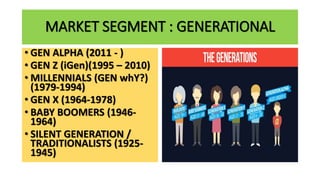
MARKET SEGMENT : GENERATIONAL
• GEN ALPHA (2011 - )
• GEN Z (iGen)(1995 – 2010)
• MILLENNIALS (GEN whY?)
(1979-1994)
• GEN X (1964-1978)
• BABY BOOMERS (1946-
1964)
• SILENT GENERATION /
TRADITIONALISTS (1925-
1945)
Average Ages & Generations
MARKET SEGMENT : LIFESTYLE
1. DINGO : Double Income Not Going
Out (Saver)
2. DINKY : Double Income No Kids Yet
3. DITCHED : Dual Income, Two or
more CHildren, Expanding Debts
4. MUPPIE : Middle-aged Urban
Professional
5. OINKY : One Income No Kids Yet
6. ORCHID : One Recent Child Heavily
In Debt
7. GLAM : Greying Leisurely Affluent
Married
8. GOFER : Genial Old Fellow/Female
Enjoying Retirement
9. HENRY : High Earner Not Rich Yet
10. KIPPERS : Kid in Parents Pockets
Eroding Retirement Savings
11. LOHAS : Lifestyle of Health And
Sustainability
12. SINBAD : Single Income No
Boyfriend And Desperate
13. SITCOM : Single Income Two
Children Oppressive Mortgage
14. YUPPIE : Young, Upwardly mobile
Professional
My Reasons to Own a car
Choices
•Past Experience
•Present Relationship
(Emotional Attachment)
•Future Dream
(Expectations)
Determinants
•Affordability
•Pleasure
•Practical
•Status Symbol
•Latest Technology
5
3
5
3
1
3
4
4
4
2
2
5
3
5
5
AFFORDABILITY
PLEASURE
PRACTICAL
STATUS SYMBOL
LATEST TECHNOLOGY
0% 10% 20% 30% 40% 50% 60% 70% 80% 90% 100%
DETERMINANTS ON CAR CHOICES
PAST EXPERIENCE PRESENT RELATIONSHIP FUTURE DREAM
PRODUCT PROMISES : Car Ownership
1. Building Cars People First
2. It’s in the Drive!
3. The Power of Dreams
4. All about the drive.
5. Innovation that excites
6. Passion for life
7. Driving matters
8. Go further.
9. Drive@earth
10.The best or nothing.
11.The Ultimate Driving
Machine
12.New thinking New
Possibilities
13.The power to surprise
CLASSIC-INNOVATION
DEPENDABLE - PASSIONATE
CAR OWNERSHIP : MALAYSIA
PASSION
INNOVATIVE
CONVENTIONAL
DEPENDABLE
PERCEPTUAL MAP : INNOVATIVE VS PASSION
[CELLRANGE]
[CELLRANGE]
[CELLRANGE]
[CELLRANGE]
[CELLRANGE] [CELLRANGE]
[CELLRANGE]
[CELLRANGE] [CELLRANGE]
[CELLRANGE]
[CELLRANGE][CELLRANGE]
CLASSIC-INNOVATION
DEPENDABLE - PASSIONATE
CAR OWNERSHIP : MALAYSIA 2015 (591,298 new cars)
PASSION
INNOVATIVE
CONVENTIONAL
DEPENDABLE
PERCEPTUAL MAP : INNOVATIVE VS PASSION
PRODUCT PROMISES : Car Ownership
BRANDS
1. Perodua
2. Proton
3. Honda
4. Toyota
5. Nissan / Renault
6. Mazda
7. Isuzu / Ford
8. Mitsubishi
9. Mercedes
10. BMW
11. Hyundai
12. Kia
PROMISES
1. Building Cars People First
2. It’s in the Drive!
3. The Power of Dreams
4. All about the drive.
5. Innovation that excites / Passion for life
6. Driving matters
7. Go further.
8. Drive@earth
9. The best or nothing.
10. The Ultimate Driving Machine
11. New thinking New Possibilities
12. The power to surprise
WHAT ARE THE NEEDS OF YOUR CUSTOMER?
Hierarchy of Needs of Individuals and Organisations
Maslow Hierarchy of Needs
1.Self-actualization
2.Esteem
3.Love/Belonging
4.Safety
5.Physiological
PROMISES, PROMISES
CONSUMER
1. “Think different”
2. “Do the Right Thing”
3. “Taste the Feeling”
4. “Be What’s Next”
5. “Let’s Go Places”
6. “Imagine the Possibilities”
7. “i’m lovin’ it”
8. “and you’re done.”
B2B
1. “Do the Right Thing”
2. “Be What’s Next”
3. “Think.”
4. “Let’s Go Places”
5. “Imagine the Possibilities”
6. “Imagination at work”
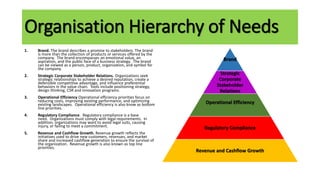
Organisation Hierarchy of Needs
1. Brand. The brand describes a promise to stakeholders. The brand
is more than the collection of products or services offered by the
company. The brand encompasses an emotional value, an
aspiration, and the public face of a business strategy. The brand
can be viewed as a person, product, organization, and symbol for
the company.
2. Strategic Corporate Stakeholder Relations. Organizations seek
strategic relationships to achieve a desired reputation, create a
defensible competitive advantage, and influence preferential
behaviors in the value chain. Tools include positioning strategy,
design thinking, CSR and innovation programs.
3. Operational Efficiency Operational efficiency priorities focus on
reducing costs, improving existing performance, and optimizing
existing landscapes. Operational efficiency is also know as bottom
line priorities.
4. Regulatory Compliance. Regulatory compliance is a base
need. Organizations must comply with legal requirements. In
addition, organizations may want to avoid legal suits, causing
injury, or failing to meet a commitment.
5. Revenue and Cashflow Growth. Revenue growth reflects the
initiatives used to drive new customers, revenues, and market
share and increased cashflow generation to ensure the survival of
the organization. Revenue growth is also known as top line
priorities.
Brand
Strategic
Corporate
Stakeholder
Relations
Operational Efficiency
Regulatory Compliance
Revenue and Cashflow Growth
MARKET SEGMENTATION : B2B
• DEMOGRAPHIC
• Industries range
• Company size
• Geographic Locations
• OPERATING VARIABLES
• Customer Technologies
• User or non-user status / Level of usage
• Customer capabilities / Level of service
support needed
• SITUATIONAL FACTORS
• Urgency
• Specific or all applications
• Size of order
• PURCHASING APPROACHES
• Centralized or decentralized purchasing
function in organization
• Power structure of decision-makers
(engineering/finance)
• Nature of existing relationships
• General purchasing policies
(leasing/service contract/system
purchases/tenders)
• Purchasing criteria (quality/ service/
price)
• PERSONAL CHARACTERISTICS
• Buyer-seller similarity (People/values)
• Attitude towards risk
• Loyalty level to suppliers
GLOBAL BRANDS
THE MARKETING MIX 4+Ppl
Understanding interactions with the customer
Select your Supermarket Product
PRODUCT
COMPETITORS
COMPLEMENTORS
SUBSTITUTES
BRANDS SELECTED BRAND COMPETITOR 1 COMPETITOR 2
(SUBSTITUTE)
COMPETITOR 3
(COMPLEMENTOR)
MARKETING MIX
(1=Disadvantage,
2=No difference,
3=Superior Advantage to
competitors)
1. PRODUCT : promise,
packaging, ingredients
2. PRICE : Value for
money, discounts,
bundling offers
3. PROMOTION : On
pack offers, in-store
advertising, newspaper
ad, social media,
website
4. PLACE : Availability,
convenience of outlets,
online store
5. PEOPLE : Store
customer service,
Helpline, Email support
TOTAL SCORE
(x/15)
COMPETITIVEADVANTAGES
MARKET SHARE
CONSUMER BRANDS@SUPERMAKET
MARKET LEADERS
CHALLENGERS
COMPLEMENTORS
LAGGARDS
COMPETITOR ANALYSIS : SUPERMARKET WARS
Consumption at 10x speed …
There is always an alternative …

Tcm step 2 market needs analysis

  • 1.
    “Does your productmeet a clear market demand or solve a problem?” Innovation SPACE™ Technology Commercialization Model Phase 1 : CONCEPT Stage 1 : DISCOVERY Step 2 : MARKET NEEDS ANALYSIS
  • 2.
    The Technology CommercialisationModel SCIENCE & TECHNOLOGY MARKET ENTERPRISE / BUSINESS CONCEPT PHASE STAGE 1 : DISCOVERY Step 1 Technology Analysis Step 2 Market Needs Analysis Step 3 Venture Assessment CREATION PHASE STAGE 2 : DO-ABILITY Step 4 Technical Feasibility Step 5 Market Study Step 6 Economic Feasibility STAGE 3 : DESIGN Step 7 Engineering Prototype / Pilot Plant Step 8 Strategic Marketing Plan Step 9 Strategic Business Plan STAGE 4 : DEPLOYMENT Step 10 Pre-production Prototype Step 11 Market Validation Step 12 Business Start-Up COMMERCIAL PHASE STAGE 5 : DELIVERY Step 13 Production Step 14 Sales & Distribution Step 15 Business Growth STAGE 6 : DOMINATION Step 16 Production Support Step 17 Market Diversification Step 18 Business Maturity
  • 3.
    Step 2: MarketNeeds Analysis Does this product meet a clear market demand or solve a problem? • Assuming all things are still positive, the next step is to investigate a marketing concept for the product. This step is called the Market Needs Analysis. The questions are straightforward and simple: who will buy the product, how many will they buy, and how much will they pay? Discovering this information is not as simple as asking the questions. At this level of analysis, the information comes primarily from secondary sources such as trade journals, periodicals, existing market studies and electronic data. The permissible margin for error at this level is large. This activity is designed more to qualify the market opportunity than quantify it at this point in the process. The purpose here is to develop a level of confidence about the marketability of the product. • Definition: The process of determining whether the concept demonstrates superior ability over current solutions to meet a market need. • Objective: The objective of a market needs assessment is to identify a potential market for the concept, estimate the market size and determine a preliminary value of the product. • Product: The product of this step is a short summary of information from trade journals, data bases, and interviews which follows the marketing section of a standard business plan format. • Marketing Activities: The marketing activities common to this step are those necessary to demonstrate that the product is unique and sustainable in a competitive marketplace. • During the conceptual phase the following activities must be completed: • • Identify three unique features or benefits of the product; • Identify the competition; • Establish customer requirements for the product; • Identify potential market barriers; • Identify market distribution channels; • Identify product pricing criteria • Milestones: Background research materials • Funding Sources: Personal finances, Family and friends • Marketing Information: Completion of the conceptual marketing step will usually result in a rationale of why the product will receive a positive market response, gross estimates of the market and its segmentation, a simple explanation of how the product will be marketed, and an estimated price for the product. • Key Questions : • Have you assessed the needs of the market? Do you know the product uniqueness? Do you know the product competition? Do you know the customer requirements? Have you identified the barriers to market entry? Have you identified distribution channels? Do you know the pricing criteria?
  • 4.
    KEY QUESTIONS 1. Haveyou assessed the needs of the market? 2. Do you know the product uniqueness? 3. Do you know the product competition? 4. Do you know the customer requirements? 5. Have you identified distribution channels? 6. Do you know the pricing criteria? 7. Have you identified the barriers to market entry?
  • 5.
    WHAT IS AMARKET SEGMENT? WHO IS THE CUSTOMER? Demographic Grouping and Buying Behaviour
  • 6.
    MARKET SEGMENT :GENERATIONAL • GEN ALPHA (2011 - ) • GEN Z (iGen)(1995 – 2010) • MILLENNIALS (GEN whY?) (1979-1994) • GEN X (1964-1978) • BABY BOOMERS (1946- 1964) • SILENT GENERATION / TRADITIONALISTS (1925- 1945)
  • 7.
    Average Ages &Generations
  • 10.
    MARKET SEGMENT :LIFESTYLE 1. DINGO : Double Income Not Going Out (Saver) 2. DINKY : Double Income No Kids Yet 3. DITCHED : Dual Income, Two or more CHildren, Expanding Debts 4. MUPPIE : Middle-aged Urban Professional 5. OINKY : One Income No Kids Yet 6. ORCHID : One Recent Child Heavily In Debt 7. GLAM : Greying Leisurely Affluent Married 8. GOFER : Genial Old Fellow/Female Enjoying Retirement 9. HENRY : High Earner Not Rich Yet 10. KIPPERS : Kid in Parents Pockets Eroding Retirement Savings 11. LOHAS : Lifestyle of Health And Sustainability 12. SINBAD : Single Income No Boyfriend And Desperate 13. SITCOM : Single Income Two Children Oppressive Mortgage 14. YUPPIE : Young, Upwardly mobile Professional
  • 11.
    My Reasons toOwn a car Choices •Past Experience •Present Relationship (Emotional Attachment) •Future Dream (Expectations) Determinants •Affordability •Pleasure •Practical •Status Symbol •Latest Technology
  • 12.
    5 3 5 3 1 3 4 4 4 2 2 5 3 5 5 AFFORDABILITY PLEASURE PRACTICAL STATUS SYMBOL LATEST TECHNOLOGY 0%10% 20% 30% 40% 50% 60% 70% 80% 90% 100% DETERMINANTS ON CAR CHOICES PAST EXPERIENCE PRESENT RELATIONSHIP FUTURE DREAM
  • 13.
    PRODUCT PROMISES :Car Ownership 1. Building Cars People First 2. It’s in the Drive! 3. The Power of Dreams 4. All about the drive. 5. Innovation that excites 6. Passion for life 7. Driving matters 8. Go further. 9. Drive@earth 10.The best or nothing. 11.The Ultimate Driving Machine 12.New thinking New Possibilities 13.The power to surprise
  • 14.
    CLASSIC-INNOVATION DEPENDABLE - PASSIONATE CAROWNERSHIP : MALAYSIA PASSION INNOVATIVE CONVENTIONAL DEPENDABLE PERCEPTUAL MAP : INNOVATIVE VS PASSION
  • 15.
    [CELLRANGE] [CELLRANGE] [CELLRANGE] [CELLRANGE] [CELLRANGE] [CELLRANGE] [CELLRANGE] [CELLRANGE] [CELLRANGE] [CELLRANGE] [CELLRANGE][CELLRANGE] CLASSIC-INNOVATION DEPENDABLE- PASSIONATE CAR OWNERSHIP : MALAYSIA 2015 (591,298 new cars) PASSION INNOVATIVE CONVENTIONAL DEPENDABLE PERCEPTUAL MAP : INNOVATIVE VS PASSION
  • 16.
    PRODUCT PROMISES :Car Ownership BRANDS 1. Perodua 2. Proton 3. Honda 4. Toyota 5. Nissan / Renault 6. Mazda 7. Isuzu / Ford 8. Mitsubishi 9. Mercedes 10. BMW 11. Hyundai 12. Kia PROMISES 1. Building Cars People First 2. It’s in the Drive! 3. The Power of Dreams 4. All about the drive. 5. Innovation that excites / Passion for life 6. Driving matters 7. Go further. 8. Drive@earth 9. The best or nothing. 10. The Ultimate Driving Machine 11. New thinking New Possibilities 12. The power to surprise
  • 18.
    WHAT ARE THENEEDS OF YOUR CUSTOMER? Hierarchy of Needs of Individuals and Organisations
  • 19.
    Maslow Hierarchy ofNeeds 1.Self-actualization 2.Esteem 3.Love/Belonging 4.Safety 5.Physiological
  • 20.
    PROMISES, PROMISES CONSUMER 1. “Thinkdifferent” 2. “Do the Right Thing” 3. “Taste the Feeling” 4. “Be What’s Next” 5. “Let’s Go Places” 6. “Imagine the Possibilities” 7. “i’m lovin’ it” 8. “and you’re done.” B2B 1. “Do the Right Thing” 2. “Be What’s Next” 3. “Think.” 4. “Let’s Go Places” 5. “Imagine the Possibilities” 6. “Imagination at work”
  • 21.
    Organisation Hierarchy ofNeeds 1. Brand. The brand describes a promise to stakeholders. The brand is more than the collection of products or services offered by the company. The brand encompasses an emotional value, an aspiration, and the public face of a business strategy. The brand can be viewed as a person, product, organization, and symbol for the company. 2. Strategic Corporate Stakeholder Relations. Organizations seek strategic relationships to achieve a desired reputation, create a defensible competitive advantage, and influence preferential behaviors in the value chain. Tools include positioning strategy, design thinking, CSR and innovation programs. 3. Operational Efficiency Operational efficiency priorities focus on reducing costs, improving existing performance, and optimizing existing landscapes. Operational efficiency is also know as bottom line priorities. 4. Regulatory Compliance. Regulatory compliance is a base need. Organizations must comply with legal requirements. In addition, organizations may want to avoid legal suits, causing injury, or failing to meet a commitment. 5. Revenue and Cashflow Growth. Revenue growth reflects the initiatives used to drive new customers, revenues, and market share and increased cashflow generation to ensure the survival of the organization. Revenue growth is also known as top line priorities. Brand Strategic Corporate Stakeholder Relations Operational Efficiency Regulatory Compliance Revenue and Cashflow Growth
  • 22.
    MARKET SEGMENTATION :B2B • DEMOGRAPHIC • Industries range • Company size • Geographic Locations • OPERATING VARIABLES • Customer Technologies • User or non-user status / Level of usage • Customer capabilities / Level of service support needed • SITUATIONAL FACTORS • Urgency • Specific or all applications • Size of order • PURCHASING APPROACHES • Centralized or decentralized purchasing function in organization • Power structure of decision-makers (engineering/finance) • Nature of existing relationships • General purchasing policies (leasing/service contract/system purchases/tenders) • Purchasing criteria (quality/ service/ price) • PERSONAL CHARACTERISTICS • Buyer-seller similarity (People/values) • Attitude towards risk • Loyalty level to suppliers
  • 23.
  • 24.
    THE MARKETING MIX4+Ppl Understanding interactions with the customer
  • 25.
    Select your SupermarketProduct PRODUCT COMPETITORS COMPLEMENTORS SUBSTITUTES
  • 26.
    BRANDS SELECTED BRANDCOMPETITOR 1 COMPETITOR 2 (SUBSTITUTE) COMPETITOR 3 (COMPLEMENTOR) MARKETING MIX (1=Disadvantage, 2=No difference, 3=Superior Advantage to competitors) 1. PRODUCT : promise, packaging, ingredients 2. PRICE : Value for money, discounts, bundling offers 3. PROMOTION : On pack offers, in-store advertising, newspaper ad, social media, website 4. PLACE : Availability, convenience of outlets, online store 5. PEOPLE : Store customer service, Helpline, Email support TOTAL SCORE (x/15)
  • 27.
    COMPETITIVEADVANTAGES MARKET SHARE CONSUMER BRANDS@SUPERMAKET MARKETLEADERS CHALLENGERS COMPLEMENTORS LAGGARDS COMPETITOR ANALYSIS : SUPERMARKET WARS
  • 28.
  • 29.
    There is alwaysan alternative …