Skeletal System Anatomy
‫العالي‬ ‫الصحيت‬ ‫المهن‬ ‫معهد‬
‫م‬‫المادة‬ ‫درس‬
‫م‬.‫إختصاص‬ ‫جامعي‬
‫الحمداني‬ ‫الوهاب‬ ‫عبد‬ ‫نزار‬ ‫صـالح‬
‫تمـريض‬ ‫علــوم‬ ‫ماجـستير‬(‫بالغين‬)
Salah Nazar Abdulwahhab  M.Sc. Nursing
1
Skeletal System (Skeleton)
The adult human skeletal system consists of 206 bones, as well as a network of tendons,
ligaments and cartilage that connects them.
The skeletal system performs vital functions as following:
• Framework
– Supports muscle, fat and skin
• Protection
– Surrounds vital organs
– EX: skull, ribs, pelvis
• Movement
– Muscles attach to bones to provide movement
• Production of blood cells
– Red and white blood cells and platelets
• Storage minerals like
– Calcium and Phosphors
2
Parts of the skeletal system
 Bones (skeleton)
 Joints
 Cartilages
 Ligaments (bone to bone)
 (tendon=bone to muscle)
3
Bones classification according to the shape
• long bones
• short bones
• flat bones
• irregular bones
4
Long bones
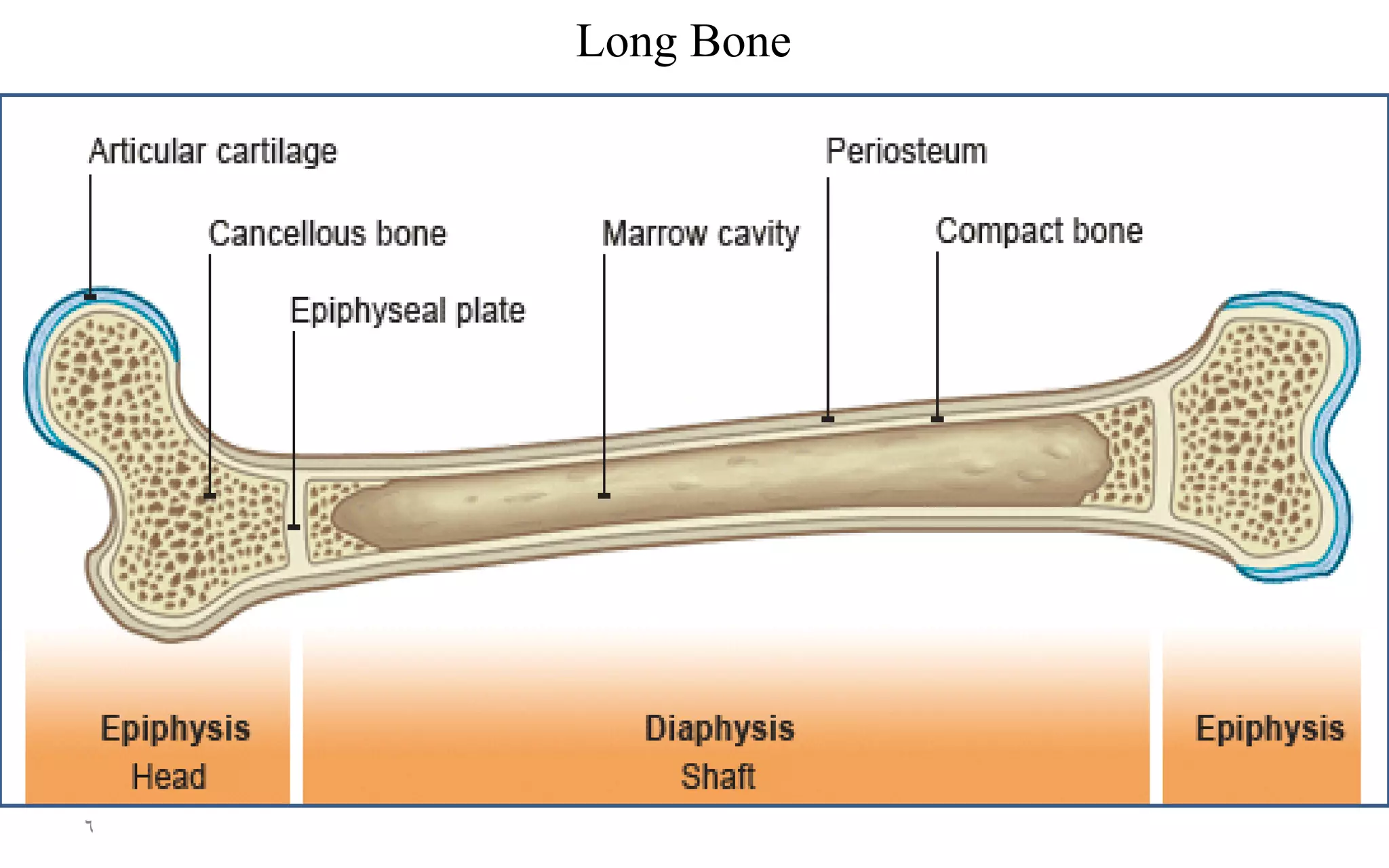
Typically longer than wide, have a shaft with heads at both ends,
contain mostly from compact bone (examples: femur, humerus)
Gross Anatomy of a Long Bone
· Diaphysis = (Shaft) composed of compact bone
· Epiphysis = (Ends of the bone) composed mostly of spongy bone
5
Long Bone
6
Structures of a Long Bone
 Periosteum
- Outside covering of the diaphysis
- Fibrous connective tissue membrane
 Sharpey’s fibers
- Secure periosteum to underlying bone
 Blood Vessels
- Supply bone cells with nutrients
7
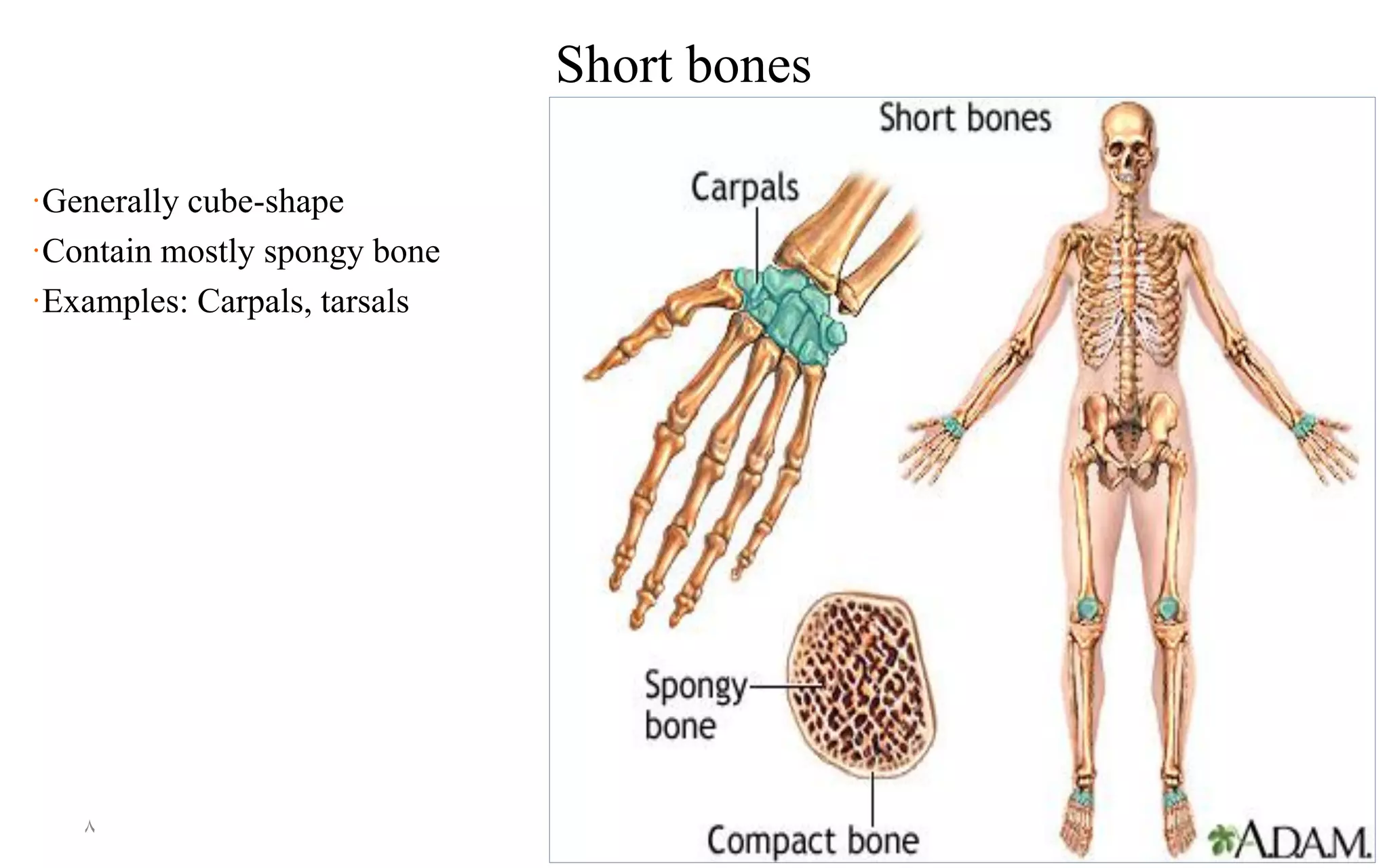
Short bones
·Generally cube-shape
·Contain mostly spongy bone
·Examples: Carpals, tarsals
8
Flat bones
·Thin and flattened
·Usually curved by Thin layers of compact
bone around a layer of spongy bone
·Examples: Skull, ribs, sternum
9
Irregular bones
· Irregular shape
·Do not fit into other bone classification
categories
·Example: Vertebrae and hip
10
Types of Bone Cells
1. Osteocytes: Mature bone cells
2. Osteoblasts: Bone-forming cells
3. Osteoclasts: Bone-destroying cells
- Break down bone matrix for remodeling and release of calcium
- Bone remodeling is a process by both osteoblasts and osteoclasts
11
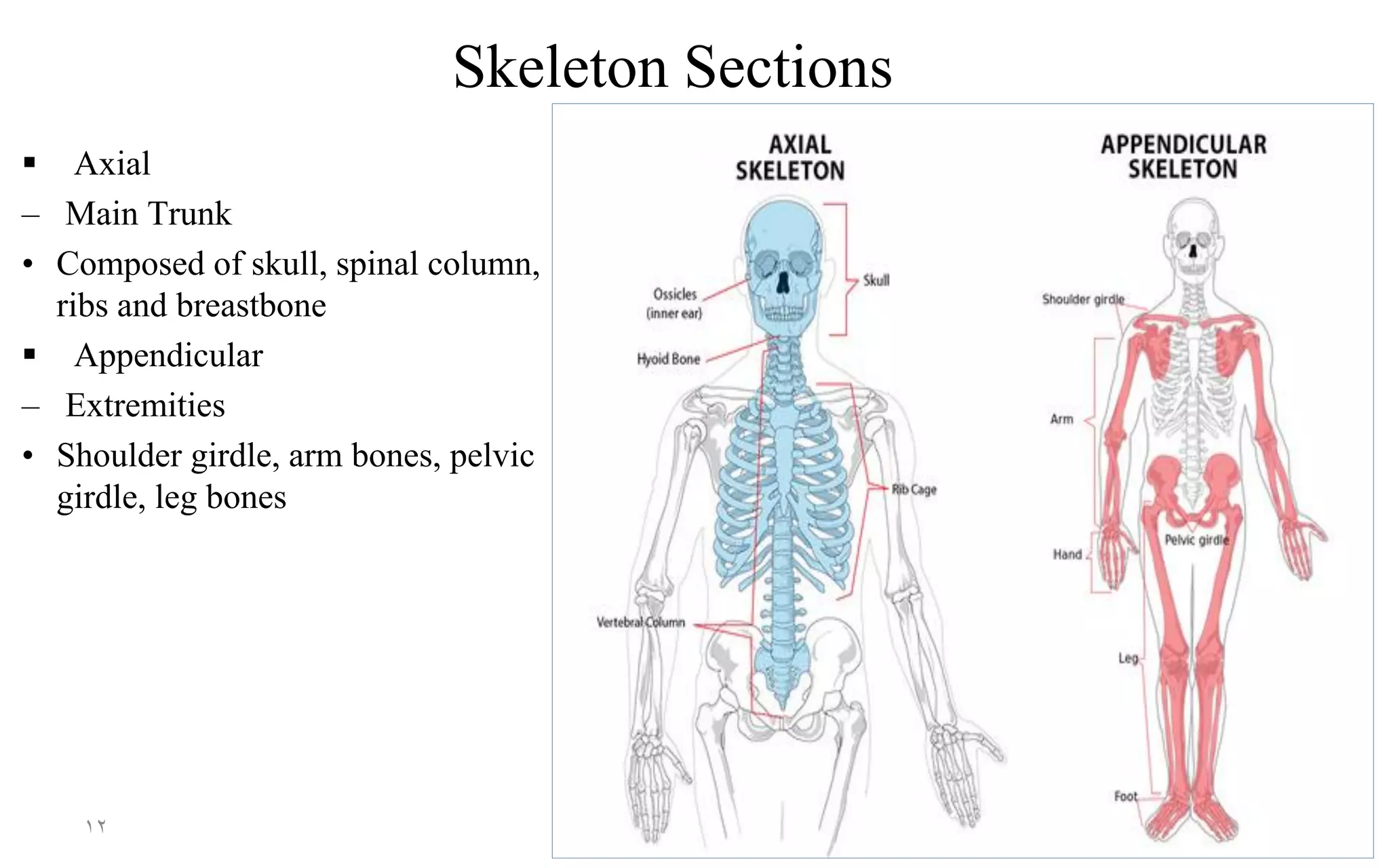
Skeleton Sections
 Axial
– Main Trunk
• Composed of skull, spinal column,
ribs and breastbone
 Appendicular
– Extremities
• Shoulder girdle, arm bones, pelvic
girdle, leg bones
12
The Skull
The bones of the skull can be divided into:
 Cranium bones
 face bones
The (vault) is the upper part of the cranium and the base of the skull is the lowest
part of the cranium
13
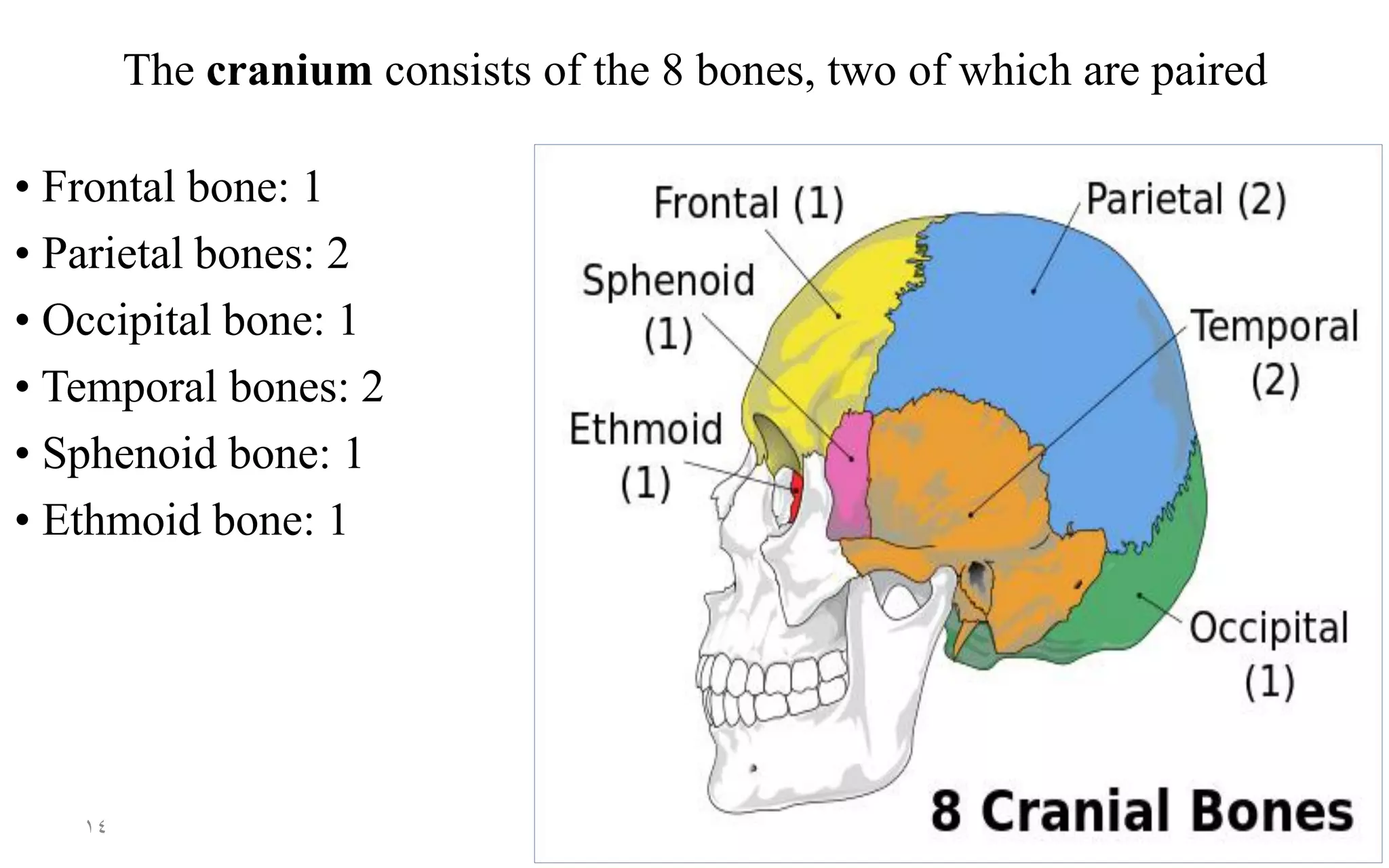
The cranium consists of the 8 bones, two of which are paired
• Frontal bone: 1
• Parietal bones: 2
• Occipital bone: 1
• Temporal bones: 2
• Sphenoid bone: 1
• Ethmoid bone: 1
14
The facial bones consist of the following, two of which are single
• Zygomatic bones: 2
• Maxillae: 2
• Nasal bones: 2
• Lacrimal bones: 2
• Vomer: 1
• Palatine bones: 2
• Inferior conchae: 2
• Mandible: 1
15
Thank You
16

Skeletal system

  • 1.
    Skeletal System Anatomy ‫العالي‬‫الصحيت‬ ‫المهن‬ ‫معهد‬ ‫م‬‫المادة‬ ‫درس‬ ‫م‬.‫إختصاص‬ ‫جامعي‬ ‫الحمداني‬ ‫الوهاب‬ ‫عبد‬ ‫نزار‬ ‫صـالح‬ ‫تمـريض‬ ‫علــوم‬ ‫ماجـستير‬(‫بالغين‬) Salah Nazar Abdulwahhab M.Sc. Nursing 1
  • 2.
    Skeletal System (Skeleton) Theadult human skeletal system consists of 206 bones, as well as a network of tendons, ligaments and cartilage that connects them. The skeletal system performs vital functions as following: • Framework – Supports muscle, fat and skin • Protection – Surrounds vital organs – EX: skull, ribs, pelvis • Movement – Muscles attach to bones to provide movement • Production of blood cells – Red and white blood cells and platelets • Storage minerals like – Calcium and Phosphors 2
  • 3.
    Parts of theskeletal system  Bones (skeleton)  Joints  Cartilages  Ligaments (bone to bone)  (tendon=bone to muscle) 3
  • 4.
    Bones classification accordingto the shape • long bones • short bones • flat bones • irregular bones 4
  • 5.
    Long bones Typically longerthan wide, have a shaft with heads at both ends, contain mostly from compact bone (examples: femur, humerus) Gross Anatomy of a Long Bone · Diaphysis = (Shaft) composed of compact bone · Epiphysis = (Ends of the bone) composed mostly of spongy bone 5
  • 6.
  • 7.
    Structures of aLong Bone  Periosteum - Outside covering of the diaphysis - Fibrous connective tissue membrane  Sharpey’s fibers - Secure periosteum to underlying bone  Blood Vessels - Supply bone cells with nutrients 7
  • 8.
    Short bones ·Generally cube-shape ·Containmostly spongy bone ·Examples: Carpals, tarsals 8
  • 9.
    Flat bones ·Thin andflattened ·Usually curved by Thin layers of compact bone around a layer of spongy bone ·Examples: Skull, ribs, sternum 9
  • 10.
    Irregular bones · Irregularshape ·Do not fit into other bone classification categories ·Example: Vertebrae and hip 10
  • 11.
    Types of BoneCells 1. Osteocytes: Mature bone cells 2. Osteoblasts: Bone-forming cells 3. Osteoclasts: Bone-destroying cells - Break down bone matrix for remodeling and release of calcium - Bone remodeling is a process by both osteoblasts and osteoclasts 11
  • 12.
    Skeleton Sections  Axial –Main Trunk • Composed of skull, spinal column, ribs and breastbone  Appendicular – Extremities • Shoulder girdle, arm bones, pelvic girdle, leg bones 12
  • 13.
    The Skull The bonesof the skull can be divided into:  Cranium bones  face bones The (vault) is the upper part of the cranium and the base of the skull is the lowest part of the cranium 13
  • 14.
    The cranium consistsof the 8 bones, two of which are paired • Frontal bone: 1 • Parietal bones: 2 • Occipital bone: 1 • Temporal bones: 2 • Sphenoid bone: 1 • Ethmoid bone: 1 14
  • 15.
    The facial bonesconsist of the following, two of which are single • Zygomatic bones: 2 • Maxillae: 2 • Nasal bones: 2 • Lacrimal bones: 2 • Vomer: 1 • Palatine bones: 2 • Inferior conchae: 2 • Mandible: 1 15
  • 16.