Bones, cartilage, and the
special structures that
connect them make up
your skeletal system
Major Organs of the
Major Organs of the
Skeletal System
Skeletal System
Skull Clavicle
Ribs Humerus
Radius Ulna
Patella Femur
Tibia Fibula
Pelvic Vertebral
girdle column
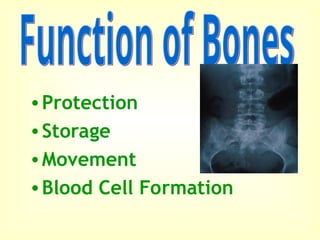
•Protection
•Storage
•Movement
•Blood Cell Formation
Protection
• Your heart and lungs are shielded by
your ribs
• Your spinal cord is protected by
your vertebrae
Your brain is protected
by your
skull
Storage
• Bones store minerals that help
the nerves and muscles function
properly
• Your arm and leg bones also
store fat that can be used for
energy
Movement
•Skeletal muscles pull on the
bones to produce movement
•Without bones, you
would not be able to
sit, stand, walk, or run
Blood Cell
Formation
•Some of your bones
are filled with a
special material
that makes blood
cells
•A bone may seem lifeless, but it
is a living organ made of several
different tissues.
•Bone is composed of connective
tissue and minerals that are
deposited by living cells called
osteoblasts.
Different Kinds of
Different Kinds of
Bone Tissue
Bone Tissue
Compact Bone
Bone tissue that does not have any visible open spaces
Spongy Bone
Bone tissue that has many open spaces
Spongy bone provides most of the strength and
support for a bone. It acts like the trusses of a
bridge.
Bone Marrow
Red marrow, found in spongy bone, produces red
blood cells
Yellow marrow, found in the central cavity of long
bones, stores fat
Growing Bones
Growing Bones
• Most bones start out as a soft, flexible
tissue called cartilage
• When you were born, you had little
true bone
• As you grow, the cartilage is replaced
by bone
• During childhood, growth plated of
cartilage remain in most bones,
providing a place for those bones to
continue to grow.
• The place where two or more bones
connect is called a joint
• Some joints allow a lot of movement,
while other joints are fixed.
• Joints that have a wide range of
movement tend to be more susceptible
to injury that those that are less
flexible.
Three Types of
Three Types of
Joints
Joints
• Sliding Joint
– Sliding joints allow bones in the hand to glide
over one another, giving some flexibility to the
area.
• Ball-and-Socket Joint
– Like a joystick on a computer game, the
shoulder enables your arm to move freely in all
directions.
• Hinge Joint
– Like a hinge on a door, the knee enables you to
flex and extend your lower leg.
Sliding
Sliding
Joint
Joint
Ball-and-Socket
Ball-and-Socket
Joint
Joint
Hinge Joint
Hinge Joint
• Joints are kept together with strong elastic
bands of connective tissue called ligaments.
• A strained ligament will usually heal with
time, but a torn ligament will not.
• A torn ligament must be repaired surgically
• Cartilage helps cushion the area where two
bones meet
• If cartilage wears away, the joint becomes
arthritic.

Skeletal_systemSkeletal_systemSkeletal_system.ppt

  • 1.
    Bones, cartilage, andthe special structures that connect them make up your skeletal system
  • 2.
    Major Organs ofthe Major Organs of the Skeletal System Skeletal System Skull Clavicle Ribs Humerus Radius Ulna Patella Femur Tibia Fibula Pelvic Vertebral girdle column
  • 3.
  • 4.
    Protection • Your heartand lungs are shielded by your ribs • Your spinal cord is protected by your vertebrae Your brain is protected by your skull
  • 5.
    Storage • Bones storeminerals that help the nerves and muscles function properly • Your arm and leg bones also store fat that can be used for energy
  • 6.
    Movement •Skeletal muscles pullon the bones to produce movement •Without bones, you would not be able to sit, stand, walk, or run
  • 7.
    Blood Cell Formation •Some ofyour bones are filled with a special material that makes blood cells
  • 8.
    •A bone mayseem lifeless, but it is a living organ made of several different tissues. •Bone is composed of connective tissue and minerals that are deposited by living cells called osteoblasts.
  • 9.
    Different Kinds of DifferentKinds of Bone Tissue Bone Tissue Compact Bone Bone tissue that does not have any visible open spaces Spongy Bone Bone tissue that has many open spaces Spongy bone provides most of the strength and support for a bone. It acts like the trusses of a bridge. Bone Marrow Red marrow, found in spongy bone, produces red blood cells Yellow marrow, found in the central cavity of long bones, stores fat
  • 10.
    Growing Bones Growing Bones •Most bones start out as a soft, flexible tissue called cartilage • When you were born, you had little true bone • As you grow, the cartilage is replaced by bone • During childhood, growth plated of cartilage remain in most bones, providing a place for those bones to continue to grow.
  • 11.
    • The placewhere two or more bones connect is called a joint • Some joints allow a lot of movement, while other joints are fixed. • Joints that have a wide range of movement tend to be more susceptible to injury that those that are less flexible.
  • 12.
    Three Types of ThreeTypes of Joints Joints • Sliding Joint – Sliding joints allow bones in the hand to glide over one another, giving some flexibility to the area. • Ball-and-Socket Joint – Like a joystick on a computer game, the shoulder enables your arm to move freely in all directions. • Hinge Joint – Like a hinge on a door, the knee enables you to flex and extend your lower leg.
  • 13.
  • 14.
  • 15.
  • 16.
    • Joints arekept together with strong elastic bands of connective tissue called ligaments. • A strained ligament will usually heal with time, but a torn ligament will not. • A torn ligament must be repaired surgically • Cartilage helps cushion the area where two bones meet • If cartilage wears away, the joint becomes arthritic.