The Johari Window Developed by  Jo seph Luft and  Har ry  I ngham (the word "Johari" comes from Joseph Luft and Harry Ingham),  there are two key ideas behind the tool: That individuals can build trust  between themselves by disclosing information  about themselves 2.  That they can learn about themselves  and come to terms with personal issues  with the help of feedback from others.
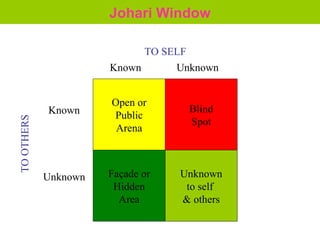
Johari Window Unknown Known TO SELF Known Unknown TO OTHERS Open or Public Arena Blind Spot Façade or Hidden Area Unknown to self  & others
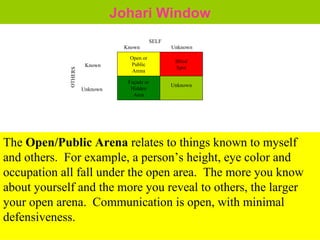
Open or Public Arena Blind Spot Façade or Hidden Area Unknown Known Unknown SELF Known Unknown OTHERS The  Open/Public Arena  relates to things known to myself and others.  For example, a person’s height, eye color and occupation all fall under the open area.  The more you know about yourself and the more you reveal to others, the larger your open arena.  Communication is open, with minimal defensiveness. Johari Window
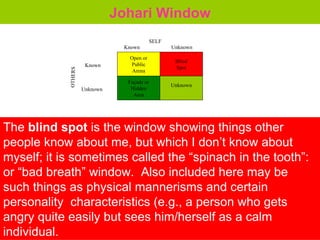
Open or Public Arena Blind Spot Façade or Hidden Area Unknown Known Unknown SELF Known Unknown OTHERS The  blind spot  is the window showing things other people know about me, but which I don’t know about myself; it is sometimes called the “spinach in the tooth”: or “bad breath” window.  Also included here may be such things as physical mannerisms and certain personality  characteristics (e.g., a person who gets angry quite easily but sees him/herself as a calm individual. Johari Window
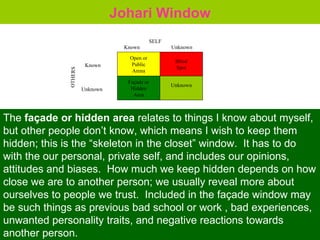
Open or Public Arena Blind Spot Façade or Hidden Area Unknown Known Unknown SELF Known Unknown OTHERS The  façade or hidden area  relates to things I know about myself, but other people don’t know, which means I wish to keep them hidden; this is the “skeleton in the closet” window.  It has to do with the our personal, private self, and includes our opinions, attitudes and biases.  How much we keep hidden depends on how close we are to another person; we usually reveal more about ourselves to people we trust.  Included in the façade window may be such things as previous bad school or work , bad experiences, unwanted personality traits, and negative reactions towards another person. Johari Window
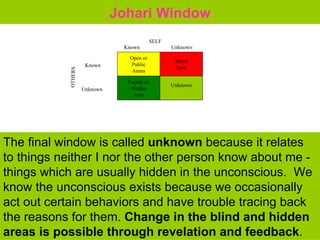
Open or Public Arena Blind Spot Façade or Hidden Area Unknown Known Unknown SELF Known Unknown OTHERS The final window is called  unknown  because it relates to things neither I nor the other person know about me - things which are usually hidden in the unconscious.  We know the unconscious exists because we occasionally act out certain behaviors and have trouble tracing back the reasons for them.  Change in the blind and hidden areas is possible through revelation and feedback .  Johari Window
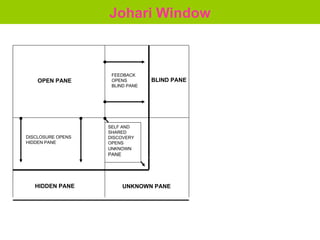
Johari Window SELF AND SHARED DISCOVERY OPENS UNKNOWN  PANE  FEEDBACK OPENS BLIND PANE OPEN PANE BLIND PANE HIDDEN PANE UNKNOWN PANE DISCLOSURE OPENS HIDDEN PANE
Johari Window Johari Window is the one self evaluation technique that requires input from another to facilitate completion.  It is important that the  person in this situation knows the student well and is able to provide feedback in a sensitive and non-judgmental fashion.
Johari Window be clear about what you say highlight the positive be specific, give examples focus on behaviour not the person give information not opinion use ‘I’ statements try not to give advice – help the person to help themselves
Instructions for completing Johari Window This is a school exercise  to help us to work better together.  It is NOT private therapy.  It is not the opportunity to get your own back on someone, or to tell someone the big secret you have been dying to tell someone for years.

Johari's Window

  • 1.
    The Johari WindowDeveloped by Jo seph Luft and Har ry I ngham (the word "Johari" comes from Joseph Luft and Harry Ingham), there are two key ideas behind the tool: That individuals can build trust between themselves by disclosing information about themselves 2. That they can learn about themselves and come to terms with personal issues with the help of feedback from others.
  • 2.
    Johari Window UnknownKnown TO SELF Known Unknown TO OTHERS Open or Public Arena Blind Spot Façade or Hidden Area Unknown to self & others
  • 3.
    Open or PublicArena Blind Spot Façade or Hidden Area Unknown Known Unknown SELF Known Unknown OTHERS The Open/Public Arena relates to things known to myself and others. For example, a person’s height, eye color and occupation all fall under the open area. The more you know about yourself and the more you reveal to others, the larger your open arena. Communication is open, with minimal defensiveness. Johari Window
  • 4.
    Open or PublicArena Blind Spot Façade or Hidden Area Unknown Known Unknown SELF Known Unknown OTHERS The blind spot is the window showing things other people know about me, but which I don’t know about myself; it is sometimes called the “spinach in the tooth”: or “bad breath” window. Also included here may be such things as physical mannerisms and certain personality characteristics (e.g., a person who gets angry quite easily but sees him/herself as a calm individual. Johari Window
  • 5.
    Open or PublicArena Blind Spot Façade or Hidden Area Unknown Known Unknown SELF Known Unknown OTHERS The façade or hidden area relates to things I know about myself, but other people don’t know, which means I wish to keep them hidden; this is the “skeleton in the closet” window. It has to do with the our personal, private self, and includes our opinions, attitudes and biases. How much we keep hidden depends on how close we are to another person; we usually reveal more about ourselves to people we trust. Included in the façade window may be such things as previous bad school or work , bad experiences, unwanted personality traits, and negative reactions towards another person. Johari Window
  • 6.
    Open or PublicArena Blind Spot Façade or Hidden Area Unknown Known Unknown SELF Known Unknown OTHERS The final window is called unknown because it relates to things neither I nor the other person know about me - things which are usually hidden in the unconscious. We know the unconscious exists because we occasionally act out certain behaviors and have trouble tracing back the reasons for them. Change in the blind and hidden areas is possible through revelation and feedback . Johari Window
  • 7.
    Johari Window SELFAND SHARED DISCOVERY OPENS UNKNOWN PANE FEEDBACK OPENS BLIND PANE OPEN PANE BLIND PANE HIDDEN PANE UNKNOWN PANE DISCLOSURE OPENS HIDDEN PANE
  • 8.
    Johari Window JohariWindow is the one self evaluation technique that requires input from another to facilitate completion. It is important that the person in this situation knows the student well and is able to provide feedback in a sensitive and non-judgmental fashion.
  • 9.
    Johari Window beclear about what you say highlight the positive be specific, give examples focus on behaviour not the person give information not opinion use ‘I’ statements try not to give advice – help the person to help themselves
  • 10.
    Instructions for completingJohari Window This is a school exercise to help us to work better together. It is NOT private therapy. It is not the opportunity to get your own back on someone, or to tell someone the big secret you have been dying to tell someone for years.