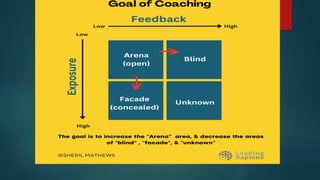
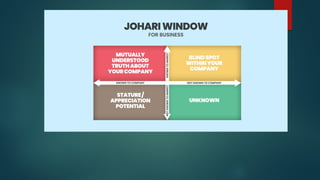
Johari window
IILM UNIVERSITY , GURGAON
SEC- B AND C
Introduction
Two American Psychologists, Joseph Luft and
Harrington Ingham in 1955, developed Johari
window model.
Luft and Ingham named their model "Johari" using
a combination of their first names.
 Johari window or Fringe is a simple model helps
people to understand their relationship within
themselves and with others.
 It is otherwise called disclosure/feedback model of
self-awareness or information processing tool.
MEANING
FOUR REGIONS / FOUR AREAS
Open self/area:
Blind self/area:
Hidden self/area:
Unknown self/area:
Open self/area:
This region represents what is
known by a person about
himself/herself and also known by
others.
Blind self/area:
This region represents what is
unknown about himself/herself but
which is known to others.
These can be positive or negative,
like adaptable, modest, self-
conscious or tense.
Hidden self/area:
This region represents what the person
knows about him/herself that others
do not know.
One either intentionally keep this
information hidden from others or you
have not found any occasion or
need to share it.
Unknown self/area:
This region represents what is
unknown by the person about
him/herself and is also unknown
by others
The model has four square grid like
window with four pans.
The four squares represents
four regions/area related to
self-awareness.
OPEN SELF
Information about you that both you and
others know.
BLIND SELF
Information about you that you don’t
know but
Others do know.
HIDDEN SELF
Information about you that you know but
others don’t know.
UNKNOWN SELF
Information about you that neither you nor
others know.
UNKNOWN TO SELF
KNOWN TO SELF
KNOWN
TO
OTHERS
UNKNOWN
TO
OTHERS
JOHARI WINDOW
GOALS OF JOHARI WINDOW
The goal of applying Johari Window is :-
 To increase the size of your open self. It has
several benefits.
 To build trust with others by disclosing
information about oneself.
 To get help from others in learning about
oneself and grow as a person.
Steps to use Johari Window
Effectively:-
The goal of self-awareness is “to enlarge
the area of quadrant 1 while reducing
the size of the other three quadrants.”
1.To achieve this, the first step is
 To enlarge the first quadrant by allowing the individual
to genuinely express their emotions, identifying and
accepting personal needs and
 Making them move in free, joyful and spontaneous
ways.
 This helps to explore personal thoughts , feelings,
memories and actions.
2. The next step in the process is
To reduce the size of the quadrant 2 by
listening to and learning from others .
As we relate our perceptions to others , we
broaden ourselves,
But such learning requires active listening
and openness to feedback from others.
3.The final step involves,
Reducing the size of the quadrant 3 by
self-disclosing or revealing the important
aspects of self to others.
Self-disclosure is both a sign or/and a
means of achieving healthy personality.
Drawbacks / PROBLEMS of
Johari Window:-
The Johari window as a tool has its own drawbacks,
 Some intimate things are better not to be
communicated with others. People may further pass
on information they received or use it in a negative
way.
 Some people or cultures have a very open and
accepting approach to feedback and some do not.
This may end up in terminating the relationship itself.
THANK YOU

Johari window organisational behaviour -.pptx

  • 1.
    Johari window IILM UNIVERSITY, GURGAON SEC- B AND C
  • 2.
    Introduction Two American Psychologists,Joseph Luft and Harrington Ingham in 1955, developed Johari window model. Luft and Ingham named their model "Johari" using a combination of their first names.
  • 3.
     Johari windowor Fringe is a simple model helps people to understand their relationship within themselves and with others.  It is otherwise called disclosure/feedback model of self-awareness or information processing tool. MEANING
  • 4.
    FOUR REGIONS /FOUR AREAS Open self/area: Blind self/area: Hidden self/area: Unknown self/area:
  • 5.
    Open self/area: This regionrepresents what is known by a person about himself/herself and also known by others.
  • 6.
    Blind self/area: This regionrepresents what is unknown about himself/herself but which is known to others. These can be positive or negative, like adaptable, modest, self- conscious or tense.
  • 7.
    Hidden self/area: This regionrepresents what the person knows about him/herself that others do not know. One either intentionally keep this information hidden from others or you have not found any occasion or need to share it.
  • 8.
    Unknown self/area: This regionrepresents what is unknown by the person about him/herself and is also unknown by others
  • 9.
    The model hasfour square grid like window with four pans. The four squares represents four regions/area related to self-awareness.
  • 10.
    OPEN SELF Information aboutyou that both you and others know. BLIND SELF Information about you that you don’t know but Others do know. HIDDEN SELF Information about you that you know but others don’t know. UNKNOWN SELF Information about you that neither you nor others know. UNKNOWN TO SELF KNOWN TO SELF KNOWN TO OTHERS UNKNOWN TO OTHERS JOHARI WINDOW
  • 11.
    GOALS OF JOHARIWINDOW The goal of applying Johari Window is :-  To increase the size of your open self. It has several benefits.  To build trust with others by disclosing information about oneself.  To get help from others in learning about oneself and grow as a person.
  • 12.
    Steps to useJohari Window Effectively:- The goal of self-awareness is “to enlarge the area of quadrant 1 while reducing the size of the other three quadrants.”
  • 13.
    1.To achieve this,the first step is  To enlarge the first quadrant by allowing the individual to genuinely express their emotions, identifying and accepting personal needs and  Making them move in free, joyful and spontaneous ways.  This helps to explore personal thoughts , feelings, memories and actions.
  • 14.
    2. The nextstep in the process is To reduce the size of the quadrant 2 by listening to and learning from others . As we relate our perceptions to others , we broaden ourselves, But such learning requires active listening and openness to feedback from others.
  • 15.
    3.The final stepinvolves, Reducing the size of the quadrant 3 by self-disclosing or revealing the important aspects of self to others. Self-disclosure is both a sign or/and a means of achieving healthy personality.
  • 18.
    Drawbacks / PROBLEMSof Johari Window:- The Johari window as a tool has its own drawbacks,  Some intimate things are better not to be communicated with others. People may further pass on information they received or use it in a negative way.  Some people or cultures have a very open and accepting approach to feedback and some do not. This may end up in terminating the relationship itself.
  • 19.