Download to read offline
![IOSR Journal of Electrical and Electronics Engineering (IOSR-JEEE)
e-ISSN: 2278-1676,p-ISSN: 2320-3331, Volume 5, Issue 4 (May. - Jun. 2013), PP 01-08
www.iosrjournals.org
www.iosrjournals.org 1 | Page
Optimal Operation of Wind-thermal generation using differential
evolution
Vishal Chaudhary1*
, Manjaree Pandit2
, Hari Mohan Dubey3
1*, 2, 3
(Department of Electrical Engineering, Madhav Institute of Technology and Science Gwalior M.P INDIA)
Abstract : Numerous optimization paradigms have been developed for power system optimization tasks till date
but none has found the level of acceptance which is being received by evolutionary soft computing methods.
Traditional methods are found to be inefficient for complex practical problems with equality and inequality
constraints therefore the complexity of the task reveals the necessity for development of efficient algorithms to
accurately locate the optimum solution. The present paper proposes to solve complex constrained optimization
problems using differential evolution (DE) with multiple mutation strategies. The role of control parameters and
mutation strategies of DE algorithm in achieving the global best result is critically explored.The depleting
reserves of fossil fuel and growing concern about environmental protection dictates the integration of
renewable power resources into the power grid. Including wind power with the conventional power has become
very popular in recent years due to the rapid development of technology in this field. Modeling of wind-thermal
system is required to find the optimal wind generator capacity that can be integrated into the existing system
such that all operating constraints are satisfied. The developed algorithm is tested on a standard test system
taking into consideration the wind uncertainty and ramp-rate limits of thermal power units. The results clearly
demonstrate the effectiveness of the proposed method in finding feasible and efficient globally optimal solutions
Keywords - Differential evolution, equality and inequality constraints, mutation strategies, wind-thermal
economic dispatch.
I. INTRODUCTION
Nature inspired, evolutionary computation is applied to solve various single and multi-objective
optimization problems, which cannot be solved using conventional optimization techniques because of high
dimensionality, nonconvexity/non-smooth nature of objective function. In general, evolutionary computation
techniques are composed of a set of different families of algorithms that iteratively improve a set of tentative
solutions to obtain an optimal or a quasi-optimal solution to the problem. Evolutionary optimization techniques
are being preferred over traditional methods for solving real-world engineering optimization problems because
these methods do not depend on the nature of the problem and are able to model complex constraints with ease.
The last decade has seen tremendous growth in the field of heuristic based optimization methods for NP
complete problems. Many new nature inspired evolutionary optimization algorithms such as genetic algorithm
(GA), particle swarm optimization (PSO), ant colony search (ACS), harmony search (HS), bacterial foraging
(BF), biogeography based optimization (BBO) etc. were proposed for almost all the fields of engineering,
science and management. The major advantages of these methods are i) population based random search
mechanism ii) non-dependence on nature of objective function iii) ability to handle complex constraints iv)
non-dependence on initial solution and v) simple implementation. The objective of solving the economic
dispatch (ED) problem of electrical power systems is to find the optimal allocation of output power among the
available generating units such that the system load is met and operating constraints are satisfied[1][2].
Alternate sources of power are continuously being explored to find a sustainable and economic solution to the
ever increasing global power needs. A model based on differential evolution is proposed in this paper to include
wind energy conversion systems (WECS) into the conventional power network. The most important factor
associated with wind energy is that after the preliminary land and capital costs, there are almost no financial
requirements in producing electrical power by harnessing wind energy. The wind energy system is environment
friendly as compared to conventional fossil fuels. A number of research efforts can be found in literature where
wind-thermal cost optimization has been carried out using numerical optimization methods. A model to include
the wind energy conversion system (WECS) in the economic dispatch(ED) problem is presented using
numerical solutions [3]. Both overestimation and underestimation of available wind power are analyzed. The
stochastic nature of wind speed characterization is modeled using Weibull probability density function for a
system having two conventional and two wind-powered generators. The economic dispatch problem for power
systems which contain wind power generation plants is presented in [4]. The dynamic optimal dispatch takes
into account of the coupling effect of system at different time moments, such as the limit on the climbing rate of
a generator. Quantum genetic algorithm is adopted in this paper, the calculation of which is to borrow fully the
concept and theory of Quantum computing [4]. The transformation of the multi-objective dispatch problem into](https://image.slidesharecdn.com/a0540108-140503012426-phpapp01/85/Optimal-Operation-of-Wind-thermal-generation-using-differential-evolution-1-320.jpg)
![Optimal Operation of Wind-thermal generation using differential evolution
www.iosrjournals.org 2 | Page
a single-objective one to compromise different objectives is presented in [5] using, the optimal generation
dispatch (OGD) model. Then the OGD is solved by a particle swarm optimization algorithm. The plant growth
simulation algorithm (PGSA) is applied to solve the wind-thermal dispatch problem with different constraints
like valve point loading effect, ramp rates, power loss and prohibited zones. Problem formulation of wind-
thermal dynamic economic dispatch [6] A stochastic optimization method utilising a simulated annealing (SA)
approach combined with an efficient constrained dynamic economic dispatch (CDED) is proposed in [7].
This paper proposes a DE based approach for wind-thermal scheduling problem in dynamic
environment with complex constraints. A detailed analysis and comparison of the various DE mutation
strategies is carried out. The proposed approach is found to be very effective in locating optimal solutions
consistently.
II. PROBLEM FORMULATION OF WIND-THERMAL DYNAMIC ECONOMIC DISPATCH
The objective function for wind-thermal economic dispatch includes minimization of the operating
cost of thermal as well as wind power at any given time interval consisting of all sub-intervals. After the initial
costs, the wind power farm does not consume fuel therefore power companies normally dispatch all wind power
first. The objective of economic dispatch for power systems containing wind power farm can be formulated as:
(1)
Where FT is the total cost for producing power for the N number of conventional generating units over time
interval T; The active power output of the ith
generator at time t is taken as PGit ; the operating cost of individual
thermal unit is expressed using the quadratic cost function as Fi(PGit) And for the tth
time it can be expressed as:
(2)
Where ai , bi and ci are the fuel cost coefficients of the ith thermal generating unit. In the electricity market,
the cost function due to environmental effects of thermal generation can also be included in the optimal wind-
thermal system by defining the emission content in terms of additional coefficients based on the emission
characteristics. The ecological cost of coal-fired generating units is added to the fuel cost of electricity
generation. The environmental cost function Fcp can be given as:
(3)
Where Mcpi is the cost coefficient for modeling environmental effect and fdi is the emission amount of the ith
thermal generating unit. On the basis of the weight of the harmful pollutant gases discharged from the thermal
units, the emission characteristics for each unit can be represented by emission per unit time as:
(4)
Where αi , βi , γi , δi and θi are the emission characteristics coefficients for the ith
thermal generating unit,
which can be measured.
The objective function specified by (1) is to be minimized subject to the following constraints:
2. 1 Power balance constraint
The total power generated by wind and thermal units at any given time should match the load plus losses at
that time [1] [2].
(5)
Where Nw represents the total wind power plants in the system; PGjt is the output of active power for the jth
wind power plant at time t; PDt is the load at time t.
2. 2 Power losses
The power losses taking place at any particular time t can be expressed using the B-loss coefficient by
applying the following expression [1]:
(6)
PLt is the line loss for the NC number of generators given by N+NW; The loss parameters Bij , Bio and Boo are
also called B parameters.
2.3 Unit operating limits constraint
The power outputs of generating units have to lie within the specified minimum and maximum values. This is
due to the operating constraints on units.
(7)](https://image.slidesharecdn.com/a0540108-140503012426-phpapp01/85/Optimal-Operation-of-Wind-thermal-generation-using-differential-evolution-2-320.jpg)
![Optimal Operation of Wind-thermal generation using differential evolution
www.iosrjournals.org 3 | Page
Where Pmin
and Pmax
are the upper and lower bound respectively for the active power output of the ith
conventional unit at time t.
2.4 Ramp-rate limit of generators
(8)
Where εidown and εiup are the ramp down rate and the ramp up rate respectively for the ith
conventional
unit.These limits are applied because a unit cannot change its output beyond these values between two
consecutive time intervals. The ramp-rate limits modify the operating limits of a unit for every time interval
depending on the state of the preceding interval.
2.5 Nonconvex cost characteristics due to valve point loading
The valve-point effects cause ripples in the cost curves of thermal units and create discontinuous, nonconvex
objective function which has multiple minima. For an accurate modeling of VPL effects, a rectified sinusoidal
function [8] is added in the fuel input-power output cost function of the ith
unit as given below
(9)
di and ei all are the coefficient cost for evaluation for the ith
unit; PGit is the minimum power output for the ith
unit.
2.6 The Weibull Probability distribution of wind power
The wind power W and wind speed V share a highly nonlinear relation. V is the wind speed (m/sec), which
varies randomly with time however the data collected from field have shown that V approximately follows [9]
(v≥0) (10)
Where c and k are referred to as the scale factor and shape factor, respectively. Correspondingly, the
probability density function of V is:
(11)
The relation between the input wind power and the output electric power depends on many factors, like the
efficiencies of generator, wind rotor, gearbox, and inverter, depending on what kind of turbine is being
employed. The generic relation between wind power and wind speed can be given as [9]:
(12)
Where vr , vin , vout : Rated, cut-in, and cut-out wind speeds; W is the power generated by the wind generating
unit; Wr is the rated power of the wind generating unit; c is the scale factor and k is the shape factor of the
Weibull distribution.
III. DIFFERENTIAL EVOLUTION
Researchers the world over are proposing evolutionary methods as alternate approaches for solving
power system optimization and other problems, because these methods are nature inspired and hence are more
robust and suitable for practical problems having a real world flavor. This section presents an i) in-depth review
and comparison of various DE strategies ii) impact of tuning parameters. The DE results are analyzed using
reliable performance metrics such as convergence behavior, consistency and solution quality for solving the
CHPED problem.DE is a population-based stochastic function minimizer/maximizer based on evolutionary
computation. It’s simple yet powerful and straightforward features make it very attractive for numerical
optimization. DE differs from classic genetic algorithms in the manner of using the vector differential of two
randomly chosen parameter vectors; a concept borrowed from the operators of Nelder and Mead’s simplex
optimization technique. The DE algorithm was first introduced by Storn and Price in 1995 [10] and was
successfully applied in the optimization of complex and nonlinear, non-convex and non-differentiable, and
functions. Optimization using DE is carried out by three operations known as mutation, crossover and selection.
3.1 Mutation
Mutation is an operation that adds a vector differential to a population vector of individuals according
to the chosen variant. Three issues are central to DE, first, the method for selecting the parent population
member which is used for creating the mutated population, second, the number of difference vectors that will be
used form the mutant vector and third issue is which crossover method is used to create the offspring population.
The notation used for these three concepts is known as DE, /α/β/δ. Most published work has explored the
variant DE / rand / 1 / bin which means, random selection, one difference vector and binomial crossover [Storn](https://image.slidesharecdn.com/a0540108-140503012426-phpapp01/85/Optimal-Operation-of-Wind-thermal-generation-using-differential-evolution-3-320.jpg)
![Optimal Operation of Wind-thermal generation using differential evolution
www.iosrjournals.org 4 | Page
et al]. The best performing variant is found to be problem specific and needs detailed investigation. The donor
or mutant vector for each population member is generated for different variants in classic DE as given by
Mutant vector generation using DE/rand/1: MS-I
)]()([)()1( 3,2,1, txtxftxtZ ririmrii
(13)
Mutant vector generation using DE/best/1: MS-II
)]()([)()1( 3,2,, txtxftxtZ ririmbestii
(14)
Mutant vector generation using DE/rand-to-best/1: MS-III
)]()([)]()([)()1( 21, trxtrxfmtxtxftxtZ iiibestimii
(15)
Mutant vector generation using DE/best/2: MS-IV
)]()([)]()([)()1( 4321, trxtrxfmtrxtxftxtZ iiirimbestii
(16)
Mutant vector generation using DE/rand/2 : MS-V
)]()([)]()([)()1( 4321,5 trxtrxfmtrxtxftxtZ iiirimrii
(17)
Where i = 1, 2 …, R is the individual population member’s index, t is the iteration count; r1, r2, r3, r4 and r5
and are random integers generated by using the randperm (R) command. These integers should be different and
not the same as the integer i.To implement the mutation operation, a parameter called mutation factor, fm in the
range [0, 2] is taken which controls the amplification of the difference between two individuals so as to avoid
search stagnation.
3.2 Crossover Operation
The crossover operation is performed after the mutation operation is completed for the set of
population. Recombination is employed to generate a trial vector Ui by replacing some attributes of the target
vector (xi) with the corresponding parameters of the randomly generated donor or mutant vector (Zi) as per the
following logic:
))int(())((.),........(
))int(())((),.....1(
)1(
irandjorCRjrandiftx
irandjorCRjrandiftZ
tU
ij
ij
ij
(18)
In the above, rand (j) is the jth
assessment of a random number generated in the range 0-1; CR is a crossover
rate.The effectiveness of a DE algorithm is normally decided by the population size N, the mutation rate fm and
the crossover factor CR.
3.3 Selection
Selection is the procedure of producing better progeny. For a continuously evolving population, each
member of the trial vector is compared to its parent target vector. If it is found to be better, then it replaces the
concerned target vector in the population as expressed below.
otherwisetx
txftuiftU
tx
i
ii
i
),....(
))(()1(()......1(
)1(
(19)
Selection helps in maintaining a stable convergence.
IV. RESULTS AND ANALYSIS
4.1 Desription of Test Cases
4.1.1 Case 1:- The DE mutation strategies are compared using a model ten thermal generating units system [7].
The system unit data and the load demand are given in Tables 1 and 2. Optimal dispatch is computed for the
thermal system alone for the given loads without considering wind and ramp rate limit.
4.1.2 Case 2:- Thermal and wind dispatch is computed taking fixed wind generation of 400 MW without ramp
rate limits.
4.1.3 Case 3:- Thermal and wind dispatch is computed taking random distribution for wind power. In this case
ramp rate limits are also considered.
TABLE I. DATA FOR TEN UNITS THERMAL SYSTEM](https://image.slidesharecdn.com/a0540108-140503012426-phpapp01/85/Optimal-Operation-of-Wind-thermal-generation-using-differential-evolution-4-320.jpg)
![Optimal Operation of Wind-thermal generation using differential evolution
www.iosrjournals.org 5 | Page
TABLE II. LOAD DEMANDS FOR 24 HOURS
4.2 To find the best strategy and F & CR values
It has been reported that the results obtained using the DE algorithm are highly dependent on i)
selected mutation strategy(MS) ii) value of mutation rate iii) value of crossover rate [11]. This observation was
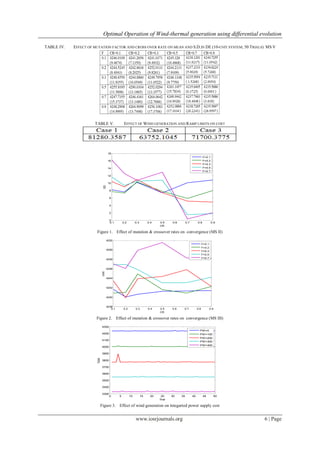
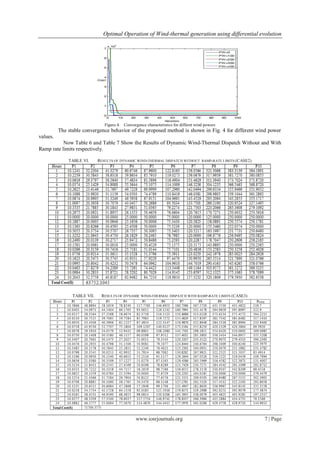
found to be true for the wind-thermal optimal power dispatch problem also. Table 3 and Table 4 present the
mean and standard deviation obtained out of 50 trials using strategy I and strategy V.
For both these mutation strategies it can be observed that as value of CR is increased the cost and
standard deviation both increase. Fig. 1 and Table 4 show that global convergence with consistent zero standard
deviation is obtained for strategy 5 for F=0.7 & CR=0.9. Strategy 3 and 4 do not produce very good
convergence, however the results are always near global best value. Fig. 2 shows that best results are found with
F=0.1. Fig. 3 shows the effect of wind power integration in reducing the operating cost.
Table 5 shows the relationship of cost with wind generation for three cases, without wind, with fixed
wind power and with random wind power. The cost is least when a fixed wind power is continuously available.
TABLE III. EFFECT OF MUTATION FACTOR AND CROSS OVER RATE ON MEAN AND S.D.IN DE (10-UNIT SYSTEM; 50 TRIALS) MS I](https://image.slidesharecdn.com/a0540108-140503012426-phpapp01/85/Optimal-Operation-of-Wind-thermal-generation-using-differential-evolution-5-320.jpg)
![Optimal Operation of Wind-thermal generation using differential evolution
www.iosrjournals.org 8 | Page
V. CONCLUSION
The effect of wind power generation in reducing the operating cost of power grid having conventional
thermal power plants has been presented. Differential evolution based optimization model has been built to
solve the complex constrained optimization problem. The results show the efficiency of the proposed method in
producing optimal schedules with satisfaction of equality and inequality constraints. The paper also explores the
dependence of the DE algorithm on the five DE mutation strategies and mutation & crossover rates in achieving
global convergence. The results are very encouraging and consistent.
Acknowledgements
The authors sincerely acknowledge the financial support provided by UGC under major research
project entitled Power System Optimization and Security Assessment Using Soft Computing Techniques, vide F
No.34-399/2008 (SR) dated, 24th December 2008. The second author acknowledges UGC, New Delhi financial
support for PD work sanctioned vide (F-30-120(SC)/2009 (SA-II)). The authors also thank the Director,
M.I.T.S. Gwalior for providing facilities for this work.
REFERENCES
[1] A.J. Wood and B.F. Wollenberg, Power Generation, Operation and Control, New York: Wiley, 1984.
[2] D.P. Kothari and I.J. Nagrath, Power system engineering, Tata McGraw- Hill, New Delhi 2008
[3] John Hetzer, David C. Yu, Kalu Bhattarai, “An Economic Dispatch Model Incorporating Wind Power” IEEE Transactions on Power
System , Vol. 23, No. 2, June 2008, pp. 603-611.
[4] Jia-Chu Lee, Whei-Min Lin, Gwo-Ching Liao, Ta-Peng Tsao, “Quantum genetic algorithm for dynamic economic dispatch with valve-
point effects and including wind power system” Electrical Power and Energy Systems, Vol. 33, 2011, pp. 189–197.
[5] C.X. Guo, Y.H. Bai, X. Zheng, J.P. Zhan, Q.H. Wuc, “Optimal generation dispatch with renewable energy embedded using multiple
objectives”, International Journal of Electrical Power and Energy systems, Vol. 42, No. 3, March 2011, pp. 440-447.
[6] H. T. Jadhav, Harsh Bhandari, Yaman Dalal, Ranjit Roy, “Economic Load Dispatch Including Wind Power Using Plant Growth
Simulation Algorithm” 11th
International Conference on Environment and Electrical Engineering (EEEIC) , 2012, pp. 388 – 393.
[7] C.L.Che,n “Simulated annealing-based optimal wind-thermal coordination scheduling” IET Gener. Transm. Distrib.Vol. 1 No. 3,
2007, pp. 447–455.
[8] D.C. Walter and G. B. Sheble, “Genetic algorithm solution of economic load dispatch with valve point loading”, IEEE Transactions
on Power Systems, Vol. 8, Aug 1993, pp.1325-1332.
[9] G. M. Masters, Renewable and Efficient Electric Power Systems, John Wiley & Sons, 2004.
[10] R. Storn and K. Price, “Differential evolution: A simple and efficient adaptive scheme for global optimization over continuous
spaces,” International Computer Science Institute, Berkeley, CA, Tech. Rep. TR-95-012, 1995.
[11] M. Sharma, Manjaree Pandit and L. Srivastava, “Reserve Constrained Multi-Area Economic Dispatch Employing Differential
Evolution with Time-Varying Mutation, International Journal of Electrical Power and Energy systems, Vol. 33, No. 3, March 2011,
pp.753-766.](https://image.slidesharecdn.com/a0540108-140503012426-phpapp01/85/Optimal-Operation-of-Wind-thermal-generation-using-differential-evolution-8-320.jpg)

This document presents an optimal operation model for a wind-thermal power generation system using differential evolution (DE). DE is an evolutionary algorithm inspired by biological evolution that can solve complex constrained optimization problems. The paper formulates the economic dispatch problem to minimize total generation cost of the wind and thermal plants subject to various constraints like power balance, generator limits, ramp rates, and valve point loading effects. Five different DE mutation strategies are analyzed for solving the wind-thermal economic dispatch problem on a test system with 10 thermal units. The results show that the best mutation strategy and control parameter values (mutation rate and crossover rate) depend on the problem and can significantly impact the solution quality and consistency obtained by the DE algorithm.


