Download to read offline
![Bulut Kezban Int. Journal of Engineering Research and Application www.ijera.com
ISSN : 2248-9622, Vol. 6, Issue 11, ( Part -4) November 2016, pp.29-34
www.ijera.com 34 | P a g e
An Optimization Model for A Proposed Trigeneration System
Bulut Kezban*, Kayakutlu Gülgün**
*(Department of Industrial Engineering, KIRIKKALE University, Turkey)
**(Department of Industrial Engineering, ISTANBUL TECHNICAL University, Turkey)
ABSTRACT
The combined cooling, heating, and power (CCHP) systems play an important role in the reduction of carbon
emissions and the increase of energy efficiency for businesses and social organizations. Because of its
potentials, tri-generation system has become a preference during the last decade. In this paper a hybrid tri-
generation system is proposed for a university campus. The system is also important because it uses renewable
energy sources as well as non-renewable energy sources. The objective of this paper is to propose an
optimization model for this new Tri-generation system.
Keywords: Tri-generation, Optimization Model, Linear Programming.
I.
I. INTRODUCTION
The population growth, urban development
and industrialization cause rapid energy demand
increases in the Globe. Electricity demand growth
rate shows an average 7-8% in the past year and 4-
5% of the overall energy demand is expected to
continue in the same way in the next 15-20 years.
Therefore, targets in the energy sector are supply the
energy by considering the economic growth and to
support social development efforts, timely, adequate,
reliable, considering the environmental impact.
It is necessary to prefer using domestic and
renewable sources, while new priorities are given to
the development and efficiency in consumption is
focused. National energy policies are expected to
include increase in fuel flexibility and consideration
of environmental impact of the energy generation
processes. Cogeneration and trigeneration systems
are among the systems that can be used to satisfy all
of these objectives.
Cogeneration is the simultaneous
generation of usable heat and power (usually
electricity) in a single process. Cogeneration uses a
variety of fuels and technologies across a wide range
of sites, and scheme sizes. The basic elements of a
cogeneration plant comprise one or more prime
movers (a reciprocating engine, gas turbine, or steam
turbine) electrical generators, or other machinery,
where the steam or hot water generated in the
process is utilized via suitable heat recovery
equipment for use either in industrial processes, or in
community heating and space heating.
Combined heating and power (CHP)
systems and combined cooling, heating and power
(CCHP) systems have become the main solutions to
improve the energy efficiency and to reduce
greenhouse gas (GHG) emissions, as a result of the
rapid development of distributed energy supply
systems.
Trigeneration is a single production process
that combines the production of electrical, thermal
and cooling energy starting from a single source of
primary energy, namely that supplied by the fuel.
Trigeneration (CCHP) can definable the evolution of
cogeneration. Trigeneration systems are more
efficient in power generation compared to the
classical systems. Because trigeneration systems can
simultaneously meet the power, heating and cooling
needs from the same sources. In the recent years,
systems for combined power, heat and cold
production, so-called trigeneration systems, have
been applied in increasing numbers. Such as
universities, hospitals, airports, cold storage
facilities, industrial plants especially food industry
such as dairy, pasta industry, sugar factories, etc.
require a supply of electricity, heat and cold.
The framework is constructed in three
steps. In the first step, Linear programming model is
developed and this model is used for university
campus energy demand satisfaction. All the
components of tri-generation system are defined by
expert decision and for a year we analyzed which
source is used.
II. PROBLEM FORMULATION
Trigeneration (CCHP) can be defined the
evolution of cogeneration [1].Trigeneration is a
single production process that combines the
production of electrical, thermal and cooling energy
starting from a single source of primary energy [2].
In the recent years, trigeneration systems, have been
applied in increasing numbers [3]. Such as
universities, hospitals, airports, cold storage
facilities, industrial plants especially food industry
such as dairy, pasta industry, sugar factories, etc.
RESEARCH ARTICLE OPEN ACCESS](https://image.slidesharecdn.com/f0611042934-161213064414/85/An-Optimization-Model-for-A-Proposed-Trigeneration-System-1-320.jpg)
![Bulut Kezban Int. Journal of Engineering Research and Application www.ijera.com
ISSN : 2248-9622, Vol. 6, Issue 11, ( Part -4) November 2016, pp.29-34
www.ijera.com 34 | P a g e
An Optimization Model for A Proposed Trigeneration System
Bulut Kezban*, Kayakutlu Gülgün**
*(Department of Industrial Engineering, KIRIKKALE University, Turkey)
**(Department of Industrial Engineering, ISTANBUL TECHNICAL University, Turkey)
ABSTRACT
The combined cooling, heating, and power (CCHP) systems play an important role in the reduction of carbon
emissions and the increase of energy efficiency for businesses and social organizations. Because of its
potentials, tri-generation system has become a preference during the last decade. In this paper a hybrid tri-
generation system is proposed for a university campus. The system is also important because it uses renewable
energy sources as well as non-renewable energy sources. The objective of this paper is to propose an
optimization model for this new Tri-generation system.
Keywords: Tri-generation, Optimization Model, Linear Programming.
I.
I. INTRODUCTION
The population growth, urban development
and industrialization cause rapid energy demand
increases in the Globe. Electricity demand growth
rate shows an average 7-8% in the past year and 4-
5% of the overall energy demand is expected to
continue in the same way in the next 15-20 years.
Therefore, targets in the energy sector are supply the
energy by considering the economic growth and to
support social development efforts, timely, adequate,
reliable, considering the environmental impact.
It is necessary to prefer using domestic and
renewable sources, while new priorities are given to
the development and efficiency in consumption is
focused. National energy policies are expected to
include increase in fuel flexibility and consideration
of environmental impact of the energy generation
processes. Cogeneration and trigeneration systems
are among the systems that can be used to satisfy all
of these objectives.
Cogeneration is the simultaneous
generation of usable heat and power (usually
electricity) in a single process. Cogeneration uses a
variety of fuels and technologies across a wide range
of sites, and scheme sizes. The basic elements of a
cogeneration plant comprise one or more prime
movers (a reciprocating engine, gas turbine, or steam
turbine) electrical generators, or other machinery,
where the steam or hot water generated in the
process is utilized via suitable heat recovery
equipment for use either in industrial processes, or in
community heating and space heating.
Combined heating and power (CHP)
systems and combined cooling, heating and power
(CCHP) systems have become the main solutions to
improve the energy efficiency and to reduce
greenhouse gas (GHG) emissions, as a result of the
rapid development of distributed energy supply
systems.
Trigeneration is a single production process
that combines the production of electrical, thermal
and cooling energy starting from a single source of
primary energy, namely that supplied by the fuel.
Trigeneration (CCHP) can definable the evolution of
cogeneration. Trigeneration systems are more
efficient in power generation compared to the
classical systems. Because trigeneration systems can
simultaneously meet the power, heating and cooling
needs from the same sources. In the recent years,
systems for combined power, heat and cold
production, so-called trigeneration systems, have
been applied in increasing numbers. Such as
universities, hospitals, airports, cold storage
facilities, industrial plants especially food industry
such as dairy, pasta industry, sugar factories, etc.
require a supply of electricity, heat and cold.
The framework is constructed in three
steps. In the first step, Linear programming model is
developed and this model is used for university
campus energy demand satisfaction. All the
components of tri-generation system are defined by
expert decision and for a year we analyzed which
source is used.
II. PROBLEM FORMULATION
Trigeneration (CCHP) can be defined the
evolution of cogeneration [1].Trigeneration is a
single production process that combines the
production of electrical, thermal and cooling energy
starting from a single source of primary energy [2].
In the recent years, trigeneration systems, have been
applied in increasing numbers [3]. Such as
universities, hospitals, airports, cold storage
facilities, industrial plants especially food industry
such as dairy, pasta industry, sugar factories, etc.
RESEARCH ARTICLE OPEN ACCESS](https://image.slidesharecdn.com/f0611042934-161213064414/75/An-Optimization-Model-for-A-Proposed-Trigeneration-System-1-2048.jpg)
![Bulut Kezban Int. Journal of Engineering Research and Application www.ijera.com
ISSN : 2248-9622, Vol. 6, Issue 11, ( Part -4) November 2016, pp.29-34
www.ijera.com 34 | P a g e
require a supply of electricity, heat and cold [4-5].
Figure 1 shows the schematic presentation of
trigeneration systems.
Trigeneration SystemFuel
Purchased electricity
Sold electricity
Heating demand
Electricity demand
Cooling demand
Figure1.Trigeneration System
A typical CCHP system has several
different components for meeting the energy
demand. Such as gas turbine (or reciprocating
engine) for the prime mover, a heat recovery steam
generator (HRSG) and an auxiliary boiler to produce
heating, absorption or electrical chiller. There are
many options for a trigeneration system and because
of these options energy management is a very
complex issue. In this paper an optimization model
is constructed for a university trigeneration system.
This model is solved for one year period.
2.1 Proposed Trigeneration System
The proposed tri-generation system consist of a
power generation unit(PGU),a waste recovery
system, absorption and electrical chiller, thermal
collector and photovoltaic systems. In figure 2 this
model can be seen.
PGU
Electricity(E)
Heat (Q)
Cooling(C)
Photovoltaic Systems
EPGU
Absorption Chiller
CoAC
QAC
Thermal Collector
ES
Electrical Chiller
CoEC
Grid
Eg
QTC
F(NaturalGas)
Qwhr
Ec
Figure 2. Proposed Tri-generation System
The university’s electric demand is
planned to met by power generation unit and
photovoltaic systems out of high energy demand
periods. In this high demand times university can
buy the electricity from the grid.
Waste heat recovery system and thermal
collector meet the heat demand of the university and
the cooling demand met by absorption chiller and
electrical chiller.
The capacities of the all components are in
Table 1. These capacities have been determined by
specialists considering electricity, heat and cooling
demands of the university for a year.
Table 1.Capacity of the components
Capacity(kWh)
ΚPGU 4000
ΚWHR 4000
KAC 2800
KEC 3500
K Photovoltaic 100
KTC 500
The proposed system is not only uses
nonrenewable energy resources but also
renewable sources.
III. LITERATURE SURVEY
Trigeneration systems consist of
components such as power generator, heat recovery
unit, electrical equipment, and absorption or
electrical chillers for cooling.All components make
the system very complex. Mathematical modeling is
often used to make decisions in these types of
problems [6].Mathematical modeling techniques
have been extensively used for optimal sizing
problems of cogeneration and trigeneration systems
[7].
When the studies in the literature are
examined, the aims can be classified as energy /
exergy activity, environmental or economical
optimization. In some studies, linear programming,
nonlinear programming, mixed integer
programming, mixed linear nonlinear integer
programming methods have been chosen as the
optimization methods. Energy sources can be
classified diesel, natural gas, solar energy, wind,
geothermal, biomass, and others.
Tuula [8] developed a mixed integer linear
programming model aimed at increasing power
generation in a small-scale cogeneration plant. The
developed model was run for the four different
plants and electrical efficiency and power / heat ratio
increased when system components were changed.
Lozano et al. [9] demonstrated the characteristics of
a simple trigeneration system in different modes of
operation. The developed linear programming model
ensures that the optimum operating mode
corresponding to the least variable cost is
determined. Rubio et al. [10] have developed a
systematic optimization model for the natural gas,
solar energy and biomass based trigeneration
system. Economic compatibility and greenhouse gas
emissions are optimized by nonlinear programming.
Buoro et al. [11] used a mixed integer linear](https://image.slidesharecdn.com/f0611042934-161213064414/85/An-Optimization-Model-for-A-Proposed-Trigeneration-System-2-320.jpg)
![Bulut Kezban Int. Journal of Engineering Research and Application www.ijera.com
ISSN : 2248-9622, Vol. 6, Issue 11, ( Part -4) November 2016, pp.29-34
www.ijera.com 34 | P a g e
programming model to determine the optimal design
and operation style of the trigeneration system. The
purpose of minimizing total annual cost, they
determine the type and size of the power generator,
the hourly loads of the system components, the
hourly energy balance, and the amount of energy to
be purchased or sell the grid. Carvalho et al. [12]
has provided a tri-generation system at the hospital
to determine optimal system design and strategy
throughout the year with economic and
environmental criteria. Zhou et al[13-14] have set
up two mathematical models to determine the
optimal design of the system aimed at minimizing
total annual cost. Freschi et al [15] have established
a multi-objective model that assesses management
costs and environmental impacts. Hu et al.[16] have
developed a system that combines biomass and solar
energy in their work. They have made an
optimization by considering biomass suitability and
weather with a mixed integer programming model
that uses cost effectively. Buoro et al. [17] have
tended to determine the optimum production strategy
that meets the energy needs of an industrial location.
They have developed an optimization model for a
cogeneration plant that uses solar energy to meet
energy demands by minimizing costs with a mixed
integer liner programming model. Brandoni and
Renzi [18] developed a linear programming model
to determine the optimum configuration for the
micro-cogeneration system using solar energy.
Malekshah et al. [19] determined the optimal size of
the CHP unit by Mixed Integer Nonlinear
Programming (MINLP) optimization method. Omu
et al. [20] developed a new formulation of MILP for
designing of a solar thermal system.
IV. MATHEMATICAL MODEL
In this section the optimization model for
the proposed trigeneration model is explained. This
model consists of three different criteria concept.
4.1. Constraints
This model has three different constraint
concepts. First one is demand equations. To meet the
energy, heating and cooling needs of the university;
the amount of energy produced by the system must
be equal to the requested amount. Energy and
balance constraints establish this balance. In criteria
(1) and (2) respectively show the electricity and heat
demand balance. The electricity that produced by the
grid and photovoltaic systems or purchased from
the grid have to equal the electricity demand (1).
The same equation must be provided for heat
demand (2).
0 (1)grid Photovoltaic PGU EC D
t t t t tE E E E E
0 (2)WHR TC AC D
t t t tQ Q Q Q
The cooling required by the university is
provided by the absorption and electrical chiller.
Therefore, the amount of cooling produced by the
trigeneration system must be equal to the demand for
an hour. (3) shows this limitation.
0 (3)AC EC D
t t tCo Co Co (4
The second constraints consepts is
balance and efficiency equations. In constraint (4),
the natural gas amount used by the power generation
unit multiplied by the electrical efficiency value of
this unit is equal to the electricity generated by the
power generation unit for one hour.
* 0 (4)ng PGU
t PGU tF E
Balance and efficiency constraint can be seen for
waste heat recovery system in (5)
* 0 (5)ng WHR AC
t WHR t tF Q Q
For any hour in a year, the heat or the
electric that absorbed from the PGU, multiplied by
the performance coefficient of this component is
equal to the cooling produced by this unit
.Respectively this balance is established (6) and
(7) for absorption and electrical chiller.
* 0 (6)AC AC
t AC tQ Cop Co
* 0 (7)EC EC
t EC tE Cop Co
Table 2.Efficiency Factors
Efficiency Factors
ȠPGU 0,437
ȠWHR 0,47
COPAC 0,7
COPEC 5
The efficiency factors and coefficient of
performance are in Table2.
The next concept of constraint is capacity
constraints. All components in the system cannot
perform or produce energy type bigger than their
capacities. These constraints (8) to (13) provide
capacity constraints respectively for power
generation unit, waste heat recovery system,
absorption chiller, electrical chiller, photovoltaic
systems and thermal collector. All the capacities are
taken from Table 1.
(8)PGU
t PGUE K
(9)WHR
t WHRQ K](https://image.slidesharecdn.com/f0611042934-161213064414/85/An-Optimization-Model-for-A-Proposed-Trigeneration-System-3-320.jpg)
![Bulut Kezban Int. Journal of Engineering Research and Application www.ijera.com
ISSN : 2248-9622, Vol. 6, Issue 11, ( Part -4) November 2016, pp.29-34
www.ijera.com 34 | P a g e
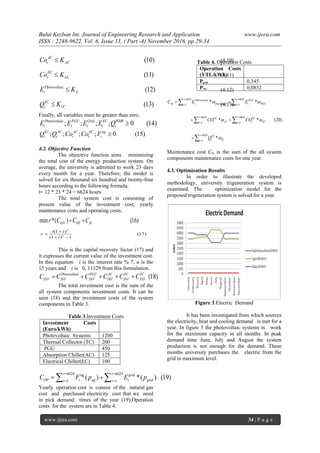
Figure 4.Heat Demand
In figure 4. heat demand that meet from
the waste heat recovery is decrease in
June,July,August.Thermal collector produce the
heat its maximum capacity level.
Figure 5.Cooling Demand
In figure 5 cooling demand that meet
from the absorption chiller is increase in
June,July,August.Electrical chiller is used less
compared to absorption chiller.
V. CONCLUSION
The generated tri-generation model can be
applied in different public institutions and
production systems. In this paper has been applied
for university campus. It is aimed to include
renewable energy sources in the system while the
components of the system are determined. For this
reason, photovoltaic systems and thermal collectors
have been included in the system in order to utilize
solar energy for electricity, heat energy production
and indirectly for cooling energy production. While
creating a mathematical model of the system, the
real life problems as well as the studies in the
literature have been guiding.
By resolving the model for 6624 hours, it
has been investigated from which source the
electricity, heat and cooling demands are met for
each time zone.
It is aimed that this work will be a guide for
the university campus or public institutions planning
to use the tri-generation system. Renewable energy
sources are also thought to be beneficial in terms of
reducing operating costs.
In future studies the different capacity
values of the elements constituting the tri-generation
system and the cost comparison for different
components can be realized. Thus, the performance
of different designs and the effects of the financial
can be investigated.
REFERENCES
[1] Chicco, G., & Mancarella, P.,From
cogeneration to trigeneration: Profitable
alternatives in a competitive market. IEEE
Transactions on Energy Conversion, 21(1),
2006, 265–272.
[2] Arcuri P. , Beraldi P. , Florio G. ,
Fragiacomo P. ,Optimal design of a small
size trigeneration plant in civil users: A
MINLP (Mixed Integer Non Linear
Programming Model), Energy Volume 80,
2015,628–641.
[3] Gopisetty, S. , Treffinger, P.,Combined
cooling, heat and power (Trigeneration) at
Offenburg University of Applied Sciences,
Environmental Biotechnology, Vol. 9, No.
1, 2013,25-37.
[4] Chicco G. Mancarella P. , Trigeneration
primary energy saving evaluation for
energy planning and policy development,
Energy Policy.Volume 35, Issue 12, 2007,
6132–6144.
[5] Compernolle, T., N. Witters, S. Van Passel,
T. Thewys. Analyzing a self-managed CHP
system for greenhouse cultivation as a
protable way to reduce CO2-emissions.
Energy 36, 2011, 1940-1947.
[6] Abbaspour, M. Saraei, A.R. An Innovative
Design and Cost Optimization of a
Trigeneration (Combined Cooling, Heating
and Power) System, Int. J. Environ. Res.,
8(4), 2014, 971-978.
[7] Arcuri P, Florio G, Fragiacomo P. A mixed
integer programming model for optimal
design of trigeneration in a hospital
complex. Energy,32 (8),2007, 1430–47.
[8] Tuula Savola C-JF. MINLP optimisation
model for increased power production in
small-scale CHP plants, Appl Therm Eng,
27(1), 2007, 89–99.
[9] Lozano MA, Ramos JC, Carvalho M, Serra
LM. Structure optimization of energy
supply systems in tertiary sector buildings,
Energy and Buildings, 41, 2009,
1063–1075.
[10] Rubio-Maya C, Uche-Marcuello J,
Martínez-Gracia A, Bayod-Rújula AA.
Design optimization of a polygeneration
plant fuelled by natural gas and renewable](https://image.slidesharecdn.com/f0611042934-161213064414/85/An-Optimization-Model-for-A-Proposed-Trigeneration-System-5-320.jpg)
![Bulut Kezban Int. Journal of Engineering Research and Application www.ijera.com
ISSN : 2248-9622, Vol. 6, Issue 11, ( Part -4) November 2016, pp.29-34
www.ijera.com 34 | P a g e
energy sources, Applied Energy, 88(2),
2011, 449–57.
[11] Buoro D, Casisi M, Pinamonti P, Reini M.
Optimization of distributed trigeneration
systems integrated with heating and
cooling micro-grids, Distributed
Generation & Alternative Energy Journal,
26, 2011, 7–34.
[12] Carvalho M, Lozano M, Serra L.
Multicriteria synthesis of trigeneration
systems considering economic and
environmental aspects, Applied Energy,91,
2012, 245–54.
[13] Zhou Z, Liu P, Li Z, Pistikopoulos EN,
Georgiadis MC. Impacts of equipment off-
design characteristics on the optimal design
and operation of combined cooling, heating
and power systems, Computer Aided
Chemical Engineering, 31, 2012,990–994.
[14] Zhou Z, Liu P, Li Z, Pistikopoulos EN,
Georgiadis MC. Impacts of equipment off-
design characteristics on the optimal design
and operation of combined cooling, heating
and power systems, Computers &Chemical
Engineering, 48, 2013, 40–47.
[15] Freschi F, Giaccone L, Lazzeroni P,
Repetto M. Economic and environmental
analysis of a trigeneration system for food-
industry: a case study, Applied Energy,107,
2013, 157–172.
[16] Hu M, Cho HA probability constrained
multiobjective optimization model for
CCHP system operation decision support,
Applied Energy, 116, 2014, 230–242.
[17] Buoro D, Casisi M, Pinamonti P, Reini M.
Optimization of distributed trigeneration
systems integrated with heating and
cooling micro-grids, Distributed
Generation & Alternative Energy Journal,
26, 2011,7–34.
[18] C Brandoni, M Renzi, Optimal sizing of
hybrid solar micro-CHP systems for the
household sector, Applied Thermal
Engineering, 75, 2015, Pages 896-907.
[19] Malekshah S., Hovanessian A. and
Gharehpetian G. B., "Combined heat and
power sizing in residential building using
mixed integer nonlinear programming
optimization method," 2016 24th Iranian
Conference on Electrical Engineering
(ICEE),2016, 1208-1213.
[20] Omu A. Hsieh S. , Orehounig K., Mixed
integer linear programming for the design
of solar thermal energy systems with short-
term storage, Applied Energy, 180, 2016,
313–326.](https://image.slidesharecdn.com/f0611042934-161213064414/85/An-Optimization-Model-for-A-Proposed-Trigeneration-System-6-320.jpg)

This document proposes an optimization model for a trigeneration system at a university campus. The trigeneration system would provide electricity, heating, and cooling and use both renewable and non-renewable energy sources. The proposed system includes a power generation unit, waste heat recovery system, absorption chiller, electrical chiller, photovoltaic systems, and thermal collector. The optimization model is formulated as a linear program to minimize total system costs over a one-year period under constraints of meeting energy demands and not exceeding the capacities of system components. The objective is to determine the optimal operation of the trigeneration system components to satisfy the university's electricity, heating, and cooling loads at lowest cost.


