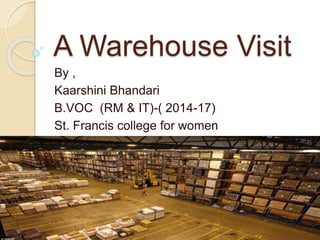
A Warehouse Visit
By ,
Kaarshini Bhandari
B.VOC (RM & IT)-( 2014-17)
St. Francis college for women
Acknowledgement
 I would like to thank Mr. Anthony Mahendra Sir ,
Suresh Padhi Sir to accompany me to the
warehouse & give me an insight about what
actually a warehouse is & how it is eminent part of
retail industry . I would like to thank Arul Sir , who
guided us throughout warehouse & patiently
answered all my questions and even shared his no.
with us to clear all out doubts . Lastly I would like to
thank Dr. Subi Varghise ma’am to give us this
opportunity .
Contents
 Chapter 1 : Introduction
 Warehouse
 Warehousing
 Need for warehousing
 Types of warehouse
 Characteristics of ideal warehouse
 Functions of warehouse
 Advantages of warehouse
 WMS
Contents
 Chapter 2 : Reliance Retail Limited
 Vision
 Mission
 Food safety policy
 Quality policy
 A visit to CPC ( reliance )
Contents
 Chapter 3:Reliance Warehouse
 Introduction to kondlakoya branch
 operations performed
 Security check
 Receiving dock
 Weight check
 Visual check
 Bar coding & scanning
 Stored
 Allocation
 Scanning
 Dispatch
Contents
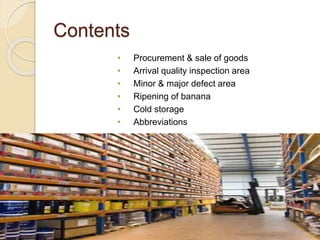
• Procurement & sale of goods
• Arrival quality inspection area
• Minor & major defect area
• Ripening of banana
• Cold storage
• Abbreviations
Contents
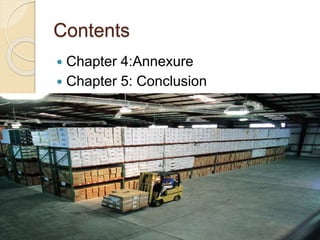
 Chapter 4:Annexure
 Chapter 5: Conclusion
Introduction
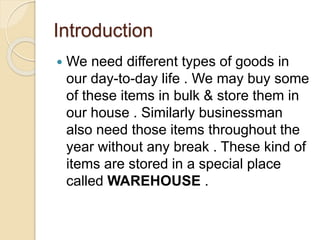
 We need different types of goods in
our day-to-day life . We may buy some
of these items in bulk & store them in
our house . Similarly businessman
also need those items throughout the
year without any break . These kind of
items are stored in a special place
called WAREHOUSE .
Warehousing
 Warehouse involves storage of goods
/ items required ( both finished & raw
materials) . Storage involves proper
arrangement for preserving goods
from time of their production or
purchase till the actual use . When this
storage is done on a large scale & in a
specified manner it is called
WAREHOUSING.
Need for Warehousing
 Seasonal production
 Seasonal demand
 Large scale production
 Quick supply
 Continuous production
 Price stabilization
Types of Warehouse
 Private Warehouse
 Public Warehouse
 Government Warehouse
 Bonded Warehouse
 Co-operative Warehouse
Characteristics Of Ideal
Warehouse
 Located at convenient place
 Mechanical & technologically forward
 Adequate space
 Preservation of perishable & non
perishable goods
 Protection from – sunlight rain wind dust
moisture & pests
 Parking space
 Security
 Fire fighting eqipment
Functions of Warehouse
 Storage of goods
 Protection of goods
 Risk bearing
 Financing
 Processing
 Grading & branding
 Transportation
Advantages of Warehousing
 Protection and preservation of goods
 Regular flow of goods
 Continuity in production
 Convenient location
 Easy handling
 Useful for small businessmen
 Creation of employment
 Facilitates sale of goods
 Availability of finance
 Reduces risk of loss
WMS
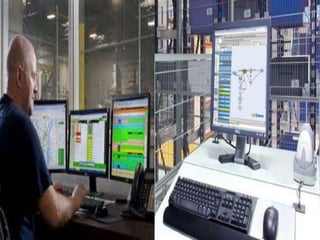
 A warehouse management system is a key
part of a supply chain management &
primarily aims to control the movement &
storage of materials within a warehouse &
process the associated transactions ,
including shipping , receiving , put away &
picking. The systems also direct & optimize
stock put away based on real time
information about the status of bin utilization .
A WMS monitors the progress of products
through the warehouse . It involves the
physical warehouse infrastructure , tracking
systems & communication between station .
Vision
 F.R.E.S.H- Receive fresh – Supply
fresh
 F: Foster farm to fork food supply
chain
 R: Raising continuously quality & food
safety standards
 E: Enforcing best practices at own &
supplier sites & Empowering
 S: Supplier , Service providers & Staff
by
Mission
 We shall aim at ever improving
performance in performance in
receiving & supplying fresh food
through .
◦ Customer centric approach (customer )
◦ Motivated & empowered manpower
(people)
◦ Optimized operations through delivery of
zero defect & sale food first time every
time (operations )
◦ optimum use of resource ( finance )
Food safety policy
 We shall ensure that
 Fresh food is protected during its journey
from farm to fork.
 Bio logical
 Chemical
 Physical hazards
Through ,
 proactive interventions at own & suppliers sites ;
 Investment in training & education of all along the supply
chain
 Alliance with farmers , middle-men, food handlers & internal
customers .
 Total companies with statutory & regulatory requirements .
Quality policy
 We shall ,
Clearly understand & accurately
internalize customer requirements in
order to improve on time delivery , F&V ,
quality , rating , picking & delivery
accuracy;
Motivate & empower people to improve
morale & reduce arrition ;
Demonstrate commitment to improve
productivity , food safety & quality;
Strive continuously to reduce operating
cost & supply chain losses .
A visit to reliance CPC unit
 With a vision to generate inclusive growth &
prosperity for farmers, vendor partners ,
small shopkeepers & consumers . Reliance
retail limited(RRL), a subsidiary to reliance
industry limited(RIL) , was set up to lead
reliance groups foray into organized retail.
Since its inception in 2006 RRL has grown
into an organization that caters to millions
of customers , thousands of farmers &
vendors . Based on its core growth strategy
of backward integration , RRL has value
chain starting from the farmers to the end
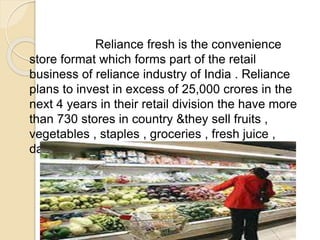
Reliance fresh is the convenience
store format which forms part of the retail
business of reliance industry of India . Reliance
plans to invest in excess of 25,000 crores in the
next 4 years in their retail division the have more
than 730 stores in country &they sell fruits ,
vegetables , staples , groceries , fresh juice ,
dairy , etc .
Floor map of CPC -
Kondlakoya
Introduction to CPC
 Reliance city processing unit is the
official warehouse of RRL. With third
party logistics named swarnalatha
enterprises .
 Located in kondlakoya village , Medchal .
 56000 square feet ( 40,000 sq ft . for
storage of fruits & vegetables & 16sq ft.
for dairy products)
 4 collection centers – Turkapally ,
Moinabad , Shankarapally & Kondlakoya
.
 They even buy merchandise from
wholesale market if need arises.
Operations performed at CPC-
Kondlakoya
Security check
 Once when the stock arrives the
warehouse , firstly the documents are
checked by the watchman at the gate .
If the papers match with the prior
information given to him the truck is
allowed in with conformation note .
Receiving dock
 When the stock passes further from security
it is received by the receiving dock . Here
the goods are received , data entry is done
by the operator . The information about
merchandise is entered .
Weight check
 Once the stock is received the stock is
weighted to find out if any shrinkage or
informality in the merchandise
received . If there are informalities
they are then and there rejected either
they are sent to the next section .
Visual check (grading &
branding)
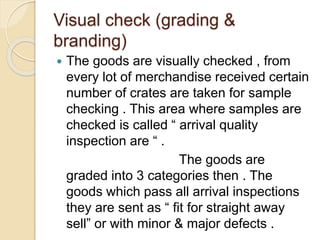
 The goods are visually checked , from
every lot of merchandise received certain
number of crates are taken for sample
checking . This area where samples are
checked is called “ arrival quality
inspection are “ .
The goods are
graded into 3 categories then . The
goods which pass all arrival inspections
they are sent as “ fit for straight away
sell” or with minor & major defects .
Bar coding & Scanning
 Once the goods are selected to be
sold they are bar coded . There is a
new system of bar coding the crates in
which vegetables and fruits and other
items are kept are bar coded . Then
they are scanned and are further sent
for storing .
Stored
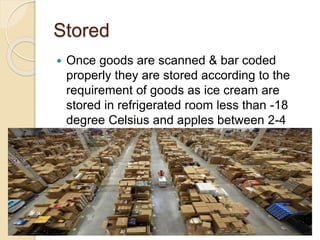
 Once goods are scanned & bar coded
properly they are stored according to the
requirement of goods as ice cream are
stored in refrigerated room less than -18
degree Celsius and apples between 2-4
degree Celsius .
Allocation or Staging
 Before the invoices for dispatch are prepared and
the merchandises are scanned they are staged /
allocated according to the 47 stores they are to be
sent . In kondlakoya branch they have a special
place which are tagged with the names of stores .
This makes it easy to recognize which stores
merchandise is it & we can avoid mistakes .
Scanning
 The goods are once staged then they
are scanned and the required
documents are prepared and then
rechecked .
Dispatch
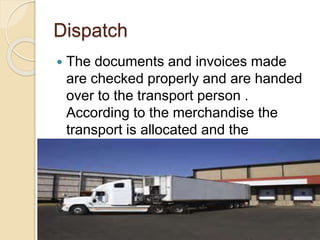
 The documents and invoices made
are checked properly and are handed
over to the transport person .
According to the merchandise the
transport is allocated and the
merchandise is dispatched .
Few sections interesting – in detail
Procurement and sale of
goods
 Procures perishable goods .
 The procurement is done from agents
and dealers .
 The goods are procured from mandi &
national sourcing when required .
 The order should be placed minimum
48 hours ago.
 The sale of goods is done through
retailers & reliance fresh outlets .
Arrival quality inspection area
 Once the goods are procured from
receiving dock they are sent to the
arrival quality check area .
 the procured goods are checked and
graded in three grades
◦ A grade - no defect
◦ B grade - minor defect
◦ C grade - major defect
 A grade goods are the flow through goods
which can be sold directly .
 B grade goods have minor defects and if
15% of them is defected they are rejected
.
 C grade goods are major defected goods
and if 5% of goods are defected they are
rejected .
 ***the information is taken from
“fruit & vegetable specification book of
reliance retail limited 2011-2012 ”
Ripening of Banana
1. The bananas are bought in plastic crates in
perforated plastic covers .
2. The room temperature is set to 18 degrees after
the temperature of bananas is also the same
temperature 5% of ethylne gas and 95% of
hydrogen gas is released in the chamber for 40-
45 minutes .
3. the chamber is then sealed for 24 hours .
4. Next day the chamber is opened for 10 minutes
and then it is sealed for 3 days . How ever in
every 24 hours they are checked once.
5. All 4 days the humidity is maintained at 18
degrees Celsius . 4th the day the bananas are
ripened .
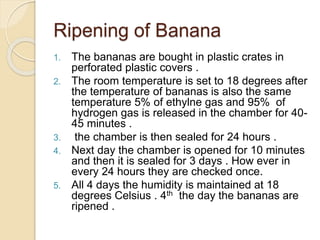
Cold storage
 A home for many perishable goods is
cold storage section . Apples , kiwis
,cheese and ice cream .
 There are different cold storage units
◦ 2 -4 degrees –for imported apples
,cheese , kiwi ,etc
◦ -18 degrees – for ice creams .
Abbreviations
 CPC – City Processing Centre
 NRR – Non Reliance Retail
 RR - Reliance Retail
 CCP – Critical Control Point
 CM – Certified Machine
 PV – Physical Verification
 FCE – Fruit Control Equipment Machine
 VAP – Value Added Process
 DEO – Data Entry Operator
 BOPT – Battery Operated Pallet Truck
 FFSC – Fresh Fruit Supply Chain
Annexure
Stock transfer note
Storage of greens.
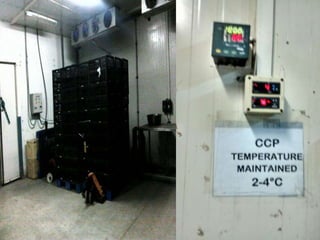
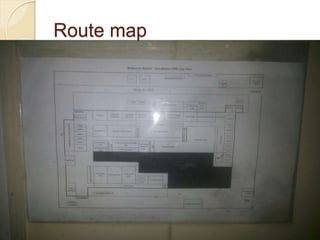
Route map
Merchandise received from
list
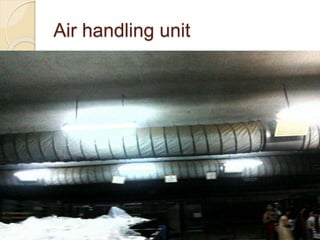
Air handling unit
Conclusion
 The visit to warehouse was a eye-
opener we learned many new things
about warehouse . The term
Warehouse was very basic for me I
thought it as just a place used for
storage , but after the visit I have
understood it is a place where many
processes take place . It is eminent
part of retail industry and surely is an
employment seeker .

A Warehouse Visit

  • 1.
    A Warehouse Visit By, Kaarshini Bhandari B.VOC (RM & IT)-( 2014-17) St. Francis college for women
  • 2.
    Acknowledgement  I wouldlike to thank Mr. Anthony Mahendra Sir , Suresh Padhi Sir to accompany me to the warehouse & give me an insight about what actually a warehouse is & how it is eminent part of retail industry . I would like to thank Arul Sir , who guided us throughout warehouse & patiently answered all my questions and even shared his no. with us to clear all out doubts . Lastly I would like to thank Dr. Subi Varghise ma’am to give us this opportunity .
  • 3.
    Contents  Chapter 1: Introduction  Warehouse  Warehousing  Need for warehousing  Types of warehouse  Characteristics of ideal warehouse  Functions of warehouse  Advantages of warehouse  WMS
  • 4.
    Contents  Chapter 2: Reliance Retail Limited  Vision  Mission  Food safety policy  Quality policy  A visit to CPC ( reliance )
  • 5.
    Contents  Chapter 3:RelianceWarehouse  Introduction to kondlakoya branch  operations performed  Security check  Receiving dock  Weight check  Visual check  Bar coding & scanning  Stored  Allocation  Scanning  Dispatch
  • 6.
    Contents • Procurement &sale of goods • Arrival quality inspection area • Minor & major defect area • Ripening of banana • Cold storage • Abbreviations
  • 7.
  • 8.
    Introduction  We needdifferent types of goods in our day-to-day life . We may buy some of these items in bulk & store them in our house . Similarly businessman also need those items throughout the year without any break . These kind of items are stored in a special place called WAREHOUSE .
  • 9.
    Warehousing  Warehouse involvesstorage of goods / items required ( both finished & raw materials) . Storage involves proper arrangement for preserving goods from time of their production or purchase till the actual use . When this storage is done on a large scale & in a specified manner it is called WAREHOUSING.
  • 10.
    Need for Warehousing Seasonal production  Seasonal demand  Large scale production  Quick supply  Continuous production  Price stabilization
  • 11.
    Types of Warehouse Private Warehouse  Public Warehouse  Government Warehouse  Bonded Warehouse  Co-operative Warehouse
  • 12.
    Characteristics Of Ideal Warehouse Located at convenient place  Mechanical & technologically forward  Adequate space  Preservation of perishable & non perishable goods  Protection from – sunlight rain wind dust moisture & pests  Parking space  Security  Fire fighting eqipment
  • 13.
    Functions of Warehouse Storage of goods  Protection of goods  Risk bearing  Financing  Processing  Grading & branding  Transportation
  • 14.
    Advantages of Warehousing Protection and preservation of goods  Regular flow of goods  Continuity in production  Convenient location  Easy handling  Useful for small businessmen  Creation of employment  Facilitates sale of goods  Availability of finance  Reduces risk of loss
  • 15.
    WMS  A warehousemanagement system is a key part of a supply chain management & primarily aims to control the movement & storage of materials within a warehouse & process the associated transactions , including shipping , receiving , put away & picking. The systems also direct & optimize stock put away based on real time information about the status of bin utilization . A WMS monitors the progress of products through the warehouse . It involves the physical warehouse infrastructure , tracking systems & communication between station .
  • 18.
    Vision  F.R.E.S.H- Receivefresh – Supply fresh  F: Foster farm to fork food supply chain  R: Raising continuously quality & food safety standards  E: Enforcing best practices at own & supplier sites & Empowering  S: Supplier , Service providers & Staff by
  • 19.
    Mission  We shallaim at ever improving performance in performance in receiving & supplying fresh food through . ◦ Customer centric approach (customer ) ◦ Motivated & empowered manpower (people) ◦ Optimized operations through delivery of zero defect & sale food first time every time (operations ) ◦ optimum use of resource ( finance )
  • 20.
    Food safety policy We shall ensure that  Fresh food is protected during its journey from farm to fork.  Bio logical  Chemical  Physical hazards Through ,  proactive interventions at own & suppliers sites ;  Investment in training & education of all along the supply chain  Alliance with farmers , middle-men, food handlers & internal customers .  Total companies with statutory & regulatory requirements .
  • 21.
    Quality policy  Weshall , Clearly understand & accurately internalize customer requirements in order to improve on time delivery , F&V , quality , rating , picking & delivery accuracy; Motivate & empower people to improve morale & reduce arrition ; Demonstrate commitment to improve productivity , food safety & quality; Strive continuously to reduce operating cost & supply chain losses .
  • 22.
    A visit toreliance CPC unit  With a vision to generate inclusive growth & prosperity for farmers, vendor partners , small shopkeepers & consumers . Reliance retail limited(RRL), a subsidiary to reliance industry limited(RIL) , was set up to lead reliance groups foray into organized retail. Since its inception in 2006 RRL has grown into an organization that caters to millions of customers , thousands of farmers & vendors . Based on its core growth strategy of backward integration , RRL has value chain starting from the farmers to the end
  • 23.
    Reliance fresh isthe convenience store format which forms part of the retail business of reliance industry of India . Reliance plans to invest in excess of 25,000 crores in the next 4 years in their retail division the have more than 730 stores in country &they sell fruits , vegetables , staples , groceries , fresh juice , dairy , etc .
  • 24.
    Floor map ofCPC - Kondlakoya
  • 25.
    Introduction to CPC Reliance city processing unit is the official warehouse of RRL. With third party logistics named swarnalatha enterprises .  Located in kondlakoya village , Medchal .  56000 square feet ( 40,000 sq ft . for storage of fruits & vegetables & 16sq ft. for dairy products)  4 collection centers – Turkapally , Moinabad , Shankarapally & Kondlakoya .  They even buy merchandise from wholesale market if need arises.
  • 26.
    Operations performed atCPC- Kondlakoya
  • 27.
    Security check  Oncewhen the stock arrives the warehouse , firstly the documents are checked by the watchman at the gate . If the papers match with the prior information given to him the truck is allowed in with conformation note .
  • 28.
    Receiving dock  Whenthe stock passes further from security it is received by the receiving dock . Here the goods are received , data entry is done by the operator . The information about merchandise is entered .
  • 29.
    Weight check  Oncethe stock is received the stock is weighted to find out if any shrinkage or informality in the merchandise received . If there are informalities they are then and there rejected either they are sent to the next section .
  • 30.
    Visual check (grading& branding)  The goods are visually checked , from every lot of merchandise received certain number of crates are taken for sample checking . This area where samples are checked is called “ arrival quality inspection are “ . The goods are graded into 3 categories then . The goods which pass all arrival inspections they are sent as “ fit for straight away sell” or with minor & major defects .
  • 32.
    Bar coding &Scanning  Once the goods are selected to be sold they are bar coded . There is a new system of bar coding the crates in which vegetables and fruits and other items are kept are bar coded . Then they are scanned and are further sent for storing .
  • 33.
    Stored  Once goodsare scanned & bar coded properly they are stored according to the requirement of goods as ice cream are stored in refrigerated room less than -18 degree Celsius and apples between 2-4 degree Celsius .
  • 35.
    Allocation or Staging Before the invoices for dispatch are prepared and the merchandises are scanned they are staged / allocated according to the 47 stores they are to be sent . In kondlakoya branch they have a special place which are tagged with the names of stores . This makes it easy to recognize which stores merchandise is it & we can avoid mistakes .
  • 36.
    Scanning  The goodsare once staged then they are scanned and the required documents are prepared and then rechecked .
  • 37.
    Dispatch  The documentsand invoices made are checked properly and are handed over to the transport person . According to the merchandise the transport is allocated and the merchandise is dispatched .
  • 38.
  • 39.
    Procurement and saleof goods  Procures perishable goods .  The procurement is done from agents and dealers .  The goods are procured from mandi & national sourcing when required .  The order should be placed minimum 48 hours ago.  The sale of goods is done through retailers & reliance fresh outlets .
  • 40.
    Arrival quality inspectionarea  Once the goods are procured from receiving dock they are sent to the arrival quality check area .  the procured goods are checked and graded in three grades ◦ A grade - no defect ◦ B grade - minor defect ◦ C grade - major defect
  • 41.
     A gradegoods are the flow through goods which can be sold directly .  B grade goods have minor defects and if 15% of them is defected they are rejected .  C grade goods are major defected goods and if 5% of goods are defected they are rejected .  ***the information is taken from “fruit & vegetable specification book of reliance retail limited 2011-2012 ”
  • 43.
    Ripening of Banana 1.The bananas are bought in plastic crates in perforated plastic covers . 2. The room temperature is set to 18 degrees after the temperature of bananas is also the same temperature 5% of ethylne gas and 95% of hydrogen gas is released in the chamber for 40- 45 minutes . 3. the chamber is then sealed for 24 hours . 4. Next day the chamber is opened for 10 minutes and then it is sealed for 3 days . How ever in every 24 hours they are checked once. 5. All 4 days the humidity is maintained at 18 degrees Celsius . 4th the day the bananas are ripened .
  • 44.
    Cold storage  Ahome for many perishable goods is cold storage section . Apples , kiwis ,cheese and ice cream .  There are different cold storage units ◦ 2 -4 degrees –for imported apples ,cheese , kiwi ,etc ◦ -18 degrees – for ice creams .
  • 46.
    Abbreviations  CPC –City Processing Centre  NRR – Non Reliance Retail  RR - Reliance Retail  CCP – Critical Control Point  CM – Certified Machine  PV – Physical Verification  FCE – Fruit Control Equipment Machine  VAP – Value Added Process  DEO – Data Entry Operator  BOPT – Battery Operated Pallet Truck  FFSC – Fresh Fruit Supply Chain
  • 47.
  • 48.
  • 49.
  • 50.
  • 51.
  • 52.
  • 54.
    Conclusion  The visitto warehouse was a eye- opener we learned many new things about warehouse . The term Warehouse was very basic for me I thought it as just a place used for storage , but after the visit I have understood it is a place where many processes take place . It is eminent part of retail industry and surely is an employment seeker .