12/13/2013
COLLECTION AGENCY DATA
WAREHOUSE
DATA WAREHOUSING – MGS 657
Aparna Dhanashri Jayaprakash – 50094768
Himanshu Yadav – 50093151
Rachita Bheemaiah Baliyada – 50093480
Vikram Singh – 50085343
COLLECTION AGENCY DATA WAREHOUSE
1December 13, 2013
ACKNOWLEDGEMENT
The success and final outcome of this project required a lot of guidance and
encouragement from many people and we are extremely fortunate to have got this all along the
completion of our project. Whatever the outcome is only due to such guidance and
encouragement and we would not miss such an opportunity to thank them.
We owe our profound gratitude to our Professor. Mohan Shetye for the support,
encouragement and motivation he gave throughout. He turned this entire process into a fun-filled
activity which spun into a great learning experience for most of us.
COLLECTION AGENCY DATA WAREHOUSE
2December 13, 2013
CONTENTS
ACKNOWLEDGEMENT..........................................................................................................................1
INTRODUCTION.......................................................................................................................................2
STAKEHOLDER’S WISHLIST ...............................................................................................................4
BACKGROUND .........................................................................................................................................4
GOALS & SUCCESS FACTORS .............................................................................................................4
KEY CHALLENGES & BENCHMARKS...............................................................................................5
INTERNAL & EXTERNAL DRIVERS...................................................................................................5
CORE PROCESSES IN THE SYSTEM ..................................................................................................6
KEY PERFORMANCE INDICATORS...................................................................................................7
INTRODUCTION
COLLECTION AGENCY DATA WAREHOUSE
3December 13, 2013
A credit collection agency collects delinquent accounts from the clients on behalf of
businesses such as banking, hospitals and insurance. In general, debt collection agencies buys a
list of defaulter accounts from the creditors and the agency collects the full amount of the debt,
but at a reduced rate. In this way, they make a profit from the difference in the collection amount
and the amount it paid to buy the debt account. They typically charge 1 to 5 percent of the debt
amount.
The debt collection is a tedious process. These agencies need to follow Fair Debt
Collection Practices Act while collecting money from the customers. They usually write a series
of collection letters to debtors. They also arrange a series of telephone calls and personal visits
with the defaulters. This projects intends to create a data model for these agencies which will
help them identify the right client base, to select the profitable account type and gauge the
employee performance. The model will also help measure how efficiently the organization is
utilizing its resources for dealing with clients. It would essentially help the collection agencies in
decision making and setting up of strategies for successful operation of their business.
COLLECTION AGENCY DATA WAREHOUSE
4December 13, 2013
STAKEHOLDER’S WISHLIST
This part gives us an insight into what the stakeholders would want for the efficient
functioning of their organization. These are displayed as below:
 To improve the revenue generation by reducing costs
 To increase the client base by diversifying the domains.
 To gauge the employee performance for efficient working of the organization.
BACKGROUND
This was a concept which originated while having a discussion with a friend who works
for a similar agency based in San Diego, CA named Encore Capital Group Inc. The company
purchases portfolios of defaulted consumer receivables from major banks, credit unions, and
utility providers, and partners with individuals as they repay their obligations and work toward
financial recovery. Encore's success and future growth are driven by its sophisticated and
widespread use of analytics, its broad investments in data and behavioral science. This was the
driving force which led us to develop a model which would assist similar organizations in
running their business efficiently and profitably.
GOALS &SUCCESS FACTORS
This section would describe how exactly the implementation of this project would help
the businesses. The project tries to provide a detailed overview to the management about
the critical success factors that needs to be considered in order to generate profitable
revenue. The project tries to aid the management of the collection agencies in analyzing
the total revenue generated based on the different categories of accounts and clients from
COLLECTION AGENCY DATA WAREHOUSE
5December 13, 2013
whom they acquire the accounts. This implementation also assists them in gauging the
employee performance which would act as an additional measure in better utilizing the
resources. It also helps them to an extent to decide on the right clients and to help them in
the bidding process.
KEY CHALLENGES & BENCHMARKS
The key issues the collection agencies are facing are the following:
 Difficulty in identifying the right client to bid for.
 Difficulty in choosing the right category of accounts.
 Difficulty in channelizing the right resources for the right kind of jobs.
The benchmark or target sets the baseline to measure the performance of the organization. In
case of our project the benchmarks will as shown below:
 The target set for the employees in terms of revenue collection. This would help the
supervisors in the appraisal process.
 Depending on the past history with the clients in terms of the accounts purchased, the
organization would be able to decide on the bidding rate and the type of account to
work with.
INTERNAL & EXTERNAL DRIVERS
COLLECTION AGENCY DATA WAREHOUSE
6December 13, 2013
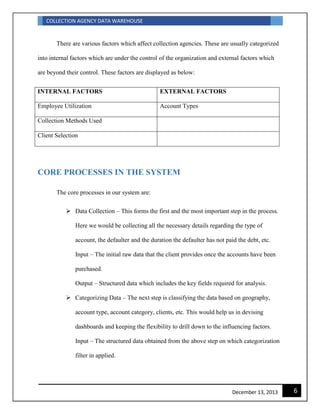
There are various factors which affect collection agencies. These are usually categorized
into internal factors which are under the control of the organization and external factors which
are beyond their control. These factors are displayed as below:
INTERNAL FACTORS EXTERNAL FACTORS
Employee Utilization Account Types
Collection Methods Used
Client Selection
CORE PROCESSES IN THE SYSTEM
The core processes in our system are:
 Data Collection – This forms the first and the most important step in the process.
Here we would be collecting all the necessary details regarding the type of
account, the defaulter and the duration the defaulter has not paid the debt, etc.
Input – The initial raw data that the client provides once the accounts have been
purchased.
Output – Structured data which includes the key fields required for analysis.
 Categorizing Data – The next step is classifying the data based on geography,
account type, account category, clients, etc. This would help us in devising
dashboards and keeping the flexibility to drill down to the influencing factors.
Input – The structured data obtained from the above step on which categorization
filter in applied.
COLLECTION AGENCY DATA WAREHOUSE
7December 13, 2013
Output – The data set which contains data segregated based on different
dimensions as defined previously.
 Based on Collection Activities – Dividing the collection methods into categories
such as sending initial letters, mailing, calling the defaulters and making personal
visits. This would determine one of the efficient ways to generate more revenue
for the organization.
Input – The Collection method dimension obtained from previous step.
Output – The categorization of the collection methods. Depending on the
performance the right method can be employed to the right kind of account.
KEY PERFORMANCE INDICATORS
Key Performance Indicators are quantifiable measurements that reflect the critical
success factors of an organization.Key Performance Indicators are selected, such that they reflect
the organization's goals, they must be key to its success, they must be quantifiable. Key
performance Indicators usually are long-term considerations. In case of our project the KPI’s
defined are as below:
 Cost Incurred per Account Category per Client–This performance indicator
shows the computations of the total cost incurred based on the account category
and client. This helps in the bidding process while trying to select the clients. This
indicator helps in analyzing the costs involved based on the account category
based on which the organization can decide to pick the preferred accounts which
yield them more profit with less cost involved.
COLLECTION AGENCY DATA WAREHOUSE
8December 13, 2013
 Employee Target vs. Amount collected – This indicator is mostly used as an
additional parameter to gauge the employee performance. The indicator shows
that every employee is given with a target that he is measured against. If the
employee surpasses that target in terms of debt collection more so using efficient
collection methods would act in favor of the employee.
 Revenue Generated Categorized based on Geographical Locations – This is
one of the most important indicators which tries to analyze the revenue generated
based on three factors – Clients, Account Type and Employees. Based on the data
which is presented the organization can decide which geographical locations they
can try increasing their foothold in those regions by attracting more clients. This
data can be used to analyze based on account type to see what account types are
more profitable in what regions or what account types needed to be avoided in
which regions of the country. Employee factor comes in when the performance
data shows that employees are better at interacting with defaulters from certain
region or not so good with people from other regions.
DATA WAREHOUSE DESIGN
CONCEPTUAL SCHEMA
COLLECTION AGENCY DATA WAREHOUSE
9December 13, 2013
A conceptual schema is a design model used to plan out or visually represent the
structure of information contained in a database or other computer system entity. It acts to
delineate the specific entities in the system, along with their attributes, and the relationships
between various entities. The purpose of a conceptual schema is to provide a higher-level order
to a computing system. The four steps involved are:
 Select the Business Process –
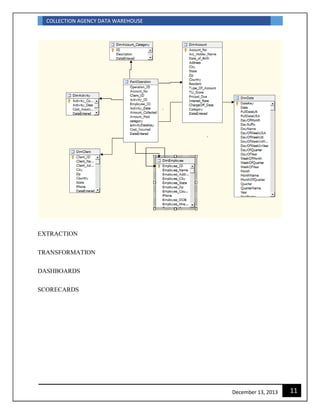
 Declare Grain – The grain of a fact table represents the most atomic level by which the
facts may be defined. The grain of our Operations Fact table can provide detail about the
amount collected and cost incurred based on the type of account, further segregated by
the account category, client, the collection method used, and the employee who worked
on this operation and based on geographical location. Each record in this fact table is
therefore uniquely defined by a date, client, account type, account category, collection
method and employee.
 Identify Dimensions – The dimension is a data set composed of individual, non-
overlapping data elements. The primary functions of dimensions are threefold: to provide
filtering, grouping and labeling. These functions are often described as "slice and dice".
Slicing refers to filtering data. Dicing refers to grouping data. In this project we have
defined six dimensions which enable us to categorize and filter the data. The client
dimension help in filtering at the client level. Based on account and account_category
dimensions the data can be grouped to analyze the revenue and cost incurred for different
categories. The Activity dimension helps in filtering the data based on the collection
methods employed to understand the methods which cost the organization more expenses
COLLECTION AGENCY DATA WAREHOUSE
10December 13, 2013
or the methods which generated more revenue. Finally the date dimension allows us to
analyze the revenue generated or cost incurred based on a month, quarter, year etc.
 Identify the Facts –A fact table is the central table in a star schema of a data warehouse.
A fact table stores quantitative information for analysis and is often denormalized.A fact
table works with dimension tables.The Fact here are the revenue generated and the cost
incurred. Based on the dimensions, the revenue and the cost incurred can be analyzed
based on the account type, account category, clients, the collection method employed, the
employees who worked on those operations and the period during which the operations
were done. Based on this the profits made based on different dimensions can also be
computed.
COLLECTION AGENCY DATA WAREHOUSE
11December 13, 2013
EXTRACTION
TRANSFORMATION
DASHBOARDS
SCORECARDS
COLLECTION AGENCY DATA WAREHOUSE
12December 13, 2013

Data warehouse Project Report

  • 1.
    12/13/2013 COLLECTION AGENCY DATA WAREHOUSE DATAWAREHOUSING – MGS 657 Aparna Dhanashri Jayaprakash – 50094768 Himanshu Yadav – 50093151 Rachita Bheemaiah Baliyada – 50093480 Vikram Singh – 50085343
  • 2.
    COLLECTION AGENCY DATAWAREHOUSE 1December 13, 2013 ACKNOWLEDGEMENT The success and final outcome of this project required a lot of guidance and encouragement from many people and we are extremely fortunate to have got this all along the completion of our project. Whatever the outcome is only due to such guidance and encouragement and we would not miss such an opportunity to thank them. We owe our profound gratitude to our Professor. Mohan Shetye for the support, encouragement and motivation he gave throughout. He turned this entire process into a fun-filled activity which spun into a great learning experience for most of us.
  • 3.
    COLLECTION AGENCY DATAWAREHOUSE 2December 13, 2013 CONTENTS ACKNOWLEDGEMENT..........................................................................................................................1 INTRODUCTION.......................................................................................................................................2 STAKEHOLDER’S WISHLIST ...............................................................................................................4 BACKGROUND .........................................................................................................................................4 GOALS & SUCCESS FACTORS .............................................................................................................4 KEY CHALLENGES & BENCHMARKS...............................................................................................5 INTERNAL & EXTERNAL DRIVERS...................................................................................................5 CORE PROCESSES IN THE SYSTEM ..................................................................................................6 KEY PERFORMANCE INDICATORS...................................................................................................7 INTRODUCTION
  • 4.
    COLLECTION AGENCY DATAWAREHOUSE 3December 13, 2013 A credit collection agency collects delinquent accounts from the clients on behalf of businesses such as banking, hospitals and insurance. In general, debt collection agencies buys a list of defaulter accounts from the creditors and the agency collects the full amount of the debt, but at a reduced rate. In this way, they make a profit from the difference in the collection amount and the amount it paid to buy the debt account. They typically charge 1 to 5 percent of the debt amount. The debt collection is a tedious process. These agencies need to follow Fair Debt Collection Practices Act while collecting money from the customers. They usually write a series of collection letters to debtors. They also arrange a series of telephone calls and personal visits with the defaulters. This projects intends to create a data model for these agencies which will help them identify the right client base, to select the profitable account type and gauge the employee performance. The model will also help measure how efficiently the organization is utilizing its resources for dealing with clients. It would essentially help the collection agencies in decision making and setting up of strategies for successful operation of their business.
  • 5.
    COLLECTION AGENCY DATAWAREHOUSE 4December 13, 2013 STAKEHOLDER’S WISHLIST This part gives us an insight into what the stakeholders would want for the efficient functioning of their organization. These are displayed as below:  To improve the revenue generation by reducing costs  To increase the client base by diversifying the domains.  To gauge the employee performance for efficient working of the organization. BACKGROUND This was a concept which originated while having a discussion with a friend who works for a similar agency based in San Diego, CA named Encore Capital Group Inc. The company purchases portfolios of defaulted consumer receivables from major banks, credit unions, and utility providers, and partners with individuals as they repay their obligations and work toward financial recovery. Encore's success and future growth are driven by its sophisticated and widespread use of analytics, its broad investments in data and behavioral science. This was the driving force which led us to develop a model which would assist similar organizations in running their business efficiently and profitably. GOALS &SUCCESS FACTORS This section would describe how exactly the implementation of this project would help the businesses. The project tries to provide a detailed overview to the management about the critical success factors that needs to be considered in order to generate profitable revenue. The project tries to aid the management of the collection agencies in analyzing the total revenue generated based on the different categories of accounts and clients from
  • 6.
    COLLECTION AGENCY DATAWAREHOUSE 5December 13, 2013 whom they acquire the accounts. This implementation also assists them in gauging the employee performance which would act as an additional measure in better utilizing the resources. It also helps them to an extent to decide on the right clients and to help them in the bidding process. KEY CHALLENGES & BENCHMARKS The key issues the collection agencies are facing are the following:  Difficulty in identifying the right client to bid for.  Difficulty in choosing the right category of accounts.  Difficulty in channelizing the right resources for the right kind of jobs. The benchmark or target sets the baseline to measure the performance of the organization. In case of our project the benchmarks will as shown below:  The target set for the employees in terms of revenue collection. This would help the supervisors in the appraisal process.  Depending on the past history with the clients in terms of the accounts purchased, the organization would be able to decide on the bidding rate and the type of account to work with. INTERNAL & EXTERNAL DRIVERS
  • 7.
    COLLECTION AGENCY DATAWAREHOUSE 6December 13, 2013 There are various factors which affect collection agencies. These are usually categorized into internal factors which are under the control of the organization and external factors which are beyond their control. These factors are displayed as below: INTERNAL FACTORS EXTERNAL FACTORS Employee Utilization Account Types Collection Methods Used Client Selection CORE PROCESSES IN THE SYSTEM The core processes in our system are:  Data Collection – This forms the first and the most important step in the process. Here we would be collecting all the necessary details regarding the type of account, the defaulter and the duration the defaulter has not paid the debt, etc. Input – The initial raw data that the client provides once the accounts have been purchased. Output – Structured data which includes the key fields required for analysis.  Categorizing Data – The next step is classifying the data based on geography, account type, account category, clients, etc. This would help us in devising dashboards and keeping the flexibility to drill down to the influencing factors. Input – The structured data obtained from the above step on which categorization filter in applied.
  • 8.
    COLLECTION AGENCY DATAWAREHOUSE 7December 13, 2013 Output – The data set which contains data segregated based on different dimensions as defined previously.  Based on Collection Activities – Dividing the collection methods into categories such as sending initial letters, mailing, calling the defaulters and making personal visits. This would determine one of the efficient ways to generate more revenue for the organization. Input – The Collection method dimension obtained from previous step. Output – The categorization of the collection methods. Depending on the performance the right method can be employed to the right kind of account. KEY PERFORMANCE INDICATORS Key Performance Indicators are quantifiable measurements that reflect the critical success factors of an organization.Key Performance Indicators are selected, such that they reflect the organization's goals, they must be key to its success, they must be quantifiable. Key performance Indicators usually are long-term considerations. In case of our project the KPI’s defined are as below:  Cost Incurred per Account Category per Client–This performance indicator shows the computations of the total cost incurred based on the account category and client. This helps in the bidding process while trying to select the clients. This indicator helps in analyzing the costs involved based on the account category based on which the organization can decide to pick the preferred accounts which yield them more profit with less cost involved.
  • 9.
    COLLECTION AGENCY DATAWAREHOUSE 8December 13, 2013  Employee Target vs. Amount collected – This indicator is mostly used as an additional parameter to gauge the employee performance. The indicator shows that every employee is given with a target that he is measured against. If the employee surpasses that target in terms of debt collection more so using efficient collection methods would act in favor of the employee.  Revenue Generated Categorized based on Geographical Locations – This is one of the most important indicators which tries to analyze the revenue generated based on three factors – Clients, Account Type and Employees. Based on the data which is presented the organization can decide which geographical locations they can try increasing their foothold in those regions by attracting more clients. This data can be used to analyze based on account type to see what account types are more profitable in what regions or what account types needed to be avoided in which regions of the country. Employee factor comes in when the performance data shows that employees are better at interacting with defaulters from certain region or not so good with people from other regions. DATA WAREHOUSE DESIGN CONCEPTUAL SCHEMA
  • 10.
    COLLECTION AGENCY DATAWAREHOUSE 9December 13, 2013 A conceptual schema is a design model used to plan out or visually represent the structure of information contained in a database or other computer system entity. It acts to delineate the specific entities in the system, along with their attributes, and the relationships between various entities. The purpose of a conceptual schema is to provide a higher-level order to a computing system. The four steps involved are:  Select the Business Process –  Declare Grain – The grain of a fact table represents the most atomic level by which the facts may be defined. The grain of our Operations Fact table can provide detail about the amount collected and cost incurred based on the type of account, further segregated by the account category, client, the collection method used, and the employee who worked on this operation and based on geographical location. Each record in this fact table is therefore uniquely defined by a date, client, account type, account category, collection method and employee.  Identify Dimensions – The dimension is a data set composed of individual, non- overlapping data elements. The primary functions of dimensions are threefold: to provide filtering, grouping and labeling. These functions are often described as "slice and dice". Slicing refers to filtering data. Dicing refers to grouping data. In this project we have defined six dimensions which enable us to categorize and filter the data. The client dimension help in filtering at the client level. Based on account and account_category dimensions the data can be grouped to analyze the revenue and cost incurred for different categories. The Activity dimension helps in filtering the data based on the collection methods employed to understand the methods which cost the organization more expenses
  • 11.
    COLLECTION AGENCY DATAWAREHOUSE 10December 13, 2013 or the methods which generated more revenue. Finally the date dimension allows us to analyze the revenue generated or cost incurred based on a month, quarter, year etc.  Identify the Facts –A fact table is the central table in a star schema of a data warehouse. A fact table stores quantitative information for analysis and is often denormalized.A fact table works with dimension tables.The Fact here are the revenue generated and the cost incurred. Based on the dimensions, the revenue and the cost incurred can be analyzed based on the account type, account category, clients, the collection method employed, the employees who worked on those operations and the period during which the operations were done. Based on this the profits made based on different dimensions can also be computed.
  • 12.
    COLLECTION AGENCY DATAWAREHOUSE 11December 13, 2013 EXTRACTION TRANSFORMATION DASHBOARDS SCORECARDS
  • 13.
    COLLECTION AGENCY DATAWAREHOUSE 12December 13, 2013