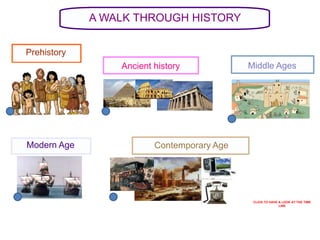
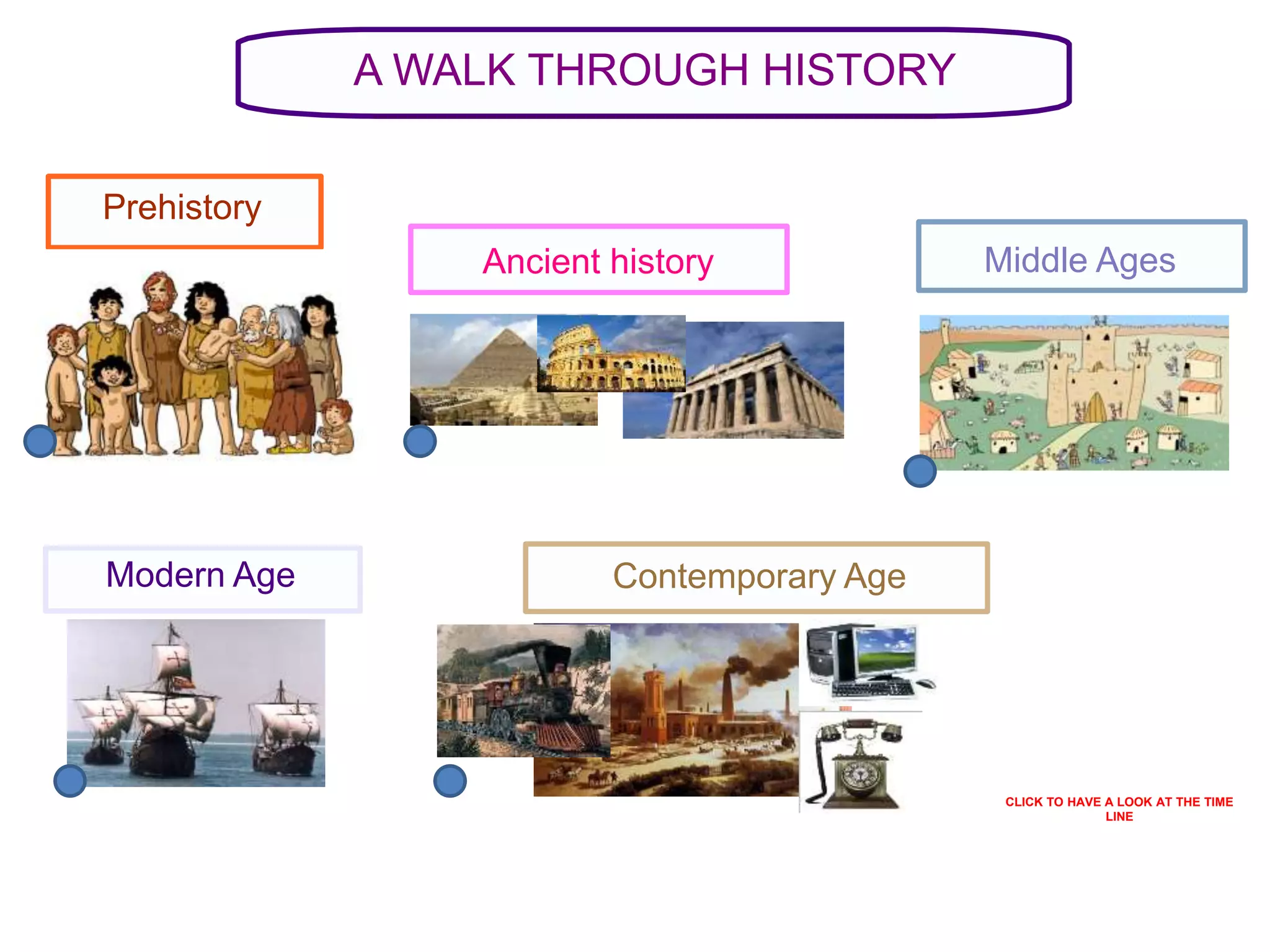
Ancient history
A WALK THROUGH HISTORY
Prehistory
Middle Ages
Modern Age Contemporary Age
CLICK TO HAVE A LOOK AT THE TIME
LINE
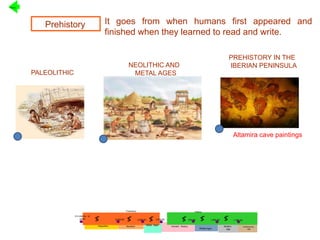
Prehistory It goes from when humans first appeared and
finished when they learned to read and write.
PALEOLITHIC
NEOLITHIC AND
METAL AGES
Home
PREHISTORY IN THE
IBERIAN PENINSULA
Altamira cave paintings
2.5 millions of
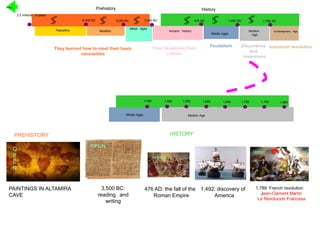
years 8,000 BC 5,000 BC 3,500 BC 476 AD 1,492 AD 1,789 AD
Paleolithic
Prehistory
Neolithic
History
Metal Ages
Ancient History
Middle Ages
Modern
Age
Contemporary
Age
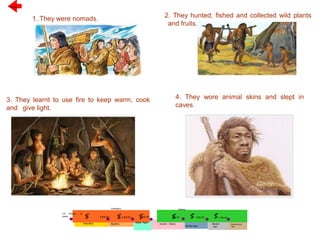
1. They were nomads. 2. They hunted, fished and collected wild plants
and fruits.
3. They learnt to use fire to keep warm, cook
and give light.
4. They wore animal skins and slept in
caves.
Previous
2.5 millions of
years 8,000 BC 5,000 BC 3,500 BC 476 AD 1,492 AD 1,789 AD
Paleolithic
Prehistory
Neolithic
History
Metal Ages
Ancient History
Middle Ages
Modern
Age
Contemporary
Age
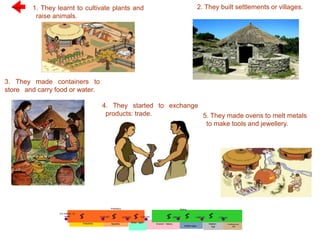
1. They learnt to cultivate plants and
raise animals.
2. They built settlements or villages.
3. They made containers to
store and carry food or water.
4. They started to exchange
products: trade.
Previous
5. They made ovens to melt metals
to make tools and jewellery.
2.5 millions of
years 8,000 BC 5,000 BC 3,500 BC 476 AD 1,492 AD 1,789 AD
Paleolithic
Prehistory
Neolithic
History
Metal Ages
Ancient History
Middle Ages
Modern
Age
Contemporary
Age
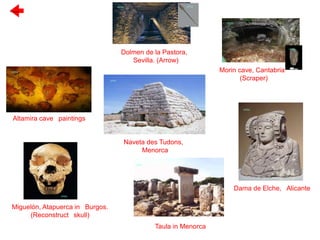
Taula in Menorca
OPEN
Dolmen de la Pastora,
Sevilla. (Arrow)
OPEN OPEN
Altamira cave paintings
OPEN
OPEN
OPEN
Morin cave, Cantabria
(Scraper)
OPEN
Dama de Elche, Alicante
Miguelón, Atapuerca in Burgos.
(Reconstruct skull)
OPEN
Naveta des Tudons,
Menorca
OPEN
Previous
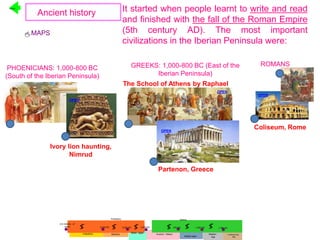
The School of Athens by Raphael
OPEN
OPEN
Partenon, Greece
GREEKS: 1,000-800 BC (East of the
Iberian Peninsula)
MAPS
PHOENICIANS: 1,000-800 BC
(South of the Iberian Peninsula)
OPEN
Ivory lion haunting,
Nimrud
It started when people learnt to write and read
and finished with the fall of the Roman Empire
(5th century AD). The most important
civilizations in the Iberian Peninsula were:
Home
Ancient history
ROMANS
Coliseum, Rome
OPEN
2.5 millions of
years 8,000 BC 5,000 BC 3,500 BC 476 AD 1,492 AD 1,789 AD
Paleolithic
Prehistory
Neolithic
History
Metal Ages
Ancient History
Middle Ages
Modern
Age
Contemporary
Age
OPEN
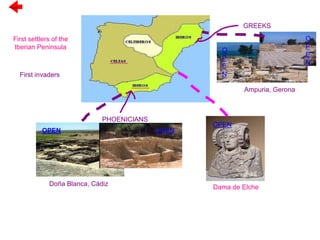
Dama de Elche
Ampuria, Gerona
O
P
E
N
O
P
E
N
Previous
First settlers of the
Iberian Peninsula
First invaders
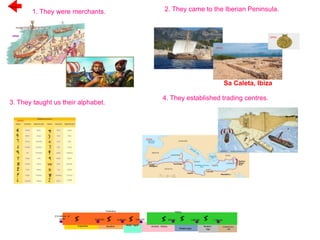
GREEKS
PHOENICIANS
Doña Blanca, Cádiz
OPEN OPEN
OPEN
1. They were merchants. 2. They came to the Iberian Peninsula.
3. They taught us their alphabet.
4. They established trading centres.
Previous
OPEN
OPEN
Sa Caleta, Ibiza
OPEN
OPEN
2.5 millions of
years 8,000 BC 5,000 BC 3,500 BC 476 AD 1,492 AD 1,789 AD
Paleolithic
Prehistory
Neolithic
History
Metal Ages
Ancient History
Middle Ages
Modern
Age
Contemporary
Age
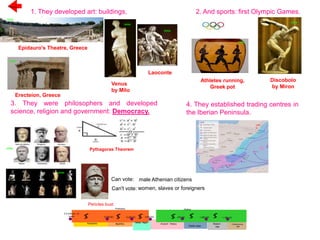
1. They developed art: buildings,
sculptures...
3. They were philosophers and developed
science, religion and government: Democracy.
4. They established trading centres in
the Iberian Peninsula.
Previous
2. And sports: first Olympic Games.
Discobolo
by Miron
OPEN
Epidauro's Theatre, Greece
OPEN
Venus
by Milo
OPEN
Erecteion, Greece
OPEN
Athletes running,
Greek pot
OPEN
Laoconte
OPEN
OPEN
Pythagoras Theorem
OPEN
male Athenian citizensCan vote:
Can't vote: women, slaves or foreigners
Pericles bust
OPEN
OPE
N
2.5 millions of
years 8,000 BC 5,000 BC 3,500 BC 476 AD 1,492 AD 1,789 AD
Paleolithic
Prehistory
Neolithic
History
Metal Ages
Ancient History
Middle Ages
Modern
Age
Contemporary
Age
OPEN
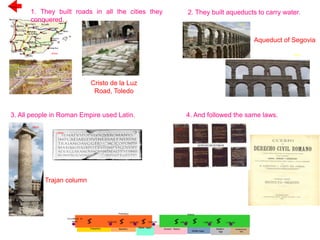
1. They built roads in all the cities they
conquered.
3. All people in Roman Empire used Latin. 4. And followed the same laws.
Previous
2. They built aqueducts to carry water.
OPEN
Cristo de la Luz
Road, Toledo
OPEN
Aqueduct of Segovia
OPEN
OPEN
Trajan column
OPEN
OPEN
OPEN
2.5 millions of
years 8,000 BC 5,000 BC 3,500 BC 476 AD 1,492 AD 1,789 AD
Paleolithic
Prehistory
Neolithic
History
Metal Ages
Ancient History
Middle Ages
Modern
Age
Contemporary
Age
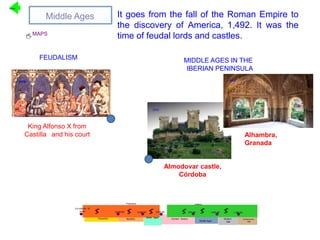
MIDDLE AGES IN THE
IBERIAN PENINSULA
OPEN
Almodovar castle,
Córdoba
Alhambra,
Granada
OPEN
FEUDALISM
King Alfonso X from
Castilla and his court
OPEN
It goes from the fall of the Roman Empire to
the discovery of America, 1,492. It was the
time of feudal lords and castles.
Home
2.5 millions of
years 8,000 BC 5,000 BC 3,500 BC 476 AD 1,492 AD 1,789 AD
Paleolithic
Prehistory
Neolithic
History
Metal Ages
Ancient History
Middle Ages
Modern
Age
Contemporary
Age
Middle Ages
MAPS
Previous
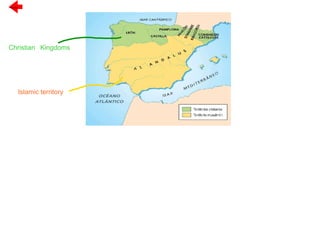
Christian Kingdoms
Islamic territory
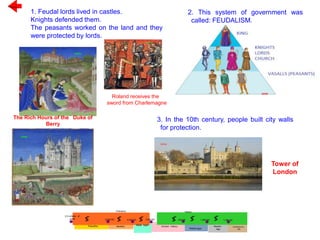
1. Feudal lords lived in castles.
Knights defended them.
The peasants worked on the land and they
were protected by lords.
3. In the 10th century, people built city walls
for protection.
Previous
2. This system of government was
called: FEUDALISM.
2.5 millions of
years 8,000 BC 5,000 BC 3,500 BC 476 AD 1,492 AD 1,789 AD
Paleolithic
Prehistory
Neolithic
History
Metal Ages
Ancient History
Middle Ages
Modern
Age
Contemporary
Age
OPEN
OPEN
Roland receives the
sword from Charlemagne
The Rich Hours of the Duke of
Berry
OPEN
OPEN
OPEN
Tower of
London
OPEN
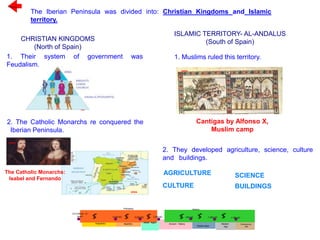
The Iberian Peninsula was divided into: Christian Kingdoms and Islamic
territory.
1. Their system of government was
Feudalism.
Previous
CHRISTIAN KINGDOMS
(North of Spain)
2.5 millions of
years 8,000 BC 5,000 BC 3,500 BC 476 AD 1,492 AD 1,789 AD
Paleolithic
Prehistory
Neolithic
History
Metal Ages
Ancient History
Middle Ages
Modern
Age
Contemporary
Age
ISLAMIC TERRITORY- AL-ANDALUS
(South of Spain)
2. The Catholic Monarchs re conquered the
Iberian Peninsula.
1. Muslims ruled this territory.
2. They developed agriculture, science, culture
and buildings.
OPEN
OPEN
The Catholic Monarchs:
Isabel and Fernando
Cantigas by Alfonso X,
Muslim camp
OPEN
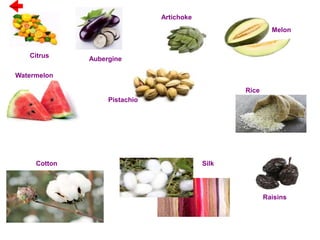
AGRICULTURE
BUILDINGS
SCIENCE
CULTURE
Citrus Aubergine
Artichoke
Melon
Watermelon
Pistachio
Rice
Cotton Silk
Raisins
Previous
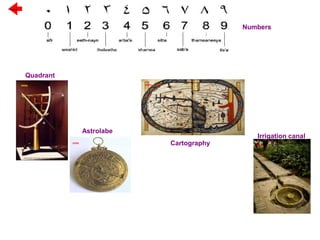
Numbers
Astrolabe
OPEN
Quadrant
OPEN
Cartography
OPEN
Irrigation canal
OPEN
Previous
Previous
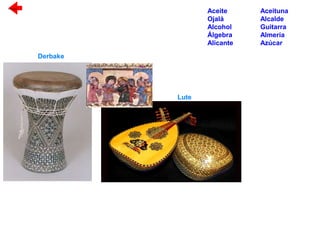
Aceite Aceituna
Ojalá Alcalde
Alcohol Guitarra
Álgebra Almería
Alicante Azúcar
Lute
Derbake
OPEN
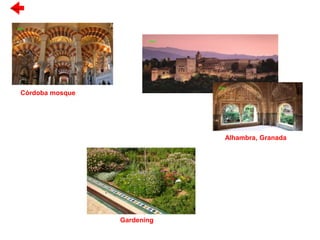
Córdoba mosque
OPEN
Gardening
OPEN
Alhambra, Granada
OPEN
Previous
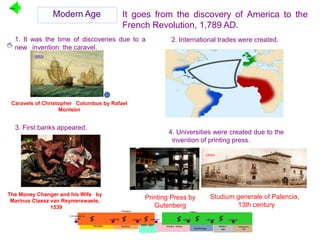
It goes from the discovery of America to the
French Revolution, 1,789 AD.
Home
2.5 millions of
years 8,000 BC 5,000 BC 3,500 BC 476 AD 1,492 AD 1,789 AD
Paleolithic
Prehistory
Neolithic
History
Metal Ages
Ancient History
Middle Ages
Modern
Age
Contemporary
Age
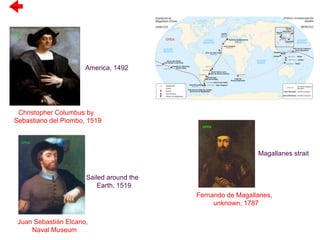
Modern Age
1. It was the time of discoveries due to a
new invention: the caravel.
Caravels of Christopher Columbus by Rafael
Monleón
OPEN
2. International trades were created.
3. First banks appeared.
4. Universities were created due to the
invention of printing press.OPEN
The Money Changer and his Wife by
Marinus Claesz van Reymerswaele,
1539
Printing Press by
Gutenberg
OPEN
Studium generale of Palencia,
13th century
OPEN
OPEN
Juan Sebastián Elcano,
Naval Museum
Christopher Columbus by
Sebastiano del Piombo, 1519
OPEN
Fernando de Magallanes,
unknown, 1787
OPEN
Magallanes strait
America, 1492
OPEN
Sailed around the
Earth, 1519
Previous
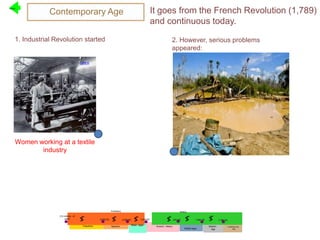
It goes from the French Revolution (1,789)
and continuous today.
Home
2.5 millions of
years 8,000 BC 5,000 BC 3,500 BC 476 AD 1,492 AD 1,789 AD
Paleolithic
Prehistory
Neolithic
History
Metal Ages
Ancient History
Middle Ages
Modern
Age
Contemporary
Age
1. Industrial Revolution started.
Women working at a textile
industry
OPEN
2. However, serious problems
appeared:
Contemporary Age
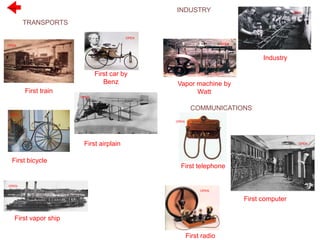
TRANSPORTS
INDUSTRY
COMMUNICATIONS
OPEN
First train
OPEN
First car by
Benz
Previous
OPEN
First bicycle
OPEN
First vapor ship
OPEN
First airplain
OPEN
Industry
Vapor machine by
Watt
OPEN
OPEN
First telephone
OPEN
First computer
OPEN
First radio
Previous
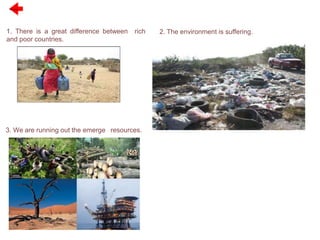
1. There is a great difference between rich
and poor countries.
2. The environment is suffering.
3. We are running out the emerge resources.
Modern Age
1,450 1,500 1,550 1,600 1,650 1,700 1,750 1,850
Middle Ages
2.5 millions of years
8,000 BC 5,000 BC 3,500 BC 476 AD 1,492 AD 1,789 AD
Paleolithic
Prehistory
Neolithic
History
Metal Ages
Ancient History
Middle Ages
Modern
Age
Contemporary Age
O
P
E
N
PAINTINGS IN ALTAMIRA
CAVE
PREHISTORY HISTORY
3,500 BC:
reading and
writing
OPEN
476 AD: the fall of the
Roman Empire
OPEN
1,492: discovery of
America
OPEN
1,789: French revolution
Jean-Clément Martin
La Revolución Francesa
OPEN
They learned how to meet their basic
necessities
They developed their
culture
Feudalism Discoveries
and
inventions
Industrial revolution
Home
http://www.fliedner.es/media/modules/editor/juandevaldes/docs/pages/ ensenanzas/primaria/tercer_ciclo/trabaj
os_informatica_1213/noemiclaudia.htm
https://3primariacono.wikispaces.com/El+descubrimiento+de+Am%C3%A9rica. +El+Antiguo+R%C3%A9gimen
+y+la+revoluci%C3%B3n+francesa+y+la+revoluci %C3%B3n+industrial
http://www.noticiasusodidactico.com/sara/2013/04/16/la-edad-media-en-primaria/
http://mimochila.drupalgardens.com/taxonomy/term/2521
Suggested web sites for more information:
If you click on the pictures or photos you will be redirected to the site where they were found.
Adjuntos
laud.jpg

A walk through history

  • 1.
    Ancient history A WALKTHROUGH HISTORY Prehistory Middle Ages Modern Age Contemporary Age CLICK TO HAVE A LOOK AT THE TIME LINE
  • 2.
    Prehistory It goesfrom when humans first appeared and finished when they learned to read and write. PALEOLITHIC NEOLITHIC AND METAL AGES Home PREHISTORY IN THE IBERIAN PENINSULA Altamira cave paintings 2.5 millions of years 8,000 BC 5,000 BC 3,500 BC 476 AD 1,492 AD 1,789 AD Paleolithic Prehistory Neolithic History Metal Ages Ancient History Middle Ages Modern Age Contemporary Age
  • 3.
    1. They werenomads. 2. They hunted, fished and collected wild plants and fruits. 3. They learnt to use fire to keep warm, cook and give light. 4. They wore animal skins and slept in caves. Previous 2.5 millions of years 8,000 BC 5,000 BC 3,500 BC 476 AD 1,492 AD 1,789 AD Paleolithic Prehistory Neolithic History Metal Ages Ancient History Middle Ages Modern Age Contemporary Age
  • 4.
    1. They learntto cultivate plants and raise animals. 2. They built settlements or villages. 3. They made containers to store and carry food or water. 4. They started to exchange products: trade. Previous 5. They made ovens to melt metals to make tools and jewellery. 2.5 millions of years 8,000 BC 5,000 BC 3,500 BC 476 AD 1,492 AD 1,789 AD Paleolithic Prehistory Neolithic History Metal Ages Ancient History Middle Ages Modern Age Contemporary Age
  • 5.
    Taula in Menorca OPEN Dolmende la Pastora, Sevilla. (Arrow) OPEN OPEN Altamira cave paintings OPEN OPEN OPEN Morin cave, Cantabria (Scraper) OPEN Dama de Elche, Alicante Miguelón, Atapuerca in Burgos. (Reconstruct skull) OPEN Naveta des Tudons, Menorca OPEN Previous
  • 6.
    The School ofAthens by Raphael OPEN OPEN Partenon, Greece GREEKS: 1,000-800 BC (East of the Iberian Peninsula) MAPS PHOENICIANS: 1,000-800 BC (South of the Iberian Peninsula) OPEN Ivory lion haunting, Nimrud It started when people learnt to write and read and finished with the fall of the Roman Empire (5th century AD). The most important civilizations in the Iberian Peninsula were: Home Ancient history ROMANS Coliseum, Rome OPEN 2.5 millions of years 8,000 BC 5,000 BC 3,500 BC 476 AD 1,492 AD 1,789 AD Paleolithic Prehistory Neolithic History Metal Ages Ancient History Middle Ages Modern Age Contemporary Age
  • 7.
    OPEN Dama de Elche Ampuria,Gerona O P E N O P E N Previous First settlers of the Iberian Peninsula First invaders GREEKS PHOENICIANS Doña Blanca, Cádiz OPEN OPEN
  • 8.
    OPEN 1. They weremerchants. 2. They came to the Iberian Peninsula. 3. They taught us their alphabet. 4. They established trading centres. Previous OPEN OPEN Sa Caleta, Ibiza OPEN OPEN 2.5 millions of years 8,000 BC 5,000 BC 3,500 BC 476 AD 1,492 AD 1,789 AD Paleolithic Prehistory Neolithic History Metal Ages Ancient History Middle Ages Modern Age Contemporary Age
  • 9.
    1. They developedart: buildings, sculptures... 3. They were philosophers and developed science, religion and government: Democracy. 4. They established trading centres in the Iberian Peninsula. Previous 2. And sports: first Olympic Games. Discobolo by Miron OPEN Epidauro's Theatre, Greece OPEN Venus by Milo OPEN Erecteion, Greece OPEN Athletes running, Greek pot OPEN Laoconte OPEN OPEN Pythagoras Theorem OPEN male Athenian citizensCan vote: Can't vote: women, slaves or foreigners Pericles bust OPEN OPE N 2.5 millions of years 8,000 BC 5,000 BC 3,500 BC 476 AD 1,492 AD 1,789 AD Paleolithic Prehistory Neolithic History Metal Ages Ancient History Middle Ages Modern Age Contemporary Age
  • 10.
    OPEN 1. They builtroads in all the cities they conquered. 3. All people in Roman Empire used Latin. 4. And followed the same laws. Previous 2. They built aqueducts to carry water. OPEN Cristo de la Luz Road, Toledo OPEN Aqueduct of Segovia OPEN OPEN Trajan column OPEN OPEN OPEN 2.5 millions of years 8,000 BC 5,000 BC 3,500 BC 476 AD 1,492 AD 1,789 AD Paleolithic Prehistory Neolithic History Metal Ages Ancient History Middle Ages Modern Age Contemporary Age
  • 11.
    MIDDLE AGES INTHE IBERIAN PENINSULA OPEN Almodovar castle, Córdoba Alhambra, Granada OPEN FEUDALISM King Alfonso X from Castilla and his court OPEN It goes from the fall of the Roman Empire to the discovery of America, 1,492. It was the time of feudal lords and castles. Home 2.5 millions of years 8,000 BC 5,000 BC 3,500 BC 476 AD 1,492 AD 1,789 AD Paleolithic Prehistory Neolithic History Metal Ages Ancient History Middle Ages Modern Age Contemporary Age Middle Ages MAPS
  • 12.
  • 13.
    1. Feudal lordslived in castles. Knights defended them. The peasants worked on the land and they were protected by lords. 3. In the 10th century, people built city walls for protection. Previous 2. This system of government was called: FEUDALISM. 2.5 millions of years 8,000 BC 5,000 BC 3,500 BC 476 AD 1,492 AD 1,789 AD Paleolithic Prehistory Neolithic History Metal Ages Ancient History Middle Ages Modern Age Contemporary Age OPEN OPEN Roland receives the sword from Charlemagne The Rich Hours of the Duke of Berry OPEN OPEN OPEN Tower of London
  • 14.
    OPEN The Iberian Peninsulawas divided into: Christian Kingdoms and Islamic territory. 1. Their system of government was Feudalism. Previous CHRISTIAN KINGDOMS (North of Spain) 2.5 millions of years 8,000 BC 5,000 BC 3,500 BC 476 AD 1,492 AD 1,789 AD Paleolithic Prehistory Neolithic History Metal Ages Ancient History Middle Ages Modern Age Contemporary Age ISLAMIC TERRITORY- AL-ANDALUS (South of Spain) 2. The Catholic Monarchs re conquered the Iberian Peninsula. 1. Muslims ruled this territory. 2. They developed agriculture, science, culture and buildings. OPEN OPEN The Catholic Monarchs: Isabel and Fernando Cantigas by Alfonso X, Muslim camp OPEN AGRICULTURE BUILDINGS SCIENCE CULTURE
  • 15.
  • 16.
  • 17.
    Previous Aceite Aceituna Ojalá Alcalde AlcoholGuitarra Álgebra Almería Alicante Azúcar Lute Derbake OPEN
  • 18.
  • 19.
    It goes fromthe discovery of America to the French Revolution, 1,789 AD. Home 2.5 millions of years 8,000 BC 5,000 BC 3,500 BC 476 AD 1,492 AD 1,789 AD Paleolithic Prehistory Neolithic History Metal Ages Ancient History Middle Ages Modern Age Contemporary Age Modern Age 1. It was the time of discoveries due to a new invention: the caravel. Caravels of Christopher Columbus by Rafael Monleón OPEN 2. International trades were created. 3. First banks appeared. 4. Universities were created due to the invention of printing press.OPEN The Money Changer and his Wife by Marinus Claesz van Reymerswaele, 1539 Printing Press by Gutenberg OPEN Studium generale of Palencia, 13th century OPEN
  • 20.
    OPEN Juan Sebastián Elcano, NavalMuseum Christopher Columbus by Sebastiano del Piombo, 1519 OPEN Fernando de Magallanes, unknown, 1787 OPEN Magallanes strait America, 1492 OPEN Sailed around the Earth, 1519 Previous
  • 21.
    It goes fromthe French Revolution (1,789) and continuous today. Home 2.5 millions of years 8,000 BC 5,000 BC 3,500 BC 476 AD 1,492 AD 1,789 AD Paleolithic Prehistory Neolithic History Metal Ages Ancient History Middle Ages Modern Age Contemporary Age 1. Industrial Revolution started. Women working at a textile industry OPEN 2. However, serious problems appeared: Contemporary Age
  • 22.
    TRANSPORTS INDUSTRY COMMUNICATIONS OPEN First train OPEN First carby Benz Previous OPEN First bicycle OPEN First vapor ship OPEN First airplain OPEN Industry Vapor machine by Watt OPEN OPEN First telephone OPEN First computer OPEN First radio
  • 23.
    Previous 1. There isa great difference between rich and poor countries. 2. The environment is suffering. 3. We are running out the emerge resources.
  • 24.
    Modern Age 1,450 1,5001,550 1,600 1,650 1,700 1,750 1,850 Middle Ages 2.5 millions of years 8,000 BC 5,000 BC 3,500 BC 476 AD 1,492 AD 1,789 AD Paleolithic Prehistory Neolithic History Metal Ages Ancient History Middle Ages Modern Age Contemporary Age O P E N PAINTINGS IN ALTAMIRA CAVE PREHISTORY HISTORY 3,500 BC: reading and writing OPEN 476 AD: the fall of the Roman Empire OPEN 1,492: discovery of America OPEN 1,789: French revolution Jean-Clément Martin La Revolución Francesa OPEN They learned how to meet their basic necessities They developed their culture Feudalism Discoveries and inventions Industrial revolution Home
  • 25.
    http://www.fliedner.es/media/modules/editor/juandevaldes/docs/pages/ ensenanzas/primaria/tercer_ciclo/trabaj os_informatica_1213/noemiclaudia.htm https://3primariacono.wikispaces.com/El+descubrimiento+de+Am%C3%A9rica. +El+Antiguo+R%C3%A9gimen +y+la+revoluci%C3%B3n+francesa+y+la+revoluci%C3%B3n+industrial http://www.noticiasusodidactico.com/sara/2013/04/16/la-edad-media-en-primaria/ http://mimochila.drupalgardens.com/taxonomy/term/2521 Suggested web sites for more information:
  • 26.
    If you clickon the pictures or photos you will be redirected to the site where they were found.
  • 27.